


There’s a job in American healthcare that doesn’t exist in any other country. It’s the “prior auth person.” Every clinic has one — sometimes two, sometimes a whole back office. Their entire working life is spent on hold with insurance companies, faxing forms (yes, faxing, in 2026), and re-submitting paperwork that got denied for reasons nobody can quite explain.
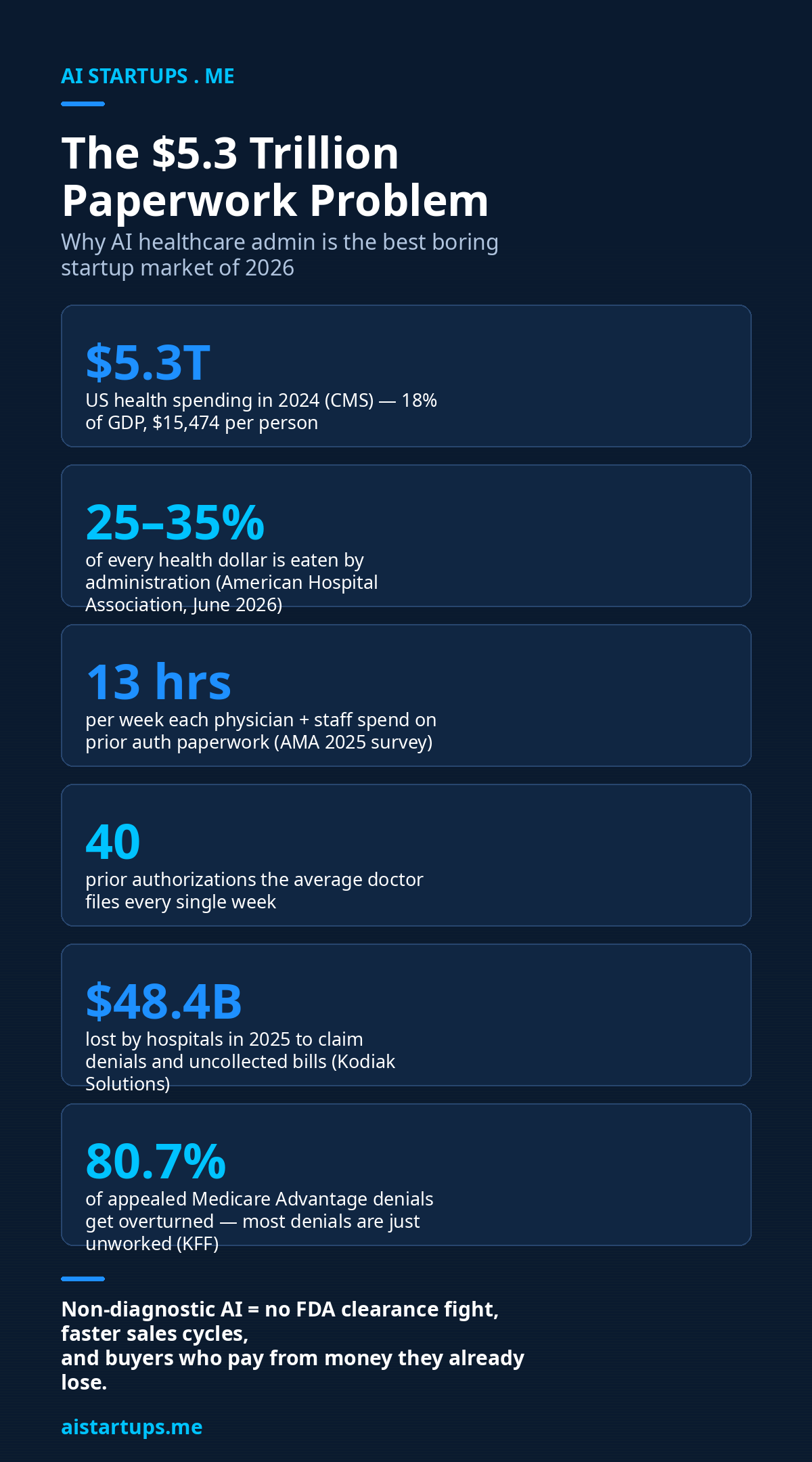
Here’s the number that stopped me cold this week: the American Medical Association surveyed 1,000 practicing physicians and found the average doctor’s office files 40 prior authorizations a week, burning 13 hours of physician and staff time. Forty. Every week. On permission slips.
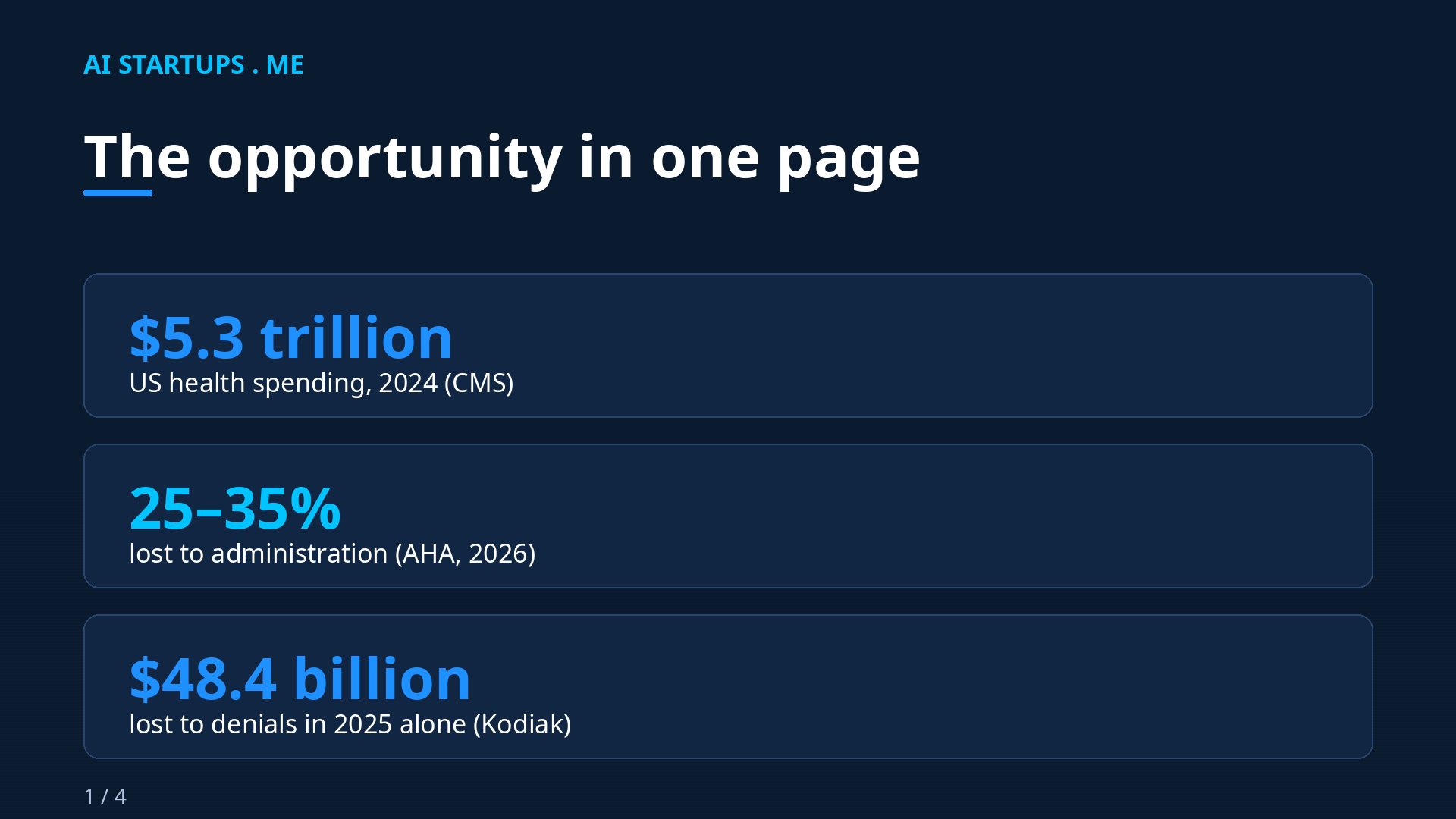
And that’s one workflow. Zoom out, and the American Hospital Association’s June 2026 report puts administration at 25 to 35 percent of all US health spending. Total spending hit $5.3 trillion in 2024, according to CMS. Do the rough math and America’s paperwork problem is a $1.3 to $1.9 trillion-a-year industry. That’s not a cost center. That’s a market.
So here’s my pitch: the best AI startup ideas in healthcare right now have nothing to do with diagnosing disease. They have to do with the fax machine, the phone tree, and the denial letter. Every idea below is non-diagnostic and low-risk — no FDA clearance fights, no malpractice minefields — just boring, expensive, automatable work that clinics are desperate to offload. Real talk: boring is where the money is.
The numbers that make this a once-a-decade market
Let me lay out the case the way I’d lay it out for a skeptical friend, because “healthcare admin” doesn’t sound exciting until you see the receipts.
The pile of money is absurd. CMS pegs US health spending at $5.3 trillion for 2024 — 18% of GDP, $15,474 per person, growing 7.2% a year. That’s the number everything else is a percentage of. And per the American Hospital Association’s June 2026 report, 25 to 35 percent of it goes to administration: compliance, billing, documentation, prior auth, credentialing. Even at the low end, that’s over a trillion dollars a year spent on not treating patients.
The pain is documented, not vibes. The AMA’s 2025 survey found 95% of physicians say prior auth delays necessary care, 94% say it contributes to burnout, and 40% employ staff who do nothing but prior authorizations. The phone — not a portal, not an API, the phone — is still the most common way doctors complete them.
Denials are a revenue hemorrhage with a fix. Kodiak Solutions’ 2025 revenue-cycle report, built on data from 2,300 hospitals, found providers lost $48.4 billion last year to claim denials and uncollected bills — up 25% in a single year. The average initial denial rate climbed to 11.6%. And here’s the kicker from KFF’s analysis of Medicare Advantage data: insurers denied 4.1 million prior-auth requests in one year, only 11.5% were ever appealed — but 80.7% of the appeals that were filed got overturned. Most denials aren’t final judgments. They’re unworked paperwork. (Hospitals spend an estimated $19.7 billion a year just appealing denials, per HFMA.)
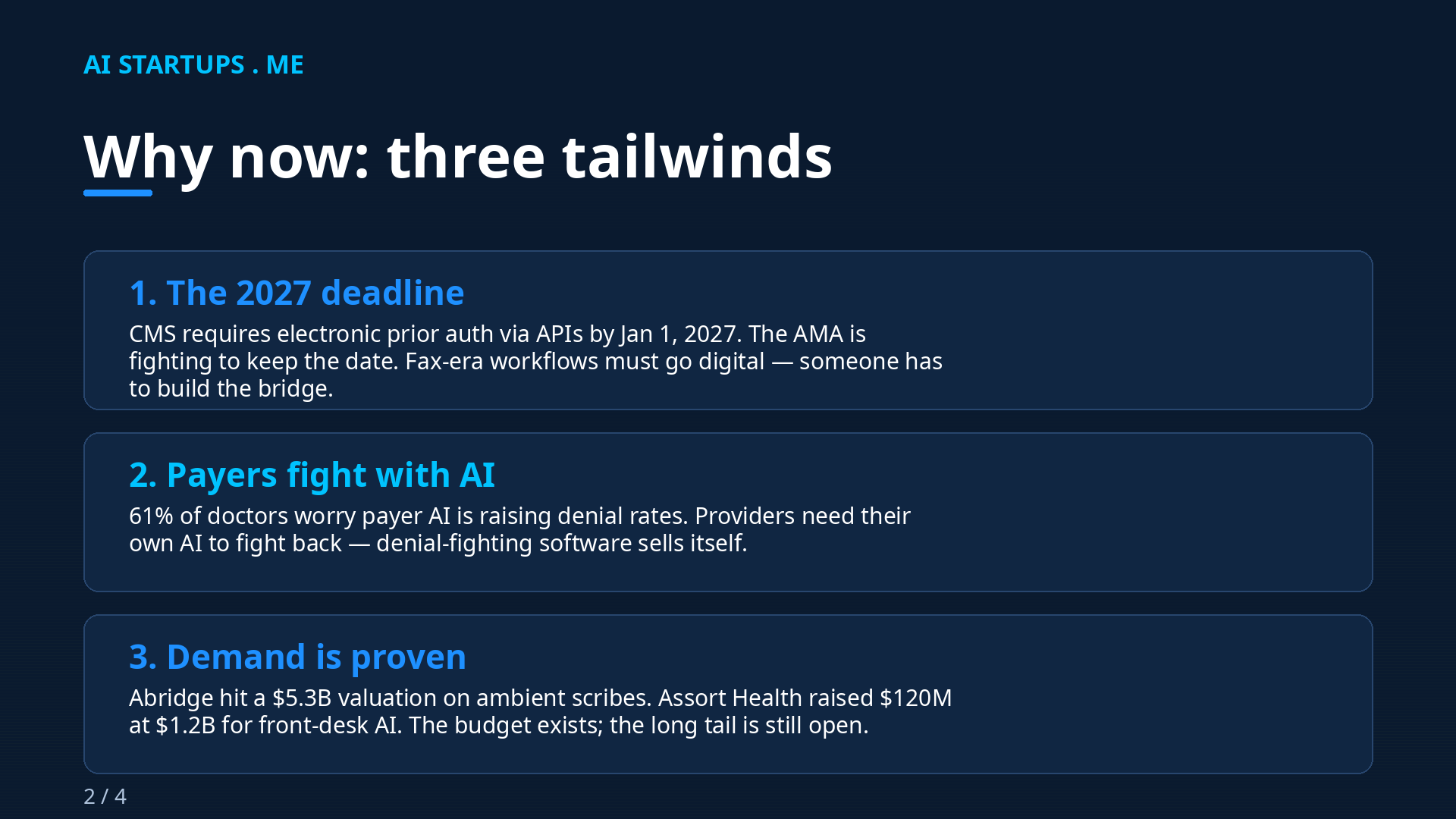
The law is forcing digitization. CMS’s Interoperability and Prior Authorization Final Rule requires payers to expose prior-auth requirements through APIs, and the AMA is currently lobbying to hold the January 1, 2027 deadline for electronic prior auth — “axe the fax,” as the AMA’s CEO put it. Every fax-era workflow has to go digital. Someone has to build the bridge. Why not you?
Why non-diagnostic is the cheat code
Here’s the thing most first-time healthtech founders get wrong: they aim at the glamorous problem. Diagnosing cancer from scans! Predicting sepsis! And then they discover that anything touching clinical judgment walks straight into FDA clearance, clinical validation studies, and hospital committees that take eighteen months to buy a stapler.
Admin AI skips all of that. You’re not telling a doctor what’s wrong with the patient. You’re doing the paperwork about the patient — scheduling, coding, authorizations, appeals, credentialing. The buyer isn’t a chief medical officer worried about liability. It’s a practice manager staring at a P&L that’s bleeding $48 billion industry-wide to denials. Your sales conversation is “we recovered $84,000 for a clinic like yours last quarter,” not “our model’s AUC is 0.94.” One of those closes deals. (The other closes conference talks.)
And the demand is already proven, which is the part I love. Abridge — ambient AI scribes, pure documentation, zero diagnosis — is valued at $5.3 billion with over $100 million in ARR across 300+ health systems. Arintra raised a $25 million Series B this August for autonomous medical coding. Assort Health raised $120 million at a $1.2 billion valuation for AI agents that handle scheduling, intake, and eligibility — and grew revenue 20x in fifteen months. The budgets exist. The category is real. What’s still wide open is the long tail: the 200,000+ independent practices and specialty clinics the enterprise vendors are too expensive and too slow to serve.
One more tailwind, and it’s a spicy one: there’s an arms race happening. Payers are deploying AI to deny claims faster — 6 in 10 physicians told the AMA they’re worried about exactly that. Providers need their own AI to fight back. You’re not selling software. You’re selling weapons in a war your buyer is currently losing. That’s a hell of a pitch.
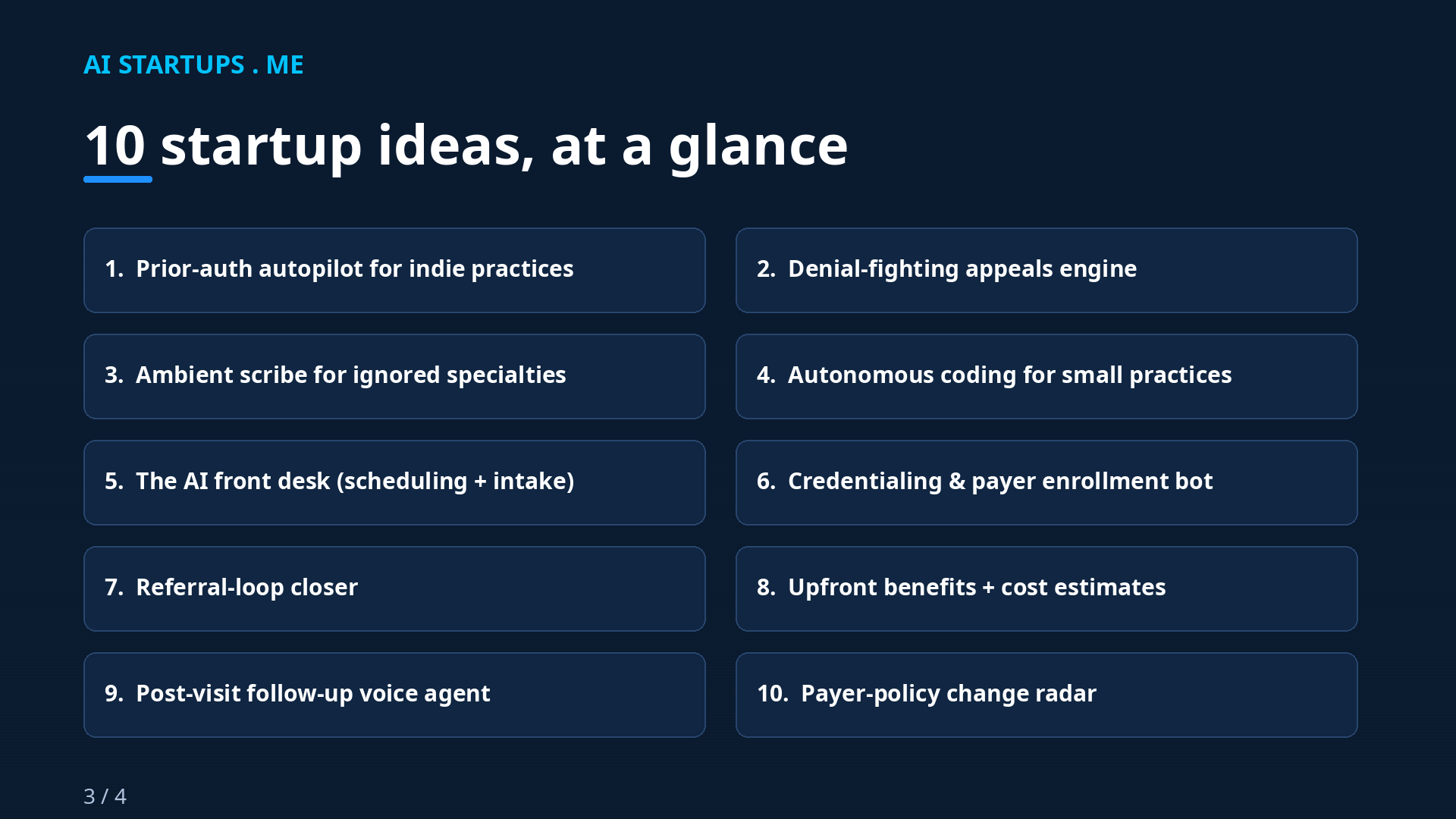
The 10 ideas
Each one below follows the same anatomy: the pain, the product sketch, who pays, and what the pricing looks like. Steal freely — execution is the whole game here.
1. The prior-auth autopilot for independent practices
The pain: 40 auths a week, 13 hours, phone calls, faxes, payer portals that each work differently. The 40% of practices with dedicated prior-auth staff are paying a full salary for work a machine could do at 2 AM.
The product: an AI agent that checks whether an auth is needed, pulls the clinical documentation from the EHR, matches it against the payer’s medical policy, submits through the right channel (portal, fax API, or — yes — an AI voice agent that navigates the payer’s phone tree), then tracks the request and nudges until there’s a decision. Human reviews edge cases; the machine does the volume.
Who pays: independent practices with 2–20 doctors, especially in auth-heavy specialties like orthopedics, dermatology, cardiology, and oncology. Pricing: per-auth fee ($8–15) against a manual cost of ~$11 per auth — or a flat monthly per-provider fee. The 2027 ePA API deadline is your free marketing campaign.
2. The denial-fighting appeals engine
The pain: 11.6% of claims get initially denied, and most small practices appeal a fraction of them because nobody has the hours. Remember: 80.7% of appealed Medicare Advantage denials get overturned. Every unworked denial is money left on the table.
The product: software that watches the claim feed, flags denials worth fighting (by dollar value × win probability), auto-assembles the appeal packet — clinical notes, policy citations, prior-auth records — drafts the appeal letter, and files it. Dashboard shows recovered revenue in real time.
Who pays: billing companies and mid-size practice groups first (they aggregate volume), then direct to practices. Pricing: this is the easiest sale in healthcare — a percentage of recovered revenue, say 15–20%. You only get paid when they get paid. Nobody says no to that pilot.
3. Ambient scribe for the specialties the giants ignore
The pain: Abridge and friends sell to big hospital systems through enterprise contracts. Meanwhile dentists, behavioral health therapists, physical therapists, home-health nurses, and chiropractors still type their own notes at 10 PM.
The product: an ambient documentation tool tuned for one ignored specialty — its vocabulary, its note templates, its billing codes. Behavioral health alone is a monster opportunity: session notes are long, templated, and universally hated. Start with one specialty, nail the workflow, expand.
Who pays: individual clinicians and small group practices, $99–299/month per provider. It’s the classic wedge the giants are structurally too expensive to chase. If you want the broader playbook for AI agent businesses you can start solo, the economics rhyme.
4. Autonomous coding for small practices
The pain: medical coding is a skilled-labor bottleneck — there’s a genuine coder shortage — and bad coding is the #1 preventable cause of denials. Enterprise “autonomous coding” platforms exist but they’re priced for health systems, not a five-doctor practice.
The product: EHR-agnostic coding that reads the visit note, suggests ICD-10/CPT codes with confidence scores and highlighted evidence, flags documentation gaps before the claim goes out (“this note won’t support a level-4 visit — add the missing element”), and learns each practice’s payer mix. Human coder reviews the low-confidence ones.
Who pays: small practices and outsourced billing shops. Pricing: per-chart or per-provider monthly, positioned against the $50K+ salary of a certified coder they can’t hire anyway.
5. The AI front desk
The pain: 60%+ of patient calls to small practices go to voicemail or hold, and every missed call is a missed appointment. Scheduling, intake forms, insurance eligibility checks, appointment reminders, no-show rescue — it’s a full-time job that pays part-time wages, so turnover is brutal.
The product: a voice + text AI agent that answers every call, books appointments into the real schedule, sends intake forms, verifies insurance eligibility in real time, and runs the no-show rescue sequence. After hours, it takes messages and books anyway. Assort Health proved the enterprise version at a $1.2 billion valuation; the indie-practice version is still up for grabs. The current generation of AI voice tools is finally good enough for this — natural enough that patients don’t hang up.
Who pays: dental, medspa, PT, behavioral health, and specialty clinics — anywhere the front desk is a bottleneck. Pricing: $300–800/month per location, sold against the cost of a $35K/year receptionist who quits every eight months.
6. The credentialing and payer-enrollment bot
The pain: getting a new doctor credentialed with payers takes 90–120 days of pure paperwork — CAQH profiles, license verifications, endless forms, each payer different. Until it’s done, the doctor can’t bill. Practices literally lose months of revenue per hire waiting on paperwork.
The product: track every credentialing application across every payer, auto-fill the repetitive forms from a single source of truth, monitor CAQH and NPI data for expirations, and proactively chase the payers that go quiet. Nobody glamorous is building this. That’s the point.
Who pays: growing practice groups, locum agencies, and telehealth companies onboarding clinicians constantly. Pricing: per-provider onboarding fee plus a monthly monitoring retainer. Deeply unsexy, deeply sticky — once you’re the system of record for a practice’s credentials, you never leave.
7. The referral-loop closer
The pain: primary-care doctors refer patients to specialists, and a shocking share of those referrals never get scheduled — the patient forgets, the fax (there it is again) goes nowhere, nobody follows up. The PCP loses the patient relationship; the specialist loses the revenue.
The product: software that tracks every outbound referral, texts the patient to schedule, follows up automatically at smart intervals, and closes the loop by sending the visit summary back to the referring doctor. Both sides see a live dashboard of referral status.
Who pays: specialist practices (orthopedics, cardiology, GI) that live on referrals, and PCP groups measured on care coordination. Pricing: per-referral-processed or monthly per location, sold on recovered appointment revenue — one recovered surgical referral pays for a year of the software.
8. Upfront benefits verification and cost estimates
The pain: patients get blindsided by bills, practices get denials from eligibility errors, and the No Surprises Act now legally requires Good Faith Estimates for uninsured and self-pay patients. Most small practices handle this with a phone call and a prayer.
The product: real-time eligibility checks at scheduling, automatic benefit breakdowns (deductible status, copay, coinsurance, prior-auth flags), and patient-friendly cost estimates generated before the visit. Denials from eligibility mistakes — one of the most common denial categories — basically disappear.
Who pays: elective and high-deductible-heavy specialties — dental, vision, orthopedics, fertility, medspa-adjacent medicine. Pricing: per-eligibility-check micro-fee or monthly per location. It also makes the practice look radically more professional to patients, which is its own sales lever.
9. The post-visit follow-up voice agent
The pain: after discharge or a procedure, patients go home with instructions they half-remember. Complications get missed, readmissions happen, and hospitals get financially penalized for them. Nurses don’t have time to call everyone.
The product: a multilingual voice AI that calls patients 24–72 hours after discharge or procedures, runs through a symptom checklist, escalates anything concerning to a nurse immediately, and logs everything to the chart. For chronic-care programs, it does the monthly check-ins that keep patients enrolled (and billable).
Who pays: hospitals worried about readmission penalties, home-health agencies, and chronic-care management programs. Pricing: per-patient-per-month in the $15–40 range, sold against the $15,000+ cost of a single preventable readmission. One caught complication pays for the program.
10. The payer-policy change radar
The pain: payers change medical policies constantly — new prior-auth requirements, new documentation rules, new coding edits — and practices usually find out via a denial. Each payer publishes changes differently, in different places, in PDF-ese.
The product: monitor every major payer’s policy bulletins, translate changes into plain English per specialty (“Aetna now requires X for CPT 27447 in your state, effective Nov 1”), and push alerts plus updated workflow checklists to the practice’s prior-auth and billing teams. Think of it as a Bloomberg terminal for payer rules.
Who pays: billing companies first (they serve dozens of practices and feel every policy change at scale), then large specialty groups. Pricing: monthly subscription tiered by number of payers and specialties tracked. It’s a data product, so margins are lovely once the monitoring pipeline is built.
How to actually sell to a clinic
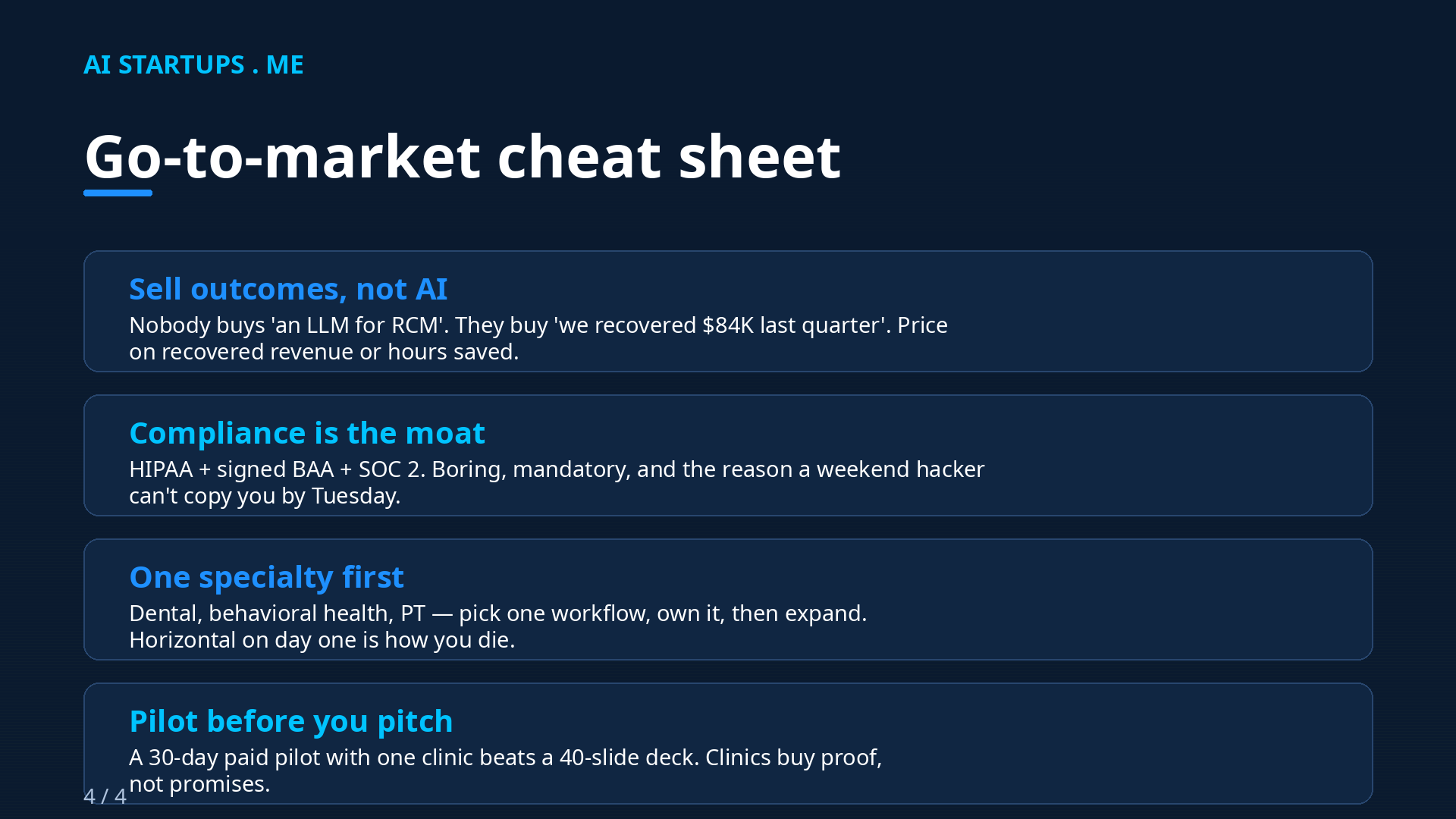
Ideas are cheap; distribution is the business. Healthcare has a reputation for impossible sales cycles, but that’s mostly true for clinical products. Admin products sell to a different buyer with a different brain. Here’s what works:
- Sell outcomes, not AI. Nobody buys “an LLM for revenue cycle.” They buy “we recovered $84K for a three-doctor orthopedics group last quarter.” Every slide, every email, every demo leads with the money.
- Start with a paid pilot, not a pitch. Thirty days, one location, the success metric in writing before you start. Clinics buy proof, not promises — and a paid pilot filters out the tourists. If you haven’t yet, validate the idea before you write a single line of code; ten conversations with practice managers will teach you more than ten weeks of building.
- One specialty first. Dental today, orthodontics tomorrow, oral surgery after that. Each specialty has its own codes, payers, and workflows — going horizontal on day one is how you build something mediocre for everyone.
- Compliance is the moat. HIPAA compliance, signed Business Associate Agreements with every vendor touching patient data, encryption everywhere, audit logs, and SOC 2 Type II before you knock on enterprise doors. It’s boring, it’s mandatory, and it’s the reason a weekend hacker can’t clone you by Tuesday.
- Find the practice manager, not the doctor. Doctors don’t buy software; the person who runs the office does. They’re on LinkedIn, they go to MGMA conferences, and they will take a call about anything that promises fewer denials.
What to build first (the 90-day MVP)
Don’t build a platform. Build one workflow for one specialty, with a human in the loop on day one — autonomy is earned, not shipped. A prior-auth agent for dental practices. A denial-appeal drafter for PT billing companies. A voice front desk for medspas. Narrow enough that you can name your first ten customers from memory.
Technically, the stack is friendlier than it looks: modern EHRs expose FHIR APIs, clearinghouses have APIs for eligibility and claims, and payer portals can be automated where APIs don’t exist yet (the 2027 deadline keeps shrinking that list). You are not building an EHR. You are building the layer that makes the EHR’s data do something.
On pricing the thing once it works — per-auth fees, percentages of recovered revenue, per-location subscriptions — the models vary wildly by workflow, so do the math per idea rather than copying a template. Our guide to pricing an AI SaaS product walks through the unit economics.
And if you’re not technical, here’s some relief: you don’t need a co-founder to test the first version. A web development and AI integration studio like AISquadX can ship the working prototype while you spend your time where it actually matters — selling the pilot. The scarcest resource in this market isn’t code. It’s a founder willing to call fifty practice managers.
In a single year, Medicare Advantage insurers denied 4.1 million prior-authorization requests. Only 11.5% were ever appealed. Of the appeals that were filed, 80.7% were overturned. The barrier was never whether the care was valid — it was whether anyone had the staff hours to fight.
— KFF analysis of federal Medicare Advantage data
FAQ
Do I need a medical background to start a healthcare AI company?
No — and for admin products, it’s genuinely optional. You’re automating paperwork, not practicing medicine. What you do need is a clinical advisor who can sanity-check your workflows and one friendly practice willing to be your design partner. Domain access beats domain credentials here: ten deep conversations with practice managers will teach you more than a medical degree would about prior auth.
Is it legal for AI to handle prior authorizations and appeals?
Yes — this is paperwork automation, not medical advice. The clinical judgment (is this treatment appropriate?) stays with licensed clinicians; the AI handles assembly, submission, tracking, and drafting. That said, healthcare is regulated and this article isn’t legal counsel: get a healthcare attorney to review your product and your BAA language before you touch real patient data.
What compliance do I actually need on day one?
The non-negotiable minimum: HIPAA-compliant infrastructure, a signed Business Associate Agreement with every vendor that touches protected health information, encryption in transit and at rest, and audit logging. Before you sell to larger organizations, expect to need SOC 2 Type II. Build this in from the start — retrofitting compliance onto a shipped product is miserable and expensive.
How do I get my first clinic as a customer?
Pick one specialty and one workflow, then find ten practice managers on LinkedIn and offer a 30-day paid pilot with the success metric defined up front. Go where they gather — MGMA events, specialty conferences, billing-company partnerships. Your first customer almost never comes from ads; it comes from a conversation where you demonstrate you understand their specific denial problem better than they do.
How much does it cost to build an MVP?
For a focused single-workflow prototype, budget roughly $15K–50K with an agency or a small dev team — the model APIs are the cheap part. The expensive parts are the sales cycle, the compliance work, and the EHR integrations. That’s actually the good news: your capital goes toward distribution and trust, which are defensible, rather than model training, which isn’t.
The Bottom Line
America spends $5.3 trillion a year on healthcare, and a quarter to a third of it goes to administration — phone calls, faxes, forms, denials, and rework. That’s somewhere around $1.5 trillion a year spent on paperwork, in an industry where the AMA found doctors burning 13 hours a week just on prior authorizations.
The founders who win this market won’t be the ones with the cleverest models. They’ll be the ones who pick one miserable workflow, automate it ruthlessly, sell the recovered dollars instead of the technology, and expand specialty by specialty. Non-diagnostic means no FDA fight, faster sales cycles, and buyers who pay you out of money they’re already losing.
Boring problems, enormous budgets, a regulatory deadline forcing digitization, and an arms race where your buyer is losing. Honestly? I can’t think of a better setup for a startup in 2026.