

Two years ago, picking support software was boring. You compared seat prices, picked the cheapest per-agent plan, and forgot about it. Then the AI agents showed up, and the entire pricing model flipped upside down while nobody was watching.
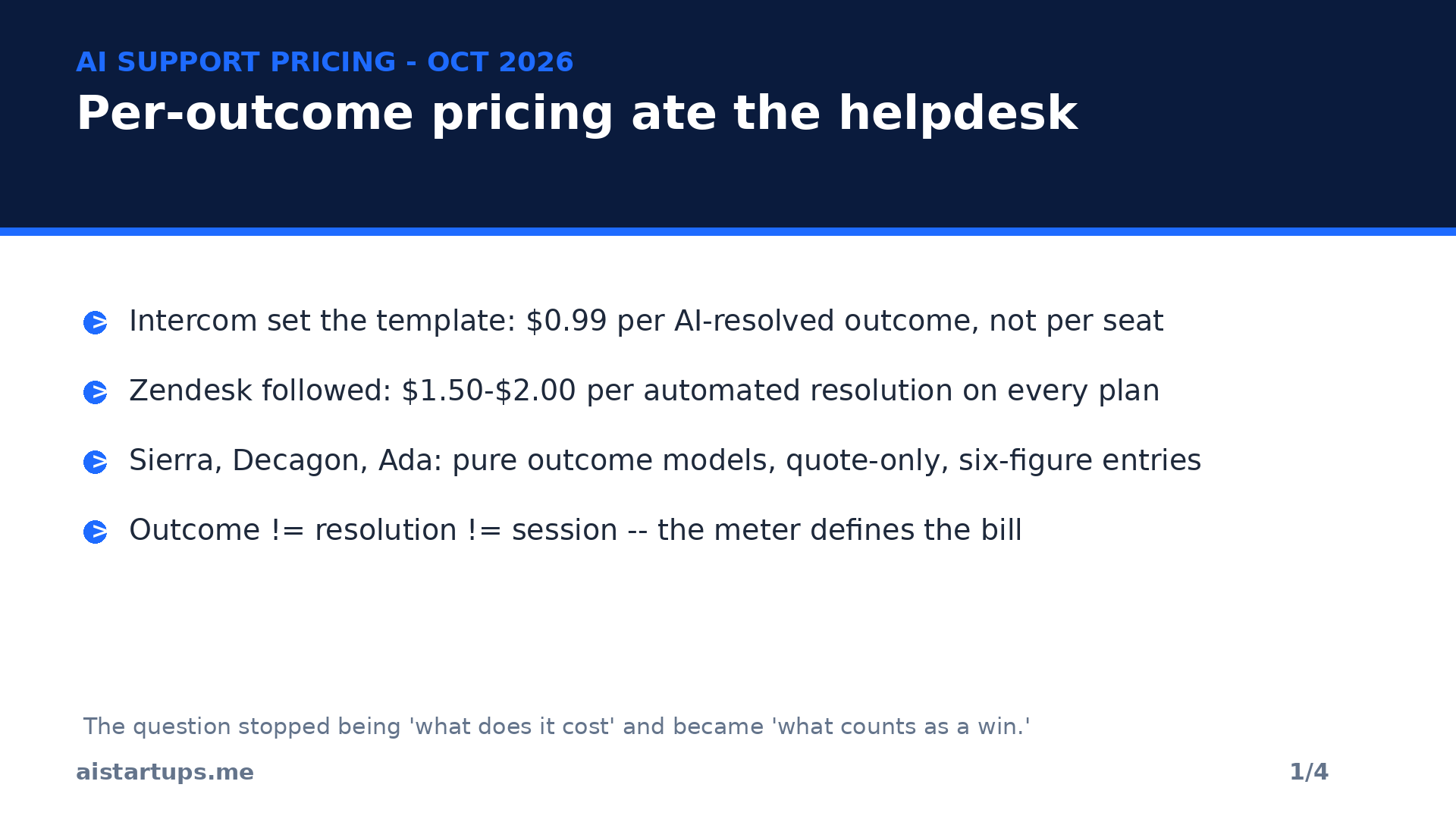
Here’s what changed: vendors stopped charging you for access and started charging you for outcomes. Every time the AI resolves a ticket on its own, a meter ticks. Intercom charges $0.99 per outcome. Zendesk charges up to $2.00 per automated resolution. And the bill — here’s the part nobody warns you about — grows precisely because the thing works. More resolutions, more money. Success has a per-unit price now.
Real talk: that’s not a scam. It’s just a different deal than the one you’re used to signing, and most founders sign it without reading the meter. I spent the last week reading the actual pricing pages — the real ones, not the marketing headlines — for the 8 tools that matter in 2026. The two old giants, the three enterprise AI natives, and the three that a solo founder can actually afford. Here’s the honest breakdown: what each one costs, what the AI actually does, and which one fits the stage you’re at.
The one thing that changed in 2026: you pay per outcome now
Let me make this concrete, because “outcome-based pricing” sounds like a slogan until you see an invoice.
Intercom — which, yes, renamed itself Fin in May 2026, though everyone still calls it Intercom — pioneered the model. Their AI agent, also called Fin, costs $0.99 per outcome. One resolved conversation: 99 cents. A sales qualification: $9.99. A handoff to a human with no configured outcome: free. Clean, legible, and — this is the genius of it — perfectly aligned. Intercom only makes money when the AI does the job.
Zendesk followed. Their AI agents are now included in every Suite and Support plan, billed at $1.50 per automated resolution on committed volume, $2.00 pay-as-you-go. And 2026 was the year Zendesk went all-in: they acquired Forethought back in March, launched an AI Dynamic Pricing Plan for enterprises, and — mark this date — they’re shutting down all their legacy AI tools on December 10, 2026. The old bot builder, Answers, Intents, autoreplies: all of it goes into maintenance mode and then disappears. If you’re on Zendesk’s old AI, you’re migrating to per-resolution billing whether you like it or not.
The enterprise AI natives never priced any other way. Sierra, Decagon, and Ada were born into the per-outcome world — no seats, no tokens, just a fee when the agent does the work. And the money followed the model: Sierra raised $950 million at a $15.8 billion valuation in May 2026, and Decagon raised $250 million at $4.5 billion back in January. When investors hand those numbers to support-software companies, the pricing model isn’t an experiment anymore. It’s the category.
So the question for your 2026 budget isn’t “which AI is smartest.” They’re all smart enough now, honestly — the gap between the best and the fifth-best agent is smaller than any vendor will admit. The real question is: what counts as a billable unit, and how fast does yours grow? Because outcome, resolution, session, and conversation are four different words for four different meters, and they produce wildly different invoices at the same volume. That’s the thread running through everything below.
How I picked these 8 (and how to read the prices)
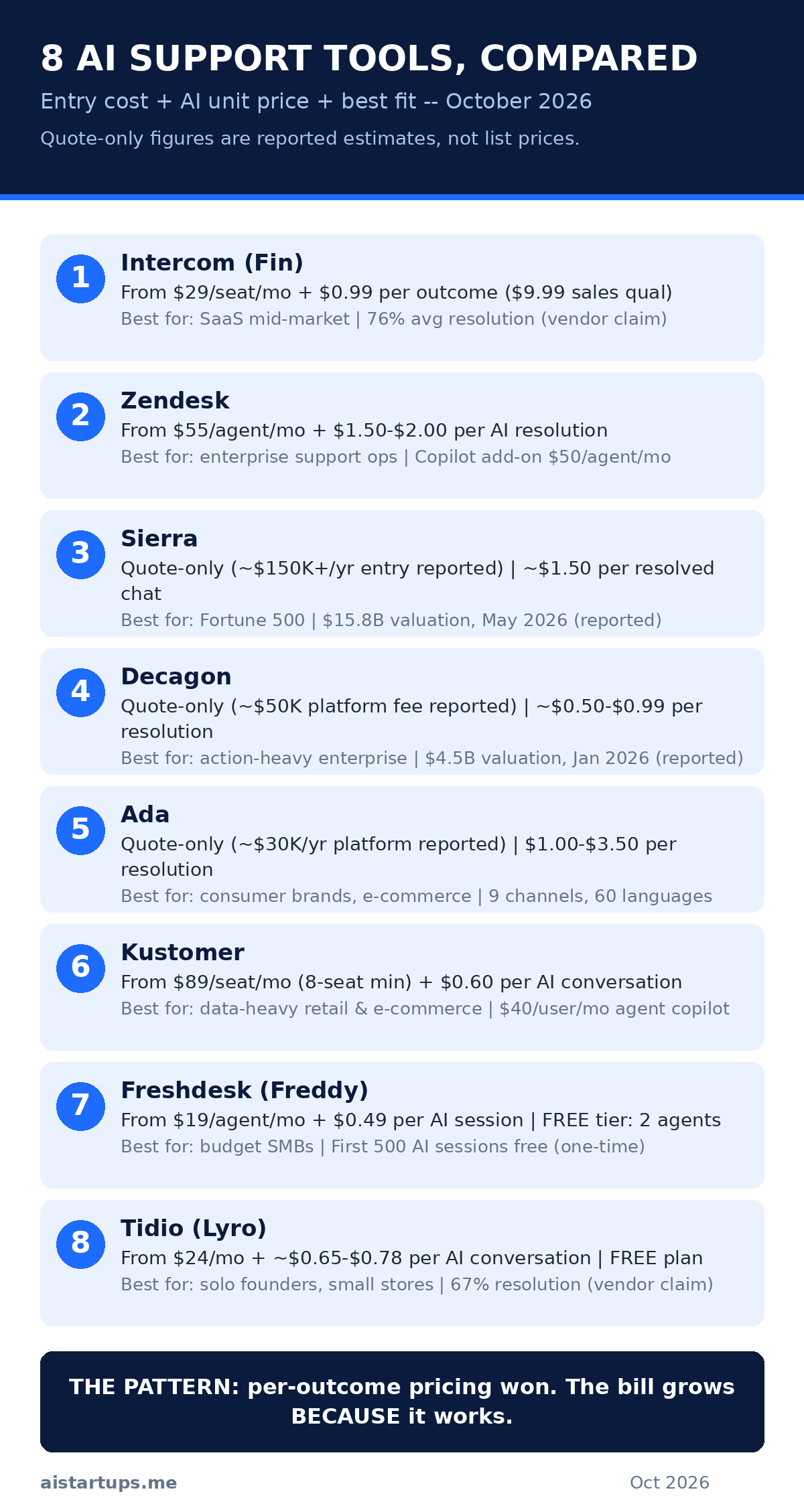
Quick honesty section, because comparison articles usually skip it. Three of these eight tools — Sierra, Decagon, and Ada — don’t publish pricing at all. Quote-only, demo-led, the whole enterprise dance. The numbers I give for them are reported estimates from third parties, and I’ve labeled them as such everywhere, including on the infographic. Treat them as directional, not as quotes.
The other five publish real numbers, and I verified them against the live pricing pages this week. Prices move fast in this category — Salesforce agreed to acquire Intercom/Fin for around $3.6 billion in June 2026, and when ownership changes, pricing pages tend to follow — so check the vendor’s page before you sign anything. A comparison article is a map, not a contract.
One more thing: “resolution rate” claims (76%! 84%! 67%!) are vendor numbers measured on vendor terms. They tell you the product isn’t broken. They don’t tell you what your resolution rate will be on your tickets. Budget on 60% of whatever they claim and you’ll rarely be disappointed.
The 8 tools, honestly reviewed
1. Intercom (Fin) — the per-outcome pioneer
The setup: seats start at $29/month on Essential (annual billing; $39 month-to-month), $85 on Advanced, $132 on Expert. Then Fin, the AI agent, bills $0.99 per outcome on top — resolution, procedure handoff, disqualification, self-serve qualification, one outcome max per conversation. Sales qualification costs $9.99, because a qualified lead is worth more than a reset password and everyone knows it.
What the AI actually does: Fin resolves end-to-end across chat, email, WhatsApp, SMS, phone (Fin Voice), and Slack. It reads your knowledge base, takes real actions — refunds, order lookups — through Fin Tasks and Procedures, and hands off to humans with full context when it’s stuck. There’s also Fin Copilot (agent assist for your human team) and a Pro analytics add-on. Intercom claims a 76% average resolution rate across 8,000+ customers. Budget on less, as discussed.
Two things worth knowing. First, you can buy Fin standalone and layer it onto Zendesk, Salesforce, or another helpdesk — $0.99/outcome with a 50-outcome monthly minimum, no seats. That’s genuinely useful if you like your helpdesk but want a better agent. Second, the Salesforce acquisition: agreed at roughly $3.6 billion in June 2026, with reports split on whether it’s fully closed. If you’re signing a multi-year deal, ask your rep what happens to Fin’s roadmap under Salesforce. (They’ll say “nothing changes.” Write down the date they said it.)
Best for: SaaS mid-market teams, especially ones already on Intercom — deployment is measured in days. Watch out: the bill scales linearly with volume. Five hundred AI resolutions a month is $495 before you’ve paid for a single seat.
2. Zendesk — the incumbent that went all-in on AI
The setup: the Customer Service Suite runs $55/agent/month on Suite Team (annual; $69 monthly), $115 on Suite Professional, with a $19 Support Team tier below. AI agents are included in every plan now, billed per automated resolution: $1.50 committed, $2.00 pay-as-you-go. Each plan includes a small allowance — 5 automated resolutions per agent/month on the lower tiers, 10 on Professional — which Zendesk now expresses as a $2/$5/$10 monthly dollar allowance per seat, capped at $5,000 a year. Overage auto-bills since January 2026. Copilot (the agent-assist layer) is another $50/agent/month.
What the AI actually does: autonomous agents across every channel Zendesk already owns — ticketing, chat, voice, help center — plus Intelligent Triage, generative replies, and an Action Builder for wiring the agent into your systems. It’s the deepest omnichannel platform here and has the largest app marketplace, which matters more than it sounds: the agent is only as useful as the systems it can touch.
The honest read: Zendesk is the default for a reason, and their outcome-based pricing announcement is worth reading in full before you sign — it’s the clearest statement of where the whole category is heading. But stacked billing (seats + Copilot + per-resolution) is genuinely hard to forecast, and there’s a cruel irony built in: the better the AI gets, the bigger the invoice. Also, if you’re on Zendesk’s legacy AI tools, you have until December 10, 2026. After that, migrate or lose them.
Best for: mid-market to enterprise support orgs that need chat, voice, help center, and serious reporting in one suite. Watch out: forecast the stack, not the headline seat price.
3. Sierra — the enterprise purist
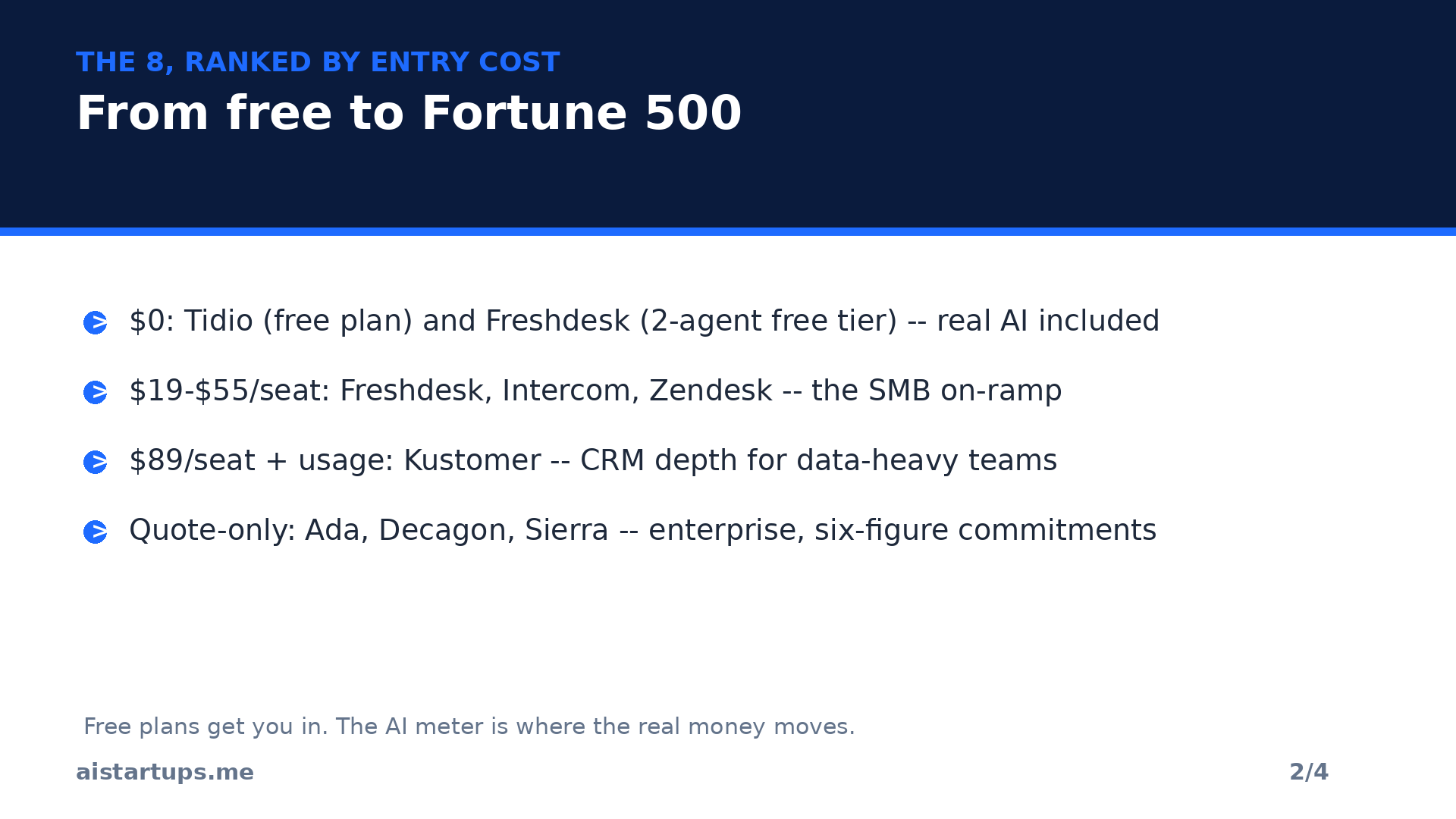
The setup: quote-only. No public pricing page, no free trial, demo-led sales with 4–10+ week implementations. Reported figures put entry around $150K–$350K a year with per-resolved-interaction rates near $1.50. Escalations to humans are free, which is the elegant part of the model: you literally only pay when the AI does the work. No seats. No tokens. Just outcomes.
What the AI actually does: conversational agents across voice, chat, email, SMS, and WhatsApp, with model-agnostic routing — Sierra runs your conversations across Claude, GPT, Gemini, and open models, picking per turn. Founded in 2023 by Bret Taylor (ex-Salesforce co-CEO) and Clay Bavor (ex-Google), it’s built AI-first rather than bolted-on, with a supervisory-agent safety architecture and heavy compliance coverage: SOC 2, HIPAA, PCI, FedRAMP. Customer list reads like a stock index — Sonos, ADT, WeightWatchers, Prudential, Cigna, Rocket Mortgage. Taylor claims 40% of the Fortune 50 are customers.
The honest read: if you’re a Fortune 500 company with massive ticket volume in a regulated industry, this is probably the best agent money can buy. If you’re not, the sales process will make that clear within one call. There’s no shame in that — Sierra knows exactly who it’s for.
Best for: large regulated enterprises (insurance, healthcare, telecom, consumer brands). Watch out: the purest pricing model in the category comes with the heaviest procurement process.
4. Decagon — the agentic workflow builder
The setup: quote-only, with reported figures around a ~$50K annual platform fee plus usage — roughly $0.50–$0.99 per resolution depending on contract. No trial, no self-serve; implementations run 4–12 weeks. Enterprise ACVs reportedly land between $95K and $590K a year.
What the AI actually does: autonomous agents across chat, email, voice, and SMS, with a genuinely interesting differentiator — Agent Operating Procedures (AOPs), where your CX team writes agent logic in plain English and it compiles into executable workflows with guardrails. Plus Watchtower (real-time QA on every interaction), an agent copilot, and 50+ enterprise integrations. Decagon claims 70%+ resolution rates, and the customer list is strong: Delta, American Airlines, Duolingo, Notion, Chime, Eventbrite. In October 2026 they announced a Plaid partnership for in-conversation financial actions — the agent verifying your bank account mid-chat, not linking you to a form. That’s the frontier: agents that do things, not agents that say things.
The honest read: Decagon’s pitch is “labor-budget pricing” — they anchor against what a call center costs, not what software costs. Their own comparison against Intercom is worth a read even if you take the framing with salt; and this independent Decagon-vs-Sierra breakdown is the best side-by-side of the two enterprise AI natives I’ve found. If your support is action-heavy — refunds, rebookings, account changes — Decagon’s architecture is built for exactly that.
Best for: mid-market to large enterprises with action-heavy support (fintech, travel, consumer brands). Watch out: you’re buying a platform implementation, not a plugin. Budget the integration time honestly.
5. Ada — the channel maximalist
The setup: quote-only. Ada’s own site says most customers choose conversation-based pricing, with a resolution-based model available for enterprises. Reported estimates: roughly a ~$30K/year platform fee to start, $1.00–$3.50 per automated resolution, enterprise contracts commonly $100K–$300K a year at volume. No self-serve trial; Ada positions itself for companies doing 300,000+ support conversations a year.
What the AI actually does: AI agents with Playbooks (no-code automation for multi-step workflows), a “Unified Reasoning Engine,” and a coaching loop — simulations, gap clustering, performance analytics — that keeps improving the agent after launch. The standout is channel breadth: web chat, email, voice, SMS, WhatsApp, Messenger, Instagram, and in-app, across 60 languages, from a single agent configuration. Ada claims an 84% automated resolution rate and 6.4 billion interactions handled. Founded 2016, ~$200M raised — one of the longest-tenured AI support platforms here, which counts for something in a category full of 2023 startups.
The honest read: if your customers talk to you on Instagram and WhatsApp as much as email, Ada’s platform page will make a strong case. The coaching loop is the most mature I’ve seen — most vendors ship the agent and wish you luck; Ada built the ongoing improvement into the product. Implementation takes weeks to months, though. This is not a Friday-afternoon project.
Best for: mid-market to enterprise consumer brands and e-commerce (published cases include IPSY, Simba Sleep, Indigo). Watch out: the channel breadth you pay for is only worth it if your customers actually use those channels.
6. Kustomer — the CRM-first outlier
The setup: seats on annual billing with an 8-seat minimum — Enterprise at $89/seat/month, Ultimate at $139. There’s also a conversation-based alternative (unlimited seats) at $0.35/conversation on Enterprise, $0.50 on Ultimate. The AI layer: AI Agents for Customers from $0.60 per engaged conversation, and AI Agents for Reps at a flat $40/user/month. Note the pricing page itself is gated behind an ROI assessment as of mid-2026 — the clearest public price list is on Kustomer’s own blog, which tells you something about enterprise software in 2026.
What the AI actually does: autonomous agents across email, chat, SMS, social, and voice, plus a copilot for human reps (summaries, writing help, translation). But the real product isn’t the AI — it’s the unified customer timeline. Kustomer organizes support around the customer, not the ticket: every conversation, order, and event in one infinite-attribute record. The AI is good; the data foundation it reasons over is the deepest of any legacy platform here.
The honest read: the flat $40/user copilot is quietly the best deal in the lineup for teams that want AI assistance without a per-resolution meter running on every agent keystroke. And the 8-seat minimum with no monthly billing tells you exactly who this is for — not you, solo founder. That’s fine. Not every tool has to be.
Best for: large enterprise and retail/e-commerce teams that want CRM depth plus omnichannel in one workspace. Watch out: sales-led procurement only. Negotiate a real PoC with your own data before signing — the timeline demo is always prettier than your reality.
7. Freshdesk (Freddy AI) — the value play
The setup: Freshdesk ticketing starts at $19/agent/month on Growth (annual), $55 Pro, $89 Enterprise. The omnichannel version, Freshdesk Omni, is a separate SKU: $29/$79/$119. Freddy AI Agent pricing is where it gets interesting: your first 500 sessions are free (one-time per account, not monthly), then $49 per 100 sessions (~$0.49 each) on Freshdesk, or $100 per 1,000 sessions ($0.10 each) on Omni. Freddy AI Copilot is a $29/agent/month add-on. And there’s a genuine free tier: up to 2 agents.
What the AI actually does: Freddy AI Agent is an autonomous conversational agent (plus vertical and email agents, with an Agent Studio on Omni), Copilot assists your human agents with suggestions and sentiment, and Freddy AI Insights handles analytics on Enterprise. Freshworks claims a 60% agent productivity lift for Copilot — plausible, since that’s roughly what copilots deliver everywhere.
The honest read — and the catch: a “session” is one unique end-user interaction inside a 24-hour window for chat, 72 hours for email — and it’s billed whether or not the AI resolves anything. This is activity-based billing, not outcome-based. If Freddy fumbles and a human takes over, you paid for the session anyway. At $0.10/session on Omni that’s a rounding error; at $0.49 on standard Freshdesk, a high-volume store should do the math. Still: free tier, $19 entry, and 500 free AI sessions make this the cheapest on-ramp to a real AI-equipped helpdesk. If you’re bootstrapped, start here and upgrade when the invoice tells you to.
Best for: solo founders through mid-market — the broadest “just start” fit in the lineup. Watch out: three stacked meters (seats + Copilot + sessions). The $0.10/session Omni tier is the one to aim for as you scale.
8. Tidio (Lyro) — the SMB sweet spot
The setup: Tidio bills on billable conversations, not seats — up to 10 seats on self-serve plans. Free: $0 for 50 billable conversations a month plus 50 one-time Lyro AI conversations. Starter: $24.17/month (annual; $29 monthly) for 100 conversations. Growth starts around $49.17/month. The Lyro AI add-on starts at $39/month for 50 conversations (~$0.65–$0.78 each at entry, ~$0.50 at volume), refreshing monthly. Premium tier is custom quote with pay-per-resolution billing and a guaranteed 50% Lyro resolution rate.
What the AI actually does: Lyro is a Claude-powered conversational agent that learns from your knowledge base and website, claiming a 67% average resolution rate — the highest advertised in the SMB class. There’s also Flows (drag-and-drop rule automation, separate meter) and an AI copilot for agents. Channels: web chat, email, Messenger, Instagram, WhatsApp. Setup is genuinely minutes — one-click for Shopify, WooCommerce, and WordPress, which is exactly the stack a small store runs. The pricing page is refreshingly legible, by the way. More vendors should be embarrassed by the comparison.
The honest read: 300,000+ businesses use Tidio, and the reason is obvious — it’s the only tool here where a solo founder can be live with AI support before lunch, free. The dual-meter system (human conversations + Lyro quota) gets unpredictable at scale, and ~$0.50+ per AI conversation is expensive at real volume. But that’s a good problem: it means you have real volume. Graduate to Intercom or Freshdesk when you get there.
Best for: solo founders, small e-commerce stores, and SMBs starting with AI support. Watch out: at scale, the per-conversation AI cost adds up faster than per-outcome pricing. Revisit at ~1,000 conversations a month.
So which one should you actually buy?
Enough specs. Here’s the decision tree I’d hand a founder friend:
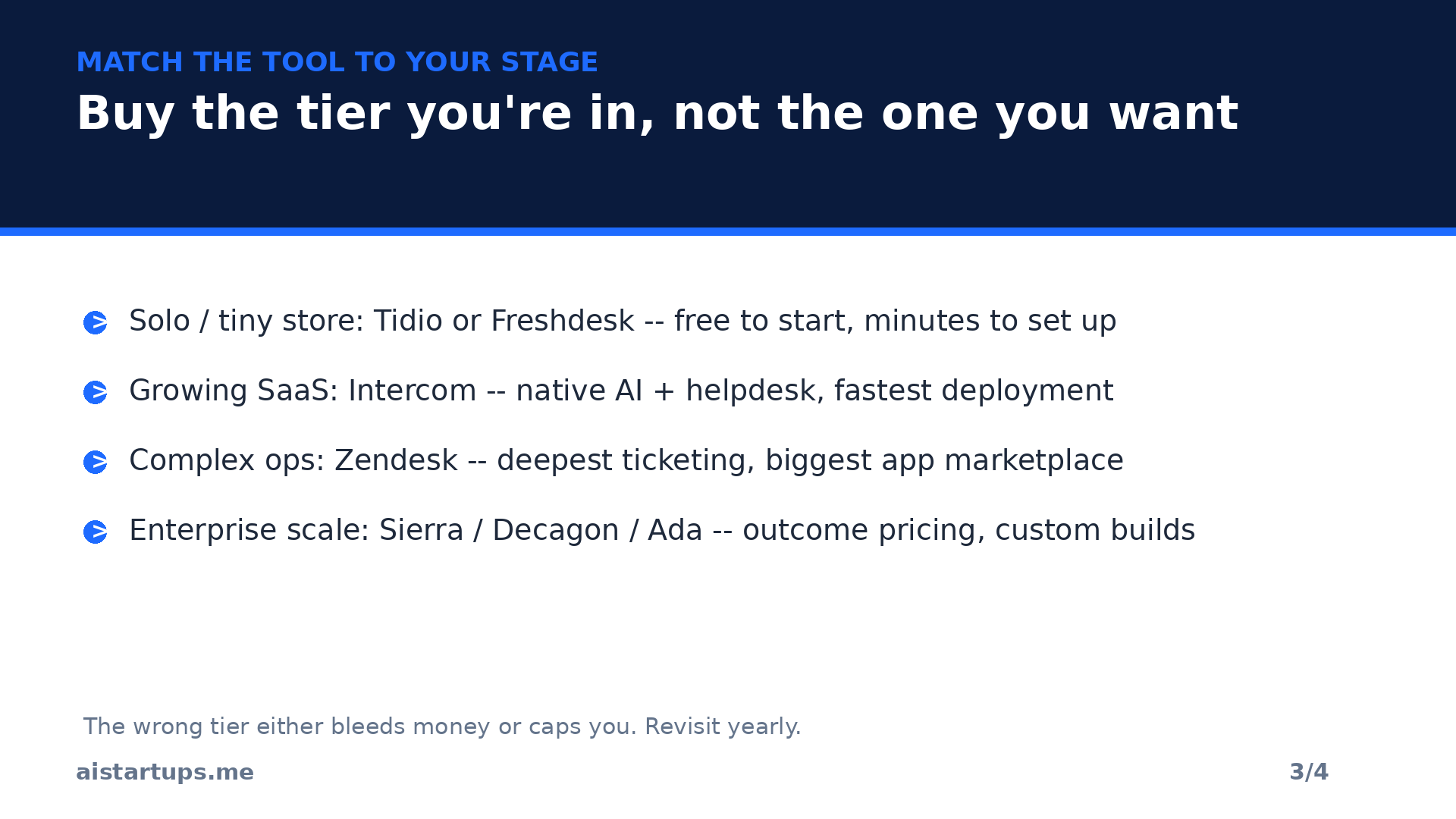
- Solo or tiny store, under ~500 conversations a month: Tidio (free plan, live today) or Freshdesk (free tier, more of a real helpdesk). Don’t overthink it. Your biggest risk isn’t picking the wrong tool — it’s spending three weeks comparing tools instead of answering customers. Both fit the kind of no-code stack I mapped out for non-technical founders: sign up, connect, done.
- Growing SaaS, 5–50 people: Intercom. The native AI-plus-helpdesk combo deploys fastest, the per-outcome pricing is the most legible in the category, and the standalone-Fin option means you’re not locked in if you outgrow the helpdesk itself.
- Complex support ops, compliance needs, big team: Zendesk if you want the deepest platform and marketplace; Kustomer if your world revolves around customer data and you want the CRM depth. Both are sales-led, so run a real PoC — the demo is never your data.
- Enterprise scale, regulated industry, massive volume: Sierra for the purest outcome model and model-agnostic routing, Decagon if your support is action-heavy (refunds, rebookings, account changes), Ada if your customers live on messaging apps and you need 60 languages. All three require a proper procurement cycle. Start it a quarter earlier than you think.
- None of these fit — custom backend actions, weird internal tools, workflows no vendor understands: that’s the point where teams stop shopping and start building, usually by hiring an AI integration studio like AISquadX to wire an agent into their actual systems instead of forcing an off-the-shelf tool to fit. The buy-vs-build line sits exactly at “does it need to touch our database.”
And one meta-point: revisit yearly. This category reprices itself every 12 months — the 2024 per-seat world is unrecognizable now, and whatever wins in 2026 will look quaint by 2028. Put a calendar reminder on your renewal date, not your launch date.
5 cost traps nobody puts on the pricing page
Read this section twice. It’s worth more than the rest of the article.
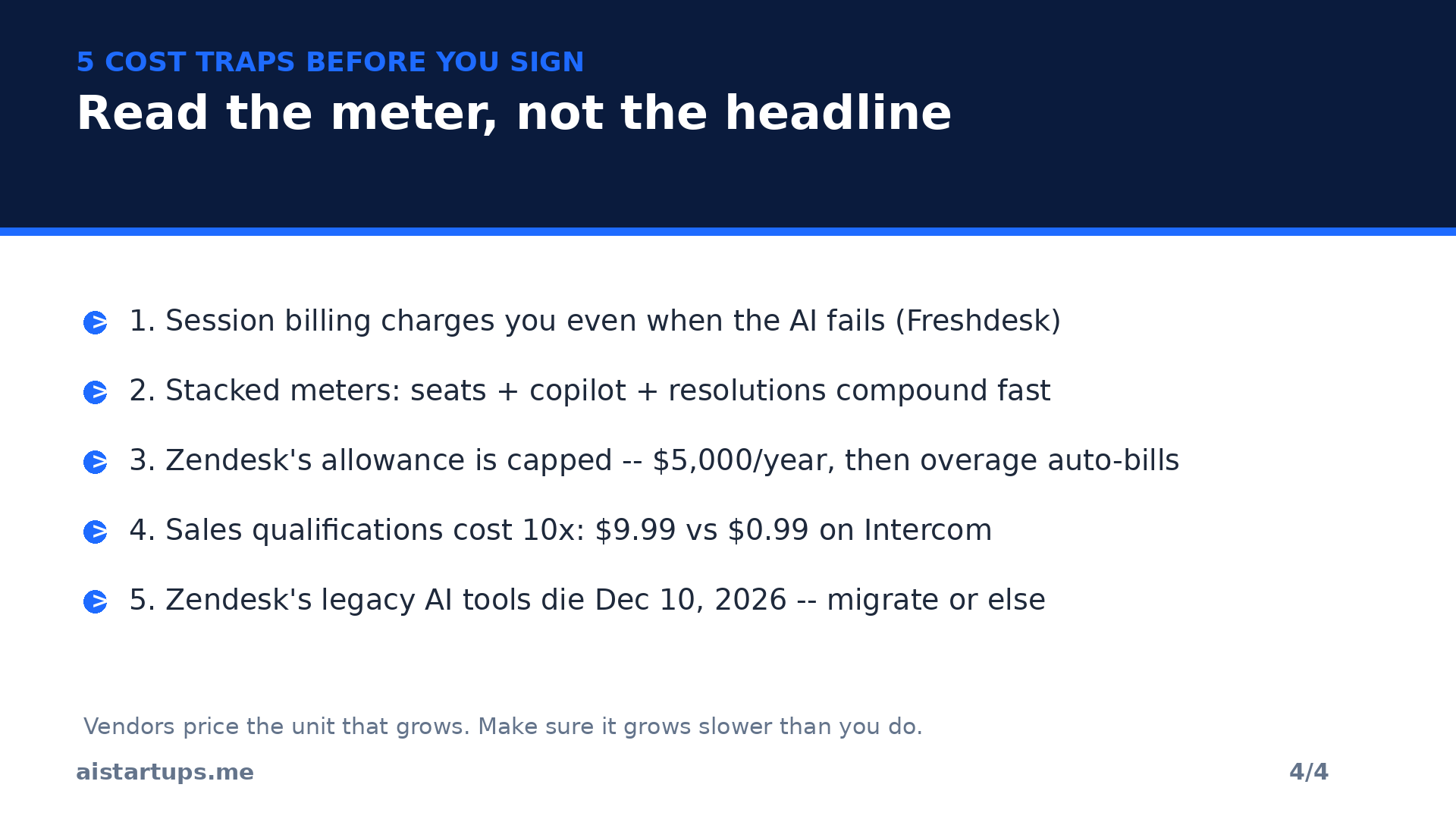
1. Outcome ≠ resolution ≠ session ≠ conversation. Intercom’s “outcome” is a completed job (max one per conversation). Zendesk’s “automated resolution” is their definition of resolved. Freshdesk’s “session” is any interaction in a 24/72-hour window — resolved or not. Kustomer’s “engaged conversation” is its own thing. Same volume, four different invoices. When a rep quotes you, ask: “define the unit, and show me what a failed handoff costs.” If they can’t answer crisply, that’s your answer.
2. Stacked meters compound. Seats + copilot + per-unit AI is three bills wearing one logo. Zendesk’s $55 seat plus $50 Copilot plus $1.50/resolution is a very different number than “$55 a seat.” Model the stack at 2x your current volume, because…
3. The bill grows because it works. This is the fundamental weirdness of outcome pricing, and I want you to sit with it: every efficiency gain raises your invoice. The AI resolving more tickets is the product working and your costs rising. That’s fine — it’s still cheaper than the humans — but budget it as a variable cost tied to growth, not a fixed SaaS line. I wrote a whole guide on cutting your AI API bill with the same mindset: metered AI spend needs architecture, not just a subscription.
4. Allowance caps are cliffs, not cushions. Zendesk’s included resolutions are a $2–$10/month allowance per seat, capped at $5,000 a year — then overage auto-bills. Intercom’s sales qualifications cost 10x a standard outcome ($9.99 vs $0.99). Tidio’s Lyro quota refreshes monthly; blow past it mid-month and you’re buying more or going manual. Know where your cliff is before you walk off it.
5. The enterprise quotes are starting points, not prices. Sierra, Decagon, and Ada will all negotiate — reported entry figures are just where the conversation starts. Vendr’s data puts Decagon’s median contract around $386K and Ada’s around $70K, which tells you the range is enormous. Get two of them bidding against each other. It works.
“We stopped arguing about which AI was smartest and started arguing about which invoice we could predict. That was the whole decision.”
— A founder friend, after migrating 4,000 monthly conversations to per-outcome pricing
If you’re on the agency side of this — and a lot of readers are — note that “we’ll set up your AI support and cut your ticket costs” is a genuinely sellable service right now. The tools do the work; the expertise is in the setup, the knowledge base, and the meter-watching. My AI agency playbook covers the packaging; support automation is one of the cleanest offers in it, because the ROI math writes itself.
FAQ
Can an AI support agent really replace my support team?
Replace entirely? No — and be suspicious of any vendor who says yes. What the good ones do is absorb the repetitive 60–70%: password resets, order status, refund policy questions, the tickets your team answers with macros anyway. Your humans move up to the messy 30% — angry customers, edge cases, judgment calls. Every team I know that deployed one of these ended up with the same headcount doing higher-value work, not a smaller team. The ROI is in leverage, not layoffs. (Well — mostly. Some CFOs read the same invoice I do.)
What’s the difference between per-outcome, per-resolution, and per-session pricing?
The unit being metered. Per-outcome (Intercom: $0.99) bills a completed job, max one per conversation — cleanest model. Per-resolution (Zendesk: $1.50–$2.00) bills when the vendor’s system marks the ticket resolved. Per-session (Freshdesk: $0.10–$0.49) bills any interaction in a time window, resolved or not — cheapest per unit, but you pay for failures too. Always ask what a failed handoff costs before comparing headline rates.
I’m a solo founder. Do I actually need any of this?
You need something answering customers while you sleep, and that something can be free. Tidio’s free plan or Freshdesk’s free tier takes an afternoon to set up and handles the overnight queue. The mistake isn’t picking the wrong tool — it’s hand-answering 40 “where’s my order” emails a day at month six because you never set anything up. Start free, upgrade when the invoice justifies itself.
How long does it actually take to set one of these up?
Honest ranges: Tidio or Freshdesk, an afternoon. Intercom with Fin, a few days if your knowledge base exists (a few weeks if it doesn’t — the AI is only as good as what you feed it, and everyone’s help center is more outdated than they think). Zendesk and Kustomer, weeks with a proper rollout. Sierra, Decagon, and Ada, one to three months including procurement. The pattern: setup time tracks with how much of your actual business the agent is allowed to touch.
Will these prices hold, or is this another race to the bottom?
Some of both. The per-unit rates will keep falling — that’s what competition does, and the enterprise AI natives are already undercutting each other on reported per-resolution fees. But the model — paying per outcome instead of per seat — looks durable, because it aligns the vendor with the customer in a way per-seat never did. My bet: cheaper units, same meters, more of your support spend variable by 2028. Budget accordingly.
The Bottom Line
Support software had its pricing flip, and most founders haven’t updated their mental model yet. You’re not buying seats anymore — you’re buying outcomes, resolutions, sessions, conversations. Four words, four meters, four different invoices.
If you remember nothing else: define the billable unit before you compare prices, model the full stack (seats + copilot + AI meter) at twice your current volume, and pick the tool for the stage you’re in — Tidio or Freshdesk to start, Intercom as you grow, Zendesk or Kustomer when ops get complex, Sierra, Decagon, or Ada when you’re playing at enterprise scale.
The AI is good enough now. That’s the easy part. The hard part — the part that shows up on your P&L — is the meter. Read it before you sign.