

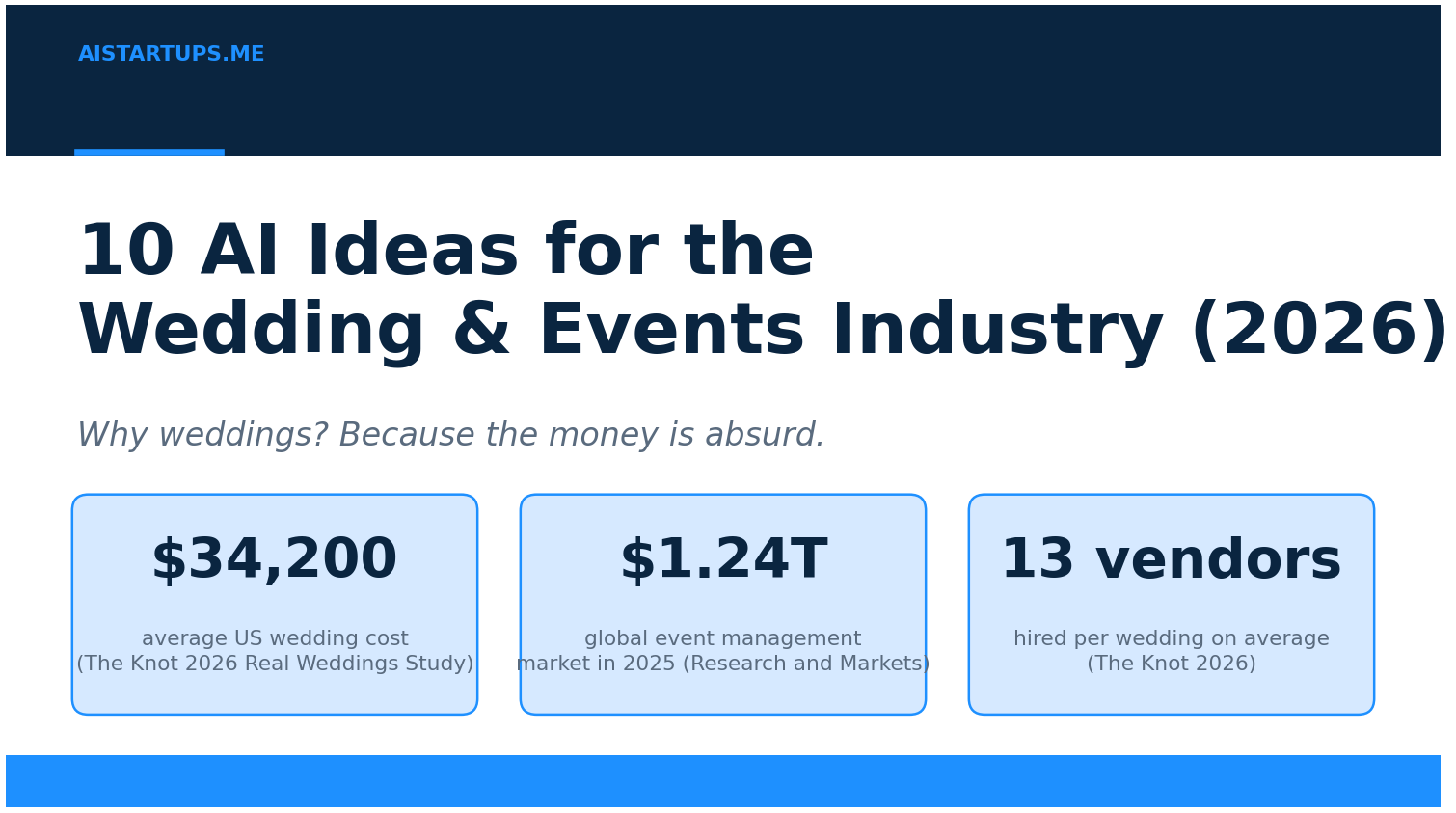
Here’s a stat that should make any founder sit up straight: the average US wedding now costs $34,200, according to The Knot’s 2026 Real Weddings Study of more than 10,000 couples. That’s not a typo. Thirty-four thousand dollars for a one-day event, bought by people who have never organized anything close to it before. And the vendors serving them? Most still run on spreadsheets, sticky notes, and “I’ll get back to you on Monday.”
That’s the opening. The wedding and events world is one of the last big service industries where the money is enormous and the software is… fine. Not terrible. Just fine. Couples hire 13 vendors on average for a single wedding (same study), which means every wedding is really 13 small businesses trying to coordinate with each other through email threads. And beyond weddings, the global event management market is estimated at $1.24 trillion in 2025, growing to $2.08 trillion by 2033 — with AI integration called out as one of the leading trends.
So no, you don’t need to out-innovate anyone’s core model. You need to walk into a chaotic, high-spend, low-tech market and sell organization, speed, and peace of mind. That’s what this list is: 10 AI product and service ideas for weddings and events that a solo founder or tiny team could realistically build and sell. Each one has the same treatment — the pain, the product, who pays, and rough pricing. No venture funding required. Let’s go.
How I scored these ideas
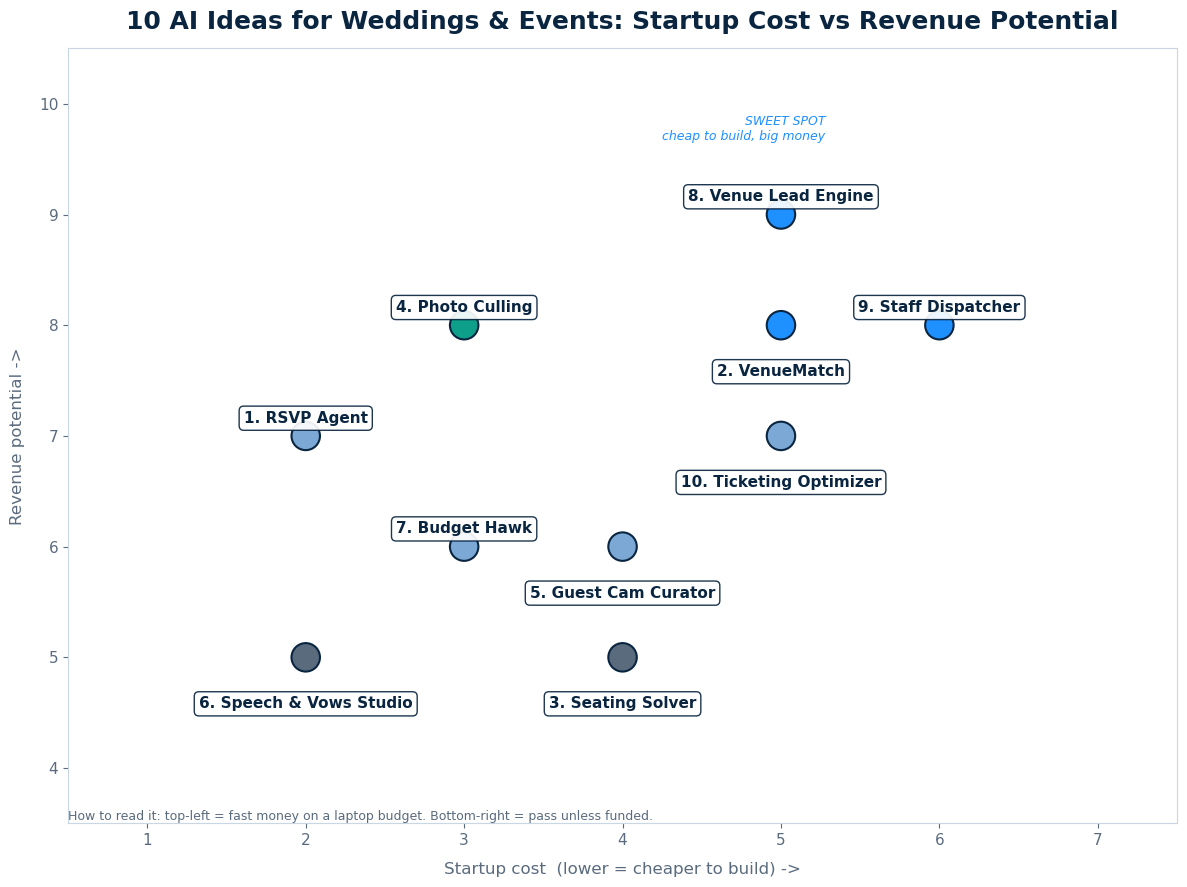
Before the list, a quick note on how I’m judging. Every idea gets two rough scores: startup cost (how much time and money to build a working version) and revenue potential (how big the check is and how often it repeats). Cheap-to-build plus big-money is the sweet spot — top-left of the chart. The chart below lays all 10 out so you can pick your lane before you fall in love with any single idea.
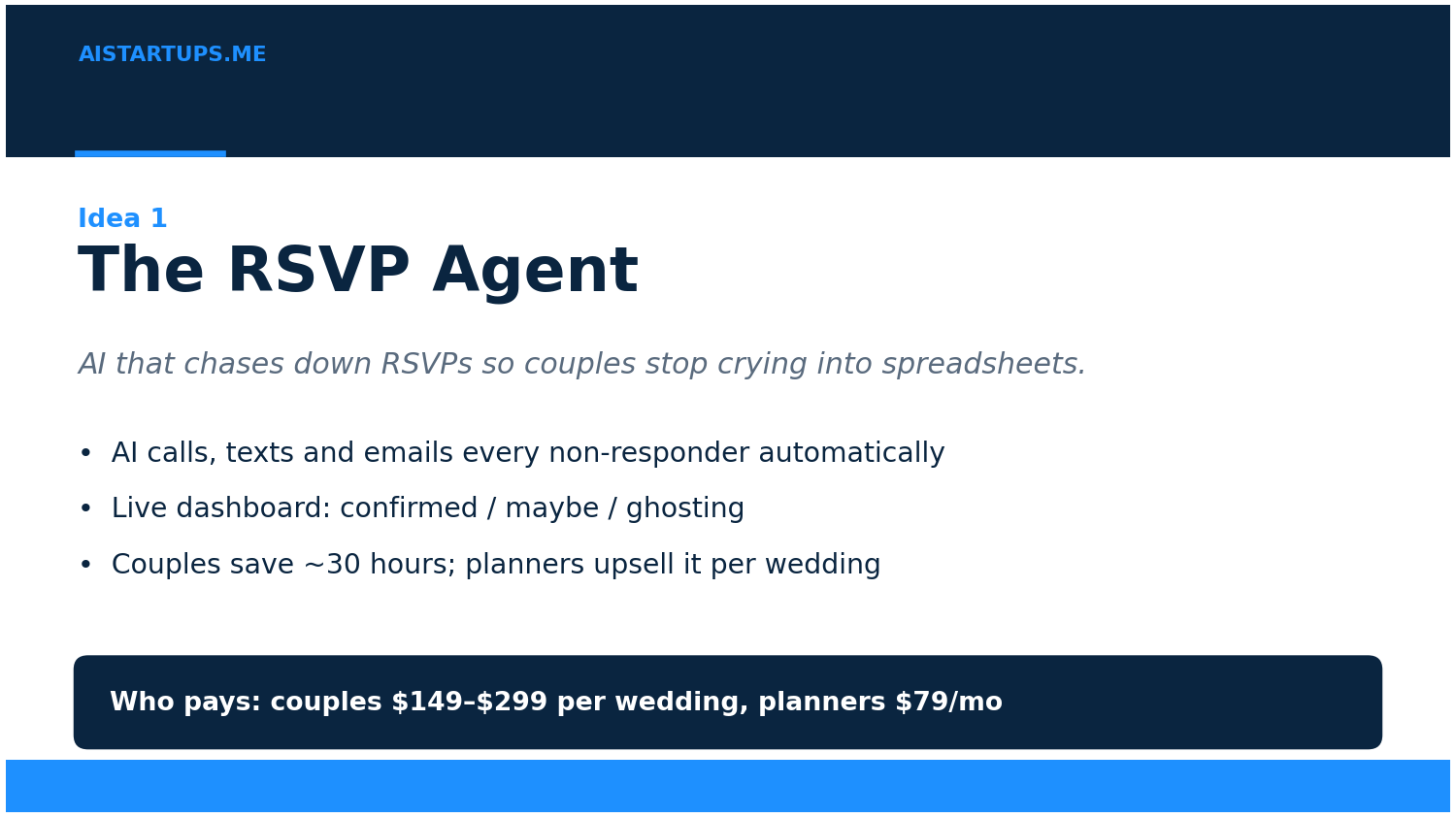
Idea 1: The RSVP Agent
Every couple has a list of 60 people who never replied to the invitation. And somebody — usually the bride, usually at 11 PM, usually with a spreadsheet — has to chase them all down by phone. It’s miserable, emotional labor at its worst. “Hey, it’s me again, just checking if you’re coming…”
The product: an AI voice and SMS agent that does the chasing. The couple (or their planner) uploads the guest list, marks who’s silent, and the agent calls and texts each non-responder with a friendly, on-brand message, records the answer, updates the headcount in real time. Think of it as a polite robot with infinite patience and zero embarrassment. It works because RSVP chasing is high-volume, low-complexity, and emotionally draining — exactly the tasks people are happiest to hand to software.
Who pays: couples, one-time, $149–$299 per wedding. Or sell it to wedding planners as an upsell: they charge the couple $199 and you take $79–$99. Planners love add-ons with this margin profile — it’s pure profit on work they were doing for free at midnight.
Idea 2: VenueMatch — the AI venue shortlist
Finding a venue is the single most stressful early decision in wedding planning. There are thousands of options, the pricing is opaque (nobody lists real prices), availability is a mystery, and the average venue costs $12,900. Couples tour five venues and pick whichever one didn’t make them cry.
VenueMatch flips it: couples answer a 5-minute conversational quiz (budget, vibe, guest count, date flexibility, must-haves), and the AI returns a ranked shortlist of 10 venues with real availability windows, estimated total costs, and trade-offs explained in plain English. “This barn is $3k under budget but only fits 90 guests. This hotel ballroom seats everyone but parking is $40 a car.”
Who pays: this is a lead-gen play. Venues pay $200–$500 per booked referral, because one booking is worth five figures to them and their current lead sources are wedding directories charging them for clicks. Alternatively, sell it to planners as a $49/mo tool. The hard part is the venue database, so start with one city and go deep. One city, 200 venues, perfect data — that’s a real business.
Idea 3: The Seating-Chart Solver
If you’ve never watched a couple argue about table assignments, congratulations on your peaceful life. Seating charts are a constraint-satisfaction nightmare: Aunt Linda can’t sit with Uncle Ray, the college friends want to be together, nobody wants the table by the kitchen. Planners burn entire weekends on this.
The product: import the guest list with a few relationship tags (plus-ones, families, “keep apart” flags), and the AI generates three candidate seating plans optimized for harmony, with explanations. It’s not magic — it’s operations research with a nice interface. Aisle Planner and similar tools charge $49.99–$229.99/mo for full planning suites, but none of them do seating intelligently. A focused tool that does one thing brilliantly can undercut and out-serve the suite.
Who pays: planners and venues, $199 per wedding or $79/mo. Corporate event planners have the same pain for galas and conferences, so the market is wider than weddings. This one is a great “boring but profitable” pick — nobody’s going to write a viral tweet about seating software, and that’s exactly why the niche is open.
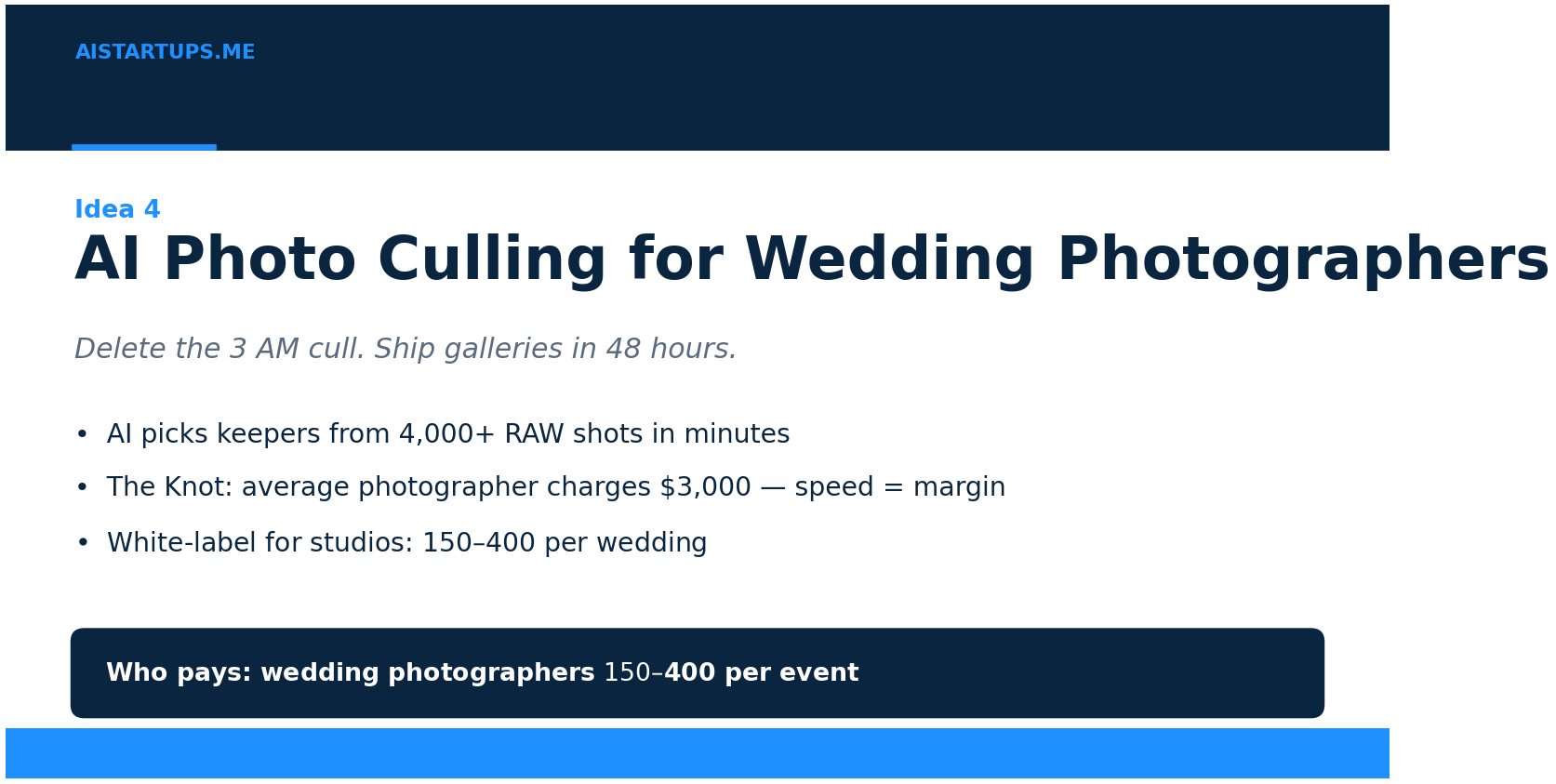
Idea 4: AI Photo Culling for Wedding Photographers
Here’s a number that explains this entire idea: the average wedding photographer charges $3,000 per wedding. Now ask a photographer how they spend the week after a wedding. Answer: staring at 4,000+ RAW files at 3 AM, deleting the blurry ones, flagging the keepers. Culling is the industry’s most-hated task, and every hour spent on it is an hour not spent shooting (the part that actually pays).
The product: drag-and-drop the RAW folder, AI culls duplicates, blinkers, and out-of-focus shots, and returns a curated keeper set ranked by quality — sharp faces, good exposure, genuine expressions. The photographer does a final 15-minute review instead of a 6-hour one. Turnaround goes from 6–8 weeks to 48 hours, which becomes their marketing: “galleries in two days.”
Who pays: photographers, $150–$400 per wedding, or $299/mo studio plans. This is a sell-to-pros play, and pros are wonderful customers: they buy with business money, they churn less, and they all know each other. One happy photographer in a city gets you ten more. If you want a validated niche before you build, this is the one I’d interview photographers about first.
Idea 5: Guest Cam — AI-curated guest photos
Here’s the thing: every wedding now has 100 amateur photographers. Guests take thousands of candid shots the hired photographer never gets — the dance floor chaos, the grandma reaction, the 2 AM after-party. But those photos live on 100 different phones and die there. Couples beg for them in group chats for months.
Guest Cam: one QR code on every table. Guests scan, upload all night. The AI dedupes, kills the blurry ones, groups by moment (ceremony, first dance, cake), and builds a curated highlight reel the couple wakes up to the next morning. Same-day slideshow at brunch? That’s the kind of feature couples cry over.
Who pays: couples, $149–$349 per event. This is a volume game — every wedding has a QR code, which means every wedding is a demo for the next 80 guests who’ll get married someday. Build the viral loop into the product: “Made with Guest Cam” watermark on the shared album, upgrade to remove it. (Yes, really. It works.)
Idea 6: The Speech & Vows Studio
Best man speeches are a public-health issue. Half are boring, a quarter are inappropriate, and the remaining quarter are read off a phone in a shaking hand. Meanwhile the couple’s own vows get written at midnight the night before. There’s a real business hiding in here.
The Speech & Vows Studio is an AI writing coach, not a template machine. It interviews the speaker (stories, inside jokes, what to avoid — “please don’t mention the Vegas trip”), drafts a speech with actual structure and timing marks, then does a practice run: pacing feedback, pause suggestions, “this joke lands better after the toast story.” Vows get the same treatment with a more emotional register.
Who pays: couples and wedding parties, $49–$149 per speech, or a $249 “whole wedding party” package. The market is enormous — every wedding has 3–6 speeches — and the purchase is emotional, which means price sensitivity is low. Nobody haggles over the speech that makes their dad cry. This is the cheapest idea on the list to build. A weekend, honestly.
Idea 7: Budget Hawk — the AI quote checker
Couples get quotes from vendors and have absolutely no idea if they’re being overcharged. Is $2,800 for flowers fair? Is $80 a head for catering good or a robbery? The Knot says the average catering cost is about $80 per person, but that number varies wildly by city, and couples have no baseline. So they either overpay or spend 40 hours researching.
Budget Hawk: upload your vendor quotes, tell it your city and guest count, and the AI benchmarks each quote against real market data, flags the outliers, and suggests what to negotiate. “This florist is 35% above your city average — ask about seasonal flowers to cut $600.” It works on the same psychology as every price-comparison tool ever: people hate feeling ripped off more than they love saving money.
Who pays: couples, $19/mo during planning or a $99 “whole wedding pass.” Freemium works here: one free quote check, pay for the full breakdown. The data moat is the interesting part — every quote uploaded makes the benchmarking smarter, and after 10,000 weddings you’ve got the most granular wedding pricing dataset in existence. That’s the asset. Before building, do what I’d do for any of these: validate the idea with real couples — five conversations will tell you more than five weeks of coding.
Idea 8: The Venue Lead Engine
This is the highest-revenue idea on the list, and it’s not close. Venues sell a $12,900 product (average reception venue, per The Knot) and many of them respond to inquiries… whenever. A day later. Three days later. Meanwhile the couple has already toured two competitors. In a business where one booking is a five-figure sale, slow follow-up is an expensive disease.
The Venue Lead Engine is an AI sales rep for venues: instant response to every inquiry 24/7, answers the common questions (capacity, pricing tiers, available dates), scores the lead, books the tour, and follows up automatically until the couple books or opts out. It’s the same AI-agent playbook that works for selling AI services to local businesses — except venues have giant deal sizes, so the ROI math is trivially easy to sell. “We pay for ourselves if we save you one lost booking a year.”
Who pays: venues, $199–$499/mo. That’s real B2B SaaS with real retention — once the AI is handling their inquiries, they don’t rip it out. Fifty venues at $299 is $15k MRR from one city’s wedding market. This is the idea I’d build if I wanted the biggest outcome. It’s also the most competitive, so move with a wedge: start with one venue type (barns, say) and own it.
Idea 9: The Event Staff Dispatcher
Weddings and events run on temp labor: servers, bartenders, setup crews, coat check. Staffing agencies juggle hundreds of workers across dozens of events, and the whole system breaks every Friday when someone no-shows. Coordinators spend their days in a group-chat hell of “can anyone cover the Johnson wedding??”
The dispatcher: AI shift scheduling that accounts for worker skills, certifications (bartending licenses, food handling), past reliability, and location — plus automated no-show coverage. When someone cancels at 6 PM, the system already has three ranked replacements texted before the coordinator even sees the notification. Event staffing is a logistics problem wearing a hospitality costume, and logistics problems are where AI earns its keep.
Who pays: staffing agencies and large venues, $299–$799/mo. This one’s B2B all the way — no consumer marketing, just outbound to agencies in your city. HoneyBook charges $29–$109/mo to manage client relationships for small event businesses, which tells you this industry already pays for software. A tool that prevents one ruined wedding pays for a year of itself.
Idea 10: The Ticketing Margin Booster
Last one, and it’s for the events side beyond weddings: concerts, festivals, conferences, charity galas. Event organizers set ticket prices by gut feel — early bird, regular, VIP — and leave money on the table in both directions. Price too high and the room’s half empty; too low and you sold out in an hour (congratulations, you donated your margin to scalpers).
The Margin Booster: AI dynamic pricing for event tickets. It watches sales velocity, day-of-week patterns, comparable events, and demand signals, then nudges prices up or down within bounds the organizer sets. Airlines and hotels have done this for decades; the events world mostly hasn’t. Eventbrite takes 3.7% + $1.79 per paid ticket just for processing — organizers are clearly comfortable paying for ticketing infrastructure, and a tool that adds 10–15% to gross revenue is an easy upsell on top of it.
Who pays: event organizers, $149/mo plus a small revenue share (or a flat per-event fee for one-offs). Start with repeat organizers — monthly meetups, venue series, festival companies — because one sale covers dozens of events. The pitch writes itself: “we take a cut of money you weren’t going to make.”
The fastest way to actually start
Okay, ten ideas. Now the part most lists skip: how do you pick one and ship it? Here’s my honest take, and it’s the same advice I’d give a friend.
- Don’t build first. Pick the idea whose customers you can reach this week. The RSVP agent sells to planners — are there 20 wedding planners in your city you could email today? The photo culling tool sells to photographers — are you already in those Facebook groups? Distribution beats product every single time, and in a relationship-driven industry like weddings, warm intros are the whole game. This is the same reason AI side hustles that actually make money tend to be boring service businesses with a clear customer, not clever tech.
- Sell the service before the software. For almost every idea on this list, you can run the first 5–10 customers manually with AI tools behind the scenes. Chase RSVPs by hand with an AI-assisted call script. Cull photos yourself using existing AI culling features. You’ll learn what customers actually want (it’s never what you think), get paid while you learn, and only automate what’s proven. The software comes later, once the playbook is obvious.
- Price on the customer’s math, not yours. A venue doesn’t care that your AI costs you $0.40 per conversation. It cares that one saved booking is worth $12,900. Price at a fraction of the value you create — $299/mo against a $12,900 booking is a rounding error, which is exactly why they’ll say yes.
Before you commit to an idea, run this five-minute gut check:
- Can you name 10 specific people who feel this pain right now?
- Would at least one of them pay you $100+ this month for a manual version?
- Does the buyer control a budget (not “ask my boss”)?
- Is there a natural repeat — another wedding, another season, another venue?
If you get four yeses, build it. Three yeses, talk to five buyers first. Fewer than that — pick a different idea off the list.
And if the idea of building the whole thing yourself makes you want to lie down — fair. This is also a legitimate path: partner with a web development studio to build the MVP while you focus on customers. AISquadX is the kind of AI integration studio that can take a validated idea from this list to a working product in weeks, which is the right division of labor when your superpower is selling, not shipping code.
A wedding is a $34,200 purchase made by someone buying it for the very first time. The vendor who responds first, follows up best, and makes it feel easy usually wins. Every idea on this list is just a different way to be that vendor.
FAQ
Do I need wedding industry experience to build one of these?
No — and honestly, outsiders often see the gaps more clearly. What you need is access: five conversations with planners, photographers, or venue managers will teach you more than a year of reading. Ask about their worst week, not their dream software. Build for the pain, not the fantasy.
How much does it cost to build an AI wedding tool?
Less than you’d think. The cheapest ideas here (speech studio, RSVP agent) can start as a service run manually with AI assistance — a few hundred dollars in tooling. A real SaaS MVP with a proper front end and integrations runs $3k–$15k depending on complexity. The expensive part was never the code; it’s the months of selling to get your first 20 customers.
Isn’t the wedding industry too seasonal?
It’s cyclical, not seasonal-dead. Peak wedding season runs roughly May through October in the US, but planners sell year-round, venues book 12–18 months out, and corporate events (ideas 9 and 10) run on a completely different calendar. Build for the full events market, not just June weddings, and the seasonality mostly disappears. Recurring revenue from venues and agencies smooths out the rest.
Can these ideas work outside the US?
Yes, with localization. Weddings are big-ticket everywhere — the UK, the Gulf, South Asia, and Latin America all have massive wedding economies with their own norms (multi-day events, bigger guest lists, different vendor structures). The RSVP agent and photo culling translate almost directly. Venue lead-gen needs local pricing data. Honestly, less-saturated markets are often the better opportunity.
Which idea makes money the fastest?
The service-first ones: the RSVP agent and photo culling. You can sell both this week as done-for-you services with AI doing the heavy lifting, and convert to software later. The slowest is the ticketing optimizer — it needs real event data and organizer trust before anyone lets it touch their pricing. Fast money: sell the painkiller. Big money: build the platform.
The Bottom Line
Weddings are emotional, expensive, and operationally chaotic — which is another way of saying they’re perfect for AI products that bring order to the chaos. You don’t need a breakthrough model. You need to pick one painful, specific problem, sell the fix to people who feel it weekly, and charge a fraction of the value you create.
My shortlist, if I were starting tomorrow: the RSVP agent for fast cash, photo culling for a sticky pro customer base, and the venue lead engine for the biggest long-term outcome. But the best idea is the one whose customers you can reach this week. Pick your lane from the chart, talk to five potential buyers, and start selling the service before you build the software. The $34,200 wedding isn’t getting any cheaper — and somebody’s going to build the tools this industry runs on. Might as well be you.