


On September 1st, the European Commission sent formal information requests to 30 AI companies. Not warning letters — documentation requests. Safety, security, copyright. The kind of paperwork that used to arrive years into a law’s life is now arriving in month one of enforcement.
And here’s the part most people missed: Brussels deferred the high-risk compliance deadline to December 2027 — but made the transparency rules enforceable immediately, on August 2nd. Chatbots in the EU already have to identify themselves as AI. Content-marking duties for older systems kick in this December. The Commission can already open investigations and issue fines.
Deferred, not canceled. That’s the phrase to remember, because it changes everything about the timing for founders.
Look, every compliance wave mints a generation of startups. GDPR created a whole industry of privacy tools — and made some very unglamorous founders very wealthy. Now it’s AI’s turn, except the buyers are more frightened and the budgets are bigger. Fines reach €35 million or 7% of global turnover. A US bill floating around Congress proposes $250,000 per day in penalties. When the downside looks like that, “we’ll figure out compliance later” stops being a strategy.
So here are 8 startup ideas for selling AI compliance and audit tools to enterprises. Each one has a named buyer, a real business model, and a reason it wins right now — not in some hypothetical future where companies “care about responsible AI.” This is about fear, budgets, and deadlines. The most reliable sales drivers in business.
Why enterprises will pay for this (the numbers)
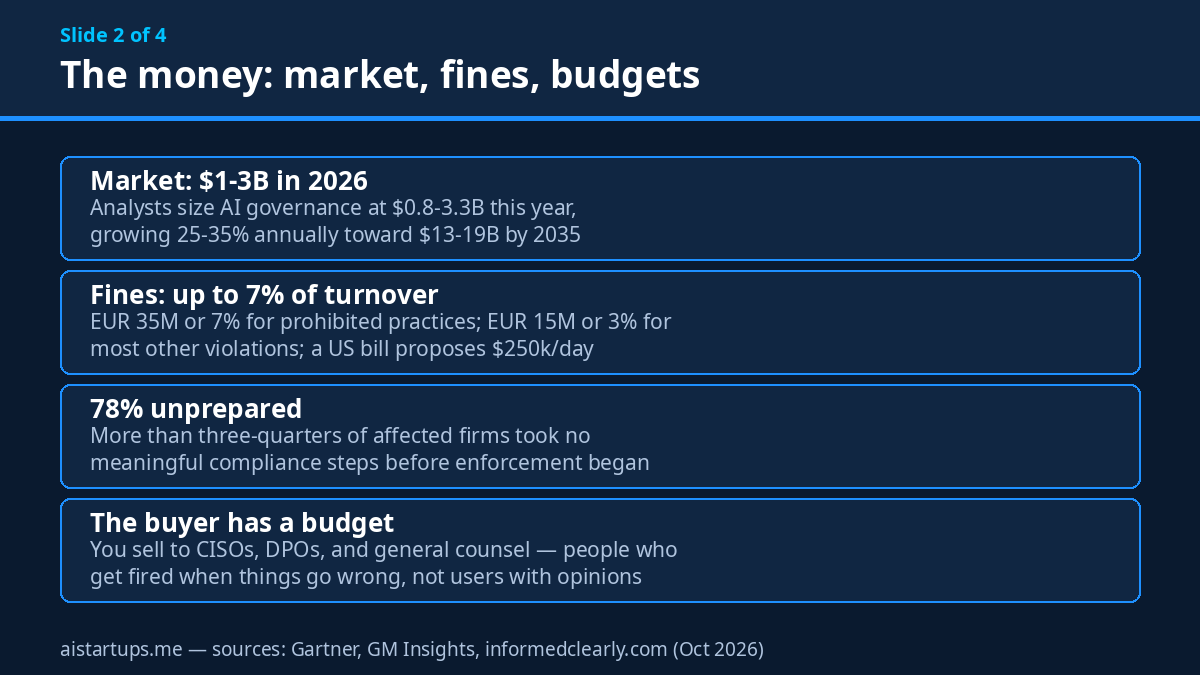
Let me put the money on the table first, because this niche runs on budgets, not vibes. Analyst estimates vary — they always do in a young market — but they all point the same direction. One research firm sizes the AI governance market at $839 million in 2025 growing to $1.11 billion in 2026, on the way to $13 billion by 2035 at a 31% compound clip. Another puts 2026 spending at $3.27 billion rising to over $19 billion by 2035. Gartner’s more conservative read: $492 million in 2026, crossing $1 billion by 2030.
Pick whichever number you believe. They’re all growing 25–35% a year, which is the only part that matters for a founder.
But the scarier numbers — the ones that make CISOs sign purchase orders — are about unreadiness. 78% of affected organizations had taken no meaningful compliance steps as the enforcement date arrived. Only about a third of managers feel adequately prepared for the EU AI Act. More than half of organizations lack even a systematic inventory of the AI systems they have in production — you can’t govern what you can’t see. And among companies that suffered AI-related breaches, 63% had no AI governance policy at all.
Read that last one again. Nearly two-thirds of companies that got burned had nothing in place. That’s not a market. That’s a stampede waiting for a direction.
Here’s the thing most startup advice gets wrong about compliance: you’re not selling to “users.” You’re selling to the CISO, the data protection officer, and the general counsel — people with actual budgets, who get fired when things go wrong. A developer tool has to convince a thousand engineers. A compliance tool has to convince one terrified executive whose board just asked “are we ready for the AI Act?” and who had no good answer.
That’s the entire pitch for this niche. Your buyer isn’t shopping for features. They’re shopping for the ability to sleep at night.
Enterprises don’t buy compliance software. They buy the ability to answer the regulator’s questions without sweating. Build the evidence machine; their lawyers decide what it proves.
One honest caveat before the ideas — and this matters for how you position everything: no tool makes a company compliant. Compliance is a mix of technology, process, documentation, and legal judgment. What your product supplies is evidence — logs, inventories, test results, documentation — that their team uses to demonstrate compliance. The vendors who say this out loud win more deals than the ones who promise “compliance in a box.” Buyers can smell the difference, and so can their lawyers.
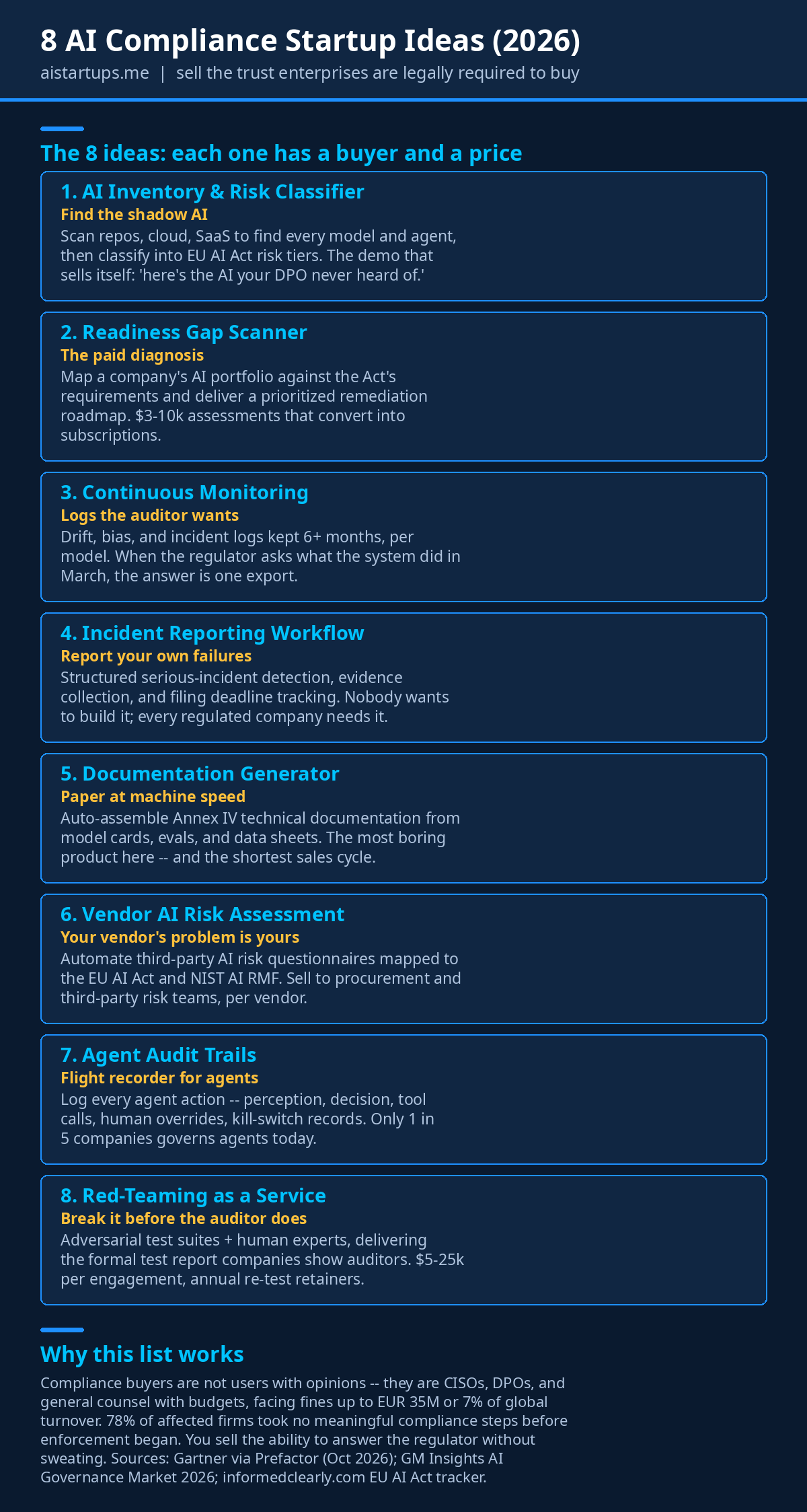
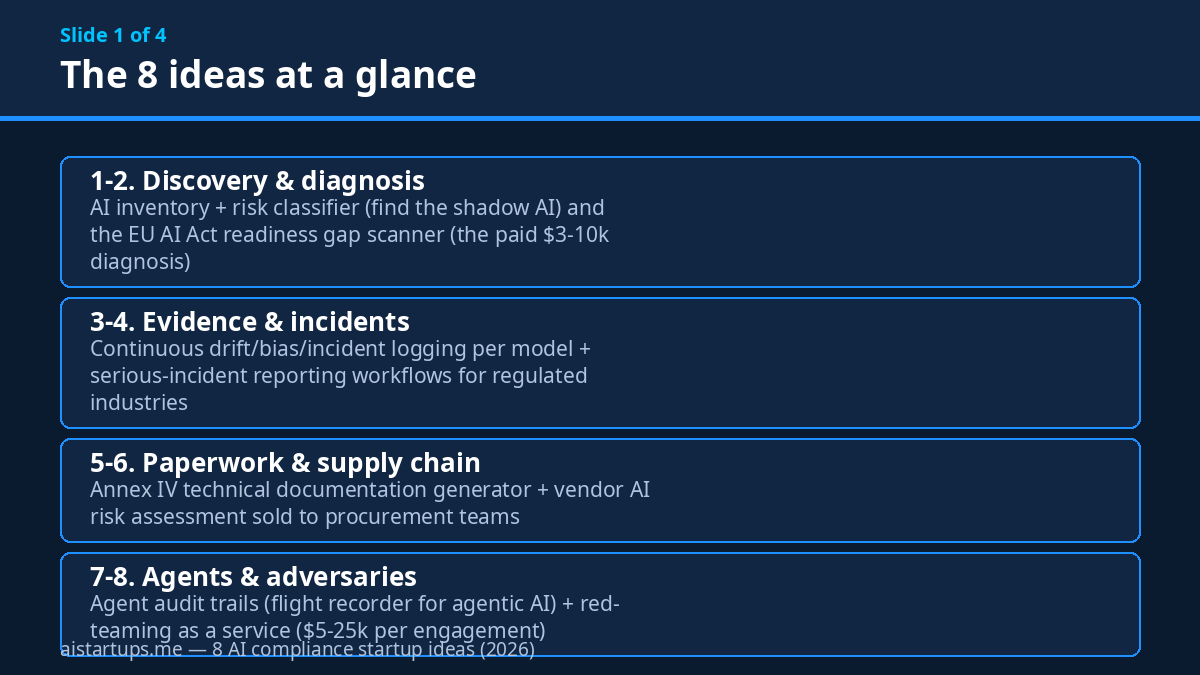
1. AI System Inventory & Risk Classifier
More than half of organizations can’t produce a systematic list of the AI systems they’re running. Think about that. The first obligation under any governance regime is knowing what you have — and most enterprises are starting from a spreadsheet somebody made in 2024 and never updated.
Your product: an automated discovery tool that scans code repos, cloud accounts, SaaS subscriptions, and API usage to find every model, agent, and AI-powered feature in the company — then classifies each one into the EU AI Act’s risk tiers (unacceptable, high, limited, minimal) and maps it to the obligations that come with the tier. Shadow AI is the wedge: marketing bought three AI tools on credit cards, engineering has a RAG prototype hitting customer data, and nobody told the DPO. Finding those is the demo that sells itself.
The business model
SaaS, $800–$3,000/month, priced by number of systems discovered. The inventory is the wedge product — once you’re the system of record for “what AI do we run,” every other governance purchase flows through you. Land with a free discovery scan, convert on the risk-classification report. If you want the product-side view of AI enforcement tooling, my guide to ZeroDrift Anchor 3.0’s AI compliance enforcement shows what the heavyweight version of this looks like — your advantage is being the lightweight one that deploys in a week.
2. EU AI Act Readiness Gap Scanner
Companies know the law exists. What they don’t know is how far they are from meeting it — and their law firms are charging $600/hour to tell them, one meeting at a time. A readiness scanner productizes that first engagement: the customer describes (or your inventory tool discovers) their AI systems, and you generate a gap report against the Act’s requirements — risk management, data governance, technical documentation, transparency, human oversight — with a prioritized remediation roadmap.
The clever bit: the gap report naturally recommends the other products on this list. You’re selling the diagnosis and the treatment plan in one motion. And because the high-risk deadline moved to December 2027, you have a long, clearly-dated runway of companies who need to start now to be ready — urgency without the panic of a missed deadline.
The business model
Start with paid assessments: $3,000–$10,000 for a one-time gap scan of a company’s AI portfolio. That’s real revenue from week one, no platform required — a good consultant with a structured methodology can deliver it. Then convert assessment customers to an ongoing monitoring subscription ($1,500–$5,000/month) that re-scans quarterly as their systems and the regulations evolve. The assessment is the product; the subscription is the annuity.
3. Continuous Model Monitoring: Drift, Bias & Incident Logs
Here’s a regulatory detail that quietly creates a product category: providers and deployers of high-risk AI systems must keep automatically generated logs for at least six months, and they need processes for detecting and reporting serious incidents. Most ML teams have model monitoring for performance — latency, accuracy, cost. Almost nobody has monitoring for compliance: is the model drifting in ways that change its risk profile? Are outputs skewing across demographic groups? Is there an immutable audit trail of what the model did and who overrode it?
Your product sits next to the model in production and records everything: inputs, outputs, confidence scores, human overrides, drift metrics, fairness checks. When the auditor (or the regulator) asks “show me what this system did in March,” the answer is one export, not a three-week engineering archaeology project.
The business model
Per-model-per-month pricing: $200–$1,000 per monitored system, scaling with log volume. This is infrastructure — boring, sticky, and nearly impossible to rip out once the auditors have seen your reports. The best wedge: companies already running MLOps who need a compliance layer without rebuilding their stack. Integrations matter here — the leading platforms already connect to 60+ MLOps tools, so pick the three your first customers actually use and go deep.
4. Serious Incident Reporting Workflow
Under the EU AI Act’s serious-incident rules, certain AI failures must be reported to authorities — malfunctions that cause harm, disruptions of critical infrastructure, that category of bad day. Right now, most companies’ “incident process” for AI is a Slack channel and hope. Nobody wants to build the workflow for reporting their own failures to a regulator. Everybody needs it.
This is the least glamorous idea on the list and possibly the most defensible. Build the structured workflow: incident detection hooks, severity classification, evidence collection, draft regulatory filings, deadline tracking, and a clean chain of custody for everything. Sell it to regulated industries first — finance, healthcare, energy — where incident reporting obligations already exist and AI just added a new category.
The business model
Platform fee plus per-incident workflow pricing: $1,000–$4,000/month base, which sounds like a lot until the general counsel compares it to one missed filing deadline. Annual contracts, multi-year if you can get them — once your incident history lives in your system, switching means migrating evidence. Nobody migrates evidence.
5. Technical Documentation Generator
Auditors love paper. The EU AI Act’s technical documentation requirements spell out exactly what that paper must contain — system descriptions, development methods, data provenance, evaluation results, risk assessments. Today, producing it means a senior engineer spending weeks writing documents nobody will read until the one day they matter enormously.
Your product generates that documentation automatically from the artifacts teams already produce: model cards, evaluation results, data sheets, training configs, deployment manifests. It assembles them into the required structure, flags the gaps (“you have no documented data-governance measures for this system”), and versions everything so the documentation matches the system it describes. Real talk: this is the most boring product on this list. It’s also the one with the shortest sales cycle, because every enterprise AI team already knows documentation is their weakest link.
The business model
$500–$2,000/month per team, or bundled into the monitoring platform from idea #3. Alternatively, sell it as a per-system documentation package ($2,000–$5,000) to companies preparing for their first audit — one-time revenue that converts beautifully into the monitoring subscription once they realize documentation rots the moment the model updates.
6. Vendor AI Risk Assessment
Here’s a supply-chain problem nobody’s solved: your company’s AI compliance depends on your vendors’ AI compliance. You bought a customer-service chatbot from a startup; if that startup’s model mishandles EU customer data, the liability flows uphill to you. Procurement teams are now being asked to assess the AI risk of every vendor — and they’re doing it with spreadsheets and questionnaires that vendors fill out aspirationally.
Build the platform that automates third-party AI risk assessment: standardized questionnaires mapped to the EU AI Act and NIST AI Risk Management Framework, evidence collection from vendors, continuous monitoring of vendor model changes, and a risk score procurement can actually use. The buyer is the CISO’s third-party risk team — people who already buy GRC software and have line items for exactly this.
The business model
Per-vendor-assessed pricing: $100–$500 per vendor per year, which sounds small until a mid-size enterprise assesses 200 vendors. Or platform pricing at $2,000–$6,000/month for the assessment suite. The network effect is the fun part: once vendors complete your assessment for one customer, they can share it with the next — and every shared assessment makes your platform the standard.
7. Agent Audit Trails
Autonomous agents are the fastest-growing governance blind spot in the enterprise. Only about 1 in 5 companies has a mature governance model for agentic AI — and agents are precisely the systems that do things: move money, change records, send messages, call APIs. When an agent does something wrong, “the AI did it” is not an acceptable answer to anyone, least of all a regulator.
Your product: the audit layer for agents. Every action an agent takes gets logged with context — what it perceived, what it decided, what tools it called, what a human approved or overrode, and the kill-switch record. Think of it as the flight recorder for agentic systems. When something goes sideways (and it will), the investigation starts with your export, not with a panicked Slack thread.
The business model
Usage-based: priced per agent-run or per thousand logged actions, $300–$1,500/month for typical deployments. Sell to the platform teams deploying agents internally — they’re the ones whose CIO is asking uncomfortable questions. This pairs naturally with the agent-automation wave I covered in 15 AI agent business ideas for solo founders — every agent business on that list eventually needs exactly this audit layer.
8. Red-Teaming as a Service
High-risk AI systems are expected to be tested for robustness — adversarial inputs, prompt injection, data poisoning, the works. Most companies have no internal red team and no idea how to scope the testing. The consultancies that do this charge eye-watering day rates and book out months in advance.
Productize it: a structured red-teaming service for AI systems — automated adversarial test suites plus human experts for the tricky stuff — delivering a formal test report mapped to regulatory expectations. The report itself is the product: it’s the artifact the company shows the auditor. Sell ahead of audit cycles and certification efforts, when the budget is already approved and the deadline is real.
The business model
Per-engagement pricing: $5,000–$25,000 per system tested, with annual re-testing retainers. This is the highest-ticket item on the list and the most service-heavy — which is fine. Services revenue funds product development, and every engagement teaches you what the automated suite should cover next. Start service-heavy, productize over time.
How to actually sell this stuff
Compliance tools don’t sell like developer tools. There’s no self-serve signup, no product-led growth flywheel — at least not at first. Here’s the playbook that works:
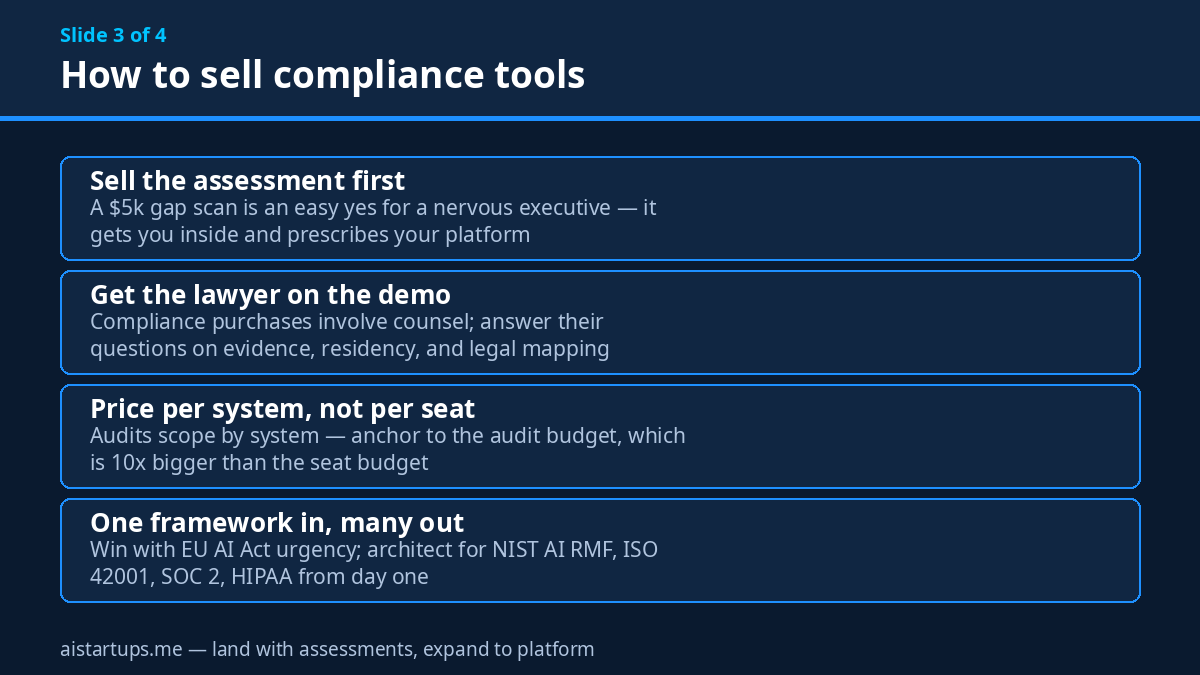
- Sell the assessment, not the software. A $5,000 gap scan is an easy yes for a nervous executive. It gets you inside, maps their real systems, and the report naturally prescribes your platform. Every idea on this list starts as a paid assessment.
- Get the lawyer on the demo call. Compliance purchases involve counsel. If your demo can answer their questions — data residency, evidence chain of custody, how your reports map to specific articles of the law — you win. If it can’t, you lose to the vendor who can.
- Price per system, not per seat. Audits scope by system, so your pricing should too. Per-seat pricing invites discounting; per-system pricing anchors to the audit budget, which is 10x bigger.
- Start with one framework, architect for many. Win with the EU AI Act’s urgency, but design for NIST’s AI Risk Management Framework, ISO/IEC 42001, SOC 2, and HIPAA from day one. Regulations shift — the deferral proved that — but the underlying evidence (inventories, logs, docs) is the same everywhere.
One more practical note. Most compliance founders I talk to can sell but can’t ship — the dashboards, the integrations into MLOps pipelines, the evidence-collection plumbing. If that’s you, don’t spend six months learning to build it. An AI integration studio like AISquadX can get your MVP built while you spend your time where it counts: selling pilot assessments to nervous enterprises. The founder’s job in this niche is distribution, not code.
What not to build
A few traps, because this niche has them:
- Don’t promise “compliance in a box.” No software makes a company compliant, and claiming yours does is a liability magnet. You sell evidence and workflows; their lawyers and auditors determine compliance. Say it on your homepage. It builds trust and keeps you out of trouble.
- Don’t build a generic “AI ethics dashboard.” Nobody has a budget line for ethics. Everybody has a budget line for audit readiness, incident reporting, and regulatory filings. If the buyer can’t name the regulation it serves, it’s a hobby project.
- Don’t bet the company on one regulation’s exact wording. The high-risk deadline moved by 16 months with a single legislative package. Build for the durable artifacts — inventories, logs, documentation, test evidence — and map them to whatever framework the customer needs this quarter.
- Don’t skip the legal review of your own product. Ironic but essential: before you sell compliance tooling, get your own house in order. My AI startup legal checklist covers the setup — entity, contracts, IP assignment, data processing terms. Selling trust while your own paperwork is a mess is a bad look.
FAQ
Isn’t the AI compliance market already crowded?
At the top, yes — IBM, OneTrust, Microsoft, and specialists like Credo AI own the Fortune 500 RFPs. But the market is enormous and barely penetrated: most mid-market companies have bought nothing yet. Solo founders win by going narrow — one regulation, one industry, one painful workflow — and landing with paid assessments instead of competing on platform features. The giants sell suites; you sell the one thing they’re too big to do well.
Do I need a law degree to build compliance tools?
No — but you need one friendly AI lawyer as an advisor or co-founder. Your product handles evidence: discovery, logging, documentation, testing. The legal interpretation stays with counsel. Honestly, the best compliance founders I’ve seen are engineers who got obsessed with one regulation’s technical requirements and partnered with a lawyer for the rest. Don’t give legal advice through your product; give lawyers better raw material.
What did the EU AI Act deferral actually change for founders?
It made your selling window longer, not shorter. The high-risk obligations moved from August 2026 to December 2027, but the transparency rules are enforceable now, the Commission is already requesting documentation from companies, and content-marking duties hit this December. Deferred, not canceled — smart enterprises are using the extra time to build real programs instead of panic-buying in 2027. That means steady demand now, not a cliff later.
Can a solo founder really sell to enterprises?
Yes, but not the way you think. You don’t start by selling to the enterprise — you start by selling $3,000–$10,000 assessments to one nervous department head, deliver an excellent gap report, and let the expansion happen. Mid-market companies (500–5,000 employees) are the sweet spot: big enough to have real AI deployments and real regulatory exposure, small enough that the CISO takes your call. Channel partners — boutique consultancies, MSSPs — can carry you into bigger accounts later.
What’s the fastest MVP I could validate this week?
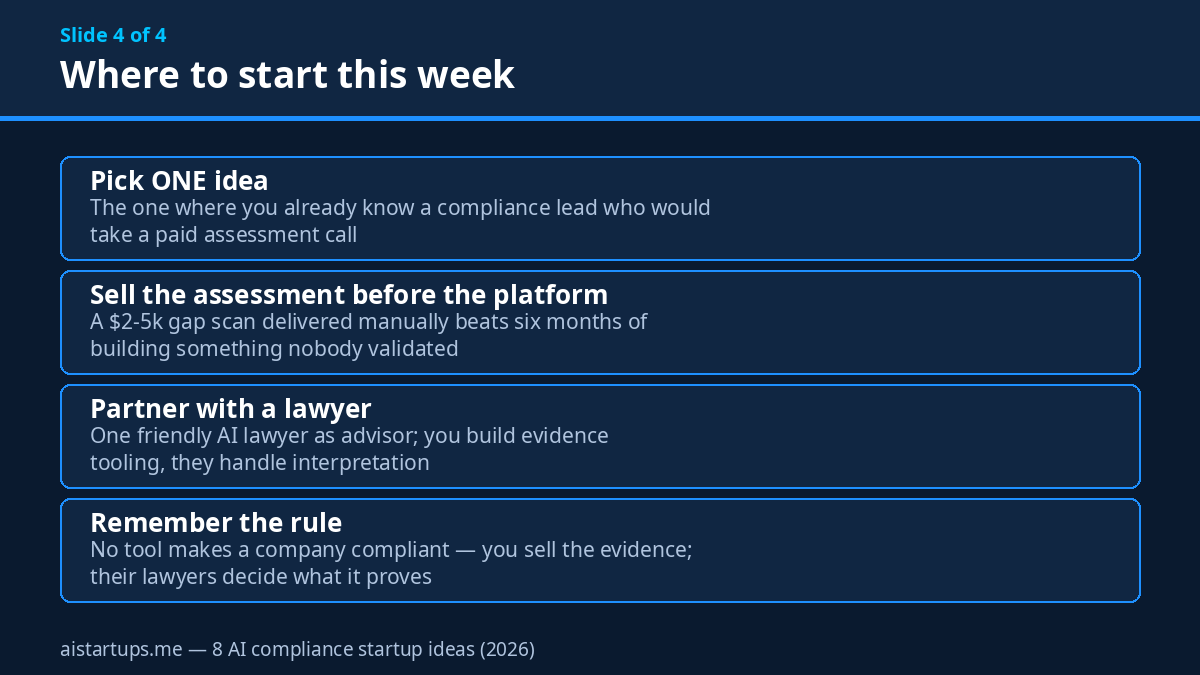
The readiness gap scanner, idea #2, delivered as a service. Find one company running AI in a regulated context, interview their compliance lead for an hour, and sell them a fixed-price gap assessment for $2,000–$5,000. Deliver it with structured templates and manual analysis. If they pay and the report leads to a “what do we do about these gaps?” conversation, you have a business. If nobody pays for the assessment, nobody will pay for the platform either — and you just saved yourself six months.
The Bottom Line
Here’s the uncomfortable truth about most AI startup ideas: the buyer is optional. Someone might want your chatbot, your copilot, your wrapper. In compliance, the buyer is mandatory — the law requires them to show up, the fines make them show up scared, and the deadlines make them show up now.
The EU is already enforcing. The US is debating daily fines. Most companies have no inventory, no logs, no documentation, and no plan. Analysts argue about whether the market is $1 billion or $3 billion this year, but nobody argues about the direction — 25–35% annual growth, driven by law rather than hype. That’s the rarest thing in startups: demand you don’t have to create.
Pick one idea from this list. Sell the assessment before you build the platform. Price on the audit budget, not the seat count. And remember the only rule that matters in this niche: you don’t sell software. You sell the ability to answer the regulator’s questions without sweating. Do that well, and enterprises will pay you for a very long time.