


Real talk: I’ve never seen a better moment to start a one-person business than right now. Not “AI will change everything someday” hype. Actual, bookable, revenue-generating AI agent businesses that one person can run from a laptop.
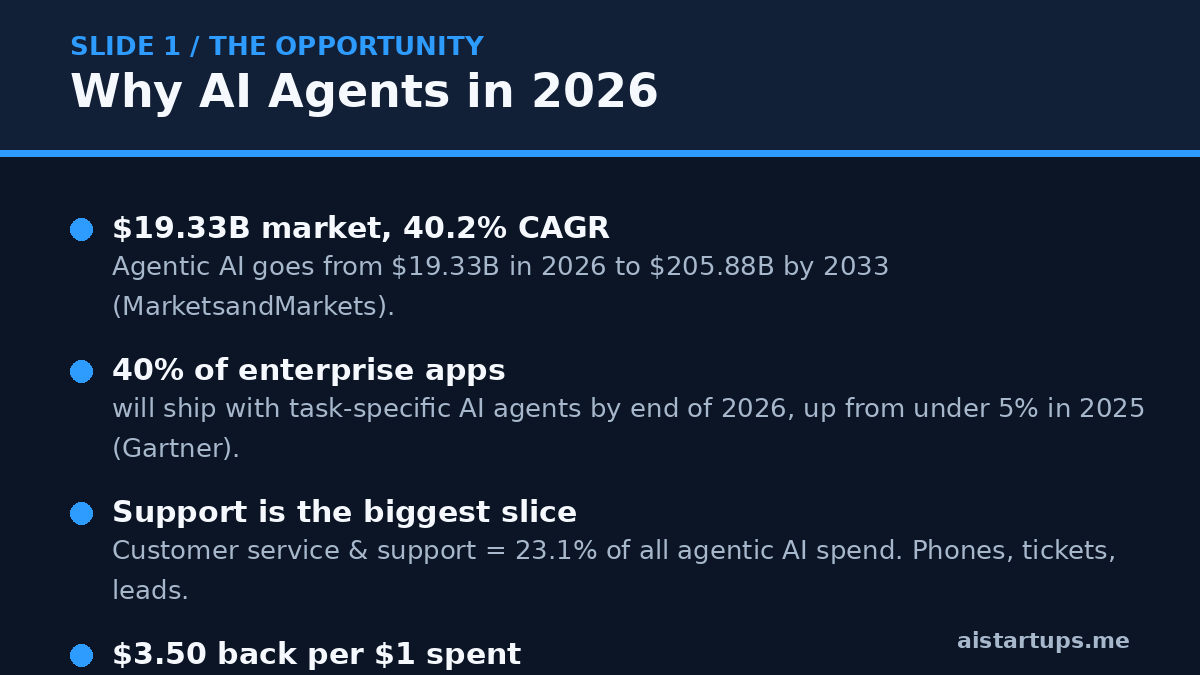
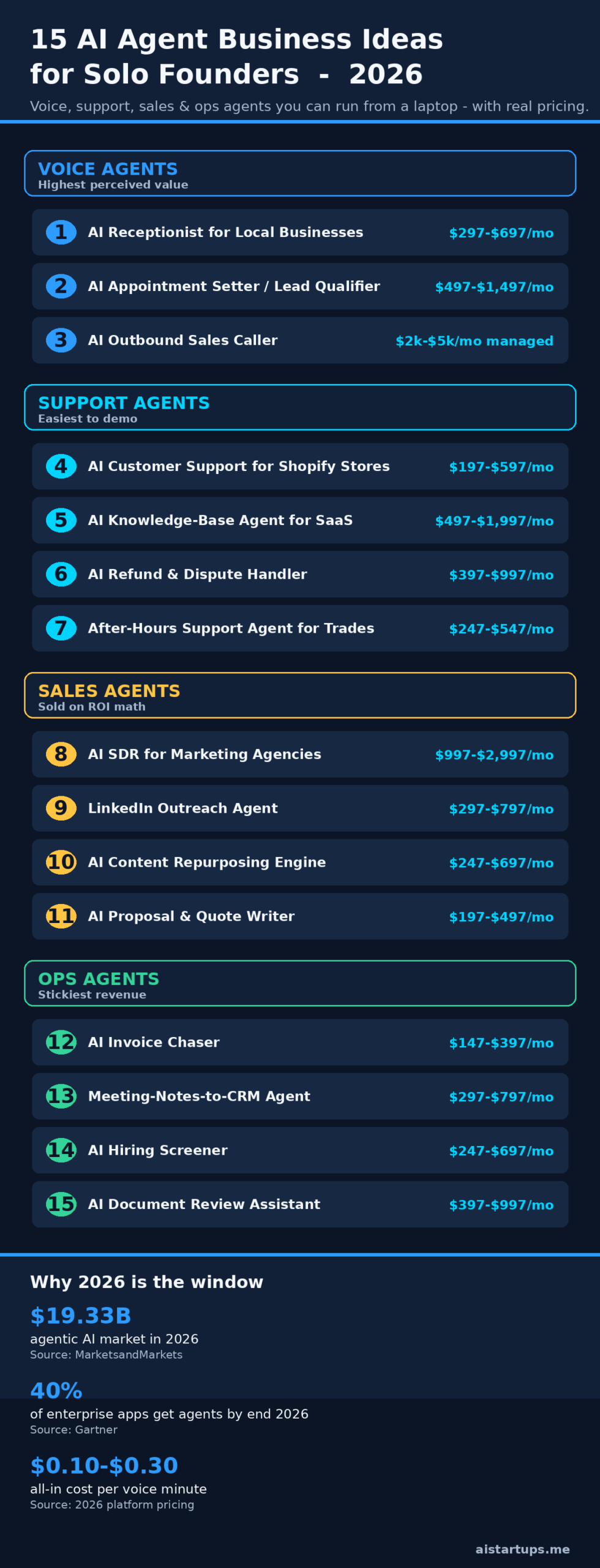
Here’s why I’m so confident about the timing. MarketsandMarkets puts the agentic AI market at $19.33 billion in 2026, heading for $205.88 billion by 2033. Gartner expects 40% of enterprise applications to ship with task-specific AI agents by the end of 2026 — up from under 5% in 2025. And customer service is the single biggest slice of the pie: 23.1% of all agentic AI spending, according to the same MarketsandMarkets report.
Read that again. The biggest money in the entire agent economy is going into answering phones, handling tickets, and qualifying leads. That’s not a job for a 50-person startup. That’s a job for you, one well-built agent, and a niche you understand.
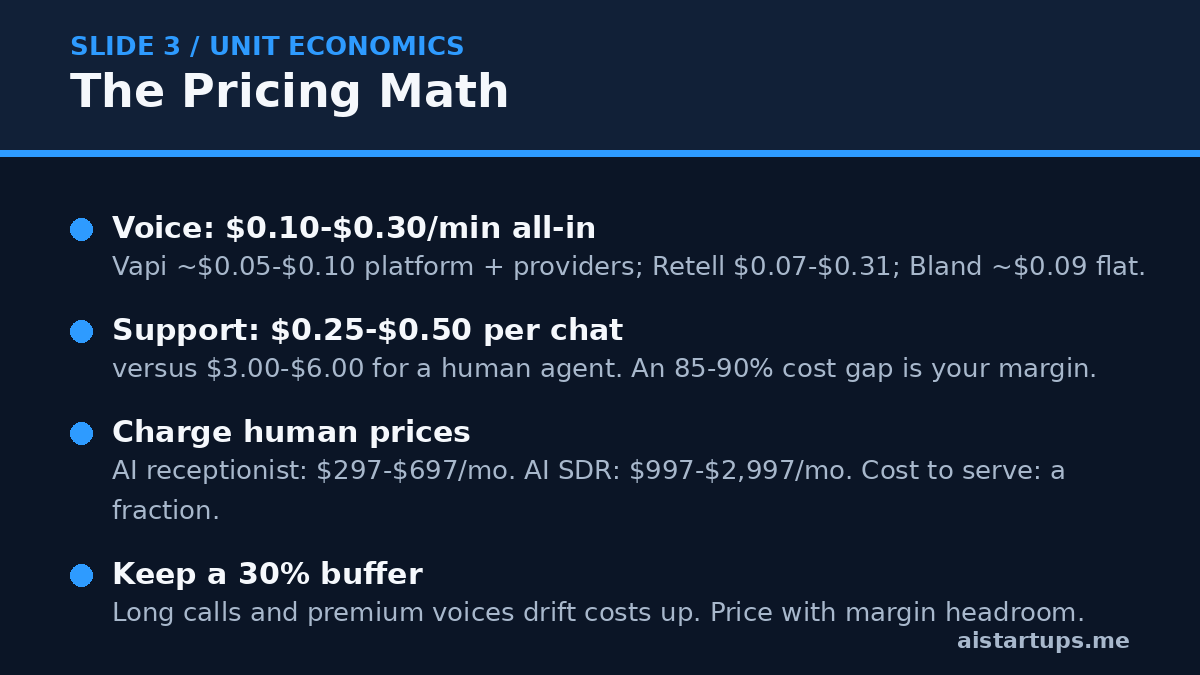
And here’s the part that made me write this article: the unit economics are absurd. An AI voice agent costs roughly $0.10 to $0.30 per minute all-in depending on the platform and voice. An AI support interaction costs $0.25 to $0.50 versus $3.00 to $6.00 for a human agent. That gap — 85 to 90% cheaper — is your margin. You sell the outcome at human prices and deliver it at AI cost.
Below are 15 specific businesses, each one runnable solo, with real pricing math and the honest version of what it takes. No “disrupt the paradigm” nonsense. Just businesses that charge real money for real work.
First, the 4 Buckets That Actually Make Money
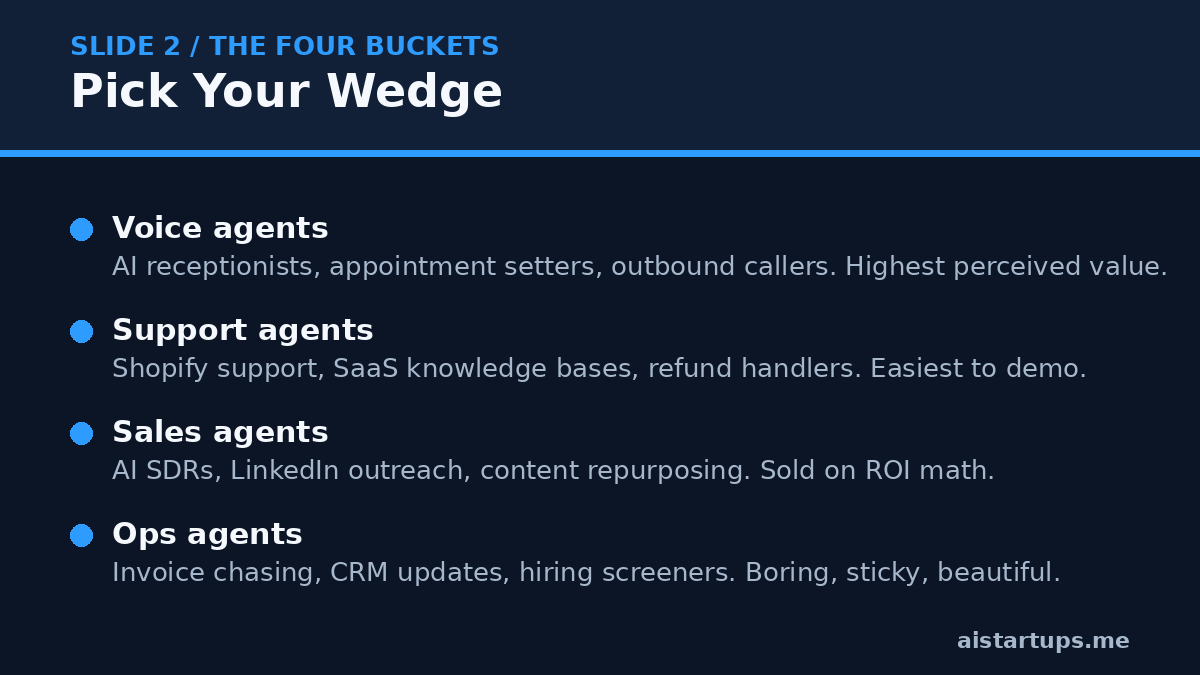
Every solo agent business I’ve seen work falls into one of four buckets. Before you pick an idea, understand which bucket you’re in — it determines how you price and who you sell to:
- Voice agents — AI that answers and makes phone calls. Highest perceived value, because missed calls are missed money and every business owner feels it.
- Support agents — AI that handles chat, tickets, and inboxes. Easiest to demo, fastest to deploy, and the data says it works: Salesforce’s own Agentforce resolved 84% of 380,000+ support interactions on its own.
- Sales agents — AI that finds, qualifies, and warms up leads. Sold on ROI math, which founders love.
- Ops agents — AI that does the boring back-office work: chasing invoices, updating CRMs, screening applicants. The least sexy bucket and, honestly, the stickiest revenue.
The slide deck below is the whole playbook on one page — the market case, the four buckets, the pricing math, and how to land your first three clients. Save it.
Voice Agents: The Highest-Value Bucket
If you only read one section, make it this one. Voice is where the money is, because the pain is the most obvious. A plumber who misses three calls a day doesn’t need a pitch deck to understand the problem.
1. AI Receptionist for Local Businesses
The classic, and still the best first business. Dentists, law firms, HVAC companies, med spas — they all miss calls, and every missed call is a customer going to the competitor who picked up. You sell them an AI receptionist that answers 24/7, books appointments, and texts the owner a summary.
The math: platforms like Vapi, Retell, and Bland charge roughly $0.05–$0.31 per minute depending on configuration. A typical local business does 300–600 minutes of calls a month, so your cost is $30–$180. You charge $297–$697/month. That’s 70–90% gross margin before you even optimize.
How to start: pick ONE vertical (dental is the classic for a reason — high appointment value, predictable call patterns). Build one great demo agent, record a 90-second demo call, and cold-call 20 practices a day offering to let them hear it. The demo sells itself.
2. AI Appointment Setter / Lead Qualifier
One step up from the receptionist: instead of answering inbound calls, your agent calls back every web lead within 60 seconds, asks three qualifying questions, and books the qualified ones straight into the calendar. Real estate teams, solar installers, and mortgage brokers will pay serious money for this, because speed-to-lead is everything in those industries.
The math: charge $497–$1,497/month per client, or $15–$40 per qualified appointment booked. Your cost is the same $0.10–$0.30 per minute. A client doing 200 callbacks a month costs you maybe $60–$120 to serve. The margin is, frankly, silly.
How to start: this one needs a CRM integration (GoHighLevel is the standard in these niches — learn it, it’s where your clients live). Start with one realtor team, nail the call flow, then clone it for the next ten.
3. AI Outbound Sales Caller
Cold calling is dead. Long live cold calling — by AI. Appointment-setting agencies are already doing this: the agent works a list of 500 prospects, has natural conversations, handles basic objections, and books meetings for the client’s closers.
The math: agencies charge $2,000–$5,000/month for this as a managed service, or $50–$150 per booked meeting. Your per-minute cost doesn’t change; what changes is the volume. Budget $200–$500/month in voice costs per active client at real scale.
The honest part: this is the highest-complaint niche in voice AI. Spam regulations are real (check TCPA rules in the US and equivalent laws wherever you operate), and a badly tuned outbound agent will embarrass your client. Only sell this once your agent genuinely handles objections well — and always, always get explicit consent frameworks in place.
Support Agents: The Easiest to Demo
Support agents are the fastest to build and the easiest to prove. You can have a working demo on a prospect’s own website in an afternoon. The market agrees: 30% of customer service cases already get resolved without a human touching them, and the average return is $3.50 for every $1 spent on AI customer service.
4. AI Customer Support for Shopify Stores
“Where’s my order?” “What’s your return policy?” “Do you ship to Canada?” — the same twenty questions, asked ten thousand times. You build a support agent trained on the store’s FAQ, policies, and order system that resolves tickets in chat and email.
The math: charge $197–$597/month per store. Your cost per interaction is $0.25–$0.50. A store doing 1,000 support interactions a month costs you $250–$500 to serve at the high end — so price on tiers and upsell the stores doing real volume.
How to start: Shopify’s app ecosystem is your distribution channel. Build the integration once, then it’s nearly the same deploy for every store. Target stores doing $50k–$500k/month in revenue — big enough to feel the pain, small enough that the founder answers your email.
5. AI Knowledge-Base Agent for SaaS Companies
Every SaaS company has the same problem: a help center nobody reads and a support team drowning in “how do I…” tickets. Your agent sits on their docs, changelog, and community forum and answers questions inside the product.
The math: $497–$1,997/month depending on ticket volume. SaaS founders understand unit economics, so sell it with the math: “your support team spends 2+ hours a day on repeatable questions; this handles them for the cost of one team lunch.”
How to start: this is a content problem disguised as a tech problem. The agent is only as good as the docs you feed it, so your real deliverable is auditing and restructuring their knowledge base first. Charge a $1,500–$3,000 setup fee for that — it anchors the value and pays you for the unglamorous work.
6. AI Refund and Dispute Handler
Niche, boring, and wildly profitable. E-commerce brands lose hours to refund requests, chargeback disputes, and “my package never arrived” claims. Your agent verifies the order, checks the policy, issues the refund or escalates with a full summary.
The math: charge per resolved case ($2–$5) or $397–$997/month flat. The ROI pitch writes itself: every chargeback you prevent is worth $15–$100 in fees alone.
How to start: partner with one 3PL or e-commerce accountant who sees this pain across dozens of clients. One referral partner beats a hundred cold emails in this niche.
7. After-Hours Support Agent for Trades
Plumbers, electricians, roofers, pest control — their emergencies happen at 2 AM and their office manager sleeps like a normal person. Your agent answers after hours, triages emergency vs. can-wait-till-morning, and dispatches accordingly.
The math: $247–$547/month. These businesses are used to paying answering services $200–$400/month for a human who just takes messages. You’re cheaper AND smarter — you can actually book the job.
How to start: walk into local trade businesses with your phone and play them a demo call. Seriously. This niche doesn’t live on LinkedIn; it lives on relationships and showing up.
Sales Agents: Sold on ROI Math
8. AI SDR for Marketing Agencies
Agencies are always hungry for pipeline and always short on SDRs. Your agent researches prospects, sends personalized first touches, follows up relentlessly (the part humans hate), and books calls for the agency’s closers.
The math: $997–$2,997/month retainer, or $75–$200 per booked meeting. Agencies already pay SDRs $4k–$6k/month fully loaded, so you’re the obvious cheaper option — and you never quit, sleep, or need managing.
How to start: run it on your own business first. Nothing sells an AI SDR like saying “this agent booked 14 of my last 20 sales calls.” Dogfood it, then sell the exact system.
9. LinkedIn Outreach Agent
A tighter version of the above, focused on one channel. The agent handles connection requests, profile-visit sequences, personalized follow-ups, and hands off warm replies. Coaches, consultants, and B2B service providers are the buyers.
The math: $297–$797/month. Lower ticket than the full SDR, but the delivery is simpler and churn is lower because the client sees the inbox filling up every week.
The honest part: LinkedIn automation sits in a gray zone — stay within LinkedIn’s terms, keep volumes human-like, and never promise what the platform can take away. Sell “outreach assistance,” not “guaranteed leads.”
10. AI Content Repurposing Engine
Every podcaster, YouTuber, and course creator sits on a goldmine of content they never repurpose. Your agent turns one long-form piece into a week of shorts scripts, LinkedIn posts, newsletter sections, and tweet threads — in the creator’s voice.
The math: $247–$697/month per creator, or $1,500–$4,000/month as a managed “content system” for small media teams. Creators already pay editors $500–$2,000/month; you’re faster and you don’t miss deadlines.
How to start: do it manually-ish for your first two clients to learn the workflow, then automate the parts that repeat. The voice-matching is the hard part — nail that and you keep clients for years.
11. AI Proposal and Quote Writer
Contractors, freelancers, and small agencies lose deals because proposals take days to write. Your agent takes a discovery call transcript (or a short brief) and produces a polished, priced proposal in minutes — with follow-up sequences when the prospect goes quiet.
The math: $197–$497/month, or $25–$75 per proposal. Sell it on speed: “send the proposal before your competitor finishes their coffee.”
How to start: this one is a wedge into bigger engagements. A contractor who trusts your proposal agent will happily buy your receptionist agent next. Land small, expand wide.
Ops Agents: Boring, Sticky, Beautiful
Nobody brags about their invoice-chasing agent at dinner parties. But ops agents have the lowest churn of any category here, because once a business depends on one, ripping it out feels like firing a reliable employee.
12. AI Invoice Chaser
Late payments kill small businesses. Your agent watches the accounting software, sends polite-but-firm payment reminders on schedule, escalates chronic late-payers, and logs everything for the owner.
The math: $147–$397/month, or 1–2% of recovered revenue. The pitch is one sentence: “what’s your outstanding receivables right now?” Whatever the number is, your fee is a rounding error next to it.
How to start: integrate with Xero and QuickBooks first — that’s where the customers are. Bookkeepers are your best referral partners; they see the late-payment pain in every client file.
13. Meeting-Notes-to-CRM Agent
Sales teams hate updating the CRM. Everyone knows it, nobody fixes it. Your agent joins calls (or ingests recordings), extracts action items and deal updates, and writes them into HubSpot or Salesforce automatically.
The math: $297–$797/month per team. The buyer is the sales manager who’s tired of yelling about CRM hygiene. ROI pitch: “your reps get 5 hours a week back.”
How to start: sell to teams of 5–30 reps. Enterprise has procurement cycles; a 12-person sales team has a credit card and a pain point.
14. AI Hiring Screener
Small businesses get 200 applications for one role and read approximately twelve of them. Your agent screens resumes against the job description, runs first-round voice or chat interviews, and delivers a ranked shortlist with interview summaries.
The math: $247–$697/month, or $500–$1,500 per hire filled. Recruiters charge 15–25% of first-year salary — you’re not competing with them, you’re replacing the “post and pray” chaos for businesses that would never hire a recruiter.
The honest part: hiring is sensitive. Build bias safeguards in from day one, keep humans making the final call, and be transparent with candidates that they’re talking to an AI. This is a trust business.
15. AI Document Review Assistant
Property managers, landlords, and small law firms drown in leases, contracts, and compliance docs. Your agent reviews incoming documents against a checklist, flags risky clauses, and drafts summaries — the paralegal work, not the lawyer work.
The math: $397–$997/month per firm. One avoided bad lease clause pays for a year of your service.
How to start: pick one document type (residential leases are the classic) and one jurisdiction. Depth beats breadth here — a generic “document AI” sells to nobody; a “lease review agent for Texas property managers” sells itself.
How to Actually Start: The 30-Day Version
Ideas are cheap. Here’s the part most articles skip — what the first month actually looks like.
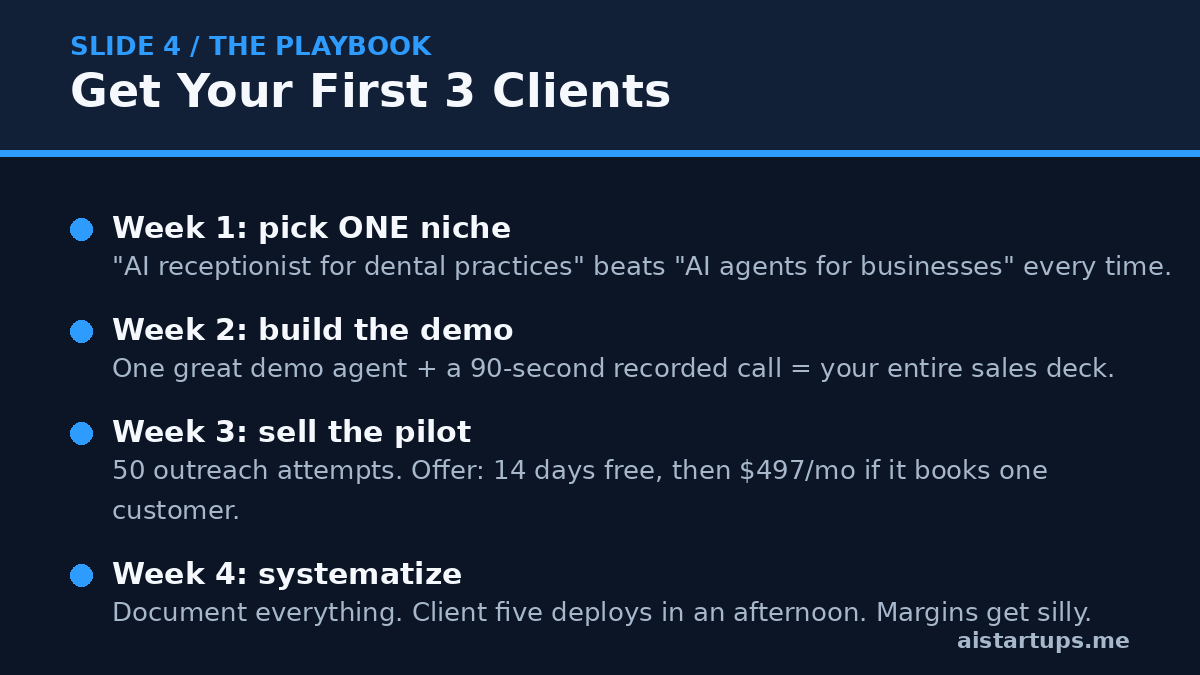
Week 1: Pick your wedge. Choose ONE idea and ONE niche. Not “AI agents for businesses” — “AI receptionist for dental practices in Texas.” Specificity is what makes marketing work when you’re solo. Before you commit, validate your AI startup idea the cheap way: ten conversations with potential buyers before you build anything.
Week 2: Build the demo. Learn one voice platform properly — Vapi’s pass-through pricing is the most transparent place to start — and build a demo agent for a fictional (or friendly real) business in your niche. Record the demo call. This recording is your entire sales deck.
Week 3: Sell before you’re ready. Fifty outreach attempts: calls, walk-ins, warm intros, niche community posts. Your offer: “I’ll set this up for you free for 14 days; if it books you one new customer, we talk about $497/month.” Risk reversal beats features every time. For the bigger picture on getting a company off the ground, my complete guide to starting an AI startup in 2026 covers the foundations.
Week 4: Fulfill and systematize. Your first client teaches you everything. Document every step, turn it into checklists, and your second deployment takes half the time. By client five, you’re deploying in an afternoon — that’s when the margins get ridiculous.
One more thing: you don’t have to build everything yourself. If the technical build is outside your comfort zone, working with a web development studio like AISquadX to get your first agent infrastructure shipped can save you months of trial and error. And if you’re still mapping out the money side, my breakdown of the real cost of starting an AI business in 2026 keeps the budget honest.
What Nobody Tells You (The Honest Risks)
I’d be doing you a disservice if I only showed the upside. So here’s the other side, straight:
- Most agent projects fail. Gartner expects over 40% of agentic AI projects to be canceled by the end of 2027 — escalating costs, unclear value, weak risk controls. The winners are narrow, well-scoped deployments. Keep your agents boring and specific.
- Trust is still the ceiling. 79% of consumers still prefer human customer service. Design your agents to escalate cleanly to a human instead of pretending to be one — clients respect honesty more than cleverness.
- Costs drift. That $0.10/minute quote is the starting line, not the finish. Long calls, premium voices, and token-heavy conversations add up. Build a 30% cost buffer into your pricing and monitor per-client margins monthly.
- Regulations are catching up. AI disclosure laws, call-recording consent, data privacy — the rules vary by state and country and they’re tightening. Budget for legal advice early, not after a complaint.
“The solo founders winning with AI agents in 2026 aren’t the best engineers. They’re the ones who picked one painful, expensive problem for one specific type of business — and refused to build anything else until it paid.”
FAQ
Do I need to know how to code to start an AI agent business?
No — and that’s the whole point. Platforms like Vapi, Retell, and Bland handle the voice infrastructure; no-code agent builders cover chat and workflows. What you actually need is the ability to understand a client’s process, configure the agent well, and sell. The founders making real money in this space are closer to consultants than engineers. That said, basic technical comfort (APIs, webhooks, reading docs) will take you from good to great.
How much does it cost to start?
Less than you think. Platform costs for your first demo are often under $50 — many offer free credits to start. Your real startup costs are your time (2–4 weeks to learn one platform deeply) and outreach. A realistic first-month budget is $100–$500, mostly in voice minutes for demos and a phone number or two. Compare that to any other business and it’s not close.
Which AI agent business idea is most profitable for a solo founder?
Voice agents for local services (ideas #1 and #2 above) have the best combination of high ticket size, obvious pain, and simple delivery. AI receptionists at $297–$697/month with $30–$180 in costs give you 70–90% margins from client one. Support agents are easier to build but more competitive; sales agents pay more but take longer to prove ROI.
How do I get my first client without a portfolio?
Sell the demo, not your resume. Build one great demo agent for the niche, record a real-sounding call, and offer a 14-day free pilot. Your pitch is: “listen to this 90-second call — imagine this answering your phones tonight.” Ten to twenty targeted conversations will get you a yes. Nobody asks for a portfolio when the product demonstrates itself.
Will AI agents replace the businesses I’m selling to?
Quite the opposite — you’re selling them leverage. The dentist still drills teeth; your agent just makes sure no patient ever hears a voicemail again. Agents handle the repetitive 70–80% so humans can do the work that actually needs a human. Position yourself as the person who gives them their evenings back, not as the robot taking jobs.
The Bottom Line
Look — the window for “AI agent businesses” being a novelty is closing. Gartner says 40% of enterprise apps will have task-specific agents by the end of this year. The question isn’t whether this market is real; it’s whether you grab a slice while the niches are still wide open.
Pick one idea from the list. Pick one niche. Build the demo this week. The solo founders who win in 2026 won’t be the ones with the best models — they’ll be the ones who shipped something specific for someone specific, and charged for it.
Start boring. Price confidently. And go get client number one.