


Let me tell you about the fastest way I’ve seen an AI startup bleed out. It’s not bad tech. It’s not a failed launch. It’s a pricing page.
A founder I know (we’ll keep names out of it) shipped a genuinely good AI support bot last year. Priced it at $79 per seat per month — nice round number, felt premium, everybody nodded on the call. Six months later he discovered his top 10 customers were costing him more in API bills than they were paying. One enthusiastic account alone was running agents so hard it burned through roughly $400 a month in inference. He was literally paying people to use his product.
Here’s the thing nobody warns you about: classic SaaS pricing is easy because the costs barely move. Add a thousand users to a normal app and your hosting bill creeps up. Add a thousand users to an AI product and your costs can explode overnight — because every single interaction runs a model, and every model call costs real money. Your pricing model isn’t just a marketing decision anymore. It’s your margin strategy.
So let’s do this properly. No guessing, no vibes, no “let’s copy what Intercom does and hope.” By the end of this guide you’ll have a framework for picking the right model, the math to set your floor, and a process to keep your pricing honest as model costs keep shifting underneath you.
Real talk: pricing is the one part of your business where “move fast and break things” gets expensive fast.
Why AI pricing breaks the old playbook
Traditional SaaS ran on a beautiful, boring formula: build once, sell infinitely, pocket 80% gross margins. Investors came to expect those margins — 70 to 85% was the benchmark everything got judged against.
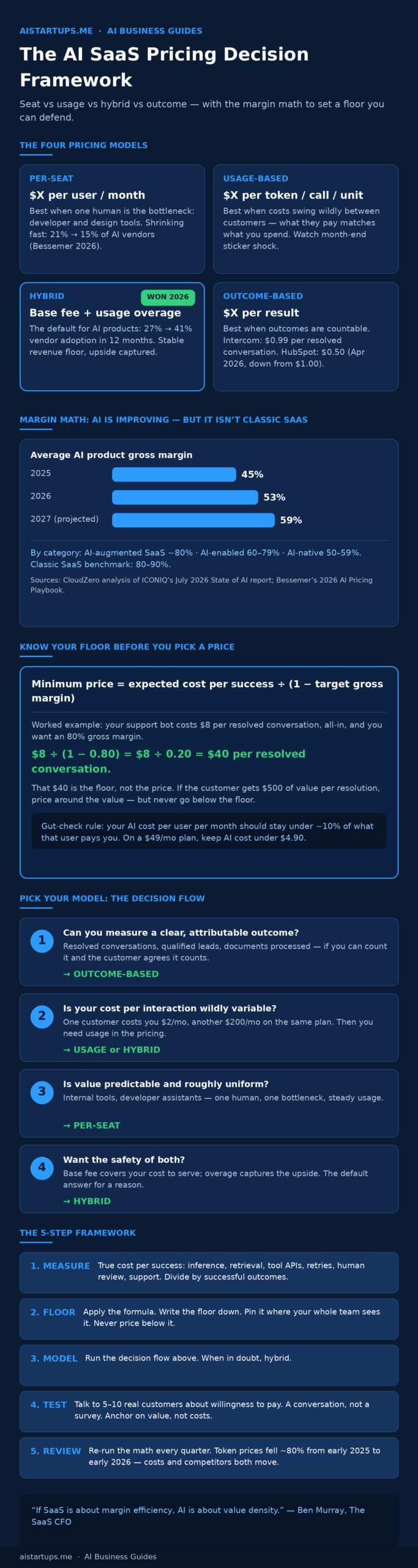
AI products don’t get that luxury. The best market data we have right now paints a clear picture. CloudZero’s analysis of AI gross margins, drawing on ICONIQ’s July 2026 State of AI report, puts average AI product gross margins at 45% in 2025, projected to climb to about 53% in 2026 and 59% in 2027. That’s improving — but still a long way from classic software. And the spread matters: AI-augmented SaaS (traditional product, some AI features) sits around 80%, AI-enabled products land in the 60–79% band, and AI-native companies — where the model IS the product — average 50–59%. Bessemer’s February 2026 pricing playbook puts it bluntly: AI companies see 50–60% gross margins versus 80–90% for plain SaaS.
Two-thirds of the companies ICONIQ surveyed say their per-query unit economics are improving — mostly thanks to smarter inference-cost management and model routing. So the trend is your friend. But the starting point is sobering: your costs are real, they scale with usage, and they’re going to eat your margin if your pricing doesn’t account for them.
This is exactly why understanding what it actually costs to start an AI business has to come before you pick a price. Pricing without cost math is just gambling with extra steps.
The four pricing models that actually matter in 2026
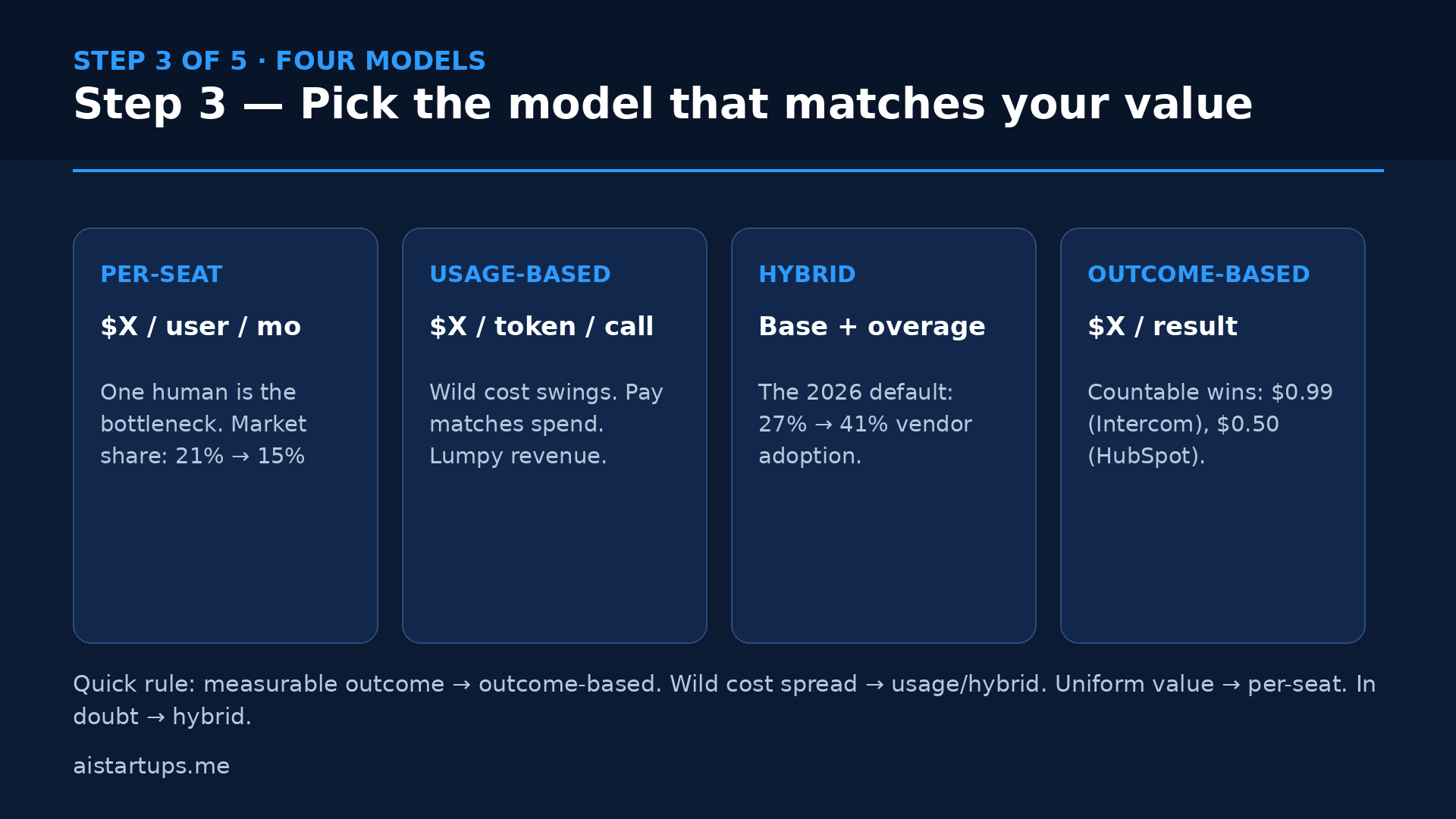
There are six or seven ways people price AI software if you count every variant, but four of them cover nearly every product you’ll encounter. Each one works for a specific shape of product — and breaks for the others. (Side note: the market is moving fast here. Bessemer’s 2026 AI Pricing Playbook breakdown tracks 200+ AI vendors and found hybrid pricing jumped from 27% to 41% adoption in just 12 months, while pure per-seat fell from 21% to 15%. The ground is shifting under everyone’s feet.)
1. Per-seat pricing ($X per user per month)
The classic. Every human with access pays a flat monthly fee. GitHub Copilot and Figma AI live here — products where one human genuinely is the bottleneck and usage roughly tracks with headcount.
When it wins: developer tools, design tools, internal assistants. Predictable for you, predictable for the buyer. Finance teams love it because they can budget it.
When it breaks: the moment AI agents do work that would’ve needed multiple humans. If one seat with your AI assistant handles triple the workload of one seat without it, charging per seat leaves a huge chunk of the value on the table. It also quietly punishes you on the cost side: 12 dormant seats cost you nothing to serve, but your power users burn API budget you’ll never see again. Real example of the failure mode: a 60-person firm bought a per-seat AI assistant for everyone at $80/month, and usage data later showed 12 of the 60 seats drove 95% of the value. They were paying nearly $46K a year for usage worth a fraction of that. Usage in AI products is almost never uniform — so don’t price as if it is.
2. Usage-based pricing ($X per token, call, or unit)
The buyer pays for what they consume: per thousand tokens, per API call, per document processed. Foundation-model APIs (OpenAI, Anthropic, Google) all price this way, and API-first AI products usually follow. Typical per-token rates run from fractions of a cent to a few cents per thousand tokens.
When it wins: when usage varies wildly between customers and your own costs are usage-driven — which, for AI products, they always are. It perfectly aligns what the customer pays with what you spend to serve them. Nobody feels ripped off because nobody pays for what they didn’t use.
When it breaks: when the customer can’t predict their bill. Month-end sticker shock is the number-one churn driver in usage-based products. A customer-support agent handling high conversation volume at premium-model pricing can land in five-figure monthly territory without optimization — and if that invoice arrives as a surprise, that customer is gone. For your own sanity: pure usage-based revenue is lumpy, which makes your investors nervous.
3. Hybrid pricing (base subscription + usage overage)
A base monthly fee that includes a defined chunk of usage, with overage charges beyond it. This is the model that won 2026 — 41% of AI vendors, per Bessemer, and rising. Most modern SaaS (HubSpot, Salesforce) runs some version of it.
When it wins: nearly always, honestly, for AI products with somewhat predictable volume plus growth upside. The base gives you a stable revenue floor and covers the cost of serving light users; the overage captures the upside when power users scale. Customers can budget their minimum spend, and you stop subsidizing your heaviest accounts.
When it breaks: when overage rates are punitively higher than in-tier rates. Some vendors quietly charge 2–3× more per unit on overage — a hidden cost that compounds as the buyer grows. Be transparent about your overage rate on day one, or the trust you burn will cost you more than the margin you gain. Also, keep it simple: a hybrid model with five tiers, three unit types, and a dozen exceptions isn’t a pricing page, it’s a puzzle.
4. Outcome-based pricing ($X per result)
You charge only when the AI delivers a specific business outcome: a resolved customer conversation, a qualified lead, a closed ticket. The buyer pays nothing for AI attempts that fail or get escalated to a human. This is the fastest-rising model in customer support and sales agents, and it has the cleanest incentive alignment of all — you only get paid when your product actually works.
When it wins: when outcomes are clearly defined and measurable. Real market numbers: Intercom charges $0.99 per resolved conversation for its AI agent; HubSpot’s Customer Agent dropped to $0.50 per resolved conversation in April 2026 (from $1.00). Salesforce’s Agentforce uses similar outcome-based pricing for specific workflows. Buyers love it because every dollar spent maps to a dollar of value received.
When it breaks: when “resolution” is fuzzy. If your definition of a resolved conversation includes cases where the customer follows up two hours later, you’re charging for false positives — and sharp buyers will call that out in procurement. Specify the resolution criteria in your contracts before anyone signs, including what counts as a genuine resolution. It also breaks when outcomes depend on factors outside your control (their data quality, their customers’ behavior). If you can’t control it, don’t price on it.
The math nobody does: your pricing floor
Look — you can pick the perfect model and still lose money if the number is wrong. Before you choose anything, you need to know your cost per successful outcome. Not per API call, not per user. Per success. Because failed attempts, retries, and escalations all cost you money and produce zero revenue.
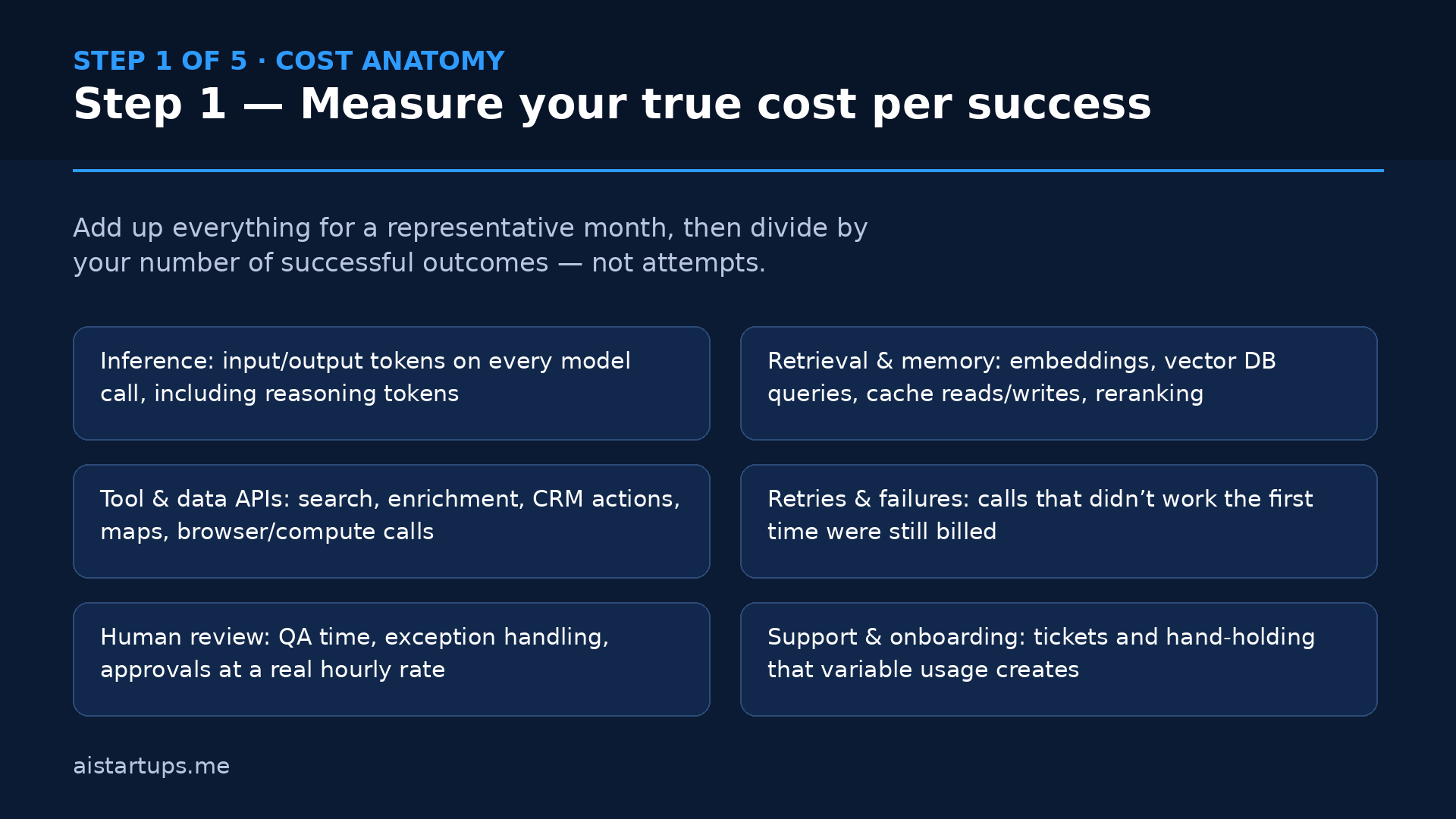
Here’s the cost anatomy of a typical AI product. Add up everything in this list for a representative month, then divide by your number of successful outcomes:
- Inference: input/output tokens on every model call, including reasoning tokens (agentic workloads burn far more tokens than you’d guess)
- Retrieval and memory: embedding calls, vector database queries, cache reads/writes, reranking
- Tool and data APIs: every third-party call your product makes — search, enrichment, CRM actions, maps, browser/compute
- Retries and failures: the calls that didn’t work the first time still got billed to you
- Human review: QA time, exception handling, approvals — multiply minutes by a real hourly rate
- Support and onboarding: the tickets and hand-holding that variable usage creates
Got that number? Good. Here’s the formula that turns it into a price floor:
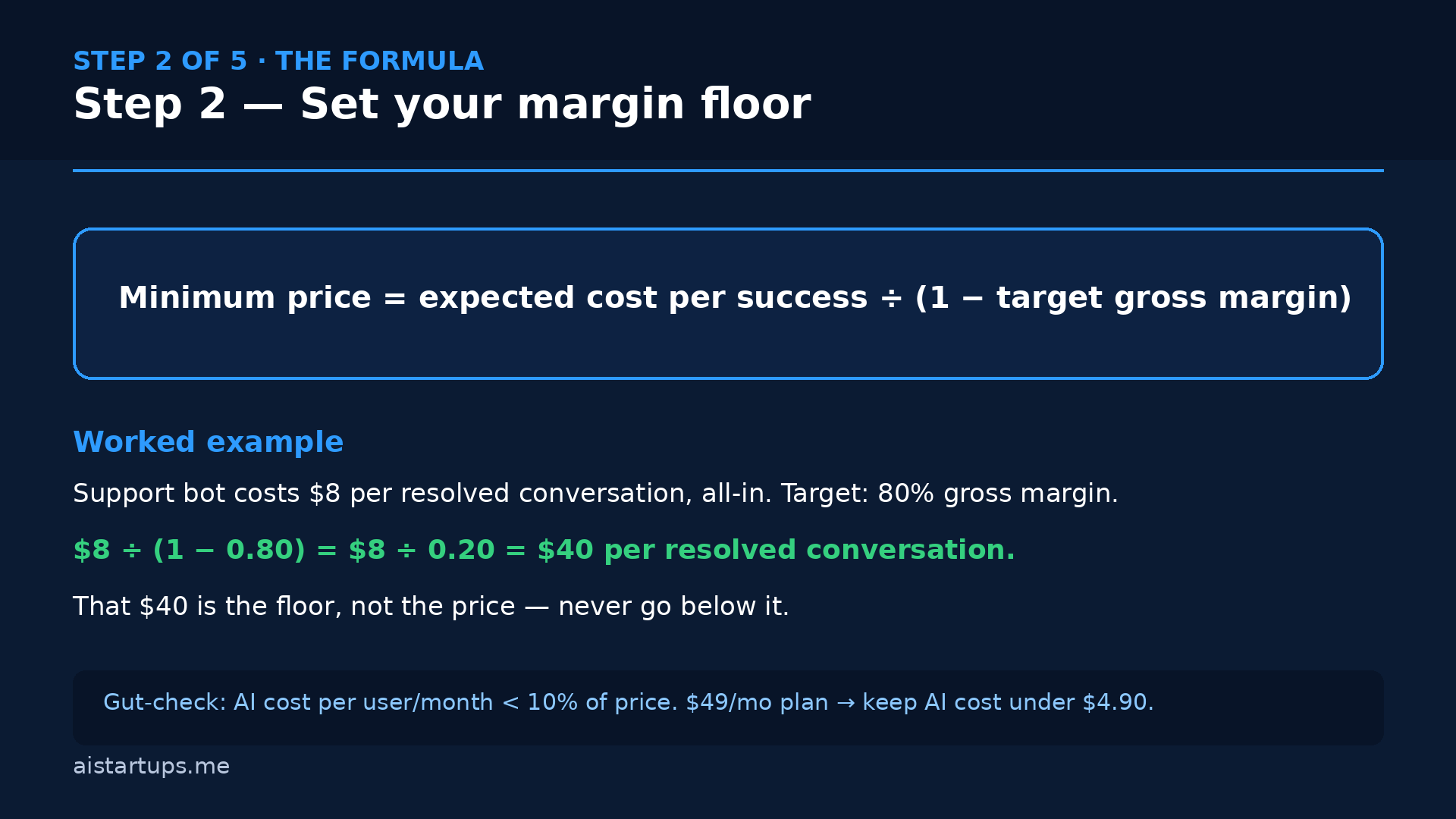
Minimum price = expected cost per success ÷ (1 − target gross margin)
Walk through it with me. Say your support bot costs you $8 per resolved conversation, all-in. You want an 80% gross margin. Your floor is $8 ÷ (1 − 0.80) = $8 ÷ 0.20 = $40 per resolved conversation. That’s the floor, not the price. If the customer gets $500 of value from each resolution, you price around the value — but you never, ever go below the floor.
A handy gut-check rule while you’re at it: your AI cost per user per month should stay under about 10% of what that user pays you. Charging $49/month? Keep your all-in AI cost per user under $4.90. Above that ratio, either optimize your costs or raise your price — there’s no third option that survives contact with your P&L. (AI-to-ROI’s AI-adjusted gross margin metric is a solid framework for tracking this honestly once you’re live.)
“If SaaS is about margin efficiency, AI is about value density.” — Ben Murray, The SaaS CFO
That line sticks with me because it’s the whole pricing problem in one sentence. Traditional SaaS won by being efficient. AI products win by being dense with value — and your pricing has to reflect that density, or you’re leaving the best part of your product unpriced.
Picking your model: a simple decision flow
Enough theory. Here’s how to actually choose, in the order I’d think about it:
Can you measure a clear, attributable outcome? Resolved conversations, qualified leads, documents processed, code shipped — if you can count it and the customer agrees it counts, outcome-based is your best alignment. This is where support bots, sales agents, and document-processing tools should live.
Is your own cost per interaction wildly variable? If one customer costs you $2/month and another costs $200/month on the same plan, you need usage in the pricing — either pure usage-based or hybrid. This is most AI products, by the way. The per-customer cost spread in AI is order-of-magnitude wide in a way hosting costs never were.
Is value predictable and roughly uniform across users? Internal tools, developer assistants, design products — one human, one bottleneck, steady usage. Per-seat is fine here, and finance teams will thank you for the predictability.
Do you want the safety of both? Hybrid. Base fee that covers your cost to serve, usage overage that captures the upside. It’s the default answer for a reason — it’s the only model where your revenue floor and your cost structure move in the same direction.
One more consideration people skip: what does your buyer’s CFO want to see? Outcome-based and hybrid both give procurement a story they can defend at the board — “we pay for resolutions” or “we pay a base plus growth.” Per-token pricing gives them an anxiety spreadsheet. The pricing model your champion can defend internally is the one that closes deals.
The five pricing mistakes that kill AI startups
I’ve watched these play out enough times to call them patterns:
1. Pricing on vibes instead of cost math. “Competitors charge $49, so we’ll charge $39 to undercut.” That’s not a pricing strategy, it’s a race to negative margins. Your costs are your costs regardless of what the competitor charges — and their cost structure might look nothing like yours.
2. Unlimited plans with AI features. Unlimited anything plus variable costs is a margin fire waiting for a match. Your most enthusiastic users will find the ceiling you didn’t build. If you must offer unlimited, gate it to the cheapest model tier, cap the expensive capabilities, or throttle with fair-use policies.
3. Forgetting the retry tax. That 15% retry rate on complex queries? That’s a 15% cost multiplier hiding in your P&L. Every pricing calculation should use cost per successful outcome, not cost per attempt.
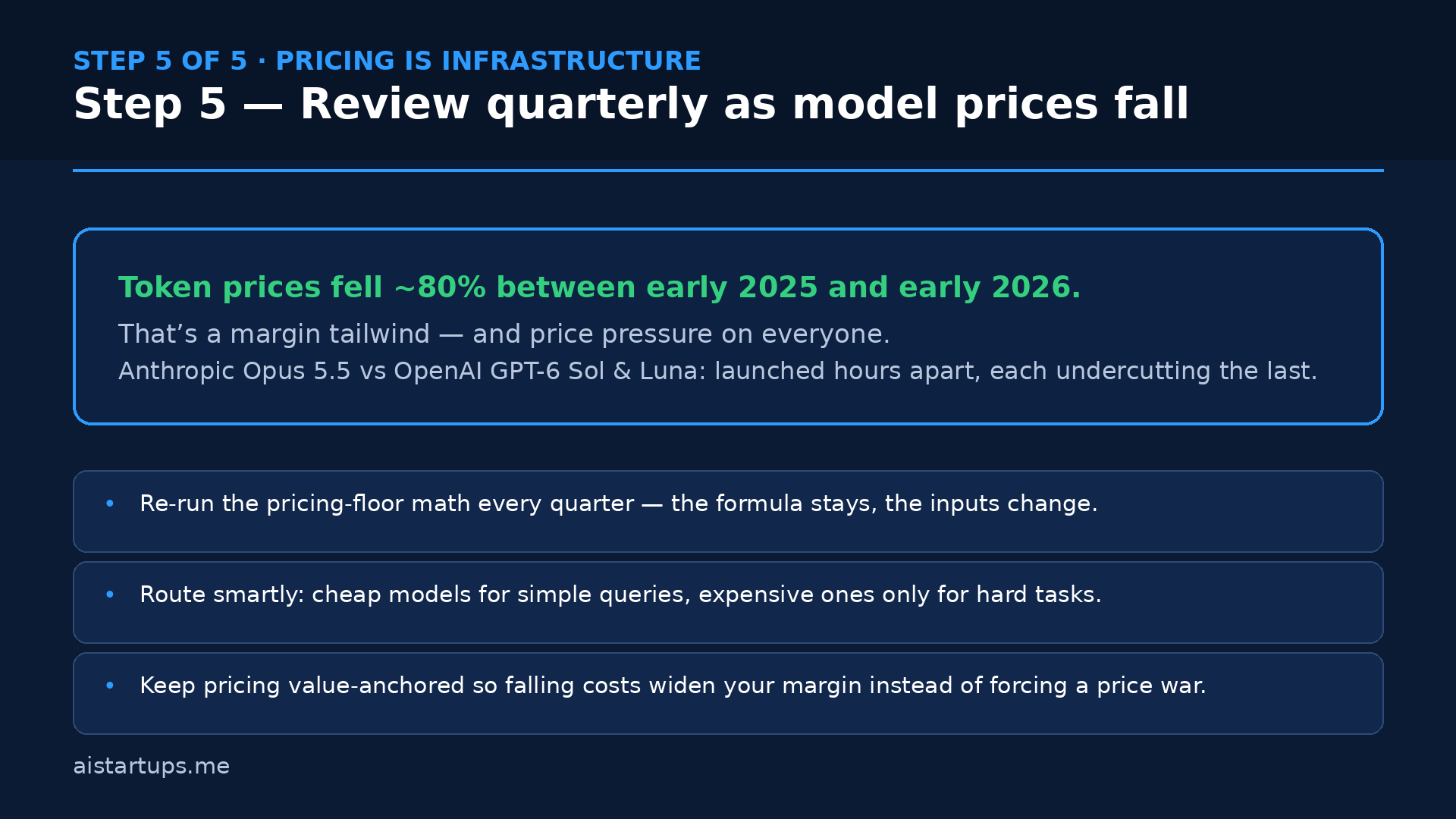
4. Setting it once and forgetting it. Model prices are falling fast — token prices dropped roughly 80% between early 2025 and early 2026. That’s great for your costs, but it also means competitors’ costs are falling too, and price pressure follows. Re-run your pricing math quarterly. The September 2026 price war — Anthropic’s Opus 5.5 and OpenAI’s GPT-6 Sol and Luna all launching within hours of each other, each undercutting the last — is what the next few years look like. Your pricing has to be a living thing.
5. Hiding the meter. Customers who can see their usage dashboard in real time don’t get surprised, don’t churn in anger, and don’t call your support team in a panic. Customers who get a surprise invoice do all three. Metering and usage visibility aren’t just engineering features — they’re retention features. If your team doesn’t have the bandwidth to build usage tracking and billing plumbing into the product properly, it’s worth bringing in specialists: a web development studio like AISquadX can wire up the metering, dashboards, and billing integration as part of the build instead of it becoming a quarter-long side project.
What to do this week
Don’t let this sit in your bookmarks. Here’s the honest minimum viable version:
- Instrument your costs. Tag every AI call by customer, feature, and model. If you can’t answer “what does this customer cost us?” you’re pricing blind.
- Compute cost per success using the buckets above. Include retries. Include human review. Be ruthless.
- Set your floor with the formula. Write it down. Pin it somewhere your whole team sees it.
- Pick your model using the decision flow. When in doubt, hybrid.
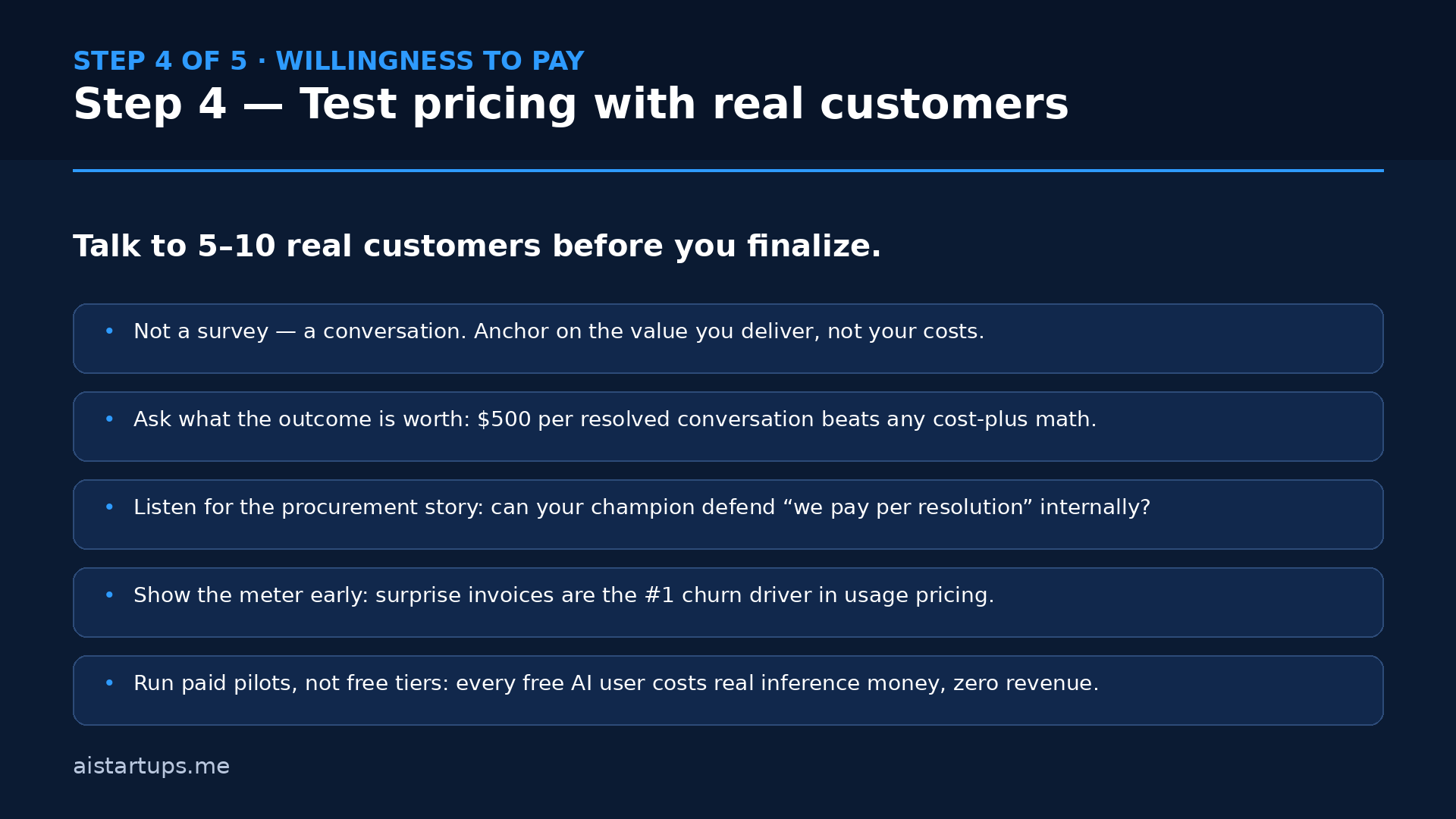
- Talk to 5–10 real customers about willingness to pay before you finalize. Not a survey — a conversation. Anchor the discussion on the value you deliver, not your costs.
And if you’re still early — still validating your AI idea before writing a line of code — do this exercise on paper first. Fake the cost math with realistic estimates. If the numbers don’t work on a spreadsheet, they won’t work in production either. Better to find that out in an afternoon than in a funding round.
Frequently asked questions
What’s the most common AI SaaS pricing model in 2026?
Hybrid pricing — a base subscription plus usage overage — is now the industry standard, adopted by 41% of AI vendors according to Bessemer’s 2026 AI Pricing Playbook, up from 27% a year earlier. Pure per-seat pricing has shrunk to about 15% of the market. For the full picture on what’s actually getting traction right now, the profitable AI startup ideas with real business models we covered are almost all hybrid-priced — that’s not a coincidence.
How do I price an AI product when my API costs keep changing?
Decouple your price from any single model’s price. Price on your unit of value (per resolution, per document, per workflow run), keep a margin buffer above your current cost floor, and build model routing into your architecture — send simple queries to cheap models, reserve the expensive ones for hard tasks. Then re-run the math quarterly as prices move. The labs are cutting prices aggressively, which is a tailwind for your margins if your pricing stays value-anchored.
Is per-seat pricing dead for AI products?
Not dead — just shrinking. It still works for products where one human genuinely is the bottleneck (developer assistants, design tools) and where usage is uniform enough that seats and costs move together. What’s dying is per-seat for agent products, where one seat can do the work of five people. If your AI multiplies human output, price the output, not the human.
What gross margin should my AI SaaS target?
It depends on your category. Directionally for 2026: around 80% for AI-augmented SaaS, 60–79% for AI-enabled products, and 50–59% for AI-native companies, per the ICONIQ data via CloudZero. The market average was 45% in 2025 and is projected near 53% in 2026 — so if you’re above that and improving, you’re in good shape. Investors care less about the absolute number than about the trajectory and whether you can explain it per feature.
Should I offer a free tier for my AI product?
Carefully. Free tiers with AI features enabled are one of the fastest ways to discover that your margin math was fiction — every free user costs you real inference money with zero revenue. If you offer one, cap it hard: limited monthly usage, cheapest model tier only, no agentic workflows. Use it as a trial funnel, not a charity. The founders running solo AI agent businesses have mostly learned to skip generous free tiers entirely and use paid pilots instead.
The Bottom Line
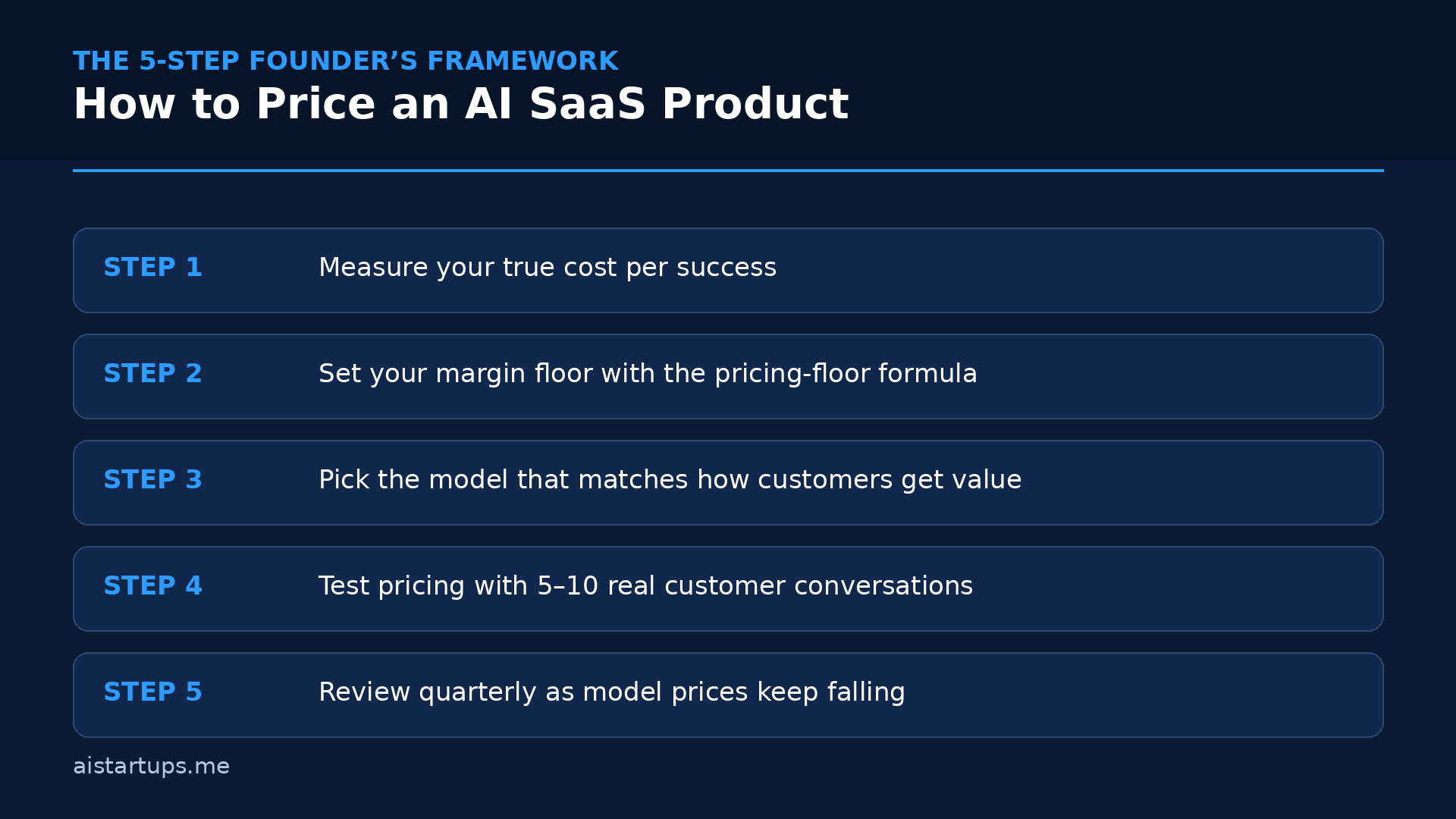
Pricing an AI SaaS product isn’t about finding a clever number. It’s about building a system: measure your true cost per success, set a floor you never cross, pick the model that matches how your customers actually get value, test it with real humans, and revisit it every quarter as the market moves.
The founders who get this right treat pricing as infrastructure — something you instrument, maintain, and improve. The founders who get it wrong treat it as a marketing decision and find out, six months too late, that they’ve been subsidizing their best customers.
Don’t be the second kind of founder. Do the math this week. Your future self — the one with healthy margins and a pricing page they can defend on a board call — will thank you.