


Here’s a nightmare scenario that’s becoming very real: your customer-support AI agent, the one you proudly launched last quarter, sends a client an email that reads “this fund is a safe way to beat the market.” One sentence. And under FINRA rules, that single sentence can be a violation — promissory performance language, the kind that costs firms real money.
Now scale that up. Not one agent, but fifty. Not ten messages a day, but ten thousand. That’s the actual problem every fintech, wealth-tech, and insurance startup is about to run into. And yesterday — September 23, 2026 — a New York startup called ZeroDrift announced what might be the most practical answer to it yet: a family of small language models called Anchor 3.0, built for exactly one job. Reading every AI-generated message before it goes out, and checking it against the rules.
Real talk: this launch is worth paying attention to, not because it’s the flashiest AI news of the week, but because it solves a boring, expensive, completely unavoidable problem. Let’s break it down.
What ZeroDrift Actually Launched
ZeroDrift describes itself as “the enforcement runtime for AI” — infrastructure that sits between your AI agents and the outside world, checking what they say before anything is sent. Anchor 3.0 is the model family that powers it, and it comes in three sizes:
- Anchor 3.0 Mini — 9 billion parameters (4B active), post-trained from Gemma E4B. The fastest, cheapest option, built for high-volume traffic. It runs ZeroDrift’s pre-built rule packs and flags violations.
- Anchor 3.0 (flagship) — also 9B with 4B active, but this is the headline model. It runs ZeroDrift’s full library of 200+ pre-built rules across FINRA, SEC, and other regulations, flags the exact lines that violate a rule, and rewrites them so the message goes out compliant. Your company’s own policies get trained in through a LoRA adapter.
- Anchor 3.0 Max — 27B parameters, post-trained from Qwen3.8-27B. The most capable of the three, built to enforce a company’s own policies out of the box with no fine-tuning, and to handle long-form content and document attachments.
How does it work in practice? Every AI output goes to an API endpoint, and you get back one verdict: pass, rewrite, block, or escalate. Their homepage even shows the shape of it — you POST your message with a rulepack like financial_services_client_communications, and back comes the verdict, the rule cited (say, FINRA Rule 2210), an explanation, and a suggested compliant rewrite.
That example is telling. Their demo shows the message “The Apex Growth Fund is a safe way to beat the market” getting blocked and rewritten as “The Apex Growth Fund may suit certain investors depending on their goals and risk tolerance.” One promises safety and market-beating. The other is a factual, qualified statement. That’s the whole job, in a nutshell.
The Benchmark Numbers (And Why They Matter)
Okay, so every startup claims their thing is faster and better. What makes this launch interesting is that ZeroDrift also published the first public benchmark measuring how well AI models enforce FINRA rules on business communications — built on human-written, attorney-labeled data produced independently by Surge AI. So there’s an actual yardstick.
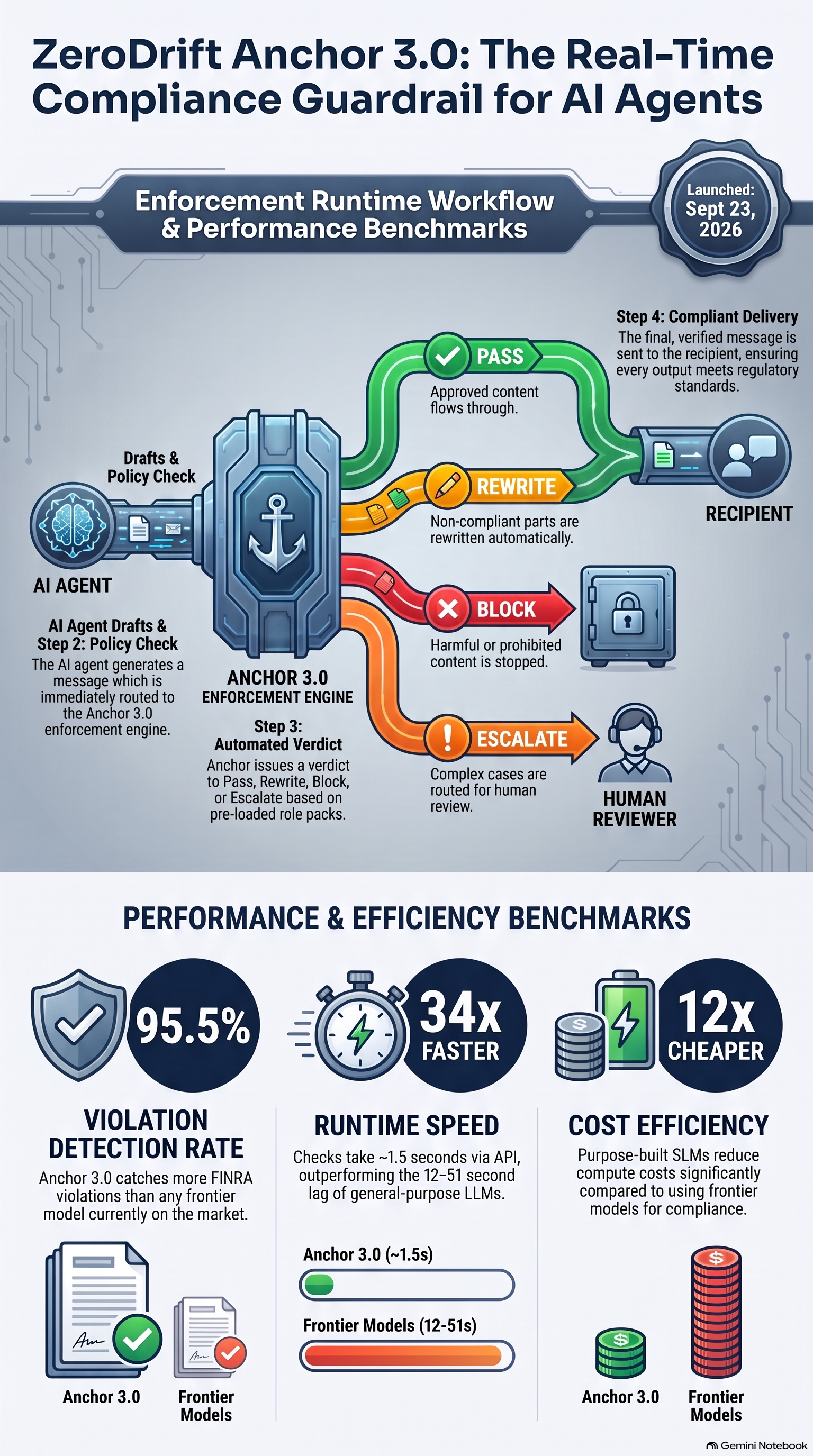
The headline results:
- 95.5% of violations caught — more than any frontier model tested, including GPT-5.6 Sol, which was the strongest competitor on the test.
- Better recall, precision, and F1 than GPT-5.6 Sol — so not just catching more, but being more accurate about it.
- Up to 34x faster and 12x cheaper to run than the frontier models.
- ~1.5 seconds per check on ZeroDrift’s API, under 100 milliseconds self-hosted.
That speed number is the one that actually matters most. ZeroDrift’s announcement makes the point plainly: frontier models take 12 to 51 seconds per message to do this job. At that speed, compliance review can only happen after the fact — you find out about the violation tomorrow. Anchor’s ~1.5 seconds means the check happens in the send path, every time, before anything leaves the building.
A quick honesty note: this is a vendor-published benchmark, and I always take those with a grain of salt. But it’s independently labeled by Surge AI attorneys, the methodology is published, and the gap (34x faster at equal-or-better accuracy) is big enough that it’s not a rounding artifact. Worth watching how it holds up in third-party hands.
Why Founders Should Care: The Regulatory Squeeze Is Real
None of this exists in a vacuum. If you’re building in or adjacent to financial services, the regulatory environment just keeps tightening around AI-generated content.
FINRA’s 2026 Annual Regulatory Oversight Report — released in December 2025 — included a dedicated GenAI section for the first time, with a specific warning about autonomous AI agents. The message: FINRA rules are “technology neutral,” so your supervision, communications, and recordkeeping obligations apply to AI-generated content exactly the same as to anything your humans write. “I didn’t know how it worked” is not a defense.
And this isn’t theoretical. FINRA’s 2025 enforcement numbers keep communications compliance in the spotlight — 22 recordkeeping cases totaling about $5.1 million in fines, many tied to firms’ failures to capture electronic communications — and ZeroDrift’s announcement notes regulators have levied billions of dollars in fines for communications failures. In February 2026, FINRA fined a financial advisor $750,000 for supervisory failures around off-channel business communications. FINRA is also proposing to modernize Rule 2210 (Communications with the Public) specifically to account for generative AI. The direction is unambiguous: more scrutiny, not less.
Here’s the founder angle, though. ZeroDrift cites Cambridge research finding that 81% of surveyed financial services firms are adopting AI at some level, with 45% agentic AI adoption among traditional institutions. That’s a lot of AI-generated messages that now legally have to follow the rules. The companies that figure out compliance first — not as an afterthought — get to move faster than everyone else. As a16z’s Jonathan Lai put it in ZeroDrift’s press material: “Compliance is about to become the rate-limiting factor for AI in the enterprise.”
Look, I get it. Compliance is nobody’s idea of a fun startup topic. But boring problems are where the money is. This is exactly the kind of infrastructure shift that creates a whole layer of startups on top of it — which brings us to the opportunity.
How You’d Actually Use This: A Founder’s Walkthrough
This isn’t a how-to for ZeroDrift’s competitors. It’s the practical bit: if you’re running a startup that sends AI-generated content in a regulated space — fintech, insurance, healthcare — here’s what adopting something like Anchor 3.0 actually looks like. The pattern is general; it’ll apply to whatever enforcement tooling you evaluate.
Step 1: Map your risk surface
Before touching any tool, list what your AI actually says, to whom, and under which rules. Support emails? Marketing copy? Sales call summaries? Every output channel is a compliance surface. Most founders discover they’ve got more of them than they thought. (Well — mostly. Some of you are meticulous. The rest of us are learning this the hard way.)
Step 2: Pick the model that fits your volume
The three-size lineup is genuinely useful here. If you’re processing a firehose of short messages, the Mini’s speed and cost matter most. If you need full FINRA/SEC coverage plus rewrites and custom policies, that’s the flagship. Long documents and attachments? Max. Match the model to the workload, not the marketing.
Step 3: Wire it into the send path
The enforcement model goes between your agent and the outside world. Every draft output gets sent to the API, you get a verdict, and your application acts on it: let passes through, send rewrites out with the suggested fix, block violations, escalate the edge cases to a human. This is the “deterministic where it matters, intelligent where it needs context” pattern — a rules engine and the model check each message in parallel, and you get one verdict.
Step 4: Train your own policies on top
The pre-built rule packs cover the regulations (200+ rules across FINRA, SEC, plus FCA and MiFID II coverage per ZeroDrift’s site). But your company also has its own rules — restricted products, approval flows, voice guidelines. On the flagship model, those go in through a LoRA adapter, which is a lightweight fine-tuning approach that doesn’t require retraining the whole model. On the Max model, your policies work out of the box.
Step 5: Keep the audit trail
Every verdict ZeroDrift produces comes with an evidence trail — what was checked, what was flagged, what was rewritten, which rule was cited. Their “Command” dashboard aggregates all of it. This is the part your future regulator (or your future acquirer’s legal team) will ask about. An AI product that can show its homework is worth more than one that can’t.
What It Costs (And What It Doesn’t Tell You)
Let’s be honest about what we don’t know yet. The launch announcement claims Anchor 3.0 is up to 12x cheaper to run than frontier models — but ZeroDrift hasn’t published public per-token or per-message pricing as of this writing. You sign up at zerodrift.com and start through their Enforcement API.
What we can reason about is the shape of the cost. You’re paying for one small-model check per AI-generated message, at roughly 1.5 seconds of compute. Compare that to the alternative people were using — sending compliance-critical content through a frontier model that takes 12–51 seconds per message — and the unit economics are obviously better. And compare it to the alternative nobody talks about: a human compliance team reading everything. That’s not even a contest at scale.
But there’s a subtlety worth flagging. A cheaper, faster compliance check makes it economically viable to check everything — which means you will check everything, which means this line item goes from zero to real on your cost of starting an AI business in 2026. It’s still a fraction of what a compliance hire costs. Just don’t model it as zero.
“Frontier models made it easy to build capable agents. The hard part is running them inside a regulated business, where every message has to follow the rules and the check has to happen every time, before anything goes out.”
— Kumesh Aroomoogan, founder and CEO of ZeroDrift, in the Anchor 3.0 launch announcement
The Bigger Play: What Smart Founders Do With This
Here’s the thing most people will miss about this launch. Anchor 3.0 isn’t just a product for big banks. It’s infrastructure that makes new kinds of startups possible.
Think about it: the reason you don’t see thousands of AI startups selling into financial advisors, insurance brokers, and mortgage lenders is that the compliance barrier is enormous. Every message is a liability. One enforcement layer — small, fast, cheap enough to run on every message — lowers that barrier dramatically. The next wave of fintech AI startups won’t just use this tool; they’ll be built on top of it.
If you’re in the profitable AI startup ideas mindset, here’s a concrete way to think about it: pick a regulated niche where AI adoption is high and compliance pain is sharp (financial advisors, insurance claims, healthcare communications), build the vertical workflow, and let enforcement infrastructure handle the part you’d never be able to staff. That’s a real moat — not because you built the compliance engine, but because you understood the compliance problem before your competitors did.
And if you’re building the product but don’t want to hand-roll the integration yourself? This is exactly the kind of work an AI integration studio like AISquadX handles — wiring compliance enforcement, audit trails, and policy layers into AI products so founders can focus on the thing that actually differentiates them.
The Caveats (Because There Are Always Caveats)
No launch is perfect. A few things to keep in mind:
It’s a vendor benchmark. 95.5% on FINRA communications, independently labeled by Surge AI attorneys, methodology published — that’s solid as vendor benchmarks go. But it’s still the company’s own test, and it’s focused on FINRA business communications. Your mileage in healthcare (HIPAA/CMS) or insurance (NAIC) may differ, and independent third-party testing hasn’t happened yet.
“Enforcement” is a strong word. What Anchor does is check AI-generated text against rules and rewrite, block, or escalate. That’s enormously useful. It’s not a substitute for a compliance program, a chief compliance officer, or legal counsel. The technology is a layer, not a shield. Any founder who reads “AI compliance enforcement” as “we’re compliant now” is asking for trouble.
Small models have limits. The 27B Max model handles long-form content and attachments, and the flagship catches what general-purpose models miss on this specific task — but these are purpose-built models. You’re not getting GPT-6-level reasoning out of a 9B enforcement model, and you don’t need to. Just don’t expect it to do double duty as your general AI.
Self-hosting is fast but not free. Under 100ms self-hosted sounds great until you’re the one running the infrastructure, keeping models updated, and proving to your examiner that your deployment matches what was certified. For most startups, the cloud API is the right starting point; SOC 2 Type II and VPC deployment exist for the enterprises that need them.
FAQ
What is ZeroDrift Anchor 3.0?
Anchor 3.0 is a family of small language models launched by ZeroDrift on September 23, 2026, purpose-built to enforce regulatory and company rules on AI-generated communications. Every message is checked against pre-built rule packs (FINRA, SEC, and others) before it’s sent, and each gets a verdict: pass, rewrite, block, or escalate.
How accurate is Anchor 3.0 at catching compliance violations?
On ZeroDrift’s published FINRA benchmark — built on human-written, attorney-labeled data from Surge AI — Anchor 3.0 caught 95.5% of violations, beating every frontier model tested (including GPT-5.6 Sol) on recall, precision, and F1. It’s a vendor-published benchmark, so treat it as a strong signal, not gospel.
How fast is Anchor 3.0?
About 1.5 seconds per message via ZeroDrift’s API, and under 100 milliseconds when self-hosted. That compares to 12–51 seconds per message for the strongest frontier models doing the same job — which is why Anchor can run in the send path while frontier models can only review after the fact.
Can startups actually use Anchor 3.0, or is it enterprise-only?
It’s built for developers, not just enterprises: sign up at zerodrift.com, send AI output to the Enforcement API, and act on the verdict. The three model sizes (Mini, flagship, Max) are meant to match different volumes and workloads, and custom company policies are supported via LoRA adapters or out-of-the-box on Max.
Does Anchor 3.0 replace a compliance team?
No — and this is the most important thing to understand. It’s an enforcement layer that checks every message against rules and rewrites or blocks violations. It doesn’t replace a compliance program, legal counsel, or human oversight. What it does is make compliance scalable: every message gets checked, every verdict gets an audit trail, and humans only need to look at the edge cases.
The Bottom Line
Anchor 3.0 is the least glamorous kind of AI launch — no chat interface, no demo of it writing poetry, no benchmark about math olympiads. Just small, fast models doing one job: reading everything your AI says, before anyone else does, and making sure it follows the rules.
But that’s exactly why it matters. The AI industry’s biggest bottleneck in regulated industries isn’t intelligence anymore — it’s trust. Every fintech founder I know has the same story: the AI works great, and legal won’t let them ship it. Infrastructure that shrinks that gap — 95.5% violation detection at 1.5 seconds a check — is the kind of thing that quietly enables an entire generation of products.
If you’re starting an AI startup in 2026 anywhere near financial services, insurance, or healthcare, put enforcement tooling on your roadmap from day one. Not because regulators are coming — though they are — but because the founder who ships compliant AI faster than everyone else wins. The tools just got a lot better. The excuses just got a lot worse.
ZeroDrift is backed by $10M from a16z speedrun, PitchDrive Ventures, and others, founded by people from Google DeepMind, Microsoft AI, and Goldman Sachs. One of their customers, Wand AI’s Chief AI Architect Cristian Felix, says it lets them move “from experimentation into production.” That’s the whole story, really: the gap between a demo and a deployed product in a regulated industry is compliance. And someone finally built the plumbing.