

Hiring your first AI engineer is one of the highest-stakes decisions you’ll make as a founder. Get it right and your product suddenly has a pulse. Get it wrong and you’ve burned six months of runway on a salary of someone who shipped… a bunch of Jupyter notebooks.
I’ve watched this play out both ways. The founder who hired a PhD with three NeurIPS papers and wondered why the product never launched. The solo founder who hired a scrappy generalist who’d shipped two AI features to real users and ended up with a working product in eight weeks. Credentials are cheap. Shipping is the currency.
Here’s the thing: the market for AI talent in 2026 is wild. Everyone’s “an AI engineer” now — the term exploded after 2023, and LinkedIn profiles got creative fast. Your job is to cut through that noise with a hiring process built for one specific purpose: finding someone who can ship AI that real users pay for. Not papers. Not demos. Product.
Let me walk you through exactly how to do that — what the role actually needs to look like at your stage, the five signals that separate real builders from talkers, what to pay (with real 2026 numbers), and where startups actually find these people.
First, Do You Actually Need an AI Engineer? (Honest Check)
Before you spend $150K+ a year, ask the uncomfortable question. A lot of founders hire “an AI engineer” when what they actually need is an AI integrator — someone who wires up existing APIs into a product. Those are two different people at two very different prices.
You probably need a full-time AI engineer if:
- AI is the core of your product — not a feature, the thing itself. If your value proposition dies without a custom model or a serious retrieval pipeline, hire.
- You have a proprietary data advantage — a dataset, a feedback loop, or domain data that gets better the more users you get. That’s the moat a real AI engineer builds on.
- You’ve validated demand — people want the thing, and the bottleneck is building it well. (If you haven’t, do the validation work first before writing any salary checks.)
You probably do NOT need a full-time AI engineer yet if:
- Your product is “GPT wrapper plus a nice UI” — a good generalist dev or a contractor can build that.
- You haven’t talked to 50 potential users yet — then your problem is demand, not talent.
- You’re pre-revenue and the hire would be more than 30% of your runway — the math just doesn’t work.
Real talk: if you’re building a business around AI products, the cost breakdown we published shows how quickly team costs dominate an AI startup’s burn. One wrong hire at $170K is a six-figure mistake you can’t undo quietly.
The 5 Skills That Actually Separate Builders From Talkers
This is the core of the whole article. A solid vetting playbook for AI developers in 2026 (the full version is worth your time) boils it down to five capabilities. In my experience, candidates who have all five are rare — and candidates missing all five are somehow everywhere.
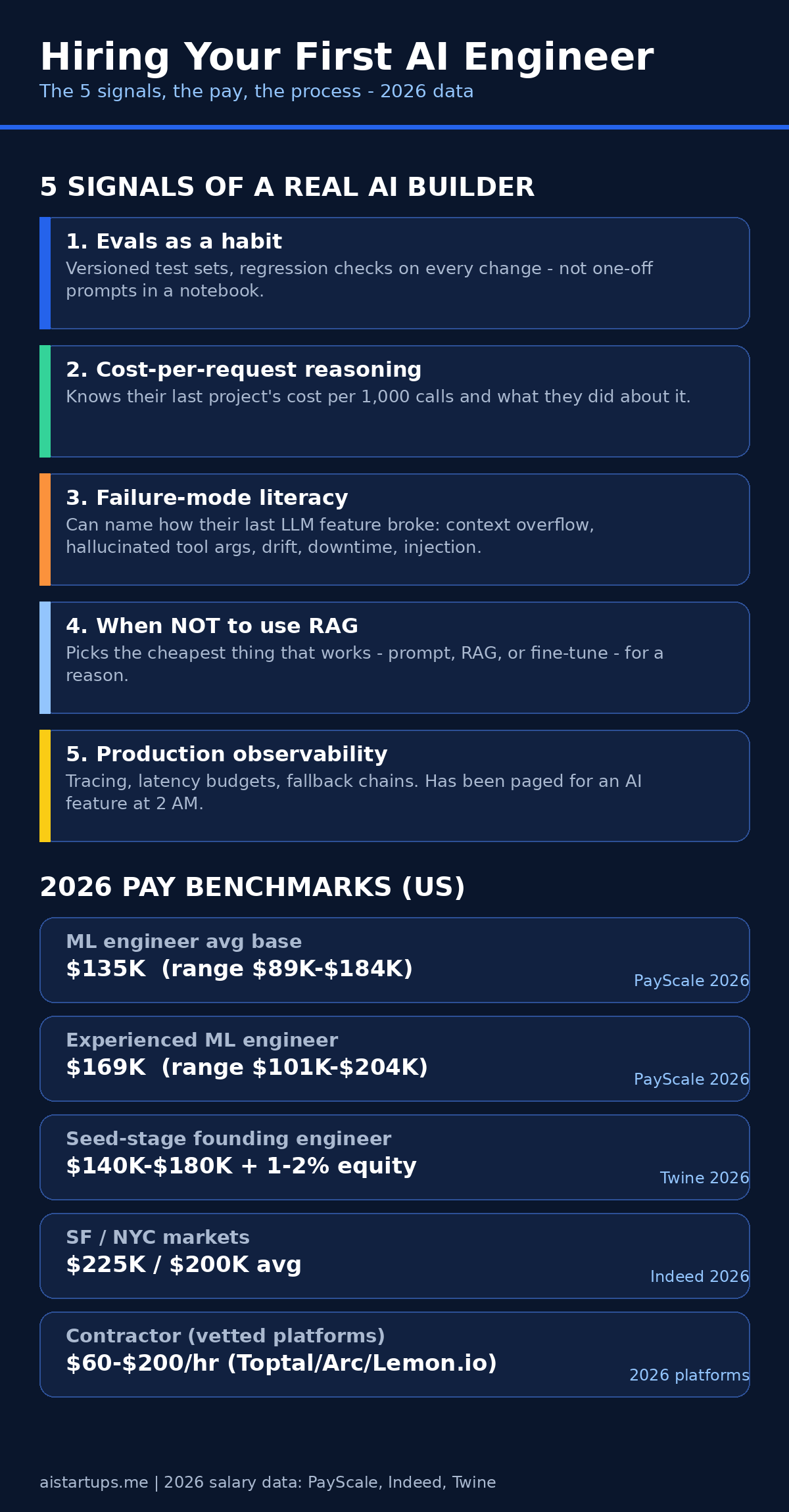
1. Evals as a habit, not a phase
Ask: “Walk me through your last eval suite.” If the answer is “I tried a few prompts in a notebook and eyeballed it,” you’re looking at a hobbyist. Production-ready engineers describe versioned test datasets, regression checks that run on every change, and at least one story where evals caught a silent regression before users did. This is the single biggest tell in the whole interview.
2. Cost-per-request reasoning
They should know what their last project cost per thousand calls, why, and what they did about it. If they shrug at the question, they’ve never owned a feature past launch day — which means you’ll be the one discovering your API bill ate the margins. (If this sounds familiar, here’s how to think about AI API costs.)
3. Failure-mode literacy
Real builders can name the five ways their last LLM feature broke: context overflow, hallucinated tool arguments, JSON-mode drift, vendor downtime, prompt injection. Generic answers like “we added more validation” are a tell — they managed around problems instead of understanding them.
4. Knowing when NOT to use RAG (or fine-tuning)
Anyone who can confidently explain when not to use RAG has shipped real work. The default-everything-to-RAG reflex is this generation’s “let’s just use microservices” — an architecture choice made for fashion, not need. Great AI engineers pick the cheapest thing that works: sometimes that’s a better prompt, sometimes it’s RAG, sometimes it’s fine-tuning. They know the decision framework.
5. Production observability
Tracing, latency budgets, fallback chains, what happens when the model is wrong at 2 AM. If they’ve never been paged over an AI feature, they haven’t really run one. Shipping a demo is a weekend. Keeping it alive for a thousand users is a job.
“Honestly, this list filters out about 70% of candidates who self-describe as ‘senior AI engineers’ on LinkedIn. That’s not cynicism — that’s the current market.”
That 70% figure isn’t a scare tactic. It’s the reality of a job title that went from niche to fashionable in about eighteen months. Your interview process has to be built to catch it.
Your Interview Process (Reject the Whiteboard)
Standard whiteboard interviews are terrible at predicting AI engineering success. Nobody ever saved a startup by reversing a binary tree. AI engineering is about code, data, and judgment under ambiguity — so test that.
A hiring process that actually works looks like this:
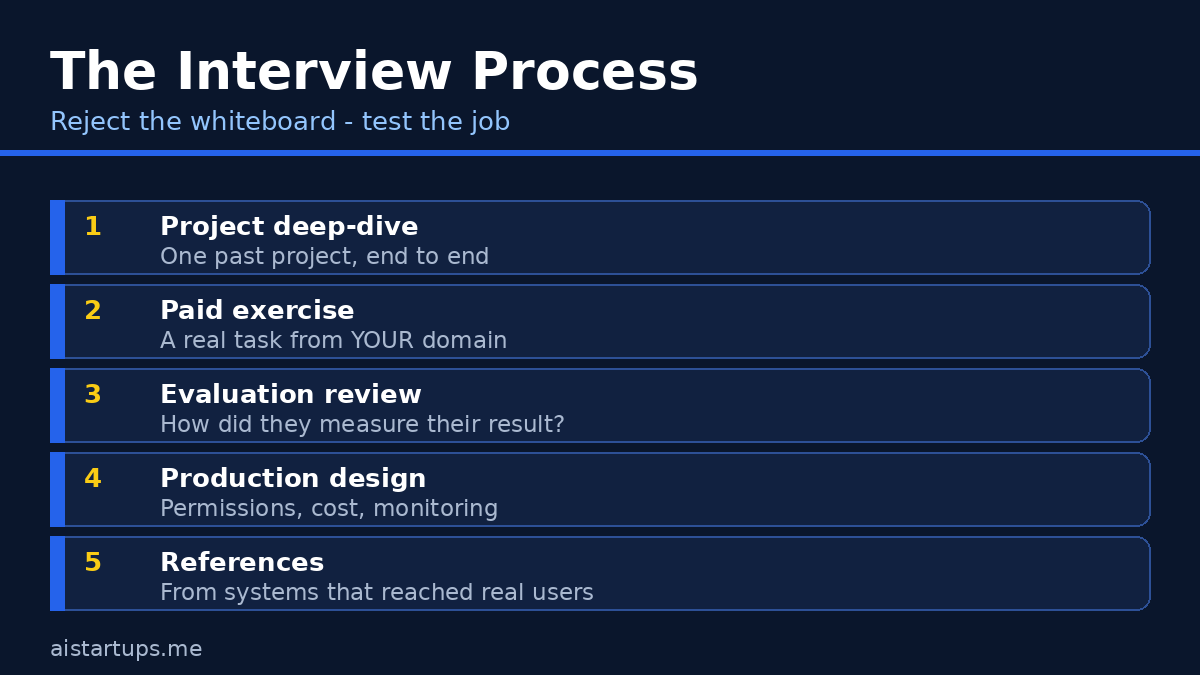
- Project deep-dive (45 min). Walk through ONE past project end to end. Listen for how they defined success, what failed, and what they’d change. Vague answers about “building a chatbot” are a warning sign. Specific, self-critical answers are gold.
- Paid, realistic exercise (a few hours). A small task from YOUR domain — improve retrieval over sample documents, diagnose why a model degrades on new data. Keep it short, and pay for their time. Let them use AI coding assistants; your team will use them on the job. What you’re testing is whether they can direct the tools and catch their mistakes.
- Evaluation review. Ask how they measured their own result. Strong candidates bring a small test set, a metric, and an honest list of failure cases — without being prompted.
- Production design discussion. Take the exercise to production on paper: permissions, monitoring, cost per request, model upgrades, and what happens when the model is wrong. This is where the five skills from the last section get pressure-tested.
- References from production work. Talk to people who worked with them on systems that reached real users — not prototypes, not Kaggle.
One more thing: keep the total ask proportionate. A few hours plus interviews is reasonable. A multi-day take-home will lose you the exact candidates you want most — they’re the ones with options. And when you have strong conviction after the work sample, skip a round and make the offer fast. Great candidates don’t wait around while you schedule panel number six. This five-stage shape mirrors a solid sequence recommended for hiring AI developers across roles.
Red Flags: The Five Ways Founders Get Burned
Watch for these like a hawk. Each one has cost some founder I know real money:
- “I only do models.” Your first AI hire needs to be a generalist who ships. Someone who says “that’s the backend team’s job” in a three-person company is telling you exactly how the next six months will go.
- Can’t explain their past work simply. If they can’t tell you, a founder, what their last project did in plain language — in a way your customers would understand — they won’t communicate with your team either.
- Every failure was someone else’s fault. “The data team gave me bad data,” “product kept changing requirements.” Lack of ownership in an interview is a preview, not an anomaly.
- Needs constant direction. Ask what they did when their manager was unavailable for two weeks. The right answer involves decisions. The wrong answer involves waiting.
- Buzzword bingo, zero depth. “Agentic workflows, RAG, vector databases, fine-tuning” in one breath — then they can’t explain when they’d choose one over the other. Fashion, not understanding.
What to Pay in 2026 (Real Numbers)
Okay, the part everyone’s actually here for. AI engineering pay in 2026 is high, wide, and extremely geography-dependent. Here are the numbers I’m comfortable standing behind, all sourced from live salary data:
Full-time salary benchmarks
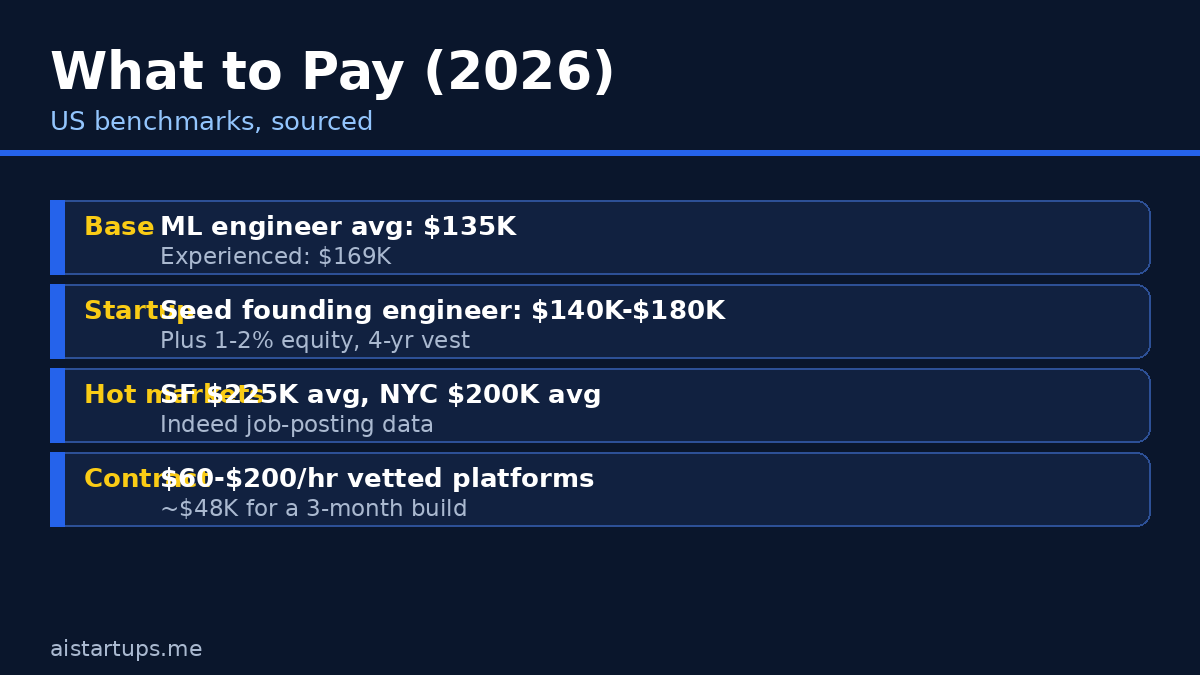
For a machine learning engineer in the US: PayScale’s 2026 data puts the average base at $135,001, with a typical range of $89K–$184K, and experienced engineers averaging $169,202. Indeed’s job-posting data runs hotter — average base around $190,484, with San Francisco at $224,793 and New York at $200,539 (PayScale, Indeed).
But here’s what those national averages miss: you’re a startup, and startup pay is its own world. The 2026 benchmarks for early-stage founding-level engineers look like this (Twine’s 2026 first-hire data):
- Seed stage founding engineer: $140K–$180K base
- Series A: $160K–$200K base
- Series B: $180K–$220K base
Translation: expect to pay 70–85% of big-tech market rate in cash, and make up the difference in equity and mission. That’s the standard early-stage deal, and good candidates know it. Be transparent about the tradeoff — founders who try to pay bottom-quartile cash and offer stingy equity just don’t close.
Equity for hire #1
Your first AI engineer (non-cofounder) typically gets 1.0%–2.0% equity, fully diluted, on a standard 4-year vest with a 1-year cliff. That range compresses fast — hires 2–4 land around 0.5%–1.5%, and it keeps dropping from there.
The cash-vs-equity mix is a genuine negotiation, and the two sane packages are: below-market salary plus meaningful equity (the standard), or market-rate salary plus smaller equity (0.25–0.5%) works for candidates who need the cash. Pick your poison honestly, in writing. And put any “raise after the next round” promises in the offer letter, not in a text message.
Contractor rates (the alternative)
Not ready for a full-time commitment? Contractor AI engineers are a legitimate path — especially for building the first version while you validate. Current 2026 rate bands from vetted platforms: $60–$200+/hr on Toptal, $60–$150/hr on Arc.dev, $50–$120/hr on Lemon.io, with US AI/ML contractor medians around $165/hr (Knowledgelib’s 2026 rate benchmarks).
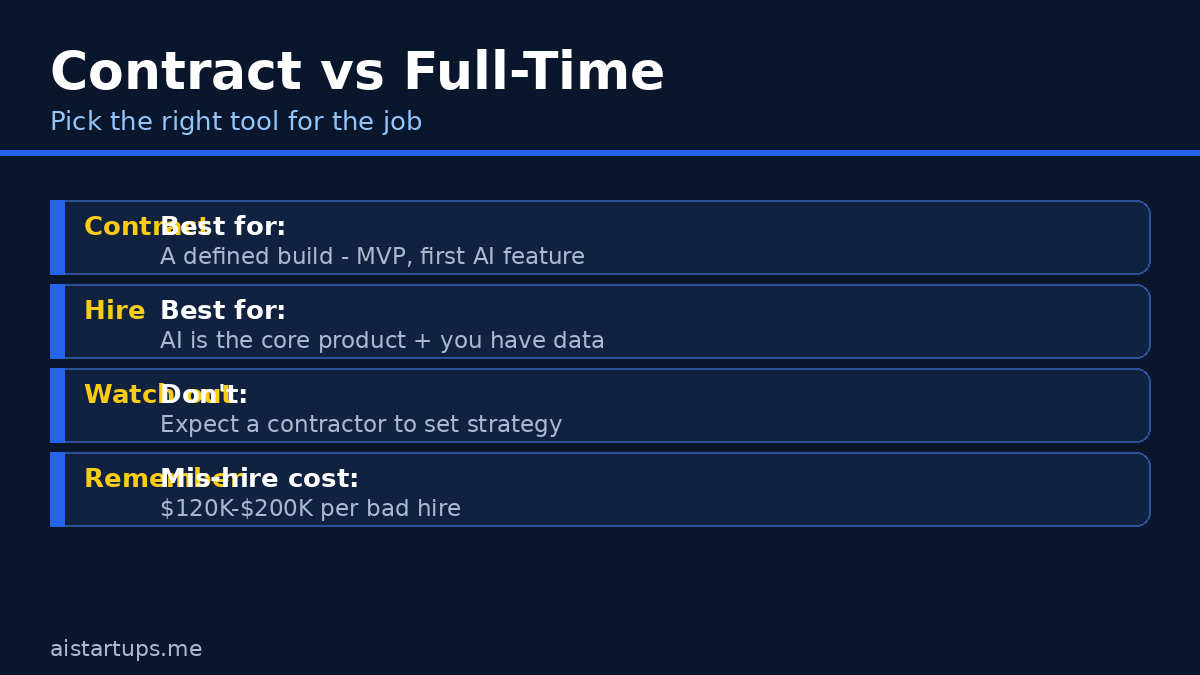
The math that matters: a senior contractor at $100/hr for three months full-time costs about $48K — versus a $170K salary plus equity plus recruiting plus onboarding. For a defined build (MVP, first AI feature), contracting can be the smarter first move. Just don’t expect a contractor to also be your technical strategy, your evals culture, and your 2 AM pager. Different job, different price.
Where Startups Actually Find AI Engineers
You don’t have a recruiter, and the generic LinkedIn firehose is mostly noise at this stage. Ranked by what actually works for early-stage founders:
- Your network. Past colleagues, ex-coworkers, school friends. Highest hit rate, lowest cost. Announce the role publicly — engineers talk to engineers.
- Investor and advisor intros. Your investors are incentivized to help you hire well. Ask them specifically — “do you know an AI engineer who’s shipped LLM features to production?”
- Niche communities. The Discords, Slacks, and subreddits where AI engineers actually hang out. Open-source contributors in your stack are warm leads — check who maintains the tools you use.
- Curated platforms. Toptal, Arc.dev, and Lemon.io all pre-vet AI talent with real technical screens — fast when you need to move, and honest about the markup. Wellfound (formerly AngelList) and YC’s “Work at a Startup” board are where startup-minded engineers actually look.
- Your own content. If you’ve written publicly about the problem you’re solving, candidates pre-warm themselves. The solo founders building AI businesses who document their journey publicly often find their first hire comes to them.
One thing to skip unless you’re desperate: contingency recruiters. $20–30K per hire, wildly variable quality, and they’ll spray your job description across the internet.
The Smart Alternative: Build the Prototype Before You Hire
Here’s a move more founders should consider. If your AI product idea is still taking shape — if you’re not 100% sure what the engineer would even build in month one — don’t hire yet. Get a working prototype into the world first, learn what users actually do with it, then hire the person to scale it.
A good web development and AI integration studio can take you from idea to working AI-powered product in weeks, for a fraction of a full-time salary. Our own studio, AISquadX, does exactly this kind of work — building AI-integrated websites and products for founders who need something real in front of users before they commit to a full-time engineering hire. It’s a completely different risk profile: fixed scope, fixed timeline, and you learn what to actually ask for in the job description.
Then, when you do hire, you’re not handing someone a vague vision — you’re handing them a working system with users, data, and a backlog. That’s the job description great engineers fight over.
Onboarding: Make Week One Count
You hired well. Now don’t waste it. The first-week mistakes I see: a week of HR orientation, no data access, no context on what exists. Your new AI engineer should have production access, the current architecture walkthrough, and a real problem to poke at by day two.
Set the eval culture from day one — literally. If your first shipped feature includes a test suite and a regression check, that’s now how your company builds AI. If it doesn’t, good luck retrofitting it later. The culture of your AI engineering org is whatever your first hire does, repeated. Choose deliberately.
FAQ
How much does it cost to hire an AI engineer in 2026?
A full-time AI/ML engineer in the US averages around $135K–$190K in base salary depending on the source, with experienced engineers at $169K+ (PayScale) and hot markets like San Francisco at $225K (Indeed). For a seed-stage startup, budget $140K–$180K base plus 1–2% equity. Contractors run $60–$200/hr on vetted platforms.
Should I hire an AI engineer or just use AI APIs?
If AI is your core product or you have a proprietary data advantage, hire. If you’re building a product that calls existing AI APIs with a good interface on top, a generalist developer or contractor is enough — and much cheaper. Most founders overestimate how much custom ML they need in year one.
What should I look for in an AI engineer interview?
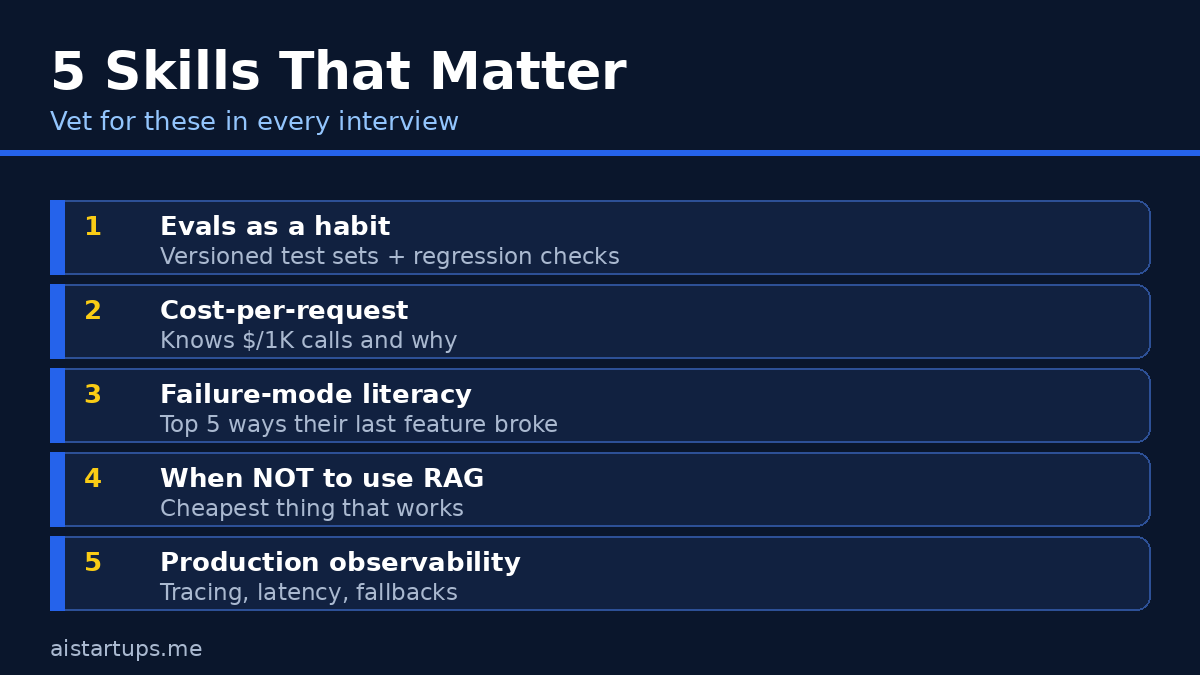
The five things that matter: evals as a habit (not a one-off), cost-per-request reasoning, failure-mode literacy, knowing when NOT to use RAG or fine-tuning, and production observability. Test with a paid, realistic work sample from your domain — not whiteboard puzzles.
How much equity should the first AI engineer get?
For hire #1 at a seed-stage startup: 1.0%–2.0% fully diluted, on a 4-year vest with a 1-year cliff. Below-market salary (70–85% of market) plus meaningful equity is the standard early-stage deal; market-rate salary plus smaller equity (0.25–0.5%) works for candidates who need the cash.
Where can I find AI engineers for my startup?
Your own network and investor intros have the highest hit rate. After that: niche AI communities and open-source contributors, curated platforms like Toptal, Arc.dev, and Lemon.io for vetted contractors, and Wellfound or YC’s Work at a Startup for full-time startup-minded engineers.
The Bottom Line
Your first AI hire isn’t really about AI. It’s about shipping. The candidates worth $170K a year are the ones who’ve kept an AI feature alive for real users — evals, cost control, failure modes, and all. Interview for that, pay the market rate for it, and give them real ownership on day one.
And if you’re not ready for that hire yet? That’s fine — it’s a data point, not a failure. Validate the idea, ship a prototype, learn what the job actually is. Then hire the person who’s already done it. Your runway will thank you.