


Here’s a painful memory. Two years into my first real startup effort, I sat across from a potential customer — an operations manager at a mid-size logistics company — and pitched him my idea for thirty minutes straight. He nodded the whole time. Smiled. Said “this is exactly what we need.” I walked out floating. Told my co-founder we had product-market fit.
We had nothing. He never answered a single email after that. Not one.
I’d done the most common founder mistake there is: I asked for compliments and called it research. If you’re building an AI product right now, this trap is even deeper for you than it was for me — because when you say the words “AI” in an interview, people stop thinking about their actual problems and start performing their opinions about the future. And opinions about the future are worth exactly nothing.
This is a practical guide to running customer discovery for AI products properly: the rules that keep you honest, 25 interview questions that actually produce evidence, a 20-minute script you can steal, the AI-specific bias traps to dodge, and — the part most guides skip — what to do with the answers once you have them.
Why Customer Discovery Is Harder for AI Products
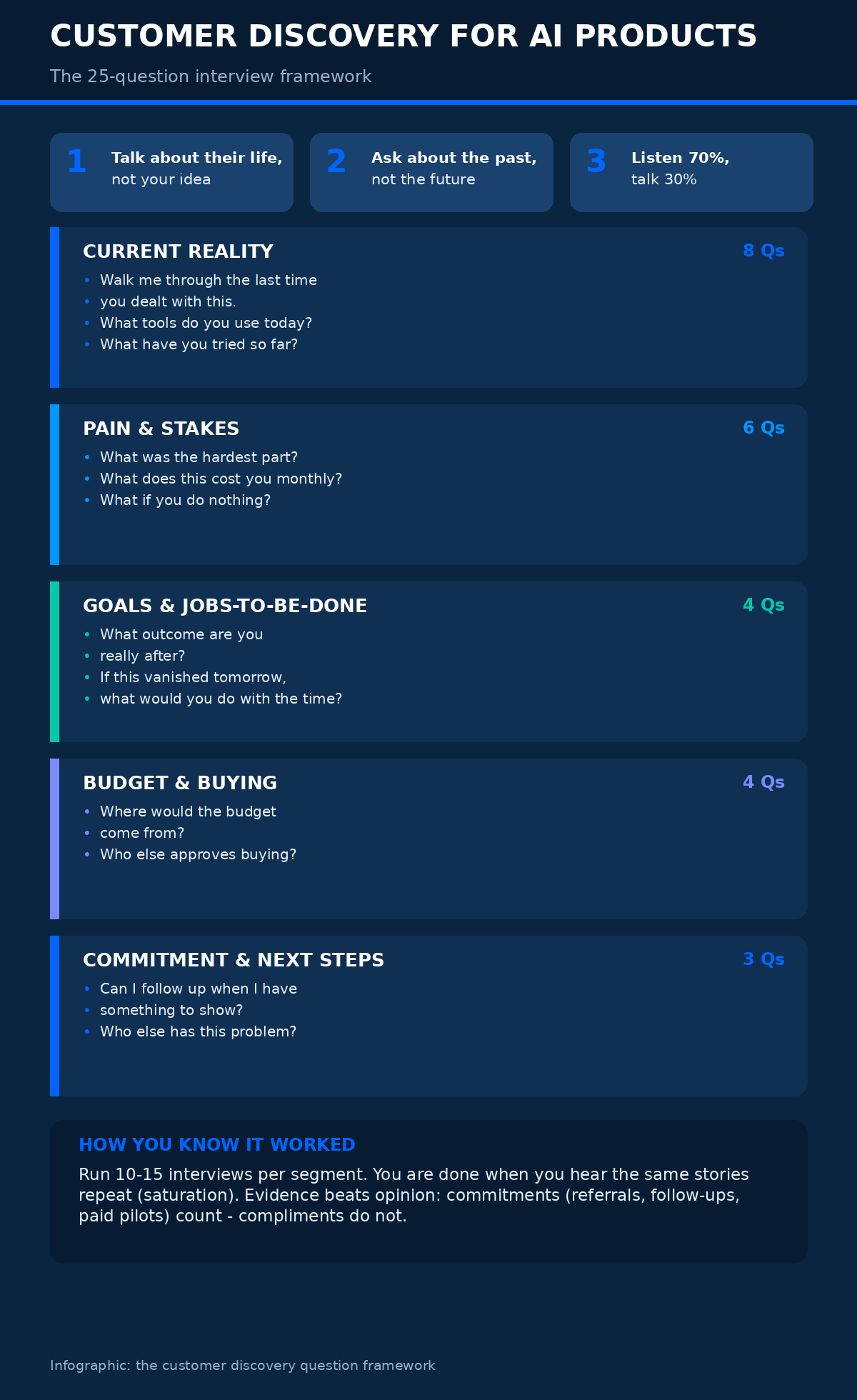
Customer discovery is supposed to be simple: talk to people, learn about their problems, build something they actually need. Rob Fitzpatrick’s The Mom Test — the short, beloved founder book on this — boils the whole discipline down to three rules. Talk about their life instead of your idea. Ask about specific things that already happened instead of opinions about the future. And talk less than you listen. The book is now taught as a required text at places like UCL, London Business School, and Harvard (you can see the teaching resources on the official Mom Test book site), which tells you how foundational this has become.
So why do AI founders mess it up so often? Three reasons, honestly, and I’ve been guilty of all of them.
First, the hype tax. The second you mention AI, the interview changes shape. People stop telling you about their Tuesday and start telling you what they think about the future of work. You’ll hear fascinating, confident, completely useless predictions. Your job is to hear what happened last Thursday, not what they think happens in 2028.
Second, the demo temptation. AI products are fun to show off. You type a prompt, something clever happens, the room lights up. And every second you spend demoing is a second the customer isn’t telling you about their problem. The demo feels like progress. It’s actually the opposite — it’s you learning nothing while burning your one shot at an honest conversation.
Third, solution-in-search-of-a-problem syndrome. AI makes it cheap to build impressive things, which means more founders than ever start with the technology and go hunting for a problem. That’s fine — lots of great companies start that way — but it makes discovery even more critical, because your starting hypotheses are further from reality than you think. NYU’s entrepreneurship team puts it bluntly: roughly 60% of your initial hypotheses won’t survive contact with real customers. That’s not failure. That IS the process working.
If you’re still at the idea stage, pair this guide with our walkthrough on validating your AI startup idea before building — discovery interviews are the raw material that whole process runs on.
The Three Rules (Tape These to Your Laptop)
Before the 25 questions, the rules. These come straight from Fitzpatrick, and they’re the filter every question below has to pass:
- Talk about their life, not your idea. If you’ve described your product and they haven’t yet described their problem in detail, you’ve already lost the interview.
- Ask about the past, not the future. “What did you do last time?” beats “what would you do if…” every single time. Humans are terrible at predicting their own behavior and surprisingly good at describing what they already did.
- They talk 70%, you talk 30%. Wind them up with a good question, then be quiet. Silence is a tool — most people fill it with the honest detail they were about to skip.
One more from the book that deserves its own line: deflect compliments. When someone says “that’s a great idea,” don’t write down “strong interest.” Ask: “What would you change about it?” or “What concerns do you have?” A compliment is politeness. A concern is data.
The 25 Questions, Organized by What They Reveal
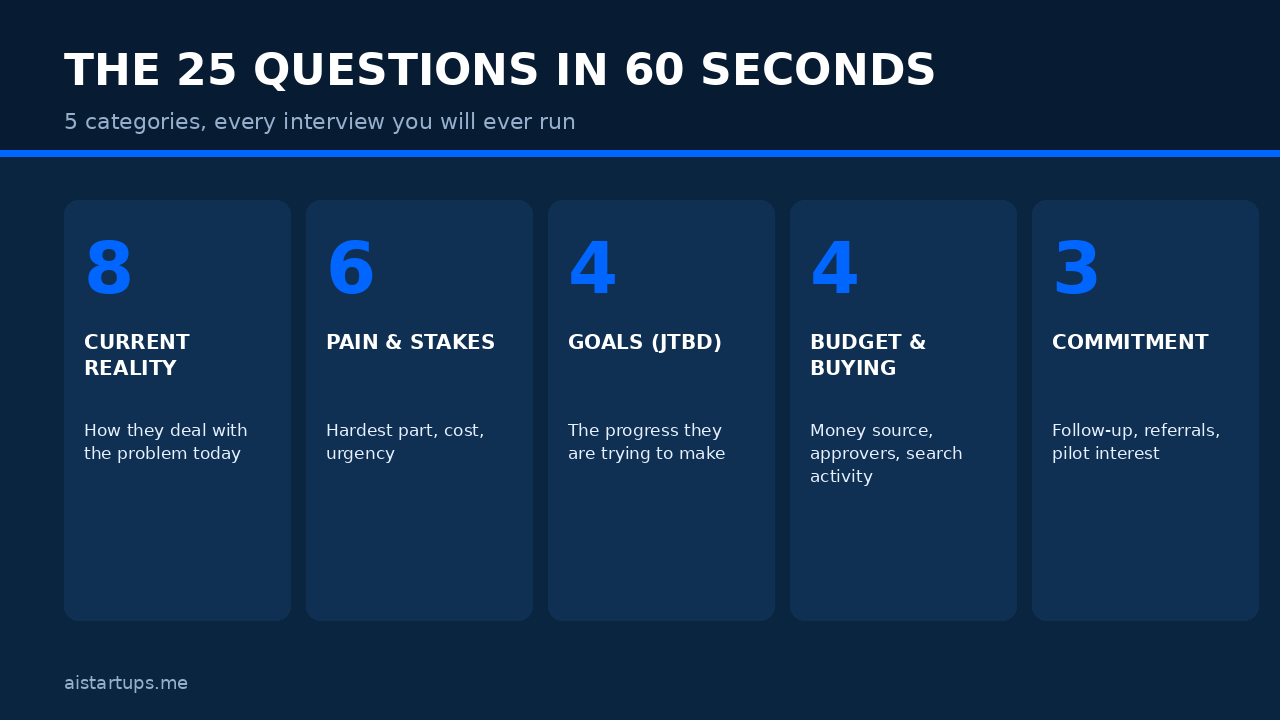
Real talk: you won’t use all 25 in one interview. Pick 5 to 7 before each call, chosen around your riskiest assumption — the thing that must be true for your idea to work. Every question targets one of five things: their current reality, the pain and stakes, the goal they’re chasing, the money and buying process, or a commitment that proves it’s real.
Category 1: Current Reality (8 questions)
These establish what the person actually does today. Current behavior is the most reliable predictor of future behavior — everything else in this list is commentary.
- “Walk me through the last time you dealt with [problem].” — Forces specifics. Generalizations hide the truth; a real story reveals the workflow, the friction, and the time spent.
- “How do you handle [problem] today, day to day?” — The opener that never leads. A detailed answer means the problem is real. A shrug means it isn’t painful enough.
- “How often does this come up for you?” — Frequency is a buying signal. Daily pain drives purchases; yearly pain drives shrugs.
- “What does your typical workflow look like right now?” — Gets you the full picture, including the steps they’d never think to mention because “that’s just how it works.”
- “Who else on your team is involved in this?” — Maps the real users versus the person you’re talking to. Often they’re different people, which matters enormously.
- “What tools or services do you use for this right now?” — Maps your competition from the buyer’s perspective. Spoiler: your competition is usually a spreadsheet and someone’s intern, not the startup you obsess over.
- “What have you already tried to fix it?” — If they’ve tried nothing, the pain isn’t strong enough. If they’ve tried three tools and quit all of them, you just found your gap.
- “Why did you stop using [previous tool]?” — Competitor churn reasons are gold. They tell you exactly what to avoid and what to promise.
Category 2: Pain & Stakes (6 questions)
These separate “mildly annoying” from “take my money.” The hardest questions in discovery live here, and most founders skip them because the answers can be uncomfortable.
- “What was the hardest part of that experience?” — Points straight at the emotional core. Watch their face when they answer this one.
- “What do you dislike most about how you handle this today?” — The complaints they volunteer unprompted are your feature priorities, in their words.
- “What does this problem actually cost you — in hours, money, or missed chances?” — Makes the pain concrete. Vague pain gets vague budgets.
- “How much time or money goes into this every month?” — Quantifies everything. If the answer is $0 and zero hours, they won’t pay you either — well, mostly.
- “How long has this been bugging you?” — Duration signals depth. A two-year-old workaround is a very different beast from last week’s annoyance.
- “What happens if you just do nothing about it?” — The urgency test. If the honest answer is “nothing bad, really,” you don’t have a business here. Move on.
Category 3: Goals & Jobs-to-be-Done (4 questions)
People don’t buy products; they hire them to make progress. That’s the core of Clayton Christensen’s Jobs-to-be-Done theory — customers “pull products into their lives to make progress in specific circumstances.” A great JTBD interview guide reconstructs the story of a real decision: the push of the situation, the pull of a new solution, the anxiety about switching, and the habit of the status quo. These four questions get at the “job” your AI product would be hired for:
- “When this goes well, what does that look like?” — Defines the desired outcome in their language, not your feature list.
- “What outcome are you really after here?” — Peels past the surface request. “Faster reports” is usually really “not looking incompetent in the Monday meeting.”
- “What is this problem getting in the way of?” — Connects the pain to the goal it blocks. The bigger the goal, the bigger the budget.
- “If it vanished tomorrow, what would you do with the time or money back?” — Reveals what the solution is actually worth to them, in their own terms.
Category 4: Budget & Buying (4 questions)
Building for someone who can’t buy is the classic discovery failure. The Mom Test is explicit about this: ask where the money comes from, or you’ll build a beautiful product for a user with no budget and no authority.
- “Have you looked for a better solution recently?” — If yes, they’re an active buyer and will convert faster. If no, they’ve accepted the status quo — and you’ll have to break that acceptance.
- “Where would the budget for fixing this come from?” — Reveals whether a budget even exists and whose it is. “We’d have to find it” is very different from “that’s my line item.”
- “Who else would need to approve buying something new?” — Maps the buying committee before you waste months selling to the wrong person.
- “What would you need to see before taking a new tool seriously?” — Their buying criteria, straight from the source. Write these down verbatim.
Category 5: Commitment & Next Steps (3 questions)
End every interview with a commitment ask, not a compliment collection. As Fitzpatrick teaches, commitments — a follow-up meeting, an introduction, a work-email waitlist signup, a paid pilot — are the only real validation. Everything else is noise.
- “Can I follow up when I have something to show you?” — A yes is a micro-commitment. A vague “sure, maybe” tells you everything.
- “Do you know anyone else who deals with this?” — Referrals are the strongest signal in discovery. Someone who won’t introduce you to a peer doesn’t believe in the problem — or doesn’t trust you yet.
- “If this worked the way you described, would you try a short pilot?” — Careful with this one: it’s the closest you get to “would you buy” without failing the Mom Test, because it’s anchored to everything they just told you. Only ask it if the pain is clearly real.
The 20-Minute Interview Script (Steal This)
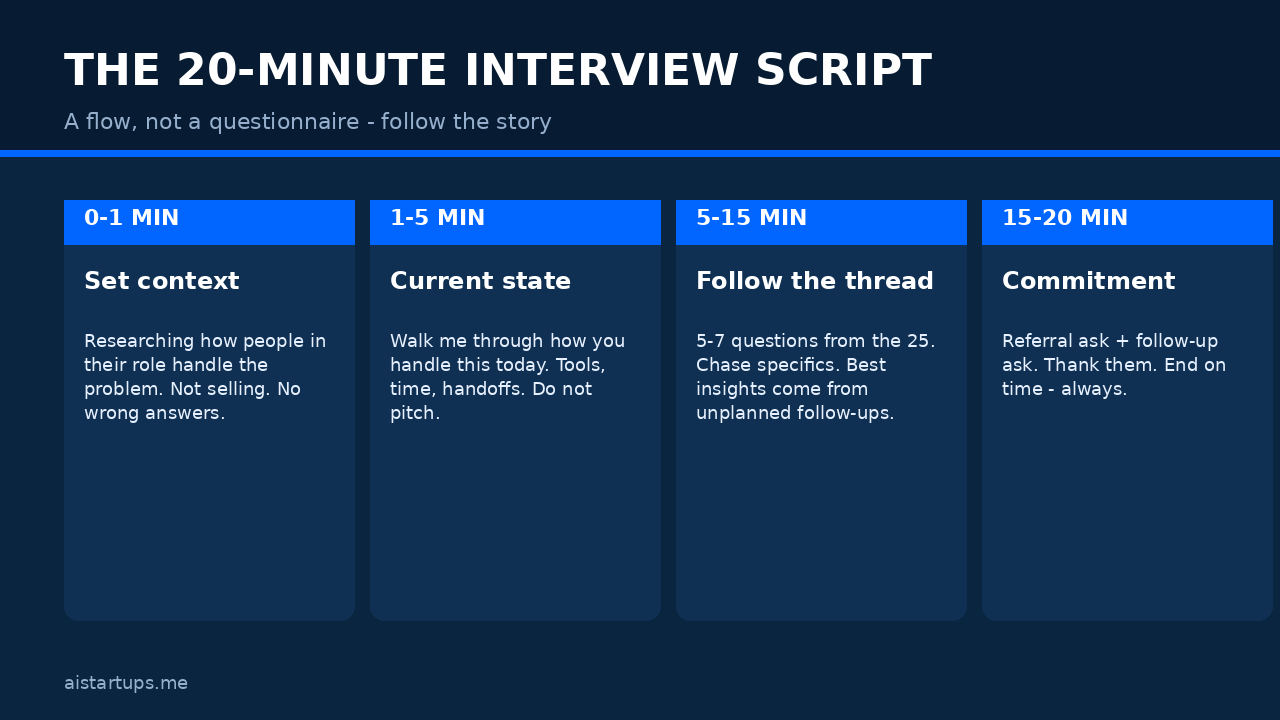
You asked for 20 minutes, so finish in 20. Ending on time makes the referral ask at the close dramatically easier. Here’s the flow that works — treat it as a map, not a questionnaire, and follow the story wherever it goes:
Minutes 0–1: Set context. “Thanks for making the time. I’m researching how [role] handle [problem area]. I’m not selling anything, and there are no wrong answers. Do you mind if I record this so I can focus on listening instead of taking notes?” Always ask before recording. Always.
Minutes 1–5: Current state. “Walk me through the last time you dealt with this.” Listen for tools, time spent, and handoffs between people or systems. Do not — I repeat, do not — mention your product here.
Minutes 5–15: Follow the thread. Use 5–7 questions from the 25 above, starting with current behavior and working toward urgency and spending. Chase anything specific. The best insights always come from follow-up questions you didn’t plan — “wait, why did you do it that way?” is worth more than any scripted question.
Minutes 15–20: Commitment. The referral ask, the follow-up ask, thank them, stop on time. If they offer to pay for early access or introduce you to a colleague without being asked, write that in your notes in capital letters. That’s the good stuff.
A note on setup, from hard experience: if you have a co-founder, go in pairs — one person leads the conversation, one takes notes. The interviewer keeps eye contact and follows threads while the notetaker captures verbatim quotes. Solo founder? Record (with permission) and transcribe. Running the conversation and the notes simultaneously degrades both. And a practical breakdown of this format is worth bookmarking — it covers recruiting, incentives (budget roughly $100/hour for B2B professionals per the User Interviews incentive report), and the 70/30 talk ratio in detail.
Bias Traps: How AI Founders Ruin Good Interviews
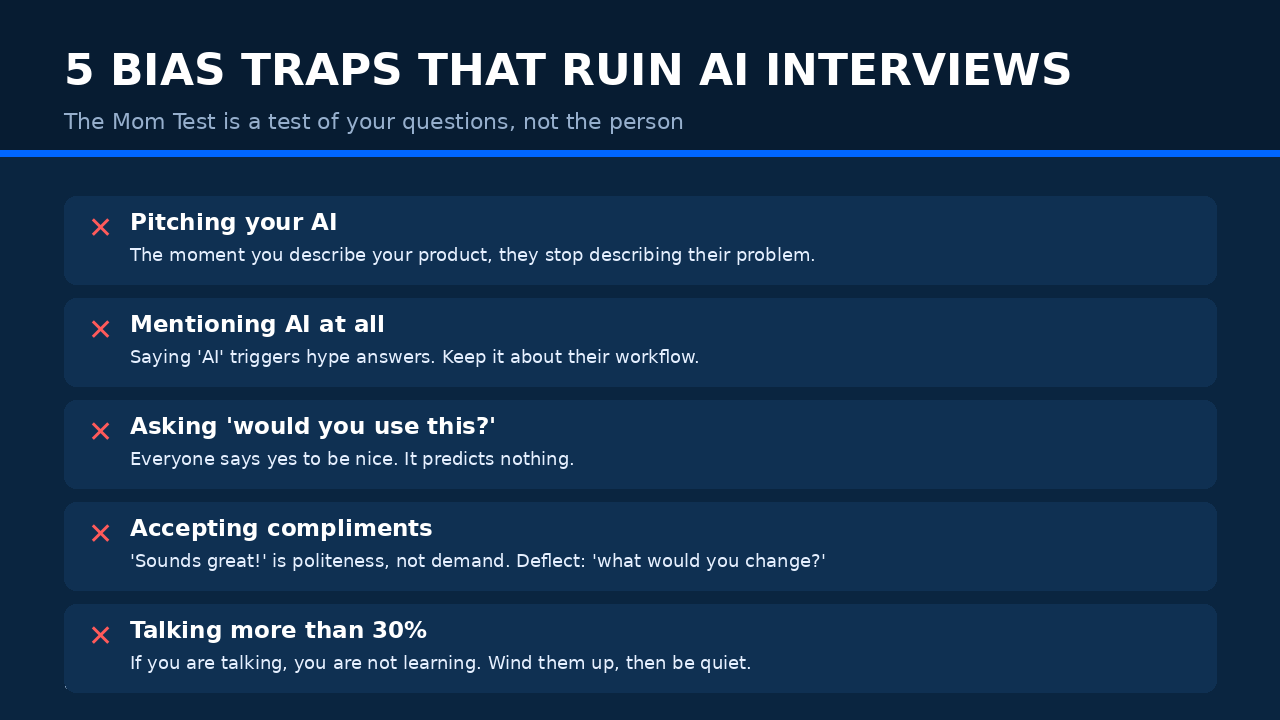
Here’s the don’t list. Print it, honestly — these are the five ways I’ve watched smart AI founders turn gold into garbage:
- Don’t pitch. Ever. Not a little pitch. Not “just to give context.” The moment you describe your solution, they stop describing their problem and start reacting to your idea. If you catch yourself pitching mid-call, say so out loud: “Sorry — I got excited and started pitching. Let’s go back. You were saying that…” Then shut up and listen.
- Don’t say the word “AI” until they do. This is the AI-specific one. “AI” triggers hype answers, sci-fi anxieties, and confident predictions about nothing. Keep the conversation on their workflow, their Tuesday, their spreadsheet. If your product’s value is real, it’ll show up in their answers without the magic word.
- Don’t ask “would you use this?” Everyone says yes to be nice. It predicts nothing. Ask what they did last month instead.
- Don’t accept compliments as data. “This sounds amazing!” feels great and means nothing. Deflect it: “What would you change about it?” or “What worries you about it?” If they can’t name a concern, they haven’t thought about it — which means the problem isn’t real to them.
- Don’t interview your friends and call it discovery. Warm intros are fine for your first two or three practice calls. After that, go cold — LinkedIn, communities, referrals from interviewees. Your friends share your blind spots; strangers don’t.
Using AI in Discovery (the Right Way)
Here’s the irony worth naming: AI is genuinely useful in customer discovery — just not as a replacement for talking to humans. Use it before and after the conversation, never during it.
Before: draft your outreach message and your question list with AI, then edit ruthlessly. Ask it to flag leading questions in your script. Ask it what angles you’re missing for a given segment. It’ll surface customer segments you hadn’t considered — one founder in an NYU workshop discovered entirely new buyer segments this way — but treat every suggestion as a hypothesis to test with real people, not an answer.
After: feed it your notes (anonymized) and ask what patterns it sees, what you might be missing, and what alternative explanations exist for what you heard. Then decide yourself what to keep. AI is a thinking partner here, not a judge — and as the NYU guide stresses, the strategic calls (which segment to focus on, whether to pivot) stay with you.
Never: outsource the conversation itself to a bot, and never let AI talk you out of what your ears heard. If ten humans tell you the problem is X and the model says it’s probably Y, trust the humans. Your edge isn’t having more information — it’s having better insight, and insight still comes from conversations.
What to Do With the Answers
Most discovery guides end at “ask good questions.” That’s like a cookbook that ends at “buy good ingredients.” Here’s the part that actually matters.
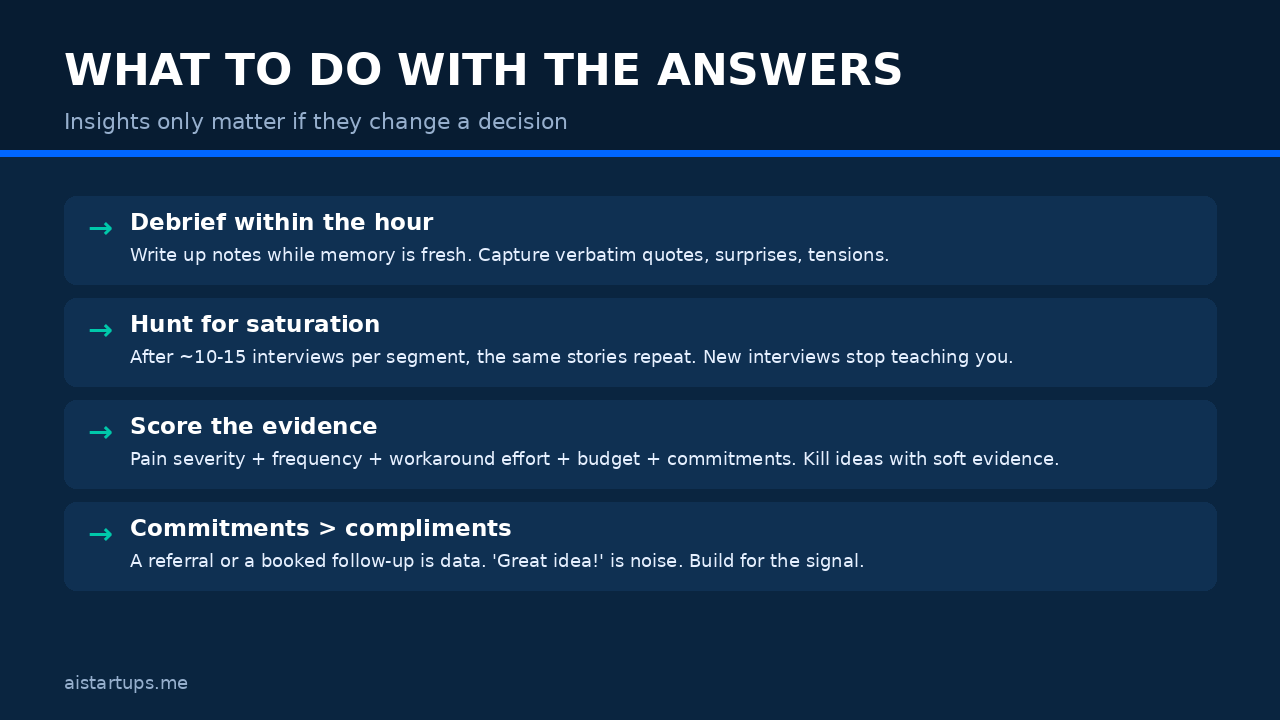
Debrief within the hour. Write up your notes while the conversation is fresh — verbatim quotes, surprises, moments of tension or hesitation. Memory degrades fast, and the exact words customers use become your future landing page copy. If you interviewed in pairs, debrief together for 15 minutes immediately after.
Hunt for saturation, not a magic number. The usual guidance is 10–15 interviews per customer segment, and that’s a fine starting target. But the real finish line is saturation: when interview 12 teaches you nothing that interviews 8–11 didn’t already reveal, you’re done with that segment. If every interview still surprises you, keep going — or narrow the segment.
Score the evidence on one page. For each segment, rate: pain severity, frequency, workaround effort, budget existence, and commitments earned. Be brutal. An idea with “everyone loved it” and zero commitments is a dead idea wearing a costume. Kill it fast — killing a bad idea in week two is a win, not a failure. That’s the whole point of doing this before you build.
Turn patterns into a test. Discovery doesn’t validate anything by itself — it tells you which hypothesis deserves a real behavioral test. Strong pain + active workarounds + real budget = build the smallest possible test: a landing page, a waitlist, a concierge MVP where you manually deliver the “AI” behind the scenes. Our guide to building your AI MVP on a no-code stack picks up exactly where discovery leaves off. And if the test says build but you’d rather not wrestle with the engineering yourself, a studio like AISquadX handles exactly that kind of AI-integration and web development work.
Keep the receipts. Save every transcript and note. Six months from now, when you’re arguing about positioning or pricing, those verbatim customer quotes will settle debates that opinions never could. Founders who skip this step end up re-learning the same lessons at ten times the cost.
If you’re working on a tight timeline, fold this whole process into a 30-day idea-to-launch sprint — discovery is days 1–7, and everything after it gets easier when the evidence is solid.
“The measure of usefulness of an early customer conversation is whether it gives us concrete facts about our customers’ lives and world views. Doing it wrong is worse than doing nothing at all — because a fistful of false positives will send you building with total confidence in the wrong direction.”
Frequently Asked Questions
How many customer discovery interviews do I actually need?
Start with 10–15 per customer segment. You’re done when you hit saturation — new interviews stop teaching you anything new. If you’re still hearing surprises at interview 15, your segment is probably too broad. Narrow it and run another round. Quality of questioning matters more than quantity of calls.
Should I tell interviewees about my AI product idea?
Not at the start — and ideally not at all during discovery. The biggest mistake founders make is mentioning the idea too soon; the moment you do, people stop describing their problems and start evaluating your solution. Learn their reality first. You can show the idea near the end only after you fully understand the problem, and even then, watch for polite encouragement versus real commitment.
How do I get strangers to agree to an interview?
Keep the ask tiny: under 75 words, a specific problem named in the first sentence, 20 minutes max, and explicitly “not selling anything.” Cold LinkedIn and email work for B2B; niche communities (Slack, Discord, Reddit) convert better but take longer to warm up. Expect plenty of no’s — that’s normal, not a signal about your idea. And always end with the referral ask; one warm introduction beats fifty cold emails.
Should I pay people for discovery interviews?
For B2B professionals, the going baseline is around $100/hour for remote sessions (per the User Interviews incentive report). For peers and fellow founders, a coffee gift card or a promise to share your findings is usually enough. The real risk of paying isn’t corrupted signal — it’s attracting people motivated by the payment instead of the problem. Screen harder if you pay: only talk to people who can describe the problem before the call.
What’s the difference between customer discovery and validation?
Discovery asks “is this problem real, painful, and worth solving?” Validation asks “will people commit to this solution?” — with time, money, or action. Discovery comes first and produces the evidence; validation comes second and tests it behaviorally (waitlists, pilots, pre-orders). Skipping straight to validation is how you get fifty “this is amazing!” responses and zero customers. Do the uncomfortable interviews first.
The Bottom Line
Customer discovery for AI products comes down to one discipline: collect facts about customers’ lives, not opinions about your idea. The 25 questions above are just a tool — the real skill is shutting up, following the story, and being willing to hear that your favorite hypothesis is wrong. Sixty percent of them will be. That’s the process working.
Run your 10–15 interviews. Debrief within the hour. Score the evidence brutally. Ask for commitments, not compliments. And when the evidence says build — build the smallest thing that tests the riskiest assumption, then talk to customers again. If you want the marketing side of what comes after, our lean AI startup marketing playbook takes it from there.
The founders who skip this work don’t save time. They just spend it later, building something nobody asked for — with total confidence, all the way down.