


I’ve watched founders spend eight months building an AI product nobody wanted. Beautiful code. Gorgeous landing page. Zero customers. Meanwhile, the founders who actually make it are usually the ones who shipped something slightly embarrassing in month one and let real users tell them what to build next.
Here’s the thing: thirty days is enough. Not enough to build a unicorn — let’s be honest with each other — but enough to go from a napkin idea to a live product with real users and, if you run the sprint right, your first paying customer. The tools in 2026 make this genuinely possible in a way it wasn’t even two years ago. AI app builders, cheap model APIs, free hosting tiers: the infrastructure for a 30-day launch exists. What’s usually missing is the plan.
So here it is. The exact sprint plan, week by week, day by day. Four weeks. One launched product. Steal it.
First, the ground rules
Before the calendar, the rules. Because a 30-day sprint without rules turns into a 30-day panic, and panic builds nothing.
Rule one: one idea, one product, one user. Not three ideas you’re “keeping warm.” Not a platform. One specific person with one specific painful problem. If you can’t describe your user in a single sentence — “freelance bookkeepers who drown in receipt chaos every tax season” — you’re not ready for day one.
Rule two: done beats perfect, every single time. Your MVP should embarrass you slightly. If it doesn’t, you shipped too slow. Nobody’s first version is good; the winners are just the ones whose first version existed.
Rule three: you talk to users every week. Non-negotiable. Building in silence for 30 days and “revealing” the product at the end is how you get a beautiful launch and crickets. The sprint bakes user contact into every week.
Rule four: no fundraising theater. No pitch decks, no logo debates, no “brand identity workshops” during the sprint. You can have a pretty logo after you have a paying customer. (Real talk: most founders use “branding” as procrastination with better fonts.)
Rule five: cap the budget. The whole sprint should cost under $150. If your plan needs more money than that, your plan is too complicated. I’ll break down exactly where the money goes later in this article.
Week 1 — Validate like your rent depends on it (Days 1–7)
Most founders skip this week. Most founders also fail. Coincidence? I don’t think so.
Validation is not a survey. It’s not asking your friends “would you use this?” (They’ll say yes. They love you. Their opinion is worthless here.) Validation is finding strangers with a painful problem and getting evidence — conversations, signups, and ideally money — that the problem is real and they’d pay to make it go away.
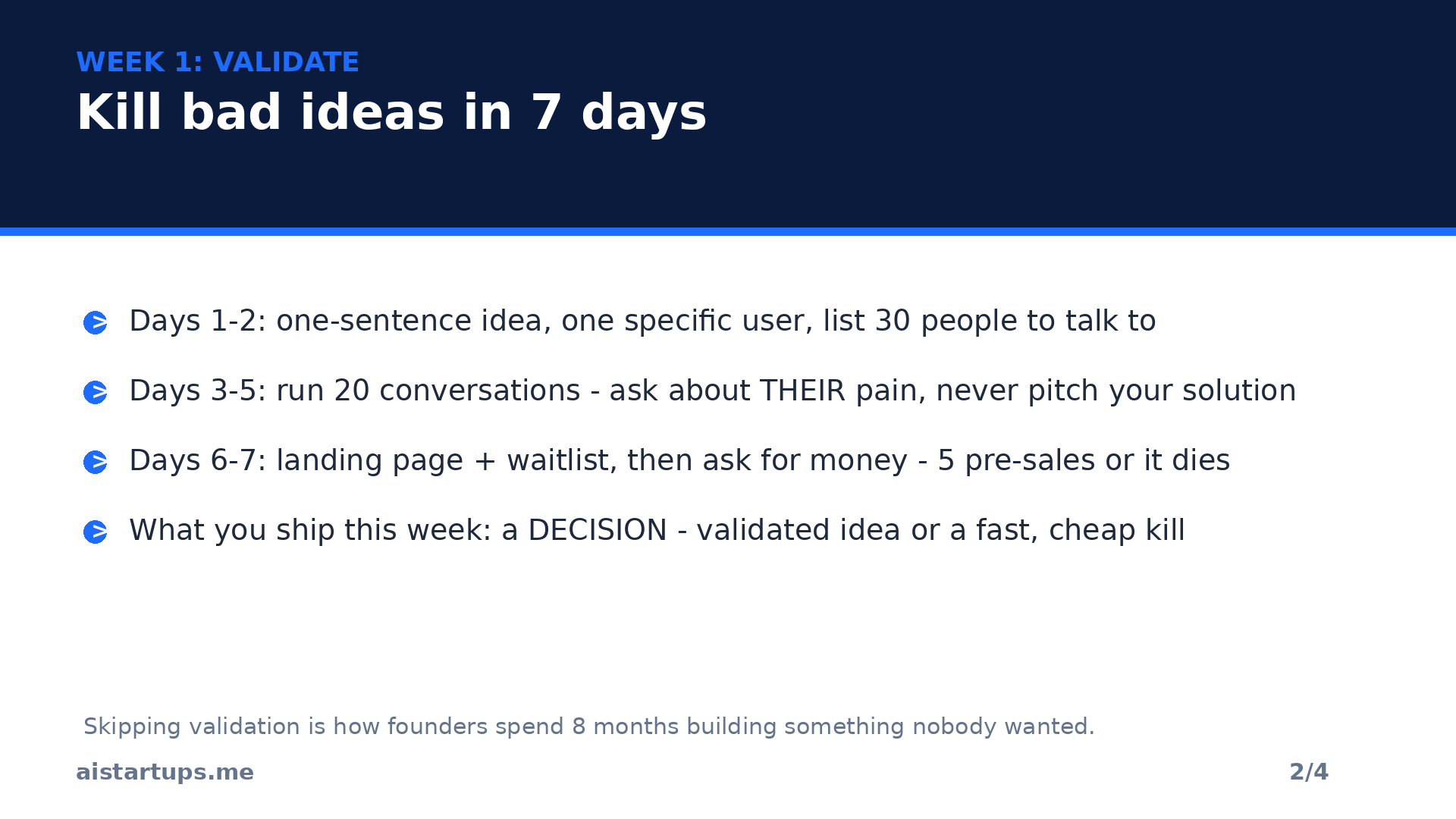
Days 1–2: Sharpen the idea
Write your idea in one sentence. Then rewrite it until a twelve-year-old understands it. Then name your ONE user — specific, reachable, with a wallet. “Small business owners” is not a user. “Dentists running solo practices who lose patients to missed appointment reminders” is a user.
Then make a list of 30 real people you can talk to this week. LinkedIn, communities, cold email, your network’s network. Thirty names, with contact info. This list is your most important asset for the next seven days — treat it that way.
Days 3–5: Twenty conversations
Run twenty conversations. Yes, twenty. In three days. It’s aggressive, but here’s the secret: after about conversation twelve, patterns emerge that no amount of thinking would have given you.
The script is simple, and the golden rule is you never pitch your solution:
- “Walk me through how you handle [problem area] today.” Listen for pain, workarounds, and swearing. Swearing is data.
- “What’s the most annoying part of that process?” This is where the real product lives — not in your idea, in their annoyance.
- “What have you tried to fix it?” If they’ve tried nothing, the pain isn’t real. If they’ve duct-taped three tools together, you’ve found gold.
- “If this problem disappeared tomorrow, what would that be worth to you?” Money talk. Awkward. Necessary.
You are a journalist this week, not a salesperson. The moment you start pitching, people start being polite — and polite people don’t tell you your idea is bad, which is exactly what you need to hear if it’s bad.
Days 6–7: Landing page and the pre-sell test
Build a one-page site: the promise, who it’s for, an email signup. Carrd or any simple builder — this should take an afternoon, not a week. Then email everyone you talked to, plus post it where your users hang out.
Then the real test: ask for money. Offer a founding-member price — say 50% off for life for the first ten buyers — for a product that doesn’t exist yet. Five pre-sales and you have a validated idea. Fewer than five? You have your answer, and it only cost you a week.
The kill criteria, written down so you can’t wiggle out of them later: if you can’t find twenty people with the problem, or nobody will pay even a little for the solution, kill it or pivot. A fast no beats a slow maybe every time. This is the cheapest failure in startup land — one week, almost zero dollars. Compare that to the eight-month version.
If you want to go deeper on the validation craft — the exact questions, the email scripts, the pre-sell mechanics — our full guide to validating an AI startup idea before writing code walks through all of it.
Week 2 — Build the ugly MVP (Days 8–14)
You survived validation. People want this thing. Now build the smallest version that delivers the core value — one workflow, end to end, for a real user. Not the vision. Not the roadmap. One workflow.
Let me give you the stack I’d use, with real numbers:
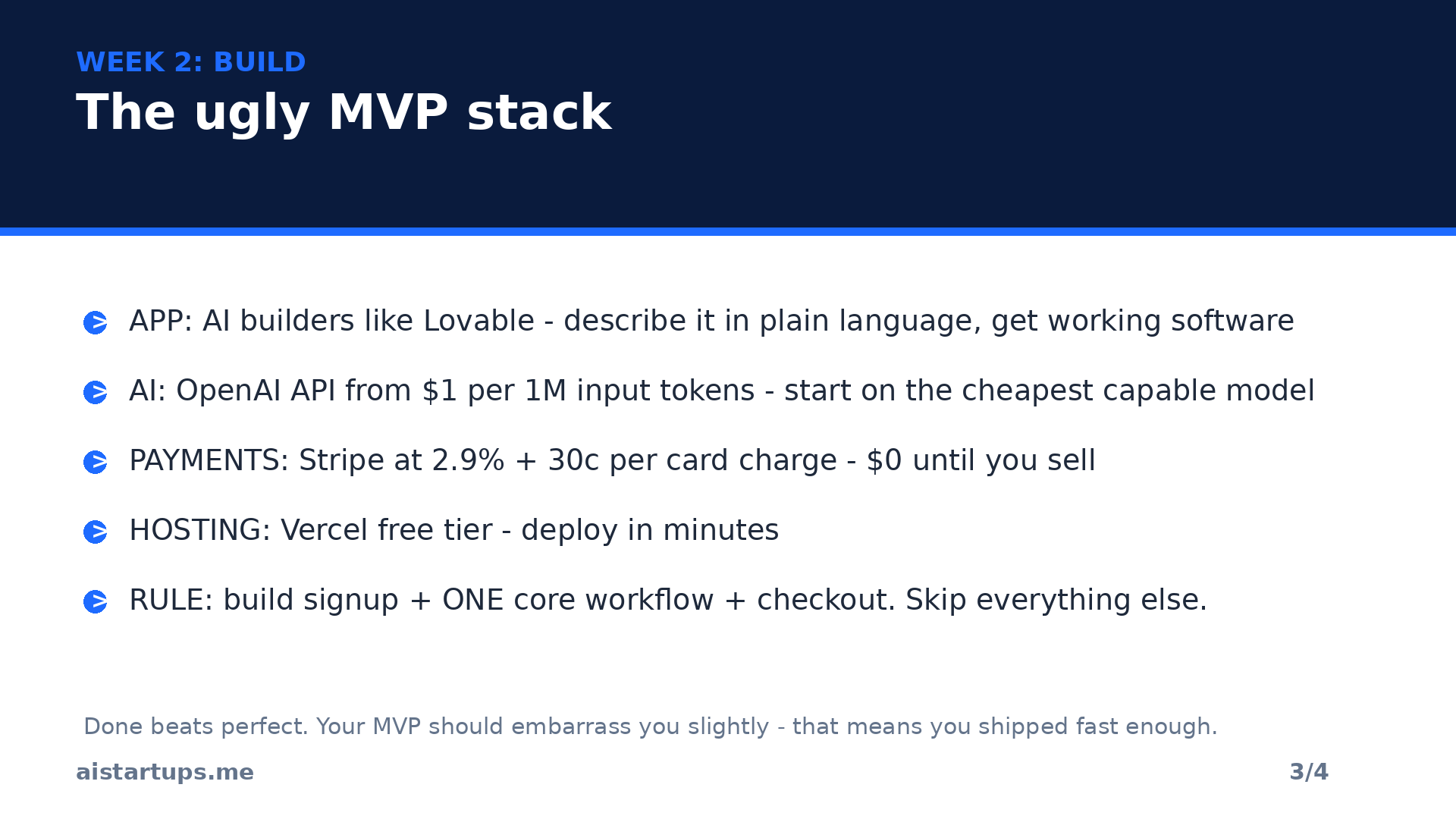
- The app itself: an AI builder like Lovable — describe what you want in plain language and get working software back. In 2026 this is genuinely how MVPs get built in days, not months.
- The intelligence: the OpenAI API, starting on the cheapest capable model (their fast tier runs about $1 per million input tokens). You can upgrade models later; you can’t get back weeks spent over-engineering.
- Payments: Stripe at 2.9% + 30¢ per successful card charge — and $0 until you actually sell something, which is exactly the pricing model a sprint needs.
- Hosting: Vercel’s free Hobby tier — deploy in minutes, pay nothing while you’re small.
Now the build list versus the skip list. This is where sprints live or die:
BUILD: signup, the ONE core AI workflow, Stripe checkout, a basic dashboard showing the user their stuff. That’s the whole product. Four things.
SKIP: admin panel, settings pages, mobile app, custom design system, SSO, multi-language support, dark mode (yes, really — ship light mode and survive). Every “nice to have” is a week you don’t have.
Real talk: if build week has you stuck — auth broken at midnight, payments not firing, deploys failing in ways Google can’t explain — this is exactly the kind of sprint a web development studio like AISquadX runs for founders, and a week of expert help can save you a month of forum-diving. Know when to call in backup; the sprint doesn’t grade you on suffering.
Your definition of done for Friday of week two: a real user can sign up, run the core workflow, and pay — without you on a Zoom call explaining it. If it needs you narrating, it’s a demo, not a product. There’s a difference, and your users will feel it.
For the full tool-by-tool breakdown of building without code in 2026 — which builders handle what, where the limits are — see our complete no-code AI MVP stack guide.
Week 3 — Polish, price, and put it in front of strangers (Days 15–21)
Your MVP works. Now the uncomfortable question: can a stranger use it without you in the room? Because your beta users won’t have you on speed dial, and “just DM me if you get stuck” is not an onboarding strategy.
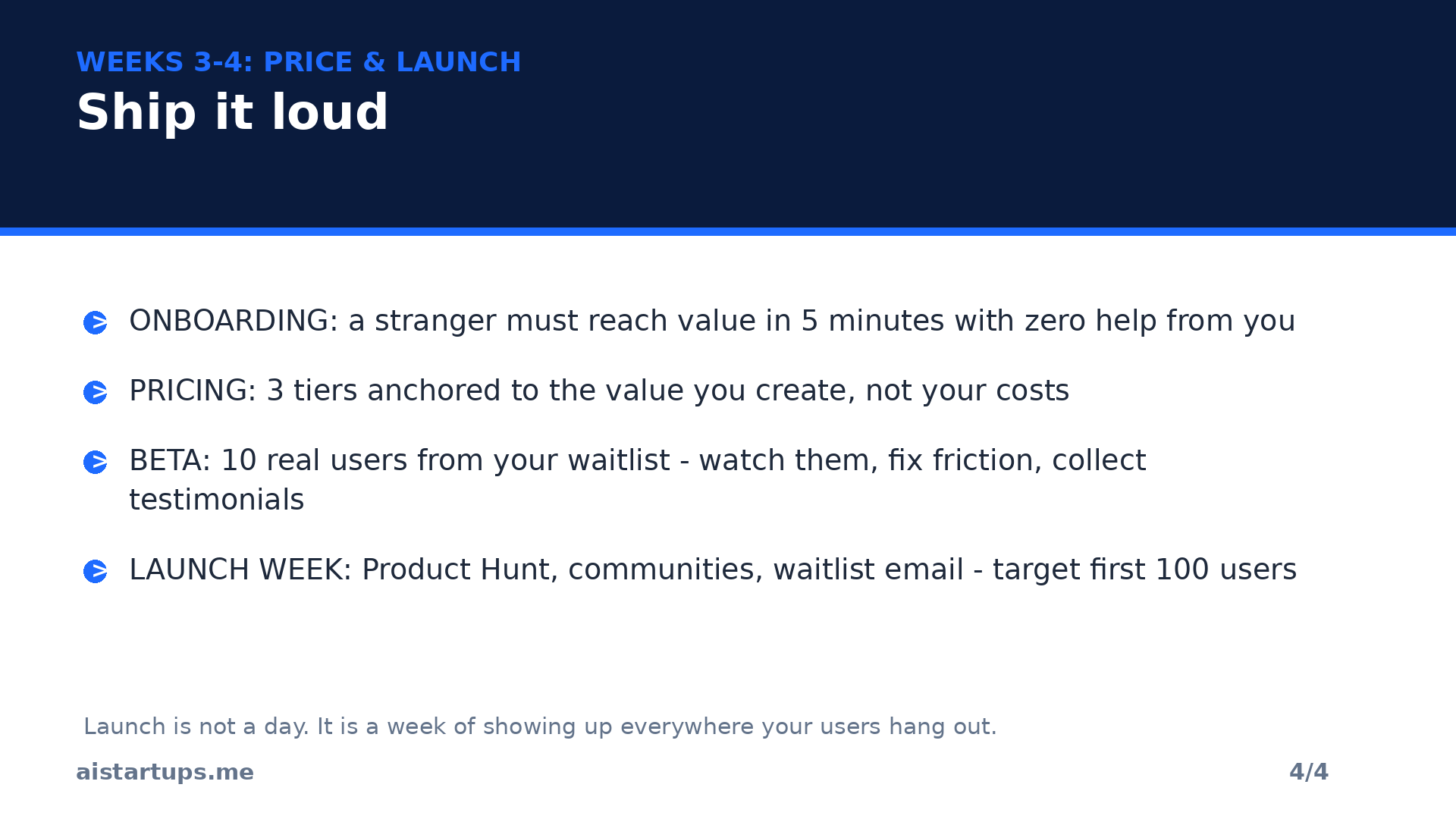
Days 15–17: The 5-minute test
Find three people who’ve never seen the product. Watch them — on a screenshare, silently — try to reach the core value. Don’t help. Don’t hint. Just watch and take notes. Every moment of confusion is a bug, and I mean that literally: confusion is a bug.
Fix the top five confusion points. Usually this means: clearer empty states, one obvious primary button per screen, and copy written like a human instead of a developer. (“Configure your workspace parameters” → “Tell us about your business.” You know the drill.)
Days 18–19: Pricing
Price on value, not cost. Your API bill is not the customer’s problem and shouldn’t set your price — the value you create should. Three tiers: a starter that captures the curious, a middle tier where most revenue lands (make it the obvious choice), and a premium tier for power users that makes the middle look reasonable.
Two more moves: offer annual billing at roughly 20% off (cash up front is a startup’s best friend), and grandfather your first ten users at their founding price forever. Those early believers become your loudest evangelists — treat them like it.
Pricing deserves more thought than two paragraphs, honestly — the psychology, the math, the mistakes. Our founder’s guide to pricing an AI SaaS product goes deep on all of it.
Days 20–21: Beta with ten real users
Pull ten people from your week-one waitlist and let them in. Watch usage, fix friction daily, and — this is the part founders forget — ask for testimonials while the delight is fresh. Three good quotes on your landing page will outperform any copy you write yourself. “Saved me 6 hours a week” from a real human beats your cleverest headline.
Week 4 — Launch loud (Days 22–30)
Launch isn’t a day. It’s a week of showing up everywhere your users hang out. The founders who “launch” with one tweet and then check analytics every four minutes are doing it wrong. Volume and consistency beat a single big-bang moment.
Days 22–24: The launch checklist
Work through it methodically:
- Product Hunt — still the highest-leverage free launch surface for a new tool. Prepare your assets the day before, not the morning of.
- BetaList and startup directories — smaller traffic, but targeted and free.
- Three communities where your users already gather — subreddits, Slack groups, Discord servers, Facebook groups. Read the rules first; nothing kills a launch like getting banned for self-promotion on day one. Contribute value, then share.
- Your waitlist email — these people raised their hands weeks ago. Give them the founding-member deal you promised and make signing up take sixty seconds.
- Your founder story — one honest post on X or LinkedIn: the problem, what you built, what you learned. Not a press release. A story.
Days 25–30: Measure and iterate
Set up one analytics funnel — signup → core workflow → paid — and look at it every morning. Where do people drop off? That drop-off point is your entire roadmap for the next sprint. Fix the biggest leak first.
Your targets for day 30: 100 users, 10 paying customers. Will everyone hit that? No. But aim at it, because a target you miss still beats a vibe you can’t measure. And if you’re far off, the funnel tells you where — which is infinitely more useful than “launch harder.”
For the ongoing engine after launch week — content, distribution, getting to your first thousand users without a budget — our lean AI startup marketing playbook picks up exactly where this sprint ends.
What the whole sprint actually costs
Let’s talk money, because “just build it” advice that ignores budget is fantasy. Here’s the honest math for all thirty days:
- Domain name: ~$12/year. Non-negotiable — you need a real URL.
- AI app builder subscription: one month of a paid plan. This is your biggest line item and worth every cent.
- API credits: $10–20 to start. At roughly $1 per million input tokens on the cheap tier, twenty bucks is an enormous amount of testing.
- Hosting: $0 on a free tier until you have real traffic.
- Payments: $0 until you sell something — then 2.9% + 30¢ per transaction, which comes out of revenue, not your pocket.
- Landing page: free tier of any simple builder, or folded into your app builder.
Total: comfortably under $150. The sprint is designed so money is never the excuse — only effort is.
The founders who win aren’t the ones with the best idea on day one. They’re the ones who reach day thirty with something real in users’ hands — and the humility to change it based on what those users say. Speed doesn’t replace judgment. It just gives judgment better data, faster.
Frequently asked questions
Is 30 days really enough to launch an AI startup?
Enough to launch, yes. Enough to “finish,” no — but products are never finished, so that’s a strange standard. Thirty days gets you a live product, real users, and real market feedback, which is more than most founders have after six months of building in private. The sprint doesn’t promise a mature company in a month. It promises proof — or a fast, cheap lesson.
What if I can’t code at all?
Then this plan was written for you. The entire build week assumes zero coding: AI app builders generate the software from plain-language descriptions, and the API, payments, and hosting all have guided setups. You’ll still need to think clearly about what the product should do — the builder can’t decide that for you — but typing code is no longer the bottleneck. Judgment is.
How do I know if my idea is actually validated?
Three levels, weakest to strongest: people say they’re interested (weak — politeness), people sign up for a waitlist (better — a tiny commitment), people pay you before the product exists (validation). Five pre-sales from strangers is the bar in this sprint. Everything below that is encouragement, not evidence.
How much money do I need for the 30-day sprint?
Under $150 for the full thirty days: a domain (~$12), one month of an AI builder subscription, $10–20 in API credits, and free tiers for hosting and payments. If someone tells you launching requires thousands in upfront spend, they’re selling you something — probably their course.
What if nobody buys at launch?
Then you have data, which is the whole point. Check the funnel: did people visit but not sign up (messaging problem)? Sign up but not use the core workflow (onboarding problem)? Use it but not pay (value or pricing problem)? Each answer points at a specific fix, not a verdict on you as a founder. Most successful products looked like failures at day 30 — the difference is their founders read the data instead of reading the obituary.
The Bottom Line
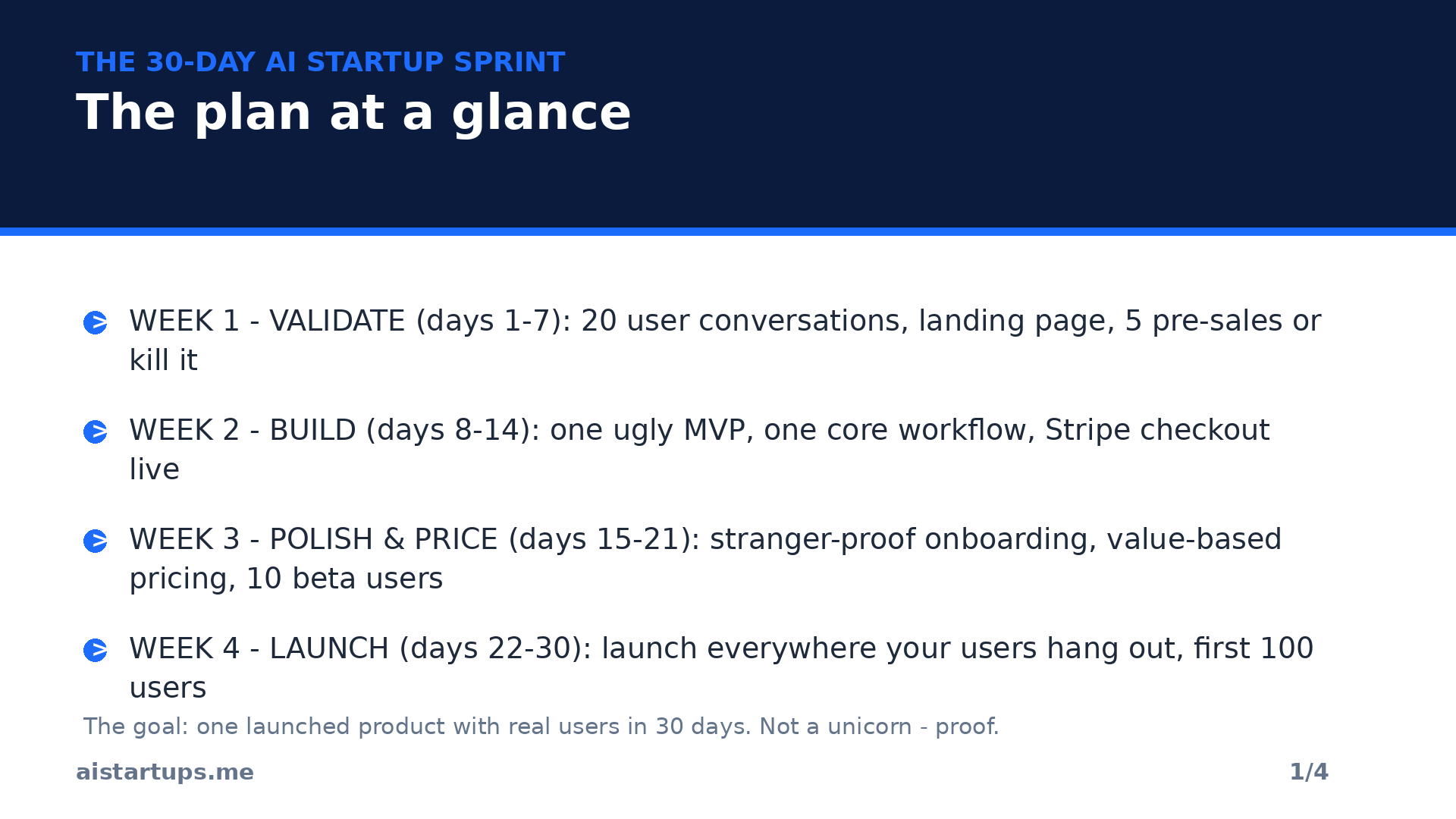
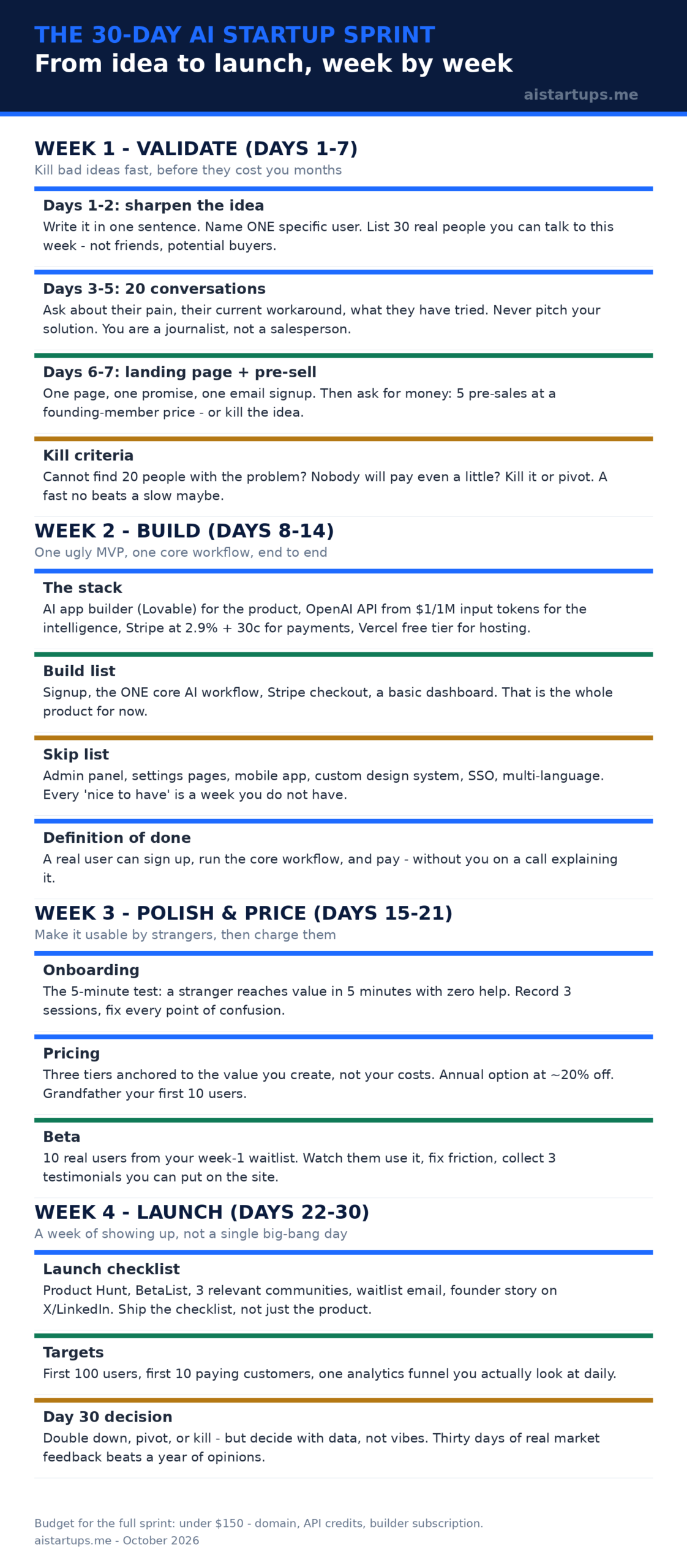
Thirty days, four weeks, one launched product. Validate in week one — twenty conversations, a landing page, five pre-sales or a fast kill. Build in week two — one ugly MVP, one core workflow, Stripe live. Polish and price in week three — stranger-proof onboarding, value-based pricing, ten beta users. Launch loud in week four — everywhere your users are, aiming for a hundred users and ten paying customers.
The sprint won’t make your idea good. Nothing can do that except the market. What it does is compress the distance between your idea and the market’s verdict from “someday” to thirty days — for less than $150. Most founders don’t need more time. They need a deadline, a plan, and the discipline to kill week-one ideas that don’t survive contact with reality.
Start Monday. Ship in thirty days. Then decide what to do with what you learned — because founders with thirty days of real data make better decisions than founders with a year of opinions. Every time.