

Picture this. You’ve spent four months building your AI product. The model calls work. The UI is slick. You push it live, post it on X, tell your friends… and hear nothing. A couple of pity likes. Your mom signs up. That’s it. Crickets.
Here’s the thing — that story plays out constantly, and it almost never has anything to do with the product. The product might be great. The problem is nobody was waiting for it. You launched to an empty room.
A waitlist fixes that. Not a sad little “notify me” form collecting dust. A real waitlist — the kind that does marketing for you while you build, the kind that turns launch day into an event instead of a whimper. Harry’s collected nearly 100,000 emails in a single week before selling a single razor. Robinhood stacked up roughly a million people before the app even opened. Those aren’t accidents. They’re systems. And AI startups? They have unfair advantages in this game that Harry’s never had.
This is the full playbook: the referral mechanics, the math, the email sequences, the AI-specific lead magnets, and the honest numbers on what “good” looks like. By the end, you’ll have everything you need to walk into launch day with 10,000 people already lined up at the door.
Your Waitlist Is Your First Product, Not Your First Marketing Channel
Real talk: most founders treat the waitlist as a formality. A landing page they slap together two days before launch, a Mailchimp form, done. Then they’re shocked when 400 people sign up and 12 show up on day one.
Flip your thinking. The waitlist isn’t the announcement of the product. It is the product — at least for the first 60 days. It’s the thing that creates demand, tests your messaging, recruits your beta testers, and gives you a crowd to launch to. Everything downstream (fundraising, Product Hunt, press) gets easier when you can say “we have 10,000 people waiting.” Investors’ ears perk up. Journalists want the story. Your Product Hunt launch has an army ready at midnight.
And here’s what I wish someone had told me years ago: a waitlist is also the cheapest market research you’ll ever run. If you can’t get 500 people to type their email for a promise, you’ve just saved yourself six months of building the wrong thing. If you’re still in the validating your AI startup idea phase, a waitlist page is the validation. No fake doors, no hand-waving — real demand, measured in real inboxes.
Do the Waitlist Math First (It Takes Five Minutes)
Before tactics, numbers. Because “10,000 emails” sounds nice until you work backward and realize what it actually takes. Let me make this concrete.
A well-built waitlist page converts around 11% of visitors into signups — that’s the median across thousands of waitlists in Waitlister’s published analysis. For context, generic landing pages sit around 6.6% (Unbounce’s benchmark report, which covered something like 57 million conversions). So waitlist pages convert nearly double — because the ask is tiny and the offer is specific.
Now the backward math for 10,000 emails at 11% conversion: you need roughly 91,000 visitors. Sounds like a lot. But referrals change everything. Harry’s got 77% of their emails from referrals — about 20,000 people referred roughly 65,000 friends, averaging more than 3 referrals each. Only about 7% of waitlists even run a referral program, which means most founders are fighting this battle with one hand tied behind their back.
Here’s my rule of thumb for the spreadsheet:
- Direct traffic needed: aim to bring ~40% yourself (communities, social, launch platforms). Referrals should carry the other ~60%.
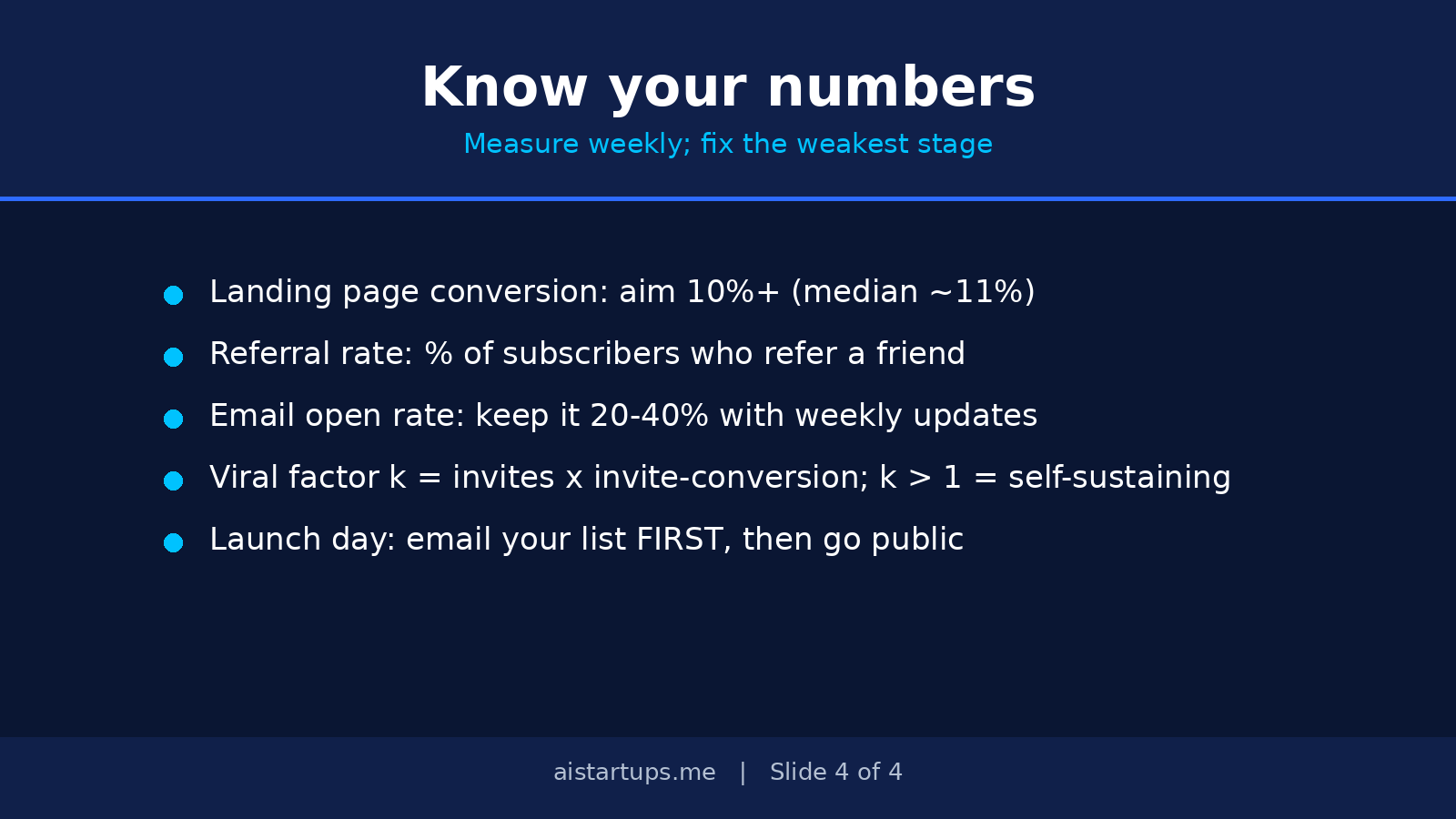
- Conversion target: under 5% means your page or offer is broken — fix it before sending traffic. Above 10% is strong. 20%+ happens with warm traffic.
- Referral rate: track the percentage of subscribers who refer at least one friend. If nobody shares, your reward is wrong, not your audience.
- Viral factor (k): k = average invites per subscriber × invite conversion rate. Above 1 means the list grows itself; below 1 means you’re buying growth with traffic. You don’t need k > 1 — Harry’s-style numbers work fine with k around 0.5 — but you should know yours.
- Open rates: an engaged pre-launch list opens 20–40% of emails. If yours dips under 15%, you’re sending too much or saying too little.
Do this math before you pick tactics. It tells you whether you need 5,000 visitors or 100,000, and that decides where you spend your time.
Steal These Three Playbooks (They Still Work)
You don’t need to invent waitlist strategy from scratch. Three companies already ran the experiments, published the results, and left you the templates.
1. Harry’s: the tiered referral ladder
Harry’s — the men’s grooming brand — ran a one-week pre-launch campaign and collected nearly 100,000 emails. Co-founder Jeff Raider wrote up the whole thing, templates and code included, and it’s still the single best waitlist case study ever published. Here’s the skeleton:
A simple two-page microsite. Splash page with one email field and deliberately mysterious copy (“Respecting the face, and wallet since like right now”). After signup, you landed on a referral page with your own unique link — yoursite.com/yourcode — plus one-click share buttons and a progress tracker showing how close you were to each prize.
The prize ladder was the genius part:
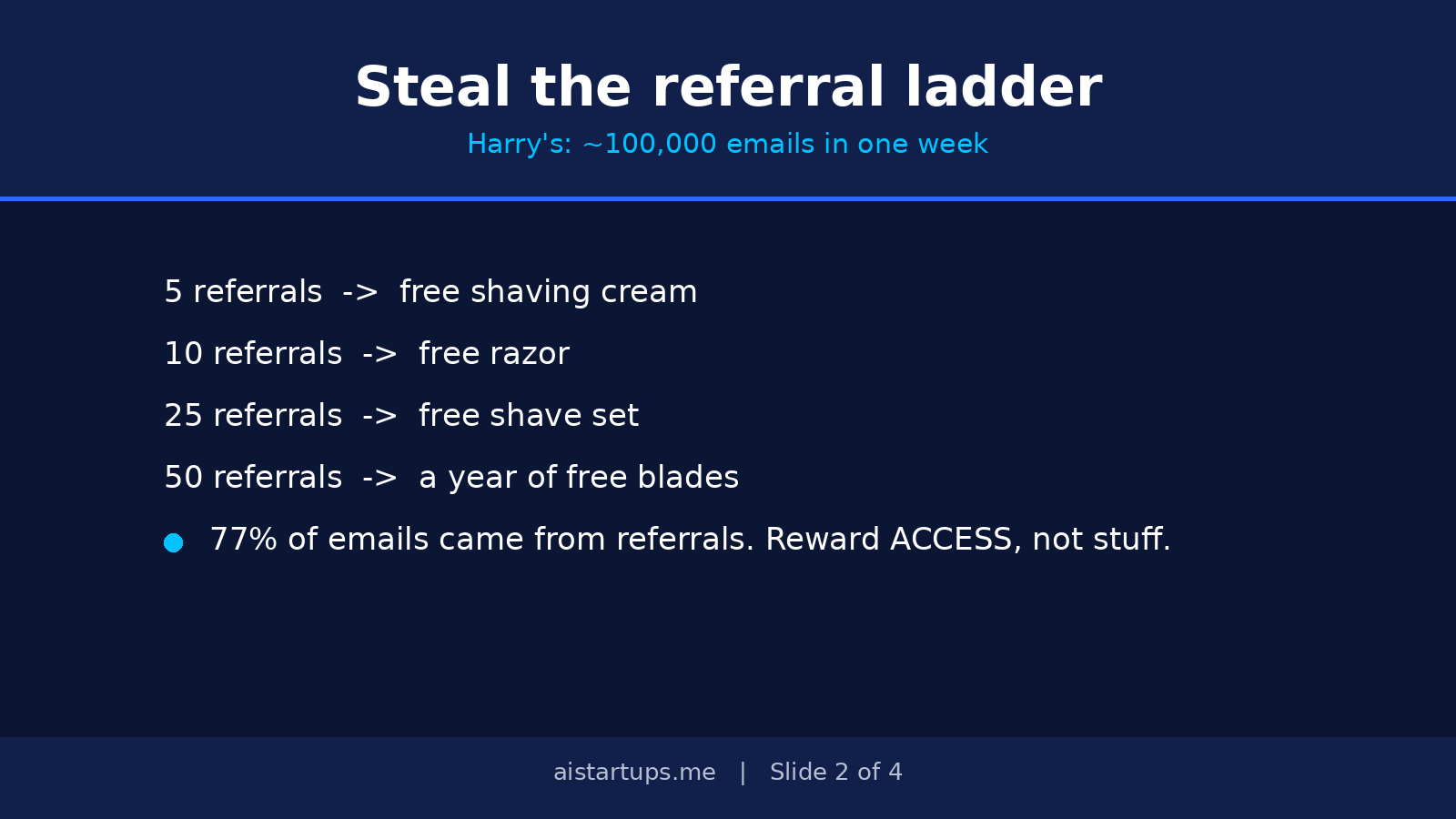
- 5 referrals — free shaving cream
- 10 referrals — free razor
- 25 referrals — premium shave set
- 50 referrals — a year of free blades
Notice the pacing. The first reward is easy — just 5 friends — so people get hooked. Each tier is a stretch but never feels impossible. Over 200 people hit the top tier. And here’s the detail founders miss: Harry’s seeded the whole thing with 12 employees emailing their own contacts first. No press. No ads. Just friends of friends, compounding for seven days.
For an AI startup, swap physical prizes for access: 1 referral = behind-the-scenes updates, 3 = early beta window, 5 = founder onboarding call, 10 = lifetime founder pricing. Access costs you nothing and it’s exactly what your audience wants anyway.
2. Robinhood: the position queue
Robinhood’s version was even simpler. One landing page, one email field, and after signup you saw your exact spot in line — “#50,432” or whatever. Every friend who joined through your personal link jumped you forward. The numbers, from co-founder Vlad Tenev himself: about 10,000 signups on day one, 50,000 in the first week, nearly a million in the first year. More than two-thirds came from referrals.
The trick that made it work: specificity. “You’re #50,432” is motivating. “You’re on the list” is not. And the reward was the product itself — earlier access. No prizes, no gimmicks. Just: the thing you want, sooner, if you help us grow.
One important nuance — Robinhood’s initial spark wasn’t the referral loop. It was a single anonymous Hacker News post that sent the first surge of traffic. The referral mechanics multiplied interest that already existed; they didn’t manufacture it. So don’t skip the part where you actually go get your first few thousand visitors.
3. Dropbox: bake the product into the referral
Dropbox’s classic: invite a friend, you both get 500MB of extra storage. The referral taught people what the product did — sharing files — while growing the list. If your AI product has a naturally shareable unit (credits, generations, seats), this is your model. Give away the thing you’re selling. It’s the cheapest customer acquisition on earth.
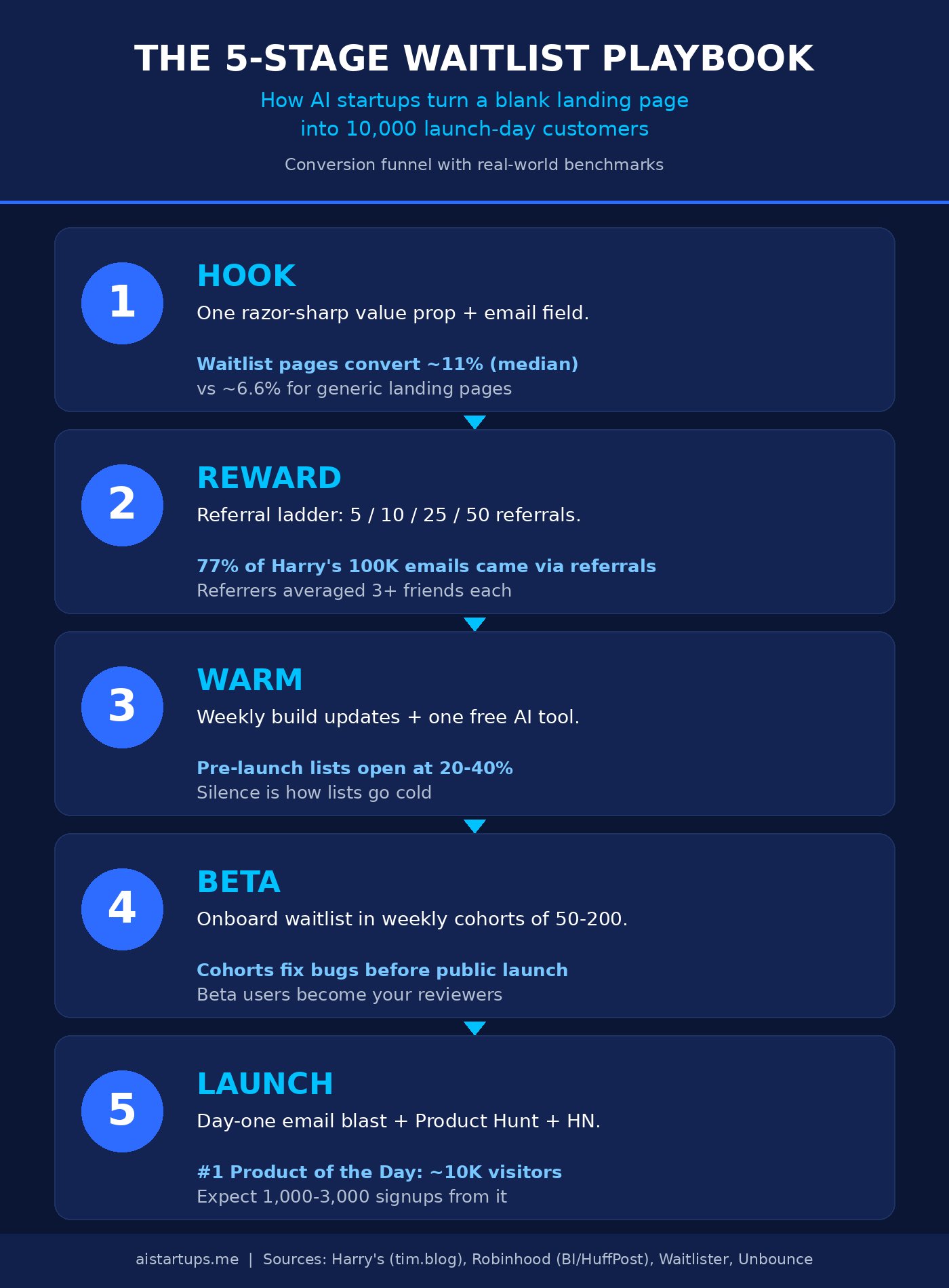
The 5-Stage Pre-Launch Playbook (Actually Do All Five)
Here’s the sequence I keep coming back to. It borrows from all three classics and adds the AI-specific stuff that didn’t exist in 2013.
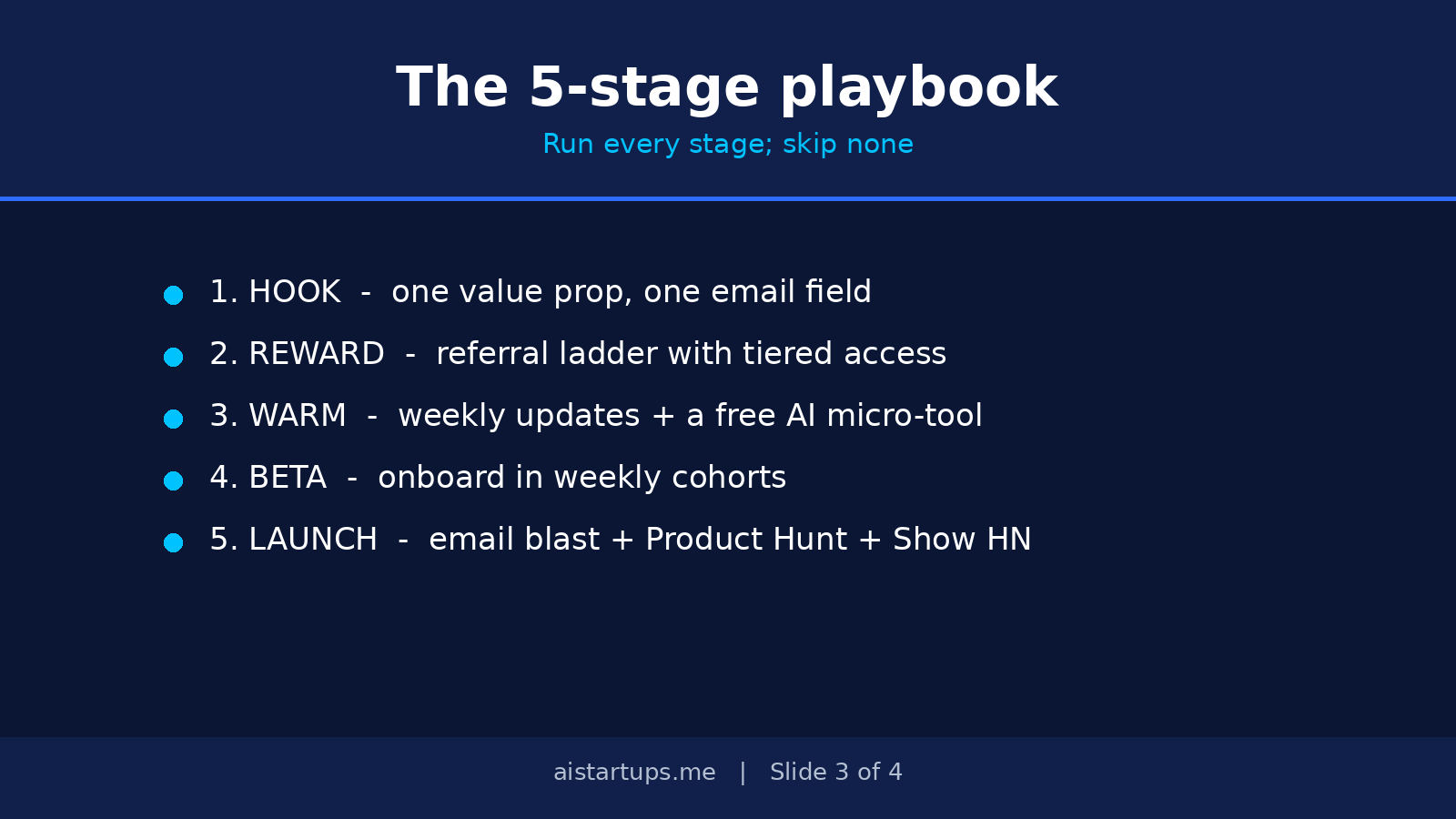
Stage 1: Hook — one page, one promise, one field
Your landing page has exactly one job: convert a curious visitor into an email. That means one razor-sharp value proposition, not a tour of your roadmap. Write the headline so a stranger can repeat it to a friend in one sentence. “AI that turns your meeting recordings into client-ready proposals” — good. “The intelligent productivity platform for modern teams” — delete it and start over.
The form asks for email. Period. Maybe first name if you’ll actually use it. Every extra field — company size, role, “how did you hear about us” — is a tax on your conversion rate, and most founders collect data they never look at. Ship the page on something cheap and fast: Carrd’s Pro Standard plan is $19/year and handles a custom domain plus forms, which is all a waitlist page needs. If you want more design muscle, Framer’s Basic plan runs $10/month on yearly billing.
Want the page to look great without burning a week on it? If design isn’t your thing, an AI integration studio like AISquadX can ship the landing page, wire up the email tool, and even build your first lead-magnet micro-tool in one sprint — so you’re collecting emails while you keep building the product.
Stage 2: Reward — build the referral ladder on day one
The referral ask starts on the confirmation page, not three weeks later in email #4. The moment someone signs up is the highest-intent moment in the entire funnel — they’ve just said “I want this.” Ask immediately: “Who else would want it?”
Show three things on that page: their personal referral link, their current status (position number or milestone progress), and the exact reward for the next tier. Pre-written share text they can post in one click. No friction. Harry’s used the standard Twitter/Facebook share icons because people recognize them instantly — don’t get clever here.
Tools that handle this without custom code: Prefinery and KickoffLabs both do unique referral links, position tracking, and fraud flagging. Harry’s fought referral fraud with simple IP blocking and bounce checks on signup emails — you should at least dedupe IPs and require email confirmation before a referral counts, or prize hunters will farm your top tier.
Stage 3: Warm — email weekly, and give them a free AI tool
This is where most waitlists die. Founders collect 3,000 emails, go quiet for two months while building, then blast “WE LAUNCHED” to a stone-cold list. Open rates crater. Nobody clicks. All that work, wasted.
Email every week. Not newsletters — build updates. What shipped, what broke, what a beta tester did with the product, one screenshot. You’re building in public in their inbox, and every update is another chance to forward the referral link. Pre-launch lists that stay warm open at 20–40%. Cold ones barely crack 10%.
And here’s the AI founder’s cheat code: give away a free micro-tool. Tools are the new lead magnets. Nobody reads the 30-page PDF anymore — it rots in the downloads folder. But a tiny AI tool that solves one specific problem? People use it, get a result in ten seconds, and trust you before you’ve ever pitched anything.
A headline scorer, a follow-up email drafter, a job-description analyzer — pick the one question your audience asks you most and wrap a prompt around it. With modern models, the API cost is fractions of a cent per use, and you can prototype the whole thing in an afternoon. Gate it with an email field and you’ve turned your lead magnet into a referral magnet: every result page says “want the full version? Join the waitlist.”
Stage 4: Beta — onboard in weekly cohorts
Don’t dump 5,000 people into a broken product on day one. Pull from the waitlist in weekly cohorts of 50–200. Small enough to actually talk to. Big enough to find the bugs.
Cohorts do three jobs at once: they stress-test your onboarding in waves, they give referrers something to brag about (“I got into the beta — here’s my invite”), and they convert your loudest fans into launch-day reviewers. Every cohort should end with one question: “Would you tell a friend about this?” If the answer isn’t yes, fix the product, not the waitlist.
Stage 5: Launch — email the list first, then go public
Launch morning: email your waitlist before you post anywhere else. These people earned first access. Give them a 24-hour head start, a founder-pricing window, or a launch-day bonus. Then hit the public channels — Product Hunt, Show HN, your social accounts — with the waitlist army behind you.
Set honest expectations for Product Hunt. Analysis of successful launches puts a #1 Product of the Day at roughly 10,000+ visitors and 1,000–3,000 signups, front page at 2,000+ visitors and 100–300 signups (via this launch checklist). And start building your supporter list at least two weeks out — most makers say you need 400+ committed supporters before launch day, not on it. One caution from founders who’ve been burned: 4,500 signups from a top launch converted to just 5 paying customers for one indie founder this year. Product Hunt traffic is browsing; community traffic is searching. Do both.
Where AI Startups Have an Unfair Advantage
Let me be blunt: AI startups have it easier here than Harry’s ever did, and most of them squander it. Four advantages, if you’ll use them:
1. The demo is the marketing. A 60-second screen recording of your AI doing something magical will outperform any landing page copy you write. Put it above the fold. AI is visceral — people need to see it, not read about it.
2. Free tools as lead magnets. Covered above, but it bears repeating: a tiny AI micro-tool costs you nearly nothing to run and converts like nothing else. This is the one tactic that didn’t exist for the classics. Use it.
3. Building in public is the distribution. AI Twitter and LinkedIn are hungry for build logs. Every week, post what you’re building, what the model did that surprised you, the ugly bug. This compounds. Your audience arrives pre-sold.
4. Personalization at scale. Segment your waitlist by use case from day one (one optional question on signup — the only exception to the email-only rule), then send cohort-specific updates. “Here’s what the tool did for marketers this week” converts better than a generic blast, every time.
Where the First 1,000 Emails Actually Come From
Forget “viral” for a minute. The first 1,000 emails come from unglamorous, deliberate work. Ranked by what actually converts for early AI products:
1. Communities where your buyers already hang out. The right subreddit, an Indie Hackers thread, a niche Slack or Discord. This is the highest-converting traffic you’ll get, because these people were already looking for a solution — you just showed up at the right moment. Read the community rules first, lead with the problem and a demo, and ask for feedback rather than signups. The signups follow.
2. Your own audience (or a borrowed one). Building in public on X and LinkedIn, guesting on a relevant podcast or newsletter, writing one genuinely useful teardown. Slow, but every subscriber arrives warm.
3. BetaList. Built specifically for pre-launch startups — it features products before they launch. Product Hunt, by contrast, doesn’t feature waitlisted products without immediate access, and Show HN excludes pure landing pages. So BetaList is your pre-launch venue; save Product Hunt for the real thing.
4. Product Hunt (on launch, not before). As above — big spike, lower intent. Use it as the megaphone, not the foundation.
5. Paid traffic (only for testing). A small budget — a few hundred dollars — to test which headline converts before you scale anything organic. If a page can’t convert cold traffic at 5%+, don’t scale it; fix the page.
Notice what’s missing: buying email lists, scraping LinkedIn, growth-hack spam. A waitlist built on rented or stolen attention doesn’t convert — it just gives you a bigger number to feel bad about. The whole point is intent. Ten thousand people who asked to be there will always beat a hundred thousand who didn’t.
The Stack That Costs Almost Nothing
You don’t need enterprise software for this. Here’s the honest minimum:
- Landing page: Carrd ($19/year for a custom domain and forms) or Framer ($10/month) if you want more design control. Ship it this weekend.
- Email: Kit (formerly ConvertKit) is free up to 10,000 subscribers with unlimited landing pages and broadcasts — that covers most pre-launch lists end to end. Mailchimp’s free tier is far smaller (250 contacts) with Essentials starting around $13/month, so do the math on your expected list size before committing.
- Referral mechanics: Prefinery or KickoffLabs for unique referral links, queue positions, and fraud detection. Or roll your own with the open-source pattern Harry’s published — unique code per email, cookie attribution, one share page.
- Analytics: track four numbers weekly — conversion rate, referral rate, open rate, k-factor. A spreadsheet beats a dashboard you never open.
Total cost to run a serious pre-launch waitlist: somewhere between $0 and $30 a month, plus your time. The expensive part was never the tooling. For a broader view on keeping your early marketing lean, our lean AI startup marketing playbook covers how to stretch every dollar in those first months.
The Legal Bit (Boring, Necessary, Five Minutes)
Nobody likes this section, but getting it wrong can genuinely hurt you. Short version:
Get real consent. Under GDPR (and increasingly everywhere else), a pre-ticked checkbox isn’t consent. Use a clear opt-in: “Email me launch updates and early access.” Say what you’ll send and roughly how often. That’s it.
Use double opt-in. After signup, send a confirmation email with one click to verify. Yes, you’ll lose some signups to people who never click. What you gain matters more: a clean list, fewer bounces, better deliverability, and proof of consent if anyone ever asks. Your launch-day email landing in spam is a worse outcome than a smaller list.
Make unsubscribing easy. One click, no login, no “please tell us why” interrogation. People who leave quietly are better than people who mark you as spam — spam complaints poison your sender reputation for everyone else.
Have a privacy policy. Even a simple one. If you’re on Carrd or Framer, link it in the footer. It takes twenty minutes and it’s the first thing a savvy subscriber checks.
This isn’t legal advice — I’m a blogger, not a lawyer — but these four steps cover the basics for a pre-launch list. When you start selling, get proper counsel.
Seven Ways Founders Kill Their Waitlist
I’ve watched a lot of waitlists die. It’s almost always one of these:
- Launching the page too late. The waitlist should go live the day you start building, not the week before launch. Every day without it is demand evaporating.
- A vague promise. “The future of AI productivity” converts at 2%. A specific outcome converts at 12%. Specificity is the whole game.
- No referral loop. Remember: only 7% of waitlists run one. This is free growth you’re choosing not to take.
- Going silent. Two months of nothing, then “WE’RE LIVE!!!” to a cold list. Email weekly or don’t bother collecting emails.
- Rewarding the wrong behavior. An iPad giveaway will grow your list with people who want iPads, not your product. Reward with access, credits, or founder pricing — things only a future customer values.
- Letting fraud eat the ladder. The moment rewards have value, someone farms them with throwaway emails. Dedupe, verify, and count only confirmed signups.
- Treating launch day as the finish line. Launch day is halftime. The waitlist becomes your onboarding queue, your review pipeline, your testimonial farm. Keep nurturing it after you open the doors — and keep the momentum going with a tight 30-day launch sprint plan so the spike turns into a slope.
“We couldn’t launch to crickets.” That was Harry’s whole strategy in one sentence — and it’s still the best reason to build a waitlist. The campaign wasn’t about emails. It was about making sure that on launch day, somebody was already in the room.
Frequently Asked Questions
How many emails should be on my waitlist before I launch?
There’s no magic number, but here’s a practical frame: your waitlist should be big enough that launch-day conversions give you meaningful signal. For most AI products, 1,000–2,000 engaged emails is a solid first milestone; 10,000 gives you real launch momentum and something worth announcing. Quality beats quantity every time — 500 people who open every update will outperform 5,000 cold signups. And remember the math: at an 11% page conversion rate, 10,000 emails means roughly 91,000 visitors unless referrals do the heavy lifting.
Should I use a queue position like Robinhood or a reward ladder like Harry’s?
Use position when early access itself is the prize — it creates urgency without costing you anything, and it works best when demand clearly exceeds supply. Use a tiered reward ladder when you can offer escalating perks (beta access, founder pricing, onboarding calls) and your audience enjoys a game-like progression. For most AI startups, a hybrid works: show queue position for urgency, layer milestone rewards on top for the top referrers. Just never invent fake scarcity — if everyone gets in on day one anyway, a position number is theater and people can tell.
How often should I email my waitlist before launch?
Weekly. That’s the cadence that keeps a list warm without burning it out. Each email should contain one genuine update — what shipped, what you learned, a beta tester story, a 60-second demo clip — plus a quiet reminder of the referral link. Engaged pre-launch lists hold 20–40% open rates; if yours slides below 15%, you’re either emailing too often or saying too little. Never go dark for more than two weeks. Silence is how warm lists go cold.
What’s the best free tool for running a waitlist?
For the page: Carrd at $19/year is the cheapest serious option; Framer’s $10/month plan gives you more design room. For email: Kit’s free tier covers up to 10,000 subscribers with unlimited broadcasts, which handles most pre-launch lists without spending a cent. For referral mechanics: Prefinery and KickoffLabs both offer waitlist-specific plans with unique links, fraud detection, and milestone rewards — worth it once referrals become a real channel. Start free, upgrade when a specific limit actually bites you.
Does a waitlist actually help with fundraising or press?
Yes — it’s one of the highest-signal metrics an early AI startup can show. “10,000 people signed up before we launched” tells an investor there’s real demand, tells a journalist there’s a story, and tells a Product Hunt audience there’s momentum. It also de-risks the narrative: you’re not asking anyone to believe in a vision, you’re showing them a spreadsheet of people who already raised their hands. Just be honest about the numbers — engaged signups, not vanity totals — because anyone serious will ask about open rates and conversion next.
The Bottom Line
A waitlist that converts isn’t a landing page. It’s a system with five stages: a sharp hook, a referral ladder that rewards the right behavior, weekly emails that keep the list warm, beta cohorts that turn subscribers into fans, and a launch sequence that treats your list like VIPs instead of an afterthought.
The classics proved the mechanics — Harry’s 100,000 emails in a week, Robinhood’s million-person queue. The benchmarks tell you what good looks like — 11% page conversion, 20–40% open rates, referrals carrying the majority of growth. And AI startups get the cheat codes the classics never had: demos that sell themselves, free micro-tools as lead magnets, and an audience that’s actively looking for what’s next.
So here’s your homework. This week: ship the page (one headline, one email field), wire up the referral ladder, and send your first update to the twelve people who already believe in you — your team, your friends, your earliest believers. Harry’s started with 12 employees and their contact lists. You can start with less.
Ten thousand emails won’t collect themselves. But the system to get them? That’s been figured out for over a decade. You just have to run it.