


Anthropic didn’t ease into this one. On Nov 9, 2026 — yesterday — the company launched Claude Fable 5.2, and the announcement reads like someone at Anthropic got tired of being polite about what their flagship model can do.
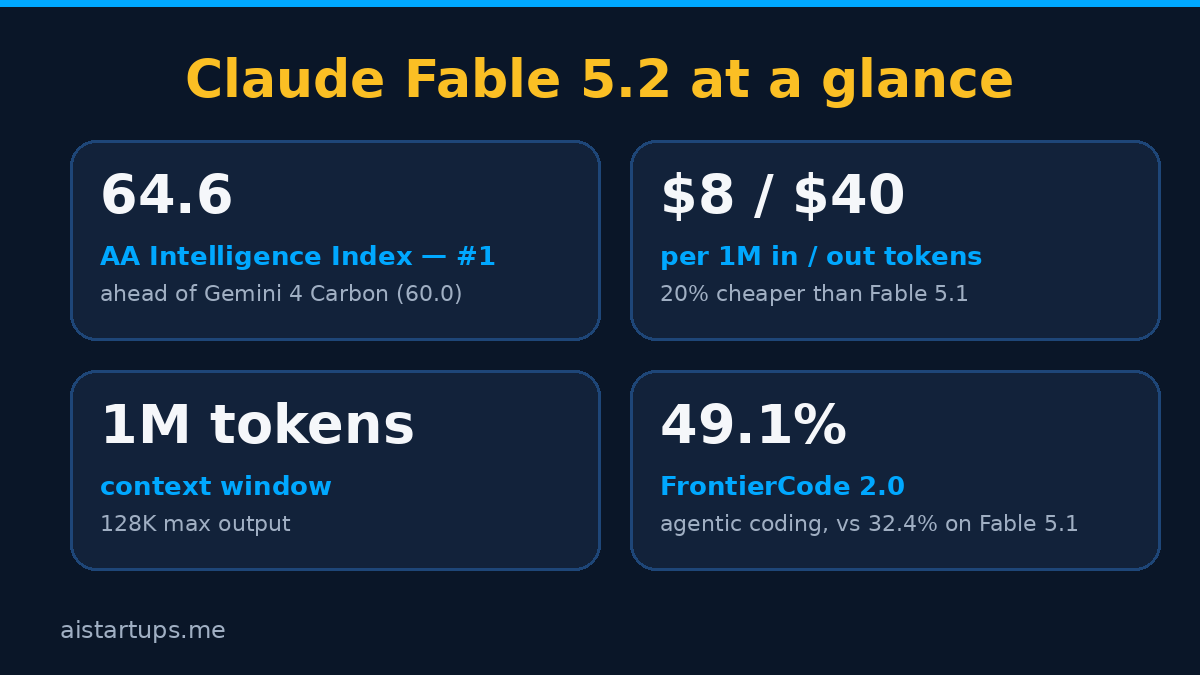
Here’s the thing, though. I’ve seen a lot of model launches. Most of them boil down to “slightly better at benchmarks you’ve never heard of, slightly more expensive.” This one is different in a way that actually matters for a founder: it’s better and cheaper. The API price dropped 20% from Fable 5.1, the thing runs up to 30% faster, and on the independent test that matters most right now, it sits at number one.
But — and this is the part the announcement doesn’t shout about — it doesn’t win everywhere. There are spots where its cheaper siblings beat it. There are spots where a rival beats it. And if you throw it at every task in your company, you’ll burn money for no good reason.
So this is the honest version. What Fable 5.2 actually is, what it costs in real dollars, what the benchmarks really say (including the ones Anthropic would rather you skim past), and a practical playbook for using it in a startup without turning your API bill into a second rent payment. Let’s get into it.
What Is Claude Fable 5.2, Really?
First, a quick bit of housekeeping, because the launch actually involved two models with the same brain. Fable 5.2 and Mythos 5.2 are the same underlying model. The difference is who gets to use which one. Mythos is reserved for vetted organisations — Anthropic’s Cyber and Life Sciences Verification Programs, basically institutions that have been through a screening process. Fable is the one the rest of us get.
That’s it. Same model, different gate. If you’re a founder, Fable 5.2 is your model.
It’s available now on paid Claude plans, in Claude Code, through the Claude Platform API (the model ID is claude-fable-5-2), and on AWS, Google Cloud, and Azure. So wherever you already run Claude, it’s there — no new vendor, no new contract, no migration project.
Anthropic calls Fable its most capable model, and on the evidence so far, that’s a fair description. It’s built for long, open-ended, technically hard work: the kind of task where you hand the model a big, messy brief and it has to plan, build, test, fix its own mistakes, and keep going for hours. Think of it as the model you call when the job is too big, too tangled, or too ambitious for the everyday models.
And here’s a detail that tells you a lot about how Anthropic sees it: over 90% of the changes merged into Anthropic’s own core codebase are now written by Claude. That’s Anthropic’s own claim, not an independent measurement — but it does explain why the company is so confident about long-running coding work. They’re eating their own cooking, at serious scale.
What Changed Since Fable 5.1?
If you used Fable 5.1, the upgrade is real, not cosmetic. Three things changed that you’ll actually feel.
First, speed. Fable 5.2 produces output up to 30% faster than Fable 5.1. That sounds like a spec-sheet line until you’ve sat watching a long coding agent run and realized the bottleneck isn’t the model’s thinking, it’s how fast tokens come back. A 30% speed-up on a two-hour agent run is real time back in your day.
Second, the context window. You get a 1M-token context window and up to 128K tokens of max output. A million tokens is roughly an entire codebase, a pile of docs, and a long conversation history, all in one go. The knowledge cutoff is June 2026, and Anthropic says it won’t retire the model before Nov 9, 2027 — so you’re not building on something that disappears in three months.
Third, price. And this is the unusual one. New flagship models normally cost more. This one costs less — 20% less than Fable 5.1. We’ll get into the exact numbers below, because the pricing structure has a few wrinkles worth knowing (there’s a fast mode, there’s a batch discount, and caching changes the math a lot).
There’s also a quieter improvement that’s easy to miss: Fable 5.2 blocks fewer legitimate requests than its predecessor. Anthropic says about 55% fewer blocks overall — 60% fewer on cybersecurity topics, 40% fewer on biology. The model still refuses most cybersecurity and biology requests (and blocked queries fall back to Opus 4.8 for cyber and Opus 5 for biology), but the false-positive rate dropped a lot. If you ever had Fable 5.1 refuse something reasonable, this is the fix.
The Price, in Real Dollars
Okay, the part founders actually care about. Here’s the pricing, straight from Anthropic:
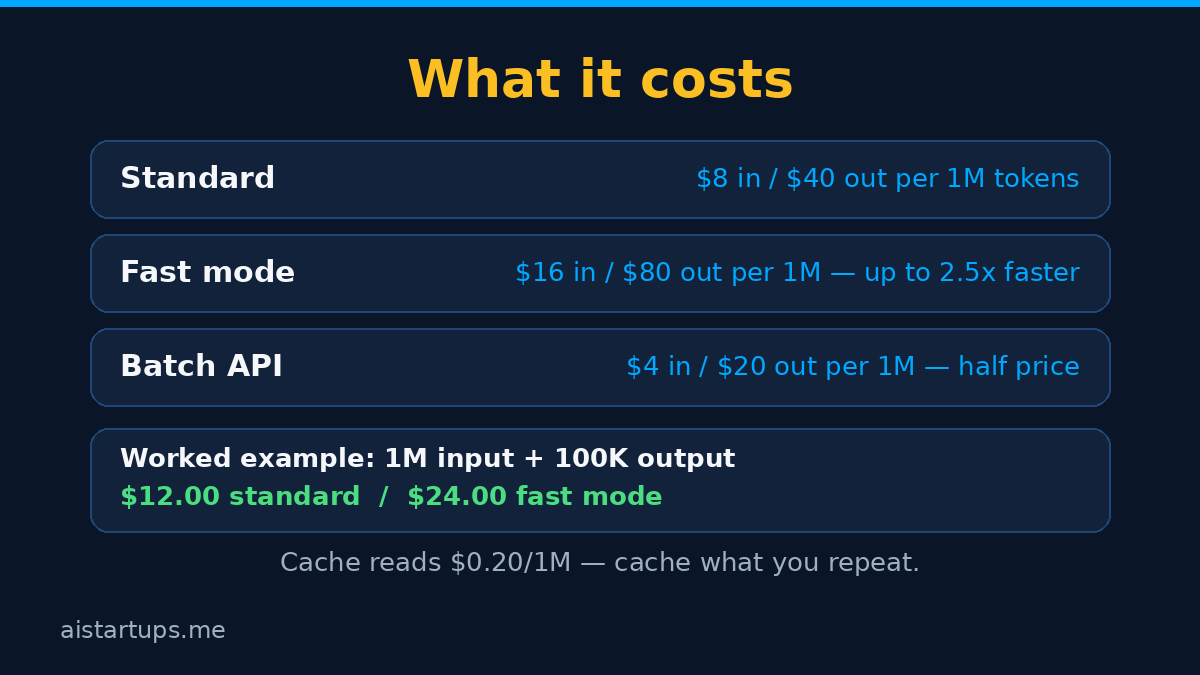
- Standard: $8 per million input tokens, $40 per million output tokens.
- Fast mode (optional): $16 per million input, $80 per million output — up to 2.5x faster token generation.
- Batch API: $4 per million input, $20 per million output — half price, for work that can wait.
- Prompt caching: $0.20 per million tokens for cache reads, $10 for a 5-minute cache write, $16 for a 1-hour cache write.
Compare that with Fable 5.1’s $10 input / $50 output, and the 20% cut is real. But the number that matters for your budget is cost per task, not cost per token — and that’s where it gets interesting.
Anthropic’s own system card puts the average cost at $6.72 per FrontierCode task at High effort. And at High effort, Fable 5.2 roughly matches Opus 5.5’s best FrontierCode score for about half the cost per task. Read that again: similar top-end coding performance, roughly half the money. That’s the kind of trade that changes which model you reach for.
Let me make it concrete with a worked example. Say you send 1 million input tokens and get 100,000 output tokens back. Standard mode: $8 for the input plus $4 for the output — $12 total. Fast mode: double that, $24. Same job, same result, twice the price for up to 2.5x the speed. Worth it when you’re sitting there waiting. Not worth it for an overnight batch job nobody’s watching.
And that batch discount is the quiet money-saver. If your work can wait — nightly reports, bulk content processing, background analysis — the Batch API halves your bill to $4/$20. Half. For a startup running a lot of background AI work, routing the patient stuff to batch and the urgent stuff to standard is one of the easiest cost wins available right now.
One more thing: there’s a launch-week promo. Eligible paid plans get 1–3 extra Fable usage resets, and Fable is included for up to 50% of weekly usage limits on Pro and standard Team seats. If you’re on a paid plan, check your account — you may have more Fable usage sitting there than you think.
So What Does It Cost to Actually Run a Startup on This?
Honestly? It depends on how you use it, and the range is wide. A founder using Fable 5.2 for a few big weekly tasks — a deep research job, a tricky refactor, a planning session — might spend tens of dollars a month. A team running it as the default model for everything, all day, could spend hundreds or thousands.
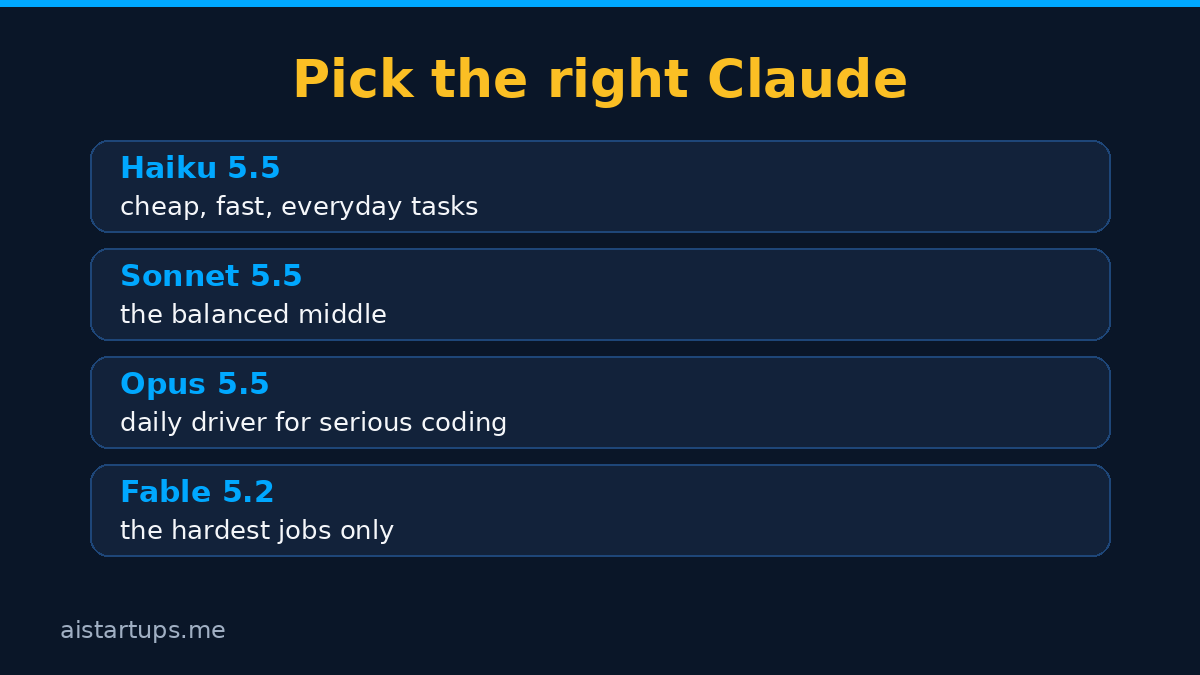
The smart move is the boring one: default to the cheaper model, escalate to Fable when the job earns it. Anthropic says this itself — Opus 5.5 stays the daily driver for most coding and knowledge work, and Fable is for the most ambitious, open-ended technical work. Use the expensive brain for the hard problems. Use the cheaper brain for everything else. Your finance person will thank you.
If you want the full picture on how the model tiers fit together, my Sonnet 5.5 hands-on guide walks through the everyday workhorse of the family, and the Opus 5.5 price war breakdown covers the pricing fight that pushed costs down across the whole market.
The Benchmarks — What Fable 5.2 Actually Scores
Right. Benchmarks. Everyone quotes them, almost nobody reads them properly. So let’s do this carefully, because there are two kinds of numbers here: Anthropic’s own (vendor-reported, and you should know that) and independent ones (from Artificial Analysis, which tests models itself).
Start with the independent headline, because it’s the strongest claim in this whole launch. On the Artificial Analysis Intelligence Index v5, Fable 5.2 scores 64.6 at max effort — number one overall, ahead of Gemini 4 Carbon at 60.0 and Claude Opus 5.5 at 59.1. That’s not a narrow win. That’s a clear gap over the next-best model from any company. You can see the full ranking on the Artificial Analysis Intelligence Index.
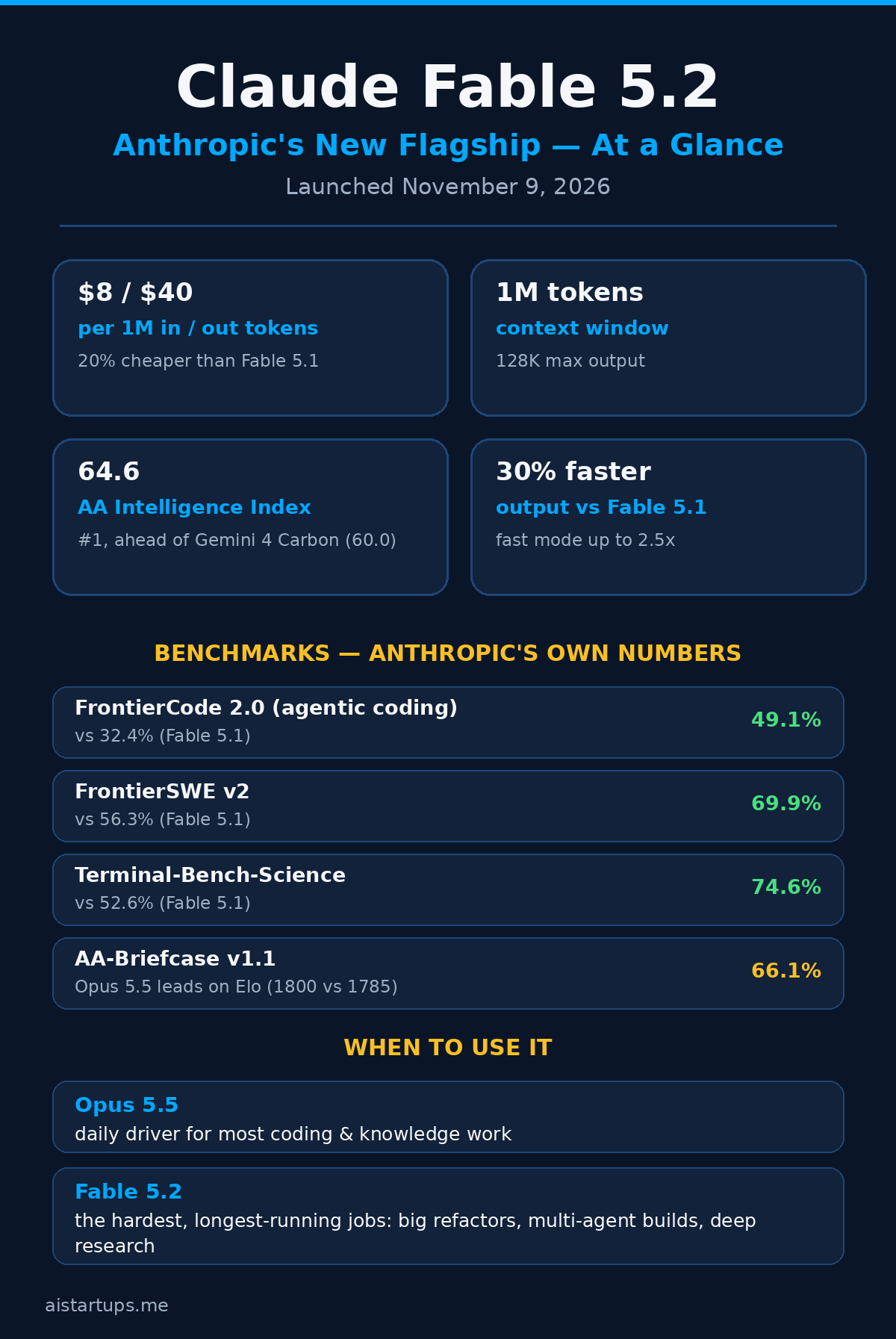
Now Anthropic’s own benchmark table. These are vendor-reported numbers, measured at the highest effort level unless I say otherwise — keep that in mind, because vendors always test their own model in the best light. Even with that caveat, some of these jumps are hard to ignore:
- FrontierCode 2.0: 49.1% — up from 32.4% for Fable 5.1. For comparison, Opus 5.5 scores 45.5%, GPT-6 Astra 42.8%, and Gemini 4 Carbon 41.1% at Medium effort. That’s a 17-point jump in one generation on a hard coding benchmark.
- FrontierSWE v2: 69.9%, up from 56.3% for Fable 5.1. Opus 5.5 is at 62.3%, Astra 65.5%, Carbon 61.2%.
- Terminal-Bench-Science 0.1: 74.6%, up from 52.6% for Fable 5.1. A 22-point jump.
- RoboDojo Sim: 64.9%, up from 27.6% for Fable 5.1. More than double. That’s the kind of number that makes you blink.
- Remote Labor Index: 41.3% at High effort, up from 17.9% for Fable 5.1. Again, more than double.
- Humanity’s Last Exam (with tools): 74.2%.
- OSWorld 2.1: 89.3%.
- Chartography: 73.4%.
- AA-Briefcase v1.1: 66.1% on the rubric, 1785 Elo.
- AutomationBench: 51.4%.
That last pair deserves a closer look, because this is where the story gets honest instead of shiny.
Where It Doesn’t Win (Yes, Really)
Here’s the part most launch coverage skips. Fable 5.2 does not lead everywhere, and if you’re picking a model for your startup, the gaps matter as much as the wins.
On AA-Briefcase v1.1, Fable 5.2 scores 1785 Elo — but Opus 5.5 scores 1800 and Sonnet 5.5 scores 1813. Yes, you read that right: on this office-knowledge-work test, both of its cheaper siblings beat it. If your main use case is briefcase-style work — documents, spreadsheets, office tasks — the flagship is not the best tool in its own family.
On AutomationBench, Gemini 4 Carbon leads at 53.9% against Fable’s 51.4%. And the independent testing from Artificial Analysis adds two more dents. On Terminal-Bench 4.0, Fable 5.2 scores 60% — behind Kimi K3.1 Pro at 67% and Gemini 4 Carbon at 65%. On GDP.pdf, it scores 24% against Opus 5.5’s 26%.
So the honest summary is: Fable 5.2 is the best overall model on the independent index, and a clear leader on the hardest coding and agentic benchmarks. But it loses specific tests to cheaper models and rival models. That doesn’t make it a bad model — it makes it a specialist. A very strong specialist. And specialists should be used like specialists: brought in for the work they’re best at, not handed everything by default.
For the rival picture, my Gemini 4 Carbon founder’s guide covers the model that beats Fable on AutomationBench, and the Kimi K3.1 Pro guide covers the model that leads it on Terminal-Bench. Worth a read before you commit to one ecosystem.
The Demos — Impressive, But Read the Label
Anthropic’s announcement comes with a set of demos that are, frankly, wild. And I want to walk through them — but with the label attached, because every one of these is Anthropic’s own claim. None of them is independently verified. That’s not me being cynical; it’s just the correct way to read a vendor announcement.
According to Anthropic, Fable 5.2 and its subagents built a bootable operating system prototype in 8 days, using more than 1,000 subagents working together. It formalised Fermat’s Last Theorem in 30 hours — a job whose first attempt took 11 days. It solved two open black-hole physics problems. It designed three working electronic devices in under a day each, working with a company called Diode: a voice-assistant hub, a USB speakerphone, and a handheld virtual pet. And in a Python-to-Rust production migration, the service now starts about 26 times faster.
Look, if even half of that holds up in real-world use, it’s a big deal. The OS prototype is the one that sticks with me — a thousand subagents, eight days, a bootable system. That’s not a chatbot answering questions. That’s a model running a small engineering organisation.
But here’s my honest take: demos are demos. They’re run by the vendor, on the vendor’s terms, with the vendor’s engineers nearby. Your startup’s codebase is messier than a demo. Your requirements are vaguer. Your tests are flakier. The demos tell you what’s possible at the ceiling. They don’t tell you what you’ll get on a random Tuesday with your actual repo.
What they do tell you is where to aim Fable 5.2. The pattern across all of them is the same: long-running, multi-step, technically deep work where the model has to keep going, check itself, and coordinate a lot of moving parts. That’s the use case. Not “write me a landing page.” That’s a job for a cheaper model. The use case is “migrate this service,” “build this prototype,” “work through this research problem for two days and show me what you found.”
Fable 5.2 isn’t the model you use for everything. It’s the model you use when the job is big enough, messy enough, and valuable enough to justify the best brain in the room — and you give it the time and the context to actually do the work.
What This Means for a Startup, Practically
Enough benchmarks. What does a founder actually do with this thing on Monday morning?
Start with the use cases where Fable 5.2 earns its price. The pattern is consistent: long tasks, big context, high stakes.
Big refactors and migrations. The Python-to-Rust migration in Anthropic’s demo is the template. Got a service that needs moving, a framework that needs upgrading, a codebase that needs restructuring across dozens of files? That’s Fable work. A million-token context window means it can actually hold your whole codebase in mind at once instead of working from fragments and guessing.
Prototypes you couldn’t staff. The OS prototype and the three hardware devices point the same way: Fable 5.2 is good at taking a vague brief — “build me a working version of this” — and grinding through the long tail of details. For a startup, that means prototypes that used to need a hire, or a contractor, or three weeks of your CTO’s time. Now they might need a weekend and a careful prompt.
Deep research that takes days. The black-hole physics problems and the Fermat formalisation are extreme versions of the same thing: give the model a hard question, a pile of sources, and time. For a startup, the realistic version is competitive research, technical due diligence, market analysis with real depth — the kind of work where a shallow answer is worse than no answer.
Multi-agent workflows. This is the one I’m watching most closely. Fable 5.2 can work as an Advisor — smaller models consult it when they get stuck — or as an Orchestrator, delegating work to smaller models and checking their output. That’s a real architecture for a startup: cheap models doing the bulk work, Fable stepping in for the hard judgment calls. It’s how you get flagship quality at non-flagship prices.
And the use cases where it doesn’t earn its price? Routine code completion, first drafts of anything, customer support replies, summarising documents, formatting data. That’s Opus or Sonnet work. Fable would do it fine — and charge you flagship rates for it. Don’t.
The Founder Playbook: Five Steps to Start This Week
Alright, the practical bit. If you’re a founder and you want to try Fable 5.2 without wasting money, here’s how I’d do it.
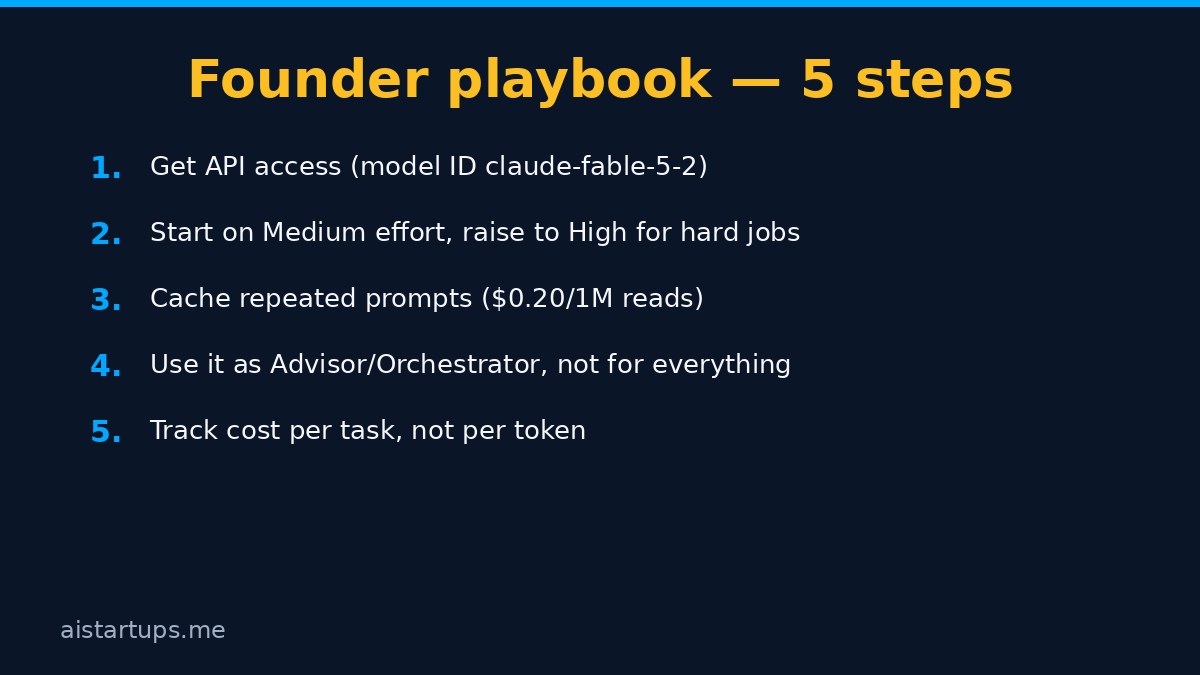
Step 1: Pick one real project, not a toy test. Don’t benchmark it on a hello-world app. Pick something you’ve been putting off because it’s big and annoying — the refactor, the migration, the prototype. Something with a clear success test, so you can tell whether the output is actually good. If you can’t tell good from bad, you’re not testing the model, you’re admiring it.
Step 2: Set the effort level deliberately. Effort levels are new-ish and they matter. Medium is the default in Claude apps and Claude Code; High is the API default. Medium is cheaper and faster. High is stronger. Start on Medium for your first run. If the result is close but not quite there, that’s when you try High — not before.
Step 3: Give it the full context. A million-token window is useless if you feed the model three files and a shrug. Point it at the repo, the docs, the past decisions, the constraints. The model’s advantage is that it can hold all of that at once. If you starve it of context, you’ve paid flagship prices for a model working blind.
Step 4: Let it run long, and check its work. The whole point of Fable is long-running work. Don’t babysit it token by token — set it going, check in at milestones, and verify the output properly. Run the tests. Read the diff. The demos show what happens when the model works for hours; your job is to make sure those hours produced something real.
Step 5: Track the cost per outcome, not per token. After the first project, do the simple math: what did it cost, and what did you get? Compare that with what a contractor would have charged, or what your own time is worth. At roughly $6.72 per FrontierCode task at High effort (Anthropic’s own figure), a lot of jobs will come out looking very cheap. Some won’t. The number tells you which is which — and it tells you whether to keep using Fable, or save it for the next big one.
One more practical note: if the project involves building an actual product or website, that’s the point where outside help can be worth it. A good build still needs human judgment on design, positioning, and the details a model can’t see — and if you want a team that does web development and AI integration work properly, AISquadX is the studio I’d point you to. Use the model for the heavy lifting, use humans for the judgment calls.
Safeguards, Retention, and the Fine Print
Two things worth knowing before you put company data through Fable 5.2.
First, the guardrails. Fable blocks most cybersecurity and biology requests — that’s by design, since this is the most capable model Anthropic has shipped and the misuse risk is real. As I mentioned, blocked queries fall back to Opus 4.8 for cyber and Opus 5 for biology, and the false-positive rate is much lower than it was on 5.1. For most startups, this won’t come up. If you’re in security or biotech, you’ll hit it — and you should plan around it.
Second, data retention. The default is 30-day retention. If that doesn’t work for your company — and for some regulated industries, it won’t — there’s a zero data retention option through Enterprise Frontier Safeguards, currently in private beta. Anthropic names Bridgewater, Salesforce, and Stripe as participants. If you’re enterprise-scale and retention is a deal-breaker, that’s the conversation to have with Anthropic directly.
And a small piece of context, since it tells you where Anthropic is headed: the company filed its S-1 on Oct 26, 2026, aiming for a Nasdaq listing under the ticker ANT. A public Anthropic will be under more pressure to show growth, which usually means more models, more features, and more pricing moves. Good for users, mostly — competition and public scrutiny tend to keep prices honest.
Should You Switch to Fable 5.2?
Honestly? It depends on what “switch” means. If you mean “make Fable 5.2 the default model for everything,” no. Anthropic says so itself, and the benchmarks back it up — Opus 5.5 is the better daily driver, and Sonnet 5.5 beats Fable on some office work while costing less.
If you mean “add Fable 5.2 to the toolkit for the hardest jobs,” then yes, absolutely, and this week is a good time to start. It’s cheaper than its predecessor, faster than its predecessor, and better on the hardest tests. The launch-week promo means you may already have extra usage sitting in your account. The cost per hard task is low enough that one good migration or prototype pays for a month of experiments.
The wrong way to use it is as a status symbol — the expensive model, on every task, because it feels premium. The right way is as a specialist: called in for the jobs that are big enough to justify it, given full context and real time, and judged on what it actually delivers.
That’s the test that matters. Not the benchmark table. Not the demo reel. What it does with your codebase, your brief, your deadline. Try it on one real project this week, measure the result honestly, and let that decide. For the full announcement, read Anthropic’s own post on Claude Fable and Mythos 5.2, and for independent coverage of the launch, VentureBeat’s report and the November 2026 AI launches roundup are both worth your time.
Frequently Asked Questions
What is Claude Fable 5.2?
Claude Fable 5.2 is Anthropic’s most capable AI model, launched Nov 9, 2026. It’s built for long, open-ended, technically demanding work — big coding projects, migrations, deep research, and multi-agent workflows. It’s the same underlying model as Mythos 5.2, but Mythos is reserved for vetted organisations while Fable is available to everyone on paid Claude plans, Claude Code, and the API.
How much does Claude Fable 5.2 cost?
The API price is $8 per million input tokens and $40 per million output tokens — a 20% cut from Fable 5.1’s $10/$50. There’s an optional fast mode at $16/$80 (up to 2.5x faster token generation), a Batch API at $4/$20 (half price for work that can wait), and prompt caching from $0.20 per million tokens for cache reads. Anthropic reports an average of $6.72 per FrontierCode task at High effort.
Is Claude Fable 5.2 better than Opus 5.5?
It depends on the task. Fable 5.2 leads on the hardest coding and agentic benchmarks — FrontierCode 2.0 (49.1% vs 45.5%), FrontierSWE v2 (69.9% vs 62.3%) — and tops the independent Artificial Analysis Intelligence Index at 64.6 vs Opus 5.5’s 59.1. But Opus 5.5 beats it on AA-Briefcase (1800 Elo vs 1785) and on GDP.pdf (26% vs 24%), and Anthropic itself says Opus 5.5 stays the daily driver for most coding and knowledge work. Fable is the specialist for the most ambitious jobs; Opus is the everyday model.
How do I use Claude Fable 5.2?
It’s available on paid Claude plans, in Claude Code, through the Claude Platform API (model ID claude-fable-5-2), and on AWS, Google Cloud, and Azure. In Claude apps and Claude Code the default effort level is Medium; the API defaults to High. You can also use it as an Advisor (smaller models consult it) or an Orchestrator (it delegates to smaller models). Start with one real project, give it full context, and check its work properly.
When should a startup use Fable 5.2 instead of a cheaper model?
Use Fable 5.2 when the job is long, complex, and high-value: a big refactor or migration, a prototype you couldn’t otherwise staff, deep multi-day research, or a multi-agent workflow where it coordinates smaller models. Use Opus 5.5 or Sonnet 5.5 for routine coding, drafts, summaries, and everyday work — they’re cheaper, and on some office tasks they actually score higher. The rule is simple: the harder the job, the more Fable earns its price.
The Bottom Line
Claude Fable 5.2 is the real thing. A flagship model that’s better than its predecessor, faster than its predecessor, and 20% cheaper — that’s not the usual launch story, and it’s worth taking seriously. The independent number one ranking on the Artificial Analysis Intelligence Index backs up Anthropic’s claims in a way vendor benchmarks alone never could.
But the honest version is also this: it doesn’t win everywhere, the demos are Anthropic’s own claims, and using it as your default model for everything would be a waste of money. The founders who’ll get the most from it are the ones who treat it like a specialist — the model for the big refactor, the impossible prototype, the research job that takes days. Give it a real project this week. Give it the full context. Check what it delivers. And let the result, not the hype, decide how much of your work it earns.
That’s the whole playbook, really. Try it on something that matters. Measure it honestly. Keep it for the jobs it wins.



