


Real talk: the most important thing about Google’s newest AI model is the thing you can’t do with it.
On 28 October 2026, Google DeepMind announced Gemini 4 Carbon, a frontier model built for cybersecurity and long-horizon engineering work. It shot straight to the top of the Artificial Analysis Intelligence Index. Its security scores jumped sharply over its predecessor. Its price, when it eventually reaches you, looks surprisingly reasonable.
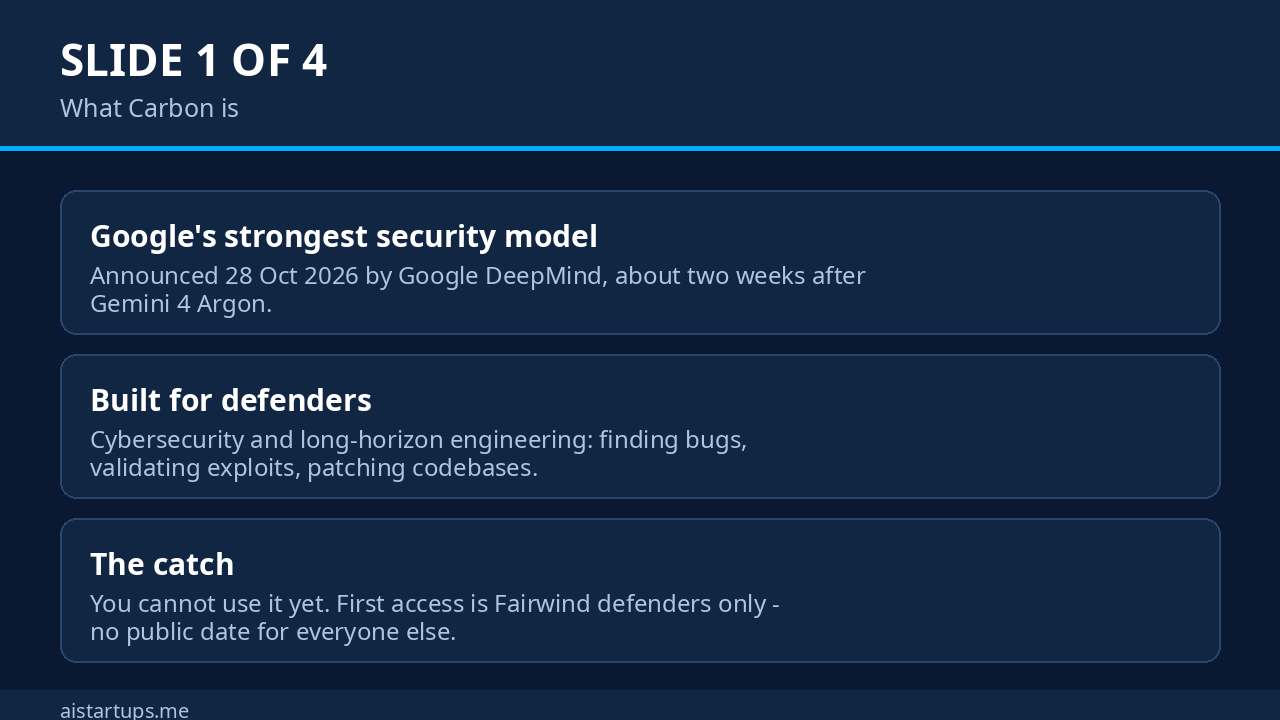
And you can’t use it. Not in the Gemini app, not in AI Studio, not through the public Gemini API. As of today, 29 October 2026, Carbon is going first to a subset of cybersecurity defenders, and Google hasn’t said when the rest of us get a turn.
So why write about it? Because founders who ignore a launch like this get caught flat-footed twice: first when everyone else starts talking about it, and again when it finally opens up and they haven’t planned for it. And founders who overreact to it — rebuilding their stack around a model they can’t touch — waste months chasing a mirage. This guide is the middle path. Here’s what Carbon actually is, what the numbers do and don’t prove, what it will cost when it arrives, and the practical playbook for what to do this week instead of waiting around.
One honesty note up front, because it matters: I haven’t tried Carbon. Nobody outside Google’s defender program has. Everything in this article comes from the announcement and the independent coverage of it, and I’ll flag every claim that comes from Google itself rather than an outside test. If a blog post tells you it spent a weekend “hands-on” with Carbon, it’s making that up.
What Google Actually Announced
Google calls Carbon its strongest model for cybersecurity and long-horizon engineering work. That’s a specific claim, and it’s worth taking literally. This isn’t a general-purpose chatbot upgrade or a video model with a new trick. Carbon is aimed at a particular job: finding vulnerabilities in code, proving those vulnerabilities are real, patching them, and sticking with huge engineering tasks for days at a time instead of giving up after one pass.
The timing is the first thing that should catch your eye. Carbon arrived about two weeks after Gemini 4 Argon, which was announced on 30 September and rolled out more widely on 13 October. Two frontier models in a fortnight is not a normal release cadence — it’s a sprint. Google is clearly shipping as fast as its labs can validate, and the two-week gap between Argon and Carbon tells you how intense the frontier race has become. If you felt like you only just got your head around Argon, well — mostly, you did. We covered Argon in detail in our Gemini 4 Argon guide for startups, and most of that advice still holds, because Argon is still the model you can actually use.
So what’s genuinely new here? Three things. First, the security focus is not marketing garnish — it’s the whole point of the model. Second, the long-horizon claim: Google says its internal teams ran Carbon for days on single tasks, root-causing and patching bugs across large codebases and low-level systems. That’s a different kind of capability than answering a question well. It’s the difference between a brilliant intern and a senior engineer who doesn’t get bored, doesn’t lose the thread, and keeps going until the bug is actually fixed. Third, the access model, which we’ll come back to because it’s the part that changes everything about how you should react.
What Google hasn’t told us is almost as telling. There’s no disclosed context window, no parameter count, no API endpoint, no model ID you can call. I mention that deliberately, because the internet is already filling those gaps with guesses dressed up as facts. If someone quotes you Carbon’s context window this week, they’re inventing it. Treat undisclosed as undisclosed.
Google calls Carbon its strongest model for cybersecurity and long-horizon engineering work — a claim about a specific job, not a claim that it wins at everything.
The Numbers, Honestly Read
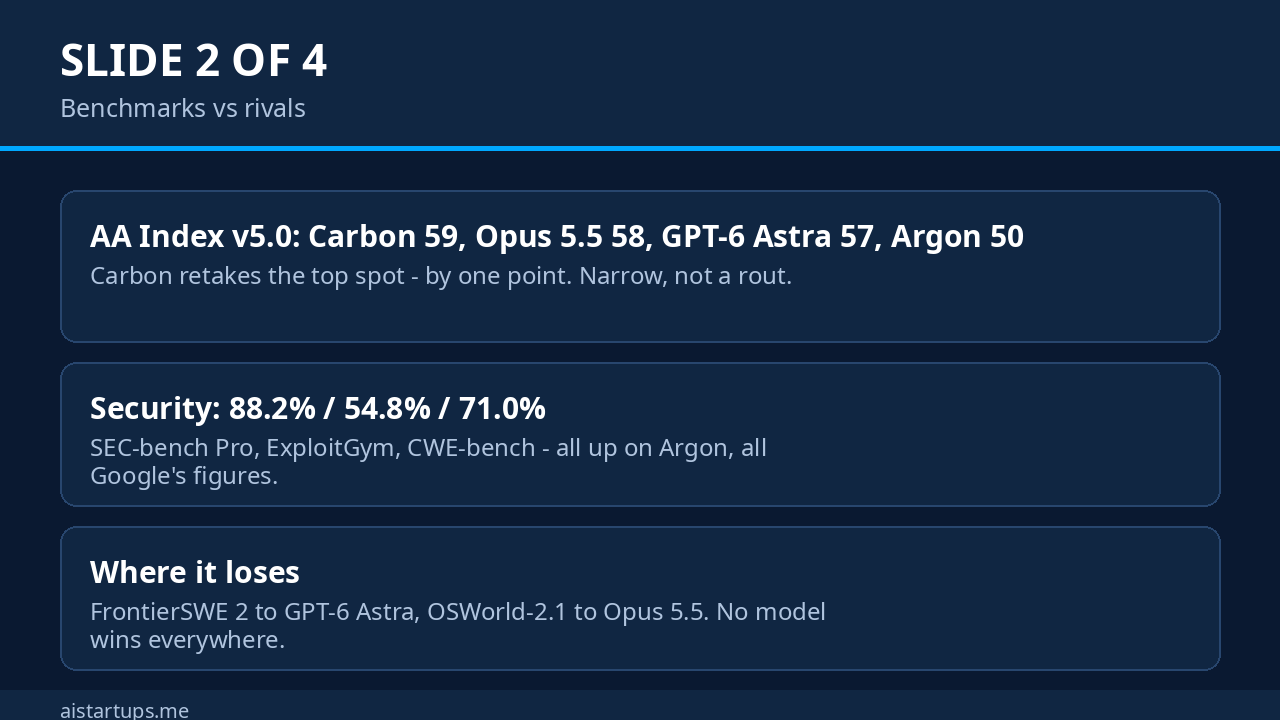
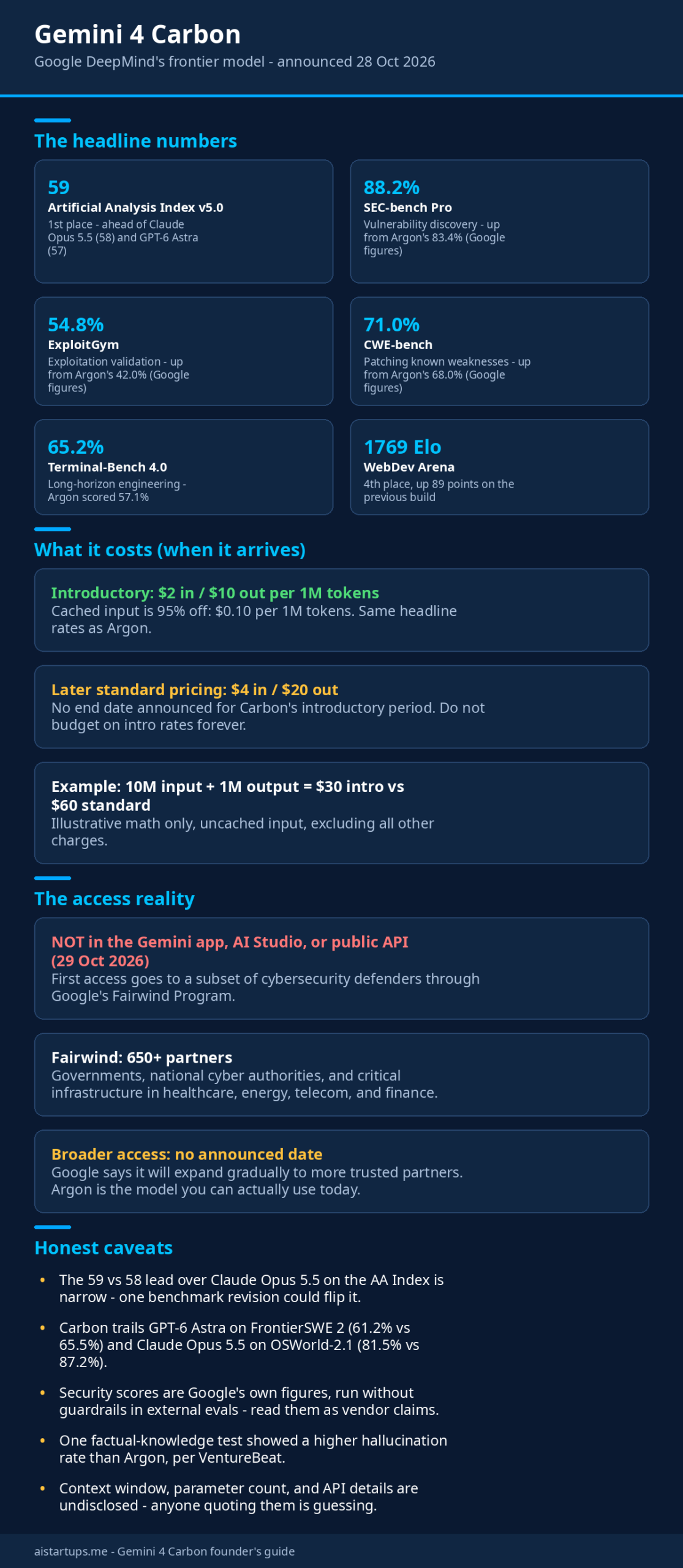
Let’s start with the headline, because it’s the number you’ll see everywhere: Carbon scores 59 on version 5.0 of the Artificial Analysis Intelligence Index, putting it first. Claude Opus 5.5 sits at 58, GPT-6 Astra at 57, and Argon at 50. Dealroom’s coverage of the new ranking notes that Carbon retook the top spot on the updated, harder benchmark suite — and that “updated, harder” part matters. Benchmarks get revised precisely because models learn to game the old ones, so a fresh index is a fairer test than a stale one. Still, look at the gap: 59 versus 58. That’s a lead, not a landslide. One benchmark revision, one new rival release, and the crown moves again. Celebrate it, don’t bet the company on it.
There’s a second index worth knowing about, because it complicates the story in a useful way. On Artificial Analysis’s Coding Agent Index, Carbon scores 59 — but Claude Code with Opus 5.5 scores 62. So the best coding agent setup, by this measure, still isn’t Carbon. That’s not a contradiction. A model and an agent system built around a model are different things, and Anthropic’s tooling edge shows up here. If your team lives inside an agentic coding tool all day, the system matters at least as much as the raw model underneath it. Our hands-on guide to Claude Sonnet 5.5 for startups goes deeper on how that ecosystem feels in practice, and it’s still the right comparison point for day-to-day coding work.
The security scores: big jumps, with a caveat attached
Now the numbers that actually justify Carbon’s existence. These are Google’s figures, from external evaluations run without guardrails — meaning the model was tested in a setting where its safety filters weren’t softening the results. Read them as vendor claims with independent testers, not as gospel:
| Benchmark | Carbon | Argon | What it measures | Source |
|---|---|---|---|---|
| Artificial Analysis Index v5.0 | 59 (1st) | 50 | Overall intelligence | Independent index |
| Coding Agent Index | 59 | — | Agentic coding (Claude Code + Opus 5.5: 62) | Independent index |
| SEC-bench Pro | 88.2% | 83.4% | Finding vulnerabilities | Google figures |
| ExploitGym | 54.8% | 42.0% | Proving exploits are real | Google figures |
| CWE-bench | 71.0% | 68.0% | Patching known weaknesses | Google figures |
| Terminal-Bench 4.0 | 65.2% | 57.1% | Long-horizon terminal engineering | Google figures |
| FrontierSWE 2 | 61.2% | — | Software engineering (GPT-6 Astra: 65.5%) | Independent |
| OSWorld-2.1 | 81.5% | — | Computer-use tasks (Opus 5.5: 87.2%) | Independent |
| WebDev Arena | 1769 Elo (4th) | — | Building web apps (+89 points) | Independent |
The ExploitGym jump is the one I’d stare at longest. Going from 42.0% to 54.8% on exploitation validation is a big move, and it matters because finding a possible bug is only half the job — proving it’s actually exploitable, without crying wolf a hundred times, is where security tools usually fall apart. The SEC-bench Pro move from 83.4% to 88.2% points the same way. And CWE-bench patching at 71.0%, up from 68.0%, is a smaller but steadier gain: patching is the unglamorous end of security work, and it’s the end that actually reduces risk.
Google’s reliability claims go further, and here’s where you should tighten your skepticism one more notch, because these are internal measurements, not outside tests. Google says secure-code generation success more than doubled versus Argon, high-severity misalignment alerts in internal coding work fell by almost 80%, and unsupported claims roughly halved. Those are striking numbers. They’re also exactly the kind of numbers a company reports about its own model in its own workflows. Useful as a directional signal — Carbon is clearly aimed at writing safer code — but not something I’d quote to a customer or a board as fact.
Two more Google claims deserve the same treatment. On indirect prompt-injection attacks, Google reports a 0.0% success rate for Carbon on the Gray Swan test, down from 0.7% for Argon. Zero is a beautiful number and a suspicious one; even a great result deserves a re-test before you trust it with anything sensitive. And the Chrome team’s claim of more than 10x better high-quality patches than an unnamed rival model? The rival is unnamed, which makes the claim unverifiable by design. I wouldn’t repeat it in a pitch deck. I mention it here so you recognise it when you see it quoted elsewhere without the caveat.
Long-horizon work: the quiet revolution that isn’t a revolution
Here’s the thing that actually excites me about Carbon, hype aside. Most AI coding tools are brilliant at the first hour and shaky by the third. They lose context, they repeat themselves, they “fix” a bug by breaking two other things. A model that can run for days on a single task — root-causing a bug across a large codebase, patching low-level systems code, keeping the whole picture in its head — would change what a small team can maintain. Not because it replaces engineers, but because it changes the size of codebase a five-person team can safely own.
Terminal-Bench 4.0 at 65.2%, up from Argon’s 57.1%, is the measurable version of that claim. It’s a real improvement, and it lines up with the story Google is telling about internal use. But “days on a single task” is still Google’s internal experience, not something you can verify, and long-horizon work is exactly where small errors compound into big messes. The right mental model is a tireless junior-to-mid engineer with a brilliant memory and no judgment about when to stop and ask. Powerful, if supervised. Dangerous, if trusted blindly.
Where Carbon Loses (Yes, Really)
A launch-day article that only lists wins is a press release with better formatting. Carbon loses in places that matter, and those losses tell you what kind of model it actually is.
First, FrontierSWE 2: Carbon scores 61.2% against GPT-6 Astra’s 65.5%. That’s a software-engineering benchmark where OpenAI’s model still leads, and it’s a reminder that “best security model” and “best general engineering model” are different titles. Second, OSWorld-2.1, which tests computer-use tasks: Carbon at 81.5% trails Claude Opus 5.5 at 87.2%. If your product involves agents clicking around real software, that’s a meaningful gap. Third, WebDev Arena puts Carbon 4th at 1769 Elo — strong, up 89 points, but not first. Building a web app and securing a codebase are different skills, and Carbon’s ranking reflects that honestly.
Then there’s the uncomfortable footnote. MarkTechPost’s breakdown of the launch and VentureBeat’s coverage both note the same wrinkle: on at least one factual-knowledge test, Carbon showed a higher hallucination rate than Argon. Read that again. The newer, smarter, more secure model makes up facts more often on one test than its predecessor did. That’s not a scandal — different tests stress different things, and a security-tuned model can trade off factual recall — but it kills any simple story that Carbon is better at everything. It’s better at its job. Its job is security and long engineering runs. For factual question-answering, you’d still want to check its work, same as every other model.
The broader lesson here is one founders keep relearning: there is no single “best model” anymore. There’s a best model for coding agents (right now, arguably Claude’s setup), a best model for frontier software engineering (GPT-6 Astra on that benchmark), a best model for computer use (Opus 5.5), and now a best model for security-flavoured engineering (Carbon, on Google’s numbers). The smart move isn’t picking a winner. It’s picking the right tool per job and keeping your code portable enough to switch when the crown moves — because it moves every few weeks now. Kimi K3.1 Pro’s launch earlier this cycle made the same point from the open-model side: the field is crowded, and no lead lasts long.
What It Costs (When It Eventually Arrives)
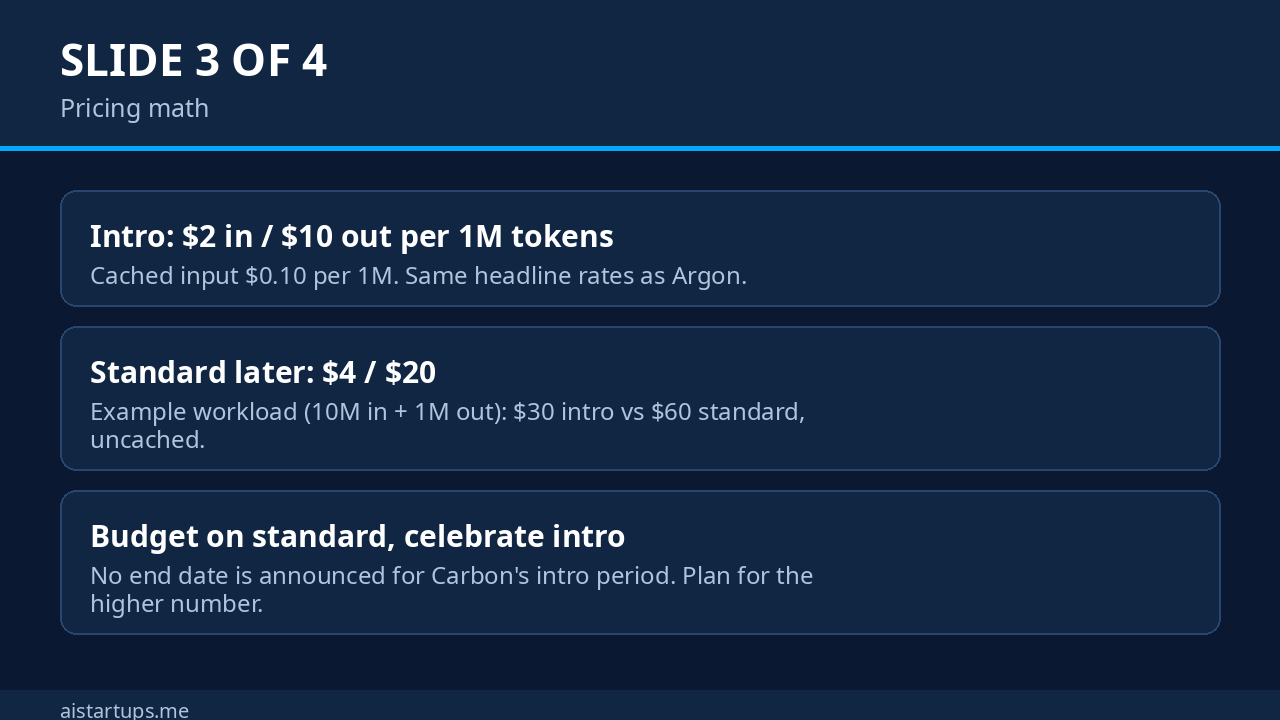
Here’s a pleasant surprise: Carbon’s announced pricing matches Argon’s headline rates exactly. Introductory pricing is $2 per million input tokens and $10 per million output tokens, with cached input at 95% off — just $0.10 per million. Later, standard pricing rises to $4 per million input and $20 per million output. That’s the same ladder Argon is on, which makes planning simpler: if you’ve already modelled Argon costs, you’ve modelled Carbon costs.
| Input (per 1M tokens) | Output (per 1M tokens) | Cached input (per 1M) | |
|---|---|---|---|
| Introductory | $2 | $10 | $0.10 |
| Standard (later) | $4 | $20 | — |
Let’s make that concrete, because token prices mean nothing until you attach them to a workload. Take an illustrative month: 10 million uncached input tokens and 1 million output tokens. At introductory rates that’s 10 × $2 plus 1 × $10, which comes to $30. At standard rates it’s 10 × $4 plus 1 × $20, which comes to $60. Same workload, double the bill, just from the rate change. That’s the number to plan around — and note what it excludes: everything else. Caching behaviour, retries, tool calls, your own infrastructure, and any partner or platform fees all sit on top. Treat $30 versus $60 as a clean illustration, not a quote.
Two traps to avoid here. First, don’t budget permanently on introductory rates. Google has not announced an end date for Carbon’s introductory period — and that’s different from Argon, whose higher rates take effect on 1 December 2026. Don’t mix those two up; I’ve already seen people conflate them. Argon’s deadline is Argon’s. Carbon’s clock hasn’t been announced, which means it could change with little warning. Second, don’t compare Carbon’s $2/$10 to a rival’s headline rate without checking what counts as a token, what caching costs, and what your actual input-to-output ratio looks like. A security review workload is input-heavy — you’re feeding it a whole codebase and getting back a short report — so the input price and the cache discount matter far more than the output price for this use case. If your caching is good, Carbon’s effective price could be far lower than the headline suggests. Our guide on how to cut your AI API bill by 70 percent covers the caching and routing tricks that make the biggest difference here, and they apply to Carbon just as much as to any other model.
One more honest note on price: a frontier security model at $2/$10 is cheap for what it claims to do, if the claims hold. A single missed vulnerability in production can cost a startup its biggest customer, its reputation, or in regulated sectors, its licence to operate. The question was never whether $30 or $60 a month is affordable. It’s whether the model actually catches the bugs your team would miss. That question can’t be answered until real teams outside Google get their hands on it.
Access: The Fairwind Gate
Now the part that decides everything else. Carbon is not publicly available, and Google has been unusually clear about the order of rollout. First access goes to a subset of cybersecurity defenders through the Fairwind Program — a Google initiative with more than 650 partners including governments, national cyber authorities, and critical infrastructure organisations in healthcare, energy, telecom, and finance. Then, gradually, access widens to more trusted partners. Broader developer, business, and consumer access has no announced date at all.
Think about what that means in practice. The first people using Carbon will be the people defending hospitals, power grids, telecom networks, and banks. That’s a deliberate choice, and honestly, it’s a defensible one — a model this good at finding and exploiting vulnerabilities is dual-use by nature, and handing it to everyone on day one would be reckless. But it also means the rest of us are reading about a tool we can’t touch, and every “Carbon did this amazing thing” story for the next few months will come from that defender circle or from Google itself. Keep that filter on everything you read.
If you genuinely are a cybersecurity defender — you run a security product, you protect critical infrastructure, you do incident response for a living — then the Fairwind expression-of-interest form is worth a look. Applying costs nothing, and there’s no stated response time and no published membership list, so don’t treat an application as a plan. It’s a lottery ticket with a good cause attached, not a roadmap. And if you’re not a defender, don’t dress your startup up as one to get in line. Google checks eligibility, and a rejected application that misrepresents what you do is worse than no application at all.
For everyone else, the honest timeline is: unknown. Not “soon”, not “next quarter”, not any date a headline implies. Unknown. Any article that gives you a public release date for Carbon is guessing, and I’d treat its other claims with the same suspicion.
What Founders Should Actually Do Now
Enough about the model you can’t use. Here’s the playbook for the company you actually run, this week and next.
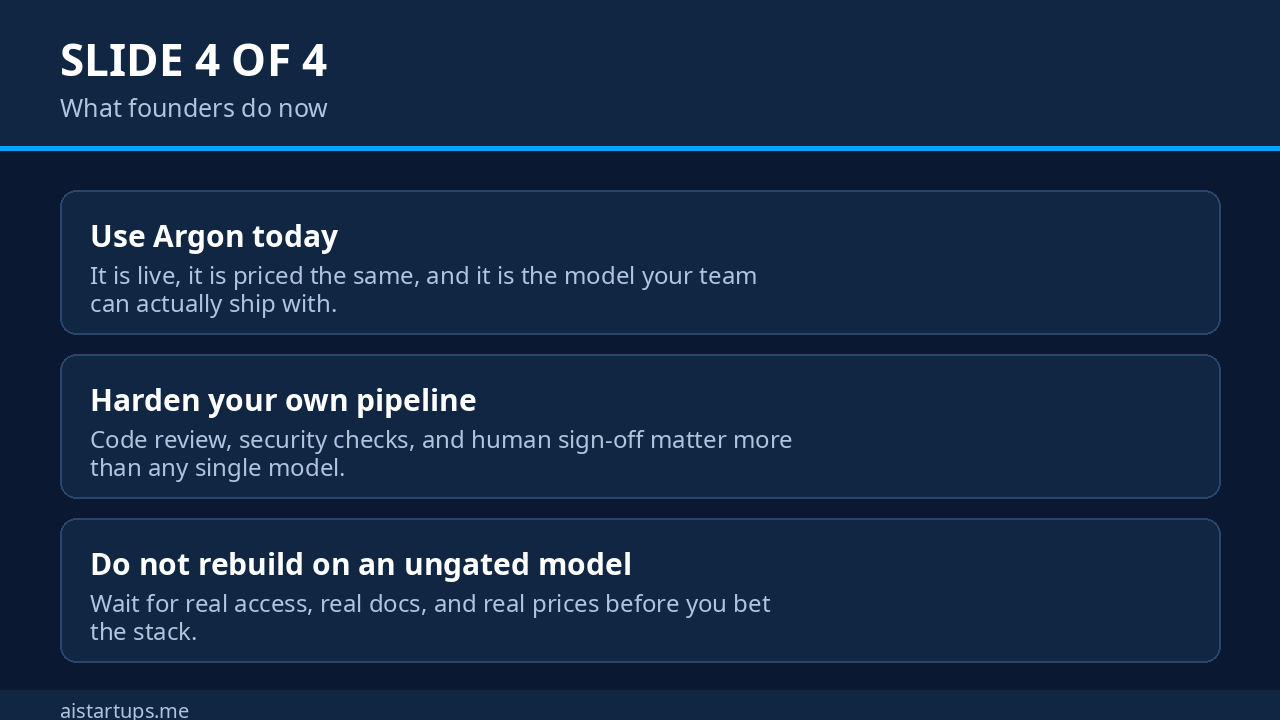
- Use Argon today. It’s live, it’s priced the same as Carbon’s intro rates, and it’s the model your team can actually ship with. Build your security review workflow on Argon now — automated code review, vulnerability triage, patch drafting with human sign-off — and you’ll be able to swap in Carbon later without redesigning anything. The workflow is the asset; the model is interchangeable.
- Harden your own pipeline before you chase a better model. Carbon’s biggest lesson isn’t “wait for Carbon”. It’s that the frontier is moving toward security-aware engineering, and your review process is already behind if it still depends on one tired senior dev reading every pull request. Add automated checks, require human review on security-sensitive changes, and log what your AI tools suggest versus what you ship. That discipline pays off with any model.
- Budget on standard rates, enjoy intro rates. Model your AI spend at $4/$20, not $2/$10. If Carbon arrives at intro pricing, that’s a bonus quarter or two of cheaper inference. If it arrives at standard pricing — or if intro ends fast — your budget doesn’t break. Founders who plan on intro rates always end up surprised, and surprises in unit economics kill startups quietly.
- Prep a Fairwind case only if you’re genuinely a defender. If you protect real infrastructure or sell real security tooling, document your case and apply. If you don’t, skip it and spend that energy on your product instead.
- Don’t rebuild your stack on an ungated model. No architecture decisions, no vendor lock-in, no “Carbon-native” rewrites until there’s a public API, real docs, and a price you can actually pay. The models change every few weeks. Your architecture should outlive them.
And here’s the part nobody wants to hear: while you’re waiting for Carbon, your product still needs to ship. Security reviews, a solid codebase, and a website that actually converts customers — those don’t pause for a model launch. If your team is stretched thin and the product work is piling up while you research AI tools, that’s exactly when bringing in outside help makes sense. A team like AISquadX can take the build and AI integration work off your plate so your own engineers stay focused on the product itself, and you ship a secure, well-built product now instead of waiting on a model you can’t access yet.
There’s a second list, too — the things not to do. These sound obvious, and I keep seeing founders do all of them in launch weeks:
- Don’t announce “powered by Carbon” anything. You aren’t powered by Carbon. You’re powered by hope and a press release. Customers and investors notice.
- Don’t quote undisclosed specs. No context window, no parameter count, no API details. If a vendor or a blog gives you numbers, ask for the source. There isn’t one.
- Don’t pause security work while waiting. The vulnerabilities in your code right now don’t care about Google’s rollout schedule. Review them with the tools you have.
- Don’t confuse Argon’s 1 December deadline with Carbon’s pricing. Argon’s higher rates kick in on 1 December 2026. Carbon’s intro end date is unannounced. Keep them separate in your budget and your head.
Frequently Asked Questions
Can I use Gemini 4 Carbon today?
No. As of 29 October 2026, Carbon is not in the Gemini app, AI Studio, or the public Gemini API. First access is going to a subset of cybersecurity defenders through Google’s Fairwind Program, and broader access has no announced date. If you need a frontier Gemini model right now, Argon is the one you can actually use.
How much will Gemini 4 Carbon cost?
Announced pricing is $2 per million input tokens and $10 per million output tokens at introductory rates, with cached input at $0.10 per million — a 95% discount. Standard pricing later rises to $4 input and $20 output. Google has not announced when the introductory period ends for Carbon, so budget on the standard rates and treat intro pricing as a bonus.
Is Carbon really the best AI model now?
It tops one respected index and loses on others, so the honest answer is: best at its job, not best at everything. Carbon leads the Artificial Analysis Intelligence Index v5.0 at 59, ahead of Claude Opus 5.5 at 58 and GPT-6 Astra at 57. But it trails GPT-6 Astra on FrontierSWE 2 and Claude Opus 5.5 on OSWorld-2.1, and Claude’s coding agent setup still leads the Coding Agent Index. Pick the model for the job, not the crown.
What is the Fairwind Program, and can my startup join?
Fairwind is Google’s program for sharing advanced AI capabilities with cybersecurity defenders — more than 650 partners including governments, national cyber authorities, and critical infrastructure in healthcare, energy, telecom, and finance. Eligible organisations can submit an expression of interest; applying costs nothing, no response time is stated, and membership isn’t disclosed. If you’re not genuinely a defender, don’t apply as one.
Should my startup wait for Carbon before improving its security?
Absolutely not. Build the workflow now on Argon: automated review, vulnerability triage, patch drafting with human sign-off. The workflow is the durable asset, and a better model slots into it later. Waiting for Carbon while known vulnerabilities sit in your code is the worst version of this launch — all of the hype, none of the protection.
The Bottom Line
Gemini 4 Carbon is real, it’s impressive on the numbers Google has shared, and it’s genuinely aimed at a problem founders should care about: shipping code that doesn’t fall over the first time someone pokes at it. The security jumps over Argon are meaningful, the long-horizon story is the most interesting capability claim in this launch cycle, and the pricing — when it reaches you — is reasonable for a frontier model.
But the lead is one point wide, the losses are real, the best numbers are Google’s own, and the model itself is behind a gate with no public opening date. That’s not a reason to ignore Carbon. It’s a reason to react to it correctly: use Argon now, build the security workflow that any frontier model can plug into, budget on standard rates, and keep shipping. When Carbon opens up — and it will, eventually — you’ll be the founder who’s ready for it on day one, instead of the founder still reading launch coverage and wondering where to start.
Look, the AI race will give you another “best model ever” in a few weeks. Probably before Christmas, if recent cadence holds. The founders who win aren’t the ones who chase each launch. They’re the ones who build systems that get better every time a new model arrives, no matter whose name is on it. Carbon is a good reason to build that system now. It’s not a good reason to wait.



