

Here’s the thing about most model launches: they arrive with a blaze of benchmark charts, everyone declares a new king for about six hours, and then founders go right back to whatever they were already using. I get it. Switching models costs real time, and time is the one budget a startup can’t top up.
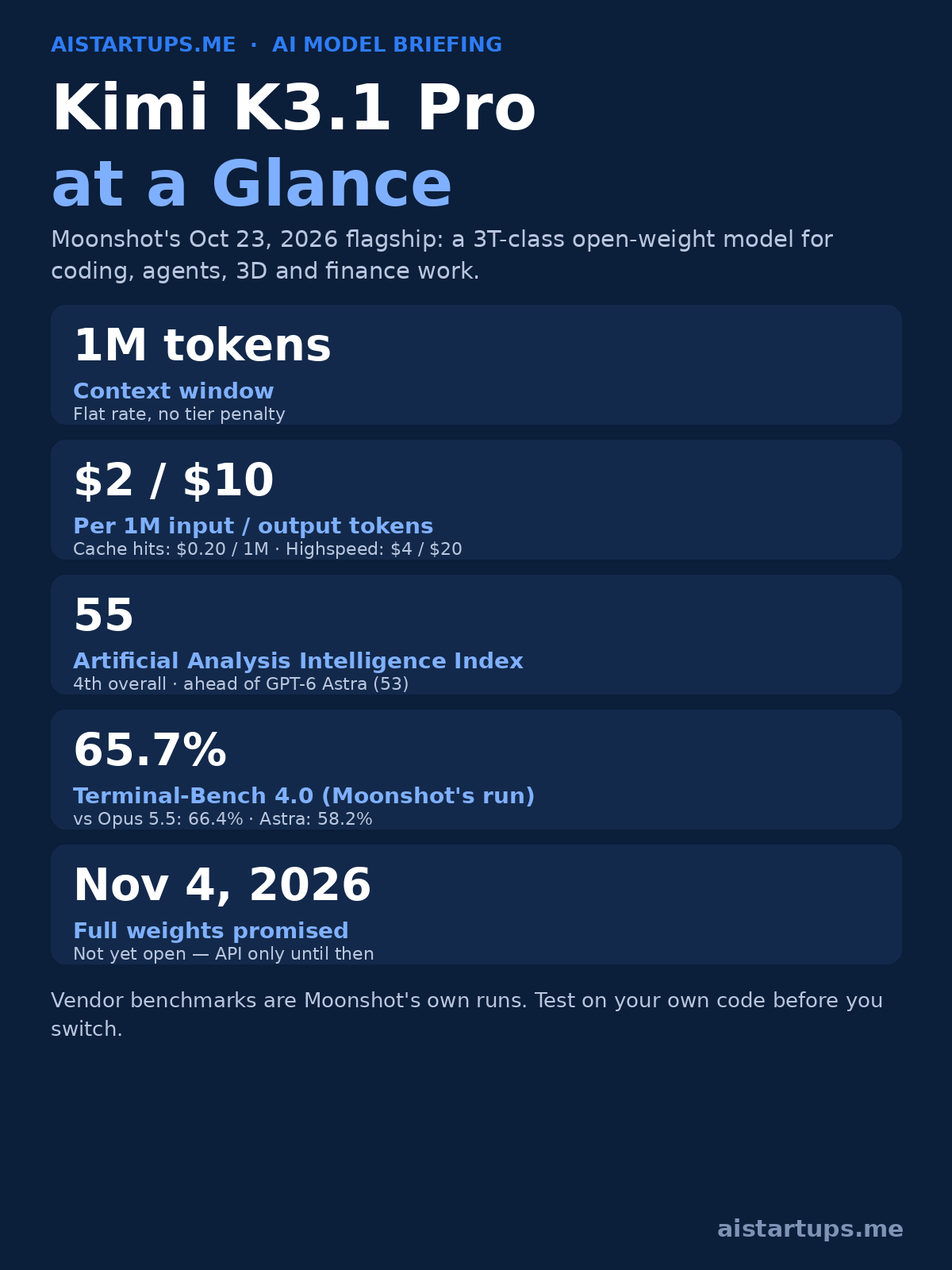
But Kimi K3.1 Pro is worth a proper look, and not just because of the charts. Moonshot AI released it on October 23, 2026, and it does something no open-weight model has done before: it sits within touching distance of the best closed models on the tests that actually matter for building software, while costing half what the top closed model costs. That’s a combination founders should pay attention to — even if, as I’ll explain, there’s one big reason not to bet the whole company on it just yet.
Real talk: I went into this launch skeptical. Moonshot’s previous model, Kimi K3, was good — genuinely good — but it lived in that awkward middle ground where it was cheaper than the frontier and just far enough behind it that most serious teams kept paying the frontier price anyway. K3.1 Pro closes most of that gap. Not all of it. Most of it. And the price went down at the same time, which almost never happens in this industry.
In this guide I’ll walk through what Kimi K3.1 Pro actually is, what the numbers mean (and which ones Moonshot ran itself, so you know how much salt to take with them), what it costs in real money for a real workload, and a step-by-step way to test it this week without disrupting anything you’re shipping. No hype. Just the working parts.
What Kimi K3.1 Pro actually is
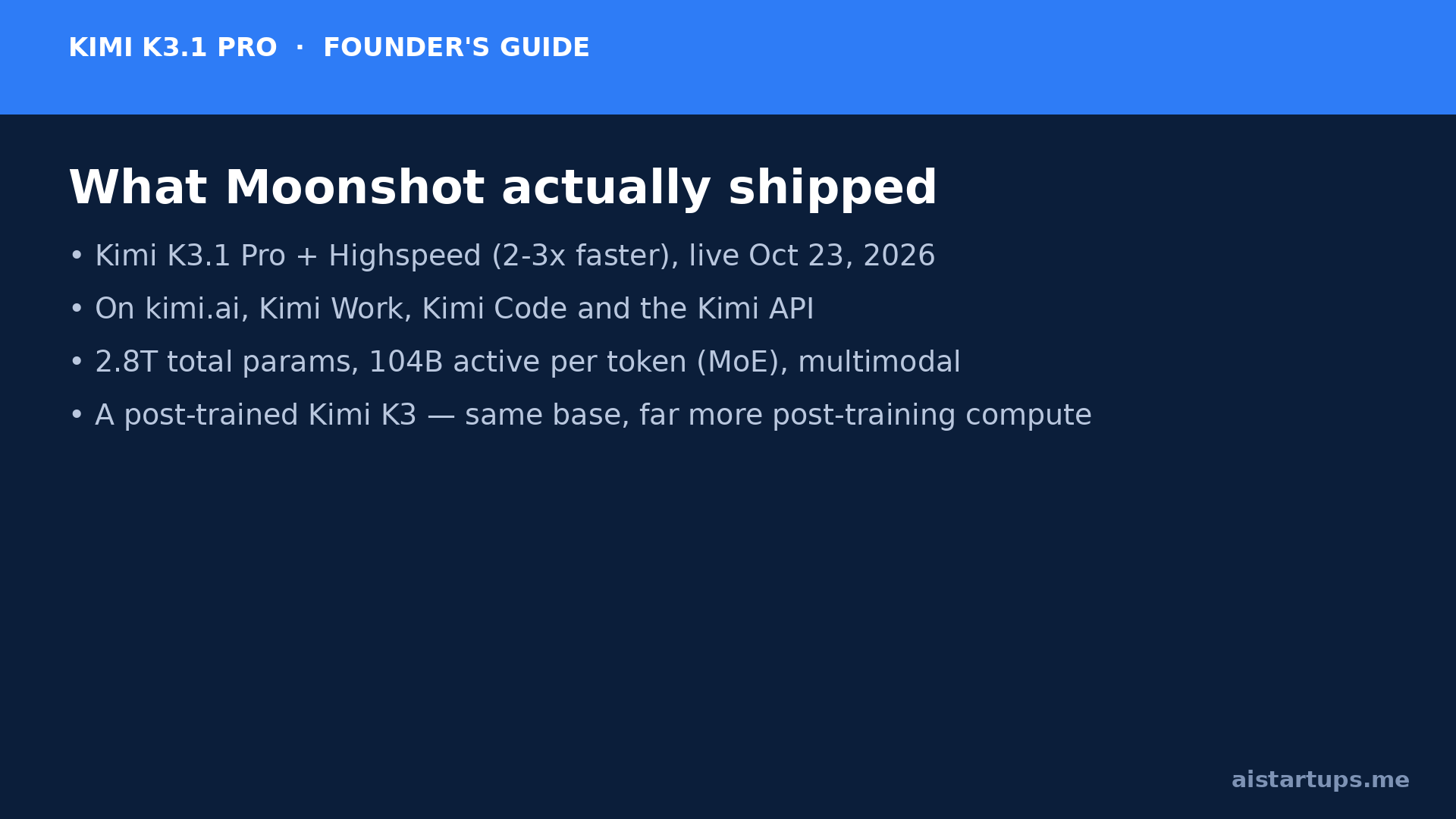
Let’s start with the basics, because the naming alone confuses people. Kimi K3.1 Pro is the first model in Moonshot’s new K3.1 series. It’s a post-trained version of Kimi K3, which launched in July 2026 — same base model, but with what Moonshot describes as substantially larger post-training compute. In plain terms: they took the model they already had and threw a lot more training effort at the part of training that teaches a model to actually do useful work, rather than just predict text.
The headline specs, straight from Moonshot’s own launch post, are:
- 2.8 trillion total parameters, 104 billion active per token. It’s a mixture-of-experts model, which means only a slice of the model fires for any given token. That’s how you get a giant model that doesn’t cost a fortune to run.
- A 1-million-token context window. Roughly speaking, that’s an entire mid-sized codebase, or a few hundred pages of documents, in one conversation. And unlike some rivals, there’s no tiered pricing penalty for using the long window.
- Multimodal input. It takes text and images, which matters for the 3D and design work Moonshot is pushing.
- Two flavors at launch. The standard K3.1 Pro, and K3.1 Pro Highspeed, which Moonshot says runs 2 to 3 times faster for more responsive interactions.
Where can you actually use it right now? It’s live on kimi.ai and the Kimi mobile apps, in the Kimi Work desktop app (version 3.1.0 or later), in Kimi Code via the /model command, and through the Kimi API under the model IDs kimi-k3.1-pro and kimi-k3.1-pro-highspeed. Business customers need an admin to enable it — access is off by default at launch, which is a sensible default, honestly. Third-party access is already live too: Vercel’s AI Gateway lists both K3.1 Pro variants for developers who already route through it.
One more thing the launch post is upfront about: K3.1 Pro covers the full range of coding work, from quick fixes in real codebases to full-project builds. Moonshot points to games built in Unity, Unreal Engine and Godot, and to a new 3D Make feature on kimi.ai that turns a text brief into a 3D model you can preview, edit, download for printing, or export as video. That’s the part of this launch that feels most different from a generic coding model — it’s clearly aimed at builders who make things, not just people who write backend code.
The benchmarks, read honestly
Okay, let’s talk numbers, because this is where most launch coverage either misleads you or bores you, and I want to do neither. There are two kinds of numbers floating around for K3.1 Pro, and keeping them apart is the whole trick to reading this launch properly.
Moonshot’s own numbers
First, the vendor table — numbers Moonshot ran itself, on its own harness, with the reasoning effort set to max. Treat these as “best case, friendly conditions,” not as gospel:
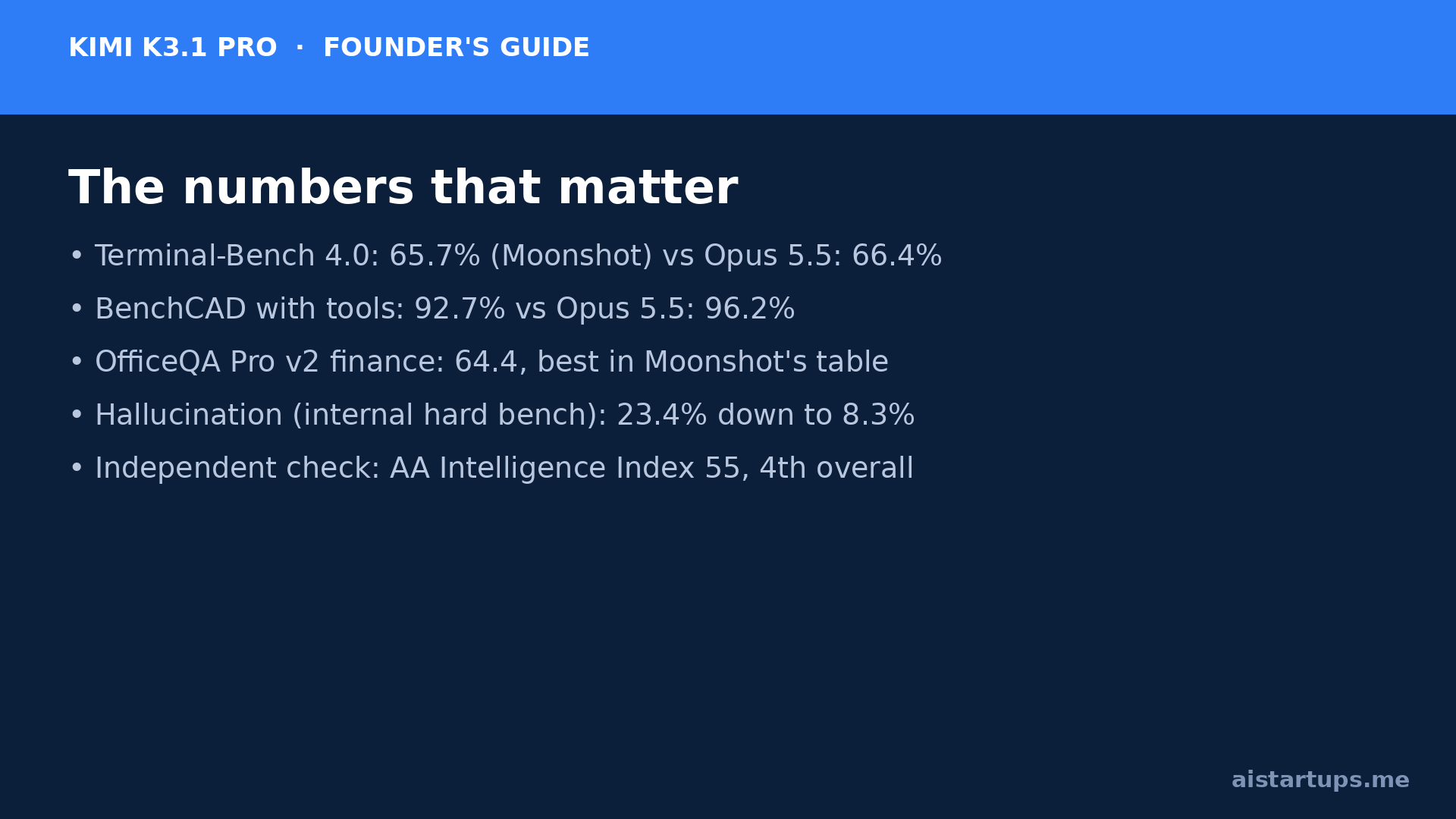
- Terminal-Bench 4.0: 65.7%. This one tests coding agents on realistic terminal tasks with strict pass/fail checks. For comparison, Moonshot’s table puts Claude Opus 5.5 at 66.4% and GPT-6 Astra at 58.2%. So K3.1 Pro lands just behind the best closed model and well ahead of OpenAI’s flagship on this particular test. That’s a real result, but remember who ran it.
- Kimi Code Bench 3.0 Long-horizon: 61.2%, up from K3’s 55.95%. This is Moonshot’s internal test of multi-step coding work — the kind where an agent has to keep going across dozens of steps without losing the thread. Long-horizon reliability is exactly where cheaper models usually fall apart, so a 5-point jump here matters more than it looks.
- BenchCAD with tools: 92.7%, against Opus 5.5 at 96.2% and Astra at 95.9%. BenchCAD tests 3D reconstruction through CAD code generation. K3.1 Pro is close, not ahead — and without tools it scores 72.8%, basically tied with Opus 5.5’s 73.0%. For a startup doing product configurators, custom furniture, or mechanical parts, that’s genuinely useful territory.
- OfficeQA Pro v2: 64.4, which Moonshot says leads its finance table. This test runs complex fiscal analysis over real financial documents — retrieval, cross-document checks, multi-step math. Moonshot also reports its internal finance benchmarks improved a lot over K3: financial modeling up 7.2 points, financial research up 11.6 points, and a simulated business-operations test up roughly 4x.
- Hallucination rate: down sharply on Moonshot’s internal hard bench — claim-level errors fell from 23.4% for K3 to 8.3% for K3.1 Pro with tools. Moonshot is careful to note this is a stress test designed to catch errors, not a measure of everyday error rates. Still, direction of travel: the right way.
There’s also a genuinely wild example in the launch post: Moonshot had K3.1 Pro build a human walking-dynamics simulator on top of an open-source anatomical model, across 167 missions and 420 reviews, and the simulated human went from collapsing within seconds to walking continuously for 11.2 seconds. When a reward-shaping trick stopped working on arm motion, the model didn’t just keep tweaking the reward — it probed the simulator, found 36 errors in shoulder-muscle calculations, fixed them, and retrained. That’s the kind of long-horizon behavior you want from a coding agent, and it’s the kind of story that’s hard to fake with a cherry-picked demo. (Well — mostly hard. It’s still Moonshot’s story. Test it yourself.)
The independent numbers
Then there’s the number that isn’t Moonshot’s: Artificial Analysis scored K3.1 Pro at 55 on its Intelligence Index, putting it fourth overall — behind Claude Opus 5.5 (58), Claude Sonnet 5.5 (56) and Muse Wonder Full (56), and ahead of GPT-6 Astra, Claude Fable 5.1 and Gemini 4 Argon (53 each). That’s the first time a soon-to-be open-weight model has ranked this high, and it’s independent measurement, not a vendor table. Independent launch coverage likewise records the October 23 date, the $2/$10 pricing and the November 4 weights promise.
The same independent data shows the agentic gains more precisely: GDPval-AA up 312 points over K3 to 1,846 Elo, Terminal-Bench 4.0 leading the independent ranking at 67% in one measurement, AutomationBench-AA up from 58% to 73%, and the hallucination rate on the independent omniscience evaluation down from 53% to 44% while overall accuracy rose from 48% to 51%. Two different harnesses, two different Terminal-Bench numbers (65.7% vendor, 67% independent) — that’s normal, and it’s why you should never quote a single benchmark number without saying who ran it.
My read: the honest summary is “close to the frontier on coding and agent work, not past it.” If anyone tells you K3.1 Pro beats Opus 5.5 across the board, they’re reading the vendor table selectively. If anyone tells you it’s just another cheap knockoff, they’re ignoring the independent 55. The truth sits in the middle, and the middle is a pretty good place for a model at this price.
Pricing: the math founders actually care about
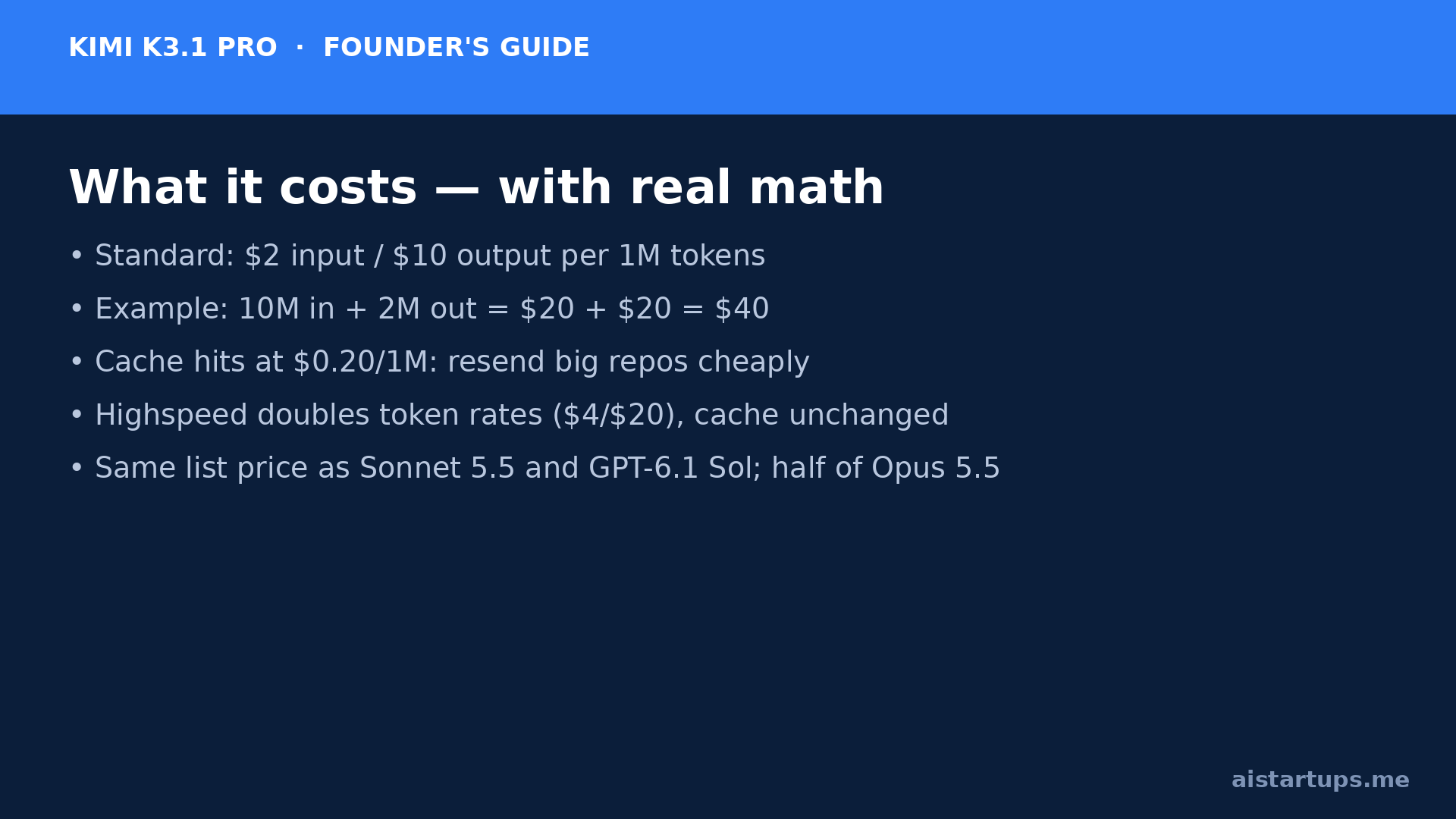
Prices are where this launch gets properly interesting, because Moonshot didn’t just match the market — it undercut its own previous model by a third. The Kimi API lists K3.1 Pro at $2 per million input tokens and $10 per million output tokens, with cache-hit input at $0.20 per million. The Highspeed variant doubles the token rates to $4 input and $20 output, but cache hits stay at the same $0.20 rate. For context, that’s a third below Kimi K3’s $3/$15, the same list price as Claude Sonnet 5.5 and GPT-6.1 Sol, and half the price of Claude Opus 5.5.
But list prices lie to you in a specific way: they hide where the money actually goes. With a reasoning model like this one, output tokens are the bill. The model thinks out loud, and you pay for every token it thinks with. So let’s do one honest worked example, the kind I’d want before committing a team to anything:
- Say your coding agent processes 10 million input tokens and produces 2 million output tokens in a week.
- Input: 10 × $2 = $20. Output: 2 × $10 = $20. Total: $40 for the week.
- Now say half your input tokens are cache hits because you resend the same repo context every turn: 5 million at $2 plus 5 million at $0.20 = $10 + $1 = $11 input, plus the same $20 output = $31. The cache lane just saved you nearly a quarter of the bill, and the saving grows the bigger your repeated context gets.
- The same week on Opus 5.5 pricing would run roughly double. The same week on Highspeed would run $40 input + $40 output = $80 before cache — so only reach for Highspeed when latency is actually costing you something, like an interactive agent loop where a human is waiting.
Artificial Analysis puts the cost at about $2.11 per Intelligence Index task for K3.1 Pro, against $5.98 for Opus 5.5 at maximum effort. That’s a benchmark-specific estimate, not a promise about your workload — but it gives you a sense of the order of magnitude. The pattern is consistent: you get roughly frontier-adjacent capability at roughly half the frontier price, and the gap widens the more you lean on caching.
One pricing trap to watch: the app plans and the API are different products with different bills. The Kimi app has free and paid membership tiers for chat and agent use, while the API is metered per token. If your team mostly chats with the model, the app plan may be cheaper. If you’re wiring it into an agent or a product, the API is the honest comparison — and that’s the price this article uses throughout.
How to use it this week (without breaking anything)
Here’s the playbook I’d actually run. It’s deliberately boring, because boring is what keeps a production system alive while you test something new.
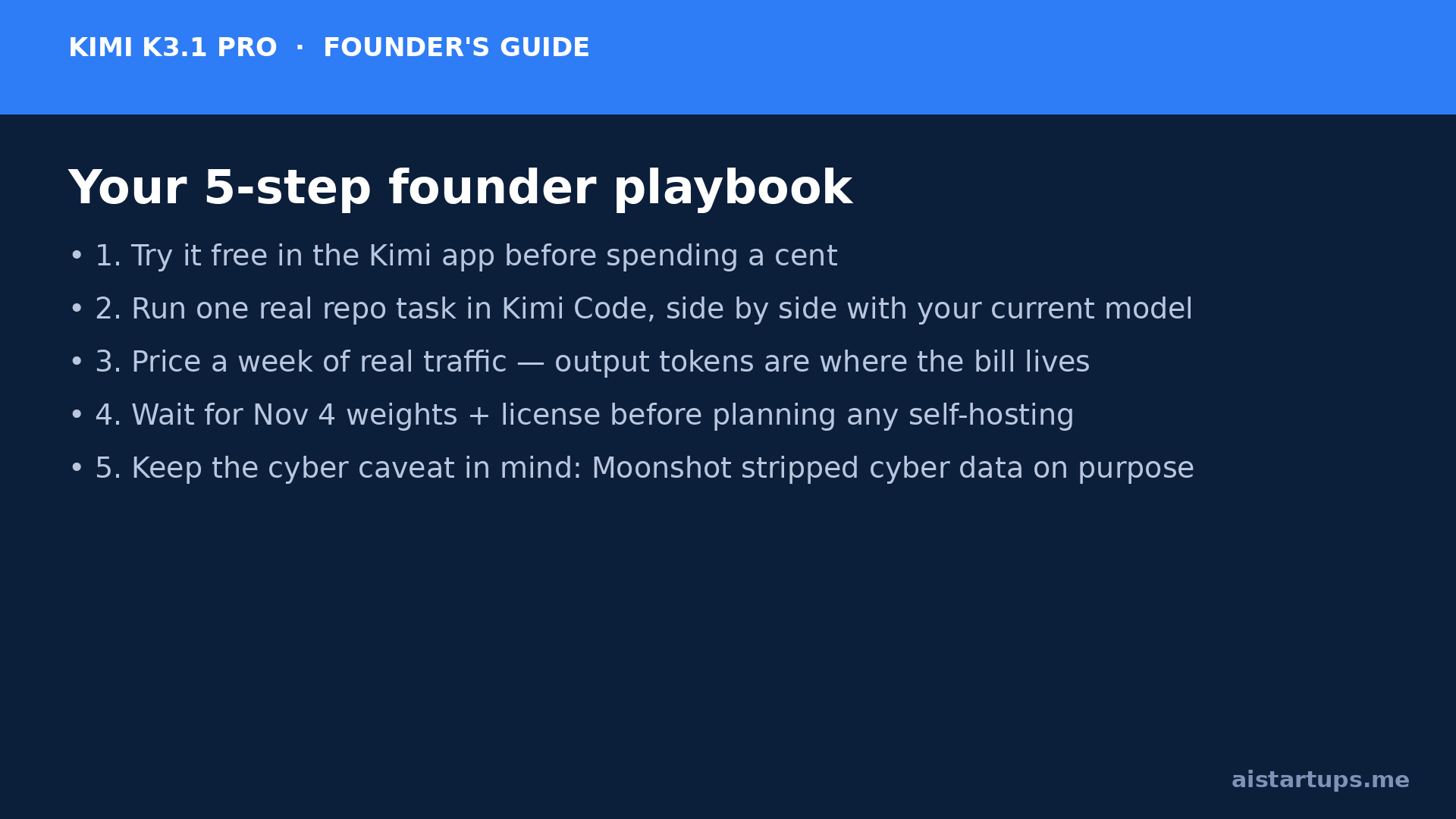
Step 1: Try it free in the app first
Open kimi.ai or the Kimi app and select K3.1 Pro in the model picker. Give it a task you already know the answer to — a bug you’ve already fixed, a document you’ve already summarized, a small feature you’ve already shipped. You’re not testing whether it can do something impressive. You’re testing whether its answers match what you know is right, and how it explains itself when it gets something wrong. A model that explains its reasoning badly will cost you more in review time than it saves in generation time.
Step 2: Run one real repo task in Kimi Code
In Kimi Code, use the /model command to select K3.1 Pro, then point it at a real, small task in a real repo — not a toy example. Something with a test suite you can run afterwards, so “it worked” means “the tests pass,” not “it looked good.” Run the same task on your current model, same prompt, same repo. Compare three things: did the tests pass, how many review comments did you leave, and how long did the whole loop take. That’s your evaluation. Everything else is marketing.
Step 3: Price a week of real traffic before you commit
From the Kimi API platform, create a key, select kimi-k3.1-pro (or the Highspeed variant for one latency-sensitive workflow), and route a slice of real traffic — say 10% — through it for a week. Track input tokens, output tokens, cache-hit rate, and pass rate side by side with your current model. The official quickstart guide covers setup. If the pass rate holds and the bill drops, you have a case for switching. If the pass rate drops even slightly, the cheaper price is an illusion — your engineers’ time costs more than the token saving.
Step 4: Use the long context deliberately
The 1M-token window is K3.1 Pro’s quiet superpower, and most teams will waste it. Don’t just dump your whole repo in and hope. Use it for the jobs where context is the actual bottleneck: onboarding a new contractor onto a legacy codebase, auditing a full financial workflow across dozens of documents, or refactoring something that touches twenty files at once. Those are the tasks where a smaller model forces you to chunk and summarize and lose information — and where K3.1 Pro’s flat-rate long window earns its keep.
Step 5: Don’t plan self-hosting yet
This is the step people skip, and it’s the one that will save you a wasted sprint. The weights aren’t out yet. Plan nothing around self-hosting until November 4, and even then, wait for the license terms, which Moonshot hasn’t confirmed. A model you can’t legally run in production isn’t an open model yet — it’s a promise. Promises don’t ship products.
Where it fits against the rivals
Context helps here, because K3.1 Pro doesn’t exist in a vacuum. If you’re already using one of the models below, here’s how I’d think about the switch:
Against Claude Opus 5.5: Opus is still ahead on the headline benchmarks and on the independent index (58 vs 55). If your work is the hardest reasoning you do, and a 3-point gap matters, stay on Opus. If your work is mostly coding and agent tasks, K3.1 Pro gets you most of the way there at half the price — and the money you save buys a lot of human review.
Against Claude Sonnet 5.5: This is the closest fight, because the price is identical ($2/$10) and Sonnet leads the independent index by a single point (56 vs 55). If you’re already happy on Sonnet, there’s no urgent reason to move — K3.1 Pro’s edge is the 1M context and the coming open weights, not raw capability. For a fuller picture of what Sonnet does well, our hands-on Sonnet 5.5 guide covers it in detail.
Against GPT-6 Astra: K3.1 Pro trails Astra nowhere that matters for builders — it’s ahead on Terminal-Bench in both vendor and independent measurements, and ahead on the independent index (55 vs 53). If Astra is your current default for coding, K3.1 Pro is a credible, cheaper alternative to test this week.
Against DeepSeek V4.1 Flash: DeepSeek’s flash model is the budget option in this set, and it’s genuinely good for its price — our DeepSeek V4.1 Flash guide walks through where it shines. K3.1 Pro costs more, but buys you meaningfully stronger agent and long-horizon performance. Think of DeepSeek as the high-volume workhorse and K3.1 Pro as the model you reach for when the task is long, tangled, or expensive to get wrong.
Against Gemini 4 Argon: Argon is Google’s frontier play, and it sits behind K3.1 Pro on the independent index (53 vs 55) while living inside Google’s ecosystem. If your stack is already Google-heavy, Argon’s integrations may matter more than two index points — see our Gemini 4 Argon guide for that trade-off. If your stack isn’t, K3.1 Pro is the cleaner pick on capability per dollar right now.
And for the broader field — Mistral’s latest large model included — our Mistral Large 4 guide is a useful second opinion on how the European open-weight contenders compare. The pattern across all of them is the same: the open-weight gap to the closed frontier is now measured in single points, not in leagues.
The November 4 question (and the cyber caveat)
Let’s be blunt about the two things that should temper your enthusiasm, because both of them are easy to miss in the launch excitement.
First, the weights. Moonshot says the full model weights will be released by November 4, 2026. Until then, “open-weight” is a description of intent, not a fact you can act on. No license has been confirmed, no download exists, and no one outside Moonshot has run the model on their own hardware. If your business case depends on self-hosting — data residency, offline use, fine-tuning on your own data — then your business case starts on November 4 at the earliest, and only if the license allows what you need. Mark the date, but don’t build the roadmap on it yet.
Second, the cybersecurity story, which is actually one of the most interesting parts of this launch and one of the least reported. Moonshot says it deliberately removed cyber-related data from mid-training and from its reinforcement-learning environments for the open-weight release, because its own experiments showed that without that removal, the model’s vulnerability-research capability would have been substantially higher. On its internal xdev-bench-hard test, the unfiltered checkpoint solved 90.5% of problems at pass@3; the released K3.1 Pro solves 81.0% — still well ahead of K3’s 33.3%, but deliberately below what the pipeline could produce, and behind frontier closed models.
What does that mean for you in practice? Two things. One: if you’re building defensive security tooling — auditing code you own, reviewing legacy systems — K3.1 Pro is still plenty capable, and Moonshot’s stated intent is to raise the open-weight cyber capability gradually over time. Two: if you were hoping the open weights would give you a top-tier offensive security model, they won’t, by design. That’s a feature, not a bug, and it’s the reason Moonshot felt comfortable promising an open release at all. For most startups, the practical consequence is nil — you’re not in the vulnerability-research business. But it’s worth knowing, because it tells you something about how Moonshot thinks about open releases, and that thinking will shape what they ship next.
There’s one more operational detail worth knowing: Kimi Enterprise administrators have to enable K3.1 Pro for their organization, and zero data retention is available for API customers. If you’re sending proprietary code through any API, turn zero retention on before you send the first prompt. That’s not specific to Kimi — it’s basic hygiene — but it’s the kind of setting people forget in the excitement of a launch week.
Here’s the honest version: Kimi K3.1 Pro isn’t the model that ends the frontier debate. It’s the model that makes the frontier debate boring for most startups — because once a soon-to-be-open model scores 55 on an independent index and costs $2/$10, the question stops being “can we afford the best model?” and starts being “can we tell the difference on our own work?” Most teams can’t, and that’s the point.
What I’d do, and what I’d skip
If I were running a small engineering team today, here’s my actual plan. I’d run K3.1 Pro in the app this week for anything I’m currently doing by hand — document review, research summaries, first drafts of specs. I’d route one real coding workflow through Kimi Code and measure it properly. I’d price a week of API traffic and compare it honestly against my current bill, cache hits included. And I’d put a calendar reminder on November 4 to check the weights and the license, not a plan to self-host.
What I’d skip: switching everything on launch day, building a product that depends on the weights before they exist, and using Highspeed everywhere because faster sounds better. Highspeed is for the workflows where a human is waiting on the loop. Everywhere else, it’s just a doubled bill wearing a nicer name.
One more practical note, since a lot of founders reading this are also thinking about what to build around a model like this: if K3.1 Pro (or any model) becomes part of a product you’re selling — a coding tool, an agent workflow, a customer-facing feature — the integration work is where most teams stall, not the model choice. If you need a team that does that kind of build properly, AISquadX is a web development and AI integration studio worth talking to. Pick the model on its merits; get the integration done by people who’ve done it before.
Frequently asked questions
What is Kimi K3.1 Pro?
Kimi K3.1 Pro is Moonshot AI’s flagship model, launched October 23, 2026. It’s a post-trained version of Kimi K3 with a 1-million-token context window, 2.8 trillion total parameters (104 billion active per token), and strengths in coding, agentic work, 3D modeling and finance. A faster Highspeed variant is also available.
How much does Kimi K3.1 Pro cost?
On the Kimi API, standard K3.1 Pro costs $2 per million input tokens and $10 per million output tokens, with cache-hit input at $0.20 per million. Highspeed costs $4 input and $20 output, with cache hits unchanged. That’s a third below Kimi K3’s pricing, the same as Claude Sonnet 5.5 and GPT-6.1 Sol, and half the price of Claude Opus 5.5.
When will the Kimi K3.1 Pro weights be released?
Moonshot says the full model weights will be released by November 4, 2026. Until then the model is available only through kimi.ai, the Kimi apps, Kimi Work, Kimi Code and the Kimi API. The license terms have not been confirmed, so don’t plan self-hosting or fine-tuning until the release lands and the license is public.
How does Kimi K3.1 Pro compare with Claude Opus 5.5?
On Moonshot’s own Terminal-Bench 4.0 run, K3.1 Pro scored 65.7% against Opus 5.5’s 66.4% — close, but behind. On the independent Artificial Analysis Intelligence Index, K3.1 Pro scored 55 against Opus 5.5’s 58. It’s near-frontier on coding and agent work, not past the frontier, and it costs about half as much.
Should my startup switch to Kimi K3.1 Pro now?
Test it this week, switch on evidence, not on launch hype. Run one real repo task in Kimi Code, price a week of real API traffic with cache hits counted, and compare pass rates against your current model. If the pass rate holds and the bill drops, switching makes sense. If you’re waiting on self-hosting, wait until after November 4.
The Bottom Line
Kimi K3.1 Pro is the strongest open-weight story of the year so far, and that’s not just launch-day enthusiasm talking — an independent index score of 55, a Terminal-Bench result within a point of the best closed model, and a price cut to $2/$10 is a combination that would have sounded unlikely six months ago. For coding teams, agent builders, and anyone doing long-context work on a startup budget, it’s the most credible alternative to the closed frontier right now.
But the honest version has two footnotes, and they’re both dates. The first is October 23, 2026 — the day the API launched, which is the only version of this model you can actually use today. The second is November 4, 2026 — the day the weights are promised, which is the day the “open” part of this story either becomes real or doesn’t. Between those two dates, the smart move is simple: test it on your own work, count your own tokens, and let your own numbers decide. The benchmarks got you interested. Your workload should get the final vote.



