
Europe just crashed the frontier-model party again — and this time it brought a meme name.
On October 6, 2026, Mistral AI unveiled Mistral Large 4, a 1.05-trillion-parameter open-weight model the company itself nicknamed “Le Chonk.” (Yes, that’s the actual nickname. In the launch announcement. I love this industry.) Three-year-old French startup, five months since its last major release, and it walks into an event in Abu Dhabi and says it now rivals China’s best open models and beats several closed frontier models on cybersecurity benchmarks.
Look — I cover a lot of model launches on this site, and most of them blur together after a while. This one’s different, and not because of the size. It’s different because of what it costs to use, where you can run it, and who it’s built for. Open weights land October 27, the preview API is priced at a level that undercuts Google and OpenAI’s flagships, and the whole pitch is aimed squarely at companies that want to run AI on their own infrastructure under European law.
If you’re a founder deciding which model to build on in Q4, this is worth 10 minutes of your time. Here’s everything that matters — pricing, benchmarks (with the asterisks nobody reads), how to try it today, and what to do before the weights drop.
What Mistral Large 4 actually is
Strip away the launch-day hype and here’s the hardware:
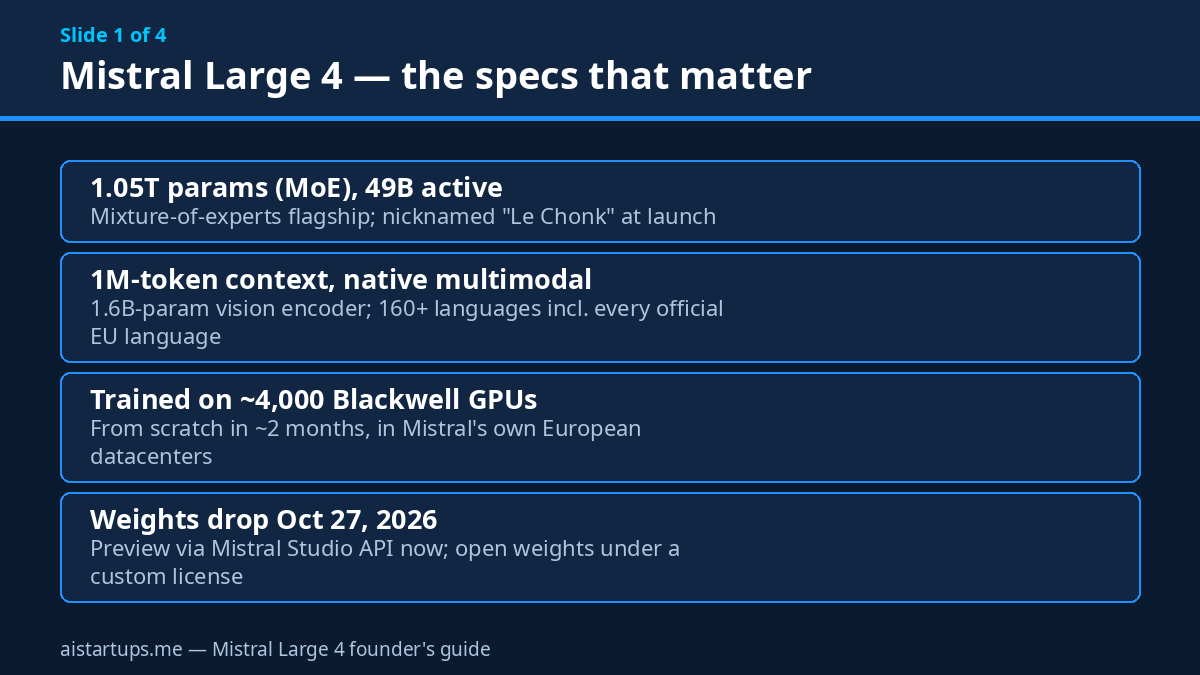
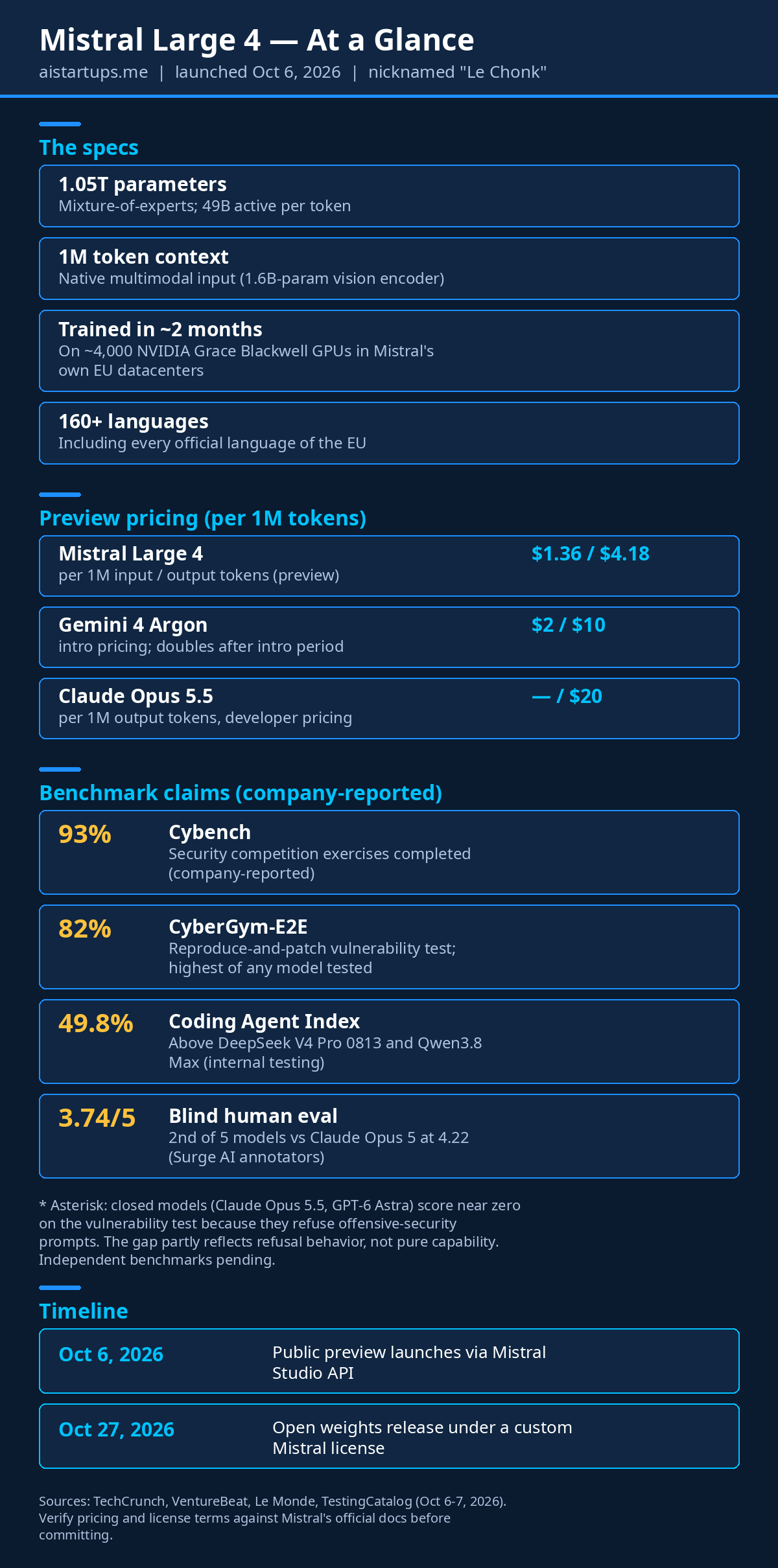
- 1.05 trillion parameters in a mixture-of-experts architecture, with 49 billion active per token. (The “Le Chonk” nickname is a joke about the trillion-parameter size — it started as a meme and Mistral ran with it.)
- Natively multimodal — text plus image input through a 1.6-billion-parameter vision encoder. It’s not a text-only model wearing a vision adapter as a hat.
- 1 million token context window, which puts it in the same long-context league as Google’s frontier models.
- Trained from scratch in about two months on roughly 4,000 NVIDIA Grace Blackwell GPUs — in Mistral’s own European datacenters, using two to three times less compute than its Chinese competitors, according to the company. That’s the efficiency story they’re proud of.
- 160+ languages, including every official language of the EU. Mistral’s always leaned on multilingual strength, and it matters if you’re selling into non-English markets.
Right now it’s preview only — you can hit it through an API via Mistral Studio on a public guardrail endpoint. The open weights follow on October 27, 2026, under a custom Mistral license, after a few weeks of red-teaming with cybersecurity firms, vetted partners, and state authorities. Those partners get a version with relaxed moderation and expanded cyber capabilities — which, we’ll get to, is exactly where the interesting benchmark claims live.
One thing worth knowing: this is the first big milestone of Mistral’s €3 billion Series D, and the company scaled its science team from 3 researchers to roughly 300. Whether you love or hate the “European champion” narrative, the resources behind this release are real.
The price tag (this is the interesting part)
Real talk: most frontier launches make me wince at the pricing slide. This one didn’t.
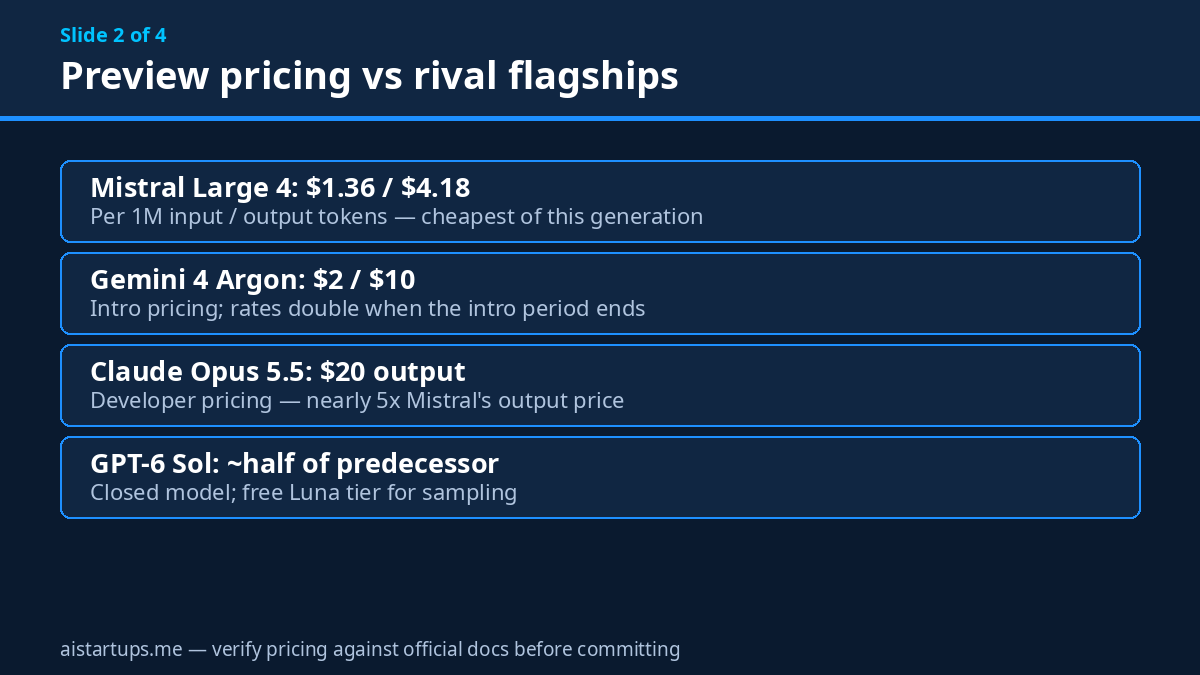
Mistral priced the Large 4 preview at $1.36 per million input tokens and $4.18 per million output tokens. Now compare that against what else shipped this year:
- Gemini 4 Argon (Google, Sept 30): $2/M input, $10/M output during its intro period — and Google says those rates double when the intro ends. Argon also carries a 15% hallucination rate claim and strong benchmark numbers, so it’s genuinely competitive, but it costs you more per token.
- Claude Opus 5.5 (Anthropic, Sept 22): $20 per million output tokens — developers’ pricing, down from $25, and near-flagship performance at ~40% lower cost. Still nearly 5x Mistral’s output price.
- GPT-6 Sol (OpenAI, Sept 22): roughly half the developer price of its predecessor, with a free lighter companion (GPT-6 Luna) for sampling. Solid for general work, but it’s a closed model you’ll never self-host.
So ML4 sits in a sweet spot: cheaper than Google’s and Anthropic’s flagships, multimodal, long context, and — this is the kicker — open weights are coming. None of the three above will hand you the weights. For a startup watching its burn, that’s a genuinely different value proposition.
Quick math for the budget-minded: a startup doing 10 million input tokens and 3 million output tokens a month on ML4 pays roughly $26.10/month. Run the same volume on Opus 5.5 and you’re looking at a very different invoice. (If your API bill is already keeping you up at night, my guide on how to cut your AI API bill by 70% pairs well with this — caching, routing, and smaller models for the easy stuff still apply even with cheap flagship pricing.)
The benchmarks — and the giant asterisk
Okay, here’s where I need to be honest with you, because launch-day benchmark slides are marketing documents with footnotes.
Mistral’s headline claims for Large 4:
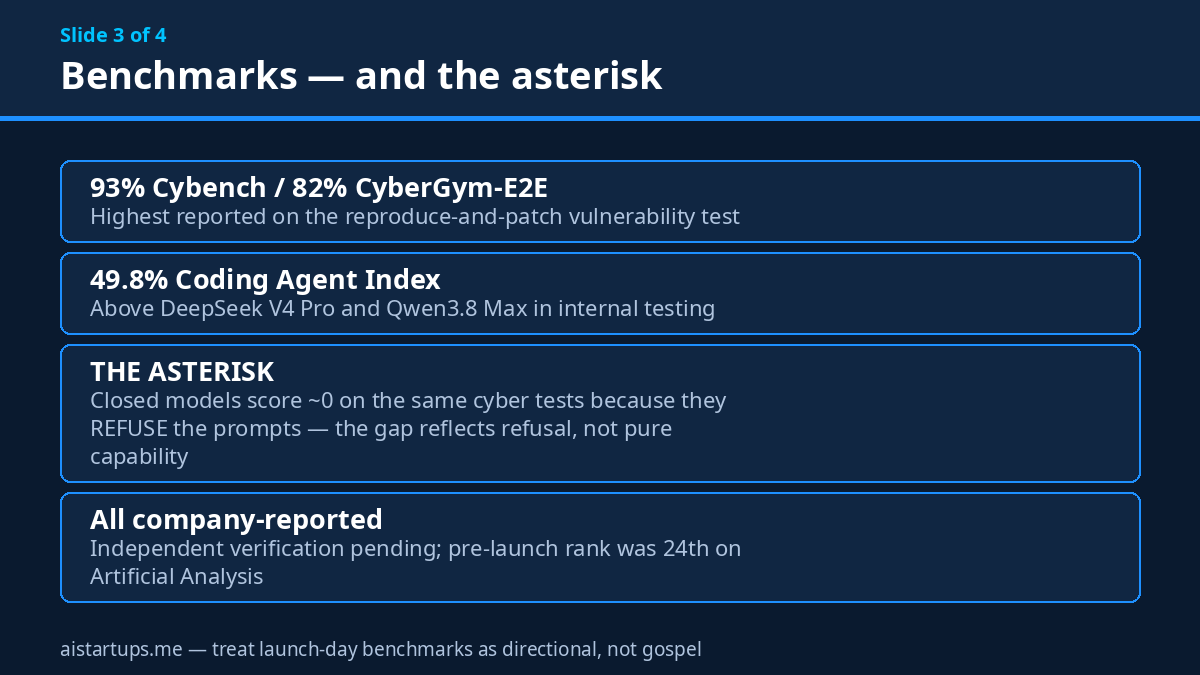
- 93% on Cybench and 82% on CyberGym-E2E — a test where the model reproduces a real software vulnerability and then patches it. Mistral says that 82% is the highest score of any model tested.
- 49.8% on a combined Coding Agent Index, above DeepSeek V4 Pro and Qwen3.8 Max in Mistral’s internal testing (privately evaluated by Artificial Analysis ahead of a public harness launch).
- A blind evaluation with Surge AI’s professional annotators placed ML4 Preview second of five models at 3.74/5 — behind Claude Opus 5 at 4.22, but ahead of the rest of the pack.
- The company claims it’s the best open-weights model from the US or Europe on aggregate benchmarks, and top-five on the Artificial Analysis Cyber Index.
Now the asterisk — and it’s a big one. On that vulnerability-reproduction test, Mistral itself notes that several closed models, including Claude Opus 5.5 and GPT-6 Astra, score near zero because they refuse to perform the task. The closed labs restrict their most cyber-capable systems from offensive-security-style prompts entirely.
So when you see “ML4 beats Claude Opus 5.5 on cyber benchmarks,” what that actually means is: ML4 will attempt the task and Claude won’t. That’s a real, meaningful difference for a security team — a model that refuses can’t help you find vulnerabilities in your own code — but it’s not the same as “ML4 is smarter than Opus 5.5.” Don’t let anyone quote that number at you without the context.
Amid a growing divide between closed models that can be unplugged and open models that are often made in China, Mistral is positioning ML4 as an alternative to both — Europe’s “third way in AI.” — TechCrunch, on the October 6 launch
Also worth noting: most of these numbers are Mistral’s own. Independent third-party rankings haven’t confirmed them yet (the open weights aren’t out, so nobody can run their own evals). The model reportedly slipped to 24th on Artificial Analysis’s aggregate intelligence ranking before this launch — ML4 is supposed to fix that, but we’ll see when the independent numbers land. Treat the benchmarks as directional, not gospel.
Why this launch actually matters for your startup
Forget the benchmark horse race for a minute. Here’s what makes ML4 strategically interesting for founders:
1. Open weights land October 27
This is the whole ballgame. When the weights drop, you can download ML4 and run it yourself — on your own hardware, in a private cloud, or on sovereign infrastructure. For startups selling into regulated industries (finance, healthcare, government), “we run the model on our own servers and your data never leaves” is a sales argument worth more than any benchmark. Mistral is explicitly planning private-cloud and on-premises deployment options for security teams.
Caveat: the weights come under a custom Mistral license, not a standard open-source license. Read the terms before you build a business on top of them — “open-weight” and “open-source” aren’t the same thing, and the license details will determine what you can actually do commercially.
2. The EU data-sovereignty angle is real
Mistral is offering a European deployment operated end-to-end by Mistral under European law — no third-party cloud providers in the loop. If you’re selling to European enterprises that flinch at US-cloud data processing (and post-Schrems, plenty do), this removes an objection from your sales calls. The GDPR-compliance positioning isn’t just marketing; it’s a genuine differentiator against US and Chinese alternatives.
3. It’s tuned for the workloads startups actually sell
Mistral’s optimized use cases: cybersecurity, finance, manufacturing, and chip design. Not “write me a poem” — enterprise workflows. If your startup does security tooling, financial analysis, document-heavy finance workflows, or anything with visual grounding (the model reportedly beats closed models on visual grounding tasks), ML4 is aimed directly at you.
4. Multimodal + 1M context at that price
A million-token context window with native multimodal input at $1.36/$4.18 per million tokens is aggressive pricing. For document-processing startups, legal-tech, or anyone doing long-context RAG, that’s a combination worth benchmarking against whatever you’re using now. (Pair it with the right supporting stack — my roundup of the 19 AI tools every startup founder should use in 2026 covers the document-processing and workflow tools that sit around a model like this.)
Hands-on: how to try Mistral Large 4 today
You don’t have to wait for October 27. Here’s the practical path:
Step 1 — Get API access through Mistral Studio
The preview is live now. Sign up for a Mistral account, head to Mistral Studio (their developer console), and you’ll find Large 4 in the model list on the public preview endpoint. Generate an API key and you’re in — it’s the standard chat-completions-style API, so if you’ve integrated any OpenAI-compatible endpoint before, this will feel familiar. The docs list support for structured outputs, function calling, document Q&A, batch processing, and their agents endpoints.
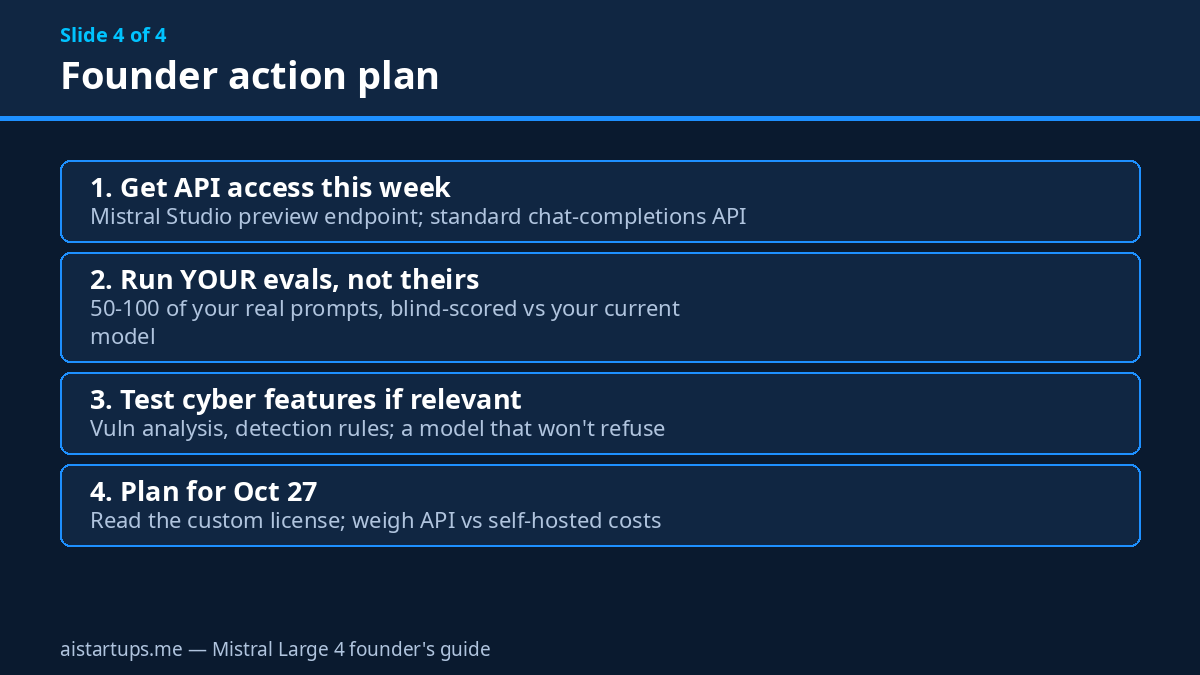
Step 2 — Run your own evals, not theirs
Don’t benchmark ML4 on Mistral’s chosen tests. Benchmark it on your workload: your actual customer prompts, your actual documents, your actual edge cases. Build a set of 50–100 representative tasks, run them through ML4 and your current model side by side, and score them blind. That’s the only benchmark that matters for your business. The Surge AI blind-eval result (3.74/5, second of five) suggests the model holds up well in human-judged quality — but your domain is your domain.
Step 3 — Test the cyber capabilities if that’s your space
If you’re in security tooling, this is the one genuinely differentiated feature: a frontier-class model that will actually attempt vulnerability analysis, malware triage, and detection-rule generation instead of refusing. Test it against your existing pipeline. Just remember the red-teaming context — the preview runs behind guardrails, and the less-moderated version is currently reserved for vetted partners and authorities.
Step 4 — Plan for October 27
Mark the weights release on your calendar. Between now and then: figure out your self-hosting story (1T parameters is not a laptop model — you’ll need serious GPU infrastructure or a hosting partner), read the custom license terms when they publish, and decide whether the API or self-hosted route fits your unit economics. If you’re building a product on top of a new model and need the actual web app, dashboard, or integration layer built around it, that’s exactly the kind of work AISquadX does — a web development and AI integration studio that can take a model API and turn it into a shippable product.
The honest caveats
I wouldn’t be doing my job if I skipped these:
- It’s a preview. The weights aren’t out, the guardrailed endpoint is the only access, and Mistral says capabilities will keep improving as reinforcement learning concludes. What you test today isn’t the final checkpoint.
- Most benchmarks are company-reported. Independent verification is pending. The pre-launch ranking slide (24th on Artificial Analysis) is the reality check on how far they had to climb.
- The cybersecurity framing will attract scrutiny. A model this capable at offensive-security benchmarks, with open weights coming, is going to draw attention from policymakers. That’s not a reason to avoid it — but it’s a reason to watch the regulatory conversation if your business depends on it.
- Custom license, not open source. Until the license terms are public, don’t assume you can do everything with the weights that “open” implies.
- Mistral’s enterprise focus is a double-edged sword. The model is optimized for cyber, finance, manufacturing, and chip design. If your use case is creative writing or consumer chat, the tuning may not favor you — test before you commit.
Mistral Large 4 vs the field: the founder’s cheat sheet
- Cheapest flagship API pricing of the current generation: $1.36/$4.18 per million tokens undercuts Gemini 4 Argon’s $2/$10 and Claude Opus 5.5’s $20 output pricing.
- Only frontier model with open weights arriving this month (Oct 27) — DeepSeek and Qwen are the open-weight competition, and Mistral claims to match or beat them at smaller total size.
- Only one with a European sovereign-deployment story — operated end-to-end by Mistral under EU law. Nobody else in the frontier pack offers that.
- Strongest cyber-capability story — but remember the asterisk: part of the gap is that closed models refuse the tests.
- Weakest independent verification right now — every number above comes from Mistral. The independent evals arrive with the weights.
For broader context on how the model landscape shifted this year, my hands-on guides to Gemini 4 Argon and the Claude Opus 5.5 vs GPT-6 price war cover the models ML4 is going up against — worth a read if you’re picking a primary model for Q4.
FAQ
What is Mistral Large 4?
Mistral Large 4 (ML4), nicknamed “Le Chonk,” is Mistral AI’s flagship model announced October 6, 2026. It’s a 1.05-trillion-parameter mixture-of-experts model (49B active parameters) with native multimodal input, a 1M-token context window, and training across 160+ languages. It’s currently in public preview via API, with open weights scheduled for October 27, 2026.
How much does Mistral Large 4 cost?
The preview API is priced at $1.36 per million input tokens and $4.18 per million output tokens — cheaper than Google’s Gemini 4 Argon ($2/$10 intro pricing) and Anthropic’s Claude Opus 5.5 ($20/M output). Once the open weights land on October 27, self-hosting becomes an option, which changes the economics entirely for high-volume use cases.
When can I download the Mistral Large 4 weights?
October 27, 2026, according to Mistral’s launch announcement. The weights will be released under a custom Mistral license (not a standard open-source license) after a red-teaming period with cybersecurity firms and government partners. Until then, the model is available only through the preview API in Mistral Studio.
Is Mistral Large 4 really better than Claude and GPT-6?
On cybersecurity benchmarks, Mistral reports the highest scores of any model tested — but with a major caveat: closed models like Claude Opus 5.5 and GPT-6 Astra score near zero on the same tests because they refuse offensive-security-style prompts. So ML4 is the most willing frontier model for security work, which is genuinely useful, but that’s not the same as being the most capable overall. Independent benchmarks are still pending.
Should my startup build on Mistral Large 4?
It’s worth evaluating now if any of these apply: you sell into European enterprises (the EU sovereign-deployment story removes objections), you’re in security/finance/manufacturing (its optimized domains), you want open weights for self-hosting or fine-tuning, or your API bill is painful (the pricing undercuts every other flagship). Run your own blind evals on your actual workload before committing — and watch the October 27 license terms.
The Bottom Line
Mistral Large 4 is the most founder-friendly frontier launch of the year — not because it’s the smartest model (that title is still contested), but because of the package: flagship-class capabilities at the lowest API pricing in its class, open weights in three weeks, and a European deployment story nobody else offers.
The smart move isn’t to switch everything today. It’s to get API access this week, run your own evals on your real workload, and have a self-hosting plan ready for October 27. The founders who do that homework now will know exactly whether Le Chonk earns a place in their stack — and they’ll know it before their competitors finish reading the launch tweets.
And honestly? A frontier lab naming its trillion-parameter flagship “Le Chonk” gives me hope for this industry. More of that energy, please.