
Real talk: I didn’t have “Meta ships a frontier model” on my October bingo card. For two years the story was the same — Llama, open weights, Meta playing the commoditize-the-model game while OpenAI and Anthropic charged real money for the good stuff.
That story ended on Monday.
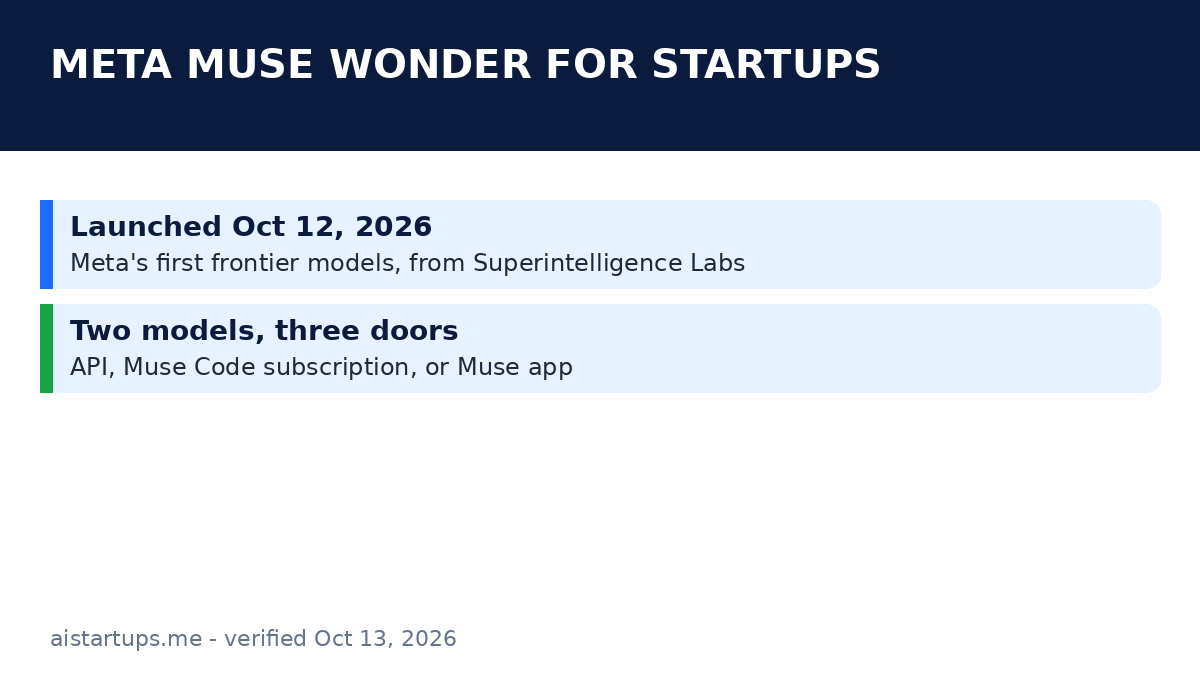
On October 12, 2026, Meta’s Superintelligence Labs released Muse Wonder and Muse Wonder Full — the company’s first attempt at a frontier-class model, announced by Mark Zuckerberg himself. And look, the specs are genuinely interesting. But the pricing and the access rules? That’s where it gets complicated for startups. So let’s do what we always do here: cut through the launch-day hype, check the actual numbers, and figure out what this means for your company.
What Meta Actually Announced
Quick context first. About fourteen months ago, Zuckerberg overhauled Meta’s AI operation and built Meta Superintelligence Labs (MSL), bringing in former Scale AI CEO Alexandr Wang to run it and pouring billions into researchers and compute. Since then we’ve gotten Muse Spark (a lightweight, low-latency model) and the Muse personal AI agent — but nothing that competed at the top of the benchmark tables.
Wonder is that attempt. Two models:
- Muse Wonder — the standard model, available now through the Meta Model API (as
muse-wonder-1.0) and through Muse Code. Also already listed on OpenRouter asmeta/muse-wonder. - Muse Wonder Full — the bigger, more capable sibling. This is the one posting the headline benchmark numbers. And you can’t get it on the API at any price.
Both accept text, images, audio, and video as input, produce text output, and support a roughly 1-million-token context window. Both were trained at Meta’s Prometheus data center in central Ohio — a gigawatt-scale facility that came online this year. Both will also power the Muse agent going forward.
And here’s the quote from Meta’s blog post that tells you everything about their ambition:
“Together, they mark the next step on our scaling ladder and a major leap toward personal superintelligence.”
Okay. Ambitious. But what does it cost, and does it actually perform?
Pricing: Three Ways to Get Your Hands on It
Meta is selling Wonder three different ways, and each one fits a different kind of company. This matters — pick the wrong door and you either overpay or can’t deploy in production.
1. The Meta Model API (pay-as-you-go)
For developers, the headline numbers:
- Input: $4 per million tokens
- Output: $20 per million tokens
- Cached input: $0.20 per million tokens
- Web search via API: $2.50 per 1,000 queries
Meta charges the same rate no matter how much of the 1M context you use, and the docs list limits of 3,000 requests and 4 million tokens per minute. The API also ships OpenAI- and Anthropic-compatible endpoints, which is a nice touch — you can test Wonder inside your existing agent stack without a rewrite. If you’ve been working on cutting your AI API bill, this matters: swap-in testing costs you an afternoon, not a sprint.
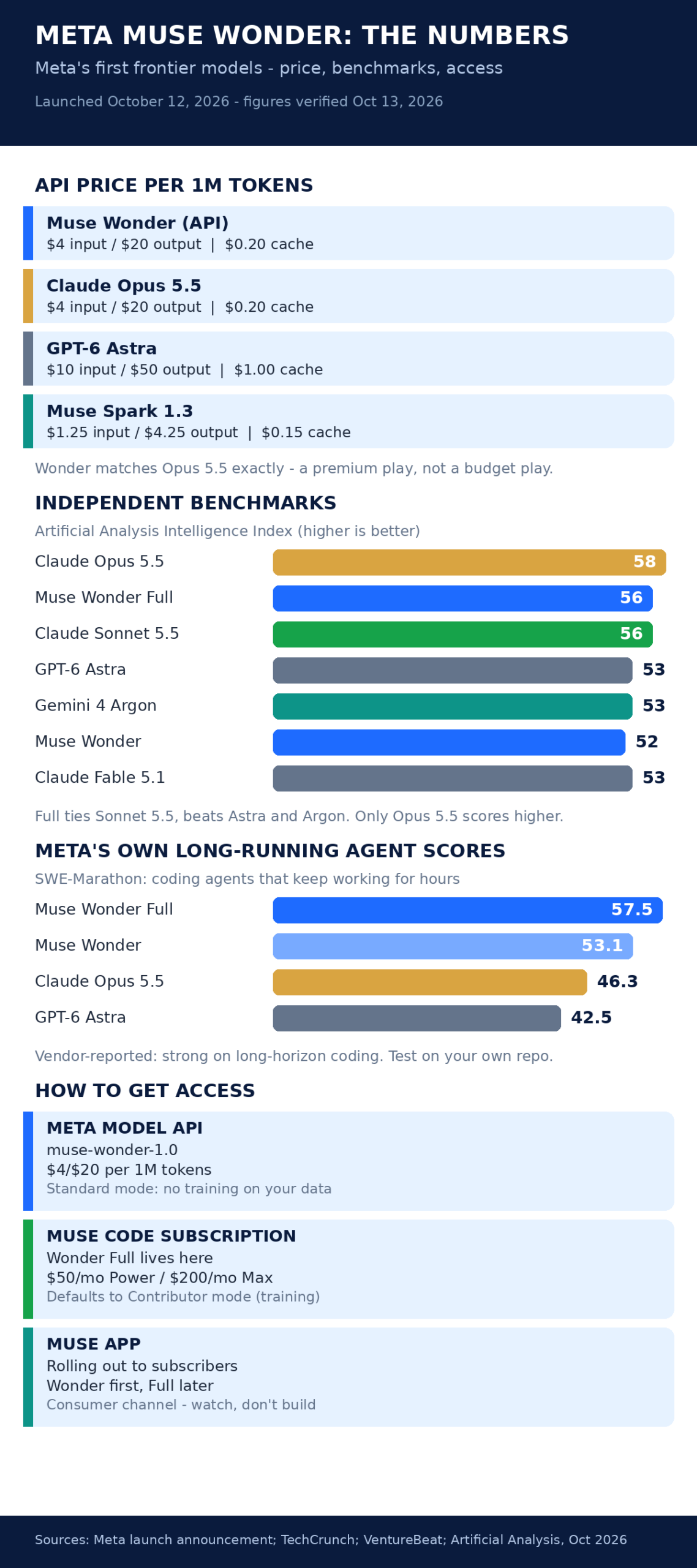
How does that stack up? Here’s the pricing table, from Meta’s official pricing and Artificial Analysis’s pricing profiles:
| Model | Input / 1M | Output / 1M | Cached / 1M |
|---|---|---|---|
| Meta Muse Spark 1.3 | $1.25 | $4.25 | $0.15 |
| Meta Muse Wonder | $4.00 | $20.00 | $0.20 |
| Claude Opus 5.5 | $4.00 | $20.00 | $0.20 |
| GPT-6 Astra | $10.00 | $50.00 | $1.00 |
| Claude Fable 5.1 | $10.00 | $50.00 | $0.20 |
| Claude Sonnet 5.5 | $2.00 | $10.00 | — |
| Gemini 4 Argon | $2.00–$4.00 | $10.00–$20.00 | — |
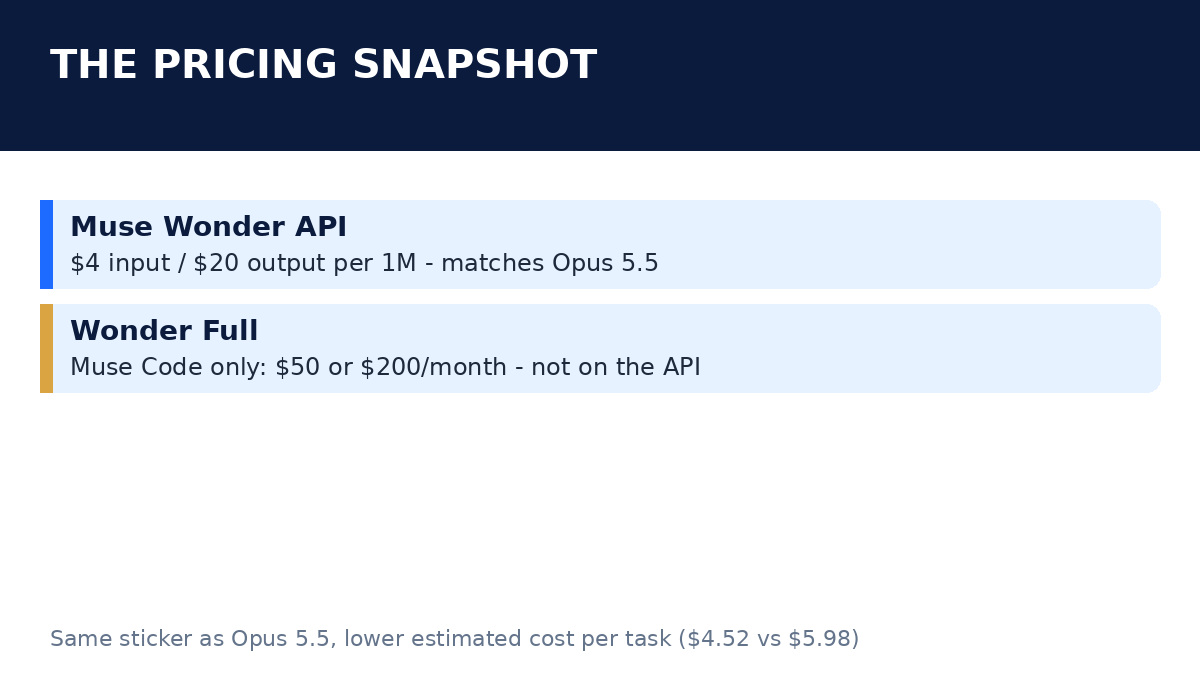
See what’s happening? Wonder is priced exactly like Claude Opus 5.5 — down to the cached-input rate. That’s not a coincidence, that’s a message: Meta thinks this model belongs in the same tier. Meanwhile the smaller models (Sonnet 5.5, GPT-6 Luna, Gemini 4 Argon at introductory pricing) sit at roughly half the cost. Wonder is not a budget play. It’s a premium play with Opus 5.5 pricing.
One more number worth knowing: Artificial Analysis estimates the cost of running its average benchmark task at $4.52 for Wonder, versus $5.98 for Opus 5.5 and $3.26 for GPT-6 Astra. Same sticker price as Opus, lower cost per completed task — because token consumption differs between models. Sticker price isn’t the whole story. (We covered this dynamic in our Claude Sonnet 5.5 guide too — pricing tables lie by omission.)
2. Muse Code subscriptions (the only way to get Wonder Full)
Want the best model Meta made? You can’t buy it by the token. Wonder Full lives exclusively inside Muse Code, Meta’s coding assistant, on two subscription tiers:
- Power Usage — $50/month: access to Wonder Full, 20x the usage allowance of the Everyday plan
- Maximum Usage — $200/month: 80x the Everyday plan’s usage allowance
For an individual developer or a tiny team, $50–200/month for a frontier coding model is… honestly, not crazy. It’s in the same ballpark as every other premium coding plan. But for a company that wants to embed the best model in its own product — customer-facing software, internal automation, production agent systems — this is a dead end right now. You can test Wonder Full inside Meta’s environment. You cannot deploy it through the API. That distinction is the whole ballgame for startups building on top of models.
3. The Muse app (subscribers first)
Muse Wonder is rolling out inside Meta’s Muse personal AI agent, starting with paying subscribers. If you’ve been following our Meta Muse for small business guide, this is the model upgrade path for that product — worth watching, but not a builder’s door.
The Benchmarks — Read Them Carefully
Okay, the part everyone skips to. I’ve split this into two piles: what independent evaluators measured, and what Meta says about itself. Both are useful. Only one should decide your roadmap.
The independent numbers (Artificial Analysis)
Artificial Analysis already evaluated both models on its Intelligence Index, which combines ten evaluations across reasoning, knowledge, coding, and professional tasks:
| Model | AA Intelligence Index |
|---|---|
| Claude Opus 5.5 | 58 |
| Muse Wonder Full | 56 |
| Claude Sonnet 5.5 | 56 |
| GPT-6 Astra | 53 |
| Gemini 4 Argon | 53 |
| Claude Fable 5.1 | 53 |
| Muse Wonder (standard) | 52 |
| Grok 4.6 | 44 |
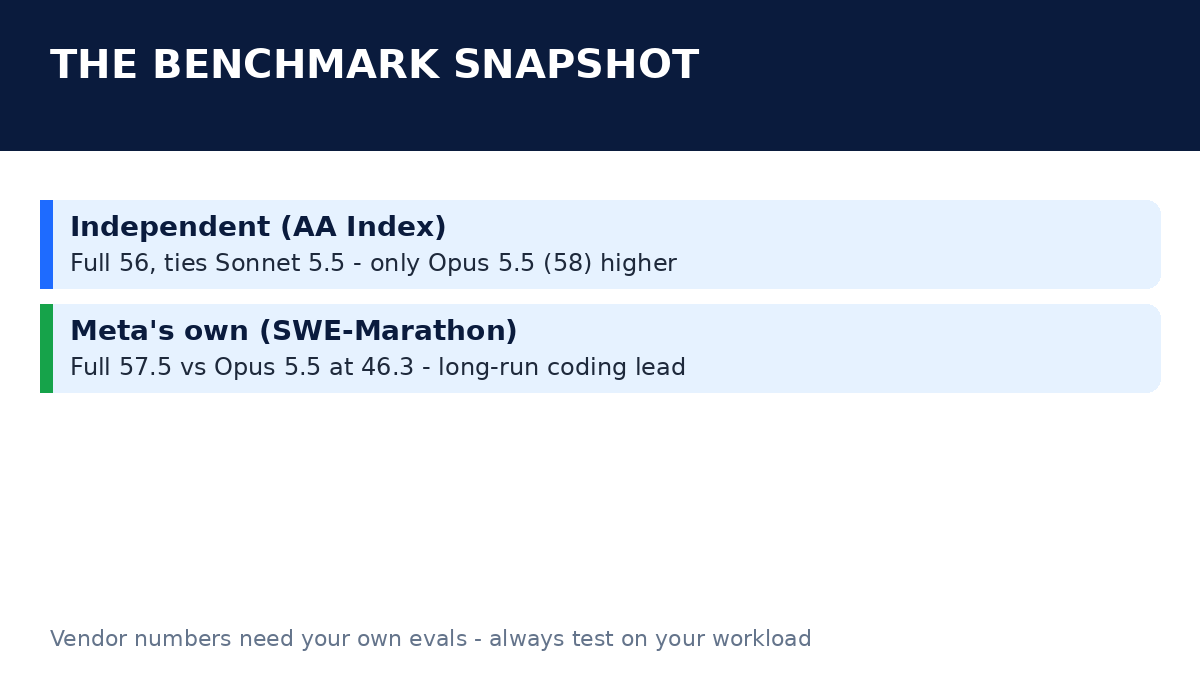
Honest read: this is genuinely impressive for a first frontier attempt. Wonder Full ties Sonnet 5.5 and beats GPT-6 Astra, Gemini 4 Argon, and Fable 5.1 on the aggregate measure. Only Opus 5.5 scores higher. The standard Wonder lands at 52 — a point behind Astra, ahead of everything in the mid tier, and a big jump from Muse Spark 1.3’s 48.
So yes: Meta is at the frontier table. Just not at the head of it.
Meta’s own numbers (handle with care)
Meta’s model card publishes its own benchmark table, mixing third-party results, vendor-supplied scores, and Meta’s own evaluations. The standouts:
- SWE-Marathon (long-running coding): Wonder Full 57.5 vs Opus 5.5 at 46.3 vs GPT-6 Astra at 42.5
- DeepSWE 1.1 (software engineering): Wonder Full 79.0
- Harvey LAB-AA (legal tasks): Wonder Full 13.1 vs 4.2 for Opus 5.5
- AutomationBench-AA (business workflows): Wonder Full 45.4 vs 41.2 for Opus 5.5
- MemoryBench (long-term recall): Meta says Wonder scores higher than Fable, Opus, or Astra
Two caveats, because someone has to say them. First, Meta’s own methodology note admits some of these comparisons use different coding tools per model — not exactly lab conditions. Second, the legal benchmark: 13.1 vs 4.2 sounds like a blowout until you notice the absolute scores are tiny — nobody’s agent is producing fully satisfactory legal deliverables yet. Directionally interesting, not decision-grade.
And the counterweight: Opus 5.5 still leads on Terminal-Bench 4.0 and HealthBench Pro, and on the aggregate index. If you want the single best-scoring model on average, it’s still Opus 5.5. Meta’s real story is narrower: long-running agentic work — coding agents that keep going, workflows that span hours, tasks that need memory across sessions. That’s the lane they’re pitching, and the SWE-Marathon and AutomationBench numbers back it up.
Active Memory and Active Focus — The Actual Differentiator
Here’s the thing I find most interesting about this launch, and it’s not the benchmark table.
Meta’s whole pitch centers on two capabilities:
- Active Memory — the agent preserves relevant personal and professional context across conversations, pulls back earlier details, and folds new information into ongoing work. Days, weeks, months, per research scientist Kavya Kopparapu.
- Active Focus — the agent keeps pursuing the objective through blockers, revises plans, tries alternatives, and asks permission before consequential actions instead of either stalling or doing something reckless.
Why should a founder care? Because every production agent deployment eventually dies on the same hill: context loss and brittle behavior. The agent forgets what the user said three sessions ago. It hits an unexpected error and gives up. It does something irreversible without asking. Meta is explicitly targeting the two failure modes that make agents unshippable — and built a benchmark (MemoryBench) to prove it.
Is it actually better? Meta’s own testing says yes; independent verification is pending. But strategically, this is the right hill. If you’re building agent-based products — and half the startups I talk to are — “remembers everything, doesn’t go rogue” is worth more than three points on a coding benchmark.
How a Startup Actually Uses This Thing
Enough theory. If you’re a founder staring at this launch, here are the practical plays, ranked by how real they are today:
1. Long-running coding agents (strongest fit)
The SWE-Marathon score is the single most startup-relevant number in this launch. 57.5 vs 46.3 for Opus 5.5 is a real gap on exactly the workload that matters: agents that work on codebases for hours, not minutes. If your team runs coding agents overnight — migrations, refactors, test backfills — Wonder Full via a $50/month Muse Code subscription is cheap enough to test this week. Run your own benchmark on your own repo. Vendor numbers are a starting gun, not a verdict.
2. Document-heavy knowledge work (good fit)
1M-token context plus the memory story makes Wonder a candidate for the unglamorous-but-valuable work: contract review pipelines, insurance workflows, financial analysis over long document sets — the exact professional use cases Meta’s announcement demos. The legal benchmark numbers say “promising, not production-ready without humans in the loop,” which, honestly, is where every model is on legal work. Price it like Opus 5.5, test it like a junior analyst.
3. Customer-facing copilots via the compatible API (solid fit)
The OpenAI/Anthropic-compatible endpoints are underrated. If your product already talks to those APIs, testing Wonder is a config change. At identical per-token pricing to Opus 5.5 but lower estimated cost per task, there’s a real chance your bill goes down — especially with the $0.20 cached-input rate on long, repetitive contexts. And if you’re already deep in the decision-model trend we covered in our OpenAI Decisions API guide, note the pattern: the whole industry is converging on typed, agentic, tool-calling workloads. Wonder is built for that world.
4. Getting it into your product (the build step)
The API makes integration straightforward for any team with backend engineers — compatible endpoints, standard token billing, no exotic SDKs. But if you’re a non-technical founder or your team is stretched thin, wiring a frontier model into a real product (auth, caching, evals, cost guardrails, the whole unglamorous stack) is genuinely a project. That’s the kind of work AISquadX does — a web development and AI integration studio that ships this stuff for companies that don’t have an AI engineering bench in-house.
5. The Muse app channel (watch, don’t build)
Wonder powering the Muse personal agent for subscribers is a distribution play, not a builder play. Interesting for understanding where Meta’s consumer AI goes. Not something you build on.
The Fine Print Nobody Tweets About
Every launch has the part they don’t put in the keynote. With Wonder, there are four:
1. The best model isn’t on the API. Wonder Full — the one with the 56 index score and the SWE-Marathon numbers — is Muse Code subscribers only. If your architecture depends on embedding Meta’s best model in your product, you can’t. You’re building on the 52, not the 56. Plan accordingly.
2. No downloadable weights. This is the big philosophical shift. Meta spent years as the open-weights champion with Llama. Wonder is proprietary — no self-hosting, no fine-tuning on your own infra, no direct modification. (Their smaller Muse Glimmer did get Apache 2.0 weights; Wonder didn’t.) If your compliance posture requires self-hosted models, Wonder is off the table. Full stop.
3. Muse Code defaults to training on your data. This one’s important. Muse Code subscriptions default to Contributor mode, which lets Meta use your prompts, code, files, and outputs to improve future models. You can disable it — but only for future submissions, and Meta’s terms explicitly prohibit submitting confidential or sensitive information. The pay-as-you-go API runs in Standard mode, where Meta says submitted content isn’t used for training. If your team touches proprietary code or customer data, know which mode you’re in before anyone pastes anything. This is not a “we’ll figure it out later” setting.
4. The benchmarks are launch-day benchmarks. Independent scores exist (Artificial Analysis moved fast), but enterprise evals on real workflows take weeks. Nobody — not Meta, not me, not anyone — has a production track record for these models yet. Early adopters get the pricing; they also get the surprises.
Should Your Startup Switch? Four Questions
Here’s my honest decision framework:
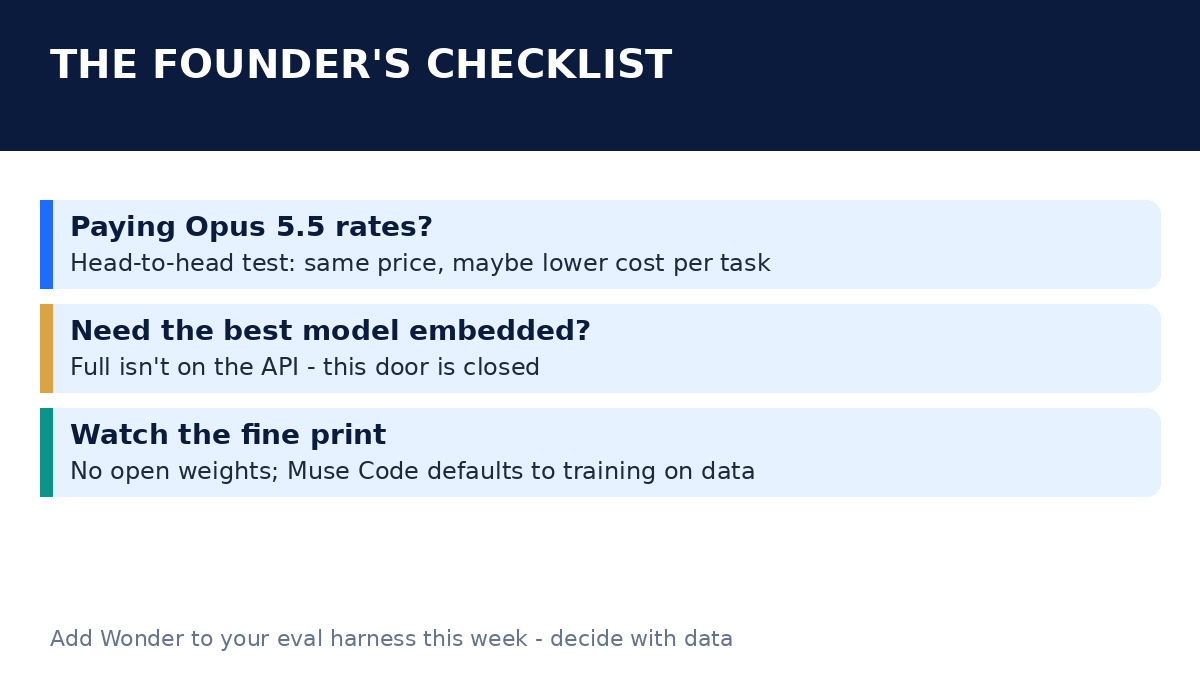
- Are you already paying Opus 5.5 rates? Then Wonder deserves a head-to-head test. Same sticker price, lower estimated cost per task, and the long-running-agent numbers favor Meta. The switching cost is low thanks to the compatible API.
- Do you need the absolute best model, embeddable in your product? Wonder can’t give you that — Full isn’t on the API. Opus 5.5 still leads the aggregate index. This door is closed for now.
- Is your workload long-running agents or document-heavy analysis? That’s Meta’s strongest lane. Test it against your current stack on your own data.
- Does your compliance require self-hosting or zero training on your data? Proprietary weights + Contributor-mode defaults mean you need to read the terms carefully. The API’s Standard mode helps, but verify before you commit.
And the meta-question: is this the week to switch anything? Probably not. Launch-week models get benchmarked to death and then quietly patched. The smart play is the boring one — add Wonder to your eval harness this week, run your own numbers over the next two, and decide with data instead of launch-day adrenaline. We’ve been saying this since the Gemini 4 Argon launch: the model you pick matters less than the evals you run.
Frequently Asked Questions
How much does Muse Wonder cost?
Through the Meta Model API: $4 per million input tokens, $20 per million output tokens, $0.20 per million cached input tokens, plus $2.50 per 1,000 web search queries. Wonder Full isn’t available on the API — it’s only for Muse Code subscribers at $50/month (Power Usage) or $200/month (Maximum Usage).
Is Muse Wonder better than GPT-6 Astra or Claude Opus 5.5?
It depends on the benchmark. On Artificial Analysis’s independent Intelligence Index, Wonder Full scores 56 — tying Claude Sonnet 5.5 and beating GPT-6 Astra (53) — while Claude Opus 5.5 leads at 58. On Meta’s own long-running coding benchmark (SWE-Marathon), Wonder Full scores 57.5 vs 46.3 for Opus 5.5. No single number tells the whole story; test on your own workload.
Can I use Muse Wonder Full in my own application?
Not currently. Wonder Full is only available inside Muse Code for paid subscribers. Only the standard Muse Wonder is served through the Meta Model API.
Does Meta train on my data when I use Muse Wonder?
It depends on the access mode. The pay-as-you-go API runs in Standard mode, where Meta says submitted content is not used to train models. Muse Code subscriptions default to Contributor mode, which permits training on your prompts and outputs — you can disable it, but only for future submissions. Don’t submit confidential data under either mode without reading the terms.
Is Muse Wonder open source?
No. Unlike Meta’s earlier Llama models, neither Wonder model is released with publicly downloadable weights. They’re proprietary, hosted-only models.
The Bottom Line
Meta just went from “the open-weights company” to a premium frontier vendor in a single launch — Opus 5.5 pricing, no downloadable weights, and the best model locked behind a subscription. That’s a bigger story than any benchmark table.
But give credit where it’s due: an independent 56 on the Intelligence Index, genuinely strong long-running-agent numbers, and a memory story aimed at the exact failure modes that kill production agents — that’s a real entry, not a press release with a model attached. Fourteen months after the Superintelligence Labs reset, Meta is at the frontier table.
For your startup? Don’t switch on launch-day hype. Do add Wonder to your eval harness this week — especially if you’re paying Opus 5.5 rates or running long-horizon coding agents. The compatible API makes the test cheap. The data will tell you the rest.
All pricing and benchmark figures verified against Meta’s launch coverage (TechCrunch, VentureBeat, Reuters) and Artificial Analysis’s independent evaluations on October 13, 2026. Vendor-reported numbers are Meta’s own; treat them accordingly.