


Anthropic dropped a new model yesterday. In any other month, a mid-tier refresh would barely move the needle — but this one’s different, and not for the reason the headlines say.
Claude Sonnet 5.5 is faster (30%+ output speed over Sonnet 5), cheaper per task (up to 30% less, without a price cut), and — the part that made me sit up — it beat Opus 5.5, the flagship, on an agentic coding benchmark. The “cheap model” outperformed the expensive one at the exact job most startups care about. That’s worth paying attention to.
I spent today reading the full announcement, the benchmark tables, and the sharpest independent analysis I could find, to answer one question: how should a founder actually use this thing? Not the hype. The workflow. Here’s everything I found.
What Sonnet 5.5 Actually Is (And Isn’t)
First, some context, because September has been genuinely absurd. OpenAI shipped GPT-6 Astra, then cut prices in half with Sol and Luna. Anthropic shipped Opus 5.5 a week ago. Google pushed Gemini 3.8 Flash. And now, hot on Opus 5.5’s heels, we get Sonnet 5.5 — the second model in the Claude 5.5 family, per Anthropic’s announcement.
Sonnet is Anthropic’s mid-tier model. Not the flagship (that’s Opus), not the budget option (that’s Haiku 5.5, due “in the coming weeks”). It’s the workhorse — the one built for coding, tool use, and everyday knowledge work at a price that doesn’t make your CFO flinch. Sonnet 5.5 is a straight upgrade over Sonnet 5, which launched about three months ago.
Here’s the spec sheet, all verified against the announcement:
- Model ID:
claude-sonnet-5-5— live now via the Claude Platform API, the Claude apps, Amazon Web Services, Google Cloud, and Microsoft Azure - Price: $2.00 per million input tokens, $10.00 per million output tokens, $0.20 per million cache reads — identical to Sonnet 5
- Speed: 30%+ faster output generation than Sonnet 5, Anthropic’s fastest Sonnet to date
- Effort levels: Low, Medium, High, Xhigh, Max — Medium is the default in Claude Code and the apps, High on the Claude Platform
- Data retention: zero data retention available, same as Opus 5.5 and Sonnet 5
- Context: 1M token context window (per the Claude Sonnet product page)
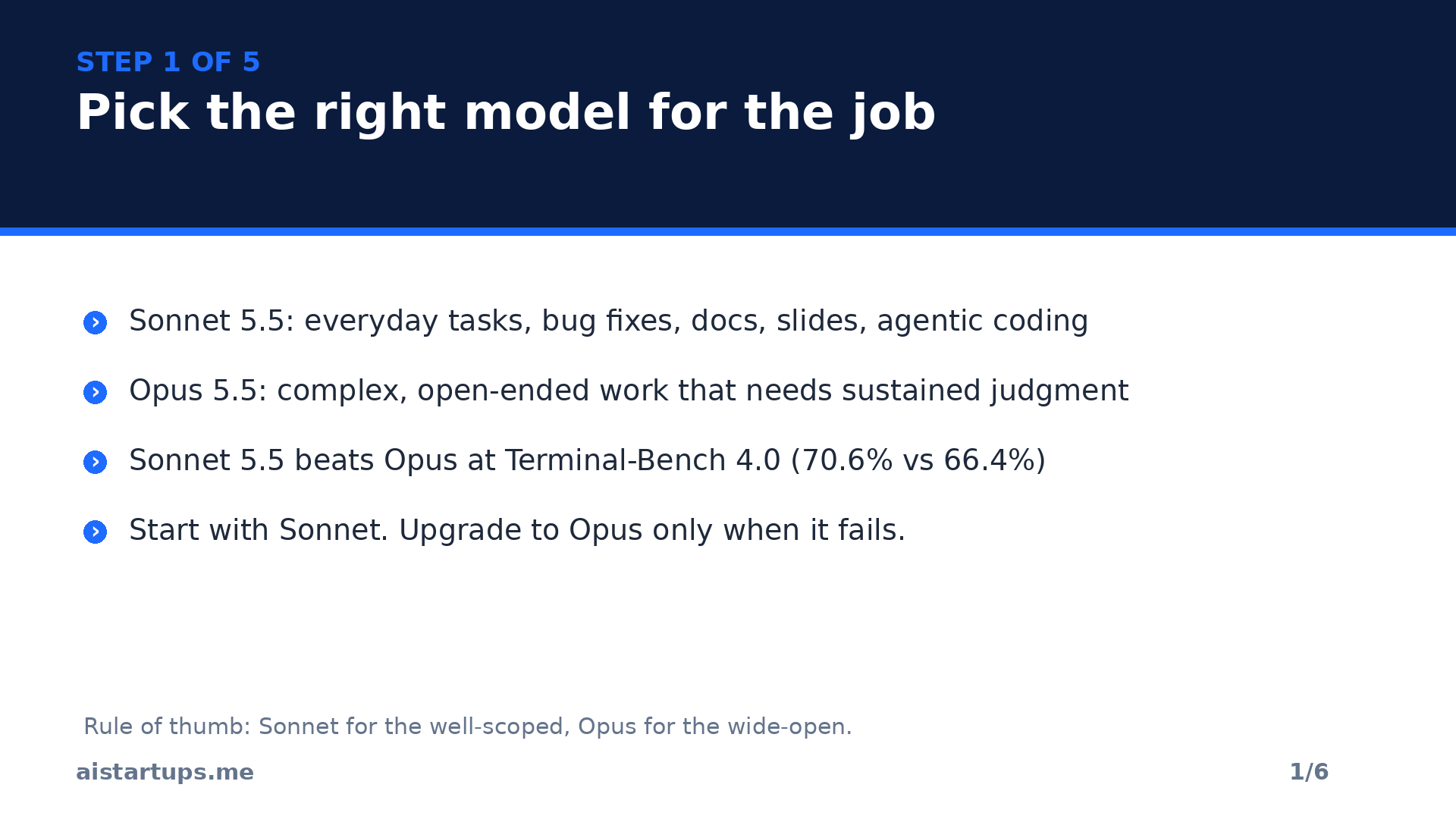
What it isn’t: a price cut. The API rate card didn’t move a cent. And it isn’t the smartest model Anthropic makes — the company is explicit that Opus 5.5 “remains clearly stronger at complex, open-ended work requiring sustained judgment.” This is a precision tool, not a bigger hammer.
The Pricing Math Nobody Explains Right
Real talk: “$2/$10, same as before” is the least interesting true thing about this launch. The interesting part is how Anthropic is now selling the cost of finishing a job instead of the cost of a token. That framing matters, because it changes how you budget.
Same sticker price, smaller bill
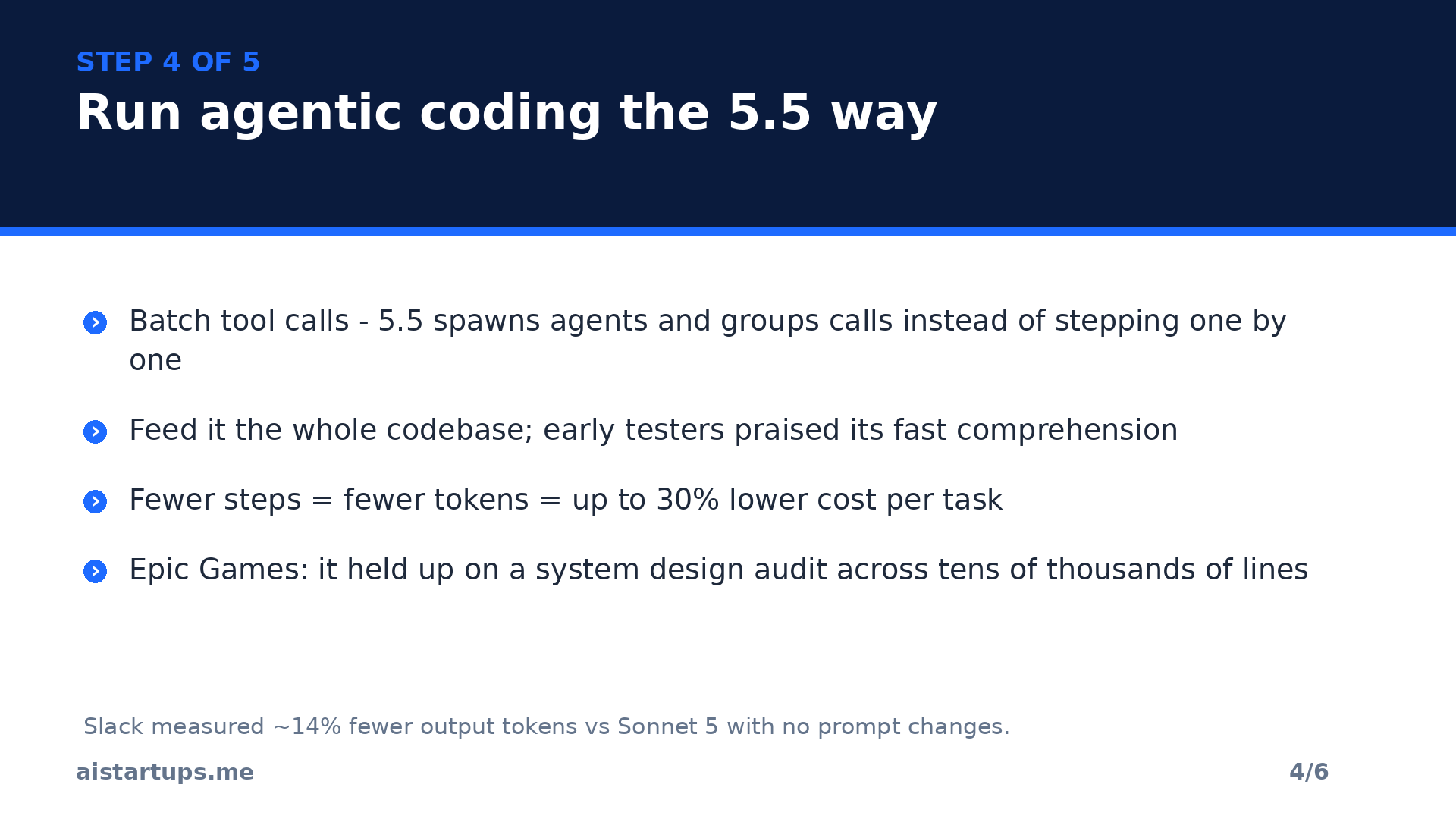
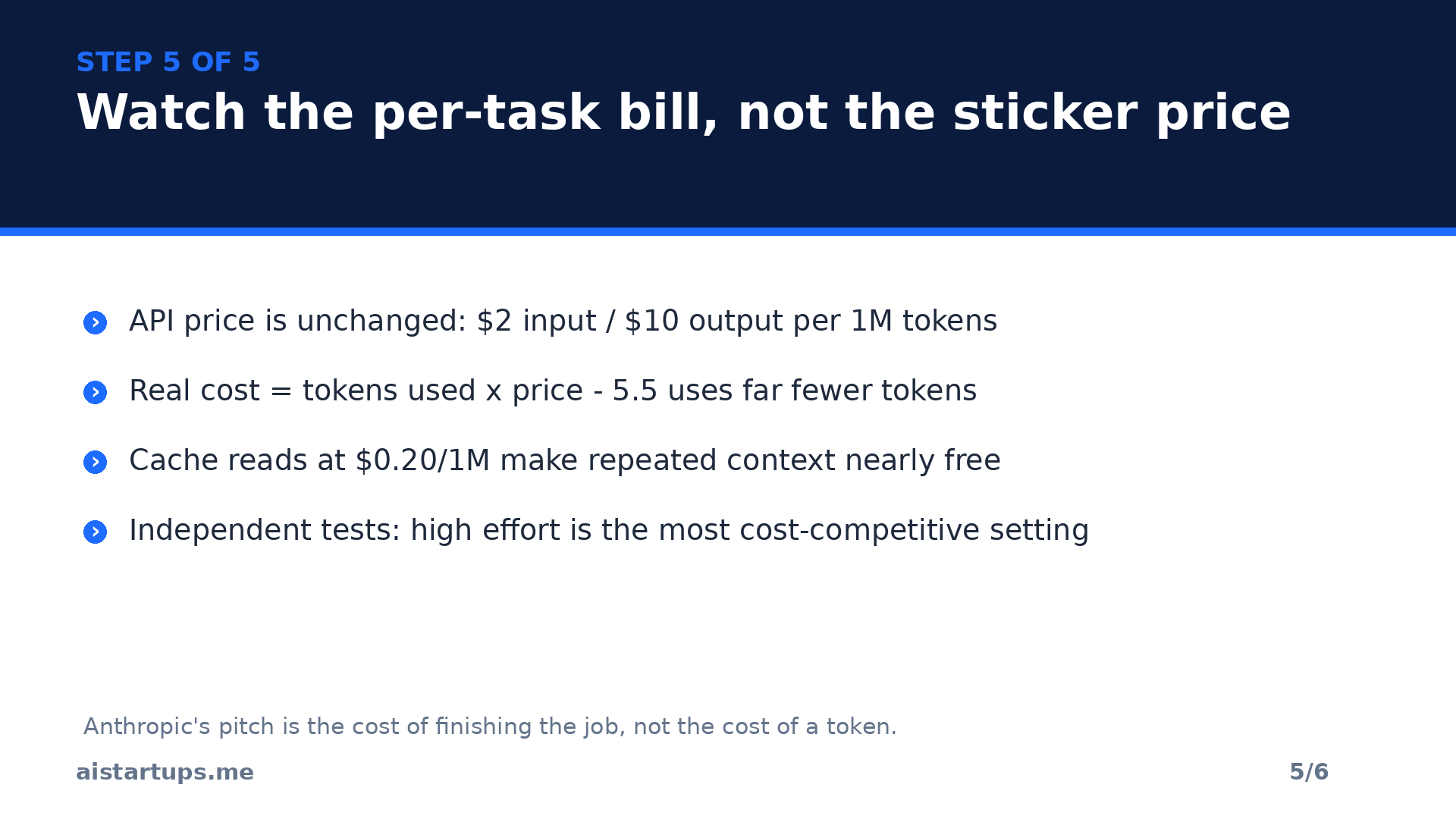
Sonnet 5.5 burns fewer tokens to do the same work — it batches tool calls together instead of stepping through tasks one at a time, and early testers kept noticing it finishing in fewer steps. Slack’s principal engineer put a number on it: in their offline Slackbot evals, Sonnet 5.5 beat Sonnet 5 on nearly everything, in fewer steps, with about 14% fewer output tokens — with zero prompt changes.
Anthropic’s claim: up to 30% less cost per task than Sonnet 5. And on their own charts, Sonnet 5.5 at Low or Medium effort beats Sonnet 5’s best score on several benchmarks at roughly a tenth of the cost per task. Read that again. The mid-tier model at its laziest setting outperforms its predecessor’s hardest setting, for 10% of the money.
If you run an AI product, this is the margin math we keep coming back to — the same math we broke down in our guide to what an AI business actually costs: API bills are usually your biggest variable cost, and output tokens are where the real money goes. A model that generates 14–30% fewer of them while working 30% faster is not a marginal upgrade. It’s a compounding one.
Opus vs Sonnet: the actual price gap
Here’s the rate card side by side:
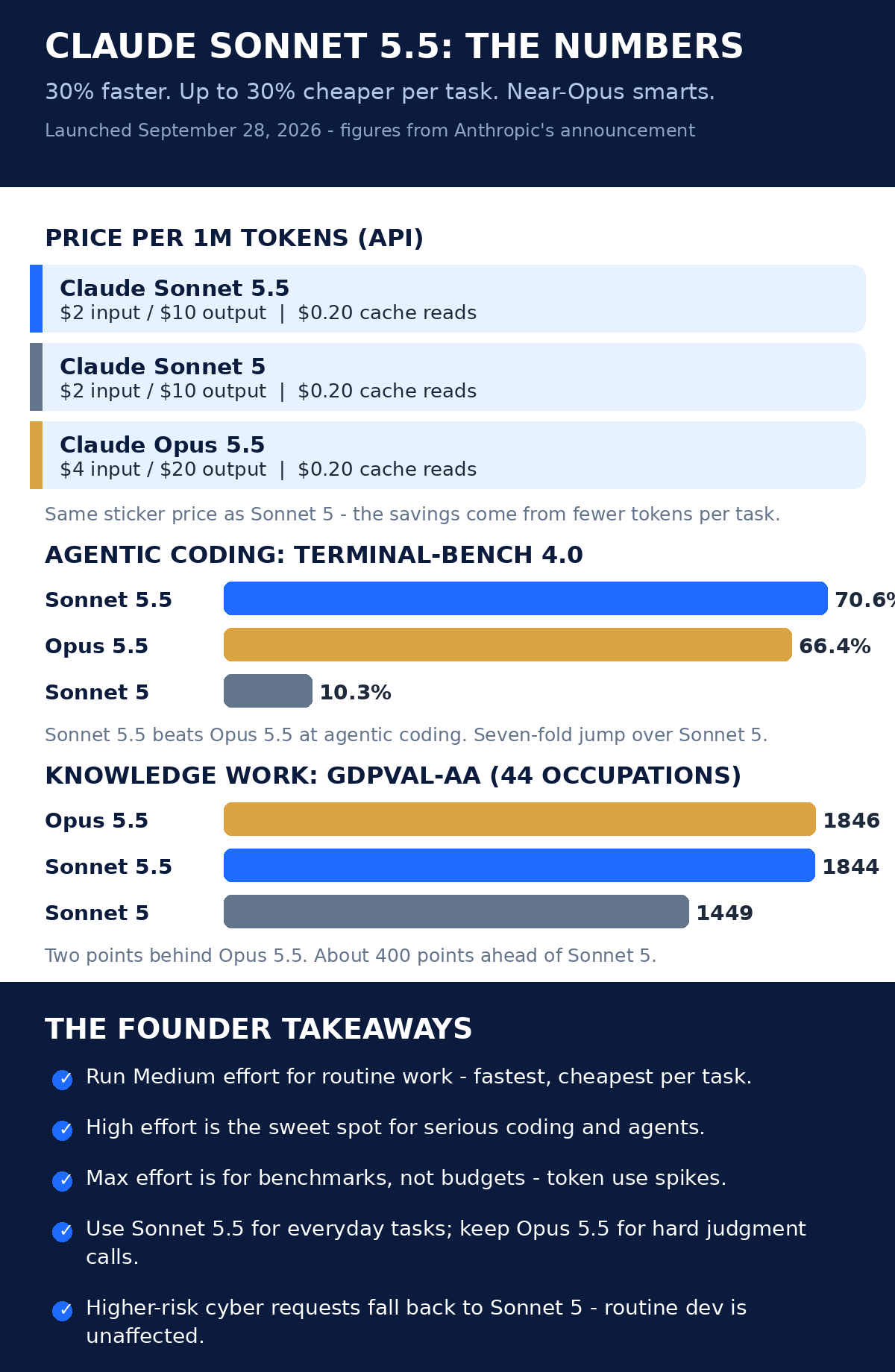
| Per 1M tokens | Sonnet 5.5 | Opus 5.5 |
|---|---|---|
| Input | $2 | $4 |
| Output | $10 | $20 |
| Cache reads | $0.20 | $0.20 |
| Cache writes | $2.50 | $5 |
Sonnet is exactly half the price of Opus on every line. And cache reads — the trick that makes repeated context nearly free in agent loops — cost the same twenty cents on both. For context on how this fits the broader market, last week’s AI price war between Claude Opus 5.5 and GPT-6 Sol & Luna already pushed mid-tier pricing down to $2/$10 territory; Sonnet 5.5 now matches that rate with meaningfully better efficiency.
Effort is the real pricing lever
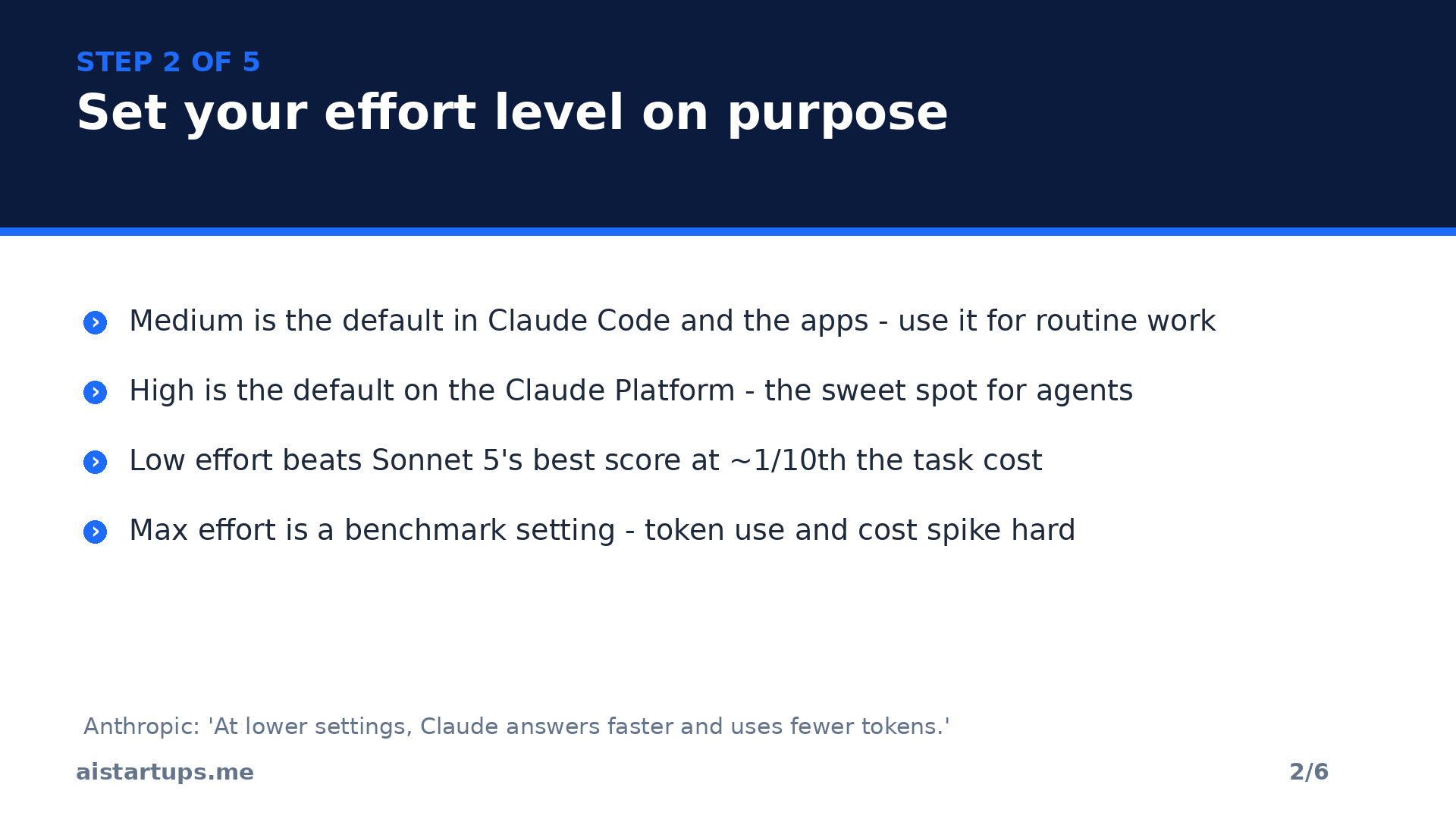
This is the part most founders will miss. Sonnet 5.5 doesn’t have one price — it has a dial. Five effort levels (Low, Medium, High, Xhigh, Max), and as Anthropic puts it: “At lower settings, Claude answers faster and uses fewer tokens, which suits routine work. At higher settings, Claude reasons for longer and checks its work more thoroughly.”
Translation: effort is a cost lever disguised as a quality setting. Medium (the default in the apps and Claude Code) is where routine work should live. High (the Platform default) is the sweet spot for serious agent runs. Max is for benchmarks and genuinely hard problems — because independent testing found it burns roughly 193,000 output tokens per hard task, which works out to about $7.60 a task. Great for winning leaderboards. Terrible for your burn rate.
Sonnet 5.5 vs Opus 5.5: When to Use Which
This is the decision you’ll actually make every day, so let’s make it a rule instead of a vibe.
Anthropic’s own framing: Opus 5.5 is for “complex work requiring careful judgment.” Sonnet 5.5 is strongest at “well-scoped everyday tasks, fixing bugs, and creating polished documents, slides, and spreadsheets.” And — genuinely surprising — it’s got “a sharp eye for design,” which early testers kept mentioning unprompted.
The benchmark table backs up the split. On Terminal-Bench 4.0 — an agentic coding test where the model completes multi-step tasks through a command line — Sonnet 5.5 scored 70.6%. Sonnet 5 scored 10.3%. Opus 5.5 scored 66.4%. The mid-tier model beat the flagship at coding agents. On GDPval-AA, which grades real work across 44 occupations, Sonnet 5.5 scored 1844 against Opus’s 1846 — two points apart, and about 400 points ahead of Sonnet 5. It also came within two points of Opus on computer use (OSWorld 2.1: 80.1% vs 81.8%) and chart recognition (61.6% vs 64.4%).
But — and this is the honest part — those are the benchmarks where Sonnet 5.5 shines. On FrontierCode, Opus still leads (54.4% vs Sonnet 5.5’s 46.2% at Max). Anthropic says plainly that Opus remains clearly stronger at complex, open-ended work. So here’s the rule:
- Default to Sonnet 5.5 for: agentic coding, bug fixes, document/slide/spreadsheet creation, data analysis, and anything well-scoped with a clear success criterion.
- Upgrade to Opus 5.5 for: open-ended strategy work, novel system design with no precedent, and tasks where the cost of a wrong answer dwarfs the API bill.
- Never start on Opus. Start on Sonnet, escalate when it fails. At half the token price and up to 30% fewer tokens per task, the savings compound fast.
If you’re weighing Claude against OpenAI’s lineup for business use, our ChatGPT vs Claude for business comparison covers the broader platform decision — Sonnet 5.5 just made the Claude side of that argument stronger.
How to Actually Use It: The Hands-On Part
Okay. Enough spec sheet. Here’s the workflow, step by step.
Step 1: Connect it where you already work
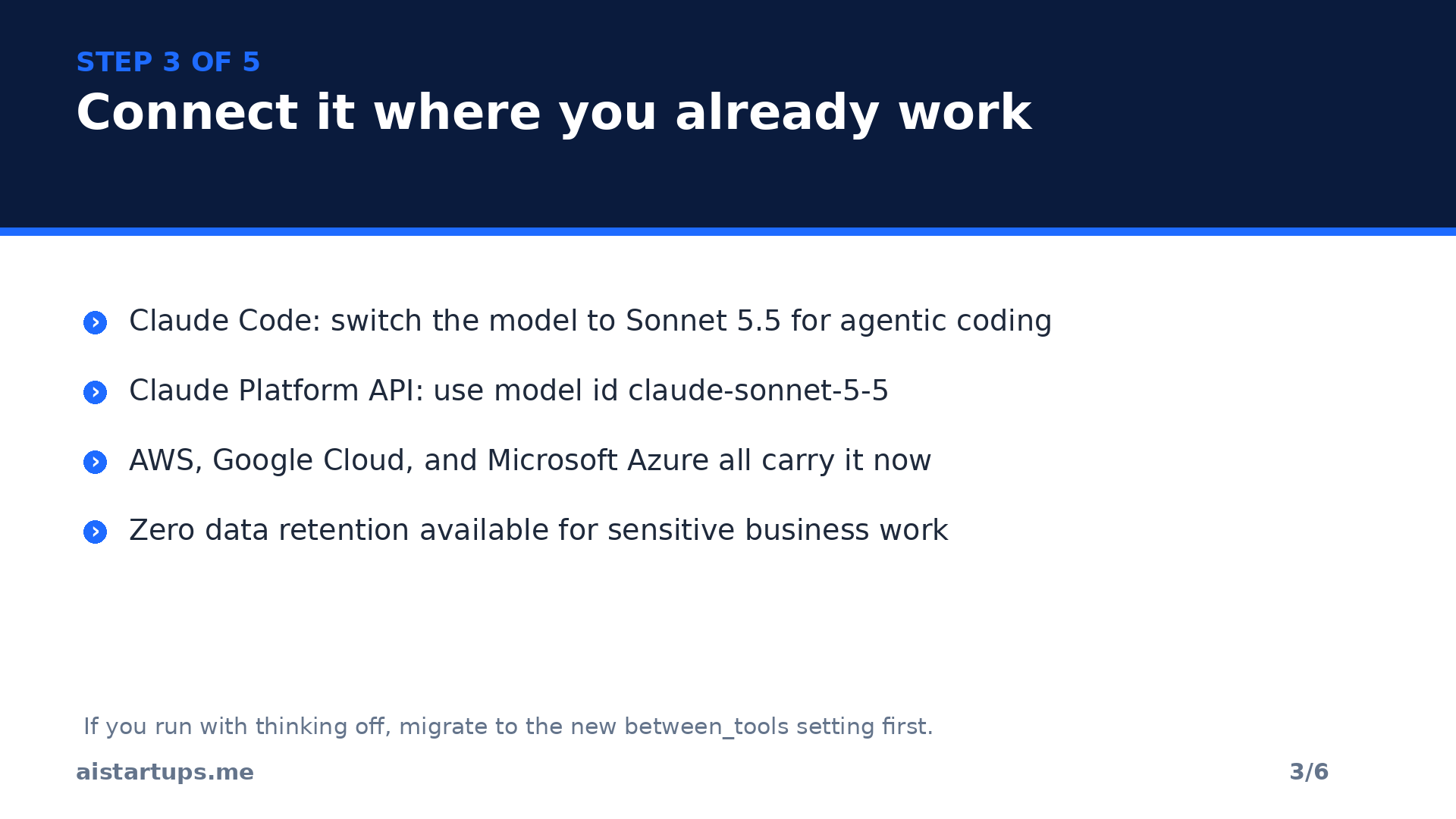
The model is live in the Claude apps, Claude Code, and the Claude Platform API under the model ID claude-sonnet-5-5. It’s also on AWS, Google Cloud, and Microsoft Azure, with zero data retention available — which matters if you’re handling customer data and your lawyer has opinions (mine does).
One migration gotcha, straight from the announcement: if you currently run Sonnet with thinking turned off, you’ll need to switch to the new between_tools setting before moving to Sonnet 5.5. Anthropic has a migration guide for it. It’s a small config change, but it’ll bite you at 11 PM if you don’t know it’s coming.
Step 2: Set your effort level on purpose
Don’t leave this on autopilot. Medium is the default in Claude Code and the apps, High on the Platform — both are sane defaults, but you should know which one you’re paying for. My suggestion: run routine work at Medium, bump to High for anything you can’t afford to redo, and reserve Max for the genuinely hard stuff. Remember that $7.60-a-task number from the independent tests — Max effort is a firehose. Point it carefully.
Step 3: Run agentic coding the 5.5 way
This is where the model earns its keep. The big behavioral change is tool-call batching — Sonnet 5.5 groups tool calls together instead of doing everything sequentially, which is why tasks finish in fewer steps. To get the most out of it:
- Feed it the whole codebase, not snippets. Early testers kept praising how fast it builds a mental model of unfamiliar code — Epic Games ran it across tens of thousands of lines of gameplay system architecture and said it held the same quality bar they’d expect from a higher-tier model.
- Let the agent loop run. Don’t micromanage with tiny prompts; the efficiency gains come from long-horizon runs where batching compounds.
- Use cache reads aggressively. At $0.20 per million, repeated context in agent loops is nearly free — this is where the “up to 30% less per task” math really comes from.
- Measure your own per-task cost for a week before you scale. Anthropic’s numbers are real, but your workload isn’t their benchmark. Independent testing flagged that high effort — not max — is the most cost-competitive setting, which matches my instinct too.
And if you don’t have an engineering team to wire all this up — the API integration, the agent loops, the caching strategy — this is exactly the kind of work an AI integration studio like AISquadX does: taking a model like Sonnet 5.5 and building it into a real product instead of a chat window. The model is cheap; the integration is where the value lives.
Step 4: Don’t sleep on the document work
Everyone will talk about the coding benchmarks, but the sleeper feature is knowledge work. Anthropic ran an internal test: they handed Sonnet 5.5 a public company’s quarterly earnings materials plus call transcripts and a slide template, and asked for a 10-slide operating review. Two experts judged the first draft ready to send as is. No edits.
For a founder, that’s investor updates, board decks, competitive teardowns, and customer QBRs — the stuff that eats your Sunday evenings. Sonnet 5.5 at Medium effort is fast enough to iterate on slides in real time and cheap enough that you stop rationing the generations.
5 Startup Workflows Where Sonnet 5.5 Shines
Concrete, not theoretical. Here’s what I’d actually hand to this model this week:
- MVP feature sprints. Describe the feature, point it at your repo, let the agent loop run at High effort. The Terminal-Bench numbers say this is literally the model’s best event — our no-code AI MVP stack guide pairs well here if you’re mixing approaches.
- Bug triage and fixes. Well-scoped, clear success criteria, fast iteration — exactly the profile Anthropic designed it for.
- Investor and board materials. Earnings-style decks, metrics narratives, competitive slides. The “ready to send as-is” test result is the strongest signal here.
- Support and docs at scale. Fast, cheap, good at following templates — the three things you want in anything customer-facing and high-volume.
- Data analysis sprints. 61.6% on chart recognition (vs 15.6% for Sonnet 5) and near-Opus computer-use scores mean it can actually work with your dashboards instead of just describing them.
“Without changing any of our prompts, Claude Sonnet 5.5 did better than Sonnet 5 on almost all of our offline Slackbot evals, in fewer steps and with about 14% fewer output tokens. When someone gives Slackbot a task, quality and speed are what matter most.”
— Curtis Allen, Principal Engineer at Slack, on early testing
The Honest Caveats
I’d be doing you a disservice if I stopped at the press release. Here’s what the announcement doesn’t lead with:
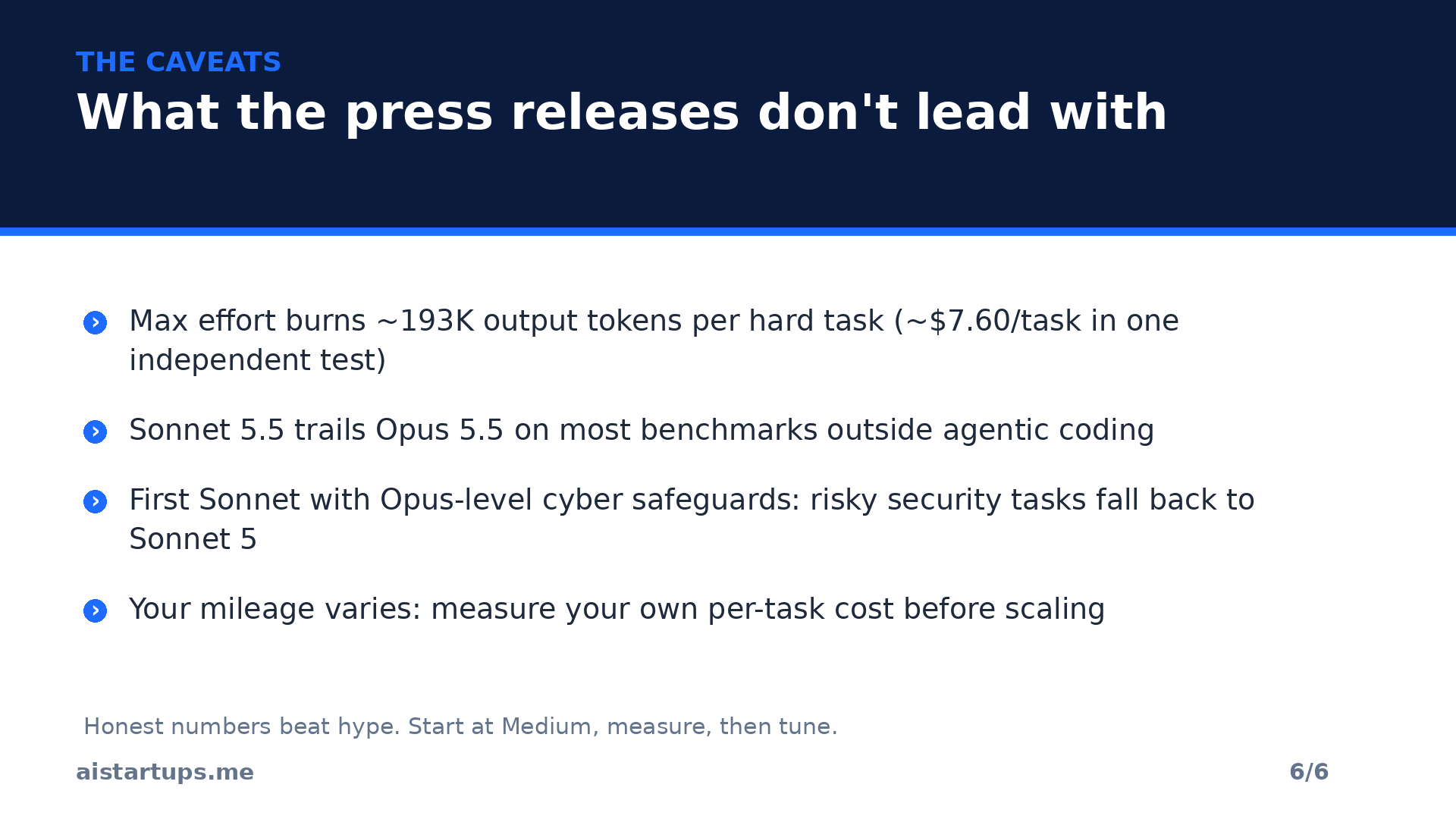
- Max effort is a budget hazard. Independent testing measured roughly 193,000 output tokens per hard task at max effort — about 60% more than Opus 5.5 uses, and nearly seven times what GPT-6 Astra burns. At ~$7.60 per task, max effort Sonnet 5.5 costs more per completed task than the settings Anthropic actually recommends. The headline “30% cheaper per task” is true at sane effort levels; it inverts at Max.
- It still trails Opus on most benchmarks. The Terminal-Bench upset is real, but Opus 5.5 leads on FrontierCode, Humanity’s Last Exam, and the full alignment audit. Sonnet 5.5 wins the efficiency story, not the capability crown.
- Cyber safeguards are new territory for Sonnet. This is the first Sonnet with Opus-level cyber safeguards, because its capabilities there are now “comparable to Opus 5’s.” Higher-risk cybersecurity requests will visibly fall back to Sonnet 5. Routine bug-fixing is unaffected — but if your startup does security tooling, read the fine print.
- It’s day one. The model launched yesterday. Early-tester quotes are curated, benchmarks are vendor-run, and the independent analysis is still thin. The numbers in this article are verified against the sources we have; they’ll get sharper over the next few weeks.
Frequently Asked Questions
How much does Claude Sonnet 5.5 cost?
The API price is unchanged from Sonnet 5: $2 per million input tokens, $10 per million output tokens, and $0.20 per million cache reads. But the per-task cost is up to 30% lower because the model uses fewer tokens and fewer tool calls to finish the same work. Opus 5.5 costs exactly double: $4 input, $20 output.
Is Sonnet 5.5 better than Opus 5.5?
At one specific thing — agentic coding, measured by Terminal-Bench 4.0 (70.6% vs 66.4%) — yes. At nearly everything else, Opus 5.5 still leads, and Anthropic says it’s clearly stronger at complex, open-ended work requiring sustained judgment. Think of Sonnet 5.5 as the efficiency king, not the capability king.
How do I access Claude Sonnet 5.5?
It’s live in the Claude apps, Claude Code, and the Claude Platform API (model ID claude-sonnet-5-5), plus AWS, Google Cloud, and Microsoft Azure. Zero data retention is available. If you run Sonnet with thinking disabled, switch to the new between_tools setting before migrating.
What are effort levels, and which should I use?
Five settings — Low, Medium, High, Xhigh, Max — that trade speed and cost against thoroughness. Medium is the default in Claude Code and the apps; High is the default on the Platform. Use Medium for routine work, High for serious agent runs, and Max sparingly: independent tests show token usage (and cost) spikes hard at Max.
Should my startup switch from Sonnet 5 to Sonnet 5.5?
Honestly? Yes, with one afternoon of testing. Same API price, 30%+ faster, up to 30% cheaper per task, better at coding and documents. The only reason to wait is if you run thinking-off configurations — handle the between_tools migration first — or if you depend on behavior that’s specifically tuned to Sonnet 5’s quirks.
The Bottom Line
Sonnet 5.5 is the most interesting kind of launch: not a price cut, not a capability leap, but a shift in what you’re actually buying. You’re buying completed tasks, not tokens — and by that measure, yesterday’s mid-tier model just lapped its predecessor and nipped at the flagship’s heels in the one benchmark startups care about most.
My take: make Sonnet 5.5 your default this week, keep Opus 5.5 in reserve for the genuinely hard calls, and run everything at Medium or High effort until you’ve measured your own per-task costs. The model wars aren’t slowing down — but for once, the new release is the one that makes your burn rate go down.