

Real talk: if you’re going to build an AI startup in 2026, education might be the most honest opportunity left. Not the flashiest. Not the one that gets you on conference stages. But parents pay. Schools pay. Companies pay. And the market is growing so fast the analysts keep revising their numbers upward.
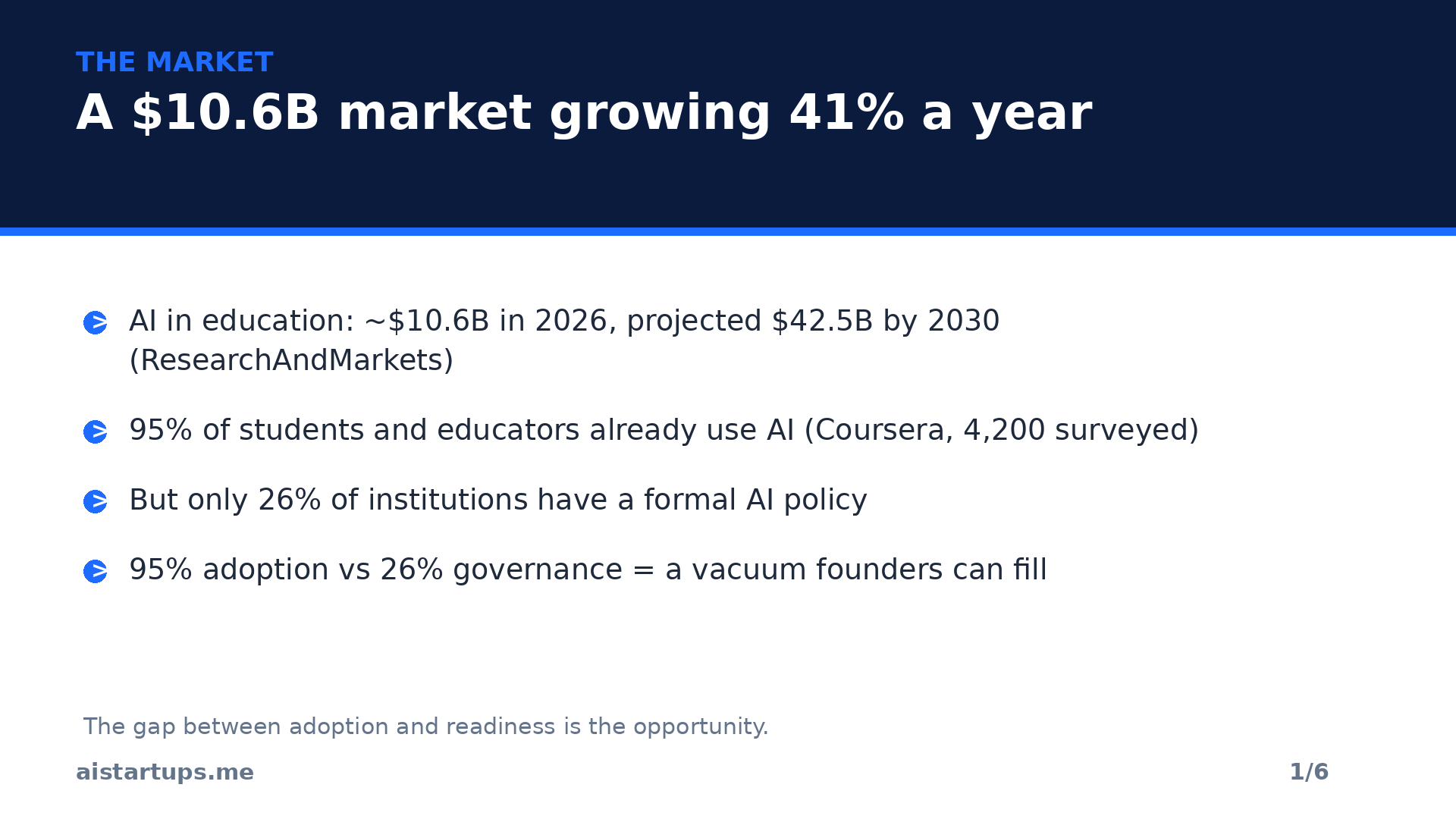
Here’s the number that should get your attention: the AI-in-education market is on track for roughly $10.6 billion in 2026, up from $7.5 billion last year, and one widely cited report puts it at $42.5 billion by 2030 — a 41.5% compound annual growth rate (ResearchAndMarkets via GlobeNewswire). That’s not a niche. That’s a land rush.
And the demand side? Coursera surveyed over 4,200 students and faculty across five countries this year: 95% are already using AI in their academic work. 81% say it’s making education better. But only 26% of institutions have a formal policy for it. Read that gap as a founder. 95% adoption, 26% governance. That’s not a market — that’s a vacuum.
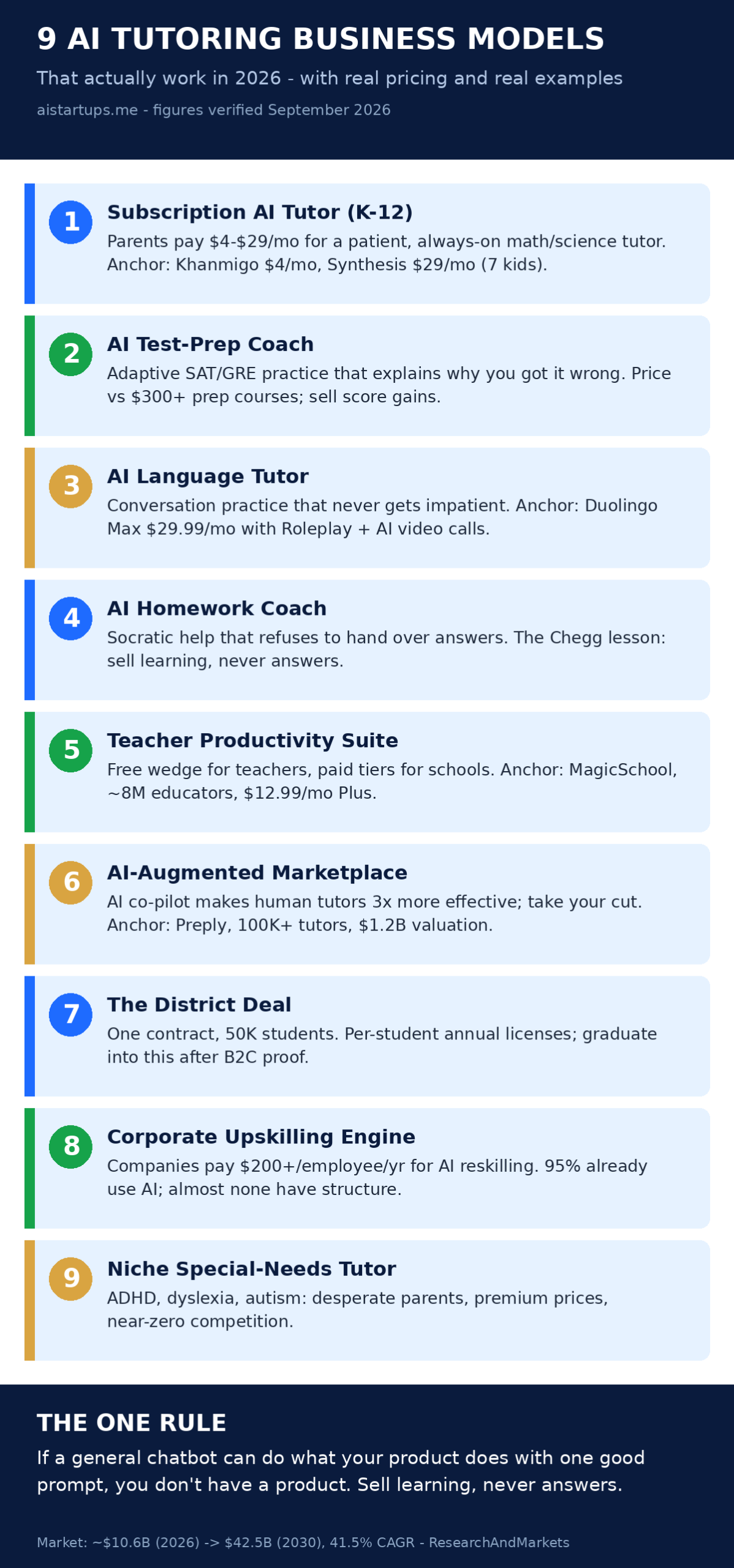
I dug through the pricing pages, the funding rounds, and the one spectacular collapse everyone in edtech knows by heart, to put together the 9 business models that actually work. Not theories. Models with real companies, real prices, and real revenue behind them.
First, Pick Your Battlefield: B2C vs B2B2C
Before you pick a model, you have to pick a customer. Everything else flows from this one decision, so don’t skip it.
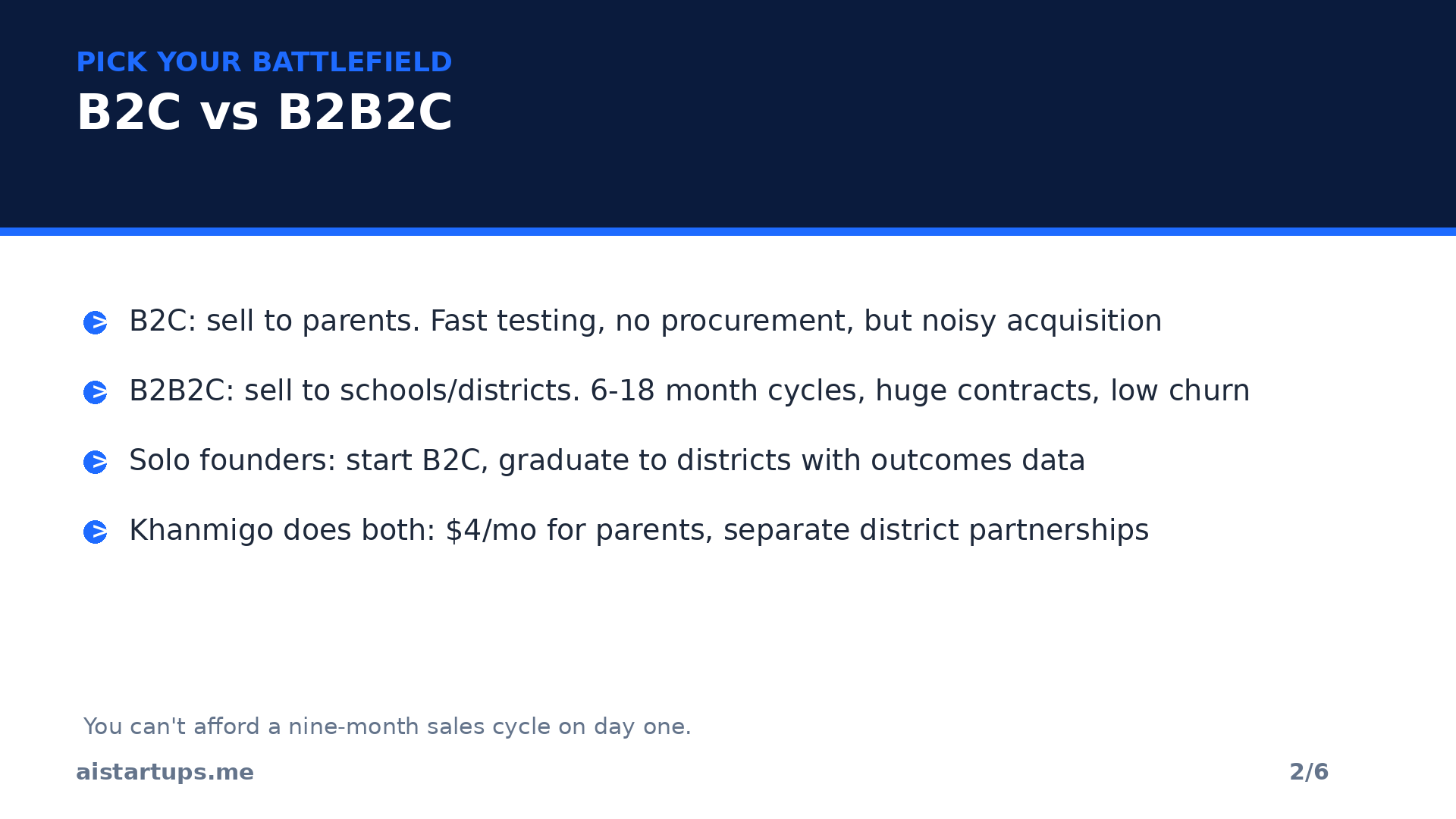
B2C means selling directly to parents and learners. You move fast, you test pricing in weeks, and nobody asks you for a security audit. The downside? You’re fighting for attention in the noisiest channel on earth — the app store — and customer acquisition costs can eat you alive if your product doesn’t spread by word of mouth.
B2B2C means selling through schools and districts, reaching students through the institution. Sales cycles are measured in quarters, not days. Procurement will ask about FERPA, COPPA, and where your data lives. But one signed district contract can put your product in front of 50,000 students overnight, and schools churn far less than parents do.
Look at how the real players split. Khan Academy charges parents $4 a month for Khanmigo — pure B2C. But it also negotiates separate district partnerships for whole-school access. MagicSchool went the other direction: free for individual teachers (the wedge), then paid tiers and custom enterprise deals for districts — reportedly partnerships spanning 10,000+ schools. Same product DNA, two different doors into the same building.
My take, honestly? If you’re solo or a tiny team, start B2C. You can’t afford a nine-month sales cycle. Get parents paying, prove the learning outcomes, then walk into districts with receipts instead of promises.
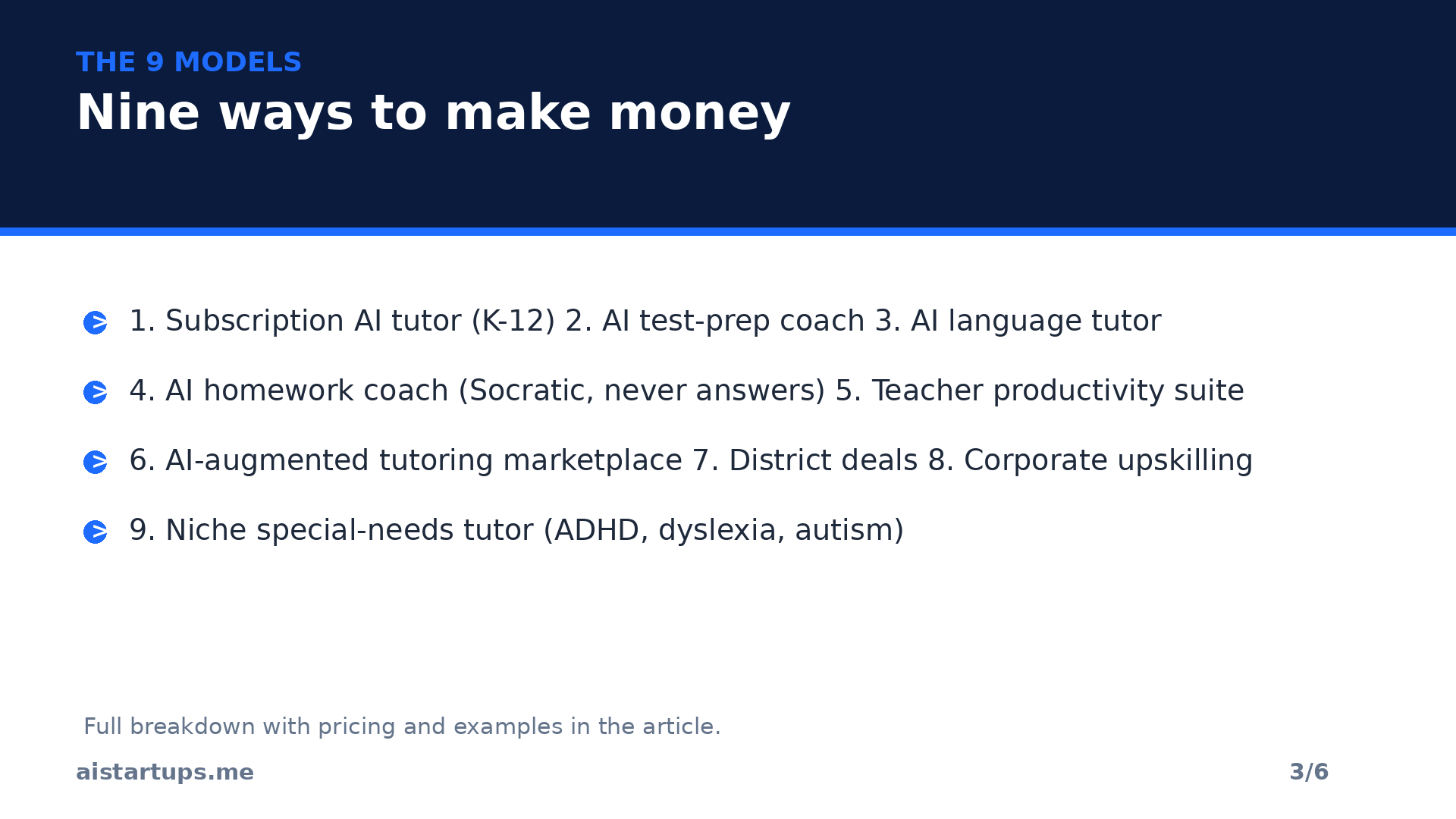
The 9 Business Models That Actually Work
1. The Subscription AI Tutor (K-12)
The simplest model in the list, and still the one with the most headroom. A patient, always-available tutor for math, science, writing — the subjects where parents feel the nightly homework pain most acutely.
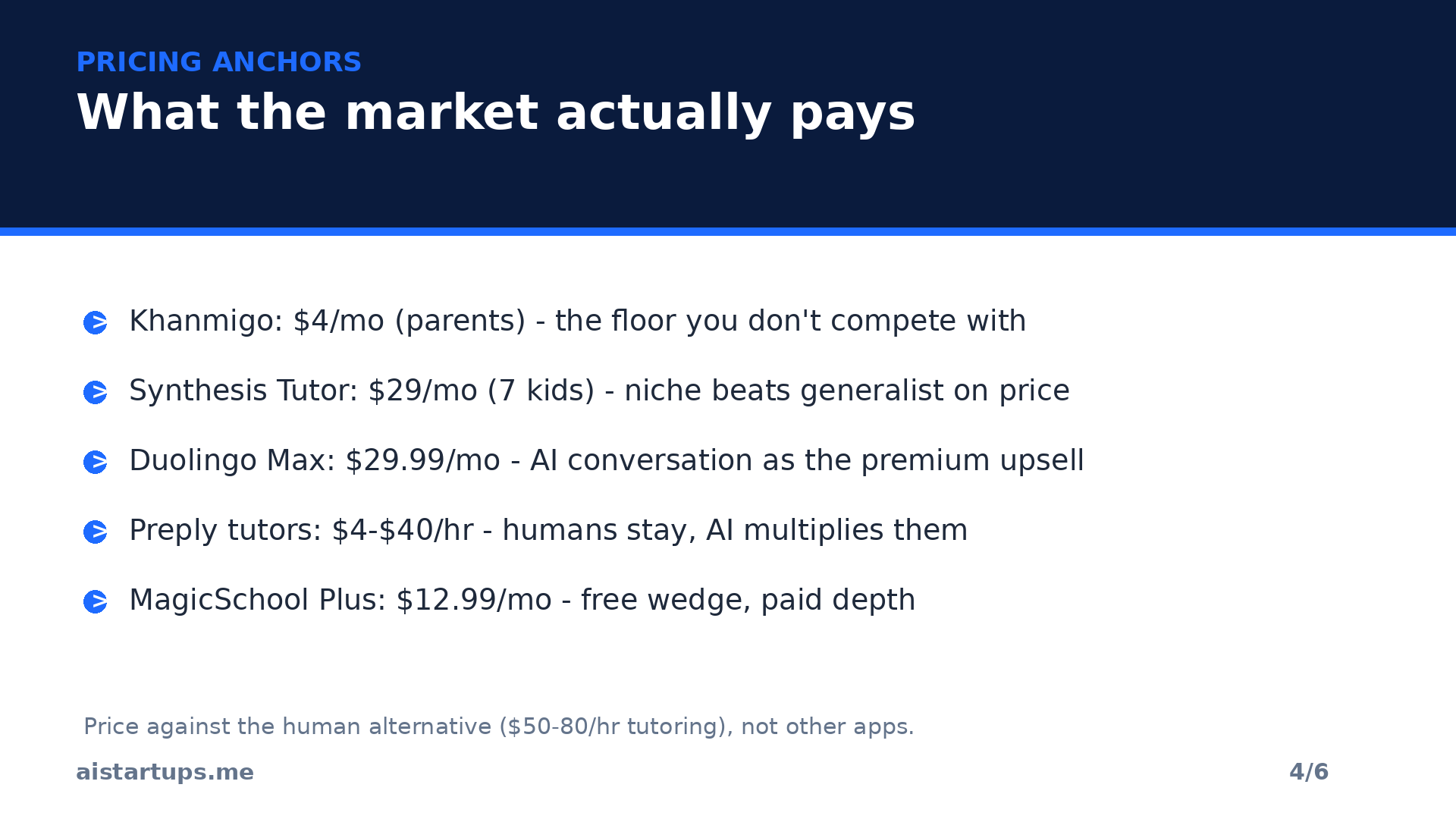
Khan Academy’s Khanmigo is the price anchor everyone has to reckon with: $4 a month or $44 a year for parents and learners, while teachers get it free. Four dollars. That’s the floor. You cannot compete with Khanmigo on price, so don’t try — compete on depth. Go narrower. Go weirder. Go somewhere Khan Academy’s generalist tutor can’t follow.
Synthesis Tutor did exactly that. It’s a voice-guided AI math tutor just for ages 5 to 11, and it charges $29 a month or $119 a year — with one plan covering up to 7 kids. That’s seven times Khanmigo’s price, and it works, because parents of young kids will pay a premium for something that feels designed for their child instead of everybody’s child.
The unit economics are the whole pitch: a human tutor runs $50 to $80 an hour. Your AI tutor costs you pennies per session in API calls and charges $10 to $30 a month. That’s not a discount. That’s a different universe.
2. The AI Test-Prep Coach
SAT, GRE, GMAT, MCAT — high-stakes exams where a few points genuinely change a kid’s life. Parents don’t comparison-shop the way they do for a $5 app. They ask one question: will this raise the score?
The model that works here is adaptive practice plus a coach that explains why you got it wrong, not just that you did. Static question banks are dead — AI can generate infinite practice at exactly the student’s weak points, then adjust difficulty in real time as they improve. That’s something a $300 prep book literally cannot do.
Price it as a fraction of the alternatives. Traditional prep courses and tutoring centers run into the hundreds per month. An AI coach at $30 to $60 a month that demonstrably moves practice-test scores will sell itself at every parent-teacher night in America. The catch: you need proof. Publish score-improvement data early, even from a small pilot. In test prep, outcomes are the marketing.
3. The AI Language Tutor
Duolingo wrote the playbook here and then rewrote it with AI. The free tier hooks hundreds of millions of learners; Duolingo Max at $29.99 a month (about $168 a year) is the premium upsell, and the upsell is pure AI: Roleplay conversations and an AI video call with a character named Lily that adapts to your level and corrects you gently. Nobody gets impatient. Nobody judges your accent at 11pm.
Two things worth stealing from this model. First, the AI features sit above the regular paid tier (Super, at roughly $13 a month), so there’s a ladder: free, paid, premium-AI. Second, Duolingo moved “Explain My Answer” down to free users in January 2026 — they use AI explanations as acquisition now, not just monetization. The lesson: let the AI do the demo. A tutor that explains one tricky answer brilliantly is the best ad you’ll ever run.
Where’s the opening for a startup? Vertical languages. Duolingo covers the big ones. Medical Spanish for nurses. Business Japanese for engineers. Legal English for immigrant professionals. A focused AI conversation partner for a high-value niche can charge Duolingo Max prices without Duolingo’s content costs.
4. The AI Homework Coach (Done Right)
This is the model with a graveyard attached, so read carefully.
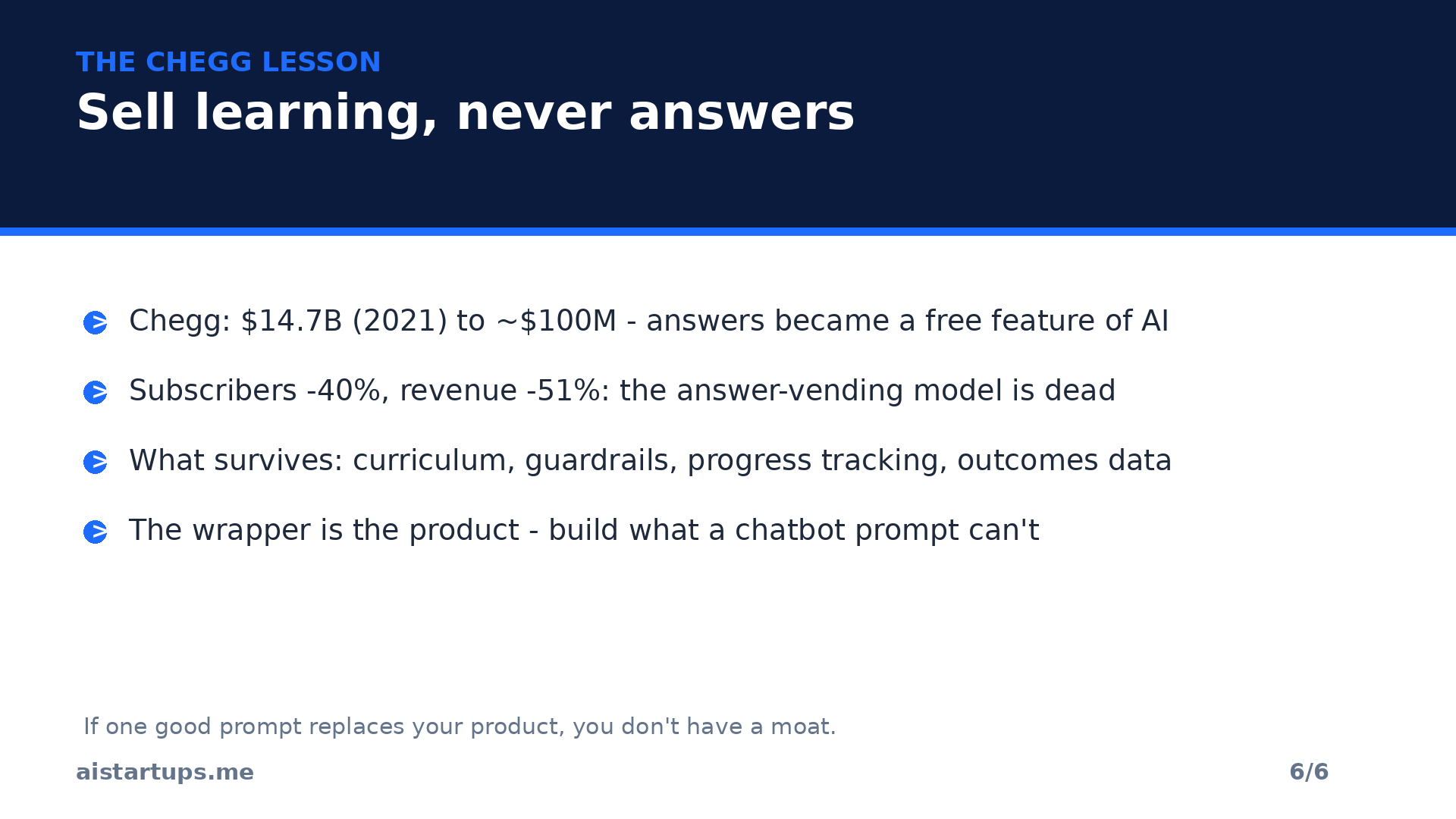
Chegg built a $14.7 billion business selling step-by-step homework answers. Then ChatGPT arrived, and free AI did the same job instantly. Chegg’s stock went from around $115 to about a dollar. Subscribers fell 40% year over year. Second-quarter 2026 revenue dropped 51%. It’s the cleanest case study in AI history of what happens when your entire value proposition becomes a free feature of a general model.
But — and this is the part most people miss — the need didn’t disappear. Students still get stuck at midnight. Parents still can’t help with calculus. What died was answer-vending. What works is the opposite: a coach that refuses to give the answer and instead asks the question that un-sticks the student. The Socratic method, at scale. That’s what Khanmigo does, and it’s the design principle every successful AI tutor shares: teach, don’t tell.
If you build in this space, build guardrails as features, not fine print. Parent-visible chat history. No direct answers on graded work. Teachers will recommend you and schools will buy you — the two distribution channels the answer-vendors never had.
5. The Teacher Productivity Suite
Here’s a secret about edtech: teachers are the most underserved power users in software. They drown in lesson plans, rubrics, IEP paperwork, parent emails, and grading. Give them hours back and they will evangelize your product in every staff room in the country.
MagicSchool is the proof. Launched in 2023 by a former teacher and principal, it now reports roughly 8 million educator sign-ups across 160 countries, around $63 million raised, and a library of 80+ AI tools — lesson planners, rubric generators, IEP builders, report-card comments. The pricing is a masterclass in the wedge: free for individual teachers (with daily generation limits), Plus at $12.99 a month for unlimited use, and custom Enterprise for districts with SSO and LMS integrations. Teachers report saving around seven hours a week. Seven hours. That’s not a nice-to-have; that’s a second job eliminated.
The founder lesson here is distribution, not technology. The tools themselves are straightforward — any decent team can build a rubric generator. MagicSchool won by being teacher-first in positioning, free at the point of entry, and obsessive about the unglamorous workflows (IEP compliance, anyone?) that generic AI tools ignore. Find the paperwork nobody else wants to automate. That’s your moat.
6. The AI-Augmented Tutoring Marketplace
Marketplaces are brutal to start — chicken-and-egg on both sides. But once they spin, they’re beautiful businesses, and AI just made the flywheel spin faster.
Look at Preply: 100,000+ tutors across 180+ countries, lessons priced by tutors themselves from $4 to over $40 an hour, and a $150 million Series D in January 2026 at a $1.2 billion valuation — reportedly now EBITDA positive. Their AI play is instructive: instead of replacing tutors, they built an AI “co-pilot” — Lesson Insights that analyze session transcripts, auto-generated lesson summaries, grammar and pronunciation feedback, personalized practice exercises between sessions. The AI makes every human lesson more valuable, which makes tutors more successful, which attracts more learners. The humans stay. The AI multiplies them.
That’s the template. Don’t build “AI tutors to replace human tutors” — build AI that makes human tutors 3x more effective, take your marketplace cut, and let the humans handle the trust, motivation, and weird edge cases that AI still fumbles. Parents pay for humans. AI just makes the humans affordable.
7. The District Deal
This is the B2B2C endgame: one contract, tens of thousands of students, multi-year terms, renewal rates that B2C founders dream about.
Khan Academy’s district partnerships put Khanmigo’s tutoring in front of entire school systems. MagicSchool’s enterprise tier does the same for teacher tools. The economics are completely different from consumer: instead of $4 to $30 a month per family, you’re negotiating per-student annual licenses across a whole district, with implementation support and professional development baked in.
Be honest with yourself about the costs, though. District sales cycles run 6 to 18 months. You’ll need FERPA and COPPA compliance, data-processing agreements, rostering integrations (Clever, ClassLink), and probably a real human being who has sold to schools before. This is not a model you start with — it’s a model you graduate into after your B2C product has the outcomes data that makes a superintendent’s decision easy.
8. The Corporate Upskilling Engine
Everyone talks about K-12. The quieter money is in companies panic-buying AI skills for their workforce.
Coursera’s 2026 higher-ed report found that 95% of students and educators already use AI — and the corporate world is scrambling the same way, with the same gap: massive adoption, almost no structure. Companies will pay serious B2B money for AI-powered reskilling: personalized learning paths, hands-on AI tool training, and proof of skill (certificates, assessments) they can show the board.
The ticket sizes here dwarf consumer edtech. A company doesn’t blink at $200 per employee per year for training that might save them a hire. And the buyer — the L&D manager, the CTO — has a budget line for exactly this. Build the AI tutor for employees learning AI itself (deliciously meta), or for regulated industries where training is mandatory and currently delivered via mind-numbing slide decks. Compliance training that doesn’t make people want to quit is a genuine market inefficiency.
9. The Niche Special-Needs Tutor
The most overlooked model on this list, and possibly the most defensible.
Kids with ADHD, autism, dyslexia, or processing disorders don’t learn like the median student — and generalist AI tutors aren’t designed for them. A tutor built specifically for neurodiverse learners, with the right pacing, sensory design, and encouragement patterns, isn’t just a product. For the parents, it’s closer to a lifeline. And parents in this segment pay premium prices without blinking, because the alternative is $150-an-hour specialized therapy with a six-month waitlist.
Synthesis Tutor explicitly positions for neurodivergent learners alongside its mainstream K-5 math product — same engine, different framing, and it justifies the $29-a-month price against free alternatives. That’s the move: take a proven tutoring engine and wrap it in deep, genuine expertise for one underserved population. Dyslexia reading coaches. ADHD homework companions with body-doubling mechanics. Speech-delay conversation partners for toddlers. Small markets, desperate customers, almost no competition. That’s a founder’s dream.
The Chegg Lesson: What Not to Build
The best AI education businesses don’t replace the teacher. They give every kid the patience of a great teacher, at a price every family can afford — and they never, ever just hand over the answer.
Chegg’s collapse deserves its own section because it’s the single most instructive failure in AI startup history. Let’s be precise about what happened: Chegg charged $15 to $20 a month for a library of worked answers. ChatGPT gave interactive, personalized explanations for free. Chegg’s value proposition didn’t get worse — it got free elsewhere. Revenue fell off a cliff, the stock lost 99% of its value, and the company is now pivoting to workforce skilling (which, tellingly, grew 2% while everything else burned).
The trap wasn’t “AI disrupted us.” The trap was selling answers instead of selling learning. Answers are a commodity; the marginal cost of an answer is now zero. Learning — the slow, guided, confidence-building process of actually understanding something — is still scarce, still valuable, and still something parents will pay for.
So the rule: if a general chatbot can do what your product does with one good prompt, you don’t have a product. You have a feature waiting to be absorbed. Build the thing the chatbot can’t do: curriculum designed by real educators, progress tracking across months, parent and teacher dashboards, guardrails for kids, accountability, outcomes data. The wrapper is the product.
How to Price It (Without Guessing)
Pricing an AI education product is a balancing act between three anchors: the AI cost floor, the human alternative, and the psychological price of the category.
The cost floor first. Your real cost is API calls per session, and it’s tiny — fractions of a cent per conversation for most tutoring interactions. That means your margin can be enormous, but it also means you should price on value, not cost-plus. Nobody cares that your API bill is $0.003 per session. They care whether their kid’s grades improve.
- Anchor against the human alternative. Human tutoring: $50-80/hour. Tutoring centers: hundreds a month. Your $15-30/month subscription isn’t competing with other apps — it’s competing with the tutor, and it wins by 10x. Say so on your pricing page.
- Use the Khanmigo floor wisely. At $4/month, Khan Academy set the “AI tutor” reference price near zero. If you’re generalist, you’re dead. If you’re specialized (test prep, special needs, professional languages), $20-50/month is completely normal — parents pay for outcomes, not tokens.
- Freemium is almost mandatory in B2C. Duolingo, Khan Academy, MagicSchool — every winner gives the core away and charges for depth, unlimited use, or premium AI features. Let the free tier be your marketing department.
- B2B2C is per-student, per-year. Districts think in annual budgets and per-pupil costs. A $10-25/student/year license sounds trivial next to a $15,000 per-pupil district budget — that’s the frame that closes deals.
If you want to go deeper on the mechanics — seat vs. usage vs. outcome-based pricing, and the margin math on API costs — I’ve written a full guide on how to price an AI SaaS product that covers the models in detail. And before you commit to any of these numbers, run the real startup math in my cost of starting an AI business breakdown — the API bill is the smallest line item, and founders keep getting surprised by the others.
Your 30-Day Launch Checklist
Enough theory. Here’s the part where it gets real. Thirty days, one model, no excuses.
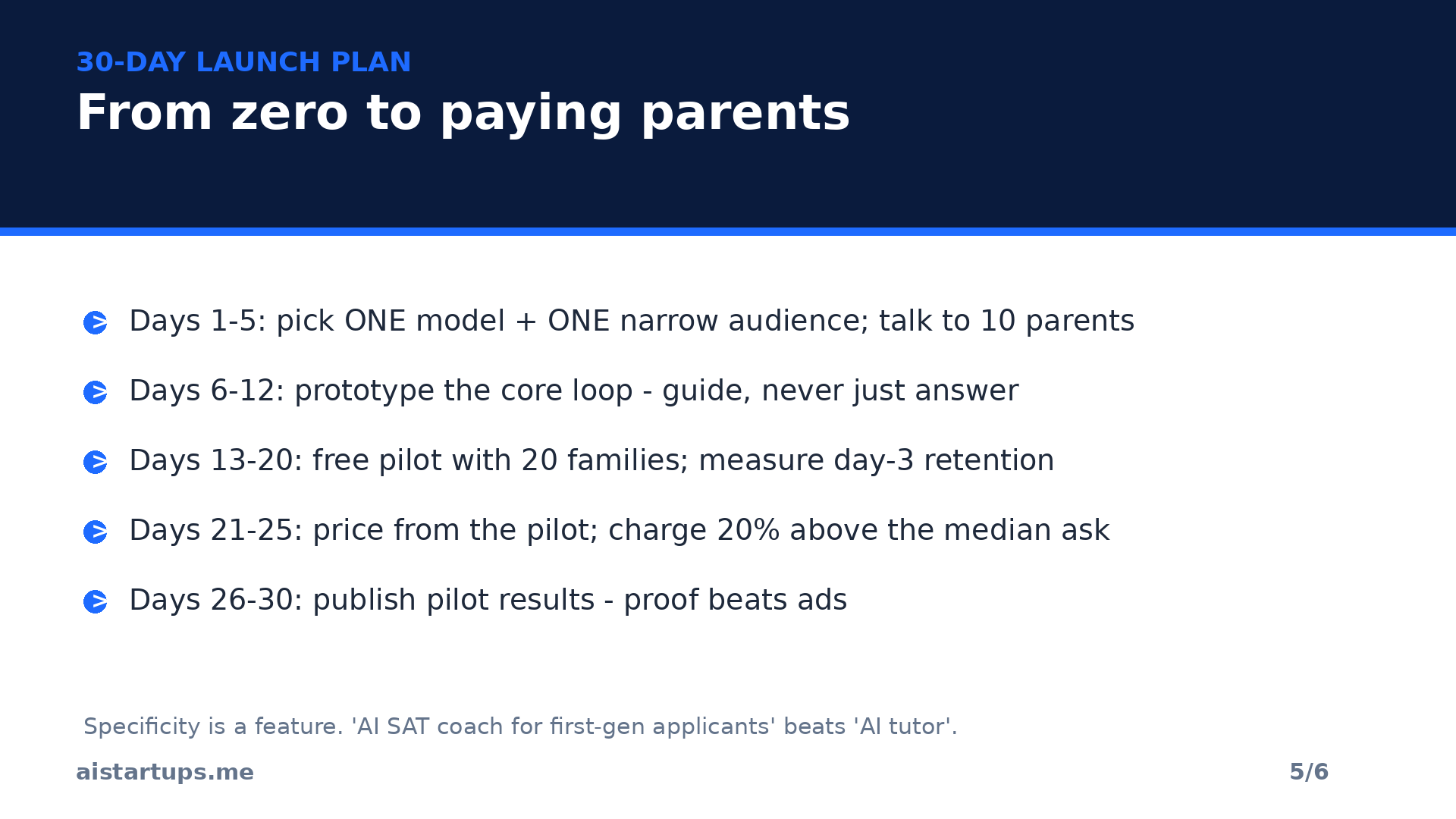
- Days 1-5: Pick ONE model and ONE narrow audience. Not “AI tutoring for students.” Try “AI SAT math coach for first-generation college applicants” or “AI reading tutor for dyslexic 3rd graders.” Specificity is a feature. And validate the idea before you write a single line of code — talk to 10 parents in the target group this week.
- Days 6-12: Prototype the core loop. One thing, done well: the student asks, the AI guides (never just answers), progress gets tracked. You can assemble this from existing APIs and no-code tools — my no-code AI MVP stack guide walks through the exact pieces. If you can’t build it yourself, a web development studio like AISquadX can get a working prototype in front of real parents in weeks, not quarters.
- Days 13-20: Run a free pilot with 20 families. No pricing page yet. Just get it into kids’ hands and watch. Measure two things: do they come back on day 3, and can you show any learning signal (quiz scores, problems solved, streaks). Retention plus one outcomes chart beats any pitch deck.
- Days 21-25: Set pricing from the pilot. Ask the pilot parents what they’d pay — then charge 20% more than the median answer. (Parents understate. Everyone does.) Launch with monthly and annual plans; annual is your cash-flow friend.
- Days 26-30: Ship, then sell the story. Publish the pilot results. “20 kids, 3 weeks, average practice-test gain of X points” is the headline every parent Facebook group and local news outlet wants. Your first 100 paying customers come from proof, not ads.
FAQ
Isn’t the AI tutoring market already dominated by Khan Academy and Duolingo?
The general market, yes — and you shouldn’t fight them there. But education is thousands of niches, not one market. Khan Academy is a generalist; Duolingo is broad consumer language learning. The openings are in verticals: test prep for specific exams, professional languages, special-needs learners, teacher workflows, corporate reskilling. Every winner on this list won by going narrower than the giants, not broader.
How much does it cost to build an AI tutoring app?
Less than you think. The AI itself is an API call — the expensive parts are curriculum design, safety guardrails for kids, and the parent/teacher dashboards. A focused MVP can be assembled with no-code tools and AI APIs for a few thousand dollars; the real budget goes to content and trust-building. The bigger risk isn’t build cost — it’s building something a free chatbot already does.
B2C or B2B2C — which should a solo founder choose?
B2C, almost always, at the start. District sales cycles run 6-18 months and demand compliance work (FERPA, COPPA, rostering integrations) that will drown a tiny team. Get parents paying first, collect outcomes data, then use that proof to open district doors later. MagicSchool itself started with free individual teachers before selling to districts.
What killed Chegg, and how do I avoid the same fate?
Chegg sold answers; AI made answers free. Its $14.7B valuation collapsed roughly 99% as ChatGPT and Google’s AI Overviews did its core job for nothing. The defense is selling learning — guided understanding, progress tracking, accountability, outcomes — not answers. If a general chatbot can replicate your product with one prompt, you don’t have a moat.
Do I need AI expertise to start an AI education company?
No — you need education expertise. The AI is increasingly a commodity you rent via API. What wins is understanding how kids actually learn, what teachers actually need, and what parents will actually pay for. The best edtech founders in this wave are former teachers, not ML researchers. Domain knowledge is the moat; the model is the plumbing.
The Bottom Line
Here’s the thing nobody tells you about edtech: it’s not a technology market. It’s a trust market that happens to run on technology.
Parents hand you their kids’ evenings. Teachers stake their classroom credibility on your tool. Districts bet public money. None of them care which model you’re running under the hood. They care that it works, that it’s safe, and that you can prove it.
That’s actually great news for founders. It means the winners won’t be the teams with the cleverest prompts — they’ll be the teams that pick one painful, specific learning problem, build the guardrails and the proof, and price against the human alternative instead of the app store. Nine models, one market growing 40%+ a year, and a 95%-to-26% adoption gap doing your marketing for you.
Pick your model. Talk to ten parents this week. And build the thing that teaches — not the thing that answers.