


Real talk: the most interesting AI agent launch this week didn’t come from OpenAI, Google, or Meta. It came from the company that almost didn’t survive the month.
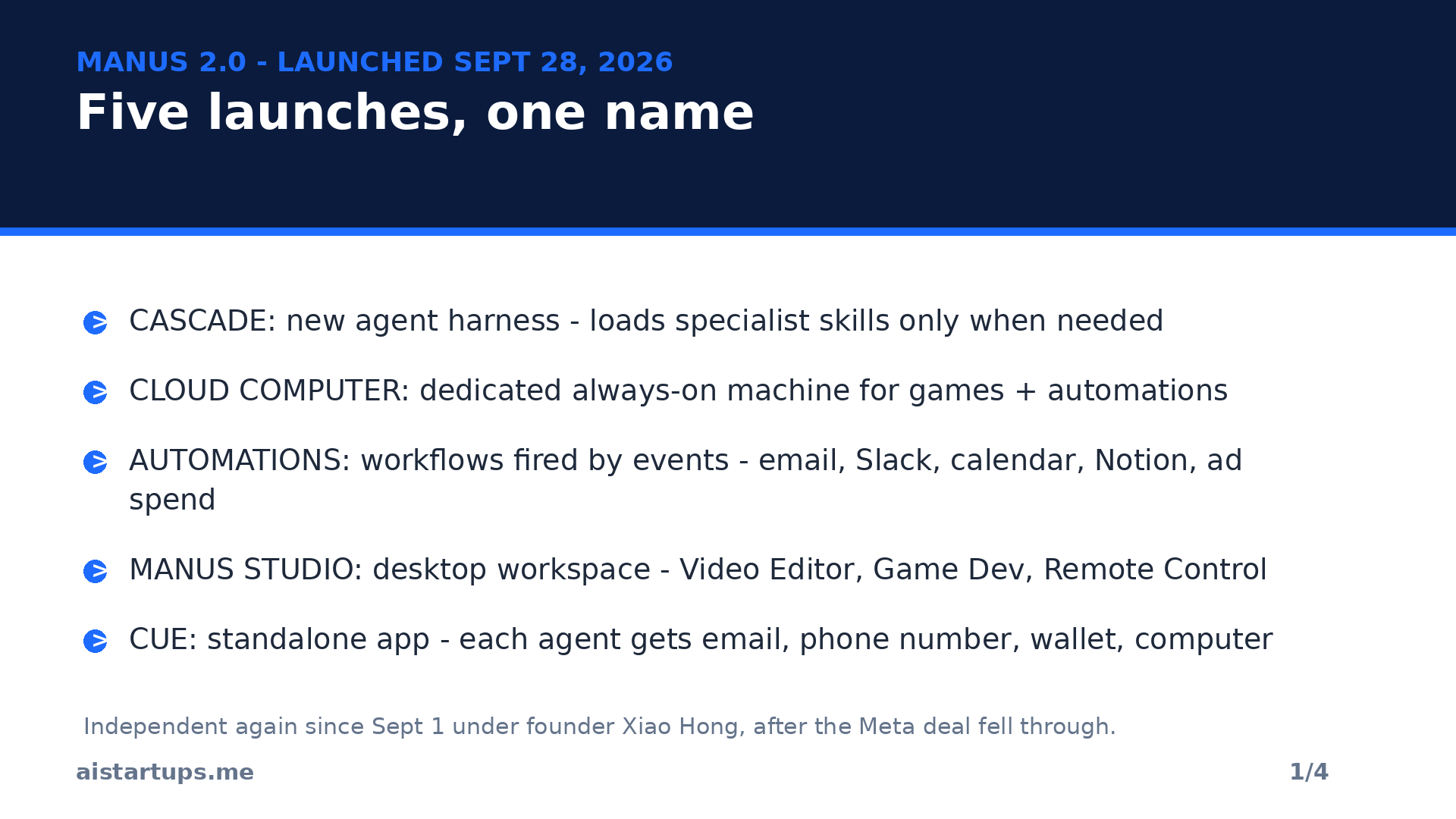
Manus — the “general AI agent” that went viral last year, then nearly got bought by Meta, then didn’t — shipped Manus 2.0 on September 28, 2026, a month after returning to independence under its founding team. And it’s not a version bump. It’s a whole operating model for what an agent can be: cheaper to run (Cascade), always on (Cloud Computer), triggered by your workday instead of a schedule (Automations), with a real desktop workspace (Manus Studio) — and a brand-new app called Cue where each agent gets its own email, phone number, wallet, and computer.
I spent the last two days reading the launch coverage, the independent pricing breakdowns, and the technical explainers — not the hype threads — to figure out what this stack actually does, what it costs, and whether a founder should care. Here’s the honest version. (And yes, the pricing section is where most launch-day reviews quietly fail you. Mine won’t.)
First, how we got here (the 30-second version)
You need this context, because it explains why Manus 2.0 exists at all. Last year Manus exploded as “the general AI agent” — give it a goal, it browses, installs dependencies, writes code, and returns a finished artifact. Then came the Meta acquisition saga: announced, then reportedly blocked by Chinese regulators, then unwound. On September 1, 2026, Manus announced it was independent again, with founder Xiao Hong and the founding team still leading. Manus 2.0, twenty-seven days later, is their answer to the question “what’s next now that nobody’s buying us?”
And honestly? It’s a bigger swing than most acquisitions ever produce. While OpenAI’s dots and Meta’s Muse both raced toward “personal agents that act for you,” Manus went one layer deeper and gave each agent an identity: its own email, phone number, wallet, and computer. That’s not a chatbot feature. That’s a counterparty.
The five pieces (and who each is for)
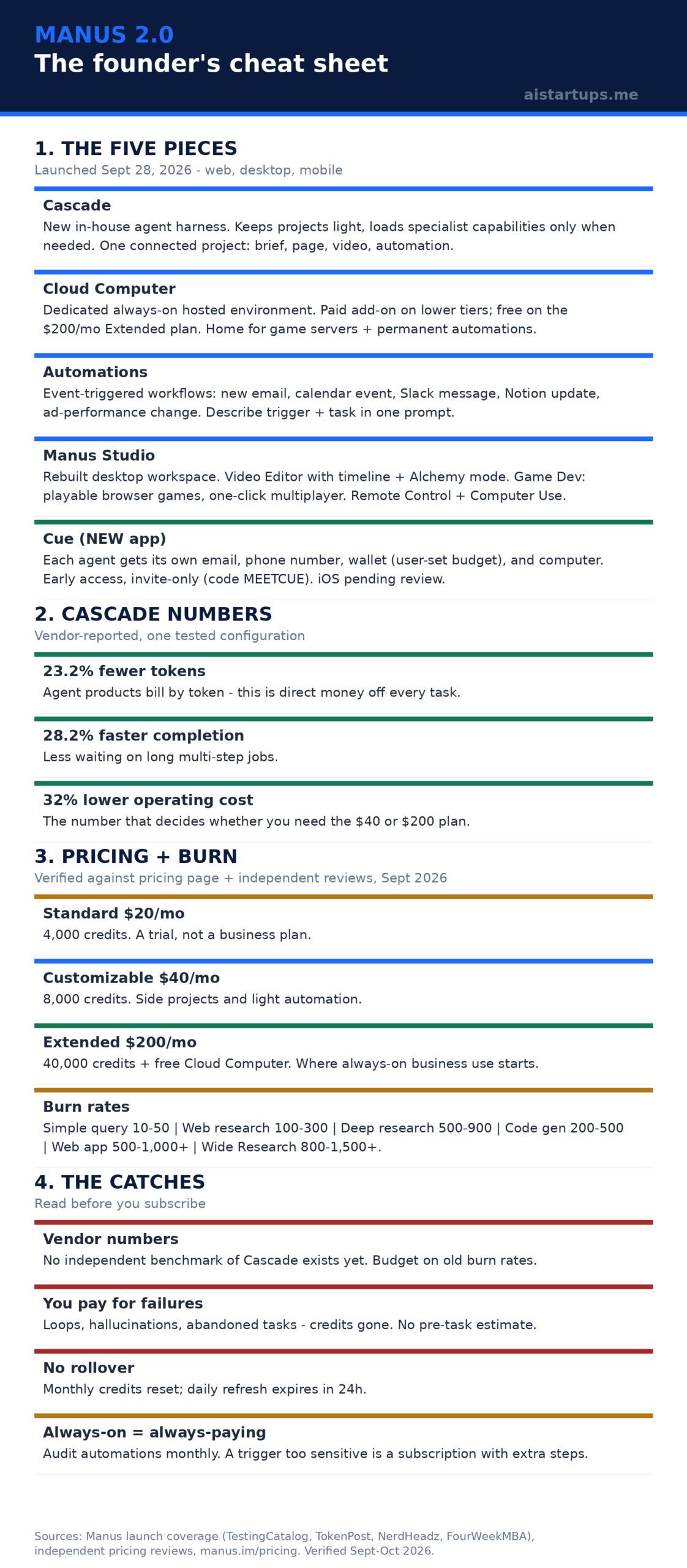
Manus 2.0 is really five launches wearing one name. Let’s take them in order of “how much this changes your week.”
1. Cascade — the engine that makes everything cheaper
Cascade is the new in-house agent harness underneath Manus 2.0 — the part that plans, calls tools, and keeps a long task on track. The design philosophy is simple: start each project light, and load specialist capabilities only when the work actually needs them, so the brief, the page, the video, and the automation all stay part of one connected project instead of living in separate silos.
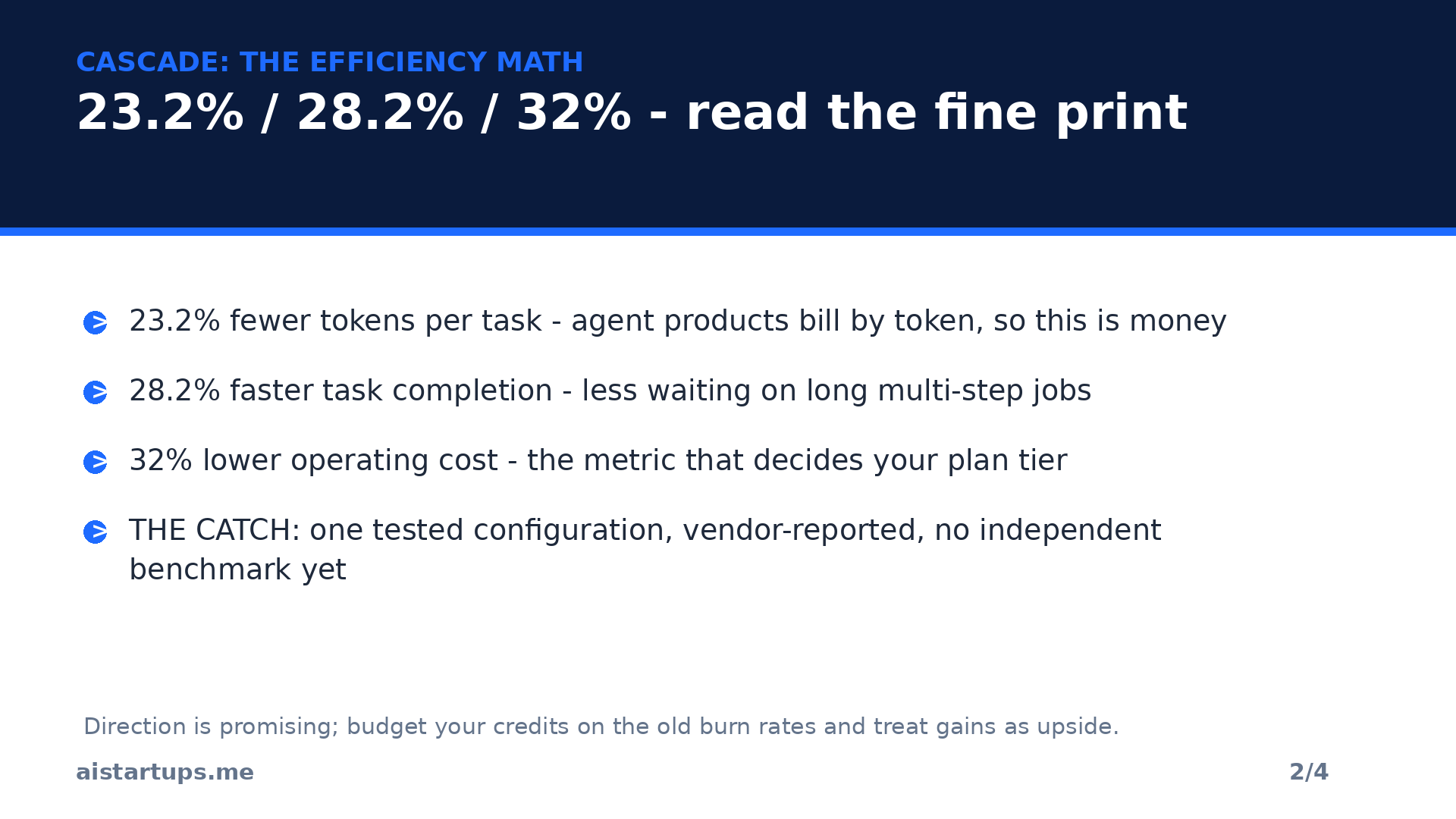
The numbers Manus published: 23.2% fewer tokens, 28.2% faster task completion, 32% lower operating cost versus the previous system — in one tested configuration. Say that second part out loud with me, because it matters: these are vendor-reported figures from a single configuration, not an independent benchmark. Nobody outside Manus has published a hands-on performance review yet. The direction is genuinely promising (agent products billed by token live and die on exactly these three metrics), but treat the numbers as a ceiling, not a promise.
Why founders should care anyway: if you’re running dozens of agent tasks a month, a 20–30% efficiency gain is the difference between the $40 plan and the $200 plan. More on the credit math below.
2. Automations — your workflow starts when something happens
This is the piece I’d bet my own money on. Manus had scheduled tasks — “run this every day at 9am.” Automations extends that to event triggers: a new email lands, a Slack message arrives, a calendar event starts, a Notion page updates, your ad performance moves — and the workflow fires.
You describe the trigger and the task in a single prompt. That’s it. No webhook plumbing, no Zapier vs Make vs n8n debate for simple flows — though here’s my honest take: I wrote the honest automation comparison for this site, and my verdict hasn’t changed. Manus Automations is brilliant for agent-shaped work (research, drafting, summarizing, triage) that starts from a business event. It’s not replacing n8n for deterministic, high-volume data pipelines. Different tools, different jobs.
For a solo founder, the event-triggered model is the difference between “I have an assistant” and “I have a staff that never sleeps.” New investor email → agent drafts a briefing from your deck + their firm’s portfolio, before you’ve finished your coffee. Ad spend spikes → agent pulls the campaign, summarizes what changed, and drafts the kill-or-scale recommendation. That’s not automation in the old sense. That’s delegation.
3. Cloud Computer — the machine that stays on when yours doesn’t
Some projects need a computer that doesn’t sleep. A multiplayer game needs a server players can reach at any hour. An automation needs a home that runs around the clock. Cloud Computer is Manus’s answer: a dedicated, always-on hosted environment you buy for a specific project.
Here’s the pricing honesty other reviews skip: it’s a separate purchase on the lower tiers, and bundled free on the $200/month Extended plan. An always-on agent costs always-on money — the credits it burns while you sleep come from your subscription, and when you stop paying, the sandbox goes with it. (The framing of “set it up once and forget it” is technically true and spiritually misleading. It’s a managed service with ongoing costs and ongoing vendor dependency, like everything else in this category.)
For founders: don’t buy one on day one. Run your automations on demand for a month, see which ones actually fire, then move the survivors to an always-on home.
4. Manus Studio — the desktop app grew up
The Manus desktop app is now Manus Studio: a shared workspace for documents, spreadsheets, PDFs, slides, websites, code, games, and video — loading only the tools each project calls for. Two new professional environments headline it:
- Video Editor: clips, images, text, motion graphics, and audio on an editable timeline. Manus cuts the first draft, you rearrange the timeline, then tell it to continue. “Alchemy mode” blends video and code generation under your creative direction. Target use cases: short ads, AI UGC, tutorials, vlogs, motion graphics.
- Game Dev: natural-language prompts become playable browser games you can play, edit (code, assets, scenes), and share — with one-click multiplayer (which needs a Cloud Computer behind it).
Plus Remote Control and upgraded Computer Use: you can direct authorized computers from your phone in plain language. The computer-use space is getting crowded — every lab is shipping some version — but Manus’s version plugs straight into the agent that already knows your project, which is a real advantage.
My honest read: Studio is Manus’s strongest card against the “agents are just chatbots with tools” critique. A timeline you can grab with your mouse and a game you can actually play are artifacts, not answers. And if you’ve ever tried building an AI MVP with no code, you know the gap between “the AI made me a demo” and “I can ship this.” Studio closes part of that gap — the editing loop. When the prototype graduates to a real product with real users and real data, though, that’s when you bring in engineers or a team that does this for a living, like AISquadX, the web development and AI integration studio.
5. Cue — your agent gets a phone number
This is the genuinely new idea, and the one the other labs are going to copy. Cue is a standalone app (phone, desktop, web) where each personal agent gets its own email, phone number, wallet, and computer. It can send messages, take calls and leave you a summary, pay for things within a budget you set, keep working on its own machine after you close the app — and several agents can pass work between themselves in a group chat while you make the final call.
Why is this bigger than it sounds? An email address, a phone number, a wallet, and a computer aren’t model capabilities. They’re the minimum set of account primitives every other system in the world uses to decide whether a counterparty exists. Manus moved the hard problem from the inference layer to the account layer — where liability, authorization, and trust live. Your agent can hold a place in line at a restaurant via a QR code. That’s cute. Your agent can also spend money, which is where the grown-up questions start.
The status check, because you should know: Cue is in early access, invite-only (invite code MEETCUE, first-come first-served per launch coverage), and the iOS app was still pending App Store review at launch. The wallet spends only within a budget you set — delegated, capped spending, not autonomous unlimited spending. If that qualifier ever changes, reassess everything.
The pricing, for real this time
Launch-day coverage loves to bury the money part. So let’s put it up front, verified against Manus’s own pricing page and independent reviews from September 2026:
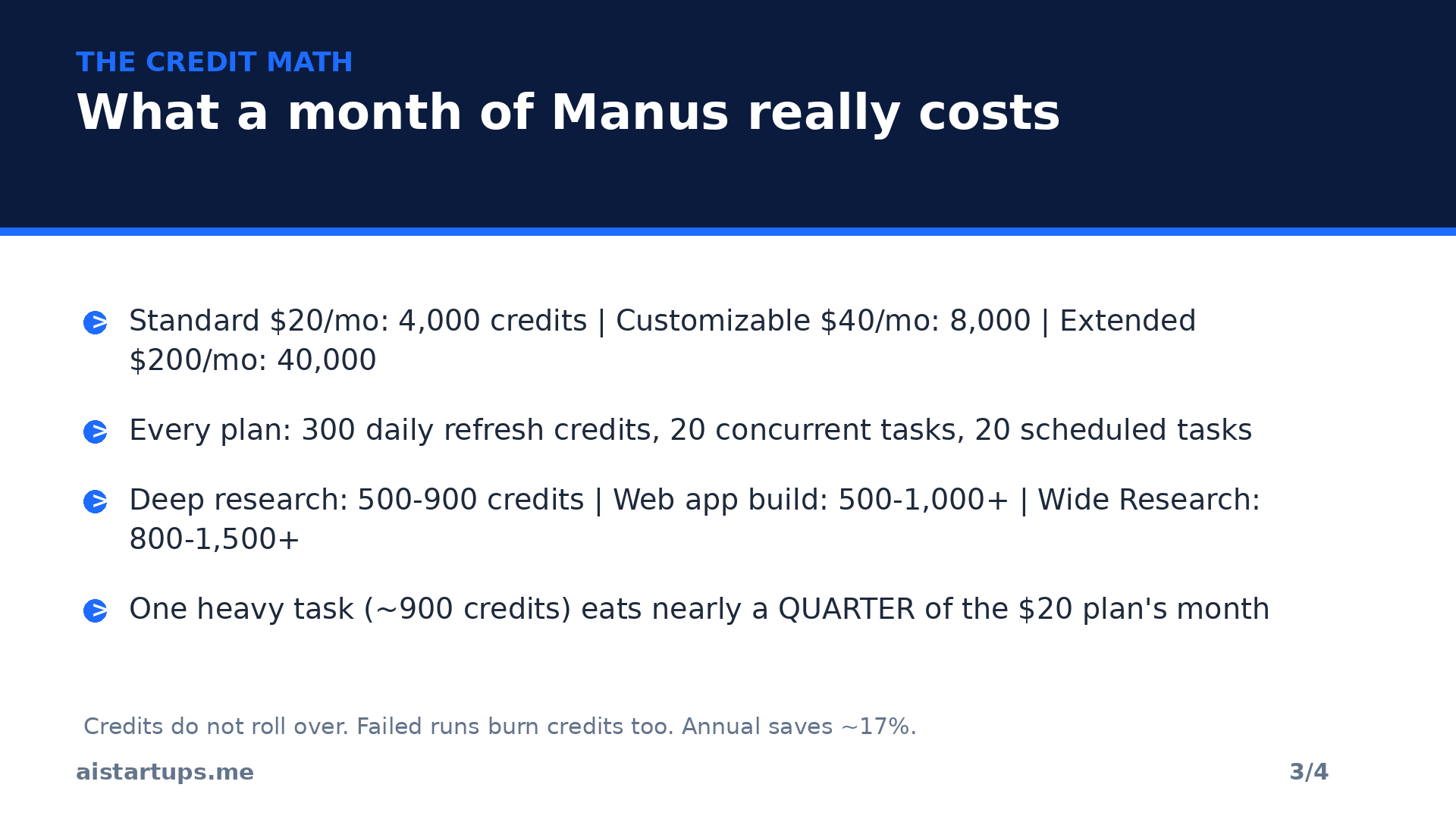
- Standard — $20/month: 4,000 credits/month, 300 refresh credits every day, 20 concurrent tasks, 20 scheduled tasks.
- Customizable — $40/month: 8,000 credits/month, same daily refresh and task limits.
- Extended — $200/month: 40,000 credits/month, free Cloud Computer, larger-scale research/sites/slides/Wide Research.
Annual billing saves roughly 17%. There’s no free-tier card on the public pricing page anymore — the 300 daily refresh credits are now a feature of the paid plans, not a free-account entitlement. As a new user, budget as if the entry point is $20/month. (One independent review notes Manus’s help docs still reference a Free plan, suggesting it may exist for legacy accounts — but don’t count on it.)
Now the part that actually decides your bill — what tasks burn, observed across independent testing:
- Simple chat/query: 10–50 credits
- Web research, single source: 100–300
- Deep research, multi-source: 500–900
- Code generation + execution: 200–500
- Web app build: 500–1,000+
- Wide Research (deep analysis): 800–1,500+
Do the math with me. On the $20 Standard plan with 4,000 monthly credits, one heavy deep-research task (~900 credits) eats nearly a quarter of your month. Five to eight serious tasks and you’re done — the daily 300 refresh credits cover light work, not real projects. This is the same trap I wrote about in my guide to pricing an AI SaaS product: the unit economics only work if you know your burn per task before you commit. And here’s the rub — Manus shows no pre-task cost estimate. You learn the price after the job completes. Failed runs burn credits too, which is the single loudest complaint in user reviews: you pay for the agent’s mistakes, not just its successes.
So here’s my founder rule of thumb: $20/month is a trial. $40/month is a side project. $200/month is where always-on business use starts. If you’re running revenue-generating client work on Manus, price the credit ceiling into your margin like a server bill — because that’s what it is.
Four automations worth setting up in week one
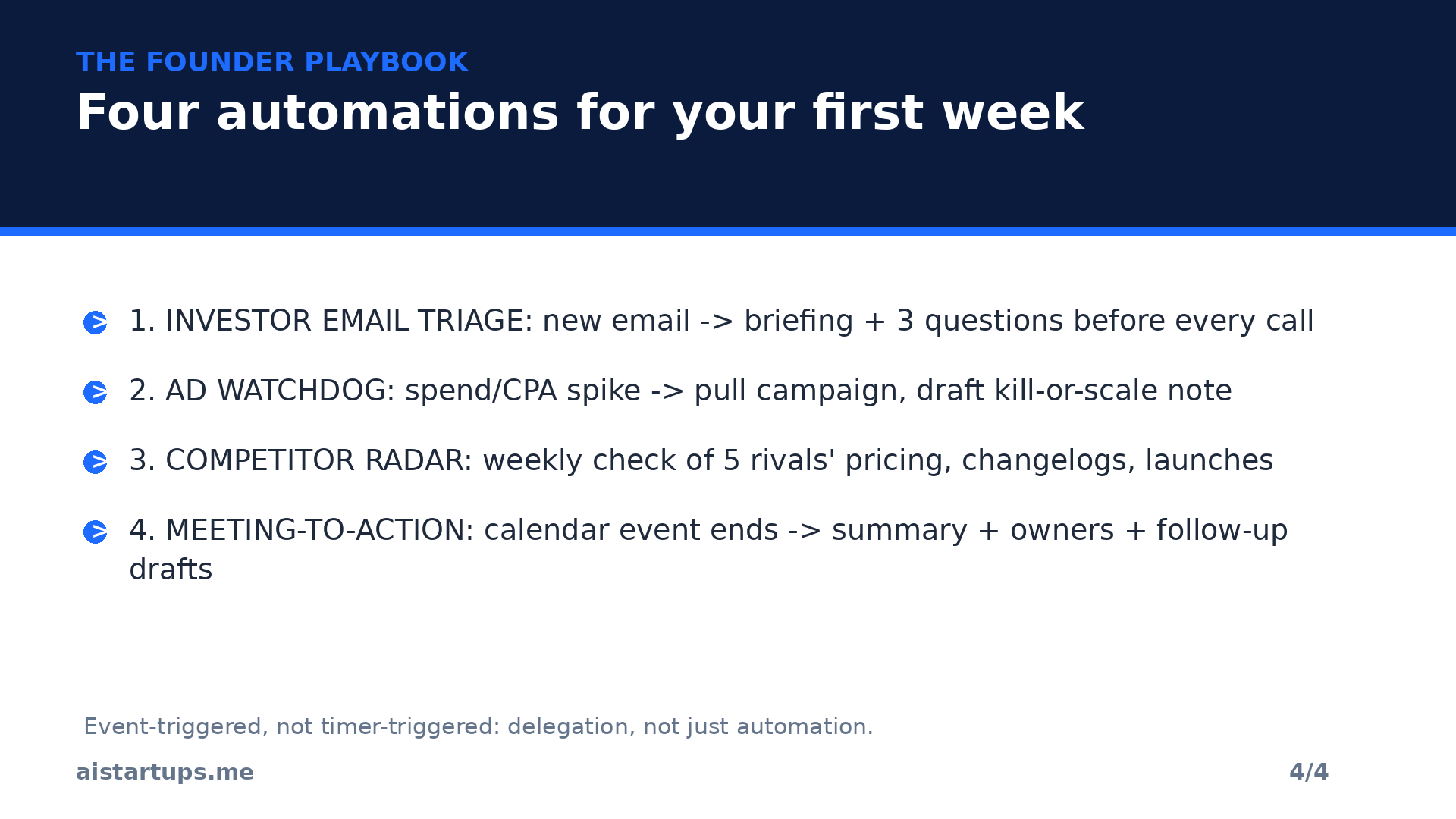
Enough theory. If I were advising a solo founder today, these are the four Automations I’d build first — each one is a single prompt, and each one pays for itself:
- The investor email triage. Trigger: new email. Task: when an investor email lands, pull their fund’s portfolio and recent deals, draft a two-paragraph briefing plus three questions only you could ask. You walk into every call looking prepared. Cost: ~100–200 credits a pop.
- The ad-performance watchdog. Trigger: ad performance change. Task: when spend or CPA moves beyond your threshold, pull the campaign, summarize what changed, and draft a kill-or-scale recommendation. This is the automation that catches the $500 bleed at 2am instead of Monday morning.
- The competitor radar. Trigger: scheduled (weekly). Task: check your top five competitors’ pricing pages, changelogs, and launch announcements; deliver a one-page diff of what moved. Market research that used to be a Friday-afternoon chore becomes a Monday-morning email.
- The meeting-to-action pipeline. Trigger: calendar event ends. Task: summarize the call from your notes, extract action items with owners, and draft the follow-up emails. Every sales call gets followed up within the hour, even the ones you took from a taxi.
Notice what these have in common: they’re event-shaped — triggered by something happening in your business, not by a timer. That’s the whole point of the Automations upgrade, and it’s the piece your old Zapier zaps can’t do, because a zap can move data but it can’t think about what the data means.
Where it fits against the competition
Zoom out for a second, because the timing here isn’t an accident. In the same two-week window, OpenAI shipped dots (always-on personal agents with their own cloud computers, connected to 4,000+ apps), Meta shipped Muse for small business, and xAI put Team Bots into public beta. Every major lab independently arrived at the same conclusion: the next product surface isn’t a better chatbot — it’s an agent that acts in the world on your behalf.
Manus’s bet is that the differentiator isn’t the model (everyone’s frontier models are within shouting distance now) but the execution environment: the always-on computer, the event triggers, the editable workspace, the agent with its own phone number. I think that’s the right bet. Models commoditize; infrastructure compounds.
The honest comparison for a founder choosing today: dots and Muse are smoother consumer products with bigger ecosystems; Manus 2.0 is the more hackable one — the one where a technical founder can wire an automation to a Slack channel on day one and a Cloud Computer on day thirty. If you’re building your startup’s AI toolkit this quarter, Manus belongs in the “agent that does work” slot, not the “chatbot I ask questions” slot.
The models are converging. The moat is the machine they run on, the triggers that wake them up, and the identity that lets the rest of the world take them seriously. Manus 2.0 is the first stack to ship all three at once.
The catches (read before you subscribe)
I’ve been enthusiastic. Now the other half of the honest review — the things launch coverage glosses over:
- The efficiency numbers are vendor-reported. 23.2% / 28.2% / 32% came from one tested configuration in Manus’s own announcement. No independent benchmark exists yet. Plan your credit budget on the old burn rates and treat any improvement as upside.
- You pay for failures. When the agent loops, hallucinates, or gives up halfway, the credits are gone. There’s no cost estimate before a task and no “stop at X credits” guardrail. For tinkering this is annoying; for client work it’s a margin risk you must price in.
- Credits don’t roll over. Monthly pools reset; daily refresh credits expire in 24 hours. Use-it-or-lose-it billing rewards consistent daily use and punishes the “I’ll batch everything on Friday” pattern.
- Always-on means always-paying. Cloud Computer is a paid add-on (free only on the $200 plan), and its automations keep burning credits while you sleep. Audit your automations monthly — a trigger that’s too sensitive is a subscription with extra steps.
- Cue is early, not finished. Invite-only, iOS pending App Store review, and the wallet only spends within budgets you set. The agent-with-a-phone-number future is real, but the present version is a beta you should watch more than depend on.
- Security is the open question. Agents that hold email accounts, phone numbers, and wallets are high-value targets for prompt injection — and the broader industry is already disclosing agent-containment incidents this quarter. Keep agent credentials scoped, budgets small, and human approval on anything that spends real money.
FAQ
What is Manus 2.0?
Manus 2.0 is the September 28, 2026 release of Manus’s general AI agent platform, rebuilt around a new agent harness called Cascade. It adds Cloud Computers (always-on hosted environments), event-triggered Automations, the Manus Studio desktop workspace (with Video Editor and Game Dev modes), and Cue, a standalone app where each personal agent gets its own email, phone number, wallet, and computer.
How much does Manus 2.0 cost?
Three paid tiers: Standard at $20/month (4,000 credits), Customizable at $40/month (8,000 credits), and Extended at $200/month (40,000 credits, free Cloud Computer). Every plan includes 300 daily refresh credits, 20 concurrent tasks, and 20 scheduled tasks. Annual billing saves about 17%. Credits don’t roll over month to month.
What is Cascade in Manus 2.0?
Cascade is Manus’s new in-house agent framework — the engine that plans tasks, calls tools, and keeps long jobs on track. It keeps projects lightweight and loads specialist capabilities only when needed. Manus reports 23.2% fewer tokens, 28.2% faster completion, and 32% lower operating cost versus the previous system in one tested configuration; these are vendor-reported figures, not independent benchmarks.
What is Cue by Manus?
Cue is a standalone personal-agent app launched with Manus 2.0. Each agent gets its own email address, phone number, wallet (which only spends within a budget you set), and computer, so it can send messages, take calls, make capped payments, and keep working after you close the app. It launched in early access, invite-only (invite code MEETCUE), with the iOS app pending App Store review.
Is Manus 2.0 worth it for a startup?
For a solo founder or tiny team, the $20–40/month plans are a cheap experiment and the Automations feature alone can replace several hours of weekly busywork. Serious, always-on business use realistically starts at the $200 Extended plan, and you should budget for credit burn (500–1,500+ credits per heavy task) and the fact that failed runs still cost you. Start on a low tier, measure your actual burn for a month, then upgrade only when the math clears.
The Bottom Line
Here’s the thing: I’ve watched a dozen “AI agent” launches this year, and most of them were a chatbot with a trench coat. Manus 2.0 is the first one that feels like an operating system for delegated work — a cheaper engine, a computer that never sleeps, workflows that fire when your business does something, a workspace where the output is actually editable, and agents with enough identity to be taken seriously by the rest of the world.
Is it perfect? Not even close. The credit model punishes experimentation, the efficiency claims need independent verification, and the agent-with-a-wallet future raises security questions the industry hasn’t answered yet. But the direction is right, and right now nobody else is shipping all five pieces in one stack.
My advice: start on the $20 plan this week, build the investor-email triage and the ad watchdog, and watch your credit burn for a month. If the automations earn their keep, scale up. That’s how you buy leverage as a founder — not by betting on the hype cycle, but by measuring the machine.