


Alibaba shipped a new flagship model today, 16 November 2026. It’s called Qwen4-Max, and if you tried the preview last week, this is the version you can actually build on. It has a price. It has benchmarks. It has a million-token context window. And it costs 25% less than the model it replaces.
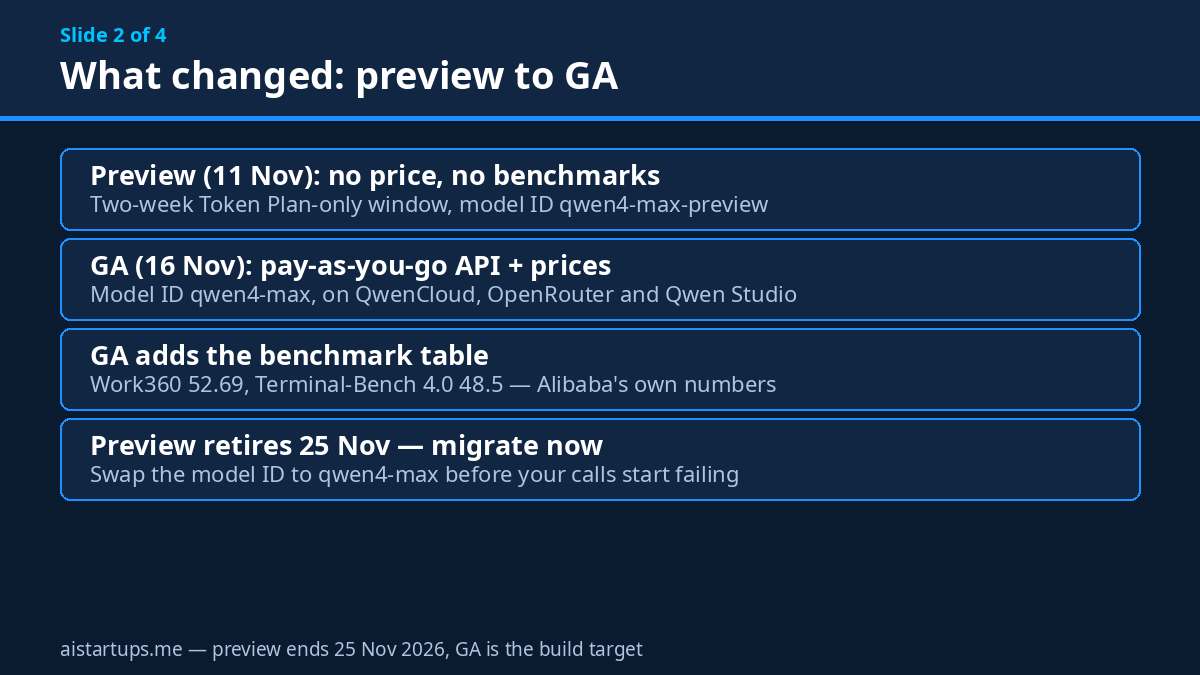
But before anything else — the one deadline in this whole article. If you pinned the preview model ID, qwen4-max-preview, it retires on 25 November 2026. Nine days from now. Your calls will just stop working. Switch to qwen4-max today, not on the 24th, not “when you get around to it.” Today. I’ll say it again later because I know how this goes.
Now. Is Qwen4-Max worth your afternoon? Honestly — yes, with a catch, and the catch is the interesting part. Alibaba says it’s a “teammate,” not a chatbot. The blog post is literally titled “Qwen4-Max: Your New Teammate Has Arrived.” And the numbers it puts up are genuinely strong on the kind of long, multi-step work that eats a startup’s budget: research, coding agents, document wrangling, the stuff where a model runs for an hour and you come back to a finished draft.
But every benchmark in the announcement comes from Alibaba itself. Every demo is Alibaba’s own showcase. And on at least one independent-feeling test, Terminal-Bench 4.0, Qwen4-Max trails two rivals by a lot. So this guide does what I always do with a launch-day model: take the vendor’s numbers seriously, keep them labeled as the vendor’s numbers, and tell you how to test the thing on your own hardest work before you trust it with anything real.
What Actually Launched Today
At 02:01 UTC on 16 November 2026, Alibaba’s official Qwen account announced that Qwen4-Max is generally available. The blog post — “Qwen4-Max: Your New Teammate Has Arrived” — frames it as a model built for agentic work: long-running tasks, tool use, and shipping a usable first version early instead of disappearing into a thinking loop for an hour.
That’s the headline. Here’s the shape of the thing underneath it.
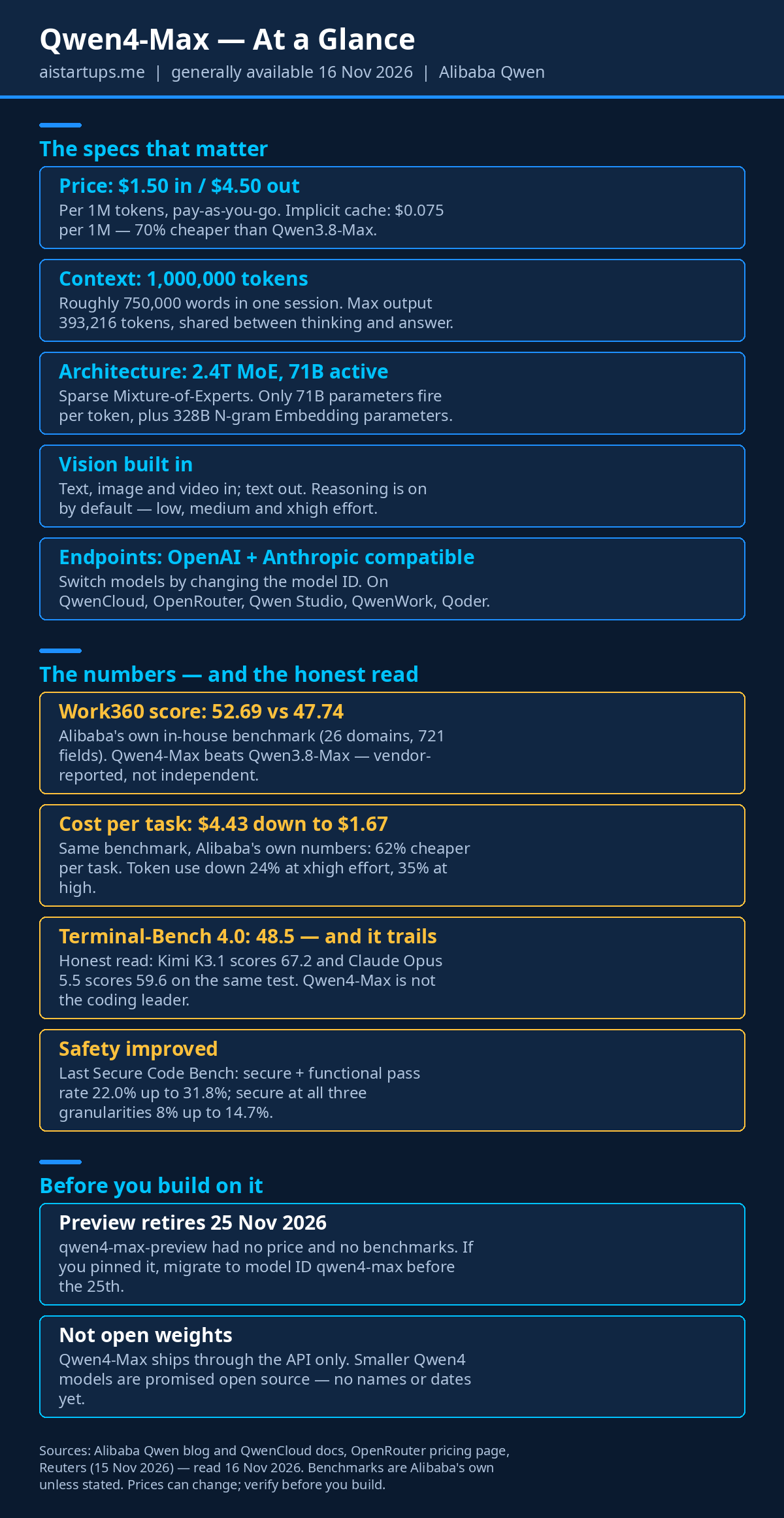
Qwen4-Max is a sparse Mixture-of-Experts model. The backbone is 2.4 trillion parameters, but only 71 billion activate per token — that’s the MoE trick, a huge brain that only wakes up the parts it needs for each word. On top of that sit 328 billion N-gram Embedding parameters, a new piece of the architecture that helps the model remember long, repeated patterns (think code, legal boilerplate, your own product docs). Three more new ingredients get named in the announcement: Gated DeltaNet, Qwen Sparse Attention (QSA), and Gated Residual. Alibaba doesn’t give you enough detail to evaluate those from the outside, so I’ll be straight with you — the names matter less than what they buy you, which is: it can hold a very long context and keep reasoning over it without the bill exploding.
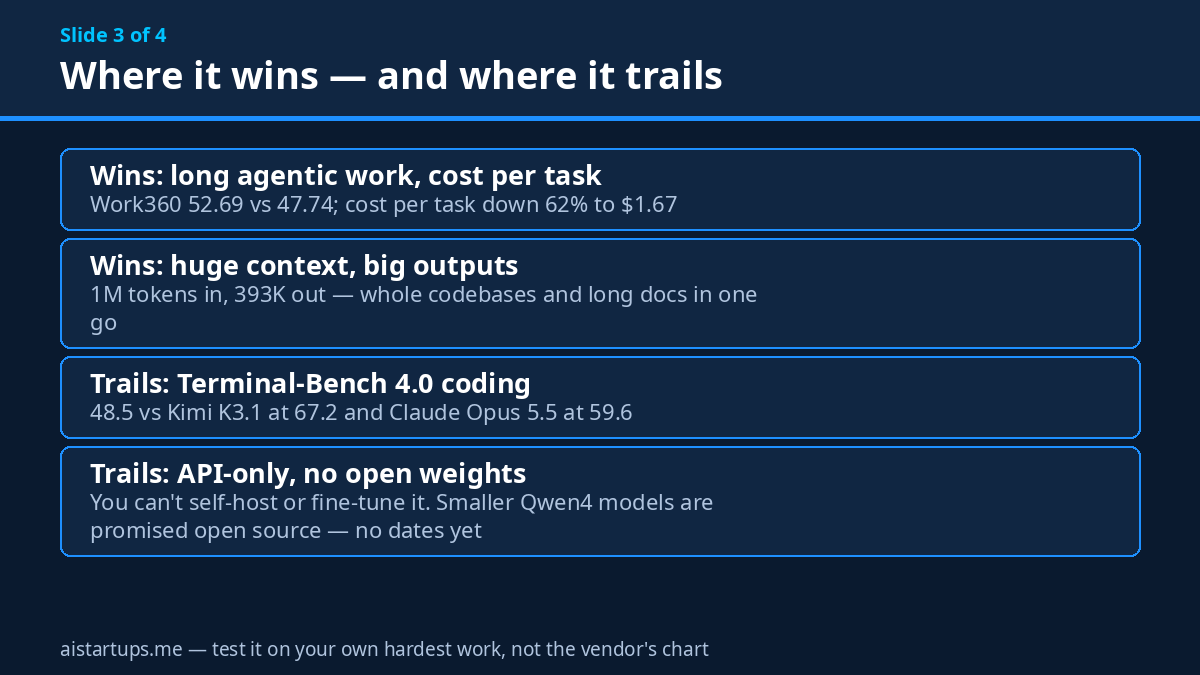
And the context is the number that changes what you can try. One million tokens in. That’s roughly 750,000 words in a single session — your whole codebase, a year of support tickets, a few hundred pages of contracts, all at once. Max output is 393,216 tokens, and here’s the catch I flagged in the preview guide: thinking and the final answer share that budget. A model that thinks for 300,000 tokens has less than 100,000 left to actually say something. For most founder jobs that never binds. For the 48-hour autonomous runs Alibaba brags about, it absolutely does, and you should know it before you plan one.
Input is text, image and video. Output is text only. Reasoning is on by default, with low, medium and xhigh effort levels — xhigh is the default, so expect it to think before it answers and to cost you for that thinking. The model ID is simply qwen4-max.
One more thing, and it’s a big one for anyone who’s been burned by a model that only exists inside one company’s app: the endpoints are OpenAI- and Anthropic-compatible. You switch by changing the model ID. That’s it. No rewrite, no new SDK, no week of integration work. If your stack already talks to an OpenAI-compatible API, Qwen4-Max is a one-line change and a pricing comparison.
What Changed Since the Preview
Five days ago, I wrote the preview guide and the honest advice in it was: test it, don’t build on it. The preview had no per-token price, no benchmark table, no model card, and a retirement date. It was a two-week test drive with the hood welded shut.
Today’s general availability changes three of those four things:
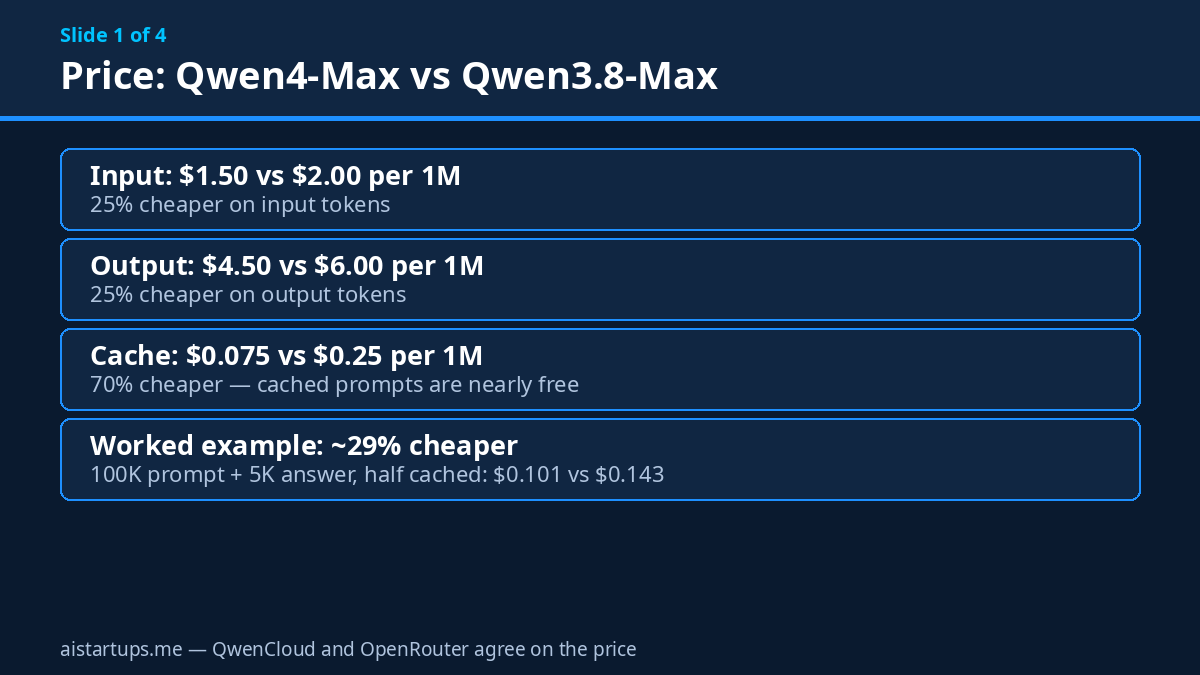
- There’s a real price now. $1.50 per million input tokens, $4.50 per million output tokens, $0.075 per million cached tokens, pay-as-you-go on QwenCloud. OpenRouter lists the same numbers, which is a good sign — two independent price pages agreeing is the cheapest fact-check you can do on launch day.
- There’s a benchmark table now. Work360, Terminal-Bench 4.0, HLAB, Code Arena, safety benches — Alibaba published numbers across all of them. They’re Alibaba’s own numbers, and I’ll keep saying that, but at least there’s something to argue with.
- There’s a stable model ID to build on.
qwen4-maxis the GA model. It doesn’t come with a retirement date.
What hasn’t changed: the weights are still not open. Qwen4-Max ships through the API only. Alibaba says smaller Qwen4 models are “coming to open source” — no names, no dates, no repo. If you were hoping to self-host or fine-tune this one, that’s not the deal. And the preview really does die on 25 November, so if any of your code, your agent config, or your teammate’s laptop still points at qwen4-max-preview, that’s a ticking clock, not a detail.
The other thing that changed is the story Alibaba tells about the model. The preview announcement was four words: “Qwen4 is coming.” Today’s blog is a full pitch — a teammate, not a tool — with demos in manufacturing, finance, law, medicine and drug discovery. Which brings us to the price, because the pitch only matters if the math works.
What It Costs — and the Math You Should Do Yourself
Here’s the price table, straight from QwenCloud and OpenRouter, which agree:
| Model | Input / 1M tokens | Output / 1M tokens | Implicit cache / 1M |
|---|---|---|---|
| Qwen4-Max | $1.50 | $4.50 | $0.075 |
| Qwen3.8-Max | $2.00 | $6.00 | $0.25 |
So: 25% cheaper on input, 25% cheaper on output, and 70% cheaper on cached tokens. That last number is the one that matters most for agentic work, because agents re-read the same context over and over — the same repo, the same spec, the same conversation history — and every re-read that hits the cache costs almost nothing.
But per-token prices are a terrible way to judge a model. What you actually pay for is a finished task. So let’s do the arithmetic on a realistic job, and I’ll show every step so you can check me.
Say you send a 100,000-token prompt and get a 5,000-token answer, with half the input served from cache. On Qwen4-Max:
- 50,000 fresh input tokens × $1.50 per million = $0.075
- 50,000 cached input tokens × $0.075 per million = $0.00375
- 5,000 output tokens × $4.50 per million = $0.0225
- Total: $0.075 + $0.00375 + $0.0225 = $0.10125, about $0.10.
The same shape on Qwen3.8-Max: 50,000 × $2.00 per million = $0.10, plus 50,000 × $0.25 per million = $0.0125, plus 5,000 × $6.00 per million = $0.03. Total $0.1425, about $0.14. So on this shape of job, Qwen4-Max runs about 29% cheaper. (0.1425 minus 0.10125 is 0.04125; divide by 0.1425 and you get 28.9%.)
Now, is $0.10 vs $0.14 a big deal? On one call, no. On a thousand agent runs a day, it’s the difference between a $101 bill and a $143 bill, and that’s before the thinking tokens. Remember — reasoning is on by default, and thinking tokens are billed as output tokens at $4.50 per million. An agent that thinks hard before every answer can easily spend more on thinking than on the answer you see. That’s why the right metric is cost per finished task, not cost per token, and it’s why Alibaba’s own headline number is cost per task, not price per token. Which is a neat segue into the benchmarks — and why you should squint at them.
Access, for the record: QwenCloud API pay-as-you-go, the Token Plan (Individual plans run $6–$43 a month), Qwen Studio at chat.qwen.ai, QwenWork, Qoder, and OpenRouter. OpenRouter also lists cache-creation pricing — $1.875 per million for a 5-minute cache, $3.00 for an hour — if you’re building something that holds context warm across calls.
Qwen4-Max vs the Rivals
Here’s the comparison table, using only the numbers that were verified for this article. I’m not inventing specs for rivals beyond these — if a cell isn’t listed, it’s because I couldn’t verify it, not because it doesn’t exist.
| Model | Input / 1M | Output / 1M | Context | Max output |
|---|---|---|---|---|
| Qwen4-Max | $1.50 | $4.50 | 1M tokens | 393,216 tokens |
| Qwen3.8-Max | $2.00 | $6.00 | 1M tokens | 131,072 tokens |
| Claude Fable 5.2 | $8.00 | $40.00 | 1M tokens | — |
| Gemini 4 Carbon | $2.00 intro* | $10.00 intro* | — | — |
| Kimi K3.1 Pro | $2.00 | $10.00 | — | — |
*Gemini 4 Carbon’s intro pricing runs through 30 November, then rises to $4.00 input and $20.00 output. Read the small print on any “intro” price — it always has an expiry date, and this one is two weeks away.
Look at that table for a second. Qwen4-Max is the cheapest model on it by a clear margin — a third of the input price of Claude Fable 5.2, and output at barely a tenth of Fable’s $40 per million. That gap is the whole pitch. Alibaba isn’t claiming to beat the best model at everything. It’s claiming to be good enough at the long, expensive jobs while costing a fraction of what the premium models charge.
Whether “good enough” is actually good enough depends on the job, which is exactly what the benchmarks are supposed to tell you. So let’s look at them — and keep the caveats in view the whole time.
For context on the rivals, I’ve written founder’s guides to both of the closest ones: Kimi K3.1 Pro is the model that beats Qwen4-Max on Terminal-Bench, and Claude Fable 5.2 is the premium-priced option on this table. If you’re comparing seriously, read both. And if you’re tracking the whole week’s model rush — it has been a busy fortnight — the Meta Muse Ember guide covers the other big launch in the same window.
The Benchmarks — and Why You Should Squint
Every score below is Alibaba’s own, from its own chart, unless I say otherwise. That’s not a reason to ignore them. Vendors pick the tests where they look good — that’s marketing — but the numbers still tell you what the model was tuned for. Here’s what they say.
Work360: 52.69 vs 47.74. This is Alibaba’s in-house benchmark for real-world professional work — 26 domains, 182 subdomains, 721 fields, everything from finance to legal to manufacturing. Qwen4-Max scores 52.69 against Qwen3.8-Max’s 47.74. More interesting than the score is the cost: average cost per task falls from $4.43 to $1.67, a 62% drop. Token use falls 24% at xhigh effort and 35% at high effort on Work360, and 48–49% on Terminal-Bench 4.0. If those numbers hold up in your hands, that’s the whole story: same or better work, a third of the tokens, less than half the money. But — and I keep coming back to this because it matters — Work360 is Alibaba’s own test, built by the same company that built the model. Treat it as a claim, not a fact, until you see it on your own work.
Terminal-Bench 4.0: 48.5 — and it trails. This one I respect Alibaba for publishing, because it doesn’t flatter them. On Terminal-Bench 4.0, Qwen4-Max scores 48.5 while Kimi K3.1 scores 67.2 and Anthropic’s Opus 5.5 scores 59.6. That’s a real gap, not a rounding error. If your main use case is terminal-based coding agents — the model sitting in a shell, running commands, editing files, fixing its own mistakes — Kimi is ahead on this test by a wide margin. Qwen4-Max is cheaper, and cheaper matters, but don’t buy the cheaper model for a job where the expensive one is measurably better at the actual work. Test both on your repo. That’s the only score that counts.
HLAB legal work: 21.3 vs 9.2. On Alibaba’s legal-work test, Qwen4-Max scores 21.3 against Anthropic Opus 5.5 at 9.2 and OpenAI’s GPT-6 Astra at 7.1. That looks like a blowout — until you notice the absolute numbers are low for everyone. A 21 out of 100 is not a model you hand your legal work to and walk away. It’s a model that’s less bad at it than its rivals. Useful direction, not a green light.
Code Arena WebDev: No. 6 debut, 1,750 points. Qwen4-Max enters the WebDev leaderboard at number six with a preliminary 1,750 points, and it’s the top Chinese model on the board. Preliminary is doing a lot of work in that sentence — the score can move as more votes come in — but a top-six debut for a model that costs a fraction of the ones above it is worth noting if you build web products.
Artificial Analysis Intelligence Index: 43. One more data point from a secondary tracker, per airushx’s coverage. Not a headline, just a pin on the board.
And then there’s the safety side, which got its own headline. Reuters reported on 15 November that the new model ships with safety upgrades and uses fewer tokens than Qwen3.8-Max. The numbers behind that: on the Last Secure Code Bench, the pass rate for code that’s both functional and secure rose from 22.0% to 31.8% at function level, and code secure at all three granularities — function, file and repo — rose from 8% to 14.7%. Better, clearly. Also clearly still low in absolute terms: roughly seven in ten generated functions still fail the combined bar. If your product writes code that touches real systems, you still review it. The model got safer. It did not get safe.
“A benchmark is a claim about a model, made by whoever paid for the test. Your own hardest job, run twice, is the only score that isn’t selling you something.”
Live Delivery: The Feature That Actually Matters
Buried under the benchmark table is the idea I think matters most for founders, and it’s not a number at all. It’s called Live Delivery, and it’s a different way of thinking about what an agent does.
The old pattern: you give a model a big task, it thinks for an hour, and it hands you a finished thing. If the finished thing is wrong, you start over. Live Delivery flips it. The agent ships a usable first version early — a rough draft, a working prototype, a first pass at the report — and then improves it through successive releases while you watch. You can redirect it at any point. Change the direction, kill a bad approach, ask for something different, mid-run. The model doesn’t vanish into a thinking loop; it stays in conversation with you while it works.
Why does that matter to a startup? Because the most expensive failure mode of agentic AI isn’t a wrong answer. It’s an hour of compute spent building the wrong thing beautifully. A model that shows you version one after ten minutes and lets you steer is worth more than a model that’s slightly smarter but silent for an hour. Speed of the first usable draft, plus the ability to correct course cheaply, is what turns an agent from a demo into a tool you actually use on a Tuesday.
Alibaba says it’s open-sourcing the Qwen-Live-Delivery-Plugin, so this pattern isn’t locked to Qwen’s own apps — you could wire it into your own agent setup. That’s a real offer if it lands, and worth watching, but “open-sourcing” with no repo link yet is a promise, not a delivery. Check before you plan around it.
The Demos Are Wild. Treat Them as Demos.
Alibaba’s blog runs through a set of showcases that read like a highlight reel, and I want to give them to you straight — as Alibaba’s own demos, not as independent proof. Some of them are genuinely impressive if even half true. All of them need your own testing before you believe the version that applies to your business.
Making things: Blender 3D scenes built by the model, and playable games in Unity, Unreal and Godot. In manufacturing, at companies called SANF and Pacific Union, programming one workpiece supposedly went from about 475 minutes to 24 minutes — roughly 95% less. That’s a demo number from a vendor blog. If it holds in a real shop, it’s enormous. If it holds for one workpiece shape and falls apart on the next, it’s a demo. You know which one you should assume.
Finance: research with 90 MCP tools plugged in, producing Excel workbooks and PowerPoint decks. Ninety tools is a lot of moving parts, and the interesting question isn’t whether it can call them — it’s whether the numbers in the workbook are right. A beautiful deck with one wrong figure is worse than no deck.
Law: a pre-IPO legal due diligence run — 198 inconsistently formatted working papers sorted into 14 folders, an 86-page report, 60,000+ Chinese characters, every conclusion cited. That’s the kind of grinding document work that eats junior associate weeks. If a model can do the sorting and the citing reliably, that’s a real product. The word “reliably” is doing all the work there.
Medicine: a critical care case — a 6-day clinical course, dozens of lab reports, 1,433 medical images — with 4 management recommendations that matched the attending physician’s orders. Matching a doctor on 4 recommendations is a good sign. It is not a medical device. Don’t treat it like one.
Science: the two that made me sit up. A 48-hour autonomous run screened 2.7 million candidate molecules, ran 4 design–synthesis–testing loops, and produced a physical sample of a novel coolant material for data-center chips. And a drug discovery run against the NLRP3 inflammasome: 454 tool calls, 3,239 metric evaluations, 24 candidates, with binding affinity around 3.6 times the patent-derived reference. Expert-endorsed, and — to Alibaba’s credit, stated plainly — still awaiting wet-lab validation. A molecule on a screen is not a drug. A coolant sample is not a product. But a model that can run a 48-hour loop and hand you something physical at the end is a different kind of tool than a chatbot, and that’s the point of the whole launch.
So read the demos as a menu of what’s worth trying, not as a list of what’s proven. The manufacturing one matters if you make things. The legal one matters if you drown in documents. The finance one matters if your team builds decks by hand. Pick the one closest to your business and test that one first.
Safety: Better, Still Not a Free Pass
I touched on the safety numbers above, but they’re worth a section of their own, because founders keep making the same mistake: treating a safer model as a safe model.
Qwen4-Max is safer than its predecessor on the tests Alibaba published. Secure-and-functional code generation is up, and the model uses fewer tokens to do the same work, which means fewer chances for it to wander off mid-task. Reuters’ coverage of the launch leads with the safety upgrades, and that’s fair — it’s a real improvement, and it’s the kind of thing that matters when your product puts model output in front of customers or into production systems.
But the absolute numbers are still sobering. Roughly 68% of generated functions still fail the combined functionality-plus-security bar. About 85% of code isn’t secure at all three levels. Those aren’t numbers you build an unsupervised pipeline on. They’re numbers you build a reviewed pipeline on — model drafts, human or automated checks, tests that run before anything ships.
Practical takeaway: use Qwen4-Max for code the same way you’d use a fast junior developer. Great for first drafts, great for boilerplate, great for the boring 80%. Never the last pair of eyes on anything that touches money, user data, or production. That rule doesn’t change because the model got better at a benchmark. It changes when your own test suite says so.
Where to Use It
You’ve got options, and they serve different purposes. Pick the door that matches what you’re trying to learn.
Qwen Studio (chat.qwen.ai) is the fastest way to meet the model. Free to sign up, and it’s where you should start — throw your real documents at it, not a toy prompt. Your messiest onboarding doc, your ugliest support thread, the proposal template your team copy-pastes and regrets. Real work tells you more in twenty minutes than a benchmark table ever will.
The QwenCloud API is the build door. Pay-as-you-go, OpenAI- and Anthropic-compatible endpoints, model ID qwen4-max. If your stack already calls an OpenAI-compatible API, this is a one-line change. Set a spend cap on the key before you hand it to an agent — agents with a 1M context window and reasoning on by default can spend money faster than you’d expect, and a cap is the cheapest insurance you’ll ever buy.
The Token Plan is the cheap-test door. Individual plans run $6–$43 a month, and it’s the same route the preview used. If you just want to run the afternoon test in the next section, six dollars is a fair price for a real evaluation.
OpenRouter is the comparison door. Qwen4-Max is listed there with the same pricing, which means you can A/B it against Kimi, Claude and Gemini from the same dashboard, same prompts, same spend tracking. If you’re deciding between models rather than just trying one, start here.
QwenWork and Qoder are the app doors — Alibaba’s own workspace and coding tools, with Qwen4-Max inside. If you already live in either of them, the model is just there now. And for the deeper background, the launch coverage on TML News and the hands-on breakdown on dev.to are both worth a read — the dev.to piece in particular walks through the 62% cost claim with the same healthy skepticism I’m bringing here. The AI Letter coverage and the Sandbase comparison of preview vs Qwen3.8-Max round out the picture if you want the full launch-day record.
Try It in an Afternoon: The Founder Checklist
Here’s the thing about launch-day models: reading about them is free, but it tells you nothing. Testing one on your own work takes an afternoon and tells you everything. This is the checklist I’d run — and the one I’d hand to a founder friend.
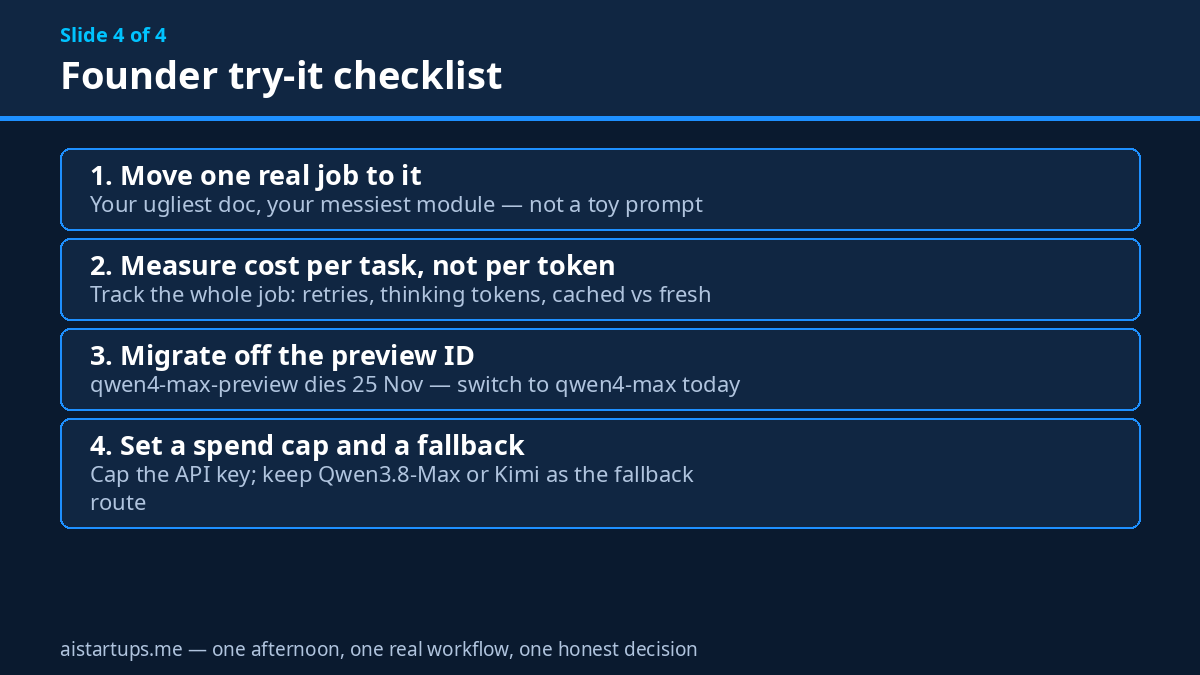
- Pick one real job, not a toy prompt. Your ugliest document, your messiest module, your longest support thread. If the model can’t help with real work, the benchmarks don’t matter.
- Run it in Qwen Studio first. No code, no API key. Paste the work in, ask for the fix, and watch what comes back. Note where it shines and where it wanders — wandering on a 1M context window is the failure mode to look for.
- Then run the same job through the API. Same prompt, same files. Log the tokens in, the tokens out, and the thinking tokens. That’s your real cost per task, and it’s the only number your finance brain should trust.
- Compare it against what you use now. Same job, current model, same scoring. Did Qwen4-Max finish faster? Cheaper? Better? If you can’t measure a difference, there isn’t one — no matter what the vendor’s chart says.
- Test the long-context claim specifically. Feed it your whole repo, or a 200-page contract, and ask a question whose answer sits at token 600,000. A model that loses the thread halfway through a million-token window is worse than a smaller window that holds together.
- Check Live Delivery on a real multi-step job. Ask for a first version early and redirect it mid-run. Does it actually adapt, or does it just keep building the thing you told it to stop building?
- Migrate off the preview ID if you haven’t already.
qwen4-max-previewretires 25 November. Search your codebase, your agent configs, and your .env files for it today. This is the unglamorous step that saves you a 2 a.m. outage. - Set a spend cap and a fallback route. Cap the API key. Keep Qwen3.8-Max or Kimi K3.1 as the fallback model ID in your config, so a bad day for one model is a config change, not a crisis.
- Decide with a number, not a feeling. Cost per finished task, quality score from your own rubric, time saved. If all three beat your current setup, switch. If only one does, keep testing. If none do, you just saved yourself a migration — and that’s a good afternoon too.
Should You Build On It?
Short answer: yes, for the right jobs, with a fallback. Here’s how I’d break it down.
Build on it if your product runs long, multi-step agent jobs where cost per task is the constraint — research, document processing, code generation with review, anything where the model works for minutes or hours and you come back to a draft. The price is real, the context window is real, and the cost-per-task claim, even discounted for vendor optimism, points in a direction worth testing. The OpenAI-compatible endpoints make the switch cheap, and cheap switches are how you find out if a model is actually better for you.
Don’t build on it yet if your core job is terminal-based coding agents — Kimi K3.1 is ahead on Terminal-Bench by a margin that matters — or if you need open weights, self-hosting, or fine-tuning. This model is API-only, and Alibaba hasn’t named a date for the smaller open models. And if your product touches law, medicine, or money, the benchmark scores are directions, not permissions. You still need your own evaluation, your own review step, and your own liability thinking.
And look — the model is the easy part. The hard part is always the same: the product around it. The website that explains what it does, the onboarding that gets a user to the first good result, the integration that wires the model into your stack without leaking API keys into a frontend. If that’s the bit you’re stuck on, that’s the kind of work a web development studio like AISquadX does every day — and honestly, most founders would get more value from a clean integration of a good-enough model than from chasing the best model with a rough product around it.
Frequently Asked Questions
Is Qwen4-Max open source?
No. Qwen4-Max ships through the API only — QwenCloud, OpenRouter, Qwen Studio, QwenWork and Qoder. Alibaba says smaller Qwen4 models are coming to open source, but it hasn’t named any models or dates. If you need weights you can download and fine-tune, this isn’t the model for that, and you should watch for the smaller Qwen4 releases instead.
How much does Qwen4-Max cost?
$1.50 per million input tokens, $4.50 per million output tokens, and $0.075 per million cached tokens on QwenCloud and OpenRouter. That’s 25% cheaper than Qwen3.8-Max on input and output, and 70% cheaper on cached tokens. Remember that reasoning is on by default and thinking tokens bill as output, so your real cost per task depends on how hard the model thinks — measure cost per finished task, not cost per token.
What happens to Qwen4-Max-Preview?
It retires on 25 November 2026 — nine days after the GA launch. The preview never had a per-token price or a benchmark table, and the GA release replaces it entirely. If any of your code, agent configs or environment files still use the model ID qwen4-max-preview, switch them to qwen4-max now. After the 25th, calls to the preview ID will fail.
Is Qwen4-Max better than Claude Fable 5.2 or Kimi K3.1 Pro?
It depends on the job, and the honest answer is mixed. Qwen4-Max is far cheaper than both — $1.50/$4.50 against Fable 5.2’s $8/$40 and Kimi K3.1 Pro’s $2/$10 — and it leads on Alibaba’s own Work360 test. But it trails Kimi K3.1 badly on Terminal-Bench 4.0 (48.5 vs 67.2) and trails Opus 5.5 too. For long agentic work where cost per task rules, Qwen4-Max is worth testing first. For terminal coding agents, test Kimi first. Run both on your own work; that’s the only comparison that matters.
Can I switch to Qwen4-Max without rewriting my code?
Yes, if your stack already uses an OpenAI- or Anthropic-compatible API. The endpoints are compatible with both, so switching is a model ID change — swap in qwen4-max and compare. That one-line switch is also what makes the afternoon test in this guide so cheap: you can A/B the model against your current one without touching your integration.
The Bottom Line
Qwen4-Max is a real launch, not a teaser. It has a price, a benchmark table, a million-token window, and a genuinely interesting idea in Live Delivery. It’s 25% cheaper than its predecessor, dramatically cheaper on cached tokens, and — on Alibaba’s own numbers — a lot cheaper per finished task. For a founder running long agent jobs, that’s worth an afternoon of testing. And testing is cheap: the endpoints are compatible with what you already use, and the Token Plan starts at six dollars.
But keep the caveats in your pocket. The benchmarks are Alibaba’s own. The demos are Alibaba’s own showcases. The model trails on Terminal-Bench, it’s API-only with no open weights, and the safety numbers improved from low to less-low. None of that makes it a bad model. It makes it a model you verify before you trust — on your own work, with your own rubric, measuring cost per task.
So here’s my suggestion. This afternoon, move one real job to it. Not a demo, not a benchmark — your ugliest document, your messiest module. Measure what it costs and whether it’s any good. If it wins, switch the model ID and keep your fallback warm. And if you pinned the preview — well, you know what to do. qwen4-max-preview retires on 25 November. Migrate it today, before it migrates you.



