
Here’s a moment every AI founder hits sooner or later. You’re demoing your product, things are going great, and then someone in the room asks a question that stops you cold: “So… where does all my data actually go?”
Not “what does it do?” Not “how much does it cost?” Where does my data go. And if you don’t have a clean answer, you can watch the trust drain out of the room in real time. I’ve seen it happen. The demo was fine. The product was fine. But the founder started mumbling about servers and third parties and “we take privacy seriously” — and the deal quietly died right there.
Look, privacy law feels like a lawyer problem. It isn’t. Not anymore. If you’re building an AI startup in 2026, privacy is a founder problem, a product problem, and honestly, a sales problem too. Your users hand you their emails, their documents, their voice recordings, their customer lists. Sometimes they paste things into your product they really shouldn’t — health details, passwords, their kids’ names. And every bit of that creates a duty. A duty to protect it, to be straight about what you do with it, and to delete it when they ask.
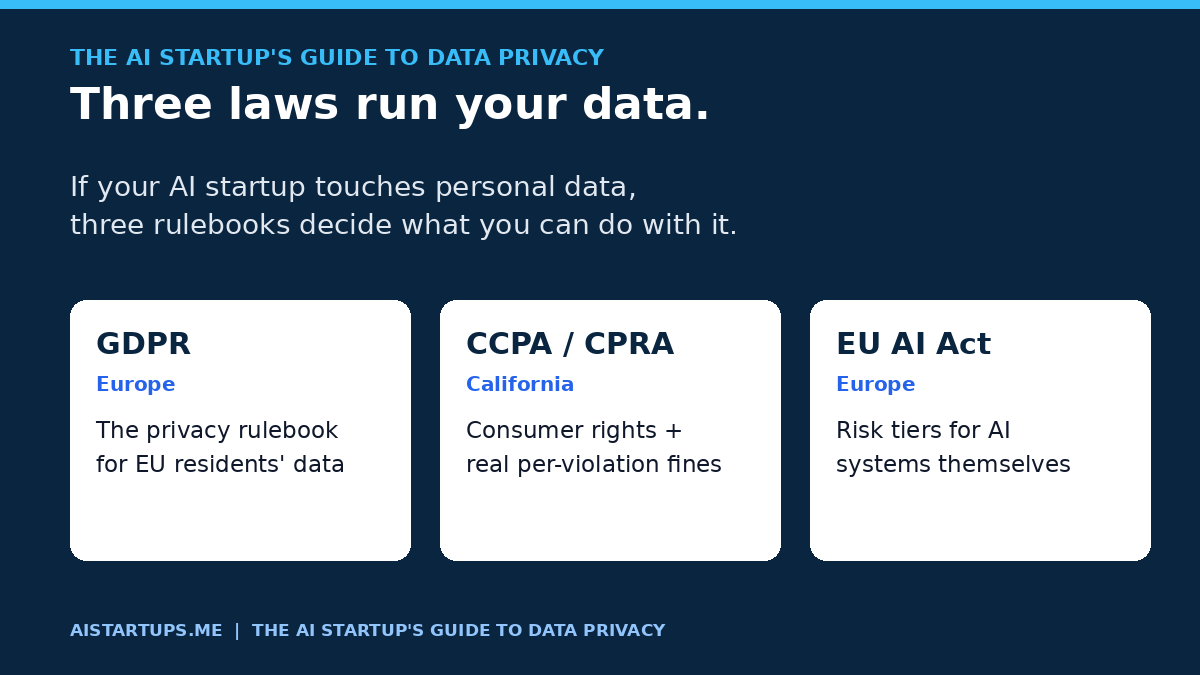
The good news? You don’t need a law degree to get this right. You need a clear picture of three rulebooks — GDPR, CCPA/CPRA, and the EU AI Act — plus a practical plan to cover the basics in about 90 days. That’s what this guide is. Plain English, real numbers, real fines, and a checklist you can actually work through. No legalese. And one thing up front: this is general information, not legal advice. When your specific situation gets tricky, get a lawyer. I’ll say that again at the end, because it matters.
Real talk: most AI startups aren’t ignoring privacy on purpose. They’re just busy. Shipping comes first, and the privacy policy is a template someone pasted in at 2 a.m. But here’s the thing — that template won’t save you when a user files a deletion request, or when a regulator comes knocking, or when an enterprise customer sends you a 40-question security questionnaire before they’ll even take a sales call. The startups that win those deals are the ones that can answer fast, with receipts. So let’s build that.
What data does your AI startup actually collect?
Before any law makes sense, you need an honest answer to this question. And I mean honest, not “we collect your name and email.” Sit down and trace what really flows through your product. Most AI founders are surprised by the answer. I was.
Start with the obvious stuff. Names, email addresses, payment details, login credentials. That’s the easy part — everyone knows they collect that. Then go a level deeper. What about the stuff users type into your product? If you run a writing assistant, that’s drafts, notes, and half-finished business plans. If you run a voice tool, that’s audio recordings. If you run a support agent, that’s customer conversations — and customers paste the wildest things into support chats. Order numbers, addresses, medical details, angry rants about their boss. All of it lands on your servers.
Then there’s the stuff your product collects without anyone typing a word. IP addresses. Device info. Usage patterns — which features people click, how long they stay, what time of day they work. Location data, if your app asks for it. Cookies and analytics. And if you use third-party tools — and you do, everyone does — each of those tools collects its own slice too. Your analytics provider, your error tracker, your email service, your payment processor, your cloud host. Every one of them touches your users’ data in some way.
And then there’s the AI-specific layer, which is where things get really interesting. Your model provider sees the prompts. If you’re fine-tuning, your training data might contain real user content. If your product generates outputs, those outputs might contain personal data pulled from the input. If you log prompts for debugging — and most teams do, at least early on — congratulations, you’ve built a database of everything your users ever typed. That log file is personal data, and the law treats it that way.
So here’s your first real job: make a data map. It’s not fancy. A spreadsheet works. One row per type of data, with columns for where it comes from, where it’s stored, who else can see it, and how long you keep it. Sounds boring, I know. But this single document is the foundation for everything else in this guide — your lawful bases, your vendor contracts, your deletion process, your breach plan. Without it, you’re guessing. With it, you’re in control. And if a regulator or a big customer ever asks “what data do you hold?”, you’ll have an answer in minutes instead of a panic attack.
A quick story, because this is where it gets real. A friend of mine ran a small AI meeting-notes tool — five people, maybe 2,000 users. One day a user asked for all their data to be deleted. Simple request, right? Except the team realized their data lived in six places: the app database, the model provider’s logs, the analytics tool, the backup system, the support inbox, and a CSV export someone had downloaded for a marketing test months earlier. Deleting from one place took ten minutes. Finding all six took three days. That’s the gap between having a data map and not having one. Don’t be the team that finds out the hard way.
GDPR in plain English
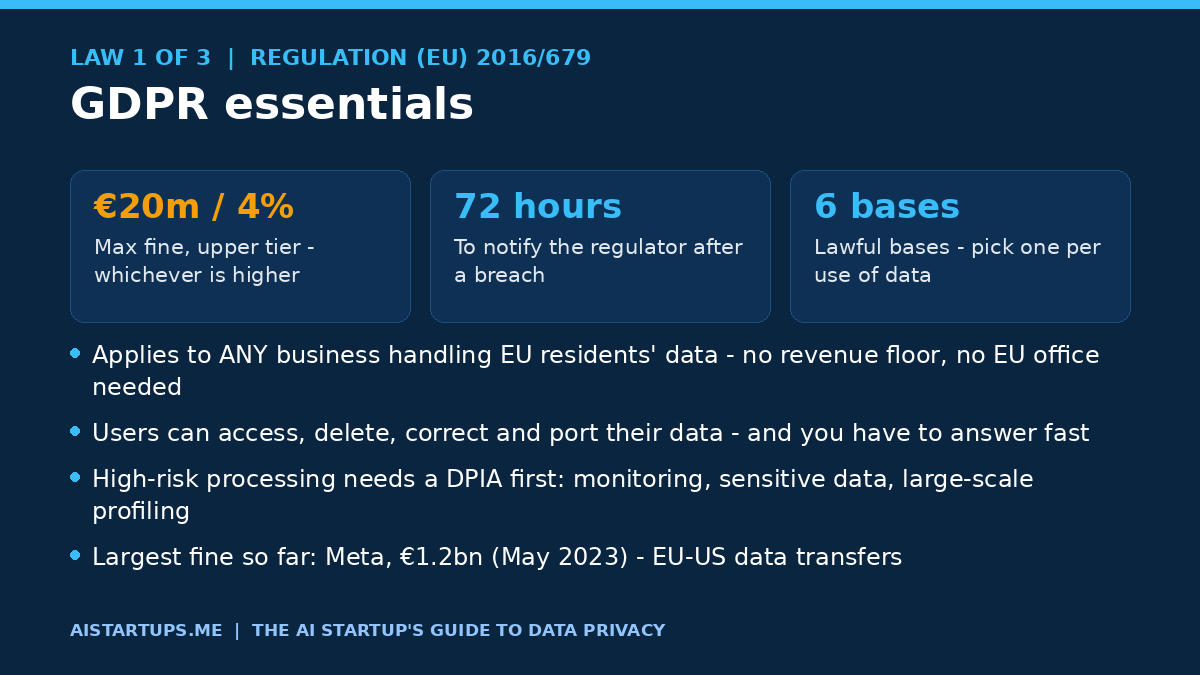
GDPR — the General Data Protection Regulation, Regulation (EU) 2016/679 — has been in force since 25 May 2018. It’s the European Union’s privacy rulebook, and it’s the one most founders have heard of, usually in the context of scary fines. But the core idea is simple: people own their personal data, and if you want to use it, you need a valid reason, you need to be transparent about it, and you need to respect their rights over it.
Now, the part that surprises a lot of US founders: GDPR applies to you even if your company has never set foot in Europe. If you process the personal data of people in the EU — say, because someone in Berlin signs up for your product — GDPR applies. There is no revenue floor, no company-size cutoff, no “we’re too small to matter” exception. A two-person startup in Texas with a handful of EU users is in scope. That’s the rule, and it’s deliberately broad.
The six lawful bases
Under GDPR, you can’t just collect personal data because it’s useful. You need a lawful basis for every use, and there are six to pick from. You don’t need all six — you need one that genuinely fits each thing you do with data.
Consent is the one everyone knows. The person says yes, clearly, freely, and specifically. Real consent, not a pre-ticked box or a wall of text nobody reads. Then there’s contract — you need the data to deliver what the user signed up for. If someone buys your product, you need their email to send them a login. That’s contract. Legitimate interests is the flexible one: you have a real business reason, it doesn’t override the person’s rights, and you’ve actually thought it through. Fraud prevention is a classic example. Legal obligation covers things the law forces you to do, like keeping invoices for tax purposes. Vital interests is the rare emergency one — protecting someone’s life. And public task covers official authorities, which won’t apply to your startup.
Here’s where founders trip up: picking “consent” for everything because it sounds safest, then designing a consent flow that isn’t really consent at all. Or picking “legitimate interests” for marketing emails without doing the balancing test the law expects. My rule of thumb: for each data use, write down the basis in your data map. If you can’t name one in a single sentence, you probably don’t have one. Fix that before you ship the feature, not after.
What your users can ask for
GDPR gives people real rights over their data, and your users will use them. The right to access — “show me everything you have on me.” The right to delete — “erase me.” The right to correct — “that’s wrong, fix it.” The right to portability — “give me my data in a format I can take elsewhere.” The right to restrict processing, and the right to object. These aren’t theoretical. Deletion requests in particular are routine now, and regulators expect you to handle them quickly and completely — including the data sitting with your vendors.
That last part is the one people forget. When a user asks to be deleted, you can’t just remove their row from your database and call it done. You need to tell your processors — your analytics tool, your email provider, your model host — to delete their copy too. That’s why vendor contracts matter so much, which we’ll get to. Build the deletion flow early, test it with a fake account, and time it. If it takes you three days of manual digging, it’s broken. Automate it.
The 72-hour breach rule
Under GDPR Article 33, if you suffer a personal data breach, you must notify your supervisory authority without undue delay and, where feasible, within 72 hours of becoming aware of it. Seventy-two hours. That’s three days from the moment you realize what happened — not three days from when you finish investigating, not three days from when your lawyer signs off. The clock starts when you become aware.
And if the breach is likely to pose a high risk to the people affected, Article 34 says you must tell them too, without undue delay, in plain language. Not a vague “we experienced a security incident.” What happened, what data was involved, what you’re doing about it, and what they should do. Your processors have their own duty here as well — a processor that suffers a breach must notify you, the controller, without undue delay, so you can start your own clock.
Now, does every breach need to be reported? Not quite — if the breach is unlikely to result in a risk to people’s rights, you don’t have to notify the authority. But that judgment call needs to be documented, and honestly, most AI startups should plan as if they’ll report. The practical takeaway: have a breach plan written down before you need it. Who decides it’s a breach? Who calls the lawyer? Who drafts the notice? Who tells the users? Rehearse it once. A plan you wrote calmly on a Tuesday beats a plan you invent at 3 a.m. during a real incident.
When you need a DPIA
A Data Protection Impact Assessment — DPIA — is a structured risk review you must do before starting high-risk processing. GDPR Article 35 spells out the triggers: systematic and extensive monitoring of people, large-scale processing of special-category data (things like health information or biometric data), and large-scale systematic profiling that significantly affects people. A lot of AI products hit at least one of these. If your product profiles users, scores them, monitors their behavior at scale, or handles sensitive data, you should assume a DPIA is on your to-do list.
A DPIA isn’t a formality. It’s a real document: what you’re doing, why, what the risks are, and what you’re doing to reduce them. It forces you to think through the scary questions before your users do. And if the DPIA shows a high risk you can’t mitigate, you’re supposed to consult the supervisory authority before you proceed. Most startups never get that far — the DPIA process itself usually surfaces fixes. That’s the point.
The fines, honestly
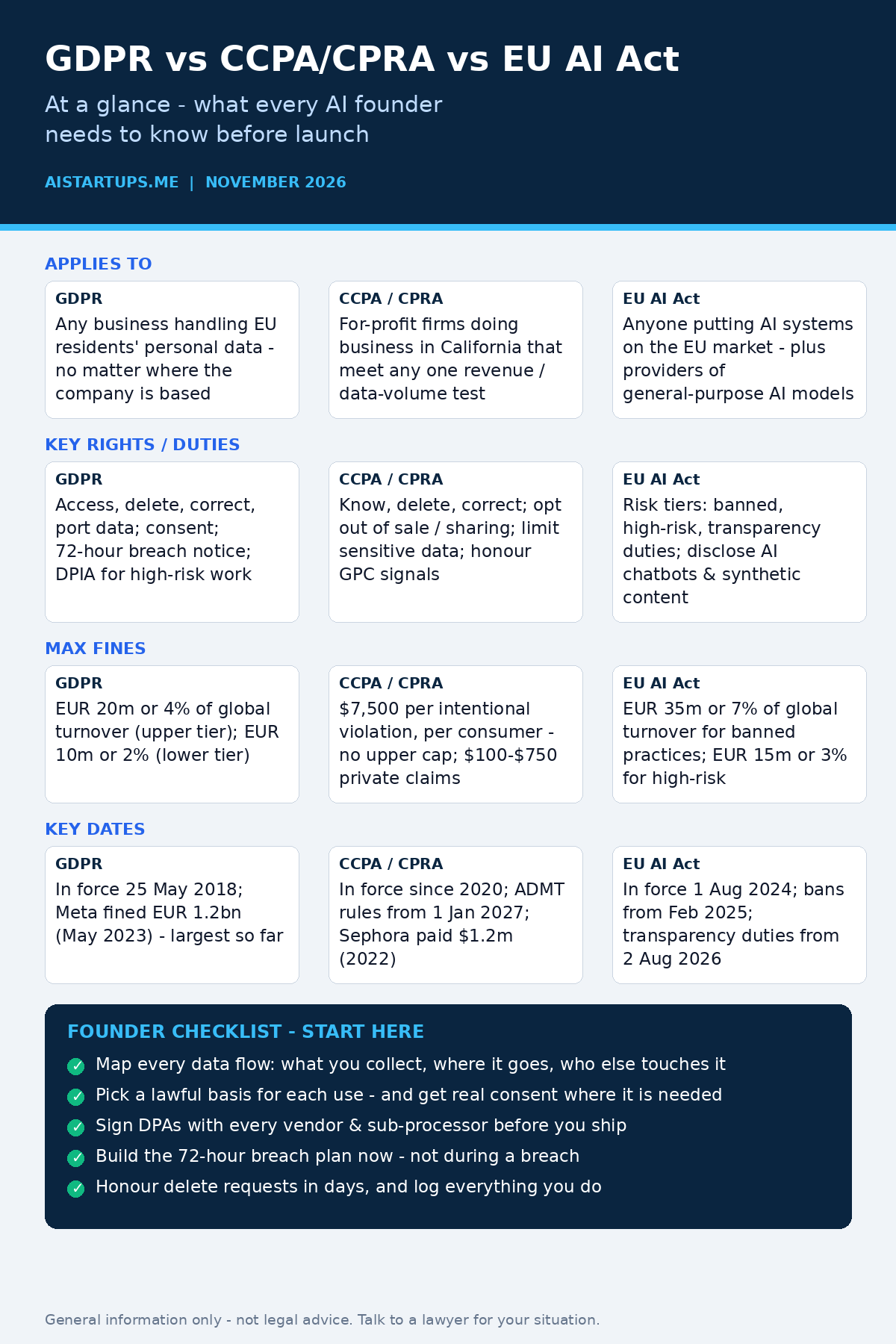
Let’s talk about the numbers everyone asks about, because they’re genuinely big. GDPR has two fine tiers under Article 83. The lower tier — for administrative failures like poor records or late breach notification — goes up to €10 million or 2% of your global annual turnover, whichever is higher. The upper tier — for breaking the core rules, like having no lawful basis, ignoring consent rules, violating data subject rights, or unlawful international transfers — goes up to €20 million or 4% of global annual turnover, whichever is higher. And “turnover” means the whole corporate group, based on the preceding financial year. So if you’re part of a bigger group, the percentage is calculated on the group’s revenue, not just your startup’s.
The largest fine so far is Meta’s €1.2 billion penalty from the Irish Data Protection Commission in May 2023, over EU-US data transfers. LinkedIn was fined €310 million in 2024 over lawful basis and transparency failures. Those are giants, though, and your startup is not Meta. Here’s the part that rarely makes headlines: for a small business, the typical outcome of a first problem is a reprimand or a corrective order — “fix this by this date” — not a fine. Regulators tend to escalate gradually. But don’t read that as a free pass. The corrective order still costs you time, money, and credibility, and repeat problems are treated very differently. The fine tiers exist, they’re real, and the smart move is to never give a regulator a reason to reach for them.
CCPA/CPRA in plain English
If GDPR is the European rulebook, the CCPA — the California Consumer Privacy Act, as amended by the CPRA — is the American one that matters most. California is the world’s fifth-largest economy on its own, and its privacy law has become the de facto US standard. If you do business with Californians, you need to know this one cold.
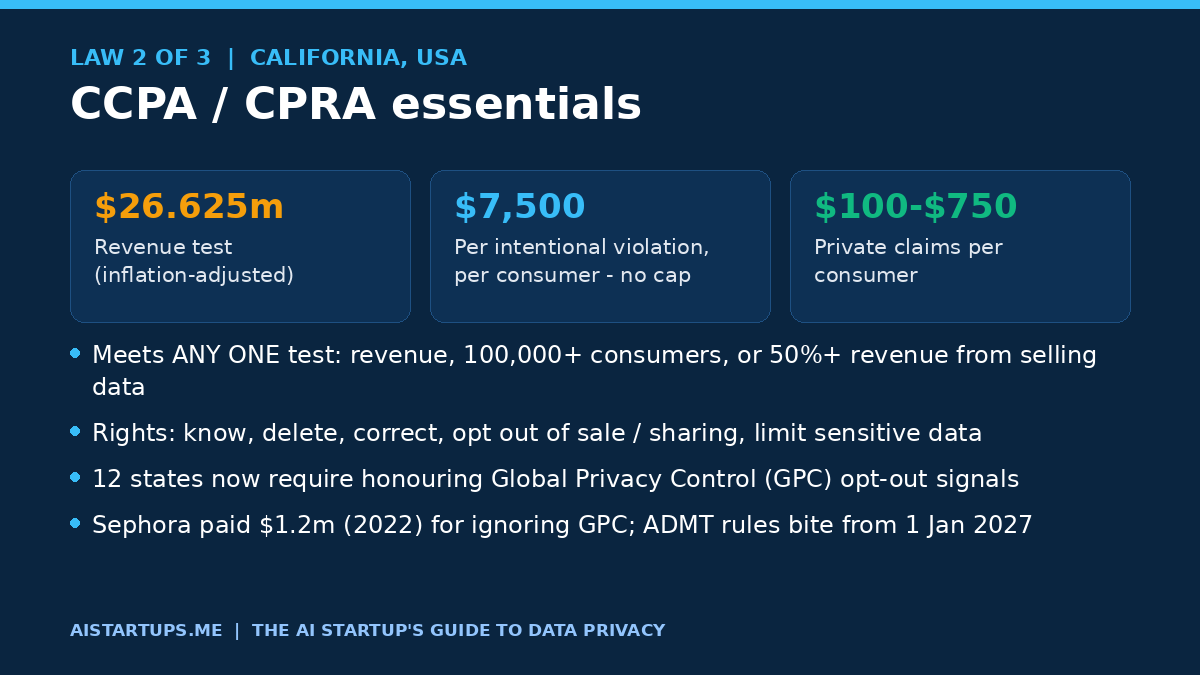
First, does it apply to you? The CCPA covers for-profit businesses doing business in California that meet any one of three tests: annual gross revenue over $25 million — inflation-adjusted to $26.625 million — or buying, selling, or sharing the personal information of 100,000 or more California consumers or households per year, or deriving 50% or more of annual revenue from selling or sharing personal information. Any one test. So a small startup with modest revenue can still be covered if it handles data from 100,000 Californians. And if you’re an AI startup with a free tier and a lot of signups, that 100,000 number is closer than you think.
What California consumers can do
Californians have strong rights under the CCPA/CPRA. They can know what personal information you collect about them and why. They can ask you to delete it. They can ask you to correct it. They can opt out of the sale or sharing of their data. They can limit the use of their sensitive personal information — things like precise location, health data, or biometric info. And they have a right to non-discrimination: you can’t punish someone for exercising their privacy rights by charging them more or giving them a worse product.
That opt-out right is where a lot of companies have stumbled. California expects you to honor opt-out signals, and that includes automated ones. The Global Privacy Control — GPC — is a browser signal that tells websites “this person doesn’t want their data sold or shared.” Honoring it isn’t optional in California anymore, and 12 states now require honoring GPC signals. The Sephora case is the cautionary tale: in August 2022, the company paid a $1.2 million settlement after failing to honor GPC opt-out signals. That’s a real enforcement action against a household name, and the lesson for startups is simple — if your site doesn’t respect GPC, fix it. It’s a small technical job that prevents a big problem.
What violations cost
California fines are counted per violation, per consumer — and that multiplication is what makes them dangerous. The penalties are $2,500 per unintentional violation and $7,500 per intentional violation, or any violation involving a minor under 16. There is no upper cap. Do the math on that for a second: a single sloppy practice affecting 10,000 users at $2,500 each is $25 million. That’s how a “small” compliance failure becomes an existential one. The law is enforced by the California Privacy Protection Agency, the CPPA, together with the Attorney General — and they’ve shown they’re willing to act. Honda paid $632,500 in 2025 in a CPPA enforcement action.
There’s also a private right of action, which is the part founders tend to miss. If there’s a breach of unencrypted personal information caused by your failure to maintain reasonable security, consumers can sue directly — $100 to $750 per consumer per incident — without having to prove they suffered actual harm. No need to show they lost money or had their identity stolen. The breach plus the security failure is enough. That’s a powerful incentive to encrypt everything and to take “reasonable security” seriously, because the words “reasonable security” will be tested in court if you ever get breached.
What’s new: automated decision-making rules
California isn’t standing still. The CPPA has adopted final regulations on cybersecurity audits, risk assessments, and automated decision-making technology — ADMT — which take effect on 1 January 2026, with ADMT compliance required from 1 January 2027. If your AI product makes automated decisions about people — screening, scoring, ranking, recommending in ways that matter — these rules are aimed squarely at you. You’ll need to explain how the technology works, what it does, and give people a way to opt out in some cases. The 2027 date sounds far away. It isn’t. Building the transparency features and the audit trail takes real engineering time, and the teams that start now will be the ones that aren’t scrambling in December 2026. For the details on the CCPA penalty structure, the NordLayer guide to CCPA penalties is a solid reference, and the MyTekPros overview of CCPA and CPRA compliance covers the managed-security angle well.
EU AI Act: what founders must know
GDPR and CCPA are about personal data. The EU AI Act — Regulation (EU) 2024/1689 — is about the AI systems themselves. It’s the world’s first comprehensive AI law, and it works on a risk-based model: the riskier the use, the stricter the rules. If you’re building AI products for the European market, this one is now part of your launch checklist, full stop.
The timeline matters, because the law is rolling out in stages. It entered into force on 1 August 2024. The bans on prohibited practices — things like manipulative AI and social scoring by governments — kicked in on 2 February 2025. Obligations for general-purpose AI model providers started on 2 August 2025. Then comes the big date for most product companies: general application of the law, including the Article 50 transparency duties, arrives on 2 August 2026. That means disclosing when someone is talking to an AI chatbot, and labelling synthetic content — AI-generated text, images, audio, and video — so people know what they’re looking at. High-risk systems get more time: Annex III high-risk systems are deferred to 2 December 2027, and Annex I product-embedded systems to 2 August 2028, under the Digital Omnibus changes. A clear breakdown of the EU AI Act effective dates and phases is worth bookmarking if dates are your thing.
The risk tiers, in one minute
Think of the AI Act as four buckets. Unacceptable risk: banned outright. That covers a small set of practices — social scoring, manipulative techniques, certain biometric identification uses. If your product does any of these, stop and rethink the product. High risk: systems used in hiring, education, credit scoring, law enforcement, medical devices, and similar areas where a bad decision can seriously harm someone. These come with the heaviest duties — risk management, data quality rules, human oversight, documentation, and accuracy requirements. Limited risk: the transparency bucket. Chatbots, deepfakes, AI-generated content. You can build these, but you must disclose that AI is involved. Minimal risk: everything else, like spam filters and AI video game characters, with no extra duties beyond the basics.
Most AI startups will land in the limited-risk or high-risk buckets, and the difference matters enormously. A chatbot that helps users draft emails is limited-risk: add a disclosure and you’re mostly done. A tool that screens job applicants or decides who gets a loan is high-risk: you need the full compliance apparatus, and you need it before you ship. Work out which bucket you’re in early, because it changes your roadmap. One honest conversation with a lawyer at the idea stage can save you a rebuild later.
The fines
The AI Act’s fines are bigger than GDPR’s, which tells you how seriously the EU takes this. For prohibited practices — the banned bucket — fines go up to €35 million or 7% of global turnover, whichever is higher. For high-risk non-compliance, it’s up to €15 million or 3% of global turnover. Those percentages are calculated on worldwide revenue, just like GDPR. And here’s a practical point: the AI Act’s transparency duties land on 2 August 2026, which is right around the corner for a product roadmap. Adding chatbot disclosure and synthetic-content labelling is genuinely small engineering work — a banner, a label, a metadata flag. There’s no excuse for missing it. Docker’s guide to EU AI Act compliance is a practical walkthrough if you want the developer’s view of what’s actually required.
The US patchwork: 20 states, no federal law
Here’s the awkward truth about American privacy law: there is no comprehensive federal privacy law. The American Privacy Rights Act died in 2024. The SECURE Data Act had a House subcommittee hearing in June 2026 and hasn’t had a vote since. Congress talks about privacy a lot and passes very little. So the states filled the vacuum — and they filled it with a patchwork that every AI startup now has to live with.
As of August 2026, 20 US states have comprehensive consumer privacy laws in effect, and 24 states have enacted them. Four more — Oklahoma, Alabama, Louisiana, and Vermont — take effect in 2027 and 2028. The details vary state by state, but the pattern is consistent: rights to know, delete, correct, and opt out; duties around sensitive data; and in 12 states, a requirement to honor Global Privacy Control signals. Enzuzo keeps a useful running tracker of US state privacy laws if you want to check whether a particular state is on the list.
What does this mean in practice? If you sell to customers across the US, you effectively have to comply with the strictest state law that applies to you — because building 20 different privacy flows is a fantasy for a small team. Most startups end up building one flow that satisfies California and treating that as the baseline, then checking the outliers. That’s a reasonable strategy, but it only works if you actually know which states you have users in and which of their rules differ. And it means every new state law that takes effect is a small project on your roadmap, not a surprise.
Don’t forget the sector laws, either. The FTC enforces privacy through its Section 5 power against unfair or deceptive practices — which, in plain terms, means if your privacy policy says you do one thing and you actually do another, the FTC can come after you. That’s not a privacy law in the GDPR sense; it’s a “don’t lie to your users” law, and it’s been the basis for some very expensive enforcement actions. Then there’s COPPA for children’s data (under-13s), HIPAA for health information, and TCPA for calls and texts. If your AI product touches kids, health data, or outbound messaging, you have extra rules on top of everything above. Know which ones apply before you build the feature, not after a complaint lands.
The 90-day privacy plan: a practical checklist
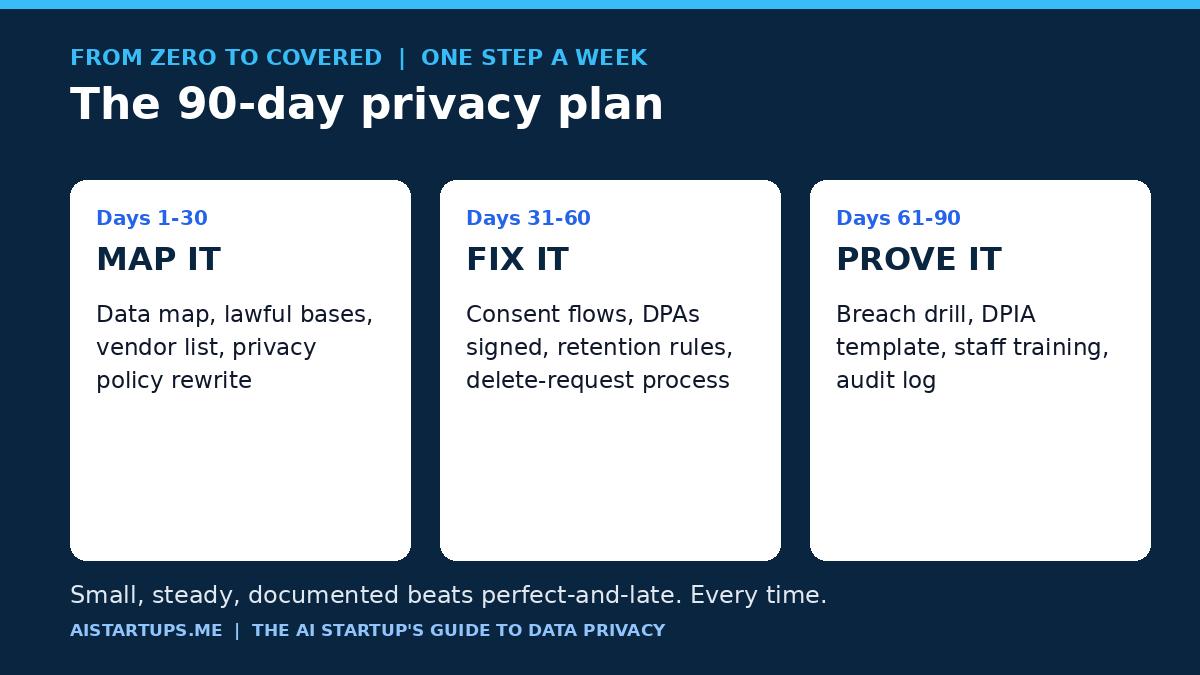
Right. Enough law. Here’s the part you actually came for: what do you do on Monday morning? This is a 90-day plan, one step a week, that takes a typical early-stage AI startup from “we have a template privacy policy” to “we can answer any customer or regulator question with receipts.” It’s not magic. It’s just steady work, in the right order. And if you run a services business alongside your product work, the same discipline applies — the starting an AI agency in 2026 playbook pairs well with this one, because agencies hold client data too.
Days 1–30: Map it
Week one is the data map. Sit down with your team and list every type of personal data you collect, where it comes from, where it lives, who else touches it, and how long you keep it. Include the embarrassing stuff — the debug logs, the downloaded CSVs, the support inbox. A data map with gaps is worse than no map at all, because it gives you false confidence.
Week two is lawful bases. For each data use on your map, write down the GDPR basis. Consent, contract, legitimate interests, legal obligation — pick one, and write one sentence explaining why it fits. If you can’t, that’s a feature to redesign, not a form to fudge.
Week three is vendors. List every third-party service that touches personal data: hosting, analytics, email, payments, model providers, error tracking, CRM. Then check one thing for each: do you have a signed Data Processing Agreement — a DPA — with them? If the answer is “I think so” or “they have standard terms,” go and check. A DPA is the contract that makes your vendor legally responsible for handling data properly on your behalf, and without it, you’re carrying their risk. Most big vendors offer a standard DPA you can sign online in ten minutes. The long tail of small tools is where it gets messy — and where most startups quietly have a gap.
Week four is the privacy policy rewrite. Not a template. Not a copy of a competitor’s policy. A real document, in plain language, that says what you collect, why, who you share it with, how long you keep it, and what rights users have. If your policy says something your product doesn’t actually do, that’s a problem the FTC cares about — remember Section 5. Read your own policy like a skeptical user. Would you trust it? If not, rewrite it. And while you’re at it, run the legal checklist every AI startup should run before launch — privacy is one piece of the legal picture, and the rest of it matters just as much.
Days 31–60: Fix it
Now you fix the gaps the map exposed. Consent flows first. If you rely on consent anywhere — marketing emails, cookies, optional data collection — make sure the consent is real: clear, specific, freely given, and easy to withdraw. No pre-ticked boxes, no “accept all or leave” walls for things that don’t need consent. And record the consent. When someone says yes, log when, what they agreed to, and what they saw. That log is your evidence if anyone ever asks.
Next, get the DPAs signed. Chase every vendor on your list. The big ones will be easy. The small ones might need an email. If a vendor won’t sign a DPA at all, that’s a signal — consider whether you really need that tool, or whether there’s an alternative that takes privacy seriously. Your vendor’s refusal becomes your liability, so choose accordingly.
Then retention rules. Decide how long you keep each type of data, and — this is the part people skip — actually delete it when the time is up. Set the retention periods in your systems, not just in a document. Old data you don’t need is pure risk: it’s data you have to protect, data you have to produce in a deletion request, and data that can leak in a breach. Deleting it on schedule is the cheapest security measure you’ll ever take.
Finally, build the deletion-request process. One inbox or form where requests land. One owner who handles them. A checklist that covers every system on your data map, including backups and vendors. Test it end to end with a test account and time it. Your goal: a complete deletion, everywhere, inside a few days, with a confirmation email to the user. If you’re selling into enterprises, this is also the moment to look at compliance and audit tools that sell trust to enterprises — because enterprise buyers will ask for this process by name, and having it documented is what closes those deals.
Days 61–90: Prove it
The last month is about proving the system works. Run a breach drill. Pick a scenario — a leaked API key, a stolen laptop, a vendor breach — and walk through it with your team. Who notices first? Who decides it’s a breach? Who starts the 72-hour clock? Who drafts the user notice? A one-hour tabletop exercise will expose five gaps you never knew you had, and it’s much better to find them in a drill than in a real incident.
Write your DPIA template. Even if you don’t need a full DPIA today, having the template ready means the next high-risk feature gets assessed properly instead of shipped on a hope. And if your product does profiling, monitoring, or sensitive-data work at scale, do the real DPIA now — Article 35 isn’t optional for that stuff.
Train your team. Not a boring slide deck — a 30-minute session on the real rules that affect their jobs. Engineers need to know about logging PII and data minimization. Support needs to know how to handle deletion and access requests. Marketing needs to know about consent and GPC. Everyone needs to know what a breach looks like and who to tell. Most breaches start with a human mistake, and training is the cheapest fix.
And set up an audit log. A simple record of the privacy-relevant things you do: deletion requests received and completed, consent changes, vendor DPAs signed, breach drills run, DPIA decisions made. When a customer or regulator asks “how do you handle this?”, the log is your answer. It turns “trust us” into “here’s the record.”
One more thing on the practical side. If your website itself needs work — a privacy-ready rebuild, a proper consent setup, AI features wired into your product the right way — that’s the kind of build where getting help pays for itself. The team at AISquadX does exactly that kind of web development and AI integration work, and a clean, compliant site is worth far more than the invoice.
- Week 1–2: Data map finished; every data use has a named lawful basis.
- Week 3–4: Vendor list complete; DPAs requested; privacy policy rewritten in plain language.
- Week 5–6: Consent flows fixed and logged; retention periods set and enforced.
- Week 7–8: Deletion-request process built, tested end to end, and timed.
- Week 9–10: Breach drill run; DPIA template written; team trained.
- Week 11–12: Audit log running; first full review of the whole system done.
Training data & AI-specific traps
Here’s where AI startups face risks that a regular SaaS company never sees. Your product doesn’t just store personal data — it learns from it, transforms it, and sometimes repeats it back. That creates traps that the standard privacy playbook doesn’t cover, and they’re the traps most likely to catch a young AI company off guard.
Trap one: training data. If you scraped data from the web to train your model, some of that data is personal data — names, photos, posts, profiles. GDPR doesn’t give you a free pass because the data was public. Publicly available personal data is still personal data, and you still need a lawful basis for processing it. The legitimate-interests argument for scraping is contested and heavily fact-dependent, and regulators in Europe have already gone after companies over it. If you’re training on scraped data, get legal advice before you scale, and document your reasoning carefully. “Everyone does it” is not a lawful basis.
Trap two: prompts with personal information. Your users will paste personal data into your product — theirs and other people’s. Health details in a medical summary tool. A customer’s full address in a support ticket. Someone else’s email in a sales email draft. If you log those prompts, you now hold that data. If you use those prompts to improve your model, you’re processing it further. The fix is boring but effective: minimize logging, strip personal data from logs where you can, set short retention on prompt logs, and never train on user prompts without clear consent and a lawful basis. Tell users in plain language what happens to their prompts. Most of them assume you keep them forever — prove them wrong.
Trap three: model outputs. A model can repeat personal data from its training set — a phone number, an address, a private email — in response to an innocent question. That’s a privacy problem you can’t fully solve with a filter, but you can reduce it: test for regurgitation, add output checks, and have a process for handling reports when your model spits out someone’s personal details. And remember, if your product generates content about real people, the EU AI Act’s transparency duties mean you need to label AI-generated content so people know what they’re looking at.
Trap four: sub-processors. Your model provider is your sub-processor, and so is every service they use in turn. When you sign a DPA with your model host, check whether it covers sub-processors — and whether it tells you when they change. Some providers add new sub-processors without notice. That matters, because data you thought stayed in one place may be processed somewhere you didn’t expect, under laws you didn’t plan for. Ask the question. Get the answer in writing. Then check again every few months, because these lists change.
Trap five: the “we anonymized it” claim. Real anonymization is hard. Removing names from a dataset doesn’t make it anonymous if the remaining data can still identify someone — and with AI, re-identification is easier than most people think. If your data can be linked back to a person, directly or indirectly, it’s still personal data under GDPR, and all the rules still apply. Be honest with yourself about whether your data is truly anonymous or merely pseudonymized. The two are very different things, and regulators know the difference.
What it costs vs what a fine costs
Let’s be blunt about money, because this is the objection I hear most: “We’re a startup. We can’t afford a privacy program.” Honestly? You can’t afford not to have one. Let me put real numbers next to each other.
On the cheap side: a data map is a spreadsheet and a few hours of your time. DPAs are mostly free — your vendors’ standard agreements. A consent tool costs tens of dollars a month. A privacy policy drafted with a lawyer’s review, not a template, might run a few hundred to a few thousand dollars depending on complexity. A breach drill is an hour of your team’s time. The whole 90-day plan above costs mostly time, not money — maybe a few thousand dollars in total for a small team that does the work themselves.
Now the other side. A GDPR fine at the upper tier is €20 million or 4% of global turnover. Even the lower tier is €10 million or 2%. A CCPA violation is $7,500 per intentional violation per consumer, with no cap — and the private right of action adds $100 to $750 per consumer for security breaches. One breach, one enforcement action, one class of users who sue, and the numbers stop being abstract. A single incident can cost more than your entire seed round. And that’s before you count the cost nobody puts in a spreadsheet: the enterprise deals that die when you can’t pass a security review, the users who leave when they read about your breach, the months of founder time burned on regulator correspondence instead of product.
There’s also a quieter cost that founders forget: the cost of doing it late. Retrofitting consent into a product that was built without it is ten times harder than building it in from the start. Migrating data out of a vendor who won’t sign a DPA, after you’ve built your whole pipeline on them, is a multi-week project. Deleting data you never mapped takes days of forensic digging. Everything in this guide is cheaper on day one than on day 300. That’s the real economics of privacy work — not the fines, but the rework.
And on the revenue side, privacy done well is a selling point, not a cost center. Enterprise buyers ask about it in every deal. Regulated industries — healthcare, finance, legal — won’t even talk to you without it. Users choose products they trust, and trust is the one thing you can’t buy with ads. If you’re thinking about pricing, remember that trust is part of what customers pay for — read up on how to price your AI SaaS product and you’ll see that the products commanding real prices are the ones buyers feel safe with. Privacy isn’t the tax on your business. It’s part of the product.
Privacy isn’t a feature you bolt on later. It’s the deal you make with every person who hands you their data — and the startups that keep that deal are the ones customers come back to.
FAQ
Does GDPR apply to my AI startup if I’m based in the US?
Yes, if you process the personal data of people in the EU. GDPR applies to any business handling EU residents’ personal data, regardless of where the company is based, and there is no revenue floor or company-size cutoff. If someone in Berlin signs up for your product, GDPR covers that data. The same logic applies to the EU AI Act for AI systems placed on the EU market. If you have EU users, assume both apply and plan accordingly.
What is the difference between GDPR and CCPA?
GDPR is the EU’s comprehensive privacy law, in force since 25 May 2018, built around lawful bases, data subject rights, and fines up to €20 million or 4% of global turnover. CCPA/CPRA is California’s consumer privacy law, built around consumer rights to know, delete, correct, and opt out, with fines of $2,500 per unintentional violation and $7,500 per intentional violation, counted per consumer with no upper cap. GDPR applies broadly to any EU resident’s data; CCPA applies to for-profit businesses meeting specific revenue or data-volume tests. Most AI startups with US and EU users need to comply with both.
How fast do I have to report a data breach under GDPR?
Under Article 33, you must notify your supervisory authority without undue delay and, where feasible, within 72 hours of becoming aware of the breach. If the breach is likely to pose a high risk to the people affected, Article 34 requires you to notify those individuals without undue delay as well. Your processors must notify you without undue delay if they suffer a breach. The clock starts when you become aware, so having a written breach plan — and rehearsing it — is what makes the 72 hours achievable.
Do I need a DPIA for my AI product?
You need a Data Protection Impact Assessment before high-risk processing under GDPR Article 35 — in particular systematic monitoring, large-scale processing of special-category data, and large-scale profiling. Many AI products hit at least one of these triggers, especially tools that profile, score, or monitor users, or handle health or biometric data. A DPIA is a structured review of what you’re doing, the risks, and how you’ll reduce them. Even if you’re not sure you need one, doing the assessment is good practice — it usually surfaces fixes before your users or a regulator do.
Can my AI startup be fined even if it’s small?
Yes, the laws apply regardless of company size — but in practice, regulators usually start with a reprimand or a corrective order for a small business’s first problem, not a fine. That doesn’t mean you’re safe: corrective orders cost time and money, repeat problems are treated much more seriously, and the fine tiers are real — up to €20 million or 4% of global turnover under GDPR, and uncapped per-consumer fines under CCPA. California also allows consumers to sue directly for breaches of unencrypted data, at $100 to $750 per consumer, without proving actual harm. Small doesn’t mean exempt. It means you should fix things while they’re still cheap to fix.
The Bottom Line
Privacy law isn’t going away, and it’s not getting simpler. GDPR, CCPA/CPRA, and the EU AI Act are the rules your AI startup lives under now, whether you planned for them or not. The fines are real — €20 million or 4% under GDPR, uncapped per-consumer penalties under CCPA, €35 million or 7% under the AI Act for banned practices — but the bigger risk was never the fine. It’s the lost deal, the lost user, the lost week rebuilding something you should have built right the first time.
So start with the data map. Pick your lawful bases. Sign the DPAs. Fix consent. Build the deletion flow. Run the breach drill. Ninety days, one step a week, and you’ll be ahead of most startups your size. And you’ll be able to answer that question in the demo room — “where does my data go?” — with a clear, confident answer. That’s worth more than any feature you’ll ship this quarter.
Disclaimer: This article is general information, not legal advice. Privacy law depends on your specific product, users, and jurisdictions, and the rules change. Talk to a qualified lawyer about your situation before making decisions based on anything you’ve read here.