


Here’s a sentence I’ve heard a hundred times, in different words, from different people: “I have this great AI startup idea, but I can’t code — so I need to find a technical co-founder first.”
And honestly? That sentence has killed more startups than bad code ever will.
Because here’s the thing. Hunting for a technical co-founder is slow, awkward, and mostly a stall tactic dressed up as strategy. You spend six months networking, pitching strangers on your idea, and trying to convince a good engineer to work for equity in a company that doesn’t exist yet. Meanwhile, somebody else — somebody with the same idea and a lot less hesitation — ships a rough version, gets ten paying customers, and learns what actually matters.
Look, I’m not going to pretend the technical stuff doesn’t matter. It does. But the rules changed. In 2026, the gap between “I have an idea” and “I have a working product” is smaller than it’s ever been, and it’s shrinking every month. AI builders can turn a plain-English description into a working app. AI coding assistants can write — and fix — real code while you watch. No-code platforms can run a whole business: users, payments, databases, the lot.
So no, you don’t need a technical co-founder to start. You need a clear problem, a small group of people who feel it, and the willingness to build something imperfect in public. The technical help comes later, when you can actually afford it — and when you know exactly what you need it for.
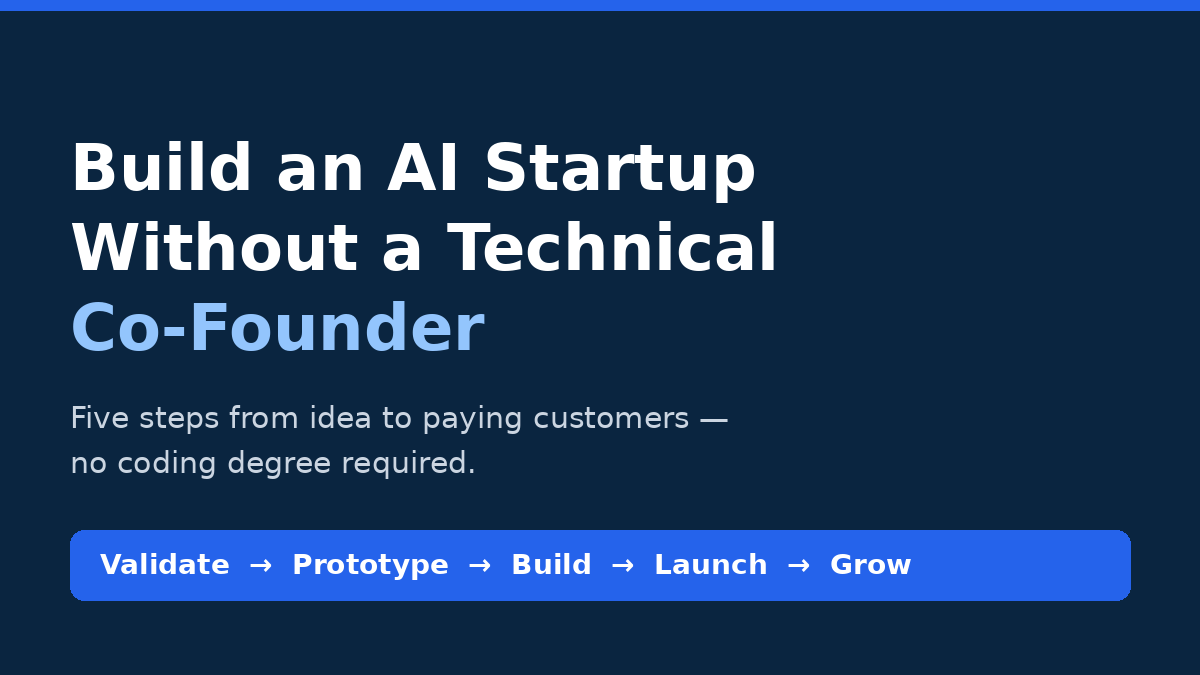
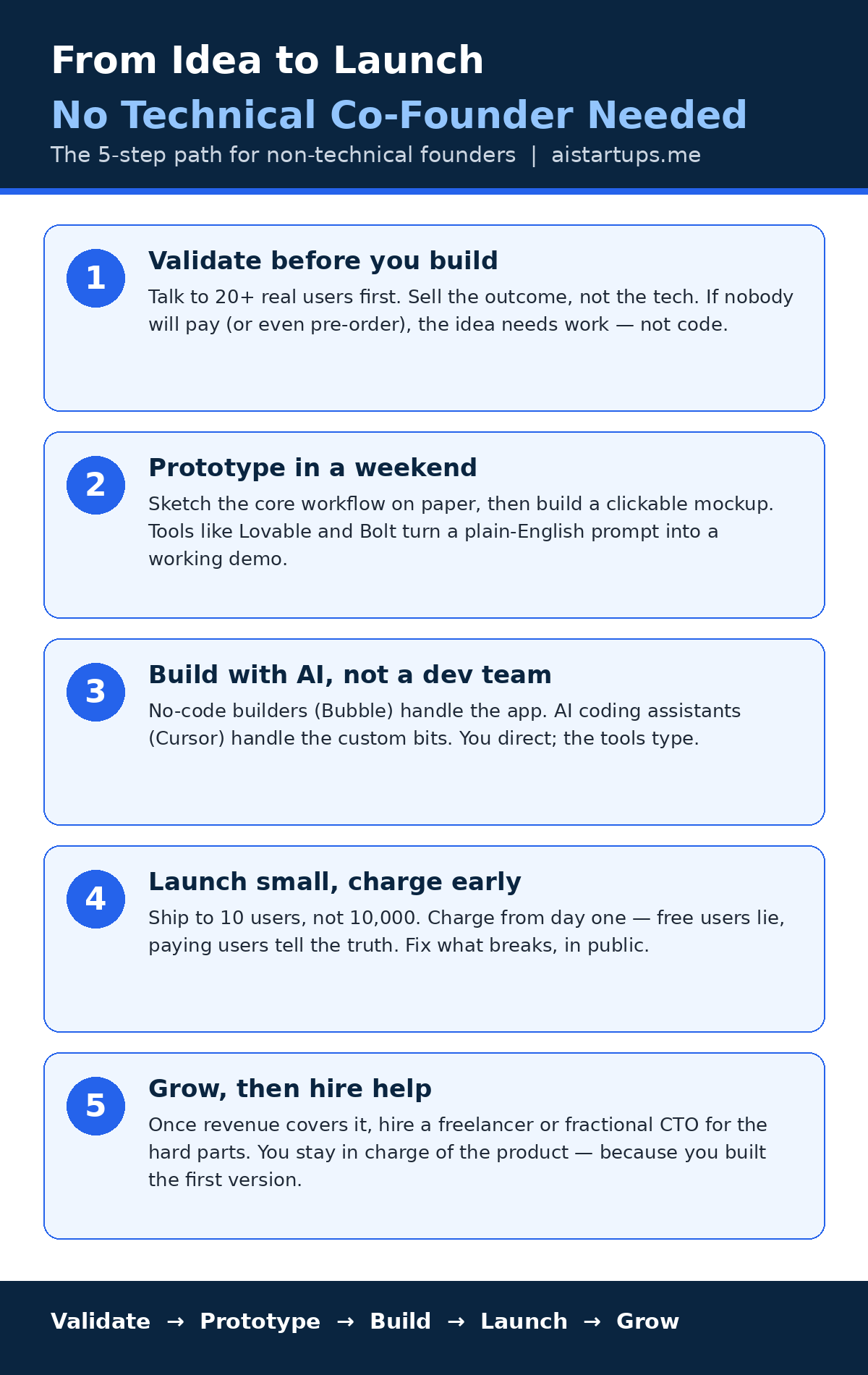
This guide walks you through the whole path, step by step. I’ve broken it into five stages, and if you follow them in order, you’ll go from idea to paying customers without writing a single line of code yourself (unless you want to — and by step three, you might).
The Honest Truth About “Technical”
Let’s clear something up first. When people say “I’m not technical,” they usually mean one of three things. They can’t write code. They don’t understand how software gets built. Or they’re scared of looking stupid in front of people who do. All three are fixable — and none of them is a reason to wait.
Real talk: the scarcest skill in a startup isn’t coding. It’s judgment. Knowing which problem is worth solving, which features matter, and which feedback to ignore — that’s the founder’s job, and no engineer can do it for you. I’ve watched technical founders build beautiful products nobody wanted. I’ve also watched a non-technical founder with a spreadsheet and a phone full of customer contacts out-earn teams of ten. The difference was never the code. It was the understanding of the customer.
That said, you do need to get comfortable with the tools. Not expert-level. Just comfortable enough to direct them. Think of it like hiring a contractor to renovate your kitchen: you don’t need to know how to lay tile, but you do need to know what you want, what good work looks like, and when someone’s cutting corners. AI tools are your contractors now. Your job is to be a demanding, specific client.
One more thing before we start. If you’re still at the very beginning — still shaping the idea itself — read our guide on how to start an AI startup first. It covers picking a problem worth solving, which is the foundation everything below sits on. This guide assumes you’ve got an idea you’re excited about and want to turn it into something real.
Step 1: Validate Before You Build Anything
This is the step everyone wants to skip. I get it. Talking to strangers about your idea feels slow and unglamorous next to the excitement of building. But skipping it is how you end up six months deep into a product nobody asked for. Trust me — validating first is the single highest-leverage thing a non-technical founder can do, because it’s free, it’s fast, and it doesn’t require a single line of code.
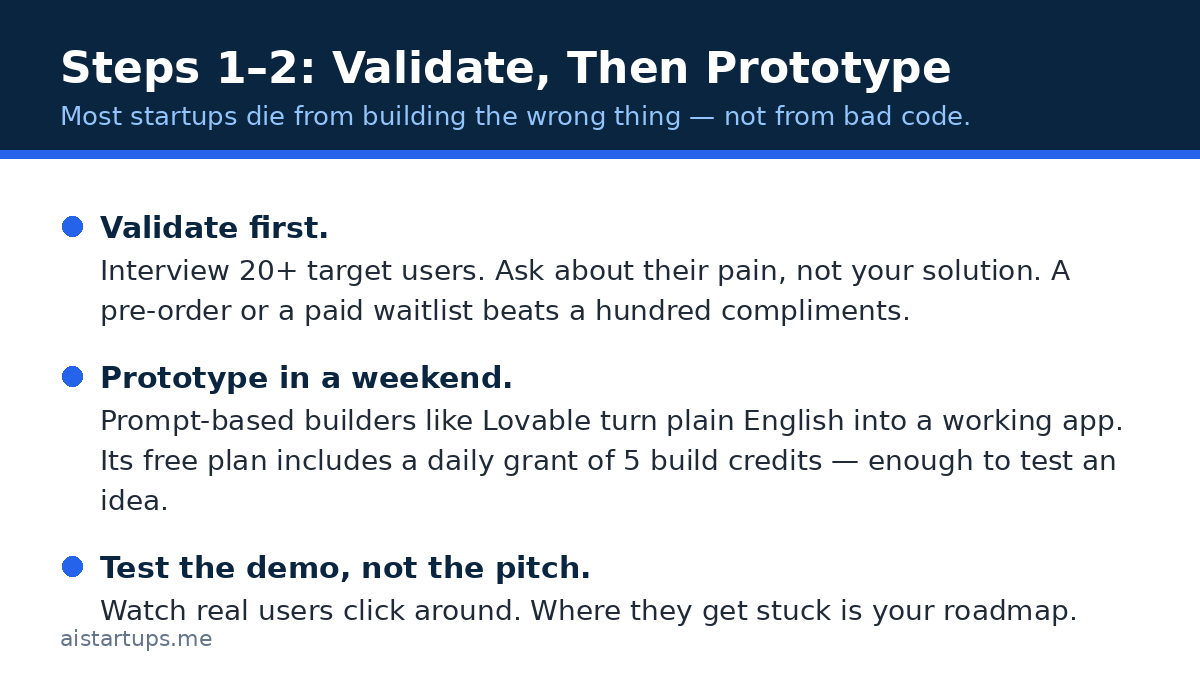
Here’s what validation actually looks like. Find twenty people who have the problem you want to solve. Not friends. Not family. Real people who deal with this pain at work or in their daily life. And talk to them — properly talk to them, for twenty or thirty minutes each. Ask them how they handle the problem today. Ask what they’ve tried. Ask what it costs them — in time, in money, in frustration — when it goes wrong.
And here’s the crucial part: don’t pitch. Don’t describe your solution and ask if they like it. People are polite. They’ll say “yeah, sounds great” to almost anything, and you’ll walk away thinking you’ve got a winner. Instead, ask about their pain. If the pain is real, they’ll talk your ear off without any prompting. If it’s not real, you’ll find out in about five minutes — and that’s a gift, because it just saved you months.
For a deeper walkthrough of this process — the exact questions to ask, and how to tell real signals from polite noise — see our guide on how to validate your AI startup idea before building. It’ll save you from the most common trap in this whole game: building something impressive that solves a problem nobody actually has.
What counts as proof?
Not compliments. Not “I’d totally use that.” Proof looks like one of these:
- Money. Someone pays you, pre-orders, or puts down a deposit before the product exists. This is the gold standard. Everything else is a hint.
- Time. Someone books a call, joins a waitlist with their real work email, or agrees to be a pilot user with a start date.
- Effort. Someone sends you their data, their files, or their messy spreadsheet — the raw material your product would need. People don’t hand that over for ideas they don’t care about.
- Pain, described in detail. “I spend four hours every Friday doing this manually and I hate it” is validation. “Sounds cool” is not.
A good rule of thumb: if you can’t find ten people who feel the pain sharply enough to talk to you for half an hour, the idea needs more work. That’s not failure. That’s the cheapest possible lesson in business, and it costs you a week of conversations instead of a year of building.
Step 2: Prototype in a Weekend
Once a handful of people have confirmed the pain is real, it’s time to show them something. Not a finished product — a prototype. Something they can click, poke at, and react to. The goal isn’t to impress them. It’s to learn where they get stuck, what confuses them, and what they’d actually pay for.
Start on paper. Seriously. Sketch the main screen of your product on a piece of paper: what does the user see first, what do they click, what happens next? If you can’t draw the core workflow in three boxes, you don’t understand it well enough yet — and that’s fine, because the sketch is what forces the understanding. I still do this before touching any tool. Five minutes with a pen saves five hours of rebuilding later.
Then turn that sketch into a clickable demo with a prompt-based AI builder. Lovable is the one I’d start with: you describe the app in plain English and it builds a working version — screens, buttons, the works. Its free plan includes a daily grant of 5 build credits (up to 30 a month), which is plenty to test an idea, and you own the code it generates. That last point matters: you’re not locked in. If the prototype works, you can keep building on it or hand it to a developer later.
Here’s how I’d spend the weekend. Friday evening: write one paragraph describing the product — who it’s for, what it does, what the main screen looks like. Saturday morning: paste that into Lovable and iterate. Be specific in your prompts. “A dashboard for freelance designers to track unpaid invoices” beats “an AI finance app” every time. Saturday afternoon: fix the obvious broken bits, add your own words instead of the placeholder text, and send the link to five of the people you interviewed in step one. Sunday: watch what they do. Where do they click first? Where do they pause? What do they ask about? Their confusion is your roadmap.
Two warnings here. First, a prototype is not a product. It will have rough edges, fake data, and at least one button that does nothing. That’s normal — say so upfront when you share it, and people will forgive it. Second, don’t spend three weeks “perfecting” the prototype. If it’s been more than a weekend or two, you’re polishing instead of learning. Ship it ugly, get the reactions, and move on.
Step 3: Build the Real Thing With AI Tools
This is the step that would have sounded like science fiction five years ago. Today, a non-technical founder can build a real, working product — real users, real data, real payments — using tools that handle the engineering while you handle the decisions. You don’t need to become a programmer. You need to become a good director.
There are two main routes, and the right one depends on what you’re building.
Route A: No-code builders
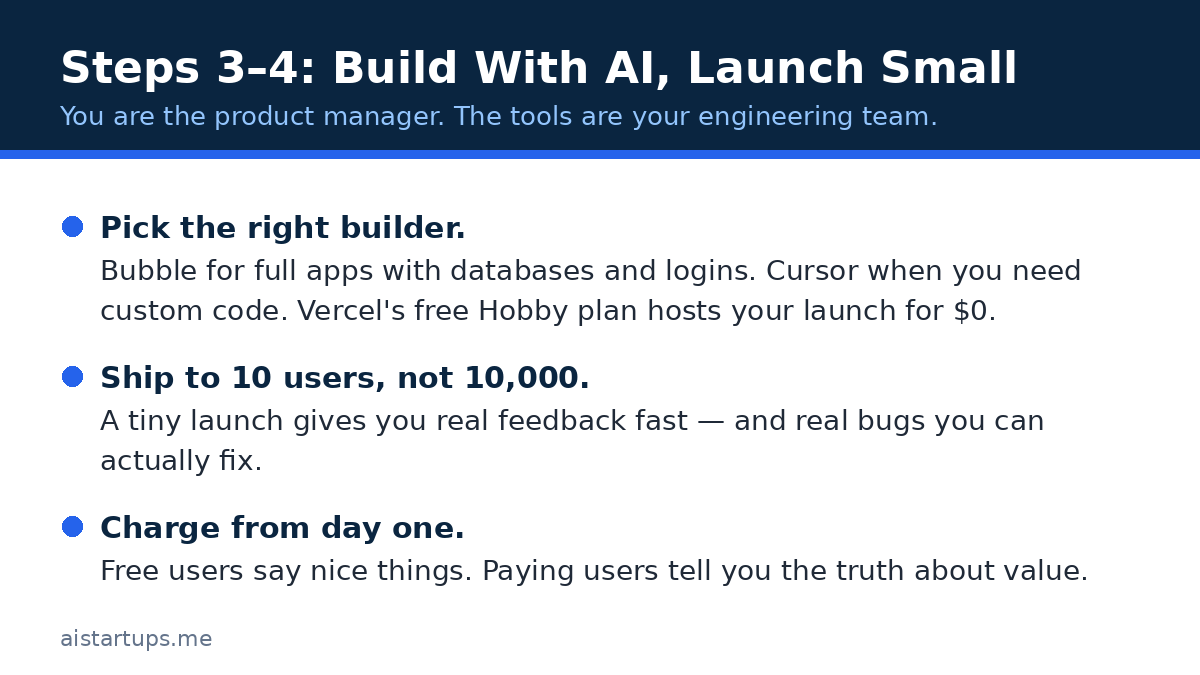
If your product is a fairly standard web app — users sign up, enter some data, get some output, maybe pay a subscription — a no-code builder will get you there fastest. Bubble is the most capable of the bunch: it handles databases, user accounts, payments, and workflows without code, and it scales further than most people expect. The trade-off is a learning curve. Bubble is powerful, which means it takes a week or two to get comfortable — but that’s still a fraction of the time it takes to learn to code, and there are excellent free tutorials for every piece of it.
Pick this route if your product’s core value is organizing information, automating a workflow, or presenting AI output in a useful way — which, honestly, describes most AI startups right now. The AI part (calling a model, processing text, generating summaries) usually plugs in through an API, and no-code tools handle API calls just fine.
Route B: AI coding assistants
If your product needs something custom — a specific interaction, a special calculation, a design that has to feel just so — an AI coding assistant is your other route. Cursor is the one most founders reach for: it’s a code editor with an AI built in, and you work with it by describing what you want in plain language. You don’t need to write the code yourself, but you do need to read the plan it proposes, test what it builds, and tell it what’s wrong. Think pair programming, where your partner types at superhuman speed and you do the thinking.
Fair warning: this route asks more of you. You’ll see code, error messages, and terms you don’t know yet. That’s okay. When something breaks — and it will — paste the error back into the assistant and ask it to explain what happened in plain English. Over a few weeks, you’ll pick up more than you’d expect, and the fear fades fast. Nobody’s asking you to become a software engineer. You’re just learning enough to steer.
For a full breakdown of which tools fit which kind of product, including the exact stack I’d use for an AI MVP in 2026, check our guide to building an AI MVP with the no-code 2026 stack. It goes deeper on the tool-by-tool choices than I can here.
Where to host it (for free, at first)
Once you’ve built something, it needs to live on the internet. Vercel is the simplest option for most founders: its Hobby plan is free, deployment takes minutes, and your app gets a real URL you can share. When you outgrow it, the Pro plan includes a $20 usage credit to use across resources. Don’t overthink hosting at this stage. Pick the free tier, ship the link, and worry about infrastructure when you have users worth worrying about.
And here’s a practical point about the AI features themselves. Your app will call an AI model through an API, and those calls cost money — usually fractions of a cent each. At prototype scale, that’s basically free. The mistake is building a product where every user action triggers ten expensive model calls. Keep the AI work focused: one smart call per user action, not a chain of them. Your future self — the one paying the API bill — will be grateful.
Step 4: Launch Small and Charge Early
Now for the part that separates real startups from side projects: launch to a small group and charge them money.
Not “launch” as in a big announcement, a Product Hunt campaign, and a press release. Launch as in: send the link to the ten people who said they had the problem, and ask them to pay. If your product saves a freelancer four hours a week, a $20 monthly subscription is an easy yes. If it doesn’t save them anything, no amount of marketing will fix that — and you want to learn it now, while the product is small and easy to change, not after a big public launch.
Charging early does three things for you. First, it tells you the truth. Free users say nice things and vanish; paying users complain, request features, and stick around — because they’ve got skin in the game. Second, it funds the next step. Even a few hundred dollars a month covers your tool subscriptions and API costs, which means the startup pays for itself while it grows. Third, it changes how you think. Once real money is moving, every decision gets sharper. You stop adding features nobody asked for and start fixing the things paying customers actually trip over.
How small is “small”? Ten users is plenty. Twenty is a crowd. What you want is a group small enough that you can talk to every single one of them — by email, by chat, on a call — and fix their problems personally. This is your unfair advantage as a tiny startup: a big company can’t do this. You can. Use it.
One practical note: take payments from day one through a proper provider, even if it’s just a simple checkout link. It makes the business real in your own mind, it gives you clean records for tax time, and it avoids the awkward “oh, I’ll start charging later” conversation — which, in my experience, almost never happens, because “later” keeps moving.
Step 5: Grow — Then Hire the Help You Actually Need
Here’s the twist in this whole story: the goal was never to stay non-technical forever. The goal was to start without waiting for permission, and to reach the point where hiring technical help is a business decision, not a desperate search for a savior.
Once you have paying customers and a product that’s working, the math changes completely. You’re no longer asking an engineer to gamble months of their life on an unproven idea. You’re offering paid work on a product with revenue, users, and a clear roadmap — because you built version one yourself, you know exactly what needs doing. That’s a much easier hire, and a much cheaper one than giving away half your company to a co-founder you met three weeks ago.
So what do you hire, and when? Here’s how I’d think about it:
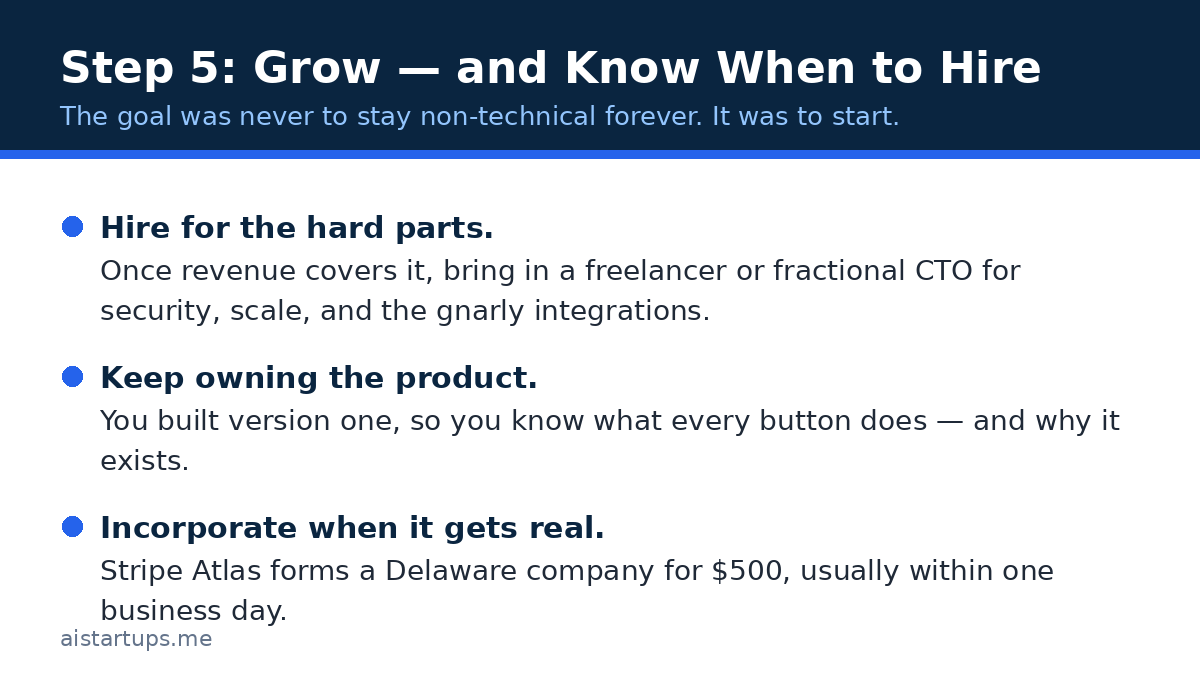
- A freelancer for specific jobs. Need proper security, a tricky integration, or a performance fix? Hire a specialist for that one job. You keep control of the product; they solve the hard problem and leave.
- A part-time or fractional CTO. Once the product gets complex enough that your decisions need a technical second opinion — architecture, data privacy, scaling — a fractional CTO gives you senior judgment for a few hours a month, without a full-time salary.
- A full-time engineer. Only when revenue comfortably covers the salary and you’ve got more technical work than you can direct yourself. For most solo founders, that’s a year-two decision, not a month-two one.
If the build ever grows past what you can direct yourself — say you need a polished marketing site, custom design work, or a deeper AI integration than the no-code tools can handle — that’s also the moment to bring in a proper team rather than struggling alone. For example, a web development studio like AISquadX can take on the design and development work while you stay focused on the product and the customers. The point is: you hire help from a position of strength, with a working product and paying users behind you, not from a position of “I can’t start until someone rescues me.”
The best technical co-founder is the one you hire after you’ve proven the business works — because by then, you’re choosing them, not begging them.
When to incorporate
Once money is coming in, make it official. If you’re targeting US customers or planning to raise funding eventually, Stripe Atlas forms a Delaware company for $500 — usually within one business day — and handles the tax ID, founder shares, and standard legal documents. More than 120,000 companies have incorporated through Atlas, and about one in four new Delaware corporations chooses it. You don’t need this on day one, but don’t leave it until you’ve got a tax headache either. The moment you have your first few paying customers, it’s time.
The Mistakes I See Non-Technical Founders Make
I’ve watched a lot of people walk this path now, and the same mistakes keep showing up. A quick list, so you can dodge them:
Waiting for the perfect co-founder. The perfect co-founder doesn’t exist, and the search becomes a comfortable excuse not to start. Build the prototype. The right people show up once there’s something real to join.
Building in secret. Some founders hide their idea because they’re afraid someone will steal it. Real talk: ideas are cheap, execution is everything, and the feedback you get from talking openly is worth far more than the tiny risk of someone copying you. If your idea is that easy to copy, it wasn’t much of a moat anyway.
Outsourcing the thinking. Hiring a cheap dev shop to “build my app” while you stay hands-off is the most expensive mistake on this list. You end up with code you don’t understand, a product you can’t change, and a bill that keeps growing. Direct the build yourself, even if the tools do the typing.
Adding features instead of getting users. A new feature feels like progress. Ten new users is actual progress. If your week was spent building instead of talking to customers, ask yourself which one the business needed more.
Treating AI tools like magic. They’re powerful, but they’ll happily build the wrong thing very quickly if your instructions are vague. Specific prompts, small steps, test after every change. The tool is fast; your judgment is the speed limit.
Your First 30 Days
Enough theory. Here’s what the first month looks like if you start Monday:
Week 1 — Talk. List twenty people with the problem. Interview ten of them. Write down their exact words about the pain. Decide: is this real enough to build?
Week 2 — Sketch and prototype. Draw the core workflow on paper. Build a clickable demo with a prompt-based builder. Send it to the five most interested people from week one.
Week 3 — Build the real version. Pick your route — no-code builder or AI coding assistant — and build the smallest version that a stranger could use and pay for. Set up payments.
Week 4 — Launch to ten people and charge. Onboard them personally. Fix what’s broken. Ask each one: would you pay for this next month? Then listen to the answer, even if it stings.
That’s it. Thirty days from idea to a real business with real customers — or to a clear, cheap lesson that the idea needs rethinking. Either outcome beats another six months of “looking for a technical co-founder.” And if you want the broader playbook for turning an AI skill into a business, our AI agency playbook for 2026 covers the service-business route, which pairs well with everything above.
Frequently Asked Questions
Can I really build an AI startup without knowing how to code?
Yes — for the first version, and often well beyond it. No-code builders handle the app, AI coding assistants handle custom logic, and APIs handle the AI itself. What you can’t outsource is understanding the customer and making product decisions. That’s your job, and it’s the job that matters most. You’ll pick up technical fluency as you go, but you don’t need it on day one.
Do I need a technical co-founder at all, ever?
Not necessarily. Plenty of solo founders hire freelancers or a fractional CTO instead, and keep full ownership. A technical co-founder makes sense when the product’s core innovation is deeply technical — a new model, novel infrastructure — and you need someone invested for the long haul. For most AI startups, which are really about applying existing models to a specific problem, hired help is the simpler path.
How much does it cost to build an AI startup with no-code tools?
Honestly? You can get to your first paying customer for under $100. Lovable’s free plan covers prototyping, Vercel’s free Hobby plan covers hosting, and API costs at prototype scale are pennies per user. The real costs show up later — paid builder plans, higher API usage, a freelancer for the hard parts — and by then, revenue should be covering them.
What if the AI tool builds something broken?
It will, regularly. That’s normal. The fix is small steps: ask for one feature at a time, test it immediately, and when something breaks, paste the error back into the tool and ask it to explain and fix it. If a problem survives three rounds of that, it’s a sign the task needs a human — a freelancer for an hour or two, not a co-founder for life.
How do I protect my idea while talking to users and builders?
Talk about the problem freely; be a bit more careful with the specifics of your solution if it truly involves something novel. In practice, though, the risk is tiny and the cost of secrecy is huge — founders who build in silence get no feedback and ship the wrong thing. Your real protection is speed: the head start you get from talking to customers early and shipping fast.
The Bottom Line
You don’t need a technical co-founder. You need a problem worth solving, ten people who feel it, and a weekend with the right tools. Validate first, prototype fast, build with AI doing the typing, launch to a tiny group, and charge from day one. Then — only then — hire technical help from a position of strength, with revenue and users behind you.
The founders who win in 2026 won’t be the ones who waited for the perfect team. They’ll be the ones who started with what they had, learned in public, and let the product earn its engineers. That can be you. Start Monday.