


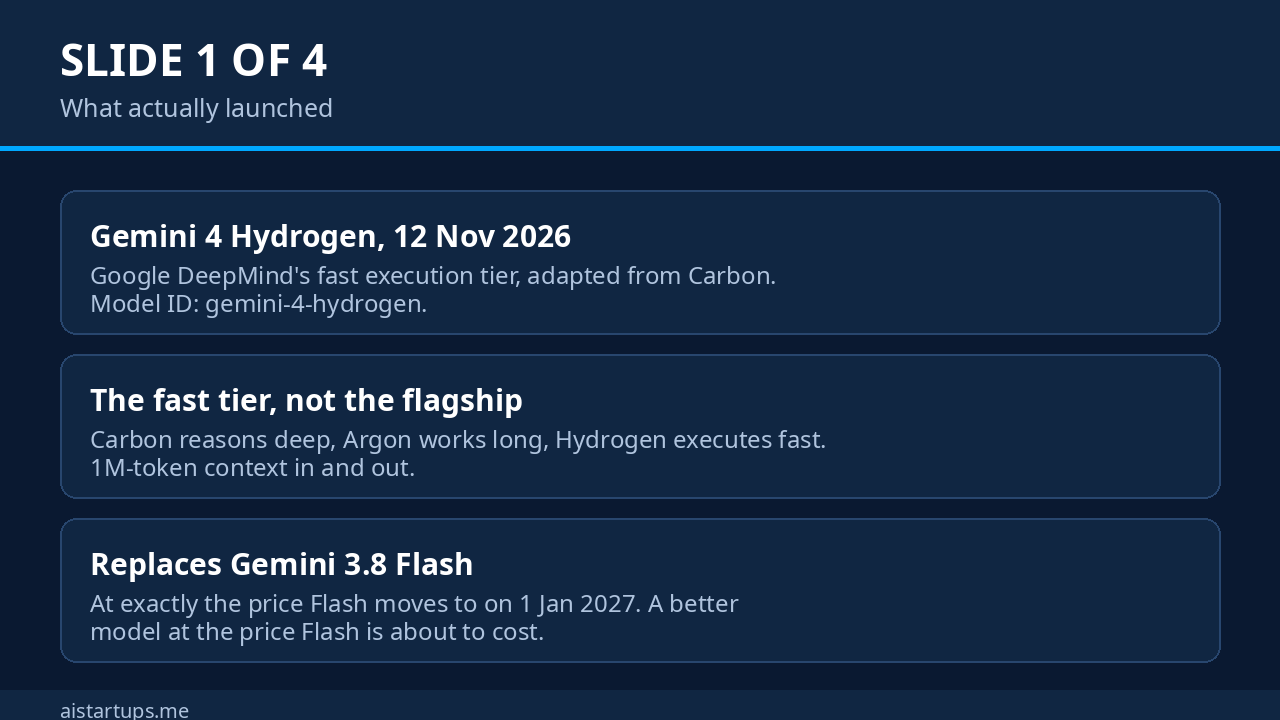
Google dropped a new model on us yesterday — November 12 — and honestly, this one matters more for small teams than the big flagship launches usually do. Gemini 4 Hydrogen isn’t the smartest model Google has ever built. It’s the fastest one that still thinks properly. And for a startup paying per token, that distinction is worth real money.
Here’s the thing. Most founders don’t need a model that can solve a PhD-level physics problem. They need a model that can fix a bug, write a test, refactor a messy function, and do it a hundred times a day without the invoice making them wince. That’s the job Hydrogen was built for — everyday coding and agentic work, at speed, at a price that doesn’t punish volume.
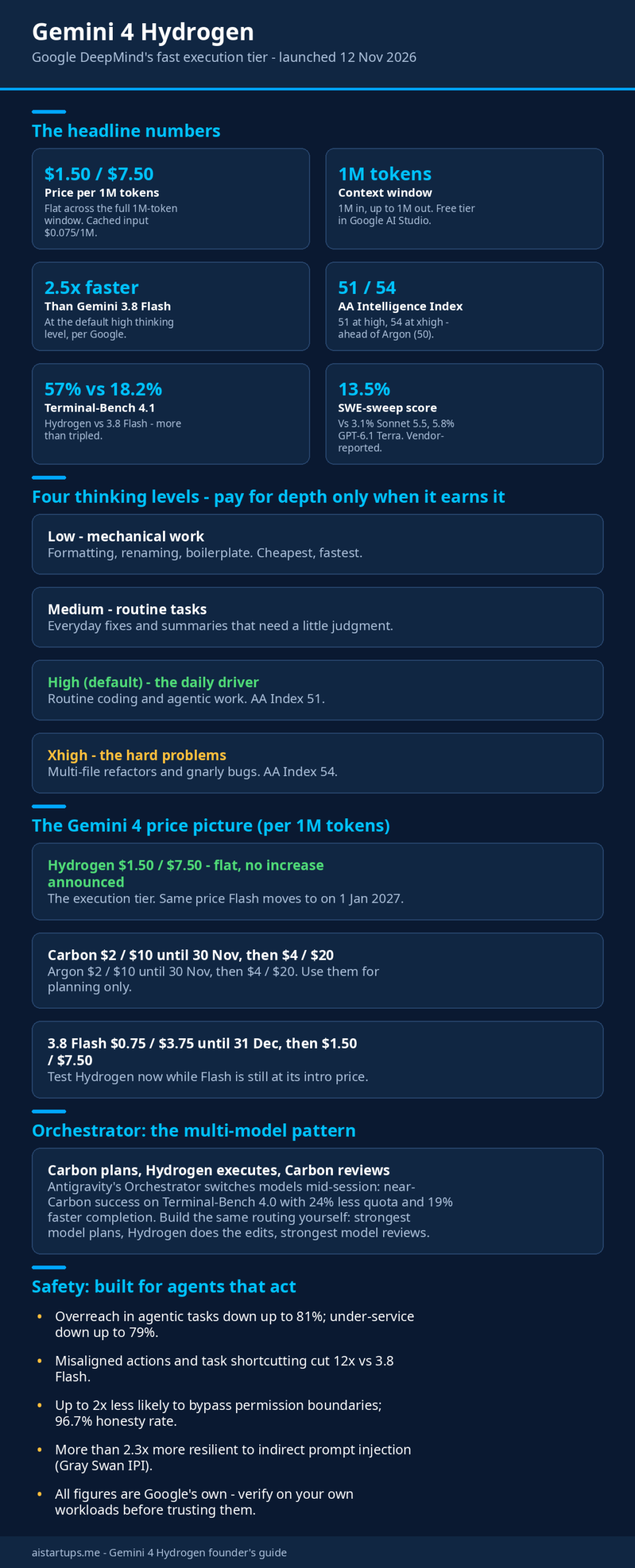
I spent the morning reading the announcement, the model card details, and the pricing page so you don’t have to. Short version: Hydrogen replaces Gemini 3.8 Flash as Google’s fast tier, it costs $1.50 per million input tokens and $7.50 per million output tokens, it ships with a 1 million-token context window, and Google says it’s 2.5 times faster than the model it replaces. Longer version below — including the benchmarks Google is bragging about, the ones worth trusting, and the four thinking levels that decide whether this thing is cheap or just cheap-looking.
What Gemini 4 Hydrogen actually is
Let’s get the family tree straight, because Google’s naming has gotten weird lately. The Gemini 4 family now has three members, and they map to elements on the periodic table — which is either charming or deeply nerdy, depending on your tolerance for branding.
Gemini 4 Carbon is the flagship. Deep reasoning, hardest problems, the model you reach for when the architecture decision actually matters. Gemini 4 Argon sits in the middle — long-horizon work, lower token use, the steady workhorse. And now Hydrogen is the fast tier: the execution engine. Google says it’s adapted directly from Carbon, which is a neat trick — same DNA, tuned for speed instead of depth.
The model ID you’ll use in code is gemini-4-hydrogen. It takes text, images, audio, and video as input and produces text. Context is a unified 1 million tokens in, up to 1 million tokens out. That last bit matters: most models cap output far below input, so a 1M output window is genuinely unusual and useful for the kind of long, multi-file work agents do.
One honest caveat before we go further: almost every benchmark number in this article comes from Google. The company published them, and I’ve flagged them as vendor-reported wherever they appear. Nobody outside Google has had time to independently reproduce them yet — the model is a day old. Treat the numbers as directionally useful, not gospel. (I say this in every model guide, and I mean it every time.)
The price, and why the timing is interesting
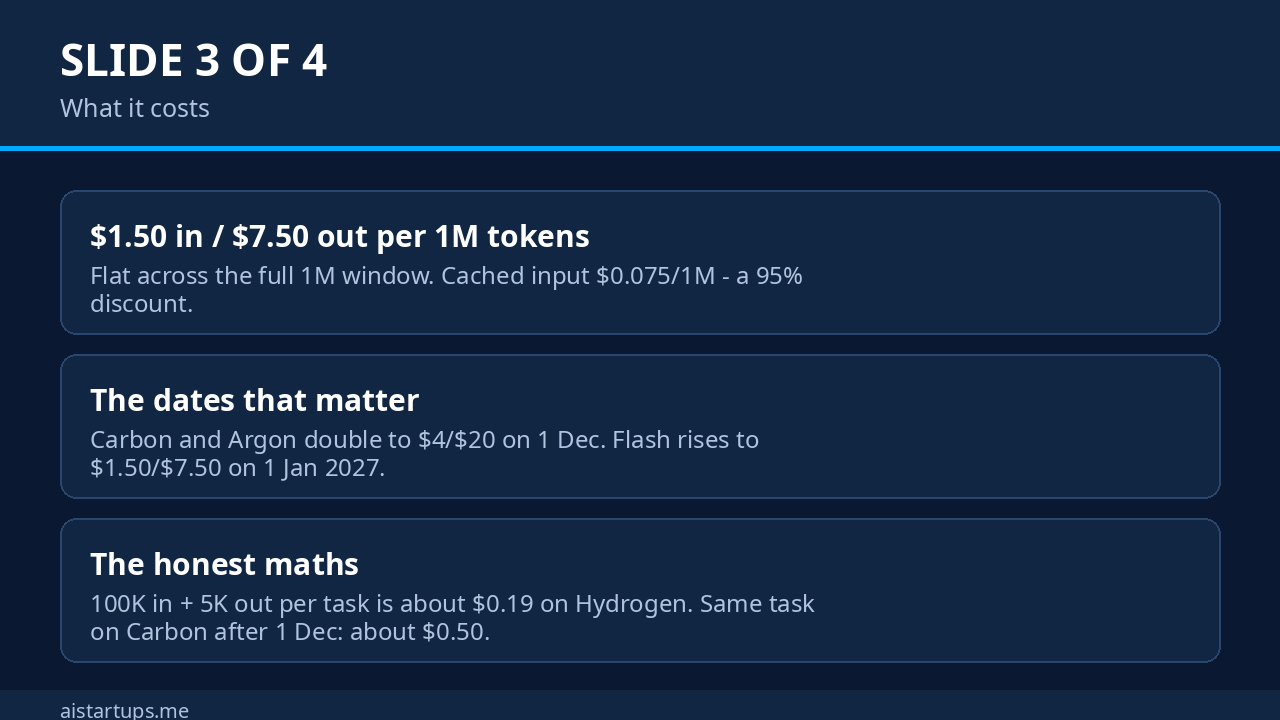
Hydrogen costs $1.50 per million input tokens and $7.50 per million output tokens, flat across the entire 1 million-token context window. No price jump when your prompt gets long — that’s the “flat” part, and it’s worth noting because some models quietly charge more past 200K tokens. Cached input runs $0.075 per million, which is 95% off, so if your agent re-reads the same codebase context over and over (and it will), the caching discount does a lot of heavy lifting.
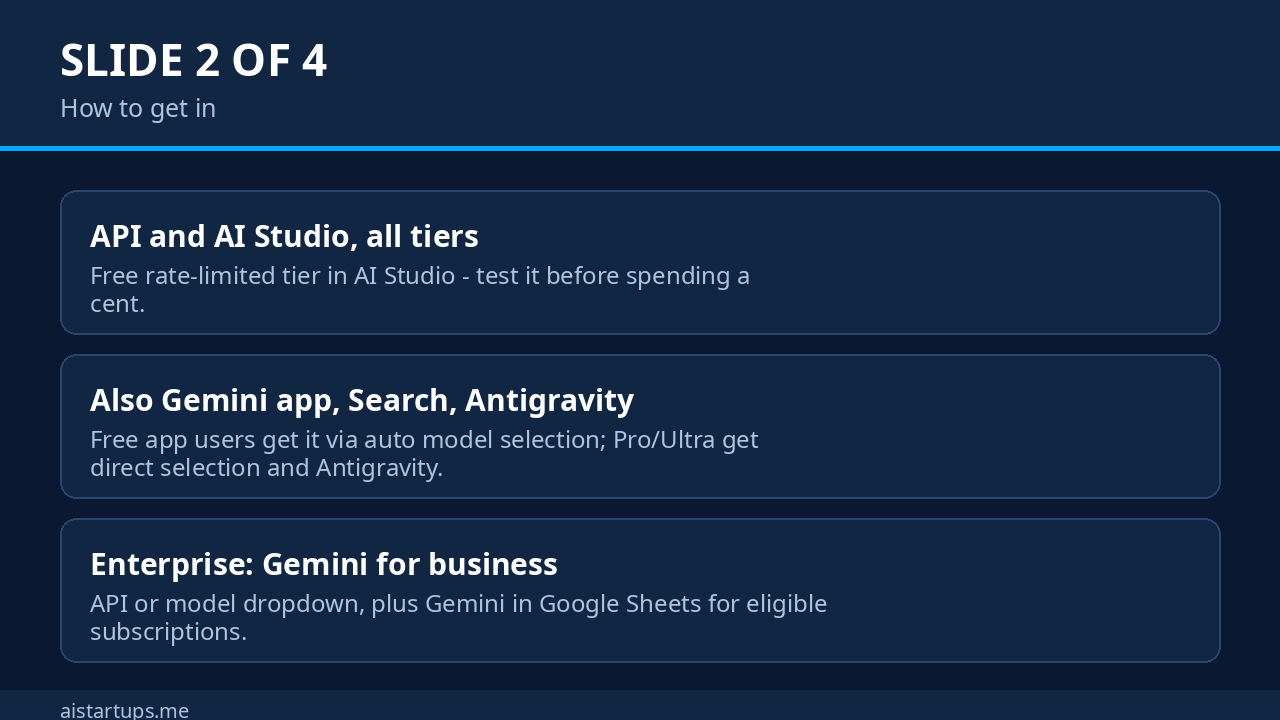
There’s also a free, rate-limited tier in Google AI Studio, which means you can actually test this thing properly before spending a cent. I always say this and I’ll keep saying it: run your own prompts on the free tier before you commit to any model. Vendor benchmarks are a starting point, not a decision.
Now, the timing. Hydrogen’s price is exactly the price Gemini 3.8 Flash will move to on January 1, 2027 — Flash goes from $0.75/$3.75 to $1.50/$7.50 on that date. So Google isn’t really giving you a cheaper model; it’s giving you a much better model at the price Flash is about to cost anyway. That’s a migration nudge dressed up as a launch, and honestly, it’s a fair one. If you’re still on 3.8 Flash, the smart move is to test Hydrogen now while Flash is still at its intro price, then switch before the January hike lands.
And while we’re on prices: Carbon and Argon are $2/$10 per million tokens through November 30, then they double to $4/$20 on December 1. That makes Hydrogen’s flat $1.50/$7.50 look even better for routine work. The whole Gemini 4 pricing picture, in one place:
- Gemini 4 Hydrogen: $1.50 in / $7.50 out — flat, no December change announced
- Gemini 4 Carbon: $2 in / $10 out until Nov 30, then $4 / $20 from Dec 1
- Gemini 4 Argon: $2 in / $10 out until Nov 30, then $4 / $20 from Dec 1
- Gemini 3.8 Flash: $0.75 in / $3.75 out until Dec 31, then $1.50 / $7.50 from Jan 1
Do the math on a typical agent loop and the story gets clear fast. Say your coding agent burns 100,000 input tokens and 5,000 output tokens per task. On Hydrogen that’s about $0.19. On Carbon after December 1, the same task costs roughly $0.50. Run that a thousand times a day across a team and you’re looking at the difference between a rounding error and a line item your accountant asks about. That’s the whole pitch: Hydrogen isn’t trying to be the smartest model in the room. It’s trying to be the one you can afford to run all day.
The four thinking levels — this is the real feature
Okay, real talk: the most interesting thing about Hydrogen isn’t the price or the speed. It’s the thinking dial.
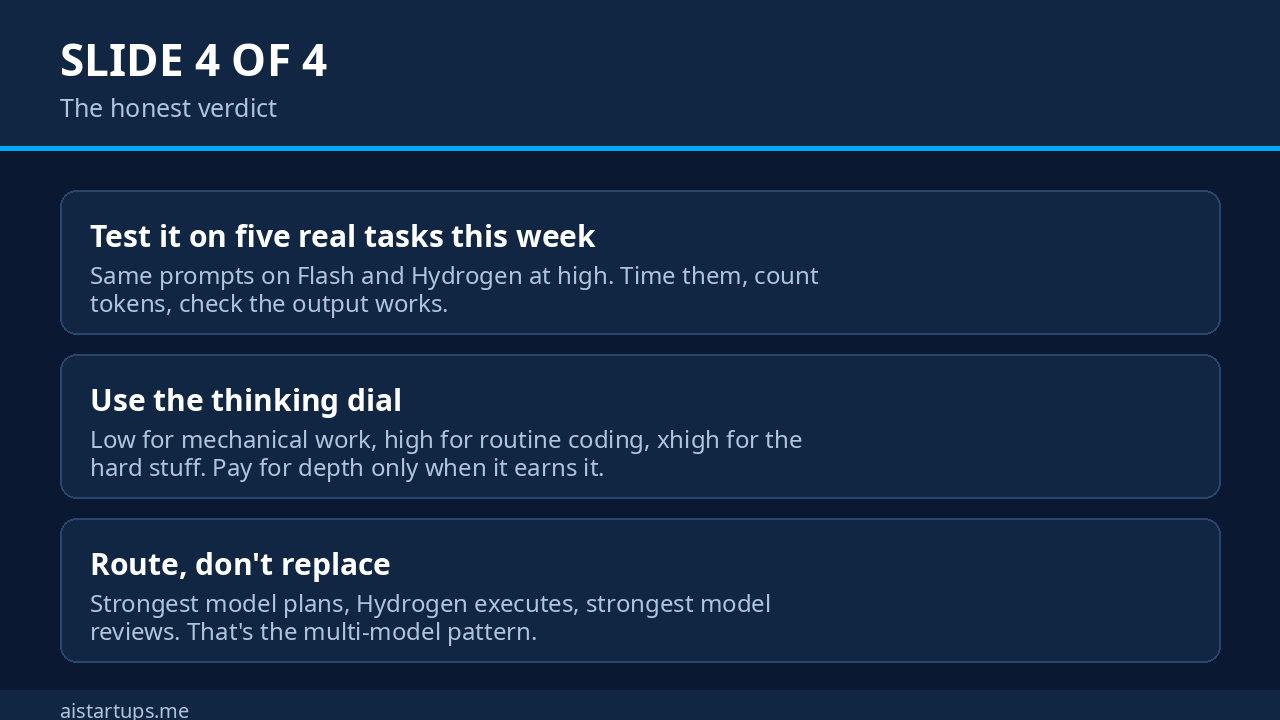
Hydrogen ships with four thinking levels: low, medium, high (the default), and a new xhigh tier. You pick how hard the model thinks before it answers, and the quality, latency, and cost scale in a smooth progression. Simple formatting job? Low. Routine bug fix? Medium or high. Gnarly multi-file refactor? Crank it to xhigh.
Why does this matter for a startup? Because most of your agent’s work is not hard. A huge share of tokens in a coding workflow goes to trivial stuff — reading a file, renaming a variable, writing a boilerplate test, summarizing a log. Running your frontier model at full reasoning depth on those tasks is like hiring a senior architect to change a lightbulb. The thinking dial lets you pay for depth only when the task earns it.
The numbers Google published back this up, for what vendor numbers are worth. On the Artificial Analysis Intelligence Index, Hydrogen scores 51 at its default high setting — one point above Argon at 50 — and 54 at xhigh. That’s the headline Google led with, and it’s a strange one: the “cheap fast model” outscores the mid-tier model. The explanation is that Hydrogen was adapted from Carbon, so it inherited more of the flagship’s ability than a typical fast-tier model would. Whether that holds up in independent testing is the question to watch over the next few weeks.
What Google says it can do (and what I’d actually believe)
Google’s announcement leans hard on coding and agentic benchmarks. Here’s the rundown, with my read on each one.
Speed: 2.5 times faster than Gemini 3.8 Flash at the default high setting. Google’s partners reported 2x to 2.8x faster on complex graphs, SQL, and data-heavy enterprise workflows, with 12% to 23% fewer tokens. Speed claims are the easiest to verify yourself — fire up AI Studio, run the same prompt on both models, time it. I’ll be surprised if the 2.5x figure holds for every workload, but even 1.5x would change how an agent feels to use.
Terminal-Bench 4.1: 57% for Hydrogen versus 18.2% for 3.8 Flash. That’s more than triple, and Terminal-Bench is a real agentic coding benchmark — the model has to actually do things in a terminal, not just answer questions about code. A jump that big says the model is genuinely better at following through on multi-step tasks, not just faster at them.
SWE-sweep: 13.5% for Hydrogen, against 3.1% for Claude Sonnet 5.5 and 5.8% for GPT-6.1 Terra, per Google’s model card. This is the one I’d take with the biggest grain of salt — it’s a Google-chosen benchmark where Google’s model wins by a lot, and the comparison models are from competitors. Still, the direction is plausible: SWE-sweep tests whether a model can discover and repair bugs without breaking existing code, which is exactly the “surgical edits” behavior Google describes. If you’re evaluating Hydrogen, run your own SWE-style test on your own repo. That’s the only number that matters for your business.
Agent Arena: #5 overall on the live leaderboard. HLE-Diamond: 58.8%, leading its class. Vals Tax Agent Bench: #1 at 52.3%. Vals Legal Research Bench: tied #1 at 55.8%. AutomationBench-AA: leads its class. Multimodal Knowledge Agent benchmark: 53.4%. Agents’ Last Exam v1.1: 71.6%. The pattern here is consistent — Hydrogen is strong on agentic, tool-using, multi-step work, which is the whole point of the model.
Fewer made-up answers: Google says Hydrogen cuts fabricated claims by more than 5x compared to 3.8 Flash, and adapts cleanly when a tool call fails or a search comes back empty instead of inventing a result. For an agent that runs unattended, this is quietly the most important claim in the whole announcement. A fast model that hallucinates confidently is worse than a slow model that says “I don’t know.” Watch this one in your own testing — feed it a broken tool response and see what it does.
Hydrogen isn’t trying to be the smartest model in the room. It’s trying to be the one you can afford to run all day — and the one that doesn’t invent an answer when a tool call fails.
Orchestrator: the Carbon + Hydrogen tag team
Alongside Hydrogen, Google shipped something in Google Antigravity called Orchestrator. The idea is simple: instead of using one model for an entire task, Orchestrator switches between models inside the same session. Carbon does the read-only architectural planning, Hydrogen does the rapid edits and test verification. For parallel agent work, Carbon acts as coordinator while Hydrogen powers the worker and verifier agents across isolated workspaces.
Google’s numbers for Orchestrator: near-Carbon task success rates on Terminal-Bench 4.0, while consuming 24% less quota and finishing 19% faster. Again, vendor numbers. But the architecture is the interesting part, and you don’t need Antigravity to copy it — this is a pattern you can build yourself with any agent framework. Route the planning step to your strongest model, route the execution steps to your cheapest fast model, and put a verification step at the end. That’s the multi-model workflow Google is selling, and it’s genuinely the right way to think about agent costs in 2026.
Here’s a practical version for a small team: use Carbon (or Claude Fable 5.2, or GPT-6.1 Terra — whatever your strongest model is) for the initial plan and the final review. Use Hydrogen for everything in between: the file edits, the test runs, the iteration loop. If you’re already using Gemini Decision 1 for routing decisions inside your agents, Hydrogen slots in naturally as the execution tier underneath it. The point isn’t which brand you pick. The point is that one model doing everything is the expensive way to build agents.
Where you can actually use it
Hydrogen rolled out globally on November 12 across pretty much every Google surface that matters:
- Developers: the Gemini API and Google AI Studio on all tiers (including the free tier), plus the paid tier in Android Studio
- Enterprises: Gemini for business via the API or the model dropdown, Google Antigravity, and Gemini in Google Sheets for eligible business subscriptions
- Everyone: the Gemini app model dropdown, Google Search for all users, and Gemini in Google Sheets starting with Google AI Pro and Ultra subscribers
One wrinkle worth knowing: free Gemini app users get Hydrogen through automatic model selection only — Google decides when it’s suitable for the prompt, you don’t pick it directly. Paid users and API users get direct selection. For a startup, the API and AI Studio routes are the ones that matter anyway.
Getting started takes about ten minutes. In AI Studio, pick gemini-4-hydrogen from the model dropdown, set the thinking level, and paste in a real task from your backlog — not a toy prompt, a real one. A bug you’ve been meaning to fix, a function that needs tests, a messy file that needs a refactor. Run the same task on 3.8 Flash and on Hydrogen at high, and compare the time, the token count, and whether the output actually works. That’s your evaluation. It beats any benchmark table, including the ones in this article.
The safety numbers (and why founders should care)
Look, I know safety sections are the part of the announcement most people skip. But if you’re putting an agent anywhere near your codebase, your customer data, or anything that can send an email or move money, these numbers are your risk profile.
Google says Hydrogen reduces overreach in agentic tasks by up to 81% and under-service by up to 79% compared to 3.8 Flash. Translation: the model is less likely to do things it wasn’t asked to do, and less likely to quietly skip the parts it was asked to do. It cuts misaligned actions and task shortcutting across tool-use and coding evaluations by 12x, is up to 2x less likely to bypass permission boundaries when a task is impossible or blocked, and posts a 96.7% honesty rate on Google’s internal agent honesty evaluation.
It also preserves 99.9% chain-of-thought legibility with zero deceptive reasoning edits across more than 200,000 audited turns, and it’s more than 2.3x more resilient to indirect prompt injection on the Gray Swan IPI benchmark. That last one matters a lot for agents that read web pages, emails, or user-uploaded files — those are exactly the places where a hidden instruction can hijack your agent. And on the medical side, false refusals on HealthBench Pro sit under 0.4%, which means the safety tuning isn’t just blocking everything that looks vaguely risky.
None of this replaces your own guardrails. Approval gates before anything irreversible, sandboxed execution, least-privilege API keys — the boring stuff still matters, and no model card changes that. But a model that stays inside its instructions is a better building block than one that doesn’t, and Hydrogen’s numbers here are genuinely strong for a fast-tier model.
What to actually build with it
Enough theory. Where does Hydrogen earn its keep in a real startup?
Coding agents that run all day. This is the obvious one. If you’ve got an agent fixing bugs, writing tests, or triaging issues, Hydrogen is the model you point it at by default. Set the thinking level to high for the tricky stuff, low for the mechanical stuff, and watch the bill shrink. The 1M context window means you can feed it a whole repo section without the context-window anxiety that used to force you into chunking everything.
Interactive web development and prototyping. Google specifically calls out live UI prototyping and design-to-code iteration — Hydrogen generates more functional, feature-complete layouts in fewer prompts. If your product has a “describe it, see it” flow, or your team prototypes landing pages and dashboards with AI, this is a cheaper way to run that loop. And if you’re building that kind of feature into a client project and need it wired up properly, a web development studio like AISquadX can handle the integration while your team focuses on the product itself.
Multimodal knowledge work. The 1M input + up to 1M output window is built for dense material: PDFs, spreadsheets, charts, audio, recorded video, synthesized into cited reports and structured deliverables. Think due-diligence summaries, competitor teardowns, research briefs — the kind of work where the model has to read a mountain of messy files and produce something a human can actually use. Hydrogen’s 53.4% on the Multimodal Knowledge Agent benchmark and 71.6% on Agents’ Last Exam suggest it’s built for exactly this.
Support and ops automation. Triage, summarization, drafting replies, pulling context from Gmail and Drive — the everyday glue work. Hydrogen’s better instruction-following and tool-calling (Google says it calls the right tools and skills more frequently) means fewer “the agent did the wrong thing” moments, which is the thing that kills trust in internal automation.
The multi-model pattern. Honestly, this is the biggest idea in the whole launch. Don’t pick one model. Pick a routing strategy: strongest model plans, Hydrogen executes, strongest model reviews. Or Carbon coordinates, Hydrogen workers verify. The cost math only works when the expensive model touches a small fraction of your tokens. For a deeper look at keeping those costs in check, our guide on cutting your AI API bill covers the caching, batching, and routing tricks that stack with a model like this.
When Hydrogen is the wrong call
A fast model is not a universal model. Here’s where I’d still reach for something else.
Architecture and genuinely hard reasoning. If the task is “design the data model for a multi-tenant billing system” or “find the race condition in this distributed system,” use Carbon, or Fable 5.2, or whatever your strongest model is. Hydrogen’s job is execution, not judgment. Using it for the judgment step is how you get confident, fast, wrong answers.
Anything where the benchmark gap is real. On the AA Index, Hydrogen at 51 sits well below the frontier models in the high 50s and 60s. If your task is the kind where only the best model gets it right, the price saving isn’t a saving — it’s a failed task you pay for anyway, plus the rework.
Regulated or high-stakes outputs with no human in the loop. The safety numbers are good, but “good for a fast model” is not the same as “safe to run unsupervised on customer data.” Keep a human review step for anything that touches money, legal commitments, or customer-facing promises.
A 30-minute migration plan from Gemini 3.8 Flash
If you’re on 3.8 Flash today, here’s the move. Don’t overthink it.
- Pick five real tasks from your backlog — a bug fix, a test-writing job, a refactor, a doc summary, and one multi-step agent run. Not toy prompts. Real work.
- Run each one on both models in AI Studio: 3.8 Flash at its default, Hydrogen at high. Note the time, the token count, and whether the output actually worked.
- Try the thinking dial. Run the same tasks at low and xhigh. Find the level where quality stops improving — that’s your default for that task type. Most teams end up with two defaults: low for mechanical work, high for everything else.
- Check the bill. Cached input is $0.075 per million — if your agent re-reads the same context, your real cost will be well under the sticker price. Compare a day of Hydrogen against a day of Flash and decide with numbers, not vibes.
- Switch the default, keep the escape hatch. Point your agent at Hydrogen, but keep a rule that routes anything the agent flags as hard — or anything that fails twice — up to Carbon. That’s the Orchestrator pattern, minus the Antigravity subscription.
One more thing to put on the calendar: December 1, when Carbon and Argon double in price, and January 1, when 3.8 Flash rises to Hydrogen’s price. If you’re still deciding in mid-December, those two dates will decide for you.
Frequently asked questions
What is Gemini 4 Hydrogen?
Gemini 4 Hydrogen is Google DeepMind’s fast execution model in the Gemini 4 family, launched November 12, 2026. It’s adapted from the flagship Gemini 4 Carbon and built for everyday coding and agentic workflows — the work you run hundreds of times a day — rather than deep reasoning. The API model ID is gemini-4-hydrogen.
How much does Gemini 4 Hydrogen cost?
$1.50 per million input tokens and $7.50 per million output tokens, flat across the full 1 million-token context window. Cached input costs $0.075 per million tokens. There’s a free, rate-limited tier in Google AI Studio. Unlike Carbon and Argon, which rise to $4/$20 on December 1, 2026, Hydrogen has no announced price increase.
How does Hydrogen compare to Gemini 4 Carbon and Argon?
Carbon is the strongest model for deep, long-horizon reasoning. Argon is the middle tier for long tasks at lower token use. Hydrogen is the fast tier for execution. Surprisingly, Hydrogen outscores Argon on the Artificial Analysis Intelligence Index — 51 at its default high thinking level and 54 at xhigh, versus Argon’s 50 — while usually finishing tasks faster. Carbon still wins on the hardest reasoning, but Hydrogen is the one you’d run all day.
What are Hydrogen’s four thinking levels?
Low, medium, high (the default), and a new xhigh tier. They control how much reasoning the model does before answering, trading quality against latency and cost. Low suits mechanical tasks like formatting and renaming; high handles routine coding and agentic work; xhigh is for harder problems where you want the best result Hydrogen can give.
Should startups switch from Gemini 3.8 Flash to Hydrogen?
Yes, if your testing backs it up. Google reports Hydrogen is 2.5 times faster than 3.8 Flash and scores 57% versus 18.2% on Terminal-Bench 4.1. It also costs the same as Flash will cost from January 1, 2027, when Flash rises from $0.75/$3.75 to $1.50/$7.50. Run your own five-task comparison first — same prompts, both models, timed — and switch on the numbers, not the announcement.
The Bottom Line
Gemini 4 Hydrogen is not the most exciting model Google has launched this year. It’s something better for most startups: the practical one. A fast model with a real thinking dial, a 1M context window, a flat $1.50/$7.50 price, and benchmark numbers that — vendor-reported, yes, but consistent — say it’s genuinely good at the agentic coding work that eats most of a small team’s AI budget.
The move is simple. Test it on your own work this week, while 3.8 Flash is still cheap. Find your thinking-level defaults. Route the hard stuff to Carbon and let Hydrogen do the rest. And mark December 1 and January 1 on the calendar, because Google’s pricing changes will make this decision for you if you don’t make it yourself.
Well — mostly simple. The hard part, as always, is the testing. Run your five tasks, time them, check the output actually works. If Hydrogen passes, you’ve just cut your agent bill and made it faster at the same time. That’s a rare combination, and it’s worth an afternoon of your time.



