

Real talk: yesterday, Meta released the most capable open-weight AI model ever built in the United States. And the number that should matter most to you as a founder isn’t the 816 billion parameters. It’s the price tag on running it yourself — north of $20,000 in Mac hardware.
That one detail tells you almost everything you need to know about Muse Spark Open, which launched on October 15, 2026. It’s a genuinely big deal. It’s also surrounded by the kind of launch-week hype that makes founders do dumb things, like planning to self-host a model that needs two maxed-out Mac Studios to run.
I spent yesterday reading the actual coverage — TechCrunch, SiliconANGLE, Reuters, the works — plus Meta’s own materials, so you don’t have to. Here’s the thing: this model is interesting for startups. Just probably not in the way the headlines suggest. Let me walk you through what it actually is, what the specs mean in plain English, how you can realistically use it this week, and the one license detail that could bite you if you skip it.
What Muse Spark Open Actually Is (And Isn’t)
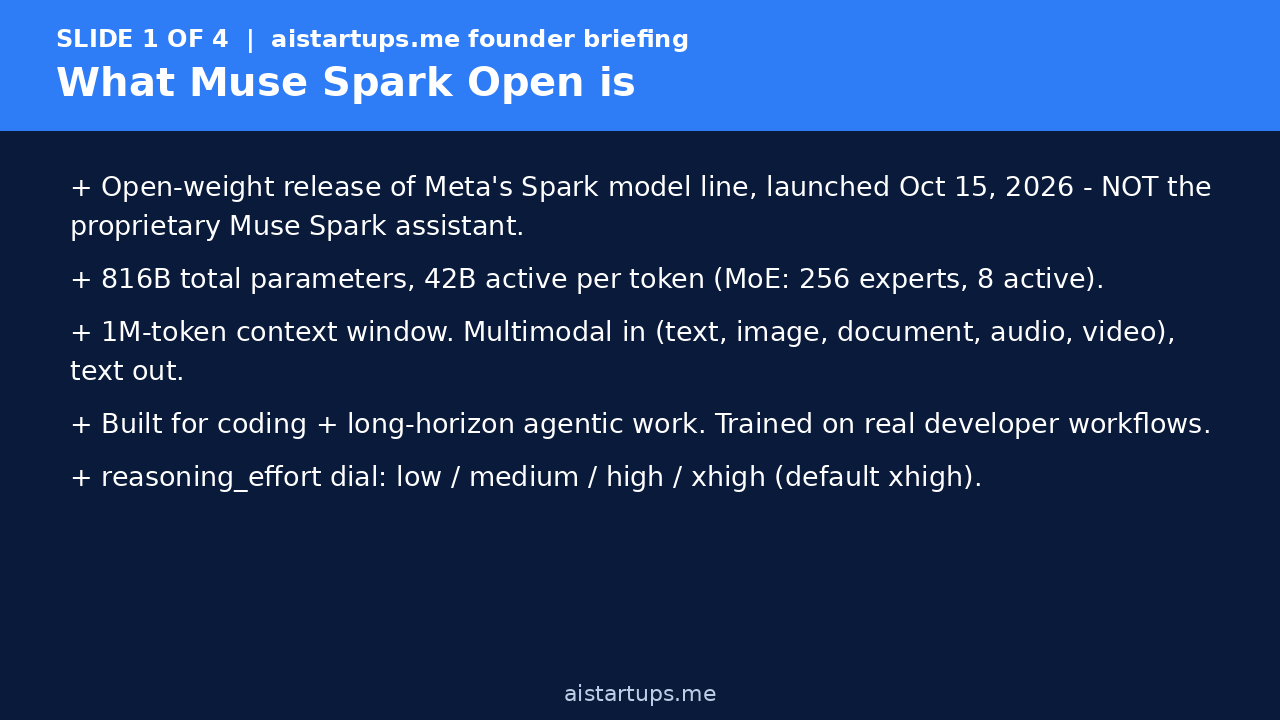
First, let’s clear up the naming mess, because Meta made this confusing. Muse Spark — the AI assistant — has been a proprietary product since April. Muse Spark Open, launched yesterday, is the open-weight release of the Spark model line. Same family, very different product. One is an assistant you chat with; the other is model weights you can download and run yourself.
So what is it, exactly? It’s a massive open-weight model built specifically for two things: coding and long-horizon agentic work. Meta says it was trained on real developer workflows — multi-file refactors, long debugging sessions, the kind of messy, sprawling tasks where an AI agent needs to keep context for hours, not seconds. That’s the bet: not a chatbot, but an engine for coding agents that do real work.
“The most capable US open-weight model to date.” — Meta’s launch announcement, October 15, 2026. Their claim, not mine. We’ll check the receipts below.
Why should a startup founder care? Because open weights change the economics of building on AI. When you rent a closed model, you pay per token forever, you can’t inspect or modify the model, and your product dies the day the provider changes pricing or terms. Open weights mean you can self-host, fine-tune, distill, and ship without asking permission. That’s real leverage — if you can handle the engineering. And that “if” is doing a lot of heavy lifting here, as we’ll see.
The Specs, Honestly Presented
Launch coverage loves throwing around giant numbers. Let me translate them into what they mean for you:
| Spec | The number | What it means for you |
|---|---|---|
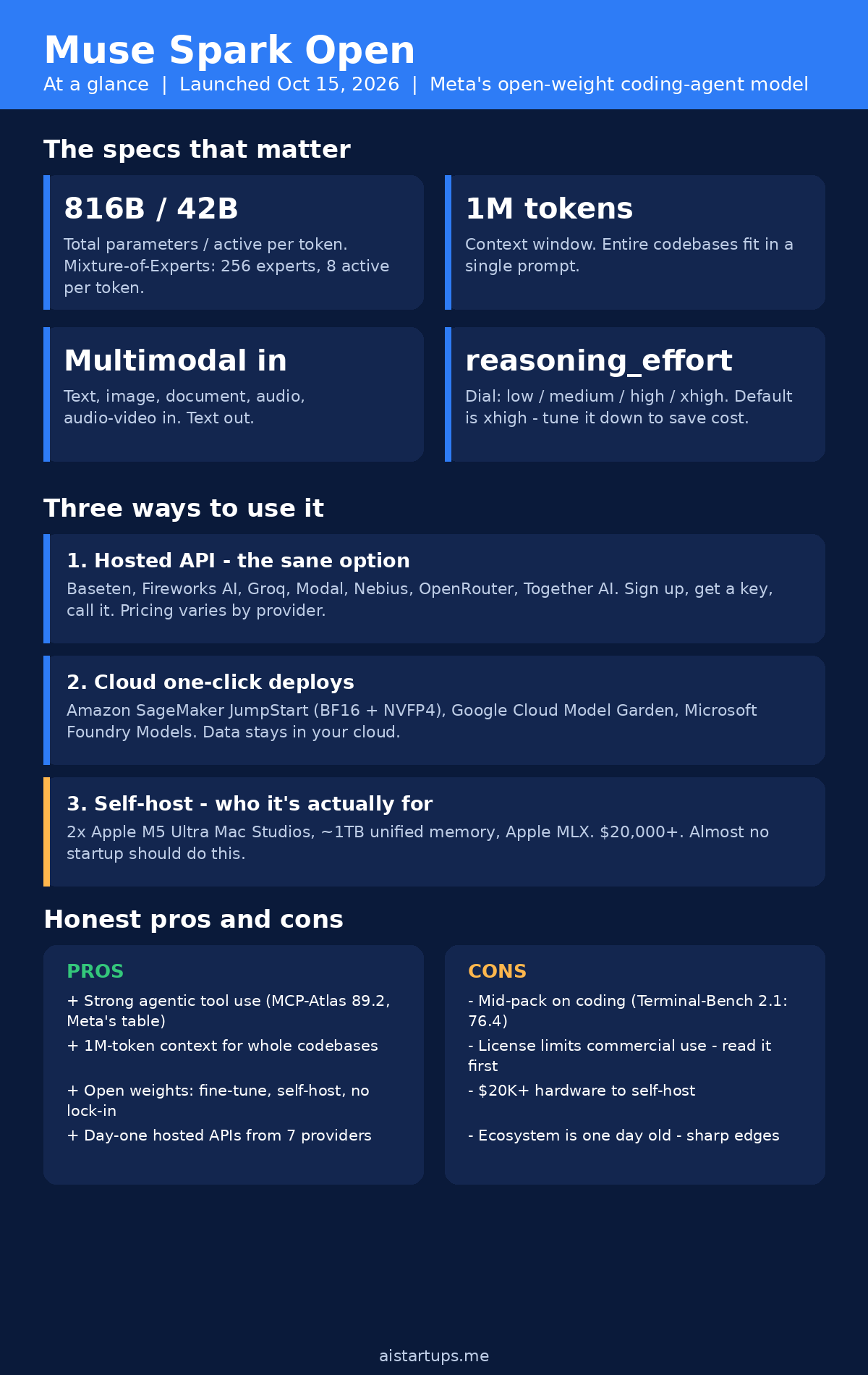
| Total parameters | 816 billion | Huge. But only 42B are active per token (see below). |
| Active parameters per token | 42 billion | This is the number that matters for inference cost. Mixture-of-Experts: 256 experts, 8 active per token. |
| Context window | 1 million tokens | Entire codebases fit in one prompt. Roughly 750,000 words — that’s multiple large repos at once. |
| Multimodal inputs | Text, image, document, audio, audio-video | It can watch a video and read a PDF, not just text. Output is text only. |
| Reasoning control | reasoning_effort: low / medium / high / xhigh (default xhigh) | A dial for how hard the model thinks per request — trade cost against quality. |
| License | Muse Model License | Free to download. Limited commercial use — not Apache or MIT. Read the section below. |
| Weights | Hugging Face | Downloadable from day one, alongside hosted APIs from seven providers. |
The MoE detail is worth a sentence: 256 expert networks, but only 8 fire for any given token. So while the model knows 816B parameters’ worth of stuff, it only computes 42B per token. Clever engineering — it means inference costs look like a 42B model while capability draws on the full 816B. Well, mostly. More on the benchmarks in a bit.
And the 1M-token context? For coding agents, that’s the headline feature. An agent that can hold your entire repo, the docs, and the last three hours of debugging in its head at once is a fundamentally different tool from one working with a 200K window and constant summarization. If you’re building AI agent products as a solo founder, context window is one of the specs that actually changes what your product can do.
How to Actually Use It This Week
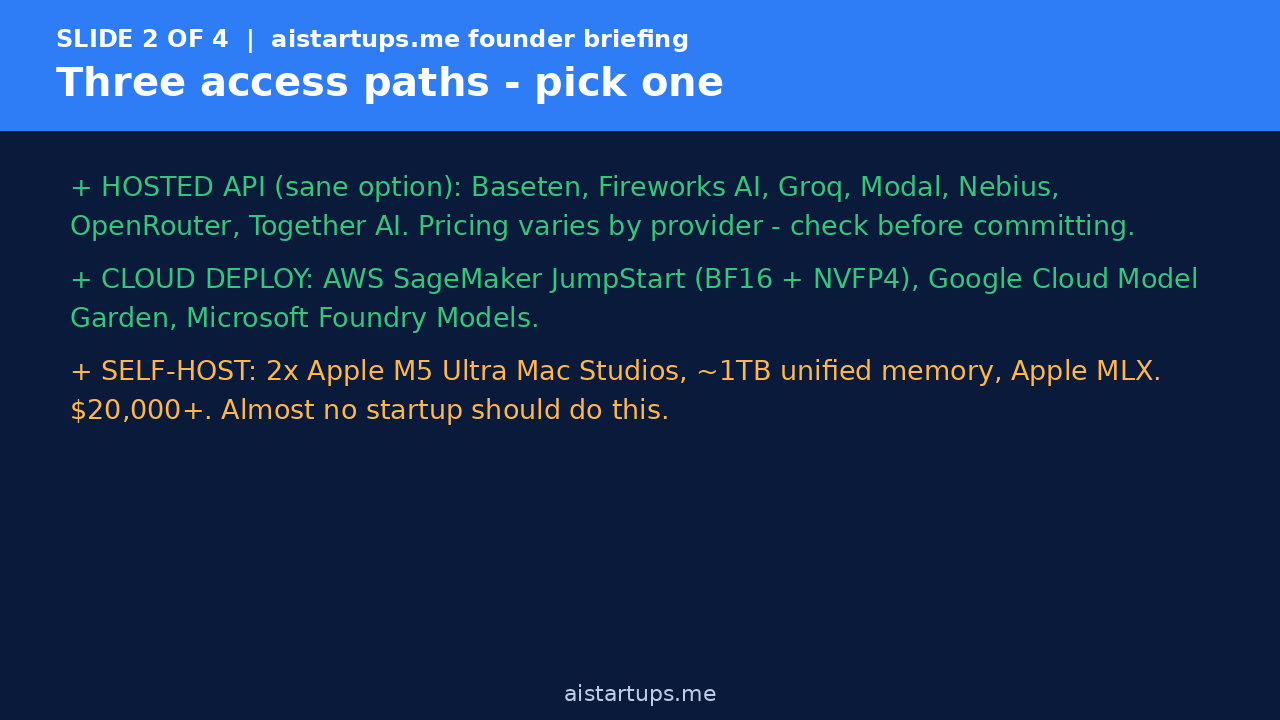
Here’s where most launch coverage goes vague and founders get stuck. You have three realistic paths, and only one of them makes sense for 95% of startups:
1. The hosted API path (the sane option)
From day one, seven providers are serving the model: Baseten, Fireworks AI, Groq, Modal, Nebius, OpenRouter, and Together AI. You sign up, get an API key, and call it like any other model API. No hardware. No DevOps. No $20K Mac Studios.
I’m not quoting per-token prices here because they weren’t verifiable at write time and they vary by provider — check each provider’s pricing page before you commit. The general rule from our guide to cutting your AI API bill still applies: benchmark two or three providers on your actual workload before standardizing, because the cheapest sticker price rarely wins once latency and throughput enter the picture.
2. Cloud one-click deploys
The big clouds moved fast on this one. Amazon has it on SageMaker JumpStart in both BF16 and NVFP4 variants (the NVFP4 one is the quantized, cheaper-to-run version). Google put it in Model Garden. Microsoft added it to Foundry Models. If your stack already lives on one of these clouds, this is the path of least resistance — and the one your investors’ security questionnaires will like best, since data stays inside your cloud account.
3. The self-host path (who it’s actually for)
Okay, the $20K reality check. Meta’s reference setup runs the model locally on two Apple M5 Ultra Mac Studios — roughly 1TB of unified memory between them — using Apple’s MLX framework. Two maxed-out 512GB Mac Studios. That’s not a dev machine; that’s a capital expense.
Who is this actually for? A tiny slice of startups: teams with serious on-premise data requirements (healthcare, defense-adjacent, some fintech), teams planning to fine-tune heavily and wanting full control, or well-funded labs. For everyone else — honestly — the hosted API path gives you 95% of the benefit at 1% of the hassle. Don’t let launch-week excitement talk you into becoming a GPU infrastructure company. You’re not.
- Hosted API — fastest, cheapest to start, zero infra. Best for: MVPs, prototypes, most production workloads.
- Cloud deploy — data stays in your cloud account, one-click-ish. Best for: regulated industries, existing AWS/GCP/Azure shops.
- Self-host — full control, fine-tuning freedom, $20K+ in hardware. Best for: special data requirements, deep customization.
Muse Code: The Other Half of the Story
The model didn’t launch alone. Meta paired it with Muse Code, an AI coding terminal — and the demos are the most interesting part of the whole launch, because they show what “long-horizon agentic work” actually looks like.
Demo one: shipping real iOS changes — actual bug fixes and new features, full build — to Ice Cubes, the open-source Mastodon client. Not a toy repo. A real app, real build system, real review cycle. Demo two: driving DaVinci Resolve end to end — reviewing footage frame by frame and cropping clips vertically, the kind of tedious multimedia busywork that eats a creator’s afternoon.
See the pattern? These aren’t “write me a function” demos. They’re “take this multi-hour task and don’t come back until it’s done” demos. That’s the agentic bet: models that hold a goal across dozens or hundreds of tool calls. If you’re building an AI MVP around coding automation, this is the capability curve to watch — the winners in this space won’t be the models that write the best single function, but the ones that don’t lose the plot at step 47 of a 60-step task.
Practical note: a coding agent is only as useful as the workflow around it. Getting an agentic coding setup from “cool demo” to “reliably shipping to production” takes real integration work — repos, CI, review gates, guardrails. If that’s not your team’s core strength, it’s exactly the kind of thing an AISquadX AI integration studio engagement covers: wiring the model into a production pipeline instead of a playground.
The License Catch Every Founder Must Read
Here’s the part the hype posts skip. Muse Spark Open ships under the Muse Model License — Meta’s own license, not Apache 2.0, not MIT. It’s free to download, yes. But commercial use is limited, and “limited” in a custom corporate license is the kind of word that deserves a careful read by someone who isn’t you at 11pm the night before launch.
What does this mean in practice? It means you can’t treat this like Llama-era open weights where the commercial terms were relatively permissive. Before you build a business on top of this model — especially if you’re fine-tuning, distilling, or redistributing — read the actual license text and, if there’s real money on the line, have a lawyer read it too. A few hundred dollars of legal review now beats a cease-and-desist later.
This is the founder-relevant caveat that matters more than any benchmark: your model choice is a legal decision, not just a technical one. Open weights with strings attached can be worse than a clean commercial API contract, depending on what you’re building. Don’t skip this step.
Open vs Closed: The Build-vs-Rent Math
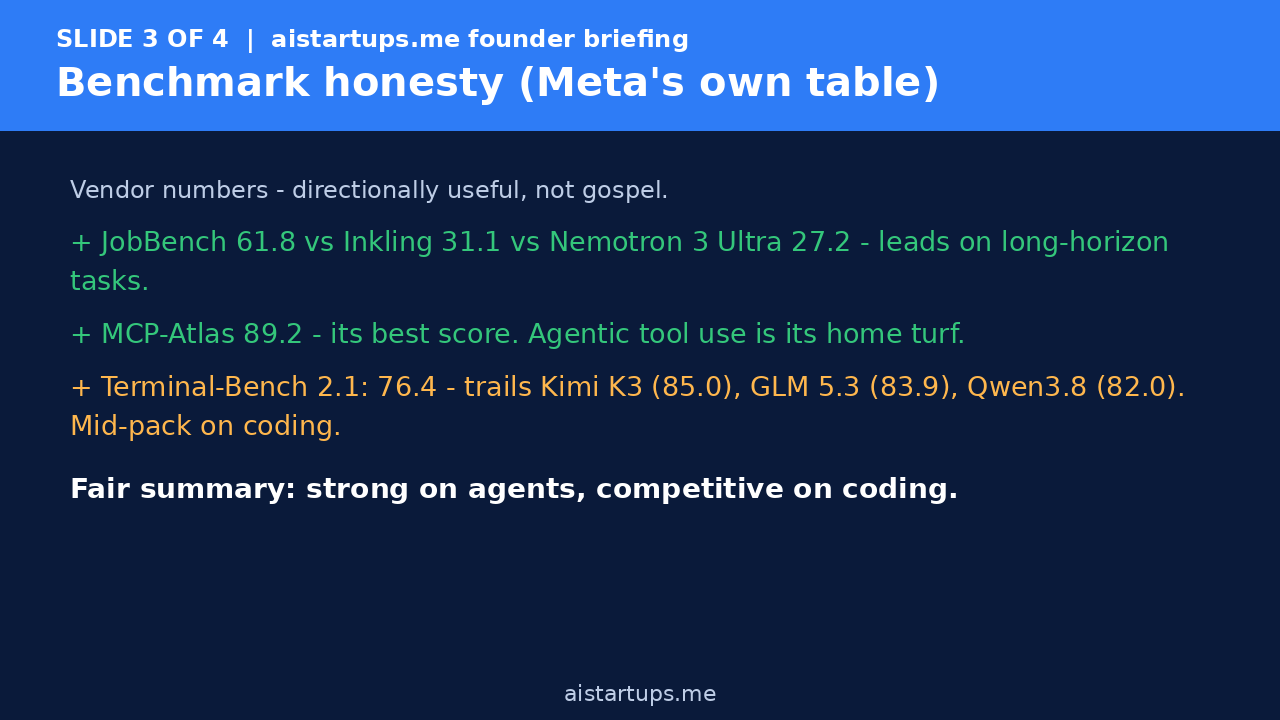
Alright, the benchmarks — with the mandatory caveat that these come from Meta’s own comparison table, so treat them the way you’d treat any vendor’s numbers: directionally useful, not gospel.
On JobBench, Muse Spark Open scored 61.8 against Inkling’s 31.1 and Nemotron 3 Ultra’s 27.2. That’s a genuine lead on that benchmark, and JobBench measures the kind of long-horizon task completion Meta built this thing for. On MCP-Atlas it hit 89.2 — its best showing, and MCP-Atlas tests tool use, which is the beating heart of agentic work.
Then the honest part: on Terminal-Bench 2.1 — a coding benchmark — it scored 76.4, trailing Chinese open models Kimi K3 (85.0), GLM 5.3 (83.9), and Qwen3.8 (82.0). Mid-pack on coding among the large open models. Not embarrassing, not leading.
So the fair summary: strong on agentic tool use, competitive-but-not-best on raw coding. Which is fine, because “best at everything” was never the pitch. The pitch is an open-weight model that’s genuinely good at the long, messy, tool-calling work agents do — and on that axis, the numbers hold up.
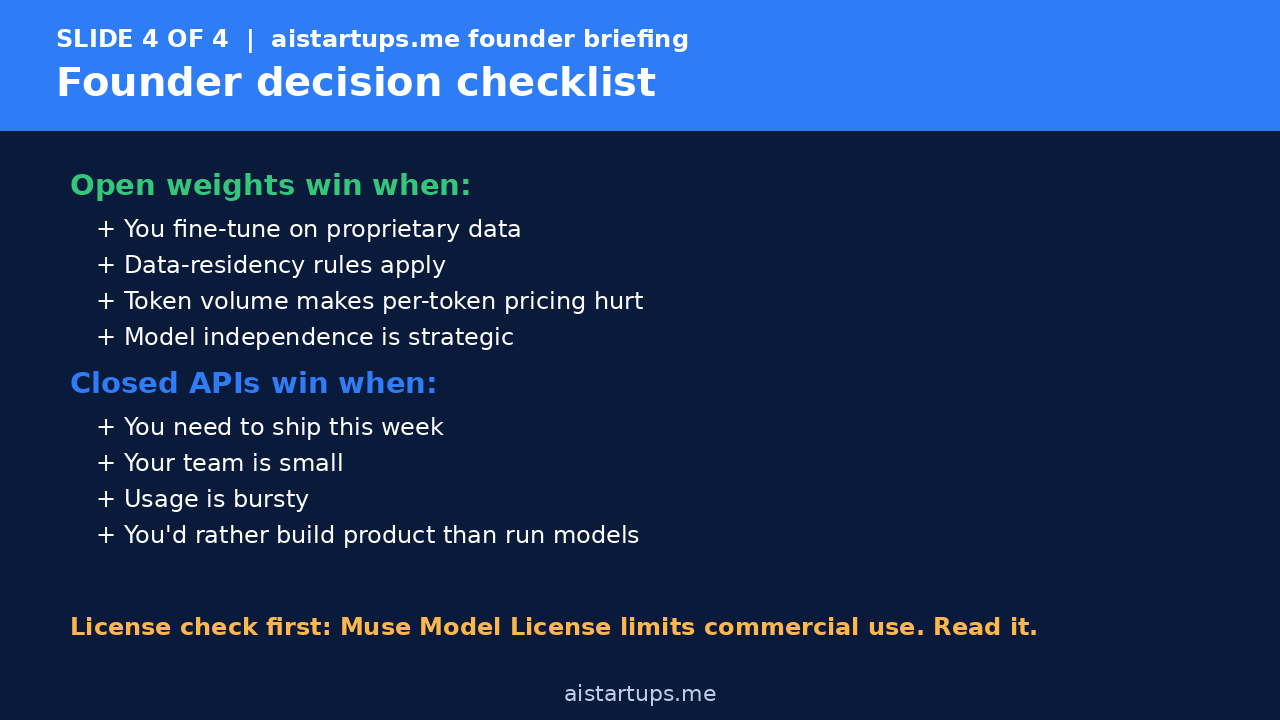
Now the build-vs-rent math. Here’s my checklist for deciding whether open weights (this model) or a closed API (the usual suspects) win for your startup:
- Open weights win when: you need to fine-tune on proprietary data, you have data-residency requirements, your token volume is high enough that per-token pricing hurts, or model independence is a strategic asset (investors do ask about this).
- Closed APIs win when: you need to ship this week, your team is small, your usage is bursty, or you’d rather spend engineering hours on product than on model ops. Most early-stage startups live here, and there’s no shame in it.
If you’re weighing this against the current AI price war between the big closed labs, remember that open weights are a hedge, not just a cost play. Today’s cheap API is tomorrow’s price hike. Having a credible open-weight alternative in your back pocket — even if you’re not using it yet — is negotiating leverage and an insurance policy in one.
What It Can’t Do Yet
Let’s keep the hype in check with a short list of honest limitations. First, it’s text-output only — it can see images, documents, audio, and video, but everything it produces is text. No native image or video generation, so multimodal product ideas need a second model in the stack.
Second, the reasoning_effort dial defaults to xhigh — maximum thinking, maximum cost. If you’re piping this into a high-volume product without touching that setting, you’re burning money on reasoning you might not need. Tune it down for simple tasks; your invoice will thank you.
Third, the ecosystem is one day old. The hosted APIs exist, but the fine-tuning guides, the community evals, the “here’s what breaks in production” blog posts — none of that exists yet. Early adopters get the upside and the sharp edges. If your launch is next month, you might be the one writing the “what breaks” post.
And fourth — the license, again, because it bears repeating — the commercial terms are limited in ways that are still being parsed by people smarter than me. Until the legal dust settles, treat aggressive commercialization plans as provisional.
FAQ
Is Muse Spark Open the same thing as Meta’s Muse Spark assistant?
No — and this is the most common confusion. Muse Spark is Meta’s proprietary AI assistant, live since April 2026. Muse Spark Open, launched October 15, 2026, is the open-weight release of the Spark model line: downloadable weights you can run yourself or access via third-party APIs. Same family, different product, different rules.
Can I actually run it on my own hardware?
Technically yes, practically probably not. Meta’s reference setup is two Apple M5 Ultra Mac Studios with roughly 1TB of unified memory between them, running through Apple’s MLX framework — a $20,000+ investment. Unless you have specific data-residency needs or plan heavy fine-tuning, the hosted APIs (Groq, Together AI, Fireworks AI, and others) or cloud deploys (AWS SageMaker JumpStart, Google Cloud Model Garden, Microsoft Foundry) are the realistic path.
Is it really free for commercial use?
Not exactly. It’s free to download under the Muse Model License, but commercial use is limited — this is Meta’s custom license, not Apache 2.0 or MIT. Read the license text carefully before building a business on it, and get legal review if there’s meaningful revenue at stake. The terms are still being digested by the community.
How does it stack up against the big closed models for coding agents?
On Meta’s own comparison table: it leads on JobBench (61.8) and scores its best on MCP-Atlas (89.2), both of which measure agentic tool use — its home turf. On Terminal-Bench 2.1 coding, it trails several Chinese open models (Kimi K3, GLM 5.3, Qwen3.8). Fair read: strong on long-horizon agentic work, mid-pack on raw coding among large open models. Independent evals will sharpen this picture over the coming weeks.
Should my startup build on it this week?
If you’re prototyping a coding-agent product, yes — spin it up via a hosted API this week and test it against your actual workload; that’s cheap and fast. If you’re deciding your production model strategy, treat it as a strong new option rather than an obvious default: weigh the license terms, benchmark it on your tasks (not Meta’s), and compare total cost against the closed APIs you’re already using. And if you’re chasing profitable AI startup ideas more broadly, the bigger story here is the trend — capable open weights keep getting cheaper to use, and that keeps expanding what a small team can ship.
The Bottom Line
Muse Spark Open is the real thing: the most capable US open-weight model to date (Meta’s claim, and the numbers don’t embarrass it), genuinely built for the agentic coding work that startups actually want to automate, available through real APIs on day one. The 1M-token context and the agentic benchmark scores are the parts worth your attention — not the 816B parameter headline.
But go in clear-eyed. Almost nobody should self-host it — that $20,000 Mac Studio setup is a flex, not a strategy. The license has strings attached that you need to read. And on raw coding benchmarks it’s good, not best. Use it where it’s strong: long-horizon agent tasks, tool-calling workflows, and as a hedge against closed-API pricing.
The smart founder move this week? Sign up for one hosted API, point it at a real task from your backlog, and see what happens. The era where serious AI capability required a serious infrastructure budget is ending — and that’s good news for everyone building on a laptop instead of a data center.