


Yesterday, xAI quietly swapped the engine under every voice agent on its API.
On October 14, 2026, the grok-voice-latest alias started pointing at Grok Voice 3.0 — xAI’s new speech-to-speech model — instead of 2.0. No email. No migration banner. If you built a voice agent on that alias, your callers are already talking to a different model. Surprised? You shouldn’t be. This is how xAI ships: fast, silent, and with benchmark charts that claim first place in everything.
So is 3.0 worth the upgrade? Honestly — yes, with caveats. The benchmarks moved meaningfully. One of them jumped from 56.5% to 71.6%, which is enormous in agent territory. The price didn’t move at all, which in 2026 counts as generosity. And the API is unchanged, so upgrading is a one-line change.
But there’s one gotcha that could bite you, a benchmark where GPT-Live-1 still beats Grok, and real cost math that most launch coverage skips. Let’s get into all of it — what changed, what it costs, where it wins, and the exact playbook for switching without breaking your voice agent.
What Actually Changed (and What Didn’t)
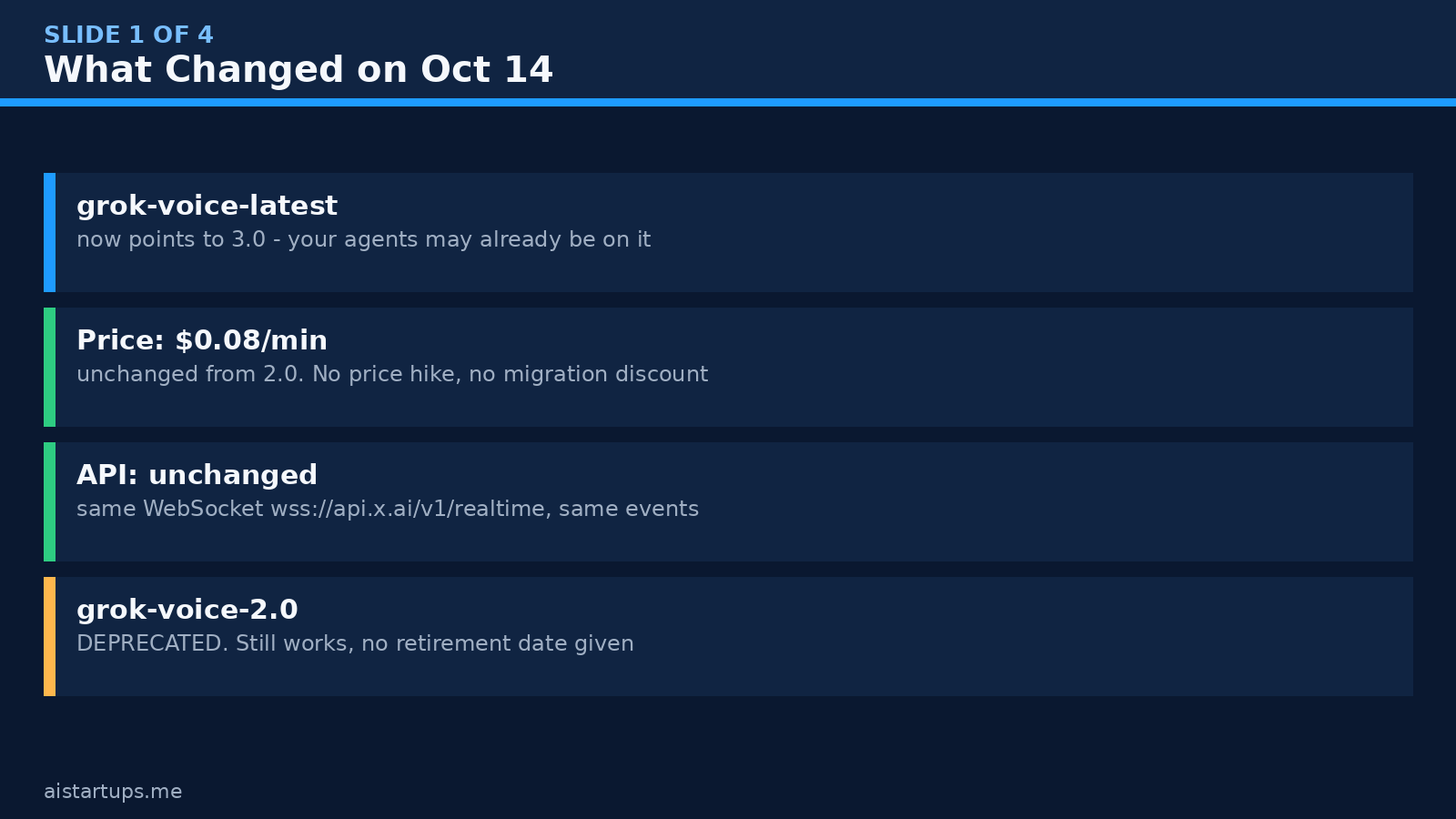
First, the unglamorous but important part: the migration story. xAI announced Grok Voice 3.0 on Oct 14 as an in-place upgrade to the Voice Agent API. The grok-voice-latest alias now resolves to 3.0. If your sessions were pinned to that alias, they upgraded automatically on launch day. You didn’t opt in. You didn’t even get asked.
If that makes you uncomfortable, good. It should. Any model behind a -latest alias can change under you on a Tuesday, and your customers will hear the difference before you do. More on the fix below.
Now what didn’t change, which is arguably the bigger story:
- Pricing is identical. $0.08 per minute of speech-to-speech ($4.80 per hour of talk time) plus $0.004 per text input. That’s unchanged from 2.0 — I checked xAI’s own model pricing page, and the Voice API STS line still reads $0.08/min. A major version bump with zero price increase is rare enough to notice.
- The API is identical. Same WebSocket endpoint (
wss://api.x.ai/v1/realtime), same session parameters, same events. You configure sessions withsession.update— voice, instructions, server-side VAD turn detection, tools — exactly like before. If you’re already wired up, switching models is genuinely a one-string change. - 2.0 still works.
grok-voice-2.0is deprecated but not retired, and xAI hasn’t announced a retirement date. Your fallback path stays open, which matters for the rollback plan.
What did change lives under the hood. xAI shipped a new turn-detection (VAD) model, better full-duplex conversation handling — that’s the natural back-and-forth where callers interrupt and the agent picks up without awkward pauses — and stronger agent behavior around tool use. There are 28 built-in voice IDs to pick from, you can clone a custom voice from a 120-second reference clip, and xAI still recommends ephemeral tokens for client-side apps so your API key never touches the browser.
For a founder’s mental model: this is a better-sounding, better-listening, better-task-executing voice engine that costs the same and plugs into the same socket. The only thing that moved without asking was the alias.
The Benchmarks — With Honest Context
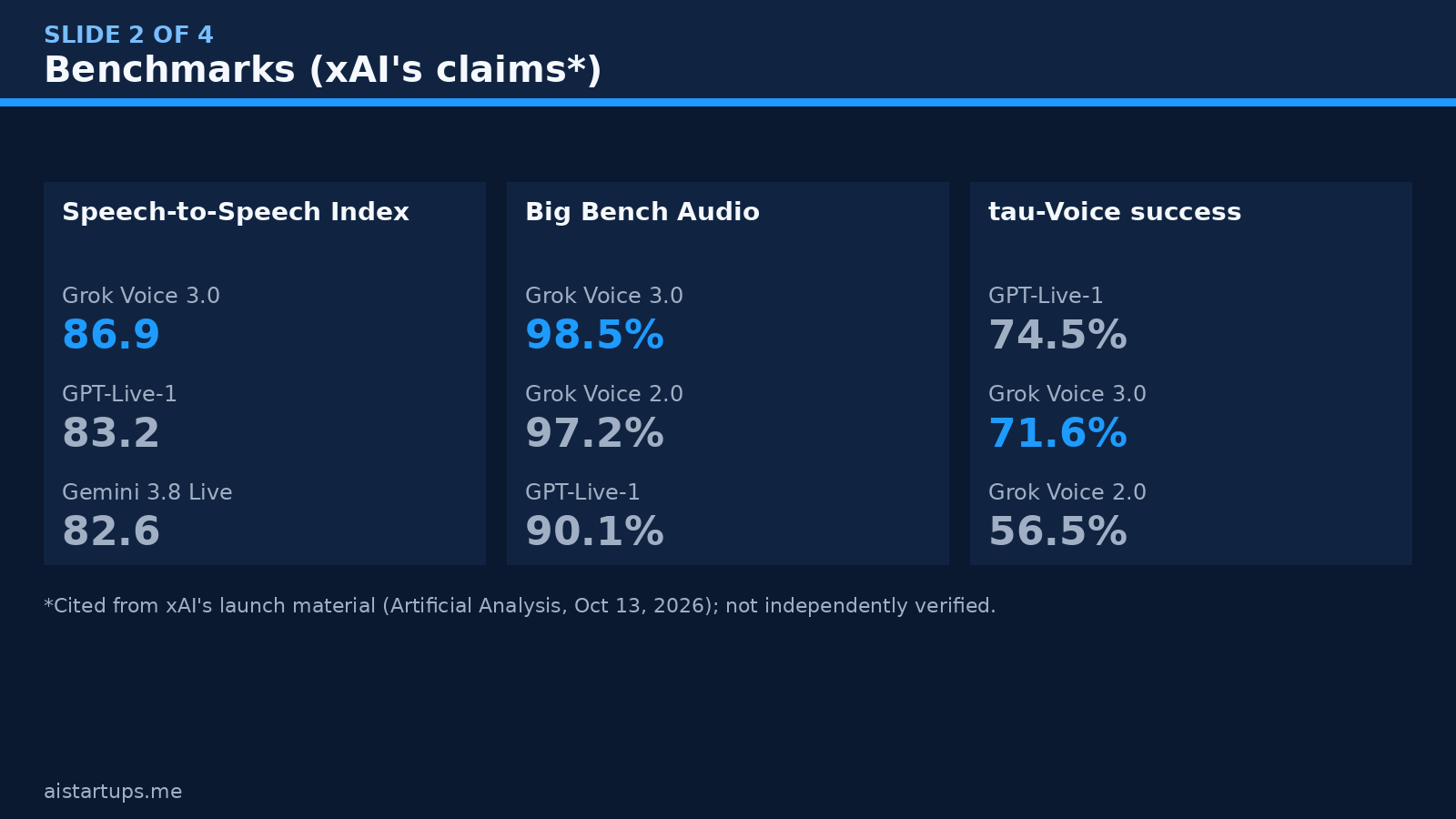
Let me be straight with you about how to read these numbers. Everything below comes from xAI’s launch material, citing Artificial Analysis measurements from October 13, 2026. I have not independently verified them, and neither has anyone else outside xAI’s review loop. Vendor benchmarks are marketing with error bars. That said, the relative gaps are big enough — and specific enough — to be worth your attention.
The headline number: Grok Voice 3.0 scores 86.9 on the Speech-to-Speech Index, taking first place. GPT-Live-1 (the Astra variant, medium setting) sits at 83.2, Gemini 3.8 Live (extended thinking, high) at 82.6, and Grok Voice 2.0 at 81.3. A 3.7-point lead over the nearest rival on an independent-ish audio benchmark is not a rounding error.
The audio-quality scores back it up. Big Bench Audio — which tests the model’s ability to handle real-world messy audio — hits 98.5%, up from 97.2% on 2.0 and well ahead of GPT-Live-1’s 90.1%. The Full Duplex Bench lands at 97.0% versus 95.1% and 94.9% for the two 2.0 variants, which xAI says makes it the best conversational turn-taking on the market. That matters more than it sounds: most voice-agent awkwardness comes from bad interruption handling, not bad voices.
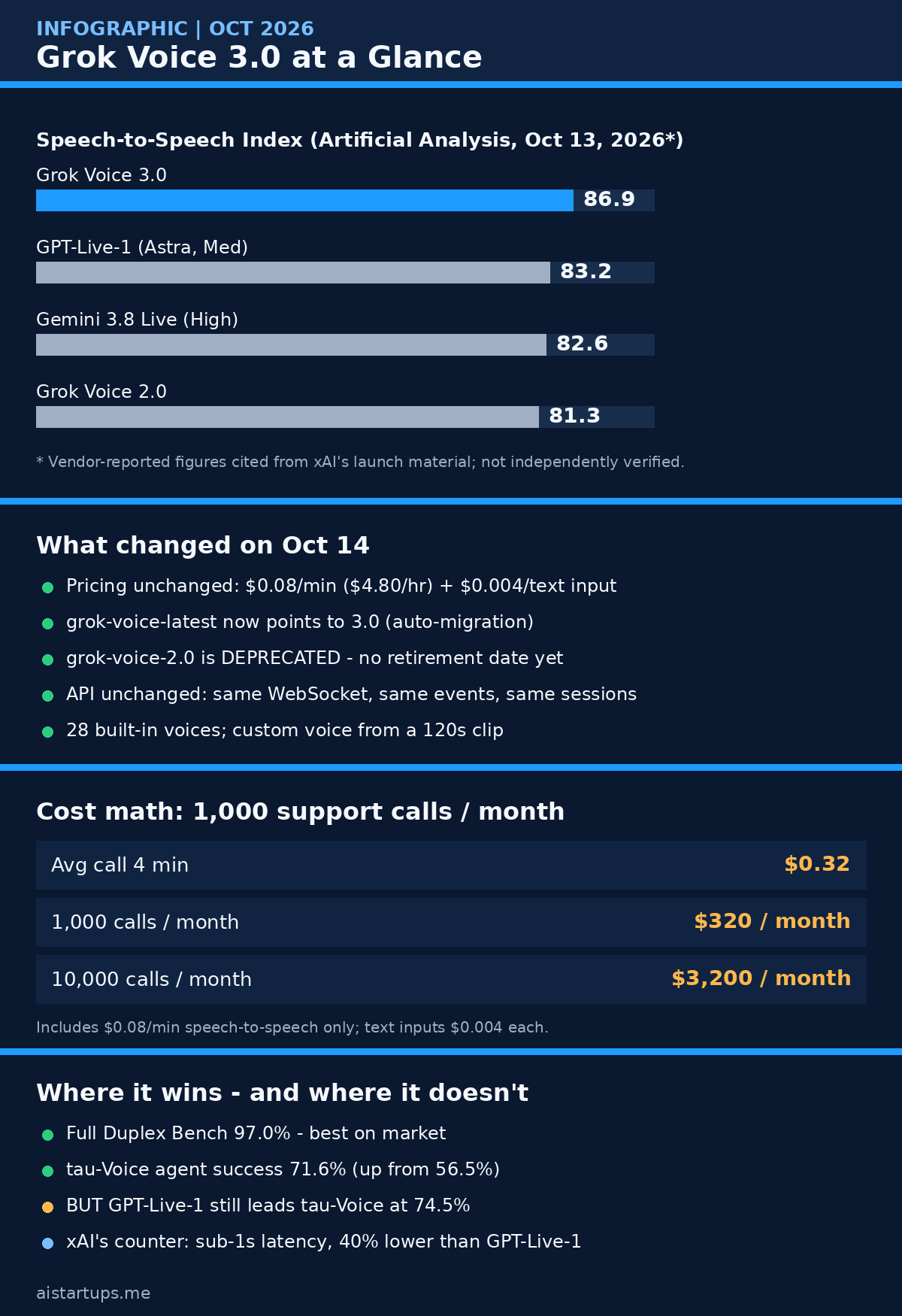
Now the number that made me sit up: tau-Voice agent success rate is 71.6%, up from 56.5% on 2.0. tau-Voice measures whether a voice agent actually completes tasks — booking, ordering, resolving — rather than just sounding nice. A 15-point jump in one generation is the kind of move that changes which products are viable. The average cost per task on Big Bench Audio also dropped to $0.025, versus $0.030 for GPT-Live-1 (Astra, medium) and $0.055 for GPT-Realtime-2.1 (high).
And here’s the honesty you asked for: GPT-Live-1 still leads tau-Voice at 74.5%. xAI didn’t hide this — it’s in their own material — but it deserves a plain reading. If your voice agent does complex multi-step work with tool calls (checking inventory, booking appointments across systems, handling edge cases), the competitor’s agent success rate is still a few points ahead. xAI’s counter-pitch is latency: they claim sub-one-second response times, roughly 40% lower than GPT-Live-1. For a phone call, latency is felt in every single exchange. I’d take the honest tradeoff seriously: slightly higher task completion on one side, noticeably snappier conversation on the other. Which matters more depends on what your agent does — more on that below.
Two more scores for completeness. On the Speech Agent Arena, Grok Voice 3.0 posts an Elo of 1070 against GPT-Live-1’s 1011, with task success at 94.8% vs 94.6% — basically a wash with a better Elo. And on EVA-Bench, the enterprise voice-agent benchmark run by ServiceNow, xAI claims 3.0 holds the highest accuracy at 74%. Enterprise buyers tend to notice that one.
What about real-world proof? xAI says the model already powers millions of conversations a day across Tesla and SpaceX. Tesla vehicles use it for hands-free tasks through Connectors and Grok Bot voice mode. The most concrete operational claim:
Starlink call centers handle 20,000 calls a day across multiple languages with Grok Voice — about 70% resolved without a human agent, and 1 in 4 sales calls ending in a purchase.
Read that as what it is: an xAI claim, not an audited figure. But it’s the right kind of evidence — a production phone operation, not a demo. If you’re evaluating for a real support line, ask xAI for a reference call with someone running comparable volume. That’s the one benchmark no chart can replace.
The Money: What 1,000 Support Calls Actually Costs
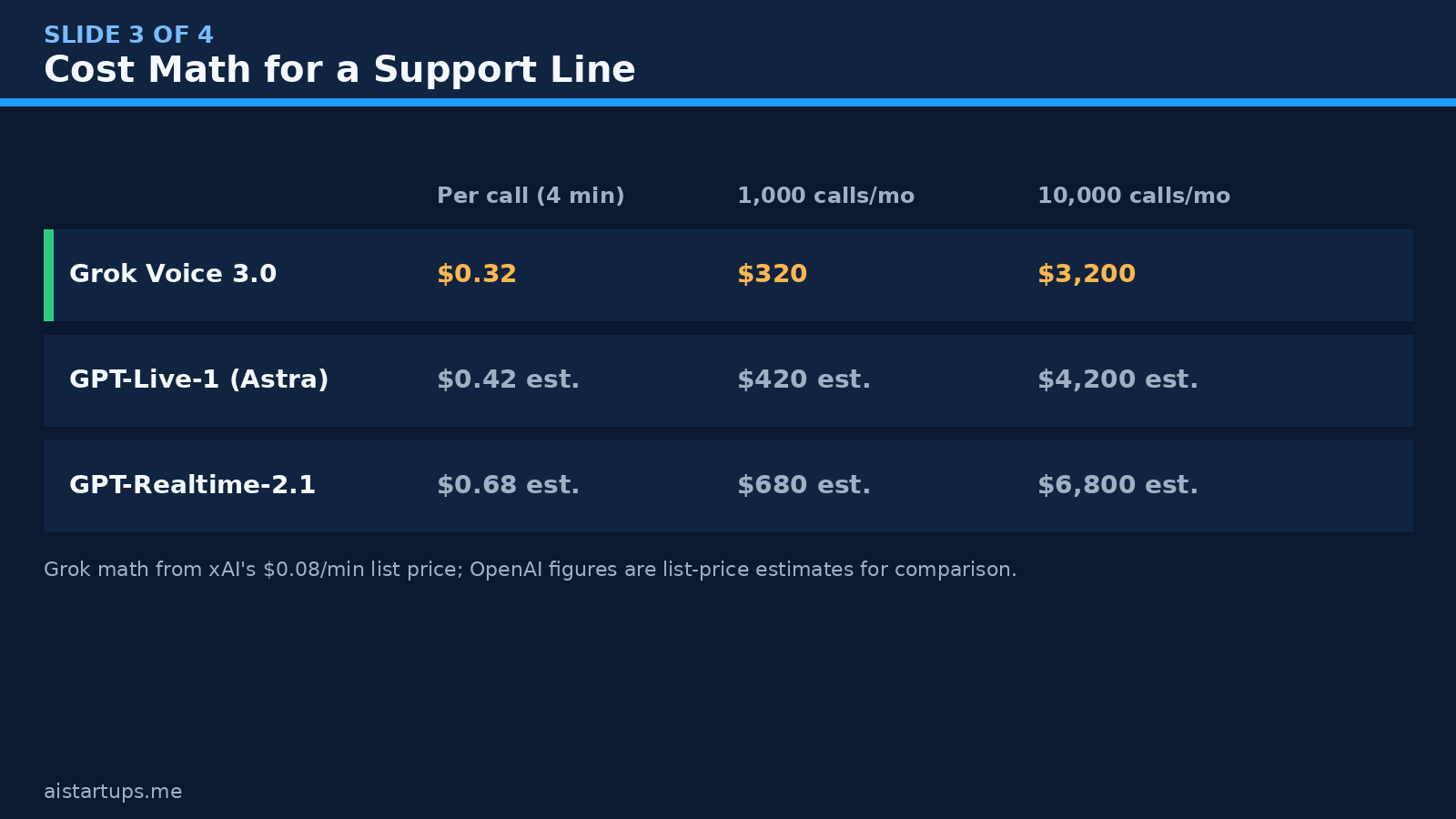
Let’s do the math xAI won’t do for you. At $0.08 per minute, a four-minute support call — a pretty standard average — costs $0.32 in speech-to-speech API time. Scale that up:
- 100 calls/month: ~$32 — less than a team lunch
- 1,000 calls/month: ~$320/month
- 10,000 calls/month: ~$3,200/month
- 100,000 calls/month: ~$32,000/month
Don’t forget the small print: $0.004 per text input on top. That covers things like tool results or text prompts fed into the session — pennies per call at normal volumes, but worth tracking once you scale. Log your per-call cost weekly. It’s the one metric that tells you whether your voice line is a feature or a bonfire.
How does that stack up? Against OpenAI’s voice offerings, Grok Voice 3.0 is the cheapest option per xAI’s numbers — $0.025 average cost per Big Bench Audio task versus $0.030 for GPT-Live-1 (Astra, medium) and $0.055 for GPT-Realtime-2.1 (high). Against a human, it’s not close: an offshore support agent costs roughly $4–6 per hour of talk time, and Grok runs $4.80 per hour while also working at 3 a.m., handling unlimited simultaneous calls, and never quitting. The business case for voice agents was already made in 2025; 3.0 just improves the unit economics.
One founder-to-founder warning: the API bill is the easy part. The real cost of a voice agent is the telephony plumbing, the tool integrations, the prompt engineering, and the month you spend listening to call recordings at 1.5x speed fixing edge cases. Budget for that. And if your API spend starts creeping, the playbook in our guide to cutting your AI API bill by 70% applies to voice just as well as it does to chat.
Where 3.0 Wins — and Where It Doesn’t
Buying decisions need a scorecard, not a press release. Here’s mine.
Buy Grok Voice 3.0 when:
Call volume is high and latency matters. Sub-second response time at $0.08/min is the combination that built the Starlink call-center case. If your product is a phone agent handling thousands of calls — support, scheduling, order status, intake — the economics and the snappiness both point at Grok.
Interruptions are part of the job. Full Duplex Bench at 97.0% is the single most product-relevant score in the launch. Real callers interrupt, talk over the agent, change their minds mid-sentence. If 2.0 ever left your callers talking into dead air, 3.0’s turn-taking is the upgrade that fixes it.
You want one throat to choke. Speech-to-speech in a single model means no separate transcription-to-LLM-to-TTS pipeline to babysit. One endpoint, one bill, one thing to debug at 2 a.m. For a small team, that simplicity is a feature.
Think twice when:
Your agent does complex multi-step tasks. tau-Voice is the honest score here, and GPT-Live-1’s 74.5% still beats Grok’s 71.6%. If your agent has to chain tool calls across multiple systems — check the CRM, verify inventory, book the slot, confirm by email — run both models against your own 20 most complex test scenarios before committing. Benchmarks are hints; your call recordings are evidence.
You need the deepest ecosystem. OpenAI’s tooling, docs, and third-party integrations are still broader. xAI’s docs are good and improving, but if you’re building on a platform that already assumes OpenAI, switching has integration costs the per-minute savings may not cover.
For the broader field, our roundup of the 11 best AI voice tools for startups in 2026 covers where each voice model fits. Grok Voice 3.0 now sits firmly at the top of the “cheap, fast, great-sounding phone agent” slot — which, frankly, is the slot most startups actually need.
The Silent Migration Gotcha: Pin Your Model ID
Let’s talk about the thing that actually matters for anyone already running a voice agent. On October 14, every session pinned to grok-voice-latest started getting 3.0. That’s fine if you wanted the upgrade. It’s a problem if you had a tuned system prompt, a carefully picked voice, and a QA process built around 2.0’s behavior — because none of that transfers automatically. The model changed; your prompts didn’t. The voice ID might resolve to a slightly different-sounding voice. The VAD turn detection is new, so your interruption behavior shifted.
The dev community flagged this within hours of the flip: if your agents call the -latest alias, you were auto-upgraded with no say in the matter. Here’s the safe way to handle it:
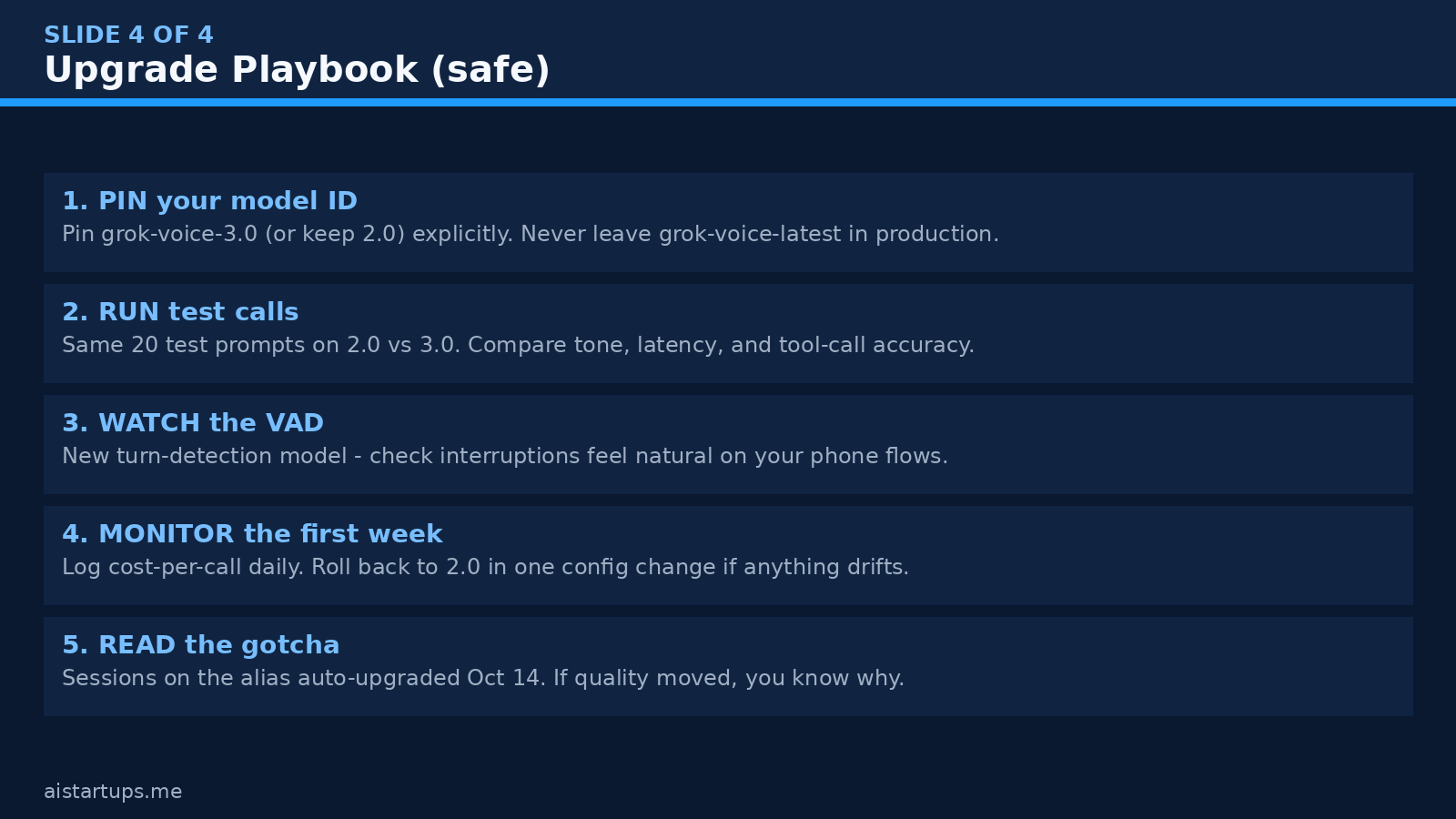
- Pin your model ID today. Go into your config and replace
grok-voice-latestwithgrok-voice-3.0explicitly. Or pingrok-voice-2.0if you want to hold the old behavior while you test. The rule is simple: never leave a-latestalias in production. Treat model IDs like dependency pins — because that’s what they are. - Run the 20-call test. Pick your 20 most common caller scenarios — the angry refund request, the confused elderly caller, the person who interrupts twice, the edge case with the weird product name. Run all 20 on 2.0 and all 20 on 3.0, and score them the same way. You’re checking tone, interruption handling, and tool-call accuracy. Twenty calls is about $6.40 at list price. Cheap insurance.
- Watch the VAD like a hawk. The new server-side voice activity detection changes when the agent decides you’ve finished talking. On phone flows, this is the difference between “snappy” and “rude.” Listen to the first 50 real calls after upgrading. If callers start getting talked over, adjust the VAD sensitivity in
session.updatebefore you blame the model. - Re-check your voice. There are 28 built-in voice IDs, and the alias flip can change which voice you actually get. Play the new voice through a real phone call, not just studio headphones. Phone audio compression is unforgiving — a voice that sounds warm on your laptop can sound tinny through a carrier.
- Monitor week one, keep the rollback loaded. Log cost per call, containment rate (calls resolved without a human), and caller complaint rate daily. If anything drifts, rolling back is one config change — that’s the whole point of step one. xAI hasn’t announced a 2.0 retirement date, so your fallback is safe for now. As one migration writeup put it, the upgrade is painless precisely because the API didn’t change — the WebSocket, the session events, everything else stayed put.
For the devs in the room: nothing about your integration code changes. Open the WebSocket to wss://api.x.ai/v1/realtime, send session.update with your voice, instructions, VAD settings, and tool definitions, and stream audio. For client-side apps, mint ephemeral tokens server-side so your API key stays on your servers. That’s it. The whole migration is a config diff, which is why xAI could afford to do it silently — and why you should pin anyway.
Five Things Actually Worth Building With 3.0
Benchmarks are fun. Businesses are better. Here are the use cases where 3.0’s combination of sub-second latency, $0.08/min pricing, and 97% full-duplex handling makes the economics genuinely work for a startup:
1. The phone agent for local businesses
This is the boring one that prints money. Dental clinics, plumbers, HVAC companies, law firms — they all miss calls, and missed calls are lost revenue. A 3.0-powered agent that answers, books appointments into their calendar, and texts a confirmation costs you ~$0.32 per call and sells for $300–1,000/month per business. The full-duplex upgrade matters here more than anywhere: real customers interrupt, ramble, and talk over the agent. That was the weak point of 2.0. It’s 3.0’s best score.
2. AI-first customer support lines
If you already run a support operation, 3.0 is a straight upgrade for the tier-one layer: order status, password resets, billing questions, appointment changes. The Starlink numbers — 70% resolved without a human — are the target to benchmark yourself against. Route the rest to humans with a warm handoff. Our comparison of the 8 best AI customer support tools covers where a voice layer fits alongside chat and email.
3. Intake and qualification agents
Sales teams drown in unqualified leads. A voice agent that calls every inbound lead within five minutes, asks three qualifying questions, and books the good ones into a rep’s calendar is one of the highest-ROI builds in this space. 1 in 4 of Starlink’s sales calls ending in a purchase is an xAI claim, not a guarantee — but even a fraction of that justifies the $0.32-per-call cost.
4. In-app voice assistants
If your product has a mobile app, a voice mode powered by 3.0’s realtime WebSocket is now cheap enough to ship as a default feature rather than a premium upsell. Ephemeral tokens keep it secure client-side. The 28 built-in voices — or a custom voice cloned from 120 seconds of audio — let you match your brand instead of shipping the same generic assistant voice as everyone else.
5. Multilingual support without the hiring
Starlink runs those 20,000 daily calls across multiple languages on the same model. If your customer base spans languages, a single voice agent that switches languages mid-conversation replaces a hiring plan. That’s not a small thing for an early-stage team.
Now the practical part: wiring up the realtime WebSocket, the telephony provider, the tool functions, and the fallback logic is a solid few weeks of engineering for a small team — especially if you’ve never shipped a realtime audio pipeline. If you don’t have that bandwidth in-house, it’s exactly the kind of build that AISquadX takes on: a web development studio that ships AI products, voice agents included. Either way, budget the engineering honestly before you promise a client a launch date.
And for context on where Grok itself sits in xAI’s lineup, our Grok 4.7 founder’s guide covers the text model side — worth reading if you’re pairing a voice front-end with a Grok reasoning back-end.
FAQ
Is Grok Voice 3.0 more expensive than 2.0?
No. Pricing is unchanged: $0.08 per minute of speech-to-speech ($4.80 per hour) plus $0.004 per text input, per xAI’s pricing page. A major version bump with no price increase is genuinely unusual in 2026.
Will my existing voice agent break after the Oct 14 update?
The API didn’t change, so no code breaks. But if your sessions were pinned to the grok-voice-latest alias, they’re now running on 3.0 — the voice, the turn-taking behavior, and the agent’s task performance may all have shifted. Run the 20-call test above and pin your model ID explicitly.
Is grok-voice-2.0 going away?
It’s deprecated, but xAI hasn’t announced a retirement date, and it still works. Treat it as your rollback option: keep it pinned in a staging config so you can switch back with one change if 3.0 misbehaves on your flows.
Is Grok Voice 3.0 really better than GPT-Live-1?
Depends on the metric, and you should hear the honest version. Grok Voice 3.0 leads on the Speech-to-Speech Index (86.9 vs 83.2), Big Bench Audio (98.5% vs 90.1%), and cost per task ($0.025 vs $0.030). GPT-Live-1 still leads on tau-Voice agent task success (74.5% vs 71.6%). xAI’s counter is latency — sub-one-second, claimed 40% lower. For high-volume phone work, I’d lean Grok; for complex multi-step agent tasks, test both against your own scenarios. All benchmark figures are xAI’s claims citing Artificial Analysis, not independent verification.
How much does a voice support line cost per month?
At list price, a 4-minute call costs about $0.32. So 1,000 calls a month runs ~$320, and 10,000 calls ~$3,200 — plus $0.004 per text input (tool results, prompts) on top. Log your actual per-call cost weekly; it’s the metric that tells you whether the line is healthy.
The Bottom Line
Grok Voice 3.0 is the rare upgrade that’s better, cheaper-feeling, and free to adopt. Same price, same API, meaningfully better benchmarks — and one score (full-duplex conversation at 97.0%) that fixes the exact thing that made older voice agents feel awkward on real calls.
Two things to actually do today: pin your model ID instead of trusting the -latest alias, and run your own 20-call test before you declare the upgrade done. The benchmarks are xAI’s; your call recordings are yours.
If you’re building a phone agent, a support line, or a voice feature in the next quarter, 3.0 just became the default starting point for the “fast and cheap” slot — and it’s worth a serious look even if you were settled on OpenAI. The voice-agent race is moving fast. This one moved yesterday.