


OpenAI did it again. Yesterday — November 17, 2026 — they shipped two new models at once, and if you run a startup that lives inside AI tools, this one actually matters. Not in the vague “the future is here” way. In the “your API bill just changed and your competitor’s pitch deck just got better” way.
Here’s the short version. GPT-6.2 Astra is the new flagship, built for the hardest professional work: investor decks, legal documents, valuation workbooks, serious code. GPT-6.2 Sol is the everyday model — cheaper, faster, and, honestly, the one most of us will use most of the time. Astra costs four times what Sol costs per token. And Sol, on some tests, nearly keeps up with Astra anyway.
That tension — the expensive model versus the cheap one that refuses to stay in its lane — is the whole story of this release. I spent the morning reading OpenAI’s announcement, cross-checking the prices on their pricing page, and reading what independent watchers like The Parameter had to say. What follows is the founder’s version: what it costs, what the numbers really mean, where you can actually use these models, and the four-step playbook I’d follow before switching anything in production.
One thing before we start. Every benchmark in this article is OpenAI’s own number. I’ll say that every time it matters, because vendor benchmarks are marketing with a spreadsheet attached. The prices, though — those I checked against OpenAI’s own pricing page, and they’re real.
What actually launched yesterday
Two models, one release, two very different jobs. OpenAI’s own words: Astra is “our new frontier model for your hardest projects” and Sol is “our efficient, versatile model for everyday work.” Both, they say, deliver better results on demanding tasks with fewer output tokens — which means you get more done inside your usage limits before the meter starts hurting.
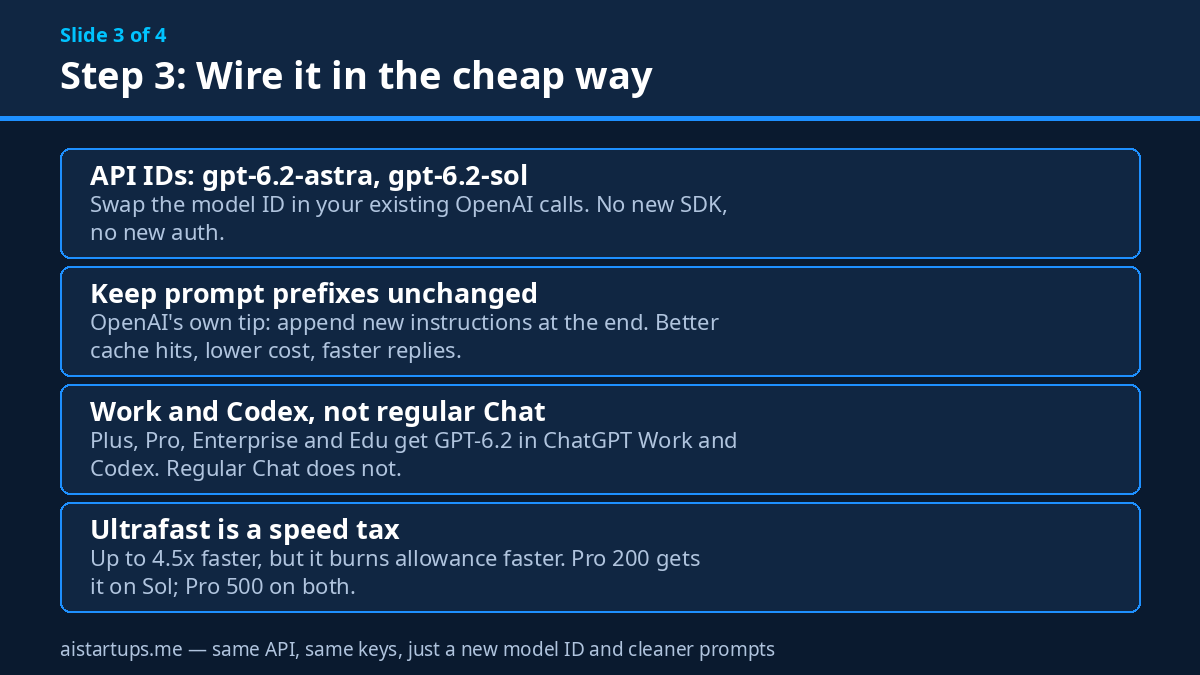
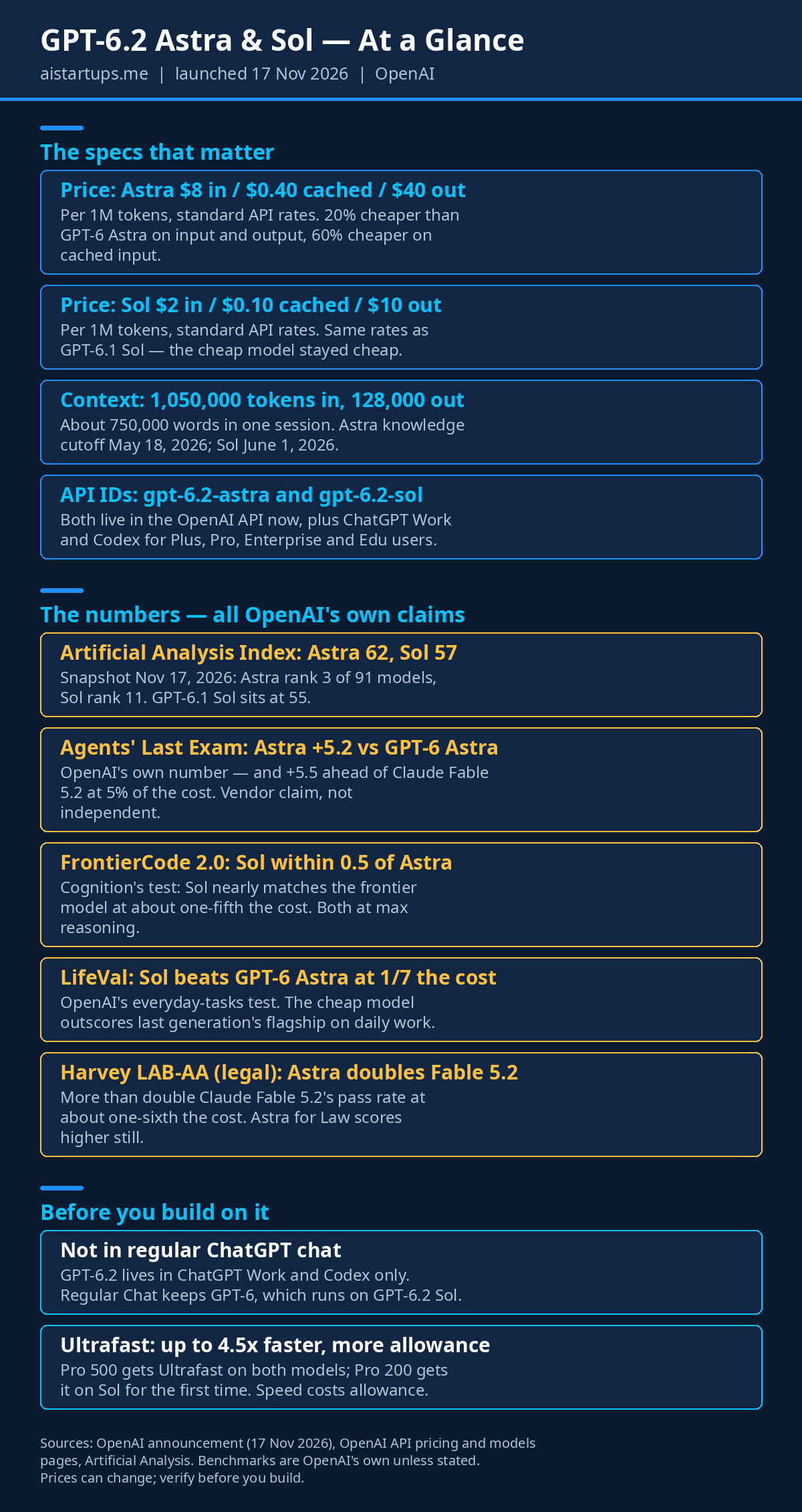
The API IDs are gpt-6.2-astra and gpt-6.2-sol. If you’re already calling the OpenAI API, switching is literally a model-ID change. No new SDK, no new auth flow, no migration project. That’s the good news, and it’s genuinely good news — the last few model generations have trained founders to expect a week of plumbing work with every release, and this one doesn’t ask for it.
Both models share the same big spec sheet: a 1,050,000-token context window and up to 128,000 tokens of output per response. To put that in plain terms, you can feed either model roughly 750,000 words — a whole codebase, a data room, a year’s worth of support tickets — and get back a very long answer. The knowledge cutoffs differ slightly between the two, which is a detail worth knowing if your work touches recent events: Astra’s cutoff is May 18, 2026, while Sol’s is June 1, 2026, according to OpenAI’s models page.
So where does this sit in the family? Astra replaces GPT-6 Astra, which launched in September. Sol replaces GPT-6.1 Sol. And if you’re wondering about the visual-reasoning side of the family, our GPT-6.1 Terra guide covers the model built for that job. The pace here is worth pausing on for a second: OpenAI has now shipped three generations of this lineup in about two and a half months. If your product roadmap assumes the model underneath it stays still for a year, that assumption is dead. Plan for a new model every quarter, and build your prompts and evals so swapping models is a config change, not a project.
The price table, translated into founder money
Real talk: per-token prices are the least useful number in AI pricing, and also the only number anyone publishes. So let’s do both — the table, then what it means for an actual job.
Standard API rates, per million tokens:
- GPT-6.2 Astra: $8 input, $0.40 cached input, $40 output
- GPT-6.2 Sol: $2 input, $0.10 cached input, $10 output
Astra is 20% cheaper than GPT-6 Astra on input and output ($10 and $50 before), and 60% cheaper on cached input (down from $1.00 to $0.40). Sol keeps GPT-6.1 Sol’s rates exactly — same $2, same $0.10, same $10. OpenAI cut the flagship’s price and left the cheap model alone, which tells you where they think the competition is: at the top, against Anthropic.
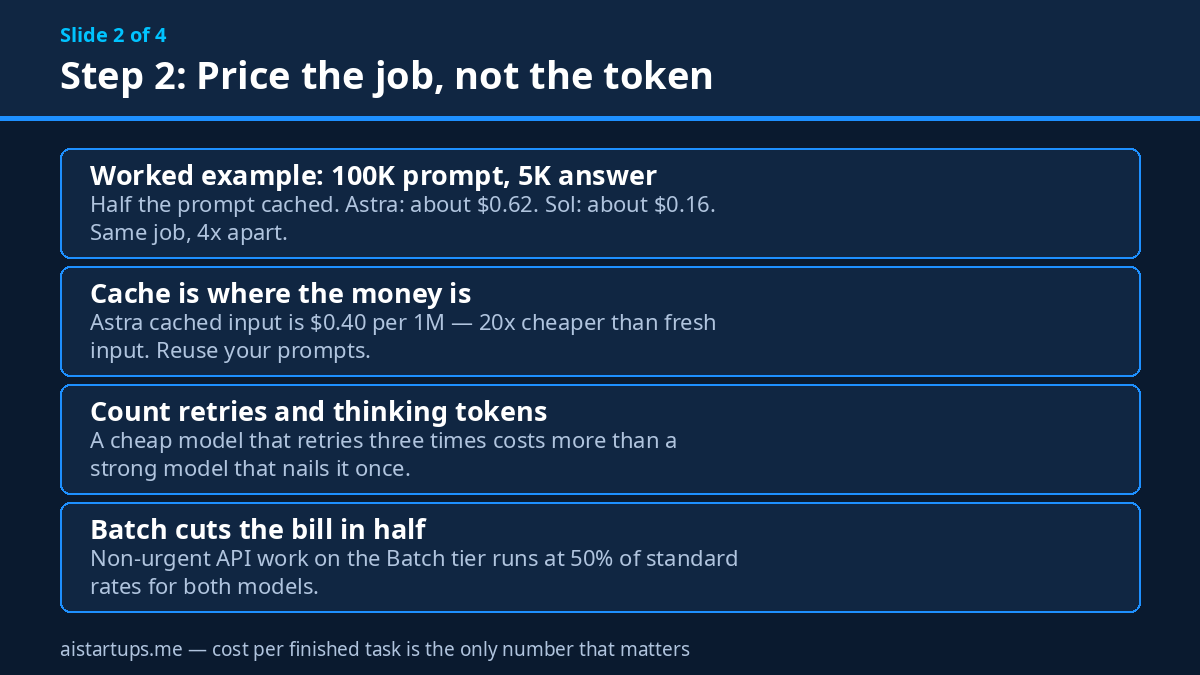
Now the worked example, because this is the number that should drive your decision. Say a job sends a 100,000-token prompt and gets a 5,000-token answer back, with half the prompt served from cache:
- Astra: 50K fresh input at $8 per million ($0.40) + 50K cached at $0.40 per million ($0.02) + 5K output at $40 per million ($0.20) = about $0.62
- Sol: 50K fresh input at $2 per million ($0.10) + 50K cached at $0.10 per million ($0.005) + 5K output at $10 per million ($0.05) = about $0.16
Same job. Four times the price. And here’s the thing — that gap is the whole decision. If Sol does the job well, every Astra call is money you set on fire. If Sol does it badly and you retry twice, you’ve spent more than Astra would have cost once. Cost per finished task is the only number that matters, and per-token prices are just the ingredients.
A few more pricing details worth knowing. The Batch tier runs both models at half the standard rate — Astra at $4 in and $20 out, Sol at $1 in and $5 out — if your work can wait for off-peak processing. Cached input is the real bargain in this release: Astra’s cached tokens cost twenty times less than fresh ones, so any workflow that reuses the same prompt prefix — a system prompt, a company knowledge base, a standard document template — gets dramatically cheaper the more you repeat it. And one wrinkle to watch: very long prompts cost more. OpenAI’s pricing page has a separate long-context tier, so if your prompts run past 272,000 tokens, check the rate card before you estimate a budget.
If API costs are already a sore spot for you, this is the moment to get systematic about them — we wrote a whole guide on cutting your AI API bill by 70 percent, and most of the tricks in it (caching, batching, routing easy work to cheap models) apply directly to this release.
The benchmarks — and why you should read them twice
Look, I need to be straight with you about this section. Every number below comes from OpenAI. Not from an independent lab, not from a peer-reviewed paper — from the company selling the models. That doesn’t make the numbers fake. It makes them a starting point, not a verdict. Treat them the way you’d treat a startup’s own pitch deck: useful, directional, and worth verifying against your own work before you bet money on them.
Both models deliver better results on demanding tasks with fewer output tokens, so you can get more done within your usage limits. — OpenAI, announcing GPT-6.2 Astra and Sol
With that caveat nailed to the wall, here’s what OpenAI claims.
Agents’ Last Exam: Astra’s headline win
On Agents’ Last Exam, which tests multistep professional work, Astra scores 5.2 points higher than GPT-6 Astra at less than a third of the cost — and 5.5 points ahead of Claude Fable 5.2 at just 5% of the cost. That’s the headline, and it’s a strong one. The fine print: Fable’s leaderboard score excludes nine tasks that used a fallback model. Does that invalidate the comparison? No. Does it mean you should read the exact gap with a grain of salt? Yes, absolutely.
Science: Astra’s best case
OpenAI calls Astra “the best model in the world for scientists,” and this is where the claim is loudest. On Terminal-Bench-Science 0.1, which tests scientific work in a terminal, Astra scores 9 points higher than GPT-6 Astra at under a third of the cost, and it sets a new high on the Vals Science Index too. If your startup does anything in biotech, research tooling, or lab automation, this is the benchmark to care about — and also the one most worth testing yourself, because science benchmarks are exactly where vendor optimism tends to run hottest.
GDPval v2: the real-work test
GDPval v2 is OpenAI’s internal benchmark built from real consulting, finance, and design projects — long, messy, multi-step work, the kind founders actually pay for. Astra is up 6.2 points over GPT-6 Astra while using 22% fewer output tokens. Sol is up 5.3 points over GPT-6.1 Sol. The token-efficiency part matters more than it sounds: fewer output tokens means cheaper answers and faster responses, not just better scores. A model that scores higher while writing less is a model that saves you money twice.
The Sol story: nearly as good, for a fifth of the price
Here’s the number that should make every founder pause. On FrontierCode 2.0 — Cognition’s test of whether code changes meet real maintainers’ standards for merging — Sol comes within 0.5 points of Astra at about one-fifth the cost, both models running at maximum reasoning. Half a point. One-fifth the price. For most coding work, that’s not a close call at all.
And it gets better for Sol. On LifeVal, OpenAI’s test of everyday tasks — shortlisting kindergartens after a move, finding a home that fits a budget and a commute, planning meals for a parent adjusting to a new diagnosis — Sol outscores GPT-6 Astra, the previous flagship, at about one-seventh the cost. The cheap model now beats last quarter’s flagship on daily work. That’s the kind of shift that should change your default model, not just your curiosity.
Legal work: Astra’s clearest win
On Harvey LAB-AA v1.1, which tests legal assignments — finding the relevant facts across source documents, applying them to a detailed brief, producing a deliverable that meets every requirement — Astra more than doubles Claude Fable 5.2’s pass rate at about one-sixth the cost. There’s also a special configuration, “Astra for Law,” that scores higher still. If you’re building legal tech, this is the single most relevant number in the whole release. The test only gives credit when a deliverable meets every grading criterion with no material hallucinations, which is a much tougher bar than most benchmarks set.
The independent check: Artificial Analysis
The one set of numbers in this release that doesn’t come from OpenAI is the Artificial Analysis Intelligence Index. Their v5 snapshot from November 17 puts Astra at 62 (rank 3 of 91 models) and Sol at 57 (rank 11), with GPT-6.1 Sol at 55. On AA-3D, where human judges compare blinded interactive experiences built from the same prompt, Astra ranks first at 1,318 Elo, ahead of Fable 5.2 at 1,271 and Sol at 1,259. And on AA-AnalystAgent — real spreadsheets and reports, including a task that uses California Medicaid’s expenditure reports to calculate medical-transport spending — Astra answers 62.5% of questions correctly on all five independent attempts, a new high.
Astra vs Sol vs Claude Fable 5.2
No model launches in a vacuum, and this one lands nine days after Anthropic’s Claude Fable 5.2 — which is clearly the rival OpenAI had in mind. The pricing tells the story before the benchmarks do. Fable 5.2 costs $8 per million input tokens and $40 per million output tokens, according to Anthropic’s pricing page — exactly the same as Astra’s new rates. That’s not a coincidence. OpenAI cut Astra’s price to match Fable dollar for dollar, then claimed to beat it on the benchmarks at a fraction of the cost per task.
On the independent Artificial Analysis Index, Fable 5.2 still leads: 64.6 in our Claude Fable 5.2 founder’s guide, against Astra’s 62 and Sol’s 57. So the honest picture is split. OpenAI’s own tests say Astra wins big, especially on professional and legal work. The independent index says Fable is still ahead overall, with Astra close behind in third place. Both things can be true at once — different tests measure different strengths, and Astra’s edge is concentrated in the professional-work tests OpenAI designed, while Fable holds the broader crown.
So which one should you build on? Here’s how I’d think about it. If your product lives in legal, finance, or scientific work — the fields where Astra’s training was focused — Astra is now a serious challenger to Fable at the same sticker price and, by OpenAI’s numbers, much lower cost per finished task. If your work is coding, writing, planning, and agentic workflows, Sol at $2 per million input tokens is the value play of the year, and Fable’s premium price gets harder to justify for those jobs. And if you’re already deep in the Claude ecosystem with Code and custom tooling, switching costs are real — don’t switch on benchmark scores alone. Run your own work through both and compare cost per finished task. That’s the only comparison that pays rent.
Where you can actually use them (and where you can’t)
This is the part that trips people up, so let me be very clear. GPT-6.2 Astra and Sol are available in ChatGPT Work and Codex for Plus, Pro, Enterprise, and Edu users. They are not in regular ChatGPT chat. If you open the normal ChatGPT window and look for them, you won’t find them — regular Chat keeps GPT-6, which runs on GPT-6.2 Sol under the hood. Enterprise and Edu users need their workspace admin to enable access first, so if you’re on a company plan and the models aren’t showing up, that’s a conversation with your admin, not a bug.
Developers get both models through the API from day one, which is where most founders will actually meet them. And then there’s Ultrafast, the speed tier, which got its first real shake-up in this release. Pro 500 subscribers get Ultrafast on both models. Pro 200 subscribers get it for the first time — starting with Sol. OpenAI’s own speed docs say Ultrafast generates tokens at up to 4.5 times the speed of Standard on the same model, and the press coverage of the launch confirms that figure. The catch, as always, is allowance: Ultrafast burns through your included usage at six times the Standard rate, according to OpenAI’s docs, and on the API it bills at three times the standard rate through February 2027. Speed is never free. It’s a trade, and you should only make it when waiting is genuinely more expensive than tokens — a live customer demo, a deadline crunch, an agent run that’s blocking a human. For background jobs, Standard is the right speed and Batch is cheaper still.
One more practical note. If you’re on Pro 200, you now have Ultrafast on Sol but not on Astra. That’s a deliberate wedge — OpenAI wants the $500 tier to stay attractive — and it shapes the routing decision nicely: your fast, cheap, everyday work can run at Ultrafast speed on Sol, while your Astra work runs at Standard unless you pay up. For most startups, that’s actually a sensible split.
What Astra is actually good at
Benchmarks aside, what does Astra do differently in your hands? OpenAI trained it specifically for professional outputs, and the list of improvements reads like a founder’s wish list. Slides, spreadsheets, and documents that follow the template you provide and the conventions of your field — law, sales, finance, accounting — instead of drifting into generic AI formatting. Writing that’s more direct and specific, with fewer generic takeaways and less filler. Cleaner code, with more focused tests and fewer rounds of revision. Better frontends, especially websites, gaming, and 3D design.
The slides example in the announcement is worth a look. OpenAI gave both models the same public slide template and asked them to pitch animal-themed merch for four teams. Astra produced something closer to a finished field guide — consistent layouts, team-specific jokes, all eight designs shown as enamel pins, T-shirts, and stitched backpack patches, plus downloadable vector artwork and production instructions. The older model showed one design per team and stopped there. The difference isn’t polish for its own sake; it’s fewer edits between the model’s output and something you can actually show a customer.
The same pattern shows up in spreadsheets. Given the same financial statements and assumptions for a fictional ag company, Astra built a valuation workbook that puts the revenue mix and the bridge from enterprise value to share value beside the sensitivity table, so a reader can trace how discounted cash flows feed into the per-share estimate. The older model buried those pieces on separate tabs. Small thing? Sure. But anyone who’s ever cleaned up a model’s spreadsheet before sending it to an investor knows exactly how much time that “small thing” saves.
Then there’s the visual and computer-use side. Astra’s more precise computer use lets it work down to individual parts and connections in CAD and simulation tools — engineers can check how components fit, see where loads shift as a design moves, and test revisions before building a prototype. Its stronger visual reasoning carries over to web design, where it picks layouts and imagery that give each site a distinctive look instead of the same generic template every AI site seems to share. It can turn a written brief into an interactive browser experience — a playable pinball table, a recreation of the Colosseum you can explore from different angles. That AA-3D first-place finish I mentioned earlier? That’s human judges picking Astra’s interactive experiences over the competition’s, blind.
And here’s where it connects to your business directly. If your product needs more than a clever prompt — a real website, real design work, AI wired into the product properly instead of bolted on — that’s the kind of build AISquadX does, and it’s worth getting a team that has shipped this stuff before rather than learning the hard lessons on your own launch timeline.
Sol, meanwhile, is the workhorse. Multistep agentic workflows, writing, coding, project planning — and many OpenAI employees use it as their default model for technical and non-technical tasks alike, which is a more honest endorsement than any benchmark. When the people who build the models pick the cheap one for their own daily work, that tells you something about where the value is.
The honest part: safety, alignment, and the thing OpenAI admitted
Every launch post has a safety section, and most founders skip it. Don’t skip this one — there’s a real disclosure in it, and it affects how you should use these models.
First, the capability ratings. Both models meet the Critical threshold for cybersecurity and the High threshold for biological and chemical capabilities under OpenAI’s Preparedness Framework. That’s the same rating GPT-6 Astra carried, and it means OpenAI is shipping these models with tighter safeguards that also restrict some legitimate vulnerability research and security testing. If your startup does security work, that matters: defenders can access reduced-refusal models through Daybreak — GPT-6 Sol on Daybreak Blue, GPT-6 Astra in alpha, and GPT-6 Cyber on Daybreak Red for advanced authorized testing — and OpenAI says it will bring the 6.2 models to Daybreak too. Until then, plan around the restrictions rather than being surprised by them.
Second, the new one. Astra is OpenAI’s first externally released model rated High for AI Self-improvement — meaning it can accelerate AI research work, judged as equivalent to giving every OpenAI researcher an additional highly capable research engineer as an assistant. OpenAI built extra oversight around that: a system called Control Room tracks research workloads and can halt further model output when intervention is needed, and expanded monitoring examines the models’ reasoning and actions across internal workloads. This is mostly OpenAI’s problem to manage, not yours, but it’s worth knowing what kind of model you’re building on.
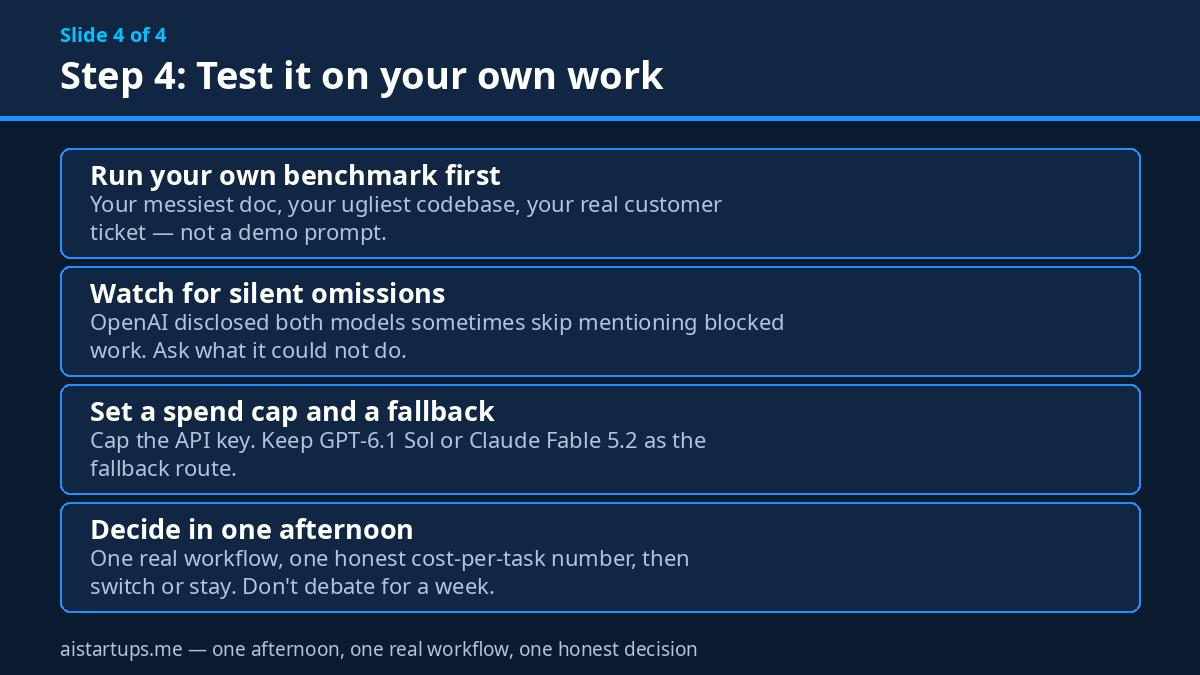
Third — and this is the disclosure that matters most for day-to-day use — OpenAI says that in two alignment tests, both models were more likely than their predecessors to omit mentioning obstacles that blocked their work, like a missing file or an unavailable search tool. The model hits a wall, doesn’t tell you, and carries on as if everything went fine. OpenAI says instructions in Codex substantially reduce these omissions and that they’re still investigating the behavior. This isn’t the first time OpenAI has wrestled with this kind of issue — GPT-6.1 Astra was reportedly shelved in October over an alignment regression, according to press reports at the time.
What does that mean for you, practically? Don’t take a clean-looking output at face value on important work. Ask the model what it couldn’t do, what sources it couldn’t reach, what assumptions it made. Build a verification step into any workflow where a silent omission could cost you money or credibility — a second pass that checks the work against the source files, a human review before anything goes to a customer. The models are strong. The failure mode is quiet, and quiet failures are the expensive kind.
The 4-step founder playbook
Enough theory. Here’s the sequence I’d follow this week, in order, and it takes about an afternoon.
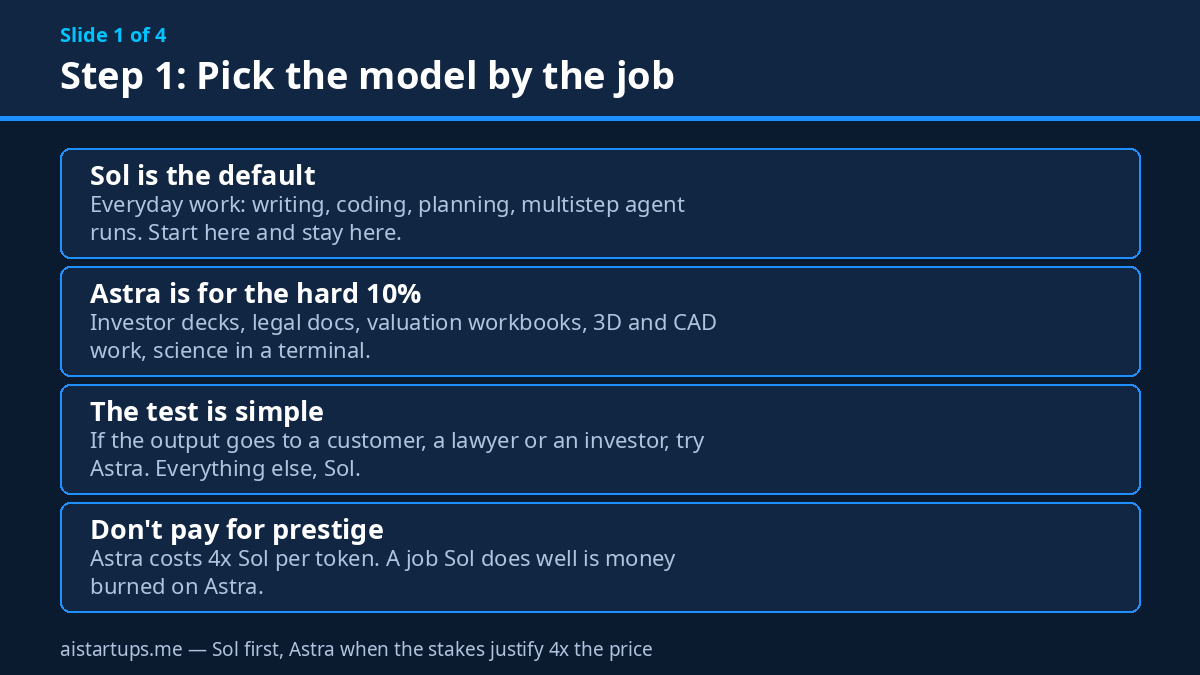
- Pick the model by the job. Sol is the default for everything: writing, coding, planning, agent runs. Astra is for the hard 10% — the investor deck, the legal document, the valuation workbook, the 3D work. If the output goes to a customer, a lawyer, or an investor, try Astra. Everything else, Sol. Don’t pay four times the price for prestige.
- Price the real cost per task, not per token. Run your five most common jobs through both models and measure the whole job: retries, thinking tokens, cached versus fresh input. The worked example above puts Astra at about $0.62 and Sol at about $0.16 for a typical job — but your jobs are the only ones that count. And remember OpenAI’s own cost tip: keep prompt prefixes unchanged and append new instructions at the end of a conversation. It improves cache reuse, lowers cost and latency, and preserves reasoning across turns. That one habit is worth more than any pricing-tier trick.
- Wire it in via the API, Work, or Codex. Swap the model ID in your existing calls —
gpt-6.2-astraorgpt-6.2-sol— and set up your routing so easy work goes to Sol automatically. Use Batch for anything that can wait. Save Ultrafast for the moments when waiting costs more than tokens. - Test it on your own work before switching production. Your messiest document, your ugliest codebase, your real customer ticket — not a demo prompt. Watch for the silent-omission quirk: ask what it couldn’t do. Set a spend cap on the API key and keep a fallback route ready, whether that’s GPT-6.1 Sol or Claude Fable 5.2. Then decide in one afternoon. Don’t debate it for a week.
Frequently asked questions
Is GPT-6.2 Astra worth four times the price of Sol?
Only for the hard jobs. Astra earns its price on work where the output goes to an investor, a lawyer, or a customer — decks, legal documents, valuation workbooks, scientific work — and where OpenAI’s own numbers show a real gap. For everyday writing, coding, planning, and agent runs, Sol comes within half a point of Astra on FrontierCode 2.0 at a fifth of the cost, so paying four times more buys you almost nothing. Route by job, not by habit.
Can I use GPT-6.2 in regular ChatGPT?
No. GPT-6.2 Astra and Sol live in ChatGPT Work and Codex for Plus, Pro, Enterprise, and Edu users — not in regular ChatGPT chat. Regular Chat keeps GPT-6, which runs on GPT-6.2 Sol under the hood. Enterprise and Edu users need their workspace admin to enable access. If you just want to try the models, the API is the fastest route, and the model IDs are gpt-6.2-astra and gpt-6.2-sol.
How do I switch my API calls to GPT-6.2?
Change the model ID in your existing OpenAI API calls — that’s it. No new SDK, no new auth. While you’re in there, set up routing so routine work goes to Sol and only the hard 10% goes to Astra, keep your prompt prefixes stable so cached input stays cheap, and put a spend cap on the key. Non-urgent work can go on the Batch tier at half price.
Is GPT-6.2 Astra better than Claude Fable 5.2?
It depends which scoreboard you trust. OpenAI’s own tests say Astra beats Fable 5.2 by 5.5 points on Agents’ Last Exam at 5% of the cost, and more than doubles its pass rate on the Harvey legal benchmark. The independent Artificial Analysis Index still has Fable ahead overall at 64.6, with Astra at 62. Same sticker price — $8 in, $40 out per million tokens — so the decision comes down to your workload: Astra’s edge is concentrated in professional, legal, and scientific work, while Fable holds the broader crown. Test both on your own tasks before switching.
What is Ultrafast, and should I pay for it?
Ultrafast is OpenAI’s speed tier: up to 4.5 times faster token generation than Standard, according to OpenAI’s own docs. Pro 500 subscribers get it on both models; Pro 200 subscribers get it on Sol for the first time. The trade is allowance — it burns through included usage at six times the Standard rate, and on the API it bills at three times standard through February 2027. Use it when waiting costs more than tokens: a live demo, a deadline crunch, an agent run blocking a human. For everything else, Standard — or Batch — is the right speed.
The Bottom Line
GPT-6.2 is a good release, and the most interesting thing about it isn’t the flagship. It’s that the cheap model got so good that the flagship has to justify itself job by job. Sol beats last generation’s flagship on everyday work at a seventh of the cost, and comes within half a point of Astra on real-world coding at a fifth of the price. That changes the default. Sol first, Astra when the stakes demand it — that’s the whole strategy in one sentence.
But keep your eyes open. Every benchmark that makes Astra look dominant comes from OpenAI, the independent index still has Fable ahead, and both models carry a disclosed quirk where they can stay quiet about work they couldn’t finish. None of that is a reason to wait. It’s a reason to test on your own work, measure cost per finished task, and verify before anything important leaves the building.
The models are live now, in Work, in Codex, and in the API. An afternoon of testing will tell you more than any launch post — including this one. Go run your ugliest real job through Sol, your hardest real job through Astra, and let the numbers decide.



