
Here’s a question almost every solo founder asks themselves at 2 a.m.: should I keep grinding on this thing, or is it time to cash out?
I’ve watched founders sit on that question for years. They build something real, get real customers, real revenue — and then they freeze. Selling feels like quitting. It feels like admitting the big dream didn’t pan out. But honestly? Selling a working business is one of the smartest moves a founder can make. It’s not failure. It’s the whole point of building something valuable in the first place.
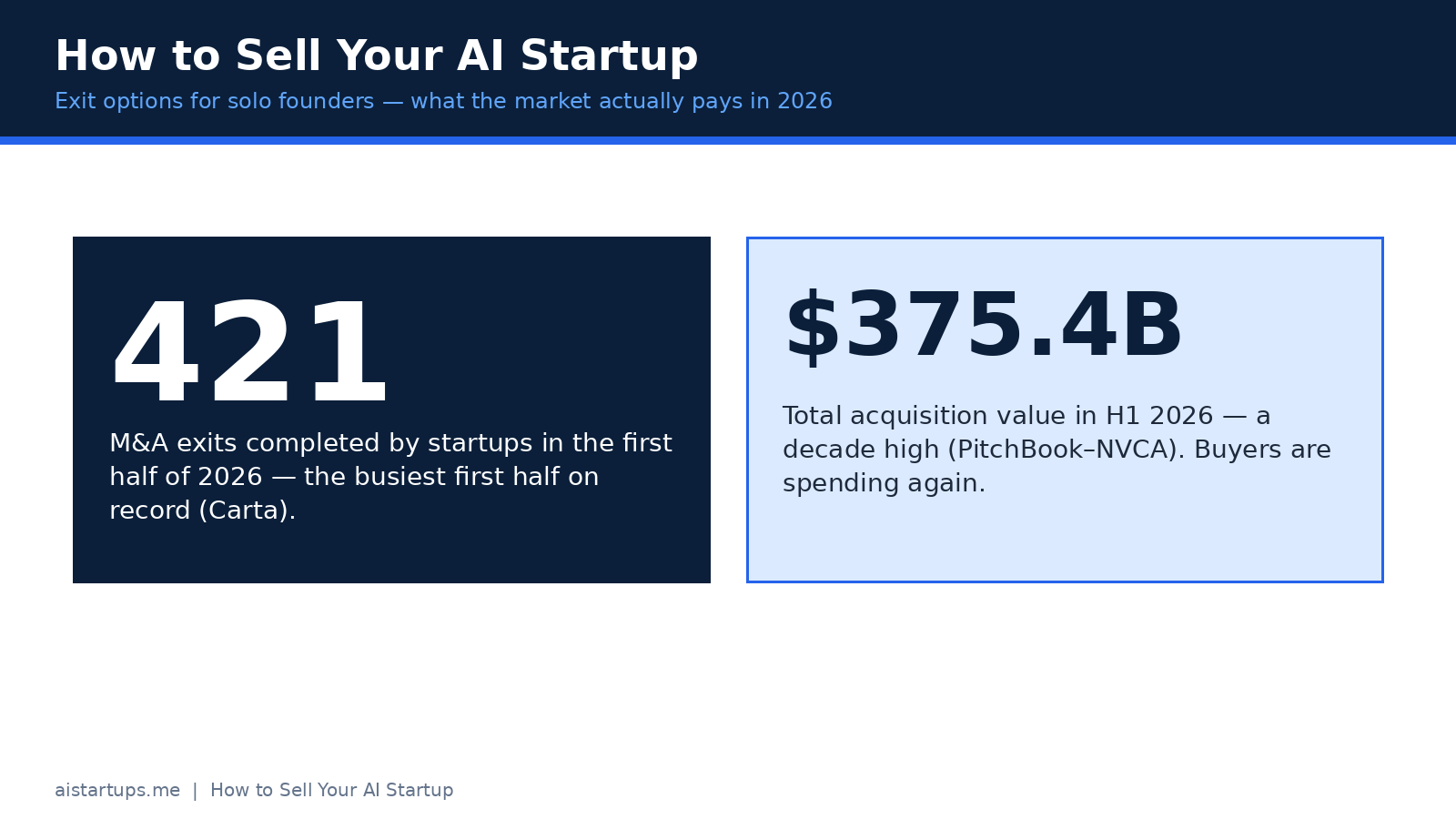
And right now, the timing is genuinely interesting. Startups completed 421 M&A exits in the first half of 2026 — the busiest first half on record, up 16% year over year, according to Carta. Total acquisition value hit $375.4 billion in that same stretch, a decade high per PitchBook–NVCA data. Buyers are spending again, and AI companies are at the top of their shopping lists.
But here’s the thing nobody tells you at the start: the founders who get the best exits aren’t the ones with the best products. They’re the ones who prepared. The ones who knew what their business was worth, picked the right kind of buyer, and didn’t sign a deal that quietly handed half the money back.
This guide is the prep I wish someone had handed me before my first exit conversation. We’ll cover when to sell and when to hold, the five ways out (and what each one actually pays), the valuation math buyers use on small AI companies, the AI premium — and the wrapper discount that kills it — plus a 90-day plan to get your business ready, and the deal traps that cost founders real money.
Sell Now or Keep Building?
Let’s start with the hardest question, because getting this one wrong costs more than anything else in this article.
There’s no formula that spits out “sell” or “hold.” But there are honest signals, and I’ve learned to trust them. You should seriously consider selling when the business has stopped growing and you know why — maybe the market is smaller than you thought, or a bigger player is about to eat your niche. You should consider it when you’re burned out and the product is starting to show it. Customers can tell when the founder has checked out. So can buyers, by the way, and they’ll price it in.
You should also think about selling when someone comes to you. An inbound offer from a strategic buyer — a bigger company that wants your tech, your data, or your customers — is often the best exit you’ll ever get. Those deals don’t come around twice. If a real buyer knocks and the number is fair, take the meeting. You can always say no.
On the flip side, keep building when growth is still compounding and you still enjoy the work. That’s not a platitude — enjoyment is a real asset. A motivated founder adds value every month, and buyers pay for momentum. If your revenue is climbing 10% a month and you wake up excited, selling now means selling the cheapest version of your company.
And keep building when the business is worth more to you than to anyone else. Some companies are lifestyle businesses in the best sense: they pay you well, they run on four hours a day, and nobody would pay you what that freedom is worth. That’s not a failed startup. That’s a win.
One more thing. Don’t sell because you’re tired of one specific problem. Hate doing support? Hire someone. Hate sales? Automate the funnel or bring in a partner. A lot of “I want to sell” is really “I want this one headache to go away.” Fix the headache first — you’ll either fall back in love with the business or sell it for more, because a business without an obvious headache is worth more. If you’re still weighing whether to raise money and push on instead, it’s worth reading up on the questions investors actually ask AI founders before you decide which direction fits.
The Market in 2026: Buyers Are Back
Let me put some numbers on the table, because the vibe in 2026 is very different from the vibe in 2023.
As I mentioned, Carta tracked 421 startup M&A exits in the first half of 2026, up 16% from the same period a year earlier — the busiest first half they’ve ever recorded. And the money is big: PitchBook–NVCA data puts H1 2026 acquisition value at $375.4 billion, the highest in a decade. Both figures come via Waveup’s roundup of the Carta and PitchBook–NVCA data, and they tell the same story: acquirers are active again after a couple of cautious years.
What does that mean for a solo founder with a small AI product? Two things. First, there’s real demand — strategic buyers and private equity firms are both hunting for AI capability, and buying a small working product is faster than building one. Second, the market rewards the right kind of company. Carta’s read on the second half of 2026 is blunt: AI-powered growth commands the premium, while profitable-but-slower companies are being told to accept today’s valuations rather than hold out for yesterday’s. In plain English: if your product is growing and genuinely AI-driven, buyers will compete for it. If it’s flat, you can still sell — just don’t expect a bidding war.
Now, a word of caution. A hot market is not a reason to rush. A disciplined startup sale takes 6 to 12 months from first engagement to close, according to Waveup (citing Windsor Drake). That’s the timeline for a proper process — finding buyers, negotiating, diligence, paperwork. If someone promises you a two-week close at a great price, they’re either buying a tiny asset or they’re not serious. Plan for the better part of a year, and don’t stop running the business while the process runs. Nothing kills a deal faster than revenue dipping mid-negotiation.
The 5 Exit Paths, Compared
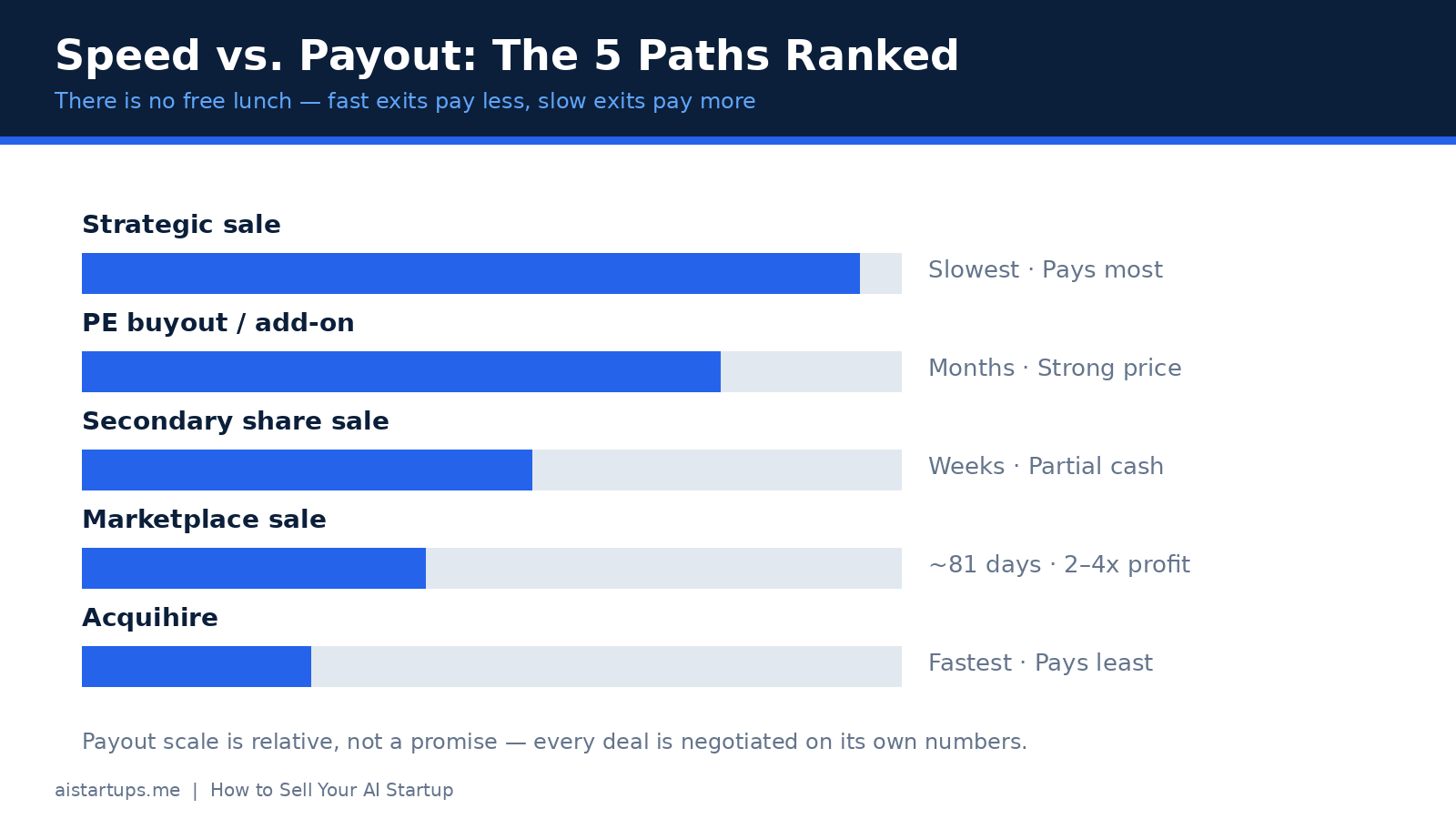
There isn’t one way to sell a company. There are five main paths, plus the rare sixth — an IPO, which happened for just 27 of 649 US VC-backed exits in the first half of 2025. For a solo founder, forget the IPO. Let’s look at the five that matter.
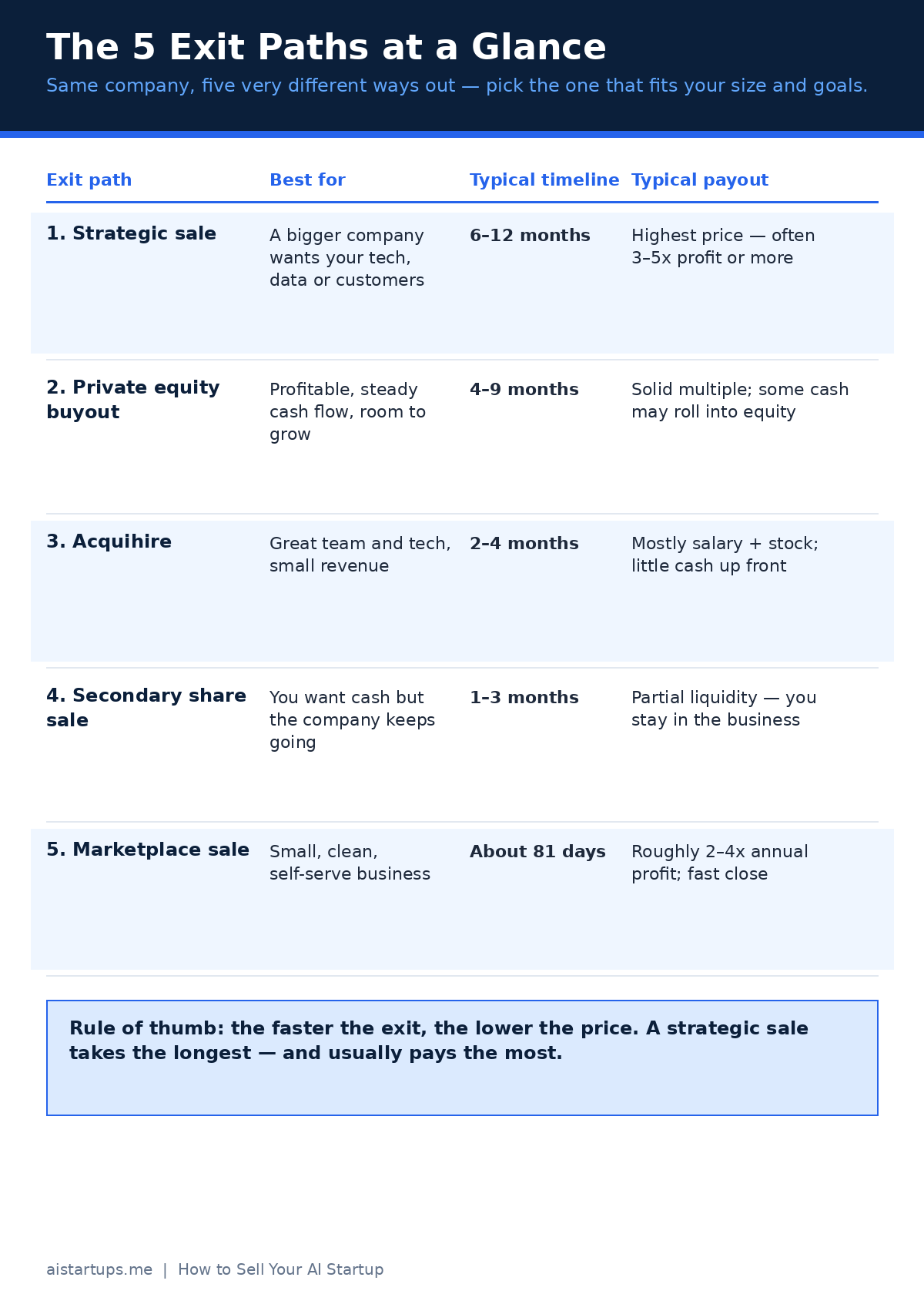
| Exit path | Best for | Typical timeline | Typical payout |
|---|---|---|---|
| Strategic sale | A bigger company wants your tech, data, or customers | 6–12 months | Highest price — often 3–5x profit or more |
| Private equity buyout / add-on | Profitable, steady cash flow, room to grow | 4–9 months | Solid multiple; some cash may roll into equity |
| Acquihire | Great team and tech, small revenue | 2–4 months | Mostly salary + stock; little cash up front |
| Secondary share sale | You want cash but the company keeps going | 1–3 months | Partial liquidity — you stay in the business |
| Marketplace sale | Small, clean, self-serve business | About 81 days on market | Roughly 2–4x annual profit; fast close |
1. Strategic sale
This is the dream exit for most founders, and it’s the one that pays the most. A larger company buys you because you have something they want: technology that would take them a year to build, a dataset they can’t get anywhere else, or customers in a market they’re trying to enter. They pay a premium because they’re not buying your cash flow — they’re buying a shortcut.
The catch is time and effort. Strategic deals take 6 to 12 months, involve long diligence, and often fall apart late. You also need to find the buyer, which usually means warm outreach to corporate development teams or working with an advisor who knows the space. But if your AI product does something a big company needs? This is where the life-changing money is.
2. Private equity buyout or add-on
Private equity firms buy profitable, predictable businesses — and increasingly, they buy small AI tools as “add-ons” to a company they already own. The model is simple: they pay a fair multiple, keep the product running, and bolt it onto something bigger.
PE buyers love clean financials and hate surprises. If your revenue is steady, your churn is low, and your costs are under control, you’ll get a serious look. The wrinkle: part of the price often comes as “rollover equity,” meaning you keep a small stake in the combined company instead of taking all cash. That’s not a bad thing — it can pay off — but go in with your eyes open.
3. Acquihire
An acquihire is when a company buys you mostly for the team — and for a solo founder, that means they buy you for your brain. The product might get shut down or folded into theirs. The payout is usually a job offer with a good salary, a signing bonus, and stock, rather than a big pile of cash.
Is that a bad exit? Not necessarily. If your revenue is small but your skills are in demand, an acquihire can be a great outcome — a soft landing with a salary and no more 3 a.m. server pages. Just don’t confuse it with a real acquisition. The headline number in an acquihire is mostly future salary, not money in the bank today.
4. Secondary share sale
This one’s different: you sell some of your shares, but the company keeps going and you stay involved. It’s partial liquidity, not an exit. Founders use it to take money off the table — pay off a mortgage, breathe a little — while keeping the upside of the business they built.
Secondary sales usually happen when there’s already an investor or a buyer who wants in. They’re faster than a full sale, typically one to three months, and they don’t require you to walk away. If you love the business but you’re tired of having 100% of your net worth locked inside it, this is the pressure valve.
5. Marketplace sale
For most solo founders, this is the most realistic path. You list the business on a marketplace like Acquire.com or Flippa, buyers browse your financials, and you close the deal on the platform. It’s fast, transparent, and you stay in control.
Acquire.com reports an average of 81 days on market, with over 350,000 registered buyers and more than $500 million in total transaction volume. They charge a 4% seller fee on close, with no upfront fees. Flippa’s first-half 2026 data shows SaaS businesses selling for about 2.47x annual profit on average, with the top quartile reaching 4.06x. The tradeoff is price: marketplace sales are efficient, but you won’t get the strategic premium a big company might pay. More on where to sell — and what each channel costs — later in this guide.
What Is Your AI Startup Actually Worth?
Okay, the question everyone really wants answered. What will someone pay me?
For small, bootstrapped companies, buyers don’t value you the way venture capitalists do. They don’t care about your total addressable market or your hockey-stick slide. They care about two numbers: revenue and profit. And they multiply one of them.
The two multiples that matter are revenue multiples and profit multiples. Here’s what the data says for small SaaS in 2026. Across 651 live listings, the median small SaaS business sells for about 2x trailing-twelve-month revenue, or about 3.4x annual profit (measured as SDE — seller’s discretionary earnings, which is basically profit plus the owner’s salary and perks added back in). The middle 50% of deals price between 1x and 3.1x revenue, or 2.1x to 5x profit. Those figures come from BigIdeasDB’s “State of Small SaaS Valuations 2026,” summarized in Beancount’s guide to bootstrapped SaaS multiples.
Let’s make it concrete with a worked example.
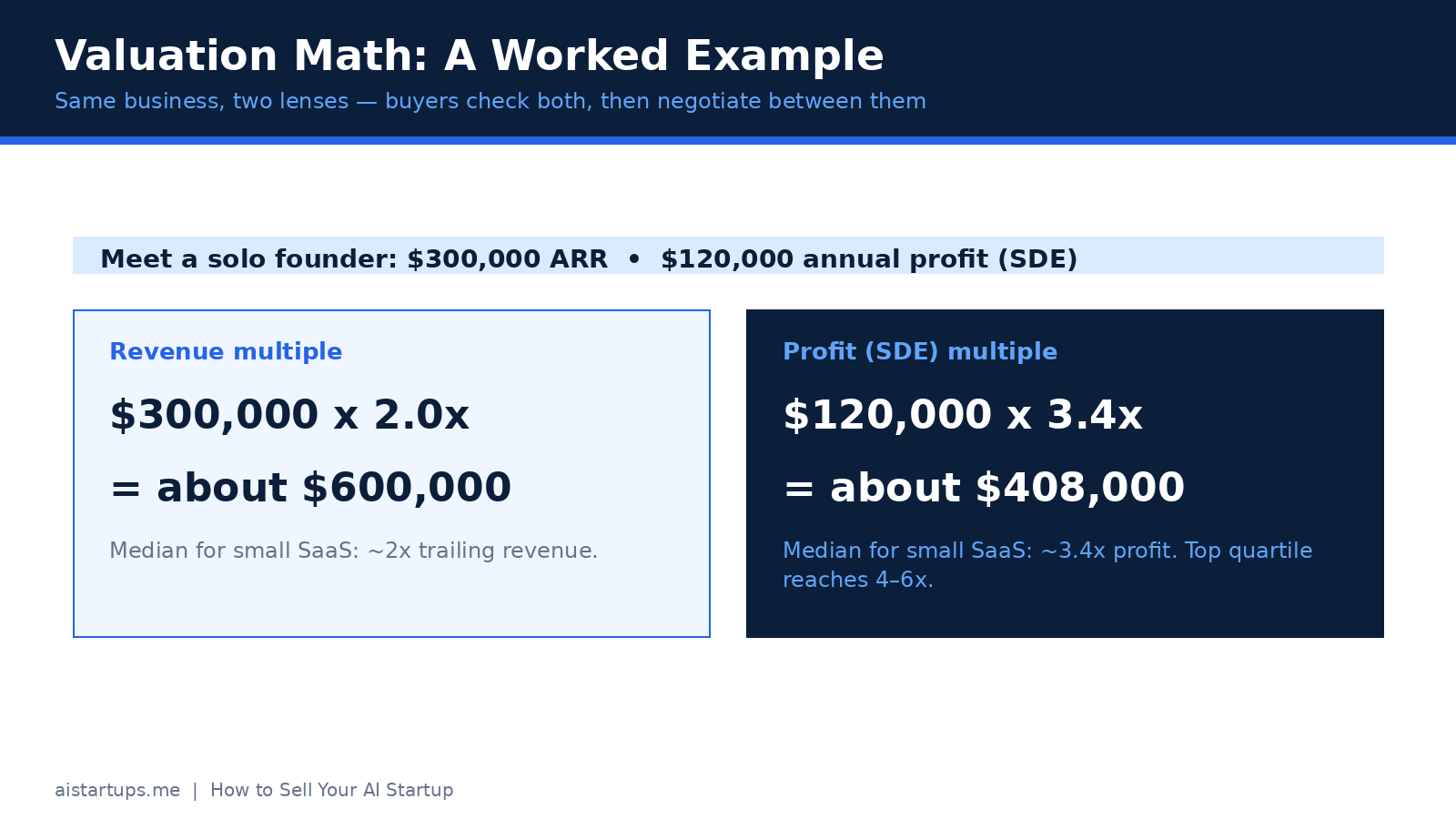
Meet a solo founder — let’s call her Sara. Her AI tool does $300,000 in annual recurring revenue and $120,000 in annual profit (SDE). Run the two lenses:
- Revenue lens: $300,000 × 2.0x = about $600,000.
- Profit lens: $120,000 × 3.4x = about $408,000.
Two honest numbers, nearly $200,000 apart. So which one is “right”? For a small deal, buyers lean on the profit number. They’re buying cash flow, and the profit multiple is how they sanity-check what they’re paying for it. The revenue number sets the ceiling — it’s the number you point to when your growth is strong and your margins are improving. Sara should expect the negotiation to center around $400,000 to $500,000, and she should know that the gap between the two numbers is the gap she negotiates in.
Now, what moves you up or down inside those ranges? Growth rate is the big one — a business growing 10% a month gets a better multiple than a flat one at the same profit. Churn is next: low churn means the revenue is real and sticky. Then comes concentration risk. If one customer is 40% of your revenue, buyers will discount hard, because losing that customer guts the business. Same story if the whole product depends on you personally answering every support ticket — we’ll come back to that in the prep section.
One more data point that matters for small sellers: Acquire.com closed deals at a median of 3.9x profit (SDE) in both 2024 and 2025 — a bit above the broader market median, which makes sense, since their listings tend to be cleaner and better documented. And on Flippa, micro-SaaS businesses under $1 million in ARR averaged 2.85x annual profit in the first half of 2026, with the top quartile reaching 6.13x. The spread is wide. The top quartile isn’t lucky — it’s the businesses with clean books, low churn, and growth. (Flippa and Acquire.com figures via startupa.ge’s micro-SaaS sale guide.)
Before you anchor on any number, get your own pricing right — because your profit is the number the multiple multiplies, and pricing is the fastest lever on profit. If you haven’t stress-tested what you charge, read our guide on how to price an AI SaaS product. A 20% price increase that sticks flows almost straight to SDE, and at a 3.4x multiple it’s worth nearly 70% of a year’s profit in exit value. That’s not a rounding error.
The AI Premium — and the Wrapper Discount
Here’s where it gets interesting for AI founders specifically. AI companies can command higher multiples than plain SaaS, according to brokers who work these deals every day. The reason is simple: buyers aren’t just paying for your revenue. They’re paying for things that are hard to build — proprietary data, defensible IP, a trained model, a team that knows how to ship AI products.
Website Closers, a brokerage that handles AI company sales, makes the case plainly: AI businesses with real proprietary assets — unique datasets, custom models, patents or trade secrets — earn a premium over generic software, because the buyer is acquiring capability, not just cash flow. (That’s a broker’s claim, so take it with the usual grain of salt — brokers sell the dream — but the logic lines up with what strategic buyers are actually hunting for in 2026.) You can read their full breakdown in their guide to selling an AI company.
But — and this is a big but — the premium has a flip side. If your product is a thin wrapper around someone else’s API, buyers will see it, and they will discount for it. Hard. Think about it from their side: if your entire product is a nice interface on top of GPT or Claude, what’s stopping them from building the same thing in a weekend? Or what’s stopping the model provider from shipping your feature natively and cutting you off at the knees?
That doesn’t mean wrappers can’t sell. They do, every day, on the marketplaces. But they sell at the bottom of the multiple range, not the top. The difference between a 2x profit multiple and a 4x profit multiple on a $120,000-profit business is $240,000. That’s the price of the moat.
So, honestly, ask yourself: what do I own that a buyer can’t get in a weekend? A proprietary dataset built from your users’ real behavior. A fine-tuned model on a niche domain. Integrations and workflows that took a year to get right. A brand and a customer list in a specific vertical. If you can name two or three of those, you’ve got a premium story. If you can’t name one, you’ve got homework to do before you list — and that’s fine. Six months of building a real moat beats six months of waiting for a buyer who’ll pay a premium for something that isn’t there.
Get Your Business Ready to Sell: The 90-Day Plan
Here’s the part most founders skip, and it’s the part that makes the most money. Buyers pay more for businesses that look boring in the best way: clean, documented, and not dependent on one exhausted human.
Think of it like selling a house. You don’t list it with a leaking roof and a junk-filled garage. You fix the obvious stuff, stage it, and let buyers imagine themselves living there. Same idea.
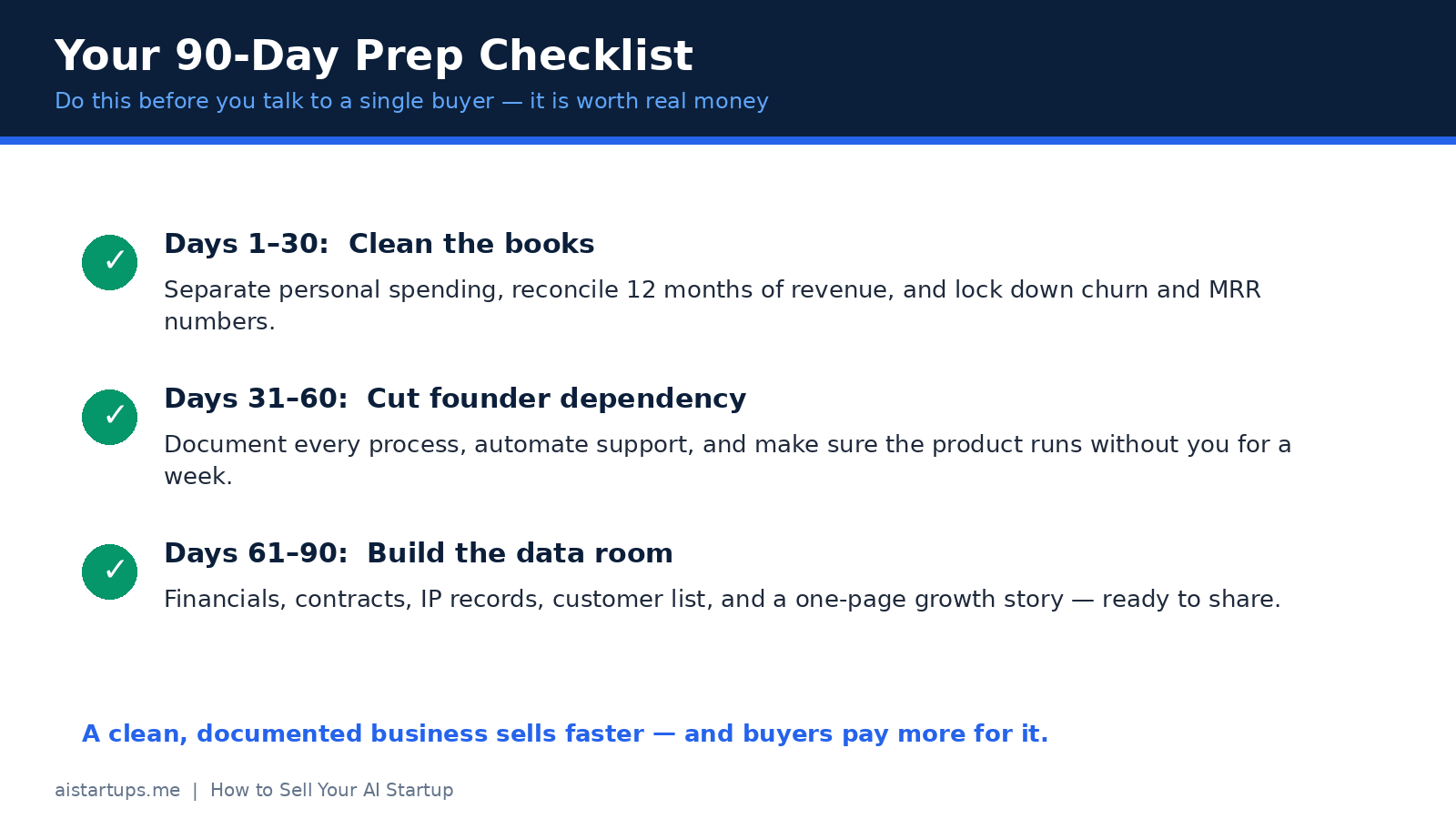
Days 1–30: Clean the books
Separate your personal spending from the business — every subscription, every dinner, every “business” laptop that was really a gift to yourself. Reconcile 12 months of revenue and expenses, month by month, so a buyer can see the trend without doing forensic accounting. Lock down your real churn and MRR numbers, and be ready to show them without flinching. If your metrics have a wart, document it and explain it. Buyers can live with a wart. They can’t live with a surprise.
While you’re in there, sort out the legal basics. Make sure you actually own your IP — if a contractor built part of the product, is there a signed IP assignment? If you built this with a co-founder who drifted away, is there a written agreement about who owns what? Unclear ownership is a deal-killer, and it surfaces at the worst possible moment. If this is still an open question for you, our guide on what to settle in a co-founder agreement before you incorporate covers the points buyers’ lawyers will ask about.
Days 31–60: Cut founder dependency
This is the one that hurts, because it means admitting you’re the bottleneck. Document every process: how support tickets get answered, how the product gets deployed, how customers get onboarded. Automate what you can. Write the runbook you’d hand to a stranger. Then — real talk — take a week off and see if the business survives without you. If it doesn’t, you just found the most valuable work you can do before a sale.
A business that needs its founder to function is worth less, sometimes dramatically less, because the buyer is really buying a job, not an asset. Every process you document and every task you delegate is money in the sale price. If parts of the product need a proper rebuild or the website needs professional work before a buyer takes it seriously, bringing in a web development studio to clean things up can be money well spent — a polished, well-built product photographs better in diligence, so to speak.
Days 61–90: Build the data room
A data room is just a shared folder with everything a buyer needs to say yes: financials, tax returns, customer contracts, IP records, a cap table if you have one, and a one-page growth story. Get it ready before you talk to anyone. The moment a serious buyer asks for something and you say “give me a week,” the energy leaks out of the deal.
Also in this window: line up your advisors. A good M&A lawyer is not optional, and an accountant who understands deal tax is worth every penny. Interview two or three of each, and don’t pick the cheapest. You’re about to do the biggest financial transaction of your life — the advice is the cheapest part of it.
Where to Sell: Marketplaces, Brokers, or Direct
You’ve got a clean, documented business. Now where do you actually find a buyer?
For most solo founders, the honest answer is a marketplace. Acquire.com is the biggest name in small startup sales, with 350,000+ registered buyers and $500M+ in transaction volume. The deal is straightforward: list for free, pay a 4% fee when the sale closes, and expect about 81 days on market on average. The platform handles the listing, the NDA process, and the secure close. It’s the closest thing this world has to a standard process, and for a business under a million in revenue it’s usually the right call.
Flippa is the older, broader marketplace — it sells everything from domains to content sites to SaaS businesses. Fees are lower in some tiers, the audience is huge, and the quality of buyers is more mixed. You’ll get more tire-kickers and more lowball offers, but you’ll also get more eyeballs. If your business is small — say under $100,000 a year in revenue — Flippa is often where the buyers are.
Then there are brokers. A good broker does what a marketplace can’t: they find strategic buyers, run a quiet process so your customers and team don’t panic, and negotiate for you. They typically charge 10% to 15% of the sale price, sometimes with a minimum fee. That sounds steep until you remember that a broker who gets you a 4x multiple instead of a 3x multiple just paid for themselves twice over. Brokers make sense when your business is worth $500,000 or more, or when you believe a strategic buyer is out there and you don’t know how to reach them.
Finally, there’s direct outreach — emailing the corporate development team at companies that should buy you. This is how the biggest strategic deals start. It works best when you can name the reason they’d want you: “You sell to the same customers, and our product fills the gap in your lineup.” It’s slow and the hit rate is low, but one yes changes everything.
Which route should you take? Here’s my honest take: if your business is under $200,000 in value, list it on a marketplace and keep it simple. Between $200,000 and $1 million, talk to a broker and list on a marketplace in parallel — the broker brings the strategic buyers, the marketplace brings the floor price. Over $1 million, hire a broker and run a real process. And whatever you do, don’t tell your team or your customers until the deal is signed. Nothing good comes from a rumor that you’re selling.
Deal Traps That Cost Founders Real Money
Alright. You’ve got a buyer and a number you’re happy with. This is the part where founders lose money they never knew they had — not because the buyer is evil, but because deal structure is where the fine print lives.
The earnout
An earnout means part of your price is paid later, only if the business hits certain targets after the sale. Say the headline is $500,000, but $150,000 of it depends on revenue staying above a threshold for a year. Sounds reasonable — until you realize you no longer control the business. The buyer changes the pricing, or stops marketing your product, or folds it into theirs, and suddenly the target is unreachable through no fault of yours.
Earnouts aren’t always bad. Sometimes they’re the bridge that gets a deal done when the buyer and seller disagree on value. But negotiate the terms like your money depends on it — because it does. Push for targets you can actually influence, a shorter earnout period, and a floor on what you get regardless. And if the earnout is more than about a third of the total price, that’s a red flag. The deal is really a smaller deal wearing a bigger number’s clothes.
The retention trap
Many buyers want you to stay on for 6 to 12 months after the sale to hand things over. That’s normal and often good — a clean handover protects the business and your earnout, if there is one. The trap is an open-ended retention with no clear end date, or a retention that quietly turns into a full-time job you never wanted. Get the length, the hours, and the pay in writing, and get a hard end date. Your post-sale life is yours to design.
Escrow and holdbacks
It’s standard for 10% to 20% of the price to sit in escrow for 6 to 12 months, released if no problems surface. That’s fair — it protects the buyer if something you told them turns out to be wrong. Just make sure the escrow terms are clear: what triggers a claim, how disputes get resolved, and when the money comes back to you. An escrow that can be raided for vague reasons isn’t protection, it’s a discount.
Asset sale vs. stock sale
Most small deals are asset sales: the buyer purchases the assets — the code, the customer list, the brand — but not the company itself. That usually favors the buyer, because they leave your company’s liabilities behind. A stock sale, where they buy the whole company, can be better for you on tax, but buyers often resist it. You won’t resolve this in a blog post — get your accountant and lawyer in the room before you agree to a structure. The difference can be tens of thousands of dollars on a small deal.
Tax — the part everyone forgets
Here’s the unsexy truth: the headline price is not what lands in your bank account. Taxes, fees, and escrow all take a cut. How much depends on where you live, how your company is structured, and how the deal is structured. Some founders can use capital gains treatment; others get hit with ordinary income rates on part of the deal. I’m not your accountant and this isn’t tax advice — but please, please get a real accountant involved before you sign a letter of intent, not after. Restructuring a deal after the fact is expensive. Restructuring it before is just paperwork.
“The best time to sell a business is when you don’t have to. The second-best time is when you’ve prepared so well that it looks like you don’t have to.”
That quote has been floating around founder circles for years, and I can’t find a clean source for it — but the idea is dead on. Buyers can smell desperation, and they price it in. A founder who can walk away gets a better deal than a founder who needs the deal to close by Friday. Preparation is leverage.
What Happens After You Sell?
People obsess over the price and forget about the day after. Let’s talk about it, because it’s the part that actually affects your life.
First, your customers. In most deals, they’ll be told the product has a new owner and nothing is changing — and for the first few months, that’s usually true. The buyer wants the revenue to keep flowing. Over time, though, things change: pricing, support, the roadmap. If you care about your customers (and you should, they got you here), negotiate a communication plan into the deal. A joint email from you and the buyer, a clear transition period, and an honest answer to “will the product keep working?” go a long way.
Second, your team — if you have one. Contractors and part-timers often get let go or re-hired by the buyer. Full-time people usually get offers, but not always, and not always at the same terms. If you have people who trusted you with their livelihoods, tell them what’s happening before they read about it somewhere else. And if you can negotiate retention bonuses or guaranteed employment terms for them into the deal, do it. It costs you little and it means a lot.
Third, you. There’s a strange quiet after a sale closes. You’ve spent years with this thing in your head every waking hour, and then suddenly it’s someone else’s. Some founders feel relief. Some feel grief. Both are normal. Give yourself a month before you decide what’s next. The worst time to start a new company is the week after you sold the last one — you’re tired, you’re rich on paper, and your judgment about what to build next is clouded by the sale. Rest. Then build.
Oh, and one practical thing: don’t spend the money before it clears. Escrow, taxes, and earnouts mean the headline number and the bank balance are two very different things for a year or more. Plan your finances around the cash you actually receive, not the number in the press release you never issued.
If selling isn’t the right move after all — if you’ve read this far and realized you actually want to keep building — that’s a fine outcome too. There are plenty of small AI products you can run solo for years, and if you want ideas, our roundup of 12 AI micro-SaaS products you can launch solo is a good place to start thinking about what comes next, whether that’s your current business or the one after it.
Frequently Asked Questions
How long does it take to sell an AI startup?
A disciplined sale takes 6 to 12 months from first engagement to close, according to Waveup (citing Windsor Drake). Marketplace sales are faster — Acquire.com reports an average of about 81 days on market — but that doesn’t include the time to prepare the business or complete diligence. Budget a full year from the day you decide to sell to the day money lands in your account.
What multiple do small AI startups sell for?
Small SaaS businesses sell for a median of about 2x trailing revenue or 3.4x annual profit (SDE), based on 651 live listings in BigIdeasDB’s 2026 data. The middle 50% of deals fall between 1x and 3.1x revenue, or 2.1x to 5x profit. AI companies with proprietary data, IP, or models can command more; thin wrappers around someone else’s API usually get less.
Do I need a broker to sell my startup?
Not always. If your business is worth under $200,000, a marketplace like Acquire.com or Flippa is usually enough. Brokers earn their fee — typically 10% to 15% — when the business is worth $500,000 or more, or when you believe a strategic buyer exists and you can’t reach them yourself. The right broker often lifts the price by more than their fee.
What is SDE, and why do buyers care about it?
SDE stands for seller’s discretionary earnings: your profit with the owner’s salary, perks, and one-off expenses added back in. It’s the closest thing to “what this business actually earns its owner in a year,” and it’s the number small-business buyers multiply. A clean SDE figure, backed by 12 months of tidy books, is the single most valuable document in your sale.
Can I sell my AI startup if it’s just a wrapper around GPT or Claude?
Yes — wrappers sell on marketplaces every day. But expect a lower multiple, because buyers know the moat is thin. Your best move is to build something defensible before you list: proprietary data, a fine-tuned model, deep integrations, or a loyal customer base in a niche. Even a few months of work on defensibility can move you from the bottom of the multiple range toward the middle, and that’s real money.
The Bottom Line
Look, selling your AI startup isn’t the end of the story. It’s the part where the story pays you.
The market is strong — 421 exits in the first half of 2026, $375.4 billion in deal value, and buyers actively hunting for AI capability. But a strong market doesn’t hand out good exits. Good exits go to founders who know what their business is worth, pick the right path (strategic, PE, marketplace, or one of the others), and spend 90 days getting clean before they talk to a single buyer.
So here’s your homework. This week, run your own numbers: trailing revenue, SDE, and both multiples. Write down what you’d accept and what you’d walk away from — before anyone makes you an offer, because that’s when your judgment is clearest. Then start the 90-day prep, even if you’re not sure you’ll sell. Worst case, you end up with a cleaner, better-run business. Best case, you end up with a cleaner, better-run business and a life-changing check.
Either way, you win. And that’s the whole point.