


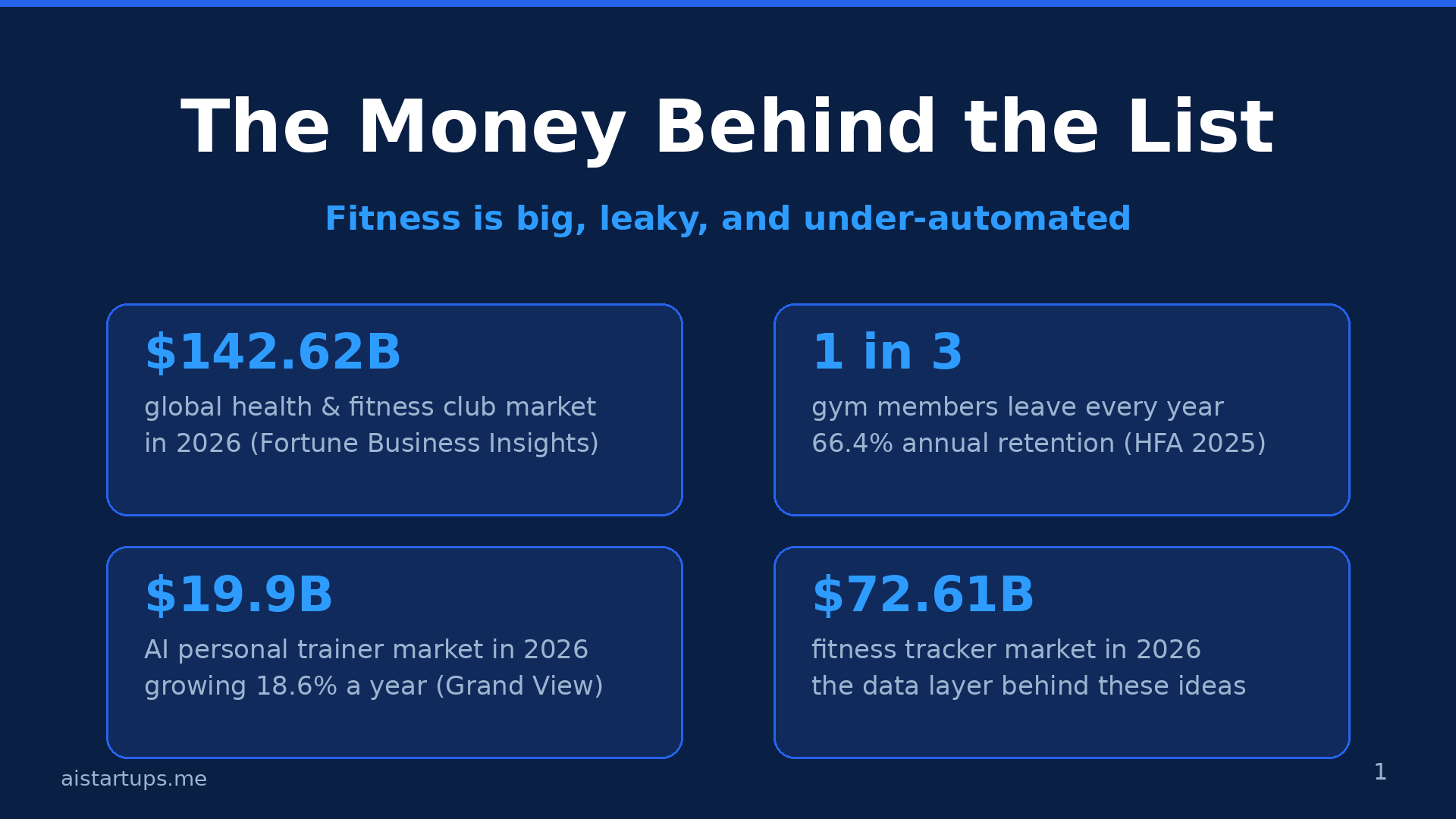
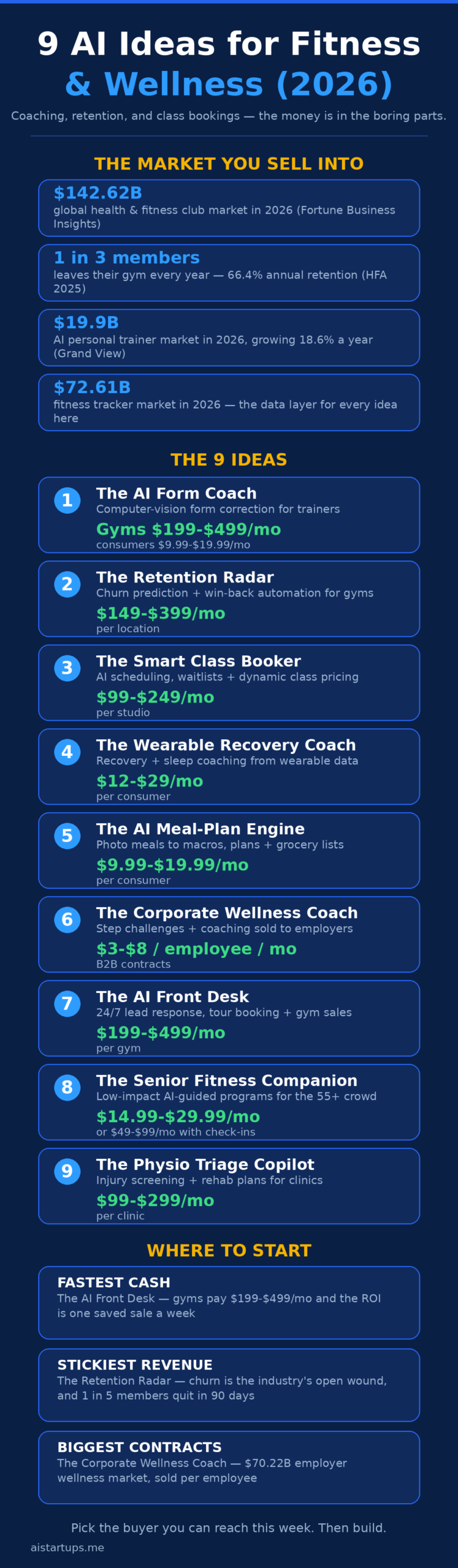
Here’s a number that should make any founder sit up straight: the average gym loses one in three members every year. The Health & Fitness Association’s 2025 benchmarking report puts annual retention at 66.4% — and nearly one in five new members quits inside the first 90 days, according to the Gymdesk Benchmark of 4,594 gyms. That’s not a rounding error. That’s a third of the customer base walking out the door every twelve months, and the gym has to pay to replace every single one of them. (Acquiring a new member costs 5–25x more than keeping one, per Harvard Business Review, cited in the same Gymdesk analysis.)
And the market itself is huge. The global health and fitness club market is projected at $142.62 billion in 2026, growing to $298.16 billion by 2034. Personal training alone is the largest segment, at 47.63% of the club market. Meanwhile the AI personal trainer market is valued at $19.9 billion in 2026 and growing 18.6% a year — and the fitness tracker market sits at $72.61 billion, which means the data layer for all of this already exists on people’s wrists.
So here’s the opening. Fitness is a giant, cash-rich industry where the core problem isn’t getting people in the door — it’s keeping them, coaching them well, and filling the classes. Most gyms and studios still run on a mix of legacy software, group chats, and gut feel. That’s the gap. This list is 9 AI product and service ideas for fitness and wellness that a solo founder or tiny team could realistically build and sell. Each one gets the same treatment — the pain, the product, who pays, and rough pricing. No venture funding required. Let’s go.
How I scored these ideas
Before the list, a quick note on how I’m judging. Every idea gets two rough scores: startup cost (how much time and money to build a working version) and revenue potential (how big the check is and how often it repeats). Cheap-to-build plus big-money is the sweet spot. But there’s a third factor I care about more in fitness than in most industries: who the buyer is. A product sold to a gym owner with a budget is a completely different business from an app sold to a consumer who cancels after January. The B2B ideas on this list will look boring next to the consumer apps. Boring is good. Boring pays rent.
One more thing before we start: every price in this article is a rough estimate, not a quote. Treat them as starting points for your own research, not gospel. The market numbers, though, are real — every stat is linked to its source.
Idea 1: The AI Form Coach
Ask any personal trainer what limits their income and they’ll give you the same answer: there are only so many hours in a day, and they can only watch one client at a time. A trainer with 20 clients is already full. A trainer with 40 is drowning. And the clients in between sessions? They’re in the gym alone, doing squats with their knees caving in, and nobody’s there to correct them.
The product: a phone-camera form coach. The client props up their phone, records a set, and the AI analyzes joint angles, bar path, tempo, and depth in real time — then tells them what to fix in plain language. “Your left knee drifts inward on rep 3. Push it out, slow the descent by one second.” Not a generic video library. Actual feedback on their actual set.
This isn’t science fiction. Computer-vision form analysis is already shipping in products — Peloton launched Peloton IQ in October 2025 with AI form feedback and rep counting across its connected equipment, and Virtuagym’s MAX AI Coach generates personalized plans from client data. The tech is proven; the gap is that it’s locked inside big platforms. A standalone tool that any independent trainer can hand to their clients — white-labeled with the trainer’s name on it — doesn’t really exist yet at the low end.
The wedge is trainers, not consumers. Sell it to the trainer as a retention and scale tool: “your clients get coached between sessions, and you can take on 30% more clients because the app handles the homework.” Trainers are wonderful customers — they buy with business money, they talk to other trainers constantly, and a tool that makes them look good spreads by word of mouth.
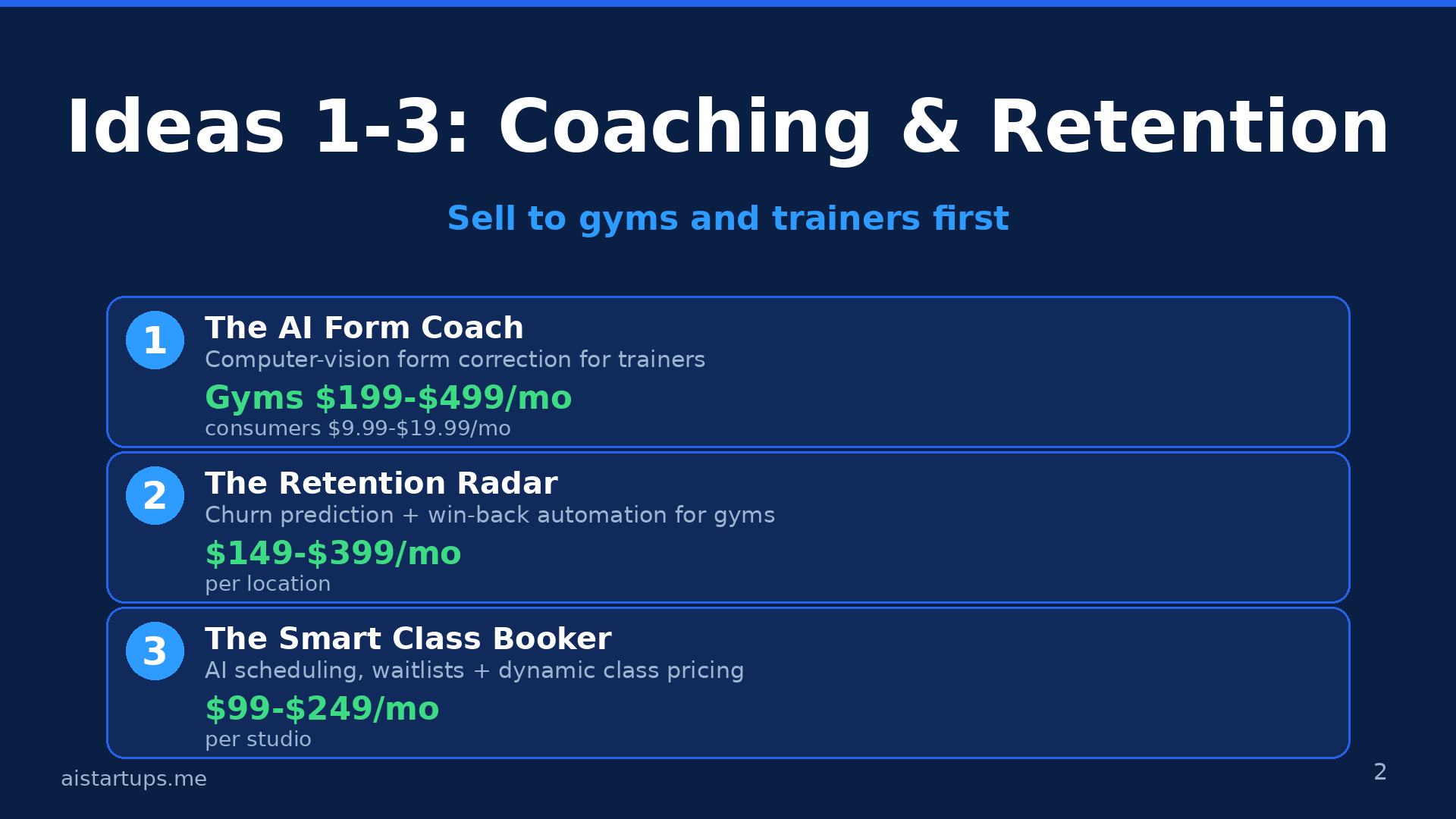
Who pays: gyms and studios, $199–$499/mo for a branded version their trainers use with clients. Or consumers directly, $9.99–$19.99/mo. I’d start B2B — one gym sale is worth 25 consumer subscriptions, and gyms churn far less than January-resolution app users. Before you build, do what I’d do for any of these: validate the idea with real trainers — five conversations will tell you whether they want form analysis, program generation, or something else entirely.
Idea 2: The Retention Radar
This is the idea I’d build if I wanted the most defensible business on the list, and it’s the one the numbers scream for. One in three members leaves every year. Nearly one in five quits in the first 90 days. And here’s the part that makes it a real product: cancellations are almost never a surprise. Attendance drops first. Then class bookings thin out. Then the payment fails. The signals are sitting in the gym’s check-in data weeks before the member cancels — and nobody’s watching them.
The product: a churn-prediction layer that plugs into the gym’s existing software (Mindbody, ABC Glofox, Gymdesk, PushPress) and flags at-risk members with a simple risk score, then triggers the right intervention automatically. Green member, do nothing. Yellow — attendance down 20% — send a friendly check-in text from their trainer. Red — two weeks absent — the manager gets a task to call them personally, with a suggested script and a free tune-up session to offer.
Why does this sell? Because the math is trivially easy to pitch. Take a 300-member gym at $50/mo losing a third of its members a year: that’s roughly 99 members and about $59,400 in recurring annual revenue walking out (Gymdesk runs the same calculation). Cut that loss by just five percentage points and the gym keeps $9,000 a year — without spending a dollar on acquisition. Your $299/mo tool pays for itself if it saves two members. That’s the kind of ROI slide that closes deals in one meeting.
The hard part is integrations, so start narrow: one platform, one gym type. Boutique studios are the best first customer — they have 2–3% monthly churn already (better than big-box gyms), which means they care about retention, and they have a named owner who can say yes in a single conversation. Build the Mindbody integration first — Mindbody’s Starter plan runs $99–$159/mo per location and the platform is the default for boutique studios, so your customers are already paying for software and already believe in it.
Who pays: gyms and studios, $149–$399/mo per location, priced by member count. This is pure B2B SaaS with real retention — once the radar is flagging members and saving them, nobody rips it out. Fifty gyms at $249 is $12,450 MRR from a single city’s fitness market.
Idea 3: The Smart Class Booker
Walk into any boutique studio on a Tuesday night and you’ll see the same two problems at once: the 6 PM spin class has a 40-person waitlist, and the 7:30 AM class has four people in it. The schedule was set months ago by a human guessing at demand, and the pricing is flat — $25 a class whether it’s prime time or a dead slot. Studios are leaving money on the table in both directions, and they’re filling the gaps with group chats and front-desk heroics.
The product: an AI scheduling and booking layer for class-based studios (yoga, Pilates, spin, HIIT, barre). It watches booking velocity, waitlist depth, no-show patterns, instructor popularity, and day-of-week demand, then does three things: suggests schedule changes (“move the 7:30 to 8:00, add a second 6 PM”), manages waitlists automatically (auto-book the next person, text them, release the spot if they don’t confirm in 15 minutes), and nudges prices on high-demand slots within bounds the owner sets.
Here’s why the timing is good: the boutique market is big and it’s fragmented. There are thousands of independent studios, and their incumbent software charges real money — Mindbody’s full stack with marketing automation runs $499/mo on Ultimate, $699+ on Ultimate Plus, with 24-month contracts. A focused tool that does one thing brilliantly — fill classes and price them right — can undercut the suite and out-serve it on the one metric owners actually check every morning: how full is tonight?
The no-show problem alone justifies the product. A studio with 20 classes a week and a 15% no-show rate is losing three full classes of revenue every week. Auto-confirmations, waitlist backfill, and a small late-cancel fee policy enforced by the system (not by a tired front-desk worker) can recover most of that. That’s found money, and found money is the easiest thing in the world to sell.
Who pays: boutique studios, $99–$249/mo per location. Start with one format — Pilates studios are perfect: small class sizes, high prices, waitlists are the norm, and owners feel every empty reformer. Own Pilates in one city, then expand to spin and yoga.
Idea 4: The Wearable Recovery Coach
Here’s the thing about wearables: everyone has one now, and nobody knows what to do with the data. Your watch tells you your HRV dropped 12 points and your sleep score is 61. Great. What does that mean? Should you train hard today or take it easy? Should you eat more carbs or go to bed an hour earlier? The device collects the data and then shrugs.
The product: a recovery coach that turns wearable data into a daily training decision. It pulls from Apple Watch, Garmin, Whoop, Oura — wherever the data lives — and answers one question every morning: “what should I do today?” Green day: push hard, here’s your workout. Yellow day: moderate session, cut the volume by 30%. Red day: rest, walk, stretch, here’s why. Over weeks it learns the user’s patterns and starts predicting: “your HRV tanks every time you train legs two days in a row — here’s a better split.”
The market is already there, which is the point. The fitness tracker market is $72.61 billion in 2026, heading to $154.47 billion by 2031, with smartwatches holding nearly half the revenue. That’s tens of millions of people generating biometric data every day and getting almost nothing actionable back from it. The hardware companies built the sensors. The coaching layer on top is still wide open for a small player — especially one that isn’t tied to a single device brand.
The consumer subscription is the obvious model, but honestly, the B2B2C route is more interesting: sell it to gyms and coaches as the thing that keeps their clients engaged between sessions (there’s that retention problem again), or to corporate wellness programs that already hand out trackers and need someone to make the data useful. A coach who can see all their clients’ recovery scores in one dashboard will pay for that. A consumer who has to remember to open yet another app will cancel by March.
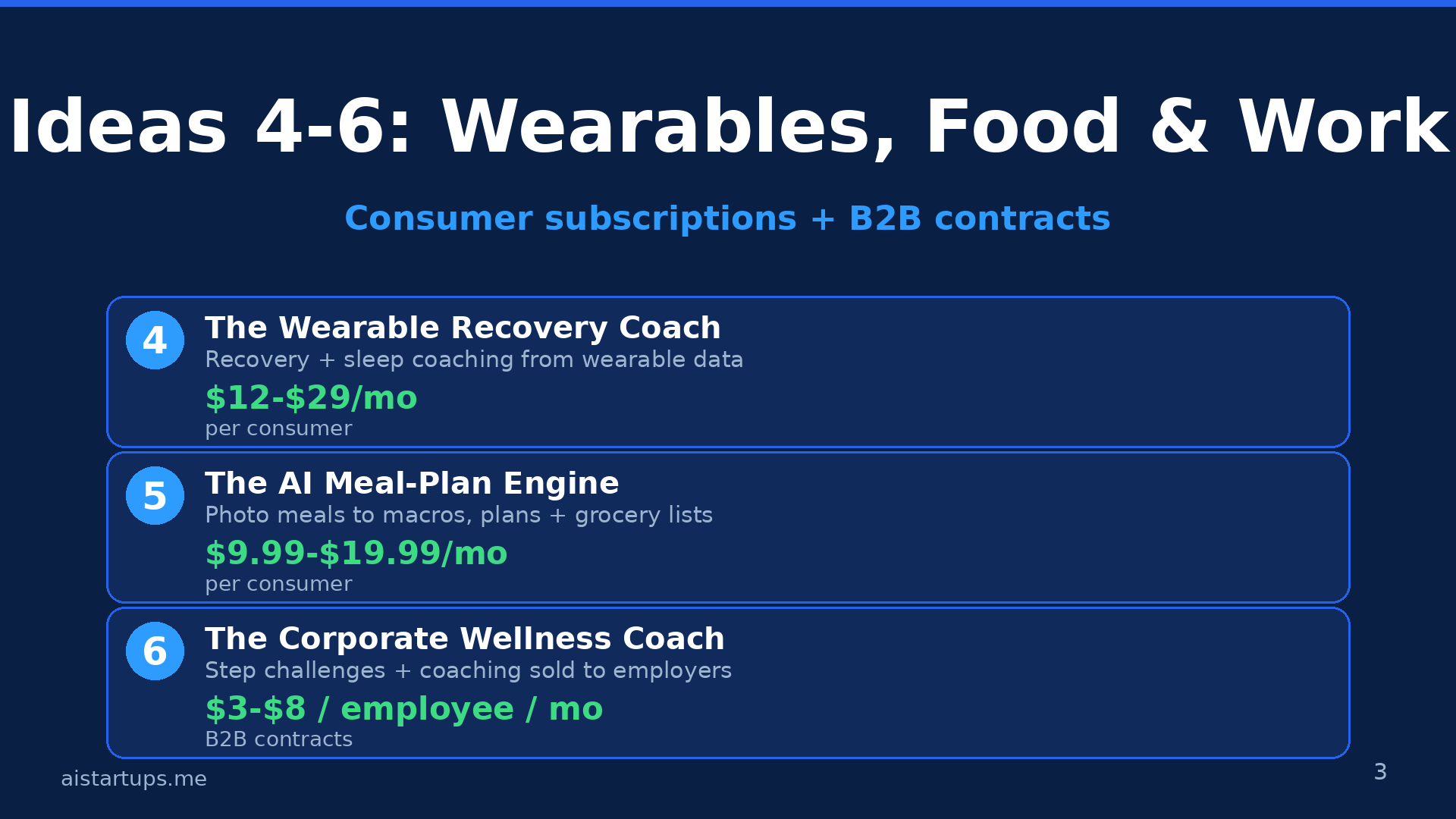
Who pays: consumers, $12–$29/mo; or gyms and coaches, $5–$15 per user per month for a white-labeled version. The consumer version is the harder business — subscription fatigue is real — so if you go direct, the free tier has to be genuinely useful and the paid tier has to feel like a coach, not a chart.
Idea 5: The AI Meal-Plan Engine
Every trainer has had this conversation. Client: “I train four times a week and I’m not losing weight.” Trainer: “What did you eat yesterday?” Client: “Uh… normal stuff.” Nobody tracks their food accurately, and the apps that exist make you weigh your chicken and log every almond. That’s why people quit them by week two.
The product: snap a photo of your meal, get the macros. Not a perfect lab-grade analysis — a good-enough estimate, plus a plan that adjusts. The AI builds a weekly meal plan around the user’s actual eating (not a fantasy diet), generates the grocery list, and re-plans when life happens: “you’re traveling Thursday, here are three airport options that fit your targets.” The magic isn’t the photo analysis, which is getting commoditized. The magic is the plan that survives contact with a real week.
Why this works as a startup idea and not just a feature: nutrition is the half of fitness that gyms don’t sell. A gym sells the workout; the other 23 hours are unmonetized. Trainers know this — it’s why so many of them sell meal plans on the side as PDFs and spreadsheets. Give them a tool that generates the plan, tracks adherence from meal photos, and flags the client who’s drifting, and you’ve just productized the most profitable thing a trainer already does by hand.
And the buyer is obvious: the trainer, the nutrition coach, the small studio that wants a nutrition upsell without hiring a dietitian. Consumer-direct is the crowded lane — MyFitnessPal and a dozen clones own it. The B2B lane, where the coach is your customer and their clients are your users, is much emptier. One coach with 30 clients is 30 users you never had to acquire.
Who pays: consumers, $9.99–$19.99/mo; or coaches and studios, $99–$249/mo for a branded version with client management. Honestly, start with the coaches. They’ll tell you exactly what’s missing in week one, and they’ll pay you while they do it.
Idea 6: The Corporate Wellness Coach
Last one in the consumer lane, and then we go where the big checks live: employers. The corporate wellness market is $70.22 billion in 2026, heading to $94.5 billion by 2031. Employers are spending that money because healthcare costs keep climbing — the average US family premium hit $25,572 in 2024, up 7% in a single year — and because they can’t hire or keep people without a wellness story anymore.
Here’s the problem, though: most corporate wellness programs are participation theater. The company buys a platform, 30% of employees sign up, engagement craters by quarter two, and HR reports “wellness” as a line item nobody believes in. The programs fail because they’re generic. A step challenge for a warehouse team and a desk-bound engineering team is the same challenge, and it fits neither.
The product: an AI wellness coach that actually adapts to the workforce. It segments employees by role, schedule, and baseline activity, then runs challenges and coaching that fit real life: a 10-minute mobility routine between shifts for the warehouse crew, a walking-meeting nudge and a screen-break stretch for the desk team, a sleep program for the night-shift nurses. The AI handles the personalization; HR gets a dashboard that shows engagement and outcomes, not just logins.
Why this is a great solo-founder B2B idea: the buyer is a benefits manager with a real budget, the contract is annual, and the sales cycle is slower but the revenue is sticky. You don’t need a thousand customers. You need twenty mid-size employers at $3–$8 per employee per month. A 500-person company at $5 a head is $2,500 a month, $30,000 a year, from one signature. Ten of those and you’re at $25k MRR. That’s a real business with a customer list you can fit on one page.
The wedge: start with companies that already have a gym benefit or a wearable program and are disappointed by it. They’re already spending the money; you’re just making it work. And don’t build the whole platform on day one — run the first three clients as a managed service with AI tools behind the scenes, learn what HR actually reports to their CFO, then automate exactly that.
Who pays: employers, $3–$8 per employee per month, annual contracts. This is the biggest-contract idea on the list, and also the slowest to close — budget for a 60–90 day sales cycle and a pilot with one department before the company-wide rollout. If you want a broader view of what sells to employers and local businesses, AI services for local businesses covers the same playbook in other industries.
Idea 7: The AI Front Desk
This is the fastest-cash idea on the list, and it’s not close. Here’s a scene that plays out every day in every gym: someone Googles “gym near me,” finds the website, fills in the contact form at 9 PM asking about memberships — and hears nothing until the front desk opens at 6 AM, by which time they’ve already joined the competitor that answered instantly. Gyms sell a product people buy on impulse, and they staff their front desk like it’s 1998.
The product: an AI front desk for gyms and studios. It answers every inquiry 24/7 — website chat, Instagram DMs, SMS, missed-call text-back — answers the common questions (pricing, class times, trial offers), scores the lead, books the tour or the trial class, and follows up automatically until the person shows up or opts out. When the conversation gets complicated, it hands off to a human with a full transcript.
The ROI pitch writes itself, and that’s the whole point. A gym that converts even two extra trial sign-ups a week has paid for the tool ten times over. “We pay for ourselves if we save you one lost sale a week” is a sentence a gym owner understands instantly, because they can feel the leads slipping away every night.
The tech here is the most accessible on this list. You don’t need to train a model — you need a good voice/text agent wired into the gym’s booking system and a solid handoff flow. The moat isn’t the AI, it’s the integrations and the playbooks: the exact follow-up sequence that gets a trial booker to actually show up, the exact answers to the 40 questions every prospect asks, the exact moment to offer the founding-member rate. Build those from your first five gyms and you’ve got something a generic chatbot company can’t copy.
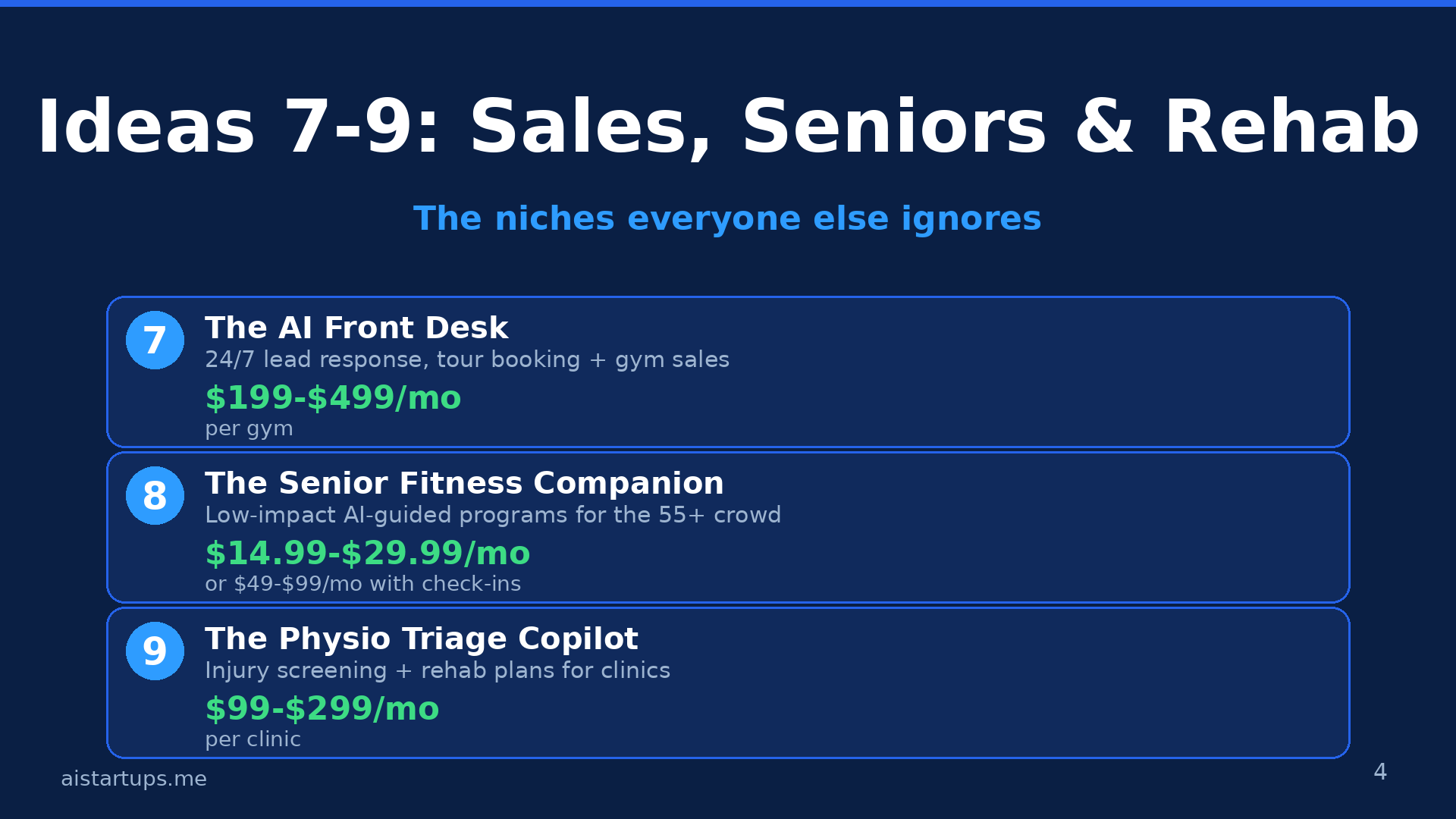
Who pays: gyms and studios, $199–$499/mo per location. This is the same AI-agent playbook that works for selling AI services to local businesses — except gyms have recurring revenue and a visible leak, so the sale is easier than in most local verticals. Start with independent gyms in one city; the owner is usually on site and can say yes the same day you demo it.
Idea 8: The Senior Fitness Companion
Everybody building fitness apps is chasing the 25-to-40 crowd. You know who’s actually got the money, the time, and the motivation? People over 55. The fitness club market’s own data says the 40-to-55 segment is the second-fastest growing, and the 55+ crowd is the one with the most to gain from staying active — and the most to lose from doing it wrong. A bad squat at 28 is a sore knee. A bad squat at 68 is a fall, a fracture, and six months of rehab.
The product: an AI-guided fitness companion built specifically for the 55+ crowd. Low-impact strength, balance, and mobility programs that adapt to the user’s actual capability — not a 25-year-old’s program with the weights turned down. Big buttons, voice-first interaction, no jargon. It checks in daily (“how are your knees today?”), adjusts the plan based on the answer, and — this is the part that makes it sellable — it keeps an adult child or caregiver in the loop with a weekly summary. “Mom did all four sessions this week, balance score up 12%.”
The buyer here is often not the user, which is a feature, not a bug. Adult children buy things for their parents’ health. That’s a purchase made with emotion and a credit card, not a price comparison. And the distribution channels are unusual in a good way: physiotherapists, retirement communities, Medicare Advantage plans that already pay for gym memberships (SilverSneakers has been doing this for years — the precedent is established), and community centers. These are channels where a small founder with a good product and a genuine story can actually get a meeting.
One caution: don’t build a medical device by accident. This is a wellness product, not a diagnostic tool. The moment you start claiming to detect or treat conditions, you’re in regulated territory. Keep the language to fitness, mobility, and balance — and partner with physios (see Idea 9) rather than replacing them.
Who pays: consumers, $14.99–$29.99/mo; or $49–$99/mo with a monthly human check-in call. Retirement communities and senior centers pay per-resident licensing too. The human check-in tier is the interesting one — it’s the highest-margin version, and for this audience the human touch is the product, not an add-on.
Idea 9: The Physio Triage Copilot
Last idea, and it’s for the clinical side of the fitness world: physiotherapy clinics, sports rehab centers, and the trainers who work at the edge of injury. A physio’s week looks like this: new patients arrive with a vague complaint (“my shoulder hurts when I lift”), the physio spends 45 minutes assessing, then writes a rehab program, then chases the patient to actually do the exercises at home. Most patients don’t. Adherence to home exercise programs is famously terrible — and the clinic has no visibility into it until the patient comes back, still hurting, six weeks later.
The product: a triage and rehab copilot for physio clinics. The patient does a guided movement screen on their phone before the first visit — a few recorded movements, a few questions — and the AI produces a structured intake summary for the physio: likely issue areas, movement asymmetries, pain patterns. After the visit, the AI generates the home exercise program from the physio’s notes, delivers it as short video-guided sessions, and tracks adherence: did they do the exercises, how did the pain respond, are they progressing? The physio sees a dashboard, not a pile of “I did them, I think” answers.
Why clinics buy this: a physio’s time is their inventory, and intake is the most expensive part of it. If the AI handles the structured part of the first visit, the physio sees more patients and spends their time on the judgment calls that actually need a human. And the adherence data is gold — it’s the difference between “the program didn’t work” and “the patient did 30% of the program,” which changes the entire treatment decision.
This is also the idea with the clearest path to a real moat: clinical data and clinician trust compound. The first clinic is the hardest sale. The tenth comes from a referral. Start with one sports-physio clinic, build the intake screen for the five most common complaints (low back, shoulder, knee, neck, ankle), and expand from there. And keep a physio as a co-designer from day one — this is not a product you can build from the outside.
Who pays: physio and rehab clinics, $99–$299/mo per clinic, or $29–$79 per patient assessment. The per-assessment model is the easier first sale — the clinic pays only when the tool does work — and the monthly plan is the upsell once they trust it. This is the most complex idea on the list to build well, and the one with the least competition, which is usually how those two things go together.
The fastest way to actually start
Okay, nine ideas. Now the part most lists skip: how do you pick one and ship it? Here’s my honest take, and it’s the same advice I’d give a friend.
- Don’t build first. Pick the idea whose customers you can reach this week. The Retention Radar sells to gym owners — are there 20 gyms in your city you could walk into today? The Senior Companion sells through physios and retirement communities — do you know anyone in that world? Distribution beats product every single time, and in a relationship-driven industry like fitness, warm intros are the whole game. This is the same reason AI side hustles that actually make money tend to be boring service businesses with a clear customer, not clever tech.
- Sell the service before the software. For almost every idea on this list, you can run the first 5–10 customers manually with AI tools behind the scenes. Answer a gym’s DMs by hand with an AI-drafted script before you build the Front Desk. Run a retention audit for three gyms in a spreadsheet before you build the Radar. You’ll learn what customers actually want (it’s never what you think), get paid while you learn, and only automate what’s proven. The software comes later, once the playbook is obvious.
- Price on the customer’s math, not yours. A gym doesn’t care that your AI costs you $0.40 per conversation. It cares that one saved member is worth $600 a year. Price at a fraction of the value you create — $299/mo against a $59,400 annual leak is a rounding error, which is exactly why they’ll say yes.
Before you commit to an idea, run this five-minute gut check:
- Can you name 10 specific people who feel this pain right now?
- Would at least one of them pay you $100+ this month for a manual version?
- Does the buyer control a budget (not “ask my boss”)?
- Is there a natural repeat — another month, another season, another location?
If you get four yeses, build it. Three yeses, talk to five buyers first. Fewer than that — pick a different idea off the list.
And if the idea of building the whole thing yourself makes you want to lie down — fair. This is also a legitimate path: partner with a web development studio to build the MVP while you focus on customers. AISquadX is the kind of AI integration studio that can take a validated idea from this list to a working product in weeks, which is the right division of labor when your superpower is selling, not shipping code.
A gym loses one in three members every year, and nearly one in five new members quits in the first 90 days. Every idea on this list is just a different way to plug that leak, coach the member who stays, or fill the class they left empty.
FAQ
Do I need fitness industry experience to build one of these?
No — and honestly, outsiders often see the gaps more clearly. What you need is access: five conversations with gym owners, trainers, or studio managers will teach you more than a year of reading. Ask about their worst week, not their dream software. Build for the pain, not the fantasy. The one exception is the physio idea, where you really do need a clinician as a co-designer from day one.
How much does it cost to build an AI fitness tool?
Less than you’d think. The cheapest ideas here (the AI Front Desk, the Retention Radar as a manual service) can start as a service run with AI tools behind the scenes — a few hundred dollars in tooling. A real SaaS MVP with integrations to gym software and a proper front end runs $3k–$15k depending on complexity. The expensive part was never the code; it’s the months of selling to get your first 20 customers. If you want the full picture, 21 profitable AI startup ideas for 2026 breaks down the same math across other industries.
Isn’t the fitness industry too seasonal?
It’s cyclical, not seasonal-dead. January is huge, summer dips, September rebounds — every gym owner knows the pattern and plans around it. The B2B ideas on this list barely feel it: gyms pay for retention software twelve months a year, and corporate wellness contracts are annual. The consumer apps feel it more, which is one more reason to start B2B. And the 55+ and rehab ideas run on a completely different calendar — nobody’s fitness goals wait for January when their knee hurts in July.
Can these ideas work outside the US?
Yes, with localization. The club market is global — Asia Pacific is the fastest-growing region for fitness trackers, and the corporate wellness market’s fastest growth is in Asia Pacific too. The Retention Radar and the Front Desk translate almost directly anywhere gyms exist. The Senior Companion needs local norms around aging and care. The Corporate Wellness Coach needs local benefits structures. Honestly, less-saturated markets are often the better opportunity — the US has the most gym software competition on earth.
Which idea makes money the fastest?
The service-first ones: the AI Front Desk and the Retention Radar run as a manual service. You can sell both this week — answer a gym’s messages for them, audit their churn in a spreadsheet — and convert to software later. The slowest is the Physio Triage Copilot: it needs clinical trust and real patient data before any clinic lets it near their intake. Fast money: sell the painkiller. Big money: build the platform.
The Bottom Line
Fitness is a $142 billion industry that loses a third of its customers every year and still runs large parts of its operation on spreadsheets, group chats, and gut feel. That’s not a criticism — it’s the opening. You don’t need a breakthrough model. You need to pick one painful, specific problem, sell the fix to people who feel it weekly, and charge a fraction of the value you create.
My shortlist, if I were starting tomorrow: the AI Front Desk for fast cash, the Retention Radar for sticky B2B revenue, and the Corporate Wellness Coach for the biggest contracts. But the best idea is the one whose customers you can reach this week. Pick your lane from the chart, talk to five potential buyers, and start selling the service before you build the software. The members are already walking out the door — and somebody’s going to build the tools that keep them. Might as well be you.