


Here’s the thing about AI model releases in late 2026: most of them blur together. A new name, a new benchmark chart, a new promise. Then you try the thing and nothing in your actual work changes.
Tencent’s Hy4 might be different. And I say “might” on purpose, because the honest version of this story has a catch you’ll want to hear before you move any workload onto it.
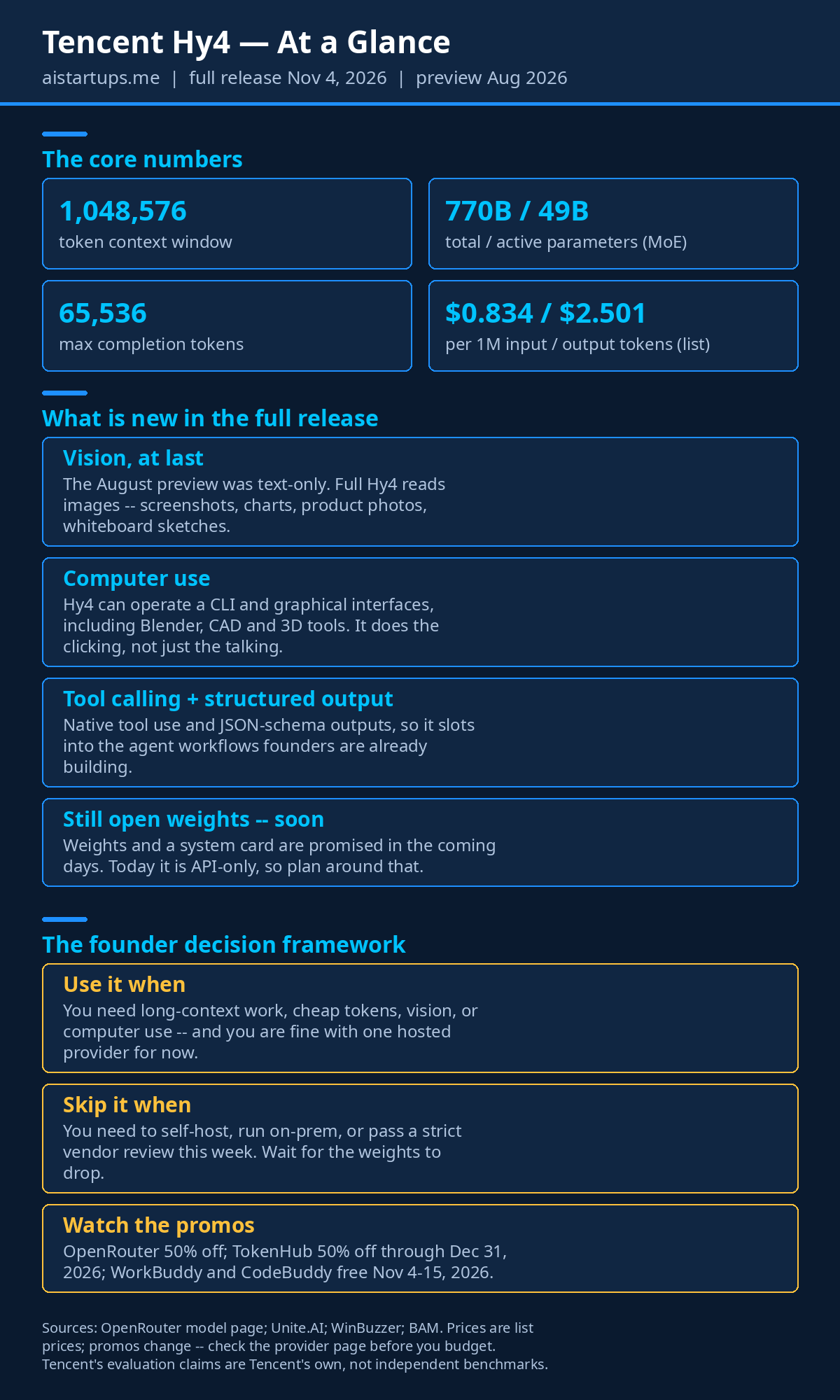
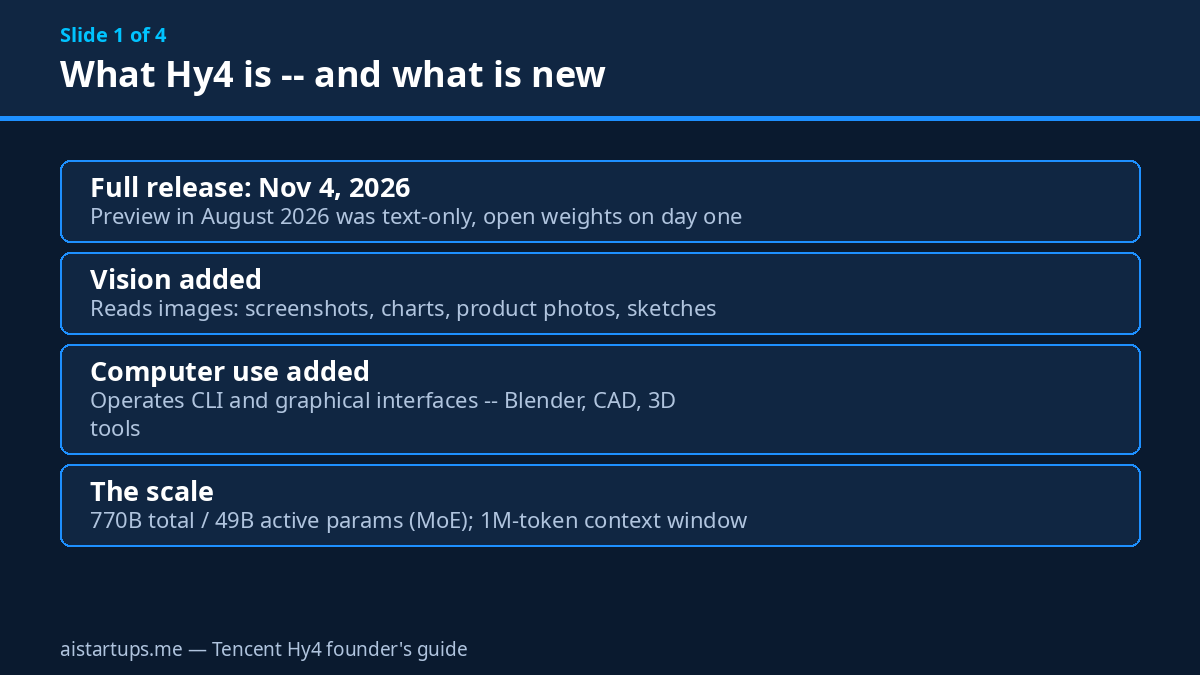
On November 4, 2026, Tencent released the full version of Hy4. The preview had been out since August — text-only, open weights on day one, interesting but easy to ignore. The full release is a different animal. It can see images now. It can operate a computer: the command line, graphical interfaces, Blender, CAD, 3D tools. It does the clicking, not just the talking.
And the price? $0.834 per million input tokens and $2.501 per million output tokens. That’s roughly a quarter of what Kimi charges on output. Right now, with launch promos running, it’s half that again.
So yeah, this one deserves your attention. But — and this matters — you can’t download it yet. The weights are still coming. Today, Hy4 lives behind hosted APIs only. If your whole plan depends on self-hosting an open model this week, this isn’t your week.
I’ve spent the last day reading the launch coverage, the OpenRouter listing, and Tencent’s own numbers, and this guide is the result: what Hy4 actually is, what it costs, how to try it in ten minutes, where it fits in a startup’s stack, and where I’d hold off. No hype. Just the facts that check out, and the gaps that don’t.
What Hy4 Actually Is (and What Changed on November 4)
Let’s start with the basics, because Tencent’s naming doesn’t help anyone. Hy4 is Tencent’s flagship foundation model, the successor to the Hunyuan line. The August preview was a text-only model with open weights available from day one. It was solid, it was cheap, and almost nobody outside the open-model crowd talked about it.
The full release, which landed on November 4, 2026, adds the two things that change what a model can actually do for a small team.
First, vision. Hy4 can now take images as input — screenshots, charts, product photos, whiteboard sketches, a photo of a broken dashboard. For a founder, that’s the difference between describing a problem in words and just showing the model what’s wrong. Send it a screenshot of your pricing page and ask what’s confusing. Send it a photo of a whiteboard full of roadmap ideas and ask it to turn them into a spec. That’s real work, not a demo trick.
Second, computer use. This is the bigger deal, and the one I’d watch most closely. Hy4 can operate a command line and graphical interfaces, including Blender, CAD, and 3D tools. In plain English: it can open software, click around, run commands, and carry out multi-step tasks inside the tools your team already uses. Most models stop at writing you a plan. Computer use means the model starts executing the plan.
Now, real talk: computer use is the kind of capability that sounds incredible in a launch post and gets messy in practice. Every vendor demos the smooth path. The question is always what happens on step seven, when a dialog box appears that wasn’t in the script. I haven’t seen independent hands-on testing of Hy4’s computer use yet — nobody outside Tencent’s orbit has had it long enough. So treat this as genuinely exciting and genuinely unproven, both at once.
Under the hood, Hy4 is a mixture-of-experts model: 770 billion total parameters, with 49 billion active for any given token. That’s the architecture trick that keeps inference costs down — only a slice of the model fires at a time — and it’s a big part of why the pricing looks the way it does.
The Numbers That Matter
Founders don’t buy parameter counts. They buy outcomes per dollar. But a few of Hy4’s specs are worth knowing, because they shape what you can throw at it.
- Context window: 1,048,576 tokens. That’s a full million tokens. You can drop in an entire codebase, a year’s worth of support tickets, or a 300-page contract and still have room to ask questions about it. Kimi K3.1 Pro, the model I covered in my Kimi K3.1 Pro founder’s guide, also offers a million-token window, so Hy4 isn’t alone here — but it joins a very small club.
- Max completion: 65,536 tokens. Long outputs matter more than people think. A 65K-token completion means the model can write a full report, a long document, or a big chunk of code in one go instead of stopping halfway and making you stitch pieces together.
- Input: text and images. Output: text. Simple, but worth stating. It reads pictures; it doesn’t generate them (at least, not in this release).
- Tool calling and structured outputs. Hy4 supports native tool use and JSON-schema outputs. If you’re building agents — and by now, most serious startups are — that matters a lot. A model that returns clean, parseable JSON saves you from writing brittle regex to scrape answers out of prose.
- Parameters: 770B total, 49B active. Big model, efficient inference. The active-parameter count is what your latency and your bill actually feel.
One more number to keep in your head: the context window and the completion limit together mean Hy4 can read a huge amount and write a lot back. That combination is exactly what long-document work needs — legal review, due diligence, research synthesis, codebase audits. If your startup lives in documents, this spec sheet should make your ears perk up.
What Tencent Claims — and What It Doesn’t Prove
Every model launch comes with a chart where the new model wins. Tencent’s is no exception, and I want to be straight with you about which numbers are Tencent’s own claims and which ones have independent backing. Short version: right now, it’s all Tencent’s numbers. No independent benchmark index has scored the full Hy4 yet. That’s not a red flag on its own — the model is a day old — but it means you should treat the scores below as the vendor’s story, not settled fact.
Here’s what Tencent says. In a finance evaluation built with 213 professionals across 579 real tasks, Hy4 scored 3.04, which Tencent says puts it first among open-weight models — ahead of DeepSeek-V4.1-Flash at 2.97, and Kimi K3.1 Pro and GLM-5.3 at 2.68 each. Finance is a smart place for Tencent to flex, by the way. Real tasks, judged by real professionals, in a domain where wrong answers cost money. If that evaluation holds up under outside scrutiny, it’s genuinely impressive.
Tencent also reports big reliability gains over the August preview. The hallucination rate in its internal search evaluations fell from 15.76% to 5.45%. Speculative errors — the model confidently inventing things — dropped from 23.1% to 5.6%. And on game development tasks, Tencent reports GameDev up 19.1% and GameLogic up 9.8% over the preview. The hallucination numbers are the ones I care about most. A model that makes things up 5% of the time is still a model you have to supervise, but it’s a very different tool from one that invents facts 15% of the time.
Now the part I respect Tencent for including: the company itself acknowledges a gap remains to the top closed models on research math, long-horizon coding, and advanced visual QA. That’s honest, and it matches what you’d expect. The closed frontier models still lead on the hardest reasoning work. Hy4 is closing distance, not claiming the crown.
“No independent benchmark index has scored the full Hy4 yet. Everything in this section is Tencent’s own evaluation — promising, but treat it as the vendor’s story until outside testing lands.”
So how should you read all this? Like an early product review from the manufacturer: useful, directional, and worth verifying with your own tests before you bet a workflow on it. The finance score is interesting because of how it was built — real professionals, real tasks. The hallucination drop is interesting because it points at reliability, not just capability. But until an independent index publishes numbers, the smart move is to run your own side-by-side tests on your own data. That’s what the hands-on section below is for.
The Price Math: Where Hy4 Actually Wins
Look, specs are fun, but price is where Hy4 stops being “another model” and starts being a business decision. Let’s do the math out loud.
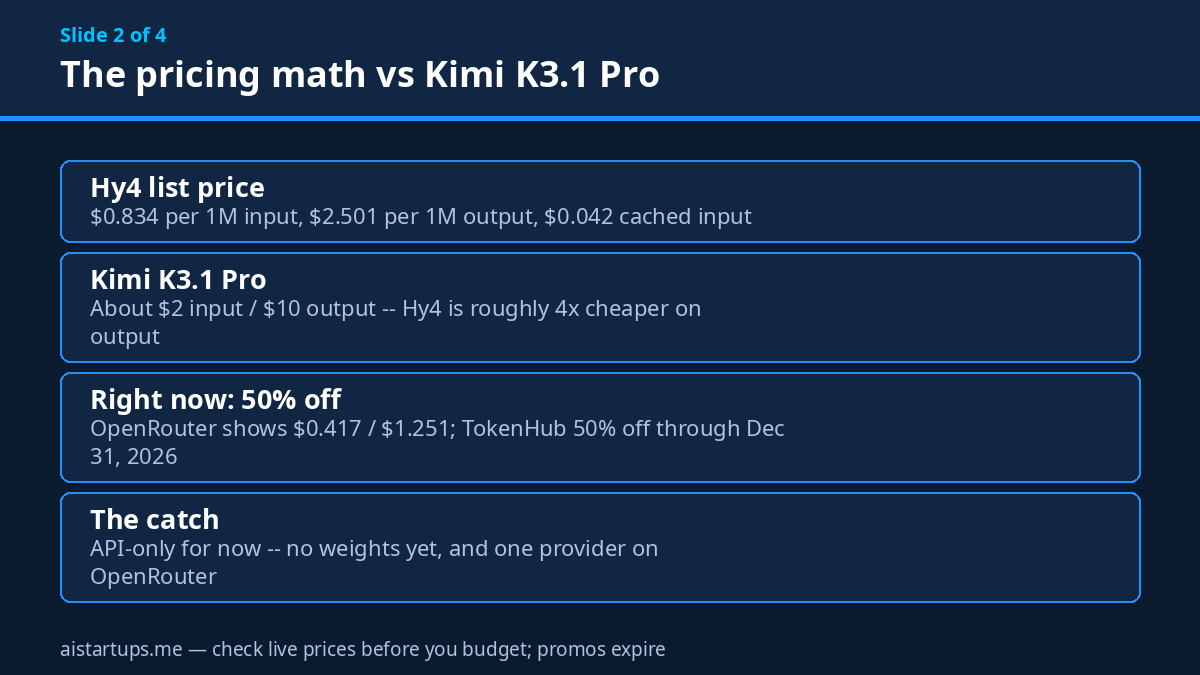
List pricing is $0.834 per million input tokens, $2.501 per million output tokens, and $0.042 per million cached input tokens. Compare that with Kimi K3.1 Pro, which runs about $2 per million input and $10 per million output. On output tokens — the ones that usually dominate your bill, because the model writes more than you feed it — Hy4 costs roughly a quarter of Kimi’s price.
Here’s a concrete example. Say your startup processes 10 million input tokens and 2 million output tokens in a month — a reasonable volume for a small team running support triage, document summaries, and a customer-facing assistant. On Hy4’s list price, that’s 10 × $0.834 = $8.34 of input plus 2 × $2.501 = $5.00 of output. Total: about $13.34. The same volume on Kimi runs about $20 of input plus $20 of output — $40. Same work, a third of the bill.
And right now it’s cheaper still. OpenRouter shows Hy4 at 50% off: $0.417 per million input and $1.251 per million output, with cached input at $0.021. Tencent Cloud’s TokenHub is running 50% off through December 31, 2026. WorkBuddy and CodeBuddy — Tencent’s own apps — are free from November 4 to 15, 2026. On the promo pricing, that same monthly workload costs about $6.67. That’s not a rounding error. That’s the difference between “we can afford to run this on every ticket” and “we have to ration it.”
Two cautions, because promos always come with fine print. First, the 50% discounts end. Budget on the list price and treat the promo as a bonus, not your baseline. Second, cached input at $0.042 per million is cheap, but it only helps if your workflow reuses the same context repeatedly — system prompts, long documents you query again and again. If every request is brand new, caching saves you nothing. Design for it where you can, but don’t count savings you haven’t engineered.
Hands-On: Calling Hy4 in Ten Minutes
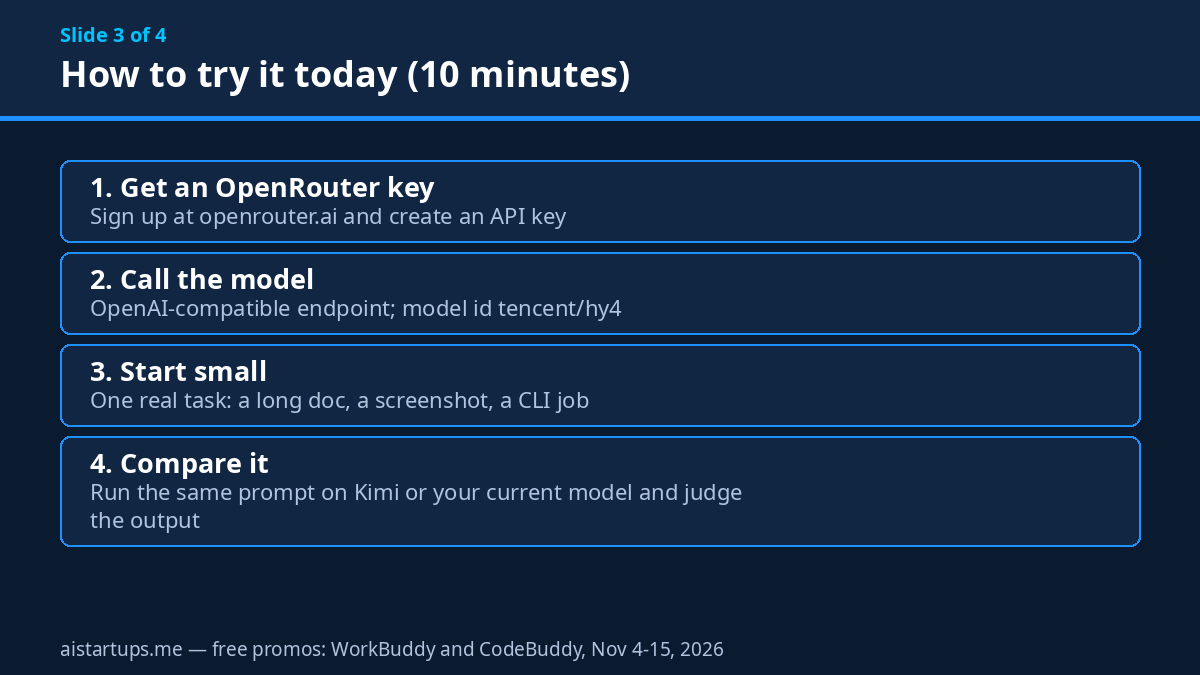
Enough theory. Here’s how a founder actually tries Hy4 today, with no waiting list and no special access. The fastest route is OpenRouter, where the model id is tencent/hy4 and Tencent Cloud is currently the sole provider. OpenRouter speaks the OpenAI-compatible API, so if your code already talks to OpenAI-style endpoints, you’re most of the way there.
Step one: create an account at OpenRouter and generate an API key. Step two: send a request. Here’s the curl version — swap in your own key and your own prompt:
curl https://openrouter.ai/api/v1/chat/completions \ -H "Content-Type: application/json" \ -H "Authorization: Bearer $OPENROUTER_API_KEY" \ -d '{ "model": "tencent/hy4", "messages": [ {"role": "user", "content": "Summarize the three biggest risks in this business plan."} ] }'If you’re in Python, the same call works through any OpenAI-compatible client — just point the base URL at https://openrouter.ai/api/v1 and set the model to tencent/hy4. That’s it. No SDK to learn, no new client library, no migration project. If your stack already calls OpenAI, Anthropic, or Kimi through an OpenAI-style interface, Hy4 slots into the same code path with a one-line change.
What should you test first? Don’t run a generic benchmark. Run your own work. Pick one real task your team does every week — triaging support tickets, summarizing sales calls, reviewing a contract, turning a screenshot of a bug into a written report — and run it on Hy4 and on whatever you’re using now. Same input, both models, judge the outputs yourself. That’s the only benchmark that matters for your business, and it takes an afternoon, not a research team.
One practical note: if you want Hy4 wired into your actual product instead of a one-off script — a support assistant on your site, document processing in your app, an agent that works inside your team’s tools — that’s integration work, and it’s the kind of thing a specialist team does well. If you go looking for help with that, AISquadX is a web development and AI integration studio that builds exactly that kind of thing. Either way, start with the ten-minute test above before you commit to anything bigger.
Where Hy4 Fits in a Startup’s Stack
So where does this thing actually earn its keep? I’ve been thinking about it in terms of jobs, not features. Here’s where Hy4 looks like a genuinely good fit right now.
Long-document work is the obvious one. A million-token window plus cheap tokens means you can feed Hy4 the whole contract, the whole codebase, or the whole quarter of support tickets and ask real questions. Due diligence, legal first passes, research synthesis — the jobs where the old workflow was “hire someone to read all of this.” Hy4 doesn’t replace the human at the end of that chain, but it does the reading fast and cheap.
Vision work is the second. Screenshot-to-report is a workflow a lot of startups need and almost nobody has automated well: a customer sends a screenshot of a bug, a teammate photographs a whiteboard, a supplier sends a photo of a damaged shipment. Hy4 takes the image in directly. That’s a small thing that removes a surprising amount of friction — no more “please describe what you’re seeing” back-and-forth.
And then there’s computer use, which is the wild card. If it works as advertised, the use cases get interesting fast: an agent that opens your design tool and makes the edits, one that runs through a QA checklist inside your actual product, one that drives a 3D tool for a client mockup. That’s the kind of capability that could change how a two-person startup operates. But — and I keep coming back to this — it’s also the capability with the least independent verification so far. Pilot it on low-stakes tasks. Watch what it does. Don’t hand it your production environment on day one.
There’s also a less glamorous but very real use case: cost arbitrage. If you’re already running a lot of tokens through a pricier model for routine work — classification, extraction, first-draft summaries — Hy4 at a quarter of Kimi’s output price is worth testing as a drop-in for the boring jobs. Keep your best model for the hard reasoning; let the cheap one handle the volume. That’s just good unit economics, and it’s the kind of move that shows up in your margins within a month.
The Honest Downsides
Okay. The other side of the coin, because a guide that only lists the good parts isn’t a guide — it’s an ad.
You can’t download it yet
This is the big one. Hy4 was an open-weights model in preview, and the full release is supposed to follow the same path — Tencent says the weights and a system card are coming “in the coming days.” But there’s no date, and “coming days” in vendor-speak has a flexible definition. Today, Hy4 is API-only. If your architecture depends on self-hosting, running on-prem, or keeping inference inside your own infrastructure, you wait. A cheaper Hy4 Flash is also planned soon, which is good news for pricing — and another reason not to over-commit to today’s setup.
One provider on OpenRouter
On OpenRouter, Tencent Cloud is currently the sole provider for Hy4. That means no failover, no price competition between providers, and a single point of failure for availability. If Tencent Cloud has a bad day, your Hy4 calls have a bad day. For a side project, that’s fine. For a customer-facing feature, you want a fallback model configured and tested — which is good practice anyway, but it’s more urgent when there’s only one provider behind the model you picked.
The vendor question
Tencent is a Chinese company, and some founders will need to think about that — not as a political question, but as a practical one. Where does your data go when it hits the API? What does your customer contract say about data residency? What does your enterprise buyer’s vendor review ask about model providers? These are boring questions and they matter more than any benchmark score. If you serve regulated customers or handle sensitive data, run Hy4 through your normal vendor review before it touches real customer information. That’s not a warning about Tencent specifically — it’s the same review you’d run for any new provider, and skipping it is how startups get surprised later.
The gaps Tencent admits
Remember the honest part of Tencent’s own report: a gap remains to the top closed models on research math, long-horizon coding, and advanced visual QA. If your core product depends on hard math reasoning or very long coding sessions, Hy4 probably isn’t your primary model yet. It’s a strong, cheap workhorse — not the frontier. Use it for what it’s good at and keep the hardest work on the model that handles it best, even if that one costs more.
Hy4 vs Kimi K3.1 Pro vs Mistral Large 4
You’re not choosing a model in a vacuum. You’re choosing between real options, and the honest comparison is messier — and more useful — than any single score.
Kimi K3.1 Pro is the closest comparison, and it’s one I’ve already written about in depth — see my Kimi K3.1 Pro founder’s guide for the full picture. It also offers a million-token window, and it’s a proven quantity with more independent testing behind it. But at roughly $2 per million input and $10 per million output, it costs about four times what Hy4 charges on output. Hy4 also adds vision and computer use, which Kimi doesn’t match in this comparison. What Kimi has that Hy4 doesn’t (yet) is maturity: more time in the wild, more independent evaluation, and downloadable weights you can actually run. If you need proven and self-hostable today, Kimi’s still the pick. If you want cheaper tokens and the new capabilities, Hy4 is the experiment worth running.
Mistral Large 4 is the other name that comes up in this conversation. It’s an open-weights model at roughly a trillion parameters, and the open weights are available — which is exactly the thing Hy4 is still promising. If self-hosting is a hard requirement for you this week, Mistral is the one you can actually download and run. My Mistral Large 4 guide covers it in detail. The trade-off is that you give up Hy4’s computer use and its price point, and you take on the infrastructure work of running a very large model yourself. Different deal, different buyer.
And for context on where the closed frontier sits: Gemini’s latest release and Claude’s newest lightweight model both aim at the same founder audience from the closed side — my Gemini 4 Carbon guide and my Claude Haiku 5.5 guide cover those. They cost more, they don’t give you weights, but they come with the deepest independent testing and the strongest reasoning on the hardest tasks. The pattern is the same as it’s been all year: open models compete on price and control, closed models compete on peak capability and trust. Hy4 just moved the open side of that line forward by a noticeable amount.
Here’s my short version of the comparison. Want the cheapest capable tokens with vision and computer use, and you’re fine with an API for now? Hy4. Need proven, self-hostable, and heavily tested today? Kimi or Mistral, depending on whether you value Kimi’s maturity or Mistral’s downloadable weights more. Need the strongest reasoning money can buy? The closed frontier still holds that title, and Tencent says so itself.
Frequently Asked Questions
Can I download and self-host Hy4 today?
Not yet. The August preview shipped with open weights, and Tencent says the full Hy4’s weights and a system card are coming “in the coming days,” but no date has been given. Today, Hy4 is available only through hosted APIs: Tencent Cloud TokenHub, OpenRouter, and Tencent’s own apps (WorkBuddy, CodeBuddy, Yuanbao, ima, and the WeCom assistant). If self-hosting is a hard requirement, wait for the weights or look at Mistral Large 4, whose open weights are already available.
How much does Hy4 actually cost?
List pricing is $0.834 per million input tokens, $2.501 per million output tokens, and $0.042 per million cached input tokens. Launch promos cut that in half right now: OpenRouter shows $0.417 / $1.251 / $0.021, TokenHub is 50% off through December 31, 2026, and WorkBuddy and CodeBuddy are free from November 4 to 15, 2026. Budget on the list price — promos end — and check the OpenRouter model page for the live numbers before you commit.
What is computer use, and should I trust it yet?
Computer use means Hy4 can operate a command line and graphical interfaces — including Blender, CAD, and 3D tools — carrying out multi-step tasks inside software instead of just describing how to do them. It’s the most exciting part of this release and the least independently tested. Pilot it on low-stakes tasks, watch what it does, and don’t hand it production systems on day one.
Is Hy4 better than Kimi K3.1 Pro?
It depends on what “better” means for you. Hy4 is much cheaper — roughly a quarter of Kimi’s output price — and it adds vision and computer use. Kimi has more independent testing behind it and is the more proven quantity today. Tencent’s own finance evaluation puts Hy4 first among open-weight models, but that’s Tencent’s evaluation, and no independent benchmark index has scored the full Hy4 yet. Run both on your own work and judge the outputs yourself.
Is my data safe with a Tencent-hosted model?
That’s a question for your vendor review, not a blog post. Hy4’s API runs on Tencent’s infrastructure, so your prompts and data go to Tencent’s servers. If you serve regulated customers or handle sensitive data, check your contracts and data-residency requirements before sending real customer information through any new provider — Hy4 included. For internal, non-sensitive work, the risk profile is the same as any other hosted API: read the terms, know where the data goes, and decide with your eyes open.
The Bottom Line
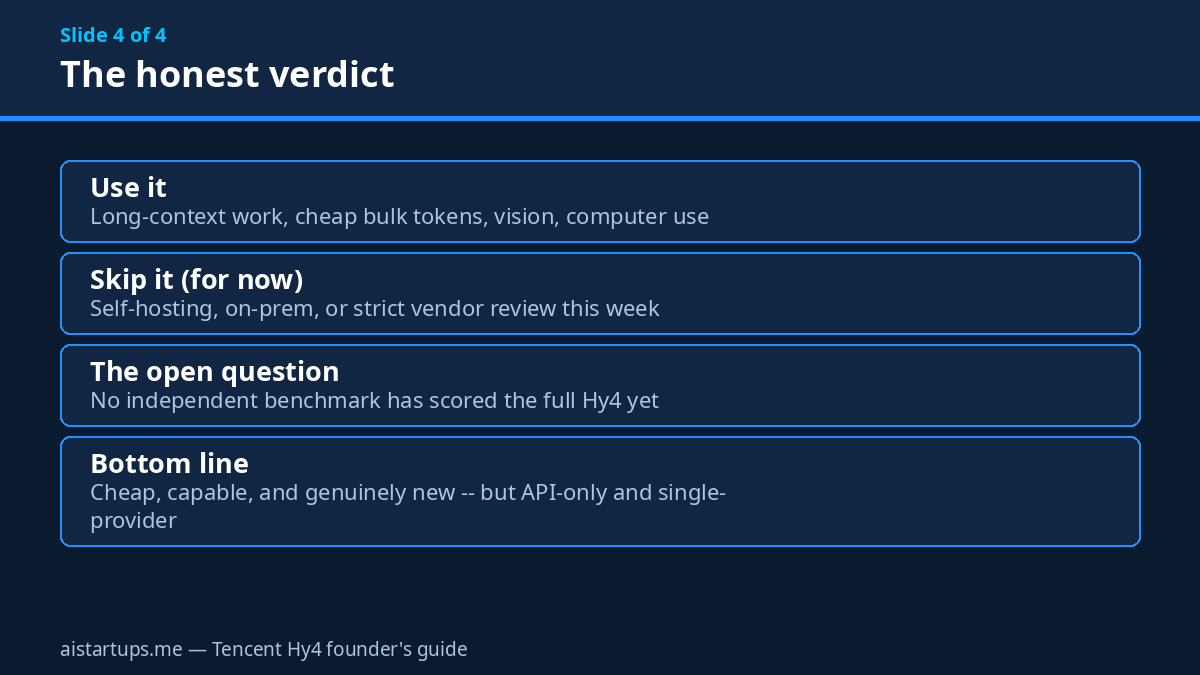
Tencent Hy4 is the most interesting open-model release I’ve seen in months — and the most honest way to say that is with the caveats attached. The full release, out November 4, 2026, adds vision and computer use to a model that was already cheap, with a million-token window and pricing that undercuts Kimi by roughly four times on output. The finance evaluation Tencent published is genuinely interesting, the hallucination drop from 15.76% to 5.45% is the kind of reliability gain that changes what you can trust a model with, and the launch promos make this the cheapest possible moment to try it.
But it’s API-only for now, single-provider on OpenRouter, and untested by any independent benchmark. Those aren’t reasons to ignore it. They’re reasons to test it properly: ten minutes with the OpenRouter call above, one real task, judged against whatever you’re using now. If it holds up on your work, the savings are real money. If it doesn’t, you’ve spent an afternoon and learned something — which is still a good trade.
My advice? Try it this week, while the promos are live and the apps are free. Keep your current model for the hard stuff. And check back for the weights — because the day Hy4 becomes downloadable, this whole conversation changes again. Sources for everything above: the OpenRouter model page, Unite.AI’s launch coverage, BAM’s November 4 issue, and WinBuzzer’s report.