
Here’s a conversation almost every founding team skips: the one about what happens when things go wrong.
Not the product. Not the pitch deck. The awkward stuff. Who owns what. Who decides what. What happens if one of you quits in month nine. Who owns the model you trained on a laptop before the company even existed.
I’ve watched founding teams treat this conversation like bad luck — like writing it down might jinx the whole thing. Honestly? The opposite is true. The teams that have this talk early are the ones that survive the hard parts. The ones that don’t are the ones that end up in a lawyer’s office arguing over a company that hasn’t even raised a seed round yet.
So let’s do it properly. This is the co-founder agreement conversation, clause by clause, in plain English. No legal degree required. (And one thing up front: this isn’t legal advice. It’s a founder’s checklist. Get a startup lawyer to turn it into real documents for your jurisdiction before you sign anything.)
Why this can’t wait until after incorporation
Here’s the thing. Before you incorporate, everything is informal. You talk, you agree, you shake hands, you get back to building. That feels fine — until it isn’t.
The moment you incorporate, shares get issued. Real shares, with real legal weight. If those shares go out with no vesting schedule and no written agreement behind them, a co-founder who leaves after three months walks away owning the same chunk as the person who stays for five years. Try explaining that to an investor. Actually, don’t — investors will just walk away. A cap table with a departed founder holding a big, fully vested stake is one of the fastest ways to kill a fundraise before it starts.
And AI startups have an extra wrinkle that most generic founder guides skip: the intellectual property is weird. It’s not just code. It’s training data, fine-tuned weights, prompts, evaluation sets, API keys, and a half-finished prototype that one founder built before you even met. If nobody writes down who owns all of that, you don’t have a company asset — you have a dispute waiting for its moment.
So the order of operations matters. Talk first. Write it down second. Incorporate third. That’s the whole game.
1. The equity split: score the future, not the past
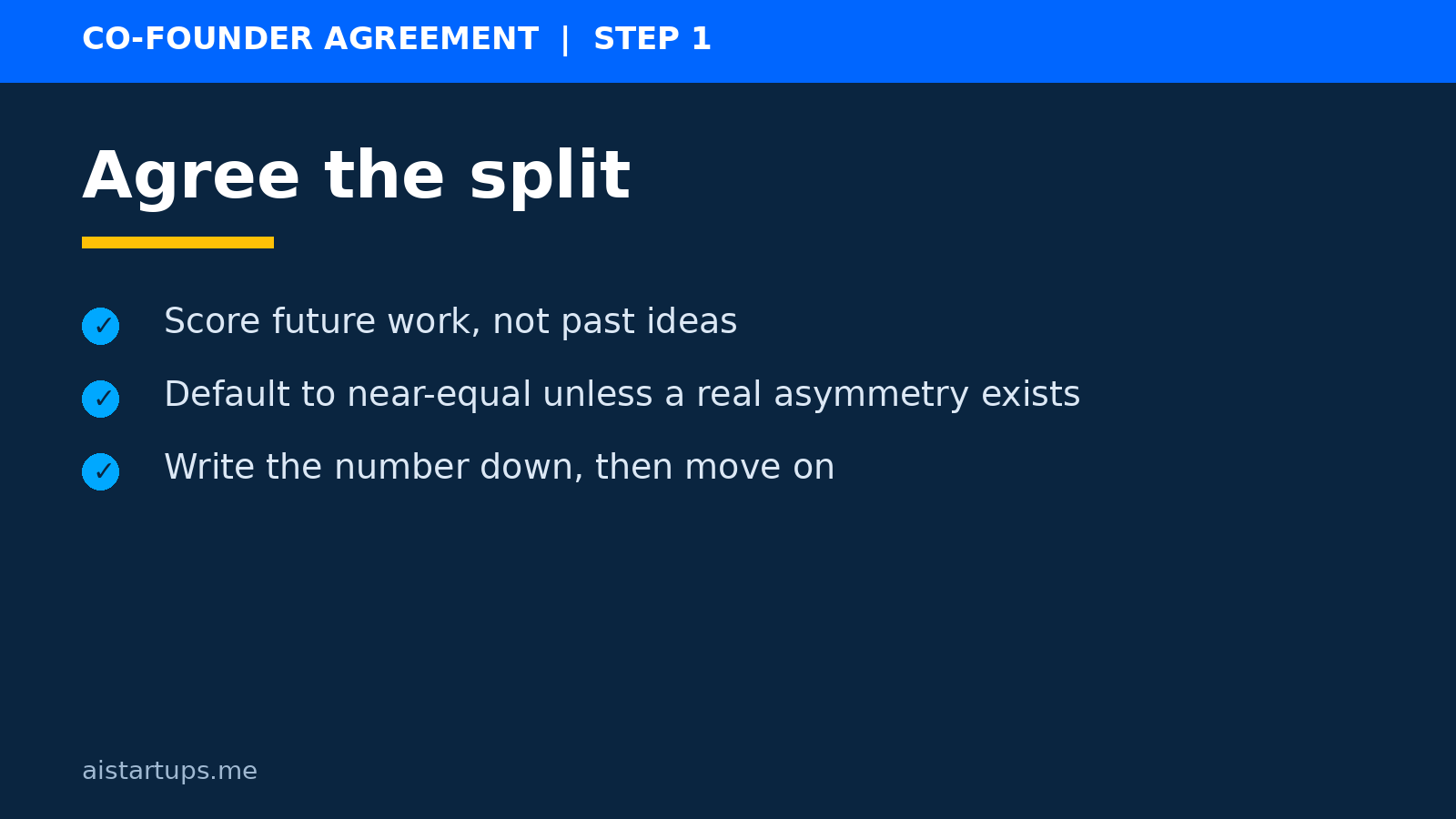
The equity split is where most founding teams stall, because it feels personal. It is personal. But it helps to reframe it: you’re not dividing up what already exists. You’re dividing up the value of years of work that hasn’t happened yet.
Y Combinator’s long-standing advice here is blunt: split equity equally, or close to it, because nearly all the work is ahead of you. The person who had the idea or wrote the first prototype did something real — but compared to the seven to ten years of building ahead, it’s a small slice of the total effort. An unequal split based on early contributions tends to demotivate exactly the person you need most.
That said, equal isn’t always right. Real asymmetries exist. One founder might be full-time while the other keeps a day job for six months. One might put in serious cash. One might bring a customer list or a patent. Those are legitimate reasons to adjust — but adjust modestly, and write down why. A 60/40 split with a clear reason behind it ages much better than a 90/10 split justified by “it was my idea.”
How to actually run the conversation
Sit down with a blank page and score each founder on the same factors: role centrality, full-time commitment, relevant experience, cash invested, and IP or assets brought in. Weight the factors by what actually matters for your business, then let the numbers produce a starting point. You’ll argue about the weights — and that’s the point. Arguing about weights is productive. Arguing about vibes is not.
Then ask the killer question: does every founder feel the split is fair enough that they’d still feel motivated in year three, when the work is grinding and the company is worth real money? If anyone hesitates, the split is wrong, no matter how logical it looks on paper.
One more rule that saves friendships: keep cash separate from equity. If a founder puts money in, treat it like an investment — a loan or a SAFE on the same terms an outside investor would get — rather than inflating their equity percentage. Mixing the two makes every later money conversation twice as messy. For a broader pre-launch sweep, our AI startup legal checklist covers the other documents you should have ready alongside this one.
2. Vesting: the clause that protects everyone
If you take one thing from this article, take this: every founder goes on a vesting schedule. No exceptions. Not even the CEO. Not even the person who “already did the work.”
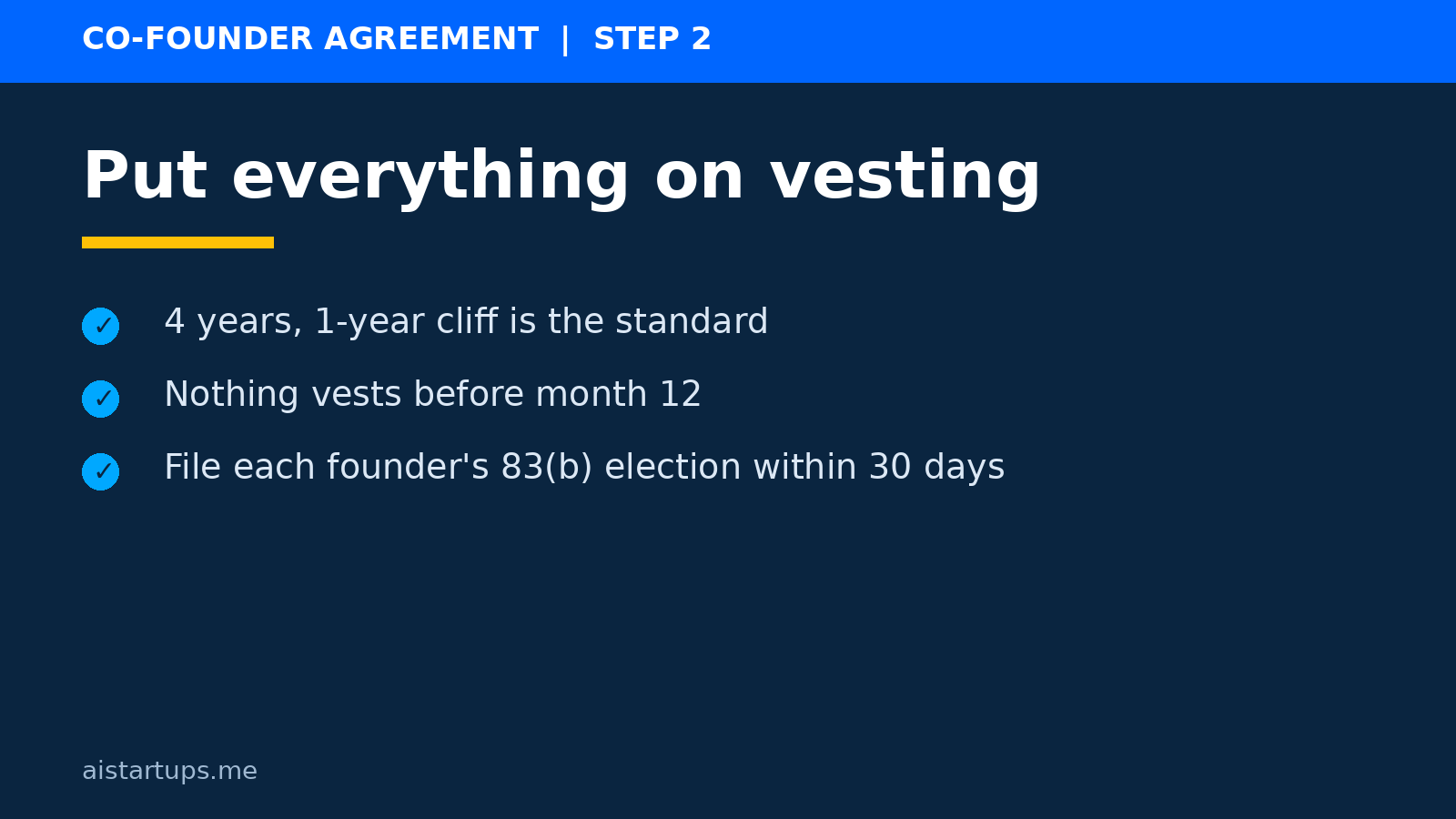
The standard schedule, used by Stripe Atlas and most startup lawyers, is four years with a one-year cliff. Here’s what that means in practice: nothing vests for the first twelve months. At the one-year mark, 25% of your shares vest all at once. After that, the rest vests monthly over the remaining three years. Leave in month six, and you leave with nothing. Leave in month eighteen, and you keep roughly 37.5% of your grant while the rest returns to the company.
Is that harsh? It feels harsh until you see the alternative. Without vesting, a founder who quits early keeps their full stake forever, and the people doing the actual work spend years diluted by a ghost. Vesting isn’t about distrust. It’s about the fact that nobody — not you, not your co-founder — can predict a health crisis, a family move, or a simple change of heart eighteen months from now.
The 30-day deadline nobody tells you about
Here’s a detail that catches first-time founders off guard. In the US, when you receive founder stock subject to vesting, you generally want to file an 83(b) election with the IRS within 30 days of receiving the shares. No extensions, no late filings. The election lets you pay tax on the shares’ value at grant — when the company is worth almost nothing — instead of paying ordinary income tax on their much higher value as each slice vests.
Miss the window and there’s no fix. Put it in your calendar the day the stock is issued, and confirm every founder has filed. This is the kind of unglamorous admin that separates founders who keep their equity from founders who hand a chunk of it to the taxman for no reason. (If you’re outside the US, your jurisdiction will have its own version of this problem — another reason to get local advice.)
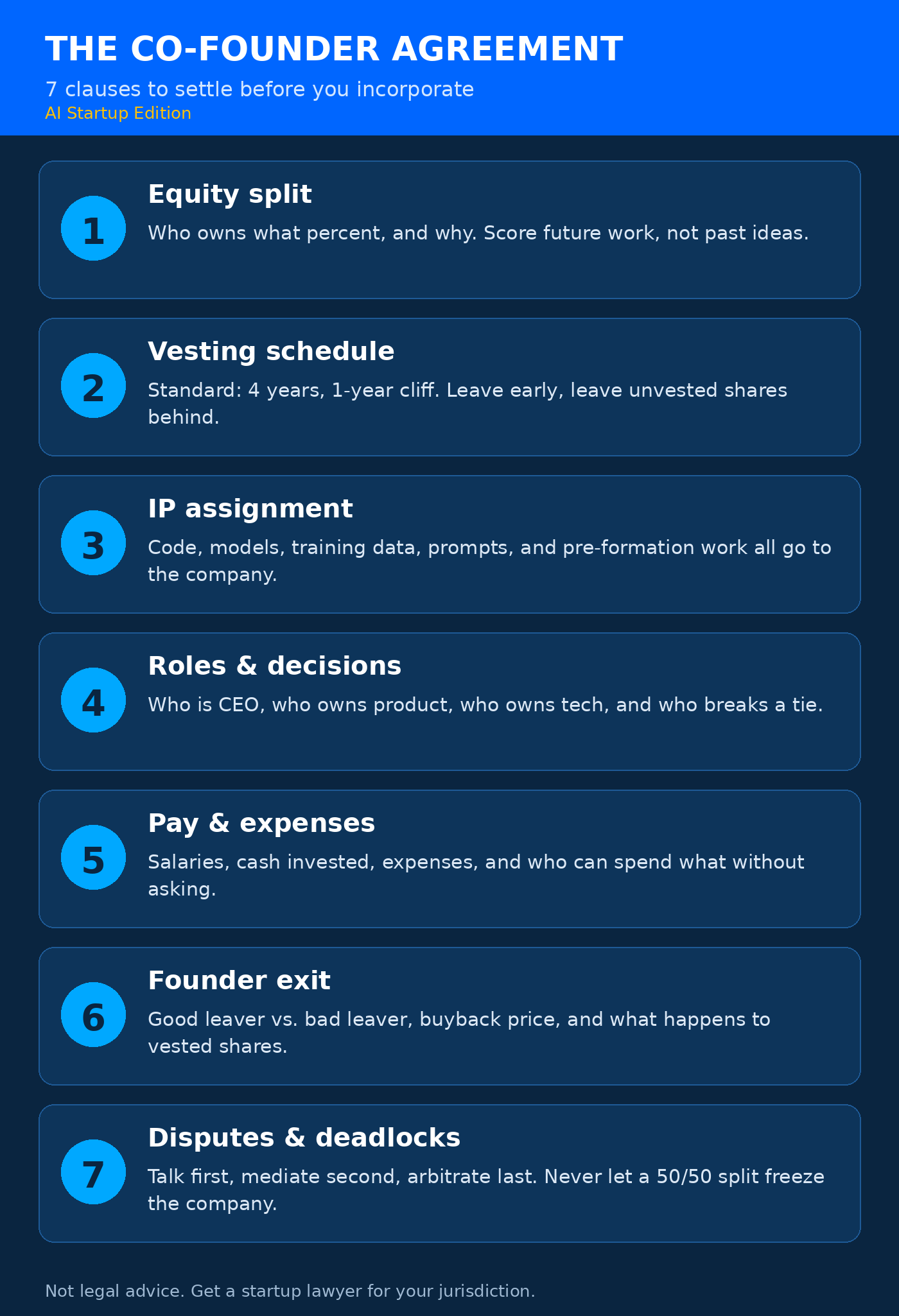
3. IP ownership: the AI-specific minefield
Real talk: this is the section most AI founding teams get wrong, because AI work doesn’t look like traditional software work.
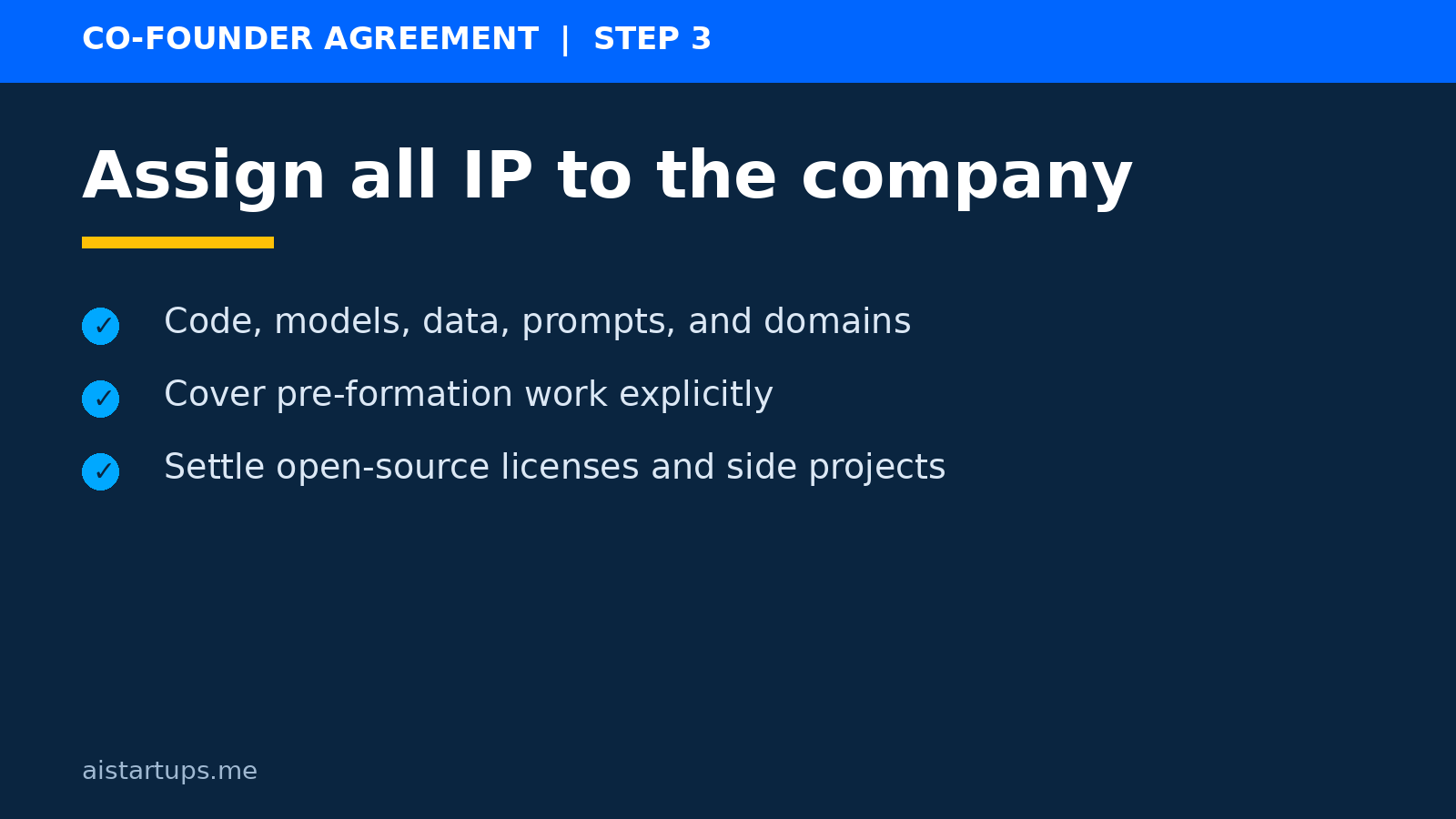
In a normal SaaS startup, the IP question is mostly “who wrote the code.” In an AI startup, the assets are scattered: the base model you fine-tuned, the dataset you scraped or licensed, the prompts and evals you iterated on for months, the API integrations, the domain name, the brand, and the prototype one founder built in their spare time before the company existed. Every single one of those needs a clear owner — and the owner needs to be the company.
The mechanism is an IP assignment agreement: each founder assigns to the company everything they created that relates to the business, including pre-formation work. Pay attention to the tense here, because lawyers care about it a lot: “hereby assigns” (present tense, it happens now) beats “agrees to assign” (a promise to do it later). The Cooley GO incorporation documents include a standard inventions assignment form for exactly this purpose, and it’s worth reading even if you incorporate another way.
The four AI IP questions to answer in writing
First, pre-formation work: list everything each founder built before incorporation that the company will use, and assign it explicitly. Vague language here is how a departing founder later claims the core model was “theirs.”
Second, training data: document where every dataset came from, what license it carries, and whether it can be used commercially. A dataset with a research-only license sitting inside a commercial product is a liability, not an asset.
Third, open-source licenses: agree on which licenses are acceptable in the codebase (permissive ones like MIT and Apache 2.0 are usually fine) and which need a conversation first (copyleft licenses like GPL can create obligations you don’t want). One founder quietly pulling in a GPL library can complicate an acquisition years later.
Fourth, side projects: define what’s yours and what’s the company’s. A common, fair rule is that anything related to the company’s business belongs to the company, while genuinely unrelated personal projects stay with the founder — as long as they’re disclosed. Silence on this point is how a side project becomes a lawsuit.
The best co-founder agreement is the one you never need to read again — because the conversation it forced was the real protection all along.
4. Roles and decision rights: name the CEO now
“We’ll figure out titles later” is how half of founder breakups start. Name the CEO in the agreement, even if it feels premature. Then name who owns product, who owns technology, and who owns fundraising and investor relationships. Overlap is fine — most early teams overlap everywhere — but final say on each domain should sit with one person.
Then handle the tie-breaker. If you have two founders with equal equity, a 50/50 deadlock is not a theoretical risk, it’s a math certainty waiting for its first real disagreement. Common fixes: give the CEO the deciding vote on day-to-day operations, require a supermajority for a short list of big decisions (raising money, selling the company, hiring or firing a founder), and set a deadlock procedure for the rest. Which brings us to disputes — more on that below.
Also settle this: can a founder be removed, and by whom? It’s an awful conversation, but a company with no removal mechanism is a company held hostage by its worst day. Typically, removal of a founder as an officer (not as a shareholder — that’s the vesting and buyback section) requires a board vote, and the board’s composition should be defined in the agreement too.
5. Money: salaries, expenses, and who can spend what
Money fights are rarely about greed. They’re about mismatched assumptions. One founder assumes both take the same salary; the other assumes the one who quit their job gets paid more. One founder assumes a $500 software subscription doesn’t need a discussion; the other sees it on the bank statement and feels blindsided. Write it all down.
Start with salaries. Early on, most founding teams pay themselves little or nothing — but “little” needs a number, and it needs to be the same conversation for everyone. If one founder has a mortgage and the other lives rent-free, that difference is real, but the answer is rarely “pay one founder double.” It’s usually a mix of modest equal pay plus honest planning. Whatever you choose, put the numbers and the review schedule (say, every six months or after a fundraise) in writing.
Next, spending authority. Set a threshold: below it, any founder can spend freely; above it, you need the other founder’s sign-off. The number doesn’t matter much at this stage — $1,000 or $5,000, pick one — but the existence of the rule matters enormously. It stops the slow drip of resentment that comes from surprise expenses.
Then there’s the product build itself. If you’re not both technical, or if you need to move faster than your own team can, you’ll probably bring in outside help at some point — contractors, a design agency, or a dev team for the first version. When that happens, make sure the contract assigns all work product to your company (the same IP rule as above, just applied to outsiders), and if you want a team that handles both the build and the AI integration in one place, a web development studio like AISquadX is the kind of partner founders typically vet for that first version. Whoever you use, the agreement should name who manages that relationship and who signs off on deliverables — otherwise you get two founders giving one agency opposite directions.
6. When a founder leaves: write the exit before anyone wants one
Look, nobody signs a co-founder agreement expecting to use the exit clause. That’s exactly why you write it while everyone is still excited. An exit clause written during a fight is a weapon; an exit clause written during the honeymoon is a safety net.
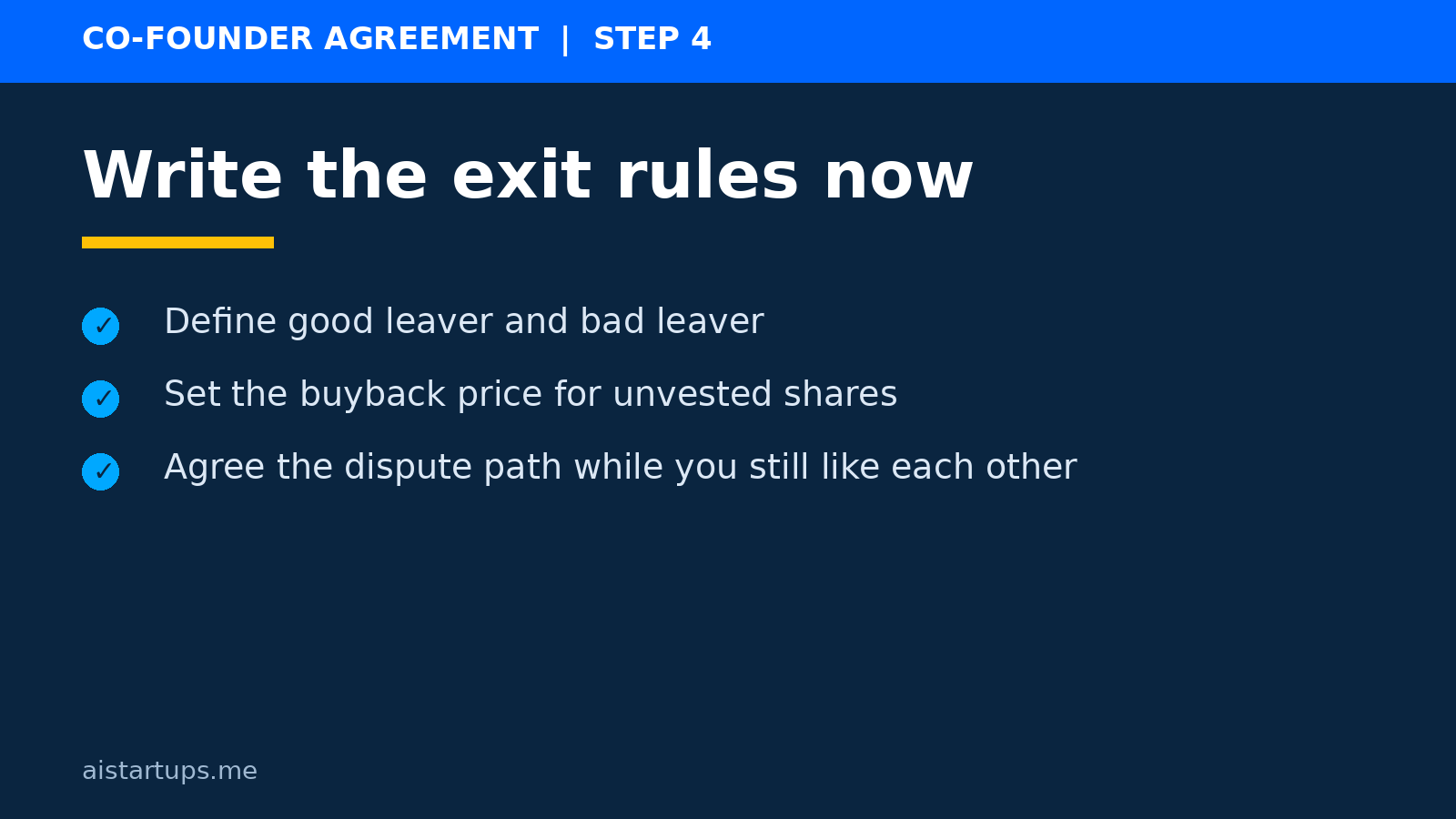
The standard structure has two parts. First, the vesting schedule already does most of the work: unvested shares return to the company at the price the founder paid for them (usually fractions of a cent per share). Second, you define “good leaver” and “bad leaver” treatment for vested shares. A good leaver — someone who leaves for health reasons, or by mutual agreement, or after years of solid work — typically keeps their vested shares. A bad leaver — someone removed for cause, like fraud or a serious breach — may have to sell vested shares back at fair market value or even at cost, depending on what you agree. The definitions matter more than the labels, so write them precisely: what counts as “cause,” who decides, and what process applies.
Also cover the practical stuff: return of laptops, code access, and API keys; a transition period (two to four weeks is common); and a non-disparagement clause, which sounds corporate but is really just “don’t trash each other in public,” and it protects the company’s reputation as much as anyone’s feelings.
And one thing founders forget: what happens to the departing founder’s board seat and officer role? They should resign both on exit, cleanly, in writing. A former founder lingering on the board is a governance headache nobody needs.
7. Non-competes, non-solicits, and side projects
This section needs a jurisdiction warning in big letters, because the rules vary wildly. In California, for example, non-compete agreements are generally void under Business and Professions Code Section 16600 — you basically can’t stop a departing founder from working in the same field, though you can still protect genuine trade secrets. In other US states and most other countries, a narrow, reasonable non-compete (limited in time and scope) may be enforceable. Don’t copy a clause from a template and assume it works where you live.
What’s almost always enforceable everywhere: confidentiality, and non-solicitation of customers and employees for a defined period. Those are the clauses that actually protect the company without trapping a human being. Focus your energy there.
Side projects deserve their own line. AI founders almost always have them — a newsletter, an open-source tool, a consulting gig. The agreement should say which side projects are pre-approved, require disclosure of new ones, and draw the line at anything that competes with the company or uses company resources. If you’re hiring your first AI engineer later, by the way, you’ll want the same disclosure rule in their contract — founders who exempt themselves from rules they impose on employees lose the room fast.
8. Dispute resolution: the ladder that keeps you out of court
Every good agreement has a dispute ladder, and the rungs are always the same: talk first, mediate second, arbitrate last. Litigation is the thing you structure the whole clause to avoid, because a lawsuit between founders usually kills the company even if someone “wins.”
Step one: a structured conversation with a deadline — say, 30 days to resolve it between yourselves. Step two: mediation with a neutral third party, where the mediator helps you find a deal but can’t impose one. Step three: binding arbitration, which is faster and more private than court but still produces a final, enforceable decision. Pick the arbitration venue and governing law now, while you’re calm, because picking them mid-fight is its own fight.
For deadlocks specifically — the 50/50 split where neither side can win a vote — add a mechanism: a cooling-off period, then mediation, then either a buy-sell provision (one founder names a price, the other chooses whether to buy or sell at that price — the classic “shotgun” clause, which is fair precisely because the person naming the price doesn’t know which side of it they’ll end up on) or a referral to the tie-breaker you named in section 4. The Montague Law founders’ agreement guide has a good walkthrough of why the present-tense IP assignment and the termination-on-incorporation clauses matter here too.
The signing checklist
When you’ve talked through everything above, here’s the short version to run down before anyone signs:
- Equity split agreed and written down, with the reasoning noted, not just the numbers.
- Four-year vesting with a one-year cliff for every founder, in the stock purchase agreements.
- IP assignment signed by every founder, covering pre-formation work, models, data, and prompts.
- Roles and tie-breaker named: CEO, product owner, tech owner, and who decides when you disagree.
- Salaries, spending threshold, and expense rules agreed, with a review date.
- Exit terms defined: good leaver vs. bad leaver, buyback price, board and officer resignation.
- Confidentiality and non-solicitation clauses in place; non-compete checked against your jurisdiction.
- Dispute ladder agreed: talk, mediate, arbitrate — plus a deadlock mechanism.
- 83(b) elections filed within 30 days of stock issuance (US founders), with proof kept on file.
- Side projects and open-source rules disclosed and approved in writing.
One last process point: once you incorporate and sign the real stock purchase agreements, explicitly terminate the pre-incorporation founders’ agreement in writing, so you don’t end up with two overlapping documents saying slightly different things. It’s a one-line clause that prevents a genuinely confusing legal mess later. A detailed guide to splitting founder equity is worth a read alongside this checklist if you want a second opinion on the numbers.
Frequently asked questions
Do we really need a written agreement if we trust each other?
Yes — and trust is exactly why. A written agreement doesn’t replace trust, it protects it. Memories of verbal deals drift, especially once money and stress enter the picture. Writing it down while you agree means you never have to argue later about what you agreed. Investors also expect to see it; a founding team with no paperwork reads as a risk, not as a sign of closeness.
Should co-founders always split equity 50/50?
Not always, but it’s the right default when both founders are full-time and equally central to the business. Y Combinator’s advice is to split equally or near-equally because the bulk of the value comes from years of future work, not from who started first. Adjust only for genuine asymmetries — part-time vs. full-time, major cash investment, or critical IP — and document the reason.
What happens if a co-founder quits before the one-year cliff?
Under a standard four-year schedule with a one-year cliff, they leave with no vested shares: the unvested stock returns to the company. That’s the cliff doing its job. It sounds harsh, but it’s the mechanism that keeps an early departure from permanently diluting the founders who stay and build the company.
Who owns the AI model we built before incorporating?
Whoever built it — unless you assign it. That’s why the IP assignment clause must explicitly cover pre-formation work: models, code, datasets, prompts, and domains. Without a written assignment, a departing founder can claim the core asset was never the company’s. Get it in writing, in present tense (“hereby assigns”), before or at incorporation.
When should we involve a lawyer, and what does it cost?
Use templates and guides (like the ones linked in this article) to have the conversation and agree the terms yourselves — that’s free. Then pay a startup lawyer to turn your agreed terms into proper documents and check them against your jurisdiction. Costs vary a lot by market, but a basic formation package is typically a few thousand dollars, and it’s the cheapest money you’ll ever spend compared to the cost of a founder dispute. If you’re raising money soon, investors will do diligence on these documents anyway, so getting them right early saves you a painful cleanup round later.
The Bottom Line
Here’s my honest summary: the co-founder agreement is not paperwork. It’s the one conversation where you find out whether you actually have a partnership or just a shared enthusiasm. If you can sit down, talk about equity, exits, and failure, and come out the other side still excited to build together — congratulations, you probably have a real team. If you can’t have that conversation at all, that’s information too, and it’s much cheaper to learn it now than after incorporation.
So book the meeting. Bring the checklist. Argue about the weights, agree on the numbers, and write it all down. Then go incorporate — and get back to building the thing that made you want to start a company in the first place.