


Alibaba dropped a new flagship model on 11 November 2026. It has a million-token context window, it takes text, images and video, and it will be gone in two weeks.
That’s not a typo. Qwen4-Max-Preview — the first Qwen 4 model anyone can actually call — is open until 25 November, and then Alibaba says it retires the model. No benchmarks. No per-token price. No model card. No weights. Just a two-week window and a subscription to get in the door.
So what do you do with that, as a founder? Honestly, the honest answer is the interesting one. You don’t build on it. You test it — cheaply, fast, on your own hardest work — and you keep building on something that will still exist in December. This guide shows you exactly how, what it costs, and what to use instead.
What Actually Launched (and What Didn’t)
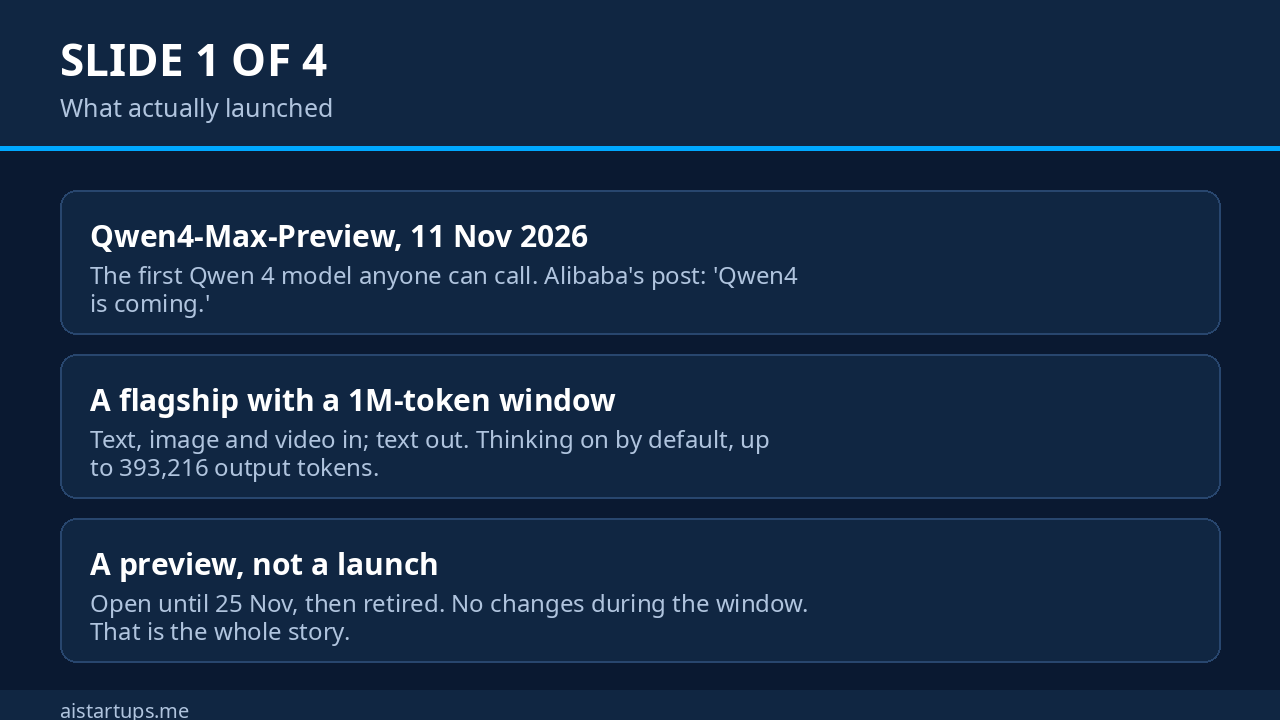
At 02:01 UTC on 11 November 2026, Alibaba’s official Qwen account posted four words: “Qwen4 is coming.” The post promised “deeper knowledge, richer world understanding, stronger coding and agentic capabilities” and said Qwen4-Max was “now in preview on Alibaba’s Token Plan,” with early access also on QwenWork, Qoder, the Qwen app and Qwen Studio. That was the whole announcement. Short, confident, and — if you read it twice — deliberately narrow.
Here’s the thing: only one model arrived. Qwen4-Max-Preview is the first Qwen 4 model anyone can call, and the rest of the family — Qwen4-Plus, Qwen4-Flash and Qwen4-27B, all shown on a slide at Alibaba’s Apsara conference in Amsterdam on 29 October — still has no date. Alibaba confirmed back on 22 September, at Apsara in Hangzhou, that Qwen 4 was “currently in training.” It took another seven weeks for anything callable to appear, and what appeared is a preview with an expiry date.
There’s a fun bit of backstory, too. A few days before the launch, Qoder — Alibaba’s coding tool — quietly put a stealth model called “Qoduck” in front of users. Nobody knew what it was. After the launch, Qoder said Qoduck had been a Qwen test build running anonymously for four days, updated daily, and that it now upgrades to Qwen4-Max-Preview. So if you were one of the people who tried Qoduck in early November, you were already testing Qwen 4 without knowing it. Cute. Also a useful reminder: Alibaba has been iterating on this model in public, under a fake name, right up to launch day.
What didn’t launch matters just as much. There are no open weights on Hugging Face — the Qwen organization’s newest upload when checked on 11 November was still Qwen-Image-2.1-Turbo from 9 October. There is no model card, no licence, no parameter count, and no benchmark table. The model isn’t on OpenRouter either, so you can’t run it through the usual comparison setups. And there is no date for a full Qwen4-Max release. As one tracker put it in its November archive, no weights, model card or Hugging Face repo is linked, and no independent tracked score exists.
That’s the shape of this launch: a flagship you can touch but can’t measure, for two weeks, through a subscription. Which brings us to the specs — the few that Alibaba actually published.
The Specs That Matter to a Founder
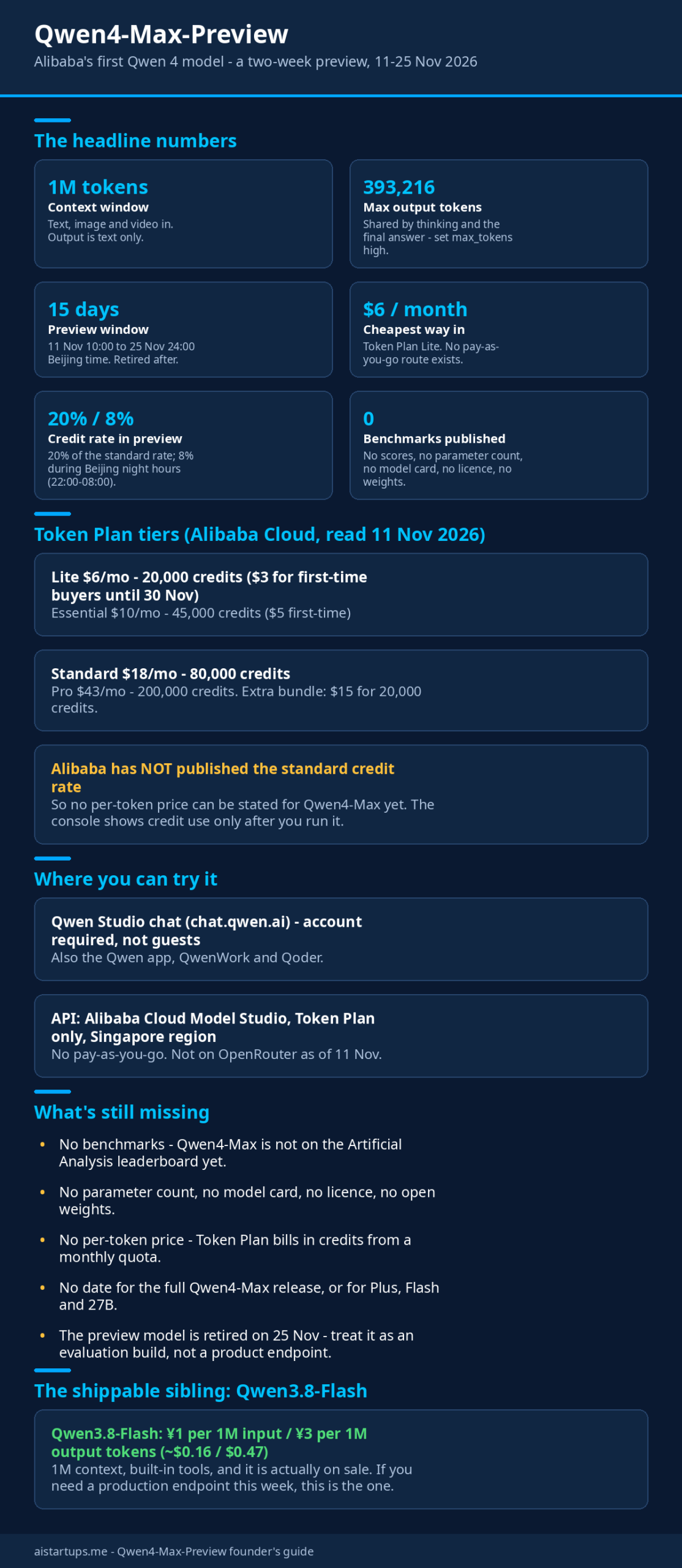
Alibaba’s own documentation — the Qwen Cloud model page for Qwen4-Max-Preview — is the first written spec for any Qwen 4 model, and it’s refreshingly specific about the things it does say. Here’s the short version:
- Context window: 1,000,000 tokens. That’s the headline number, and it’s a big one. A million tokens is roughly 750,000 words — your entire codebase, a year’s worth of support tickets, or a few hundred pages of contracts, all in one session.
- Maximum output: 393,216 tokens, shared between the model’s internal thinking and the final answer. This one has a catch we’ll come back to — it matters more than it looks.
- Input: text, images and video. In the chat apps, documents and audio work too. Output is text only.
- Thinking is on by default, with low, medium and xhigh effort levels — xhigh is the default. This is a reasoning model, not a fast autocomplete.
- Tools: function calling, web search, built-in tools and JSON structured outputs, with API compatibility for OpenAI Chat Completions and Responses, plus Anthropic Messages.
- Model ID:
qwen4-max-preview, withqwen4.0-max-previewas an alias.
For a founder, the context window is the number that changes what you can try. A million tokens means you can paste in your whole product spec, your pricing page, your last 200 customer emails and a competitor’s docs, then ask the model to find the gaps. Or drop in a full repository and ask it to trace a bug across ten files. Or feed it a 300-page contract and ask where the risk sits. These are the jobs where a huge window actually earns its keep — not chatting, but reasoning over a pile of your own material in one go.
But — and this is the part the spec sheet doesn’t warn you about — a big window is only useful if the model stays sharp across it. And that’s exactly the thing nobody can verify right now, because there are no benchmarks. A million tokens of context with a model that loses the thread at token 400,000 is worse than a 200K window that holds together. You can only find out by testing it yourself, which is the whole point of the preview. More on that in a minute.
One more thing worth knowing: the Qwen Cloud docs promise stability for the two weeks. “No changes will be made during this period, and the model will be retired after the preview ends.” So the thing you test on Monday is the same thing you test on Friday. That’s genuinely useful for an evaluation — no silent model swaps mid-test — and it’s also the clearest possible signal that this is not a product. Products don’t come with a retirement date.
How to Try It: Chat First, API Second
There are two doors in, and they serve different purposes. Pick the one that matches what you’re actually trying to learn.
The chat route: Qwen Studio
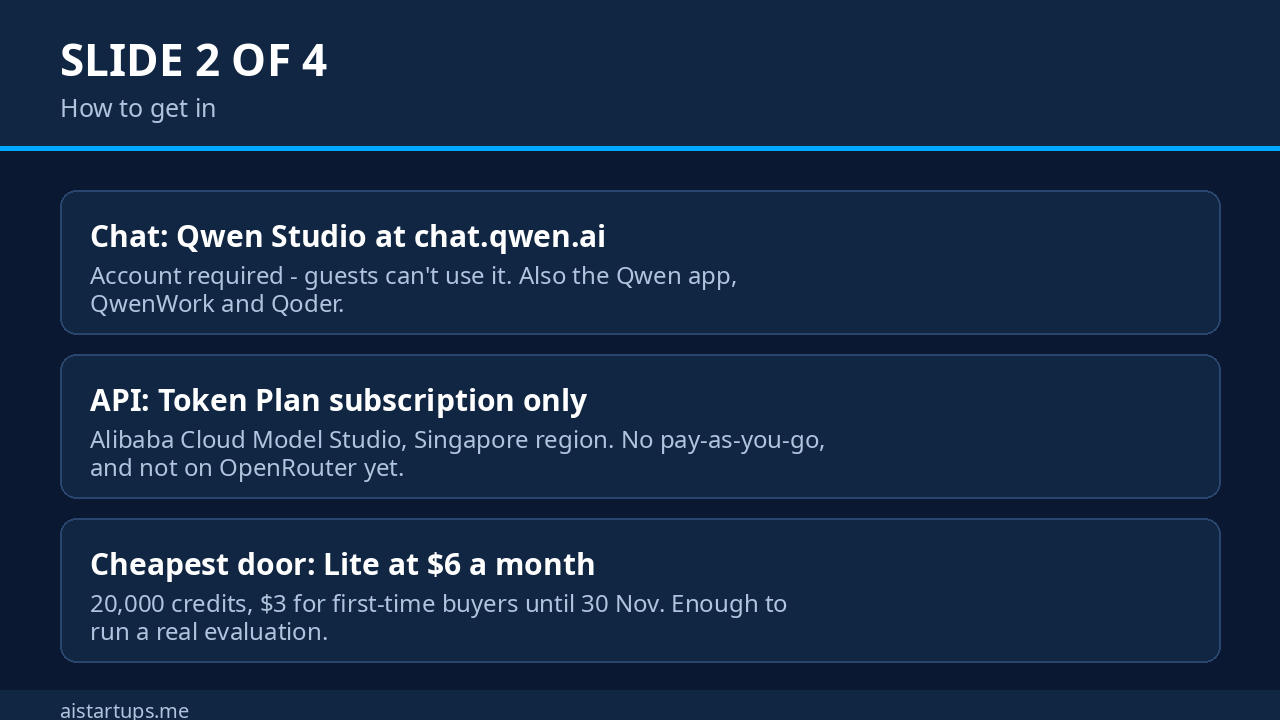
The fastest way to meet the model is Qwen Studio, Alibaba’s chat app at chat.qwen.ai. Qwen4-Max-Preview shows up in the model picker next to Qwen3.8-Max. You need an account — guests can’t use it — but signing up is free, and the chat is where you should start. Why? Because the chat gives you thinking, search, web dev, deep research and slides modes, and you can throw documents, images and audio at it without writing a line of code.
My suggestion: don’t start with a clever prompt. Start with your real work. Paste in the ugliest document your business produces — the onboarding doc nobody reads, the support thread that never resolves, the proposal template your team copy-pastes and regrets — and ask the model to fix it. Then paste in your codebase’s messiest module and ask what’s wrong with it. Real work, real fast, tells you more in twenty minutes than a benchmark table ever would. (And there is no benchmark table, so it’s your only option anyway.)
The Qwen app, QwenWork (Alibaba’s workplace AI app) and Qoder offer the same early access if you already live in one of those tools. Qoder is the interesting one for technical founders: it’s a coding tool, and as we saw, it was already running Qwen 4 under a stealth name before the launch. If you code, try the model inside Qoder on a real task — a refactor, a test suite, a front-end build — and watch how it handles a multi-file job.
The API route: Token Plan, and only Token Plan
If you want to call the model from your own code, there is exactly one route: Alibaba Cloud Model Studio, through the Token Plan subscription, in the Singapore region. The Qwen Cloud docs are blunt about this: Qwen4-Max-Preview “is available through Token Plan only. Pay-as-you-go access is not supported.” A standard Qwen Cloud API key won’t reach it.
That matters for two reasons. First, you can’t just spin up a key and pay per token the way you would with most APIs — you have to buy a monthly subscription first. Second, your existing Qwen Cloud setup, if you have one, needs the Token Plan’s dedicated base URL (https://token-plan.maas.qwencloudapi.com) and a Token Plan API key, not your regular key. The model ID is qwen4-max-preview. The API speaks OpenAI Chat Completions and Responses formats, plus Anthropic Messages, so if your code already talks to one of those, the switch is mostly a config change.
One practical note from the docs: in multi-turn Chat Completions calls, preserve_thinking is on by default, so return all historical thinking in the assistant messages’ reasoning_content field rather than concatenating it into content. Small detail, easy to get wrong, and the kind of thing that quietly breaks a conversation if you ignore it.
What It Costs (and What It Doesn’t)
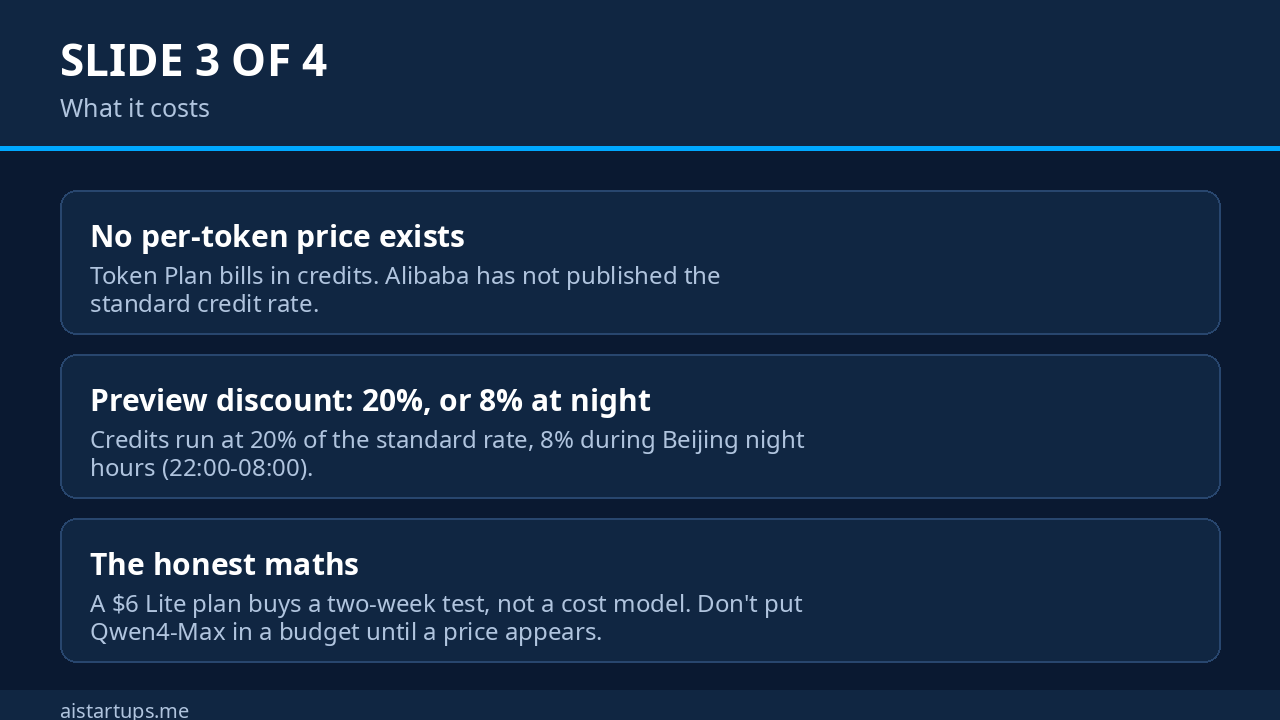
Here’s where most write-ups about this launch go vague, so let’s be precise. Qwen4-Max-Preview has no per-token price, because Token Plan doesn’t bill per token. It bills in credits from a monthly quota. You buy a plan, you get a pool of credits, and every model in the plan draws from the same pool.
The four individual plans, as read on Alibaba Cloud on 11 November, are:
- Lite — $6 a month, 20,000 credits. First-time buyers pay $3 until 30 November.
- Essential — $10 a month, 45,000 credits. First-time buyers pay $5 until 30 November.
- Standard — $18 a month, 80,000 credits.
- Pro — $43 a month, 200,000 credits.
An extra bundle costs $15 for 20,000 credits if you run dry mid-month. And during the preview, Qwen4-Max uses credits at as little as 20% of the standard rate — and just 8% during Beijing night hours, 22:00 to 08:00 UTC+8 (that’s 14:00 to 00:00 UTC). Night-owl founders in Pakistan, take note: your evening is Beijing’s night, so your testing hours are the cheap ones.
Now the catch, and it’s a big one: Alibaba has not published the standard credit rate. So nobody — not me, not the press, not the people who’ve already run the model — can tell you what a Qwen4-Max request costs per million tokens. The console shows your credit use only after you run something. As Quantslant’s preview write-up puts it, how many credits one request uses, Alibaba does not say.
So what’s the real cost of a proper test? Honestly, it’s the Lite plan: $6, or $3 if you’re a first-time buyer before 30 November. That’s the price of a coffee for two weeks of access to a flagship model at a steep preview discount. Don’t overthink the tier. Lite’s 20,000 credits are plenty for an evaluation — you’re running dozens of prompts, not serving customers. If you burn through it, that tells you something useful too (namely, that your prompts are heavy), and a $15 top-up is still cheaper than a single month of most flagship APIs at production volume.
What you can’t do with any of this is build a cost model. Don’t put Qwen4-Max in a spreadsheet. Don’t quote a per-token price to your co-founder. Don’t promise a client a price based on it. There is no price. There is a subscription, a credit pool, and a discount that expires on 25 November along with the model itself.
Your Two-Week Evaluation Plan
You have until 24:00 Beijing time on 25 November — that’s 16:00 UTC, or 21:00 in Pakistan. Fourteen days, minus the ones you’ve already spent reading about it. Here’s how I’d spend them, in order.
- Day 1: sign up and run your five hardest prompts in Qwen Studio. Not toy prompts — the five jobs you actually pay a model to do today. Code review, document drafting, research synthesis, data extraction, customer-email triage. Whatever your current model does for you, make Qwen4-Max do the same thing, side by side, and score the outputs yourself. Write the scores down. Memory is a terrible benchmark.
- Days 2–3: test the long context. This is the model’s headline feature, so test the headline. Feed it a whole repository, or a year’s worth of tickets, or a 200-page document, and ask questions that require it to connect facts from the beginning and the end. If it holds up, that’s genuinely valuable. If it starts hallucinating around page 80, you just learned something no spec sheet would have told you.
- Days 4–5: try the API. Get a Token Plan Lite subscription, wire up the dedicated base URL, and run the same prompts through the API with
max_tokensset high (remember, thinking eats from the same budget). Watch the credit use in the console and note what a real session costs in credits. This is the only way to learn the economics — Alibaba won’t tell you. - Days 6–10: run it on a real project task. A front-end build, a refactor, an agentic workflow with tool calls. The Qwen Cloud docs say the model is designed for “coding, office productivity, frontend design, and complex agentic tasks,” so hold it to that. Give it a multi-step job with tools and see whether it finishes or wanders off. Save every output — good and bad.
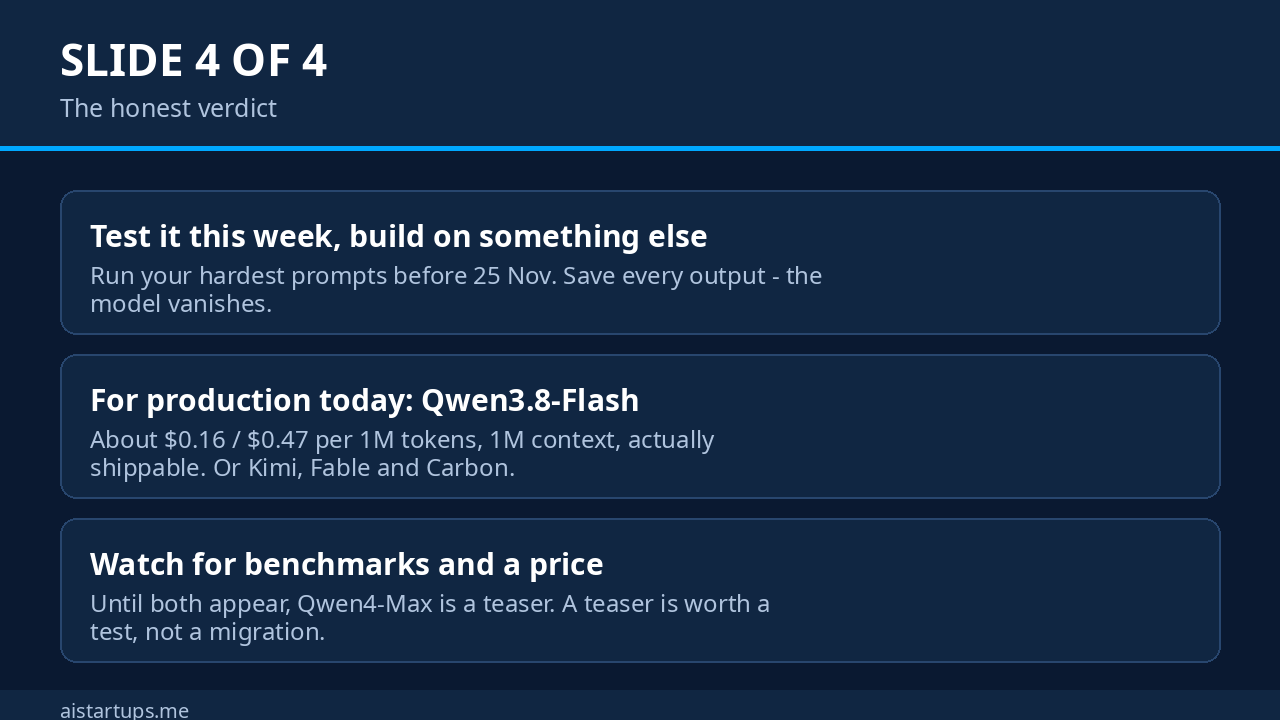
- Days 11–14: decide, and write it down. By now you either have a model worth watching or you don’t. Either way, save your prompts, your outputs and your notes somewhere durable, because on 25 November the model disappears and your test results become the only record of what it could do. If a full Qwen4-Max launches later, your notes are your head start. If it doesn’t, your notes are still a useful record of what a million-token window is worth on your work.
One rule for the whole two weeks: keep your production systems on whatever they run on today. Don’t migrate anything to a model with a retirement date. That’s not caution, that’s basic hygiene.
What Nobody Can Tell You Yet
Let’s be blunt about the gaps, because they’re the story. As of 12 November 2026, nobody outside Alibaba can answer the three questions that actually decide whether a model is worth your business:
Is it any good? There are no benchmark scores. Qwen4-Max is not on the Artificial Analysis leaderboard, and Alibaba has published nothing to compare it against. For context — and this is vendor and independent data, not a Qwen4-Max measurement — the current leaders on the Artificial Analysis Intelligence Index are Claude Fable 5.2 at 65, Gemini 4 Carbon at 60 and GPT-6 Astra at 57, while the predecessor Qwen3.8 Max scored 45 in September. Qwen4-Max would need a serious jump to catch the leaders. But “would need” is not a measurement. It’s a guess, and guesses are free. If you see a Qwen4-Max benchmark table this week, check whether it links to an Alibaba page. If it doesn’t, it’s unofficial — someone ran their own test and dressed it up. Treat it accordingly.
What does it cost? Covered above: there is no per-token price, and the standard credit rate is unpublished. You can learn what a test costs in credits, but you can’t learn what production would cost. That’s not an oversight you can work around; it’s a missing fact.
Can you build on it? No. Not in any sense that matters. The model retires on 25 November, the licence is unpublished, the weights aren’t available, and the full release has no date. Even the Qwen3.8 precedent cuts both ways: Qwen3.8-Max opened as a preview on 19 July, reached general availability on 3 August and got open weights on 12 August — 24 days from preview to weights. The Qwen4 window closes on day 14, ten days before that milestone. Tech Insider’s analysis calls the Qwen3.8 sequence “a precedent but not a promise,” and that’s exactly right. Budget for a different model name later.
There’s also the social-media noise to ignore. Posts calling the model a disappointment have no benchmark behind them either. As AI Agent Update noted, there is simply no evidence either way yet — the hype and the disappointment are both running on zero data. That’s a strange position for a flagship launch, and it’s worth sitting with for a second: the most interesting thing about Qwen4-Max right now is how little anyone can say about it with confidence.
Qwen4-Max is a flagship with no price, no benchmarks and a fifteen-day expiry date. Test it like a demo, because that’s what it is — and demos don’t move markets, they just show you what’s coming.
The Max Tokens Gotcha Nobody Mentions
Here’s a technical detail that will bite you if you miss it, and it’s straight from the Qwen Cloud docs. Starting with qwen4-max-preview, max_tokens is equivalent to max_completion_tokens: both limit the combined tokens for thinking and the final answer. The 393,216-token output ceiling sounds enormous — and it is — but thinking draws from the same pool.
What does that mean in practice? If you set max_tokens to 8,000 because that’s what you use everywhere else, and the model spends 6,000 tokens thinking, your answer gets 2,000 tokens and then stops mid-sentence. It’ll look like a quality problem. It isn’t. It’s a budget problem, and it’s your budget. The fix is simple: set max_tokens much higher than you’re used to when you point a prompt at this model, and check whether long answers end early before you score the model against your current one. A truncation showing up as a quality loss is the easiest evaluation mistake to make this week, and the docs hand you the warning in plain text.
The same logic applies in the chat app, by the way — if an answer feels cut short, it’s probably the thinking budget, not the model giving up. Bump the effort setting down, or break the job into smaller pieces, and try again before you judge it.
What to Build On Instead
So the preview is a test, not a foundation. What do you actually ship on this week? You have good options, and — unlike Qwen4-Max — all of them have prices, benchmarks and a future.
Qwen3.8-Flash is the shippable sibling. It launched alongside the Qwen 4 news with a real, published price: ¥1 per million input tokens and ¥3 per million output tokens — roughly $0.16 and $0.47. It has the same 1M-token context window, built-in tools, and it’s actually on sale through the normal API. If your work fits a fast, cheap model with a huge window — document processing, extraction, triage, long-context RAG — this is the Qwen-family model you can put in production today. It’s also, quietly, the best clue about where Qwen 4 is headed: the architecture preview for Qwen 4 shipped as Qwen3.8-Flash-Next, an open-weights model, so the family isn’t all mystery.
Kimi K3.1 Pro is the open-weights alternative. Moonshot published its weights on 4 November under the Kimi K3.1-Pro License, it runs at $2/$10 per million tokens on the API, and it has the same kind of long-context, agentic pitch. If you want a model you can self-host or at least inspect, Kimi is the one to look at first. I covered it in detail in my Kimi K3.1 Pro founder’s guide — including the licence terms, which matter more than most founders realise once revenue crosses $20 million.
Claude Fable 5.2 is the quality pick. Anthropic’s flagship launched on 9 November at $8/$40 per million tokens — down from $10/$50 — with a 1M context window, and it sits at 65 on the Artificial Analysis Intelligence Index, the highest score in the current field. It’s expensive next to Qwen3.8-Flash, but if your product lives or dies on output quality, this is the benchmark everyone else is chasing. My full Claude Fable 5.2 founder’s guide walks through where the price makes sense and where it doesn’t.
Gemini 4 Carbon is the middle ground. Google’s model is publicly available at $2/$10 per million tokens through 30 November (then $4/$20), with a 1,048,576-token context, and it scores 60 on the same index. If you want flagship-class quality without Fable’s price tag, Carbon is the pragmatic choice — see my Gemini 4 Carbon founder’s guide for the pricing timeline, because that intro rate expires soon.
And if your problem isn’t which model to pick but how to get any of this into a real product — the website, the app, the integration that turns a model into a product that customers pay for — that’s a different job, and it’s one worth hiring for properly. Our web development and AI integration studio, AISquadX, builds exactly that kind of thing: taking a model off the shelf and wiring it into a product that actually ships. The model is the easy part. The product around it is the work.
One more angle, if your workload is decisions rather than writing: Google’s Gemini Decision 1, launched the same day as Qwen4-Max, answers yes/no, choice and rubric questions for $0.10 per million input tokens with zero output tokens — because it never writes a word. If your app mostly classifies, routes, triages or grades, that’s a cheaper tool than any generative flagship. I wrote up the full picture in my Gemini Decision 1 founder’s guide.
The pattern across all of these is worth naming: November 2026 has been a flood of new models — Fable, Carbon, Decision 1, Muse Ember, Kimi K3.1 Pro, and now Qwen4-Max — and the winners for a startup aren’t the ones with the biggest numbers. They’re the ones with a price you can put in a spreadsheet, a benchmark you can check, and a release that will still exist next month. Qwen4-Max has none of those three things yet. The others do.
Frequently Asked Questions
What is Qwen4-Max-Preview?
It’s the first model from Alibaba’s Qwen 4 family that anyone can call — a multimodal flagship that takes text, image and video input, reasons, and can call external tools. It opened on 11 November 2026 as a limited preview and will be retired on 25 November. It’s an evaluation build, not a permanent product.
How long is the Qwen4-Max preview available?
From 10:00 on 11 November to 24:00 on 25 November 2026, Beijing time. That’s 02:00 UTC on 11 November to 16:00 UTC on 25 November — about two weeks. Alibaba says the model will be retired when the window closes, and no changes will be made during it.
How much does Qwen4-Max-Preview cost?
There is no per-token price. Access is through Alibaba’s Token Plan subscription only — Lite at $6 a month (20,000 credits, $3 for first-time buyers until 30 November), Essential at $10, Standard at $18 and Pro at $43. During the preview, Qwen4-Max uses credits at as little as 20% of the standard rate, and 8% during Beijing night hours. But Alibaba hasn’t published the standard credit rate, so no per-token cost can be calculated yet.
Is Qwen4-Max better than Claude Fable 5.2 or Gemini 4 Carbon?
Nobody can say yet. Alibaba has published no benchmarks, and Qwen4-Max isn’t on the Artificial Analysis leaderboard. Fable 5.2 scores 65 and Carbon scores 60 on the Artificial Analysis Intelligence Index, while the predecessor Qwen3.8 Max scored 45 in September — but those are measurements of other models, not of Qwen4-Max. Any comparison today is a guess, not a result.
Should I build my startup’s product on Qwen4-Max-Preview?
No. The model is retired on 25 November, there’s no pay-as-you-go route, no published price, no licence and no weights. Use the two-week window to evaluate it on your own work, save your results, and build on a model that will still exist in December — Qwen3.8-Flash if you want to stay in the Qwen family, or Kimi K3.1 Pro, Claude Fable 5.2 or Gemini 4 Carbon depending on your budget and quality bar.
The Bottom Line
Qwen4-Max-Preview is real, it’s impressive on paper, and it’s gone in two weeks. That’s not a contradiction — it’s the whole point. Alibaba is showing its strongest model to developers, collecting feedback and usage data, and deciding what the real Qwen 4 release looks like. You’re invited to the test drive, not the launch.
So take the invitation. Spend $6 on a Lite plan (or $3 if you’re a first-time buyer), run your hardest work through it in Qwen Studio, test the million-token window on a real pile of your own documents, and try the API before the window closes. Do it at night Beijing time if you want the 8% credit rate. Save everything. Then, when the model vanishes on 25 November, you’ll have something most people covering this launch don’t: your own evidence about what it could do.
And keep building on the models with prices, benchmarks and a future. Qwen3.8-Flash is sitting right there at sixteen cents per million input tokens, and it’s not going anywhere. The preview is a peek at what’s coming. Your product needs what’s already here.
Check back after 25 November — if Alibaba publishes benchmarks, a price, or a full release date, I’ll update this guide with the numbers that matter.



