


Here’s the thing most founders get wrong about business plans: they think longer means more serious. It doesn’t. I’ve watched founders hand over a 40-page plan and lose the room by page three, not because the idea was bad, but because nobody could find the idea inside all that padding.
Real talk: an investor doesn’t need your life story. They need to know, fast, what problem you’re solving, who pays you, what it costs you to serve them, and why you won’t get copied into oblivion next quarter. If you can’t say that on one page, you probably can’t say it at all yet. And that’s fine — that’s exactly what this exercise is for.
A one-page plan isn’t a shortcut. It’s a stress test. It forces every fuzzy assumption out into the open, where you can actually argue with it. This guide walks you through the nine blocks of the lean canvas, adapted specifically for AI startups, with a worked example you can steal and rewrite for your own idea. By the end you’ll have a page you can send before a meeting, talk through in a meeting, and update every time you learn something new.
Why One Page Beats Forty Pages
Look, a traditional business plan was built for a different world — banks, long loan applications, businesses that changed slowly. Startups don’t work like that. Your assumptions will be wrong within weeks, sometimes within days. A 40-page document can’t keep up with that. It just gets stale, and then it gets ignored.
A one-page plan stays alive. You can rewrite a block in ten minutes after a customer call. You can print it, stick it on a wall, and stare at the gaps. Honestly, the gaps are the whole point. A blank box on a one-page plan screams at you. A missing section in a 40-page plan just hides behind a table of contents.
Investors know this too. When they see a tight one-pager, they read it as a signal: this founder can prioritise. This founder knows what matters and what doesn’t. When they see a bloated plan full of market-size charts and five-year forecasts down to the dollar, they read a different signal — this founder is hiding behind formatting.
That doesn’t mean you never need detail. You do. Financial models, hiring plans, technical specs — all of that has a place. Just not on page one. Page one is the argument. Everything else is the appendix.
The Slide Deck: The Whole Framework at a Glance
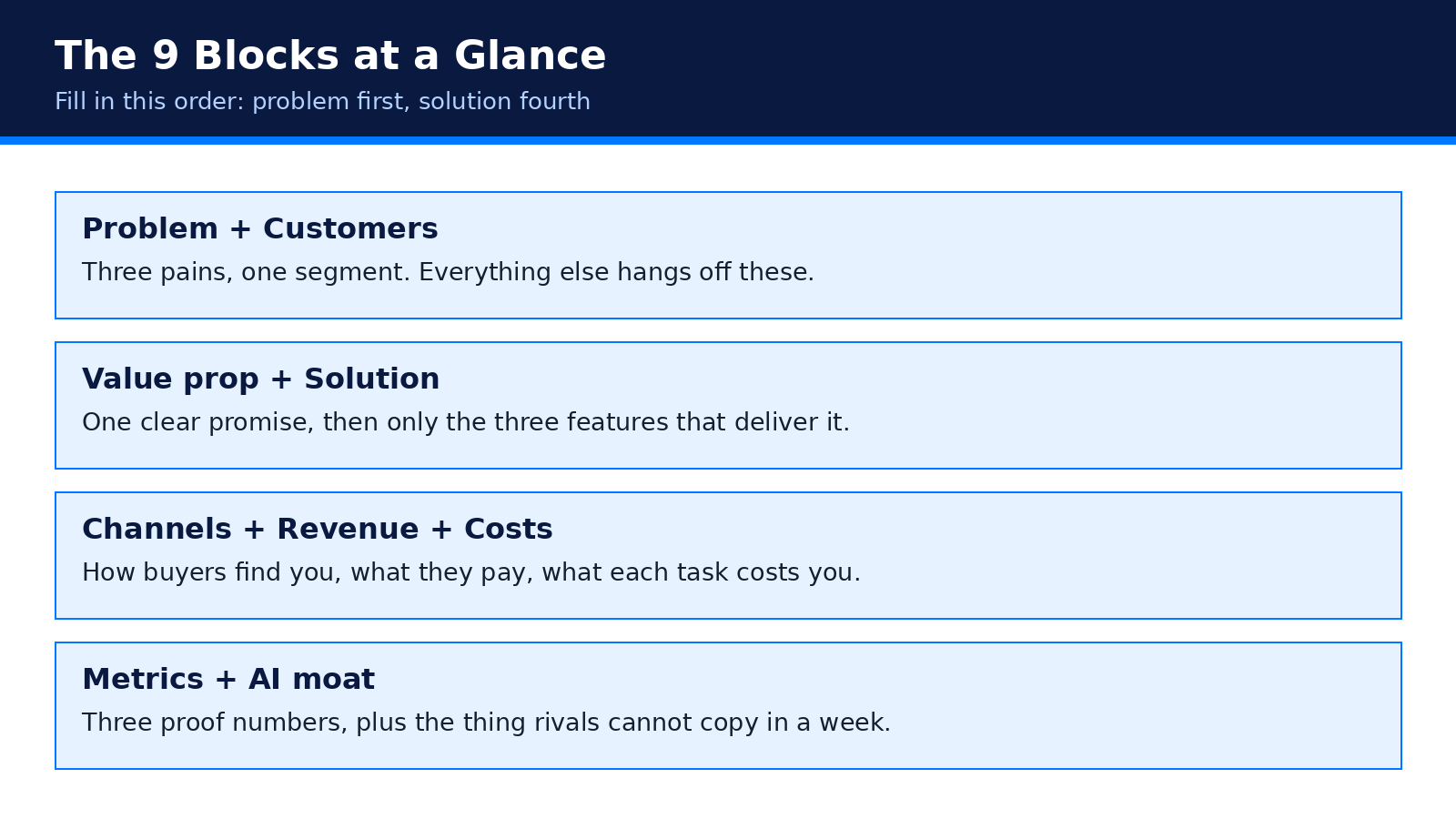
Before we dig into each block, here’s the framework in four slides. If you only have five minutes, start here.
Where the One-Page Plan Comes From
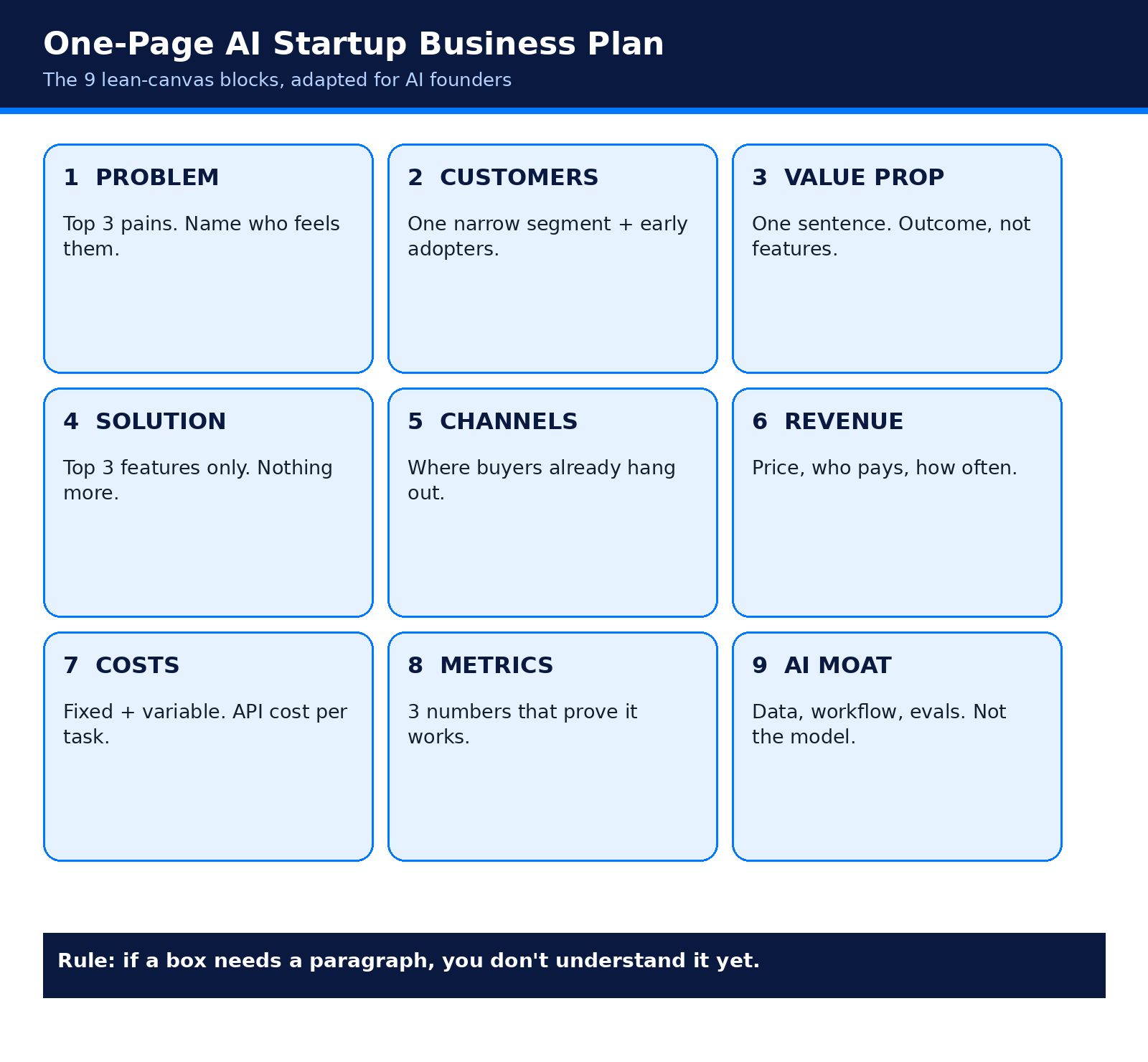
The framework here is the lean canvas, created by Ash Maurya in 2010 as a startup-focused adaptation of Alexander Osterwalder’s Business Model Canvas. Maurya swapped out four boxes that only make sense for established companies — key partners, key activities, key resources, customer relationships — and replaced them with four that matter when you’re still searching for a business: problem, solution, key metrics, and unfair advantage.
That swap is the whole philosophy. A lean canvas isn’t a description of a business that works. It’s a list of bets about a business that might work, written small enough that you can test each bet and change it when the evidence says otherwise. Canva’s lean canvas guide walks through the same nine blocks and the history behind them, and it’s worth a read if you want the original framing.
Maurya’s suggested order matters, by the way. Don’t fill the boxes left to right like a form. Start with problem and customers together, then your value proposition, then — only then — your solution. Why? Because if you start with the solution, you’ll just describe the product you already fell in love with, and the rest of the page becomes a justification for it. Starting with the problem keeps you honest.
For AI startups, I’ve adapted the last block. Instead of a generic “unfair advantage,” I want you to write “AI moat.” Same idea, sharper question: what about your business gets stronger because of AI, data, and workflow — not just because you rented a good model?
Block by Block: How to Fill Each Box
1. Problem: Name Three Pains, Not a Theme
“Small businesses struggle with marketing” is not a problem. It’s a theme. Nobody wakes up feeling a theme. People wake up feeling a specific pain at a specific moment — a contract that needs reviewing before Friday, a support queue that’s on fire, a report that takes a junior employee two full days every month.
Write your top three problems, and write them the way a customer would say them, not the way a pitch deck would. Then add the existing alternatives underneath: what do they do today instead of buying from you? Spreadsheets, interns, an old tool they hate, nothing at all? That alternative is your real competitor, more often than any startup with a similar homepage.
If you can’t name three distinct pains, you probably have one pain and two guesses. That’s useful information. Go talk to ten people in your target market before you write anything else. Seriously — the plan can wait. The conversations can’t.
2. Customers: One Segment, Plus Your Early Adopters
“Everyone” is not a segment. Neither is “SMEs” or “companies that use AI.” Pick one narrow group who feels the problem most sharply and can pay to make it go away. Small law firms with 5 to 20 lawyers. Dental clinics in one city. Shopify stores selling skincare. The narrower, the better, at this stage.
Then name your early adopters separately. These are the people inside that segment who will try something unproven because the pain is so bad they’ll tolerate rough edges. They’re your first ten customers, your first feedback loop, and often your first case studies. If you don’t know who they are by name — well, not literally by name, but close — you haven’t picked a segment yet. You’ve picked a demographic.
I tried this the vague way once, years back, with a “productivity tool for professionals.” Nobody bought it. Not because the product was terrible, but because no single person ever felt like it was built for them. Narrow feels scary. Vague feels safe. Vague is what kills you.
3. Value Proposition: One Sentence, One Outcome
This is the hardest box on the page, and it’s in the centre for a reason. Your value proposition is the single sentence that makes a busy buyer stop scrolling. Not a paragraph. Not three bullet points pretending to be a sentence. One sentence.
Here’s a test I use: can you say it to someone at a conference, and can they repeat it back to you five minutes later? If they can’t, it’s not a value proposition yet. It’s a description. Descriptions list features. Value propositions promise an outcome: “Contract review in hours, not days, for firms too small for in-house counsel.” See the difference? Outcome, buyer, and a hint of why now — all in one breath.
Avoid the classic trap of writing your value prop around the technology. “AI-powered” is not a benefit. It’s a method. Buyers don’t buy methods. They buy Tuesdays back, or fewer mistakes, or a deal closed before a competitor gets there.
4. Solution: Three Features, Max
Now — and only now — you get to write about your product. And you get three features. Not twelve. Three. The three that directly solve the three problems in box one, in the same order if you can manage it.
This constraint is a gift. It forces you to decide what your minimum viable product actually is, instead of writing a wish list and calling it a roadmap. Everything else goes on a “later” list, and honestly, most of it will never need building. Customers will tell you what matters next, if you’re listening.
For AI products, be specific about what the AI actually does in each feature. “AI reviews the contract” is vague. “The tool flags clauses that differ from the firm’s standard terms and drafts the redline” is a feature. Investors can picture it. Customers can test it. Engineers can build it.
5. Channels: Where Buyers Already Are
Channels answer a simple question: how will a stranger who needs this find you, and how will you reach them repeatedly without burning your whole budget on ads? List the channels you can actually use in the next six months, not the ones you’d use with a million-dollar marketing team.
For most early AI startups, that means one or two channels done well: content that ranks for the exact problem buyers search for, a community where your segment already hangs out, partnerships with tools they already use, or direct outreach to a tight list. Pick the channel where your early adopters already spend time, and prove it works for ten customers before you add a second one.
And be honest about cost. A channel that only works if you outspend venture-backed competitors is not a channel. It’s a hope. If you need help turning that first channel into a real website and launch presence — the kind of site that actually converts a visitor into a trial — a team like AISquadX can build that foundation while you focus on the product itself.
6. Revenue: Price, Payer, and Frequency
Revenue streams sound fancy. What they really mean is: who pays, how much, and how often? Write the actual numbers. “$99 per user per month” beats “SaaS subscription model” every single time, because numbers can be argued with and models can’t.
Think about who the payer is versus who the user is, because in AI startups they often differ. A clinic’s staff use the tool, but the clinic owner pays. A law firm’s associates use it, but the managing partner signs. Price for the payer’s budget, not the user’s enthusiasm.
Also decide early whether you charge per seat, per task, per outcome, or a flat fee. Each choice shapes your whole business. Per-seat pricing is simple but caps your revenue when AI does the work of many seats. Per-task or per-outcome pricing can align better with value — but only if customers can predict their bill. Nobody likes a surprise invoice, especially from a startup they barely trust yet.
The Worked Example: A Fictional AI Startup, Filled In
Enough theory. Let’s fill the page for a fictional startup so you can see what “good” looks like. Meet ContractLens — invented for this article, not a real company. It reviews contracts for small law firms.
Problem: small firms turn around client contracts slowly because senior lawyers review every page by hand; junior staff miss non-standard clauses; clients get frustrated waiting days for a simple review. Existing alternatives: senior lawyers doing it manually, generic document tools that don’t understand legal language, or just skipping a proper review and hoping for the best.
Customers: law firms with 5 to 20 lawyers, starting with firms that handle commercial leases. Early adopters: two-partner firms drowning in lease reviews during renewal season. Value proposition: “Lease review in hours, not days, with every non-standard clause flagged before you sign.” Solution, three features only: upload and clause extraction, comparison against the firm’s standard terms, and a drafted redline the lawyer approves or edits.
Channels: bar association events, practical guides on lease clauses that rank in search, and referrals from the first ten firms. Revenue: $99 per lawyer per month, paid by the firm. Costs: model API fees per document, hosting, and one support hire once the firm count passes fifty. Metrics: documents reviewed per firm per week, lawyer approval rate on redlines, and monthly churn. AI moat: a growing library of firm-specific standard terms and clause decisions that makes each firm’s version of the tool better the longer they use it — plus workflow integration into the document system they already open every morning.
See how tight that is? You could read it in two minutes and immediately ask smart questions: Is $99 the right price? How many documents does a firm review weekly? What happens when a big legal platform adds the same feature? Those questions are the point. A good one-pager doesn’t end the conversation. It starts a better one.
If you’re still at the idea stage, this worked example pairs well with a structured validation pass first. Our guide on how to validate an AI startup idea before building covers the customer conversations that make boxes one and two honest instead of hopeful.
Unit Economics: The Block That Sinks AI Startups
Here’s where AI plans differ from regular software plans, and where most of them quietly fall apart. In classic SaaS, serving one more customer costs almost nothing. In AI, serving one more customer costs real money every single time — tokens, compute, API calls. If you ignore that in your cost structure, your margins are fiction, and investors will find out in diligence. Better they find your honest math on page one than your invented math in a data room.
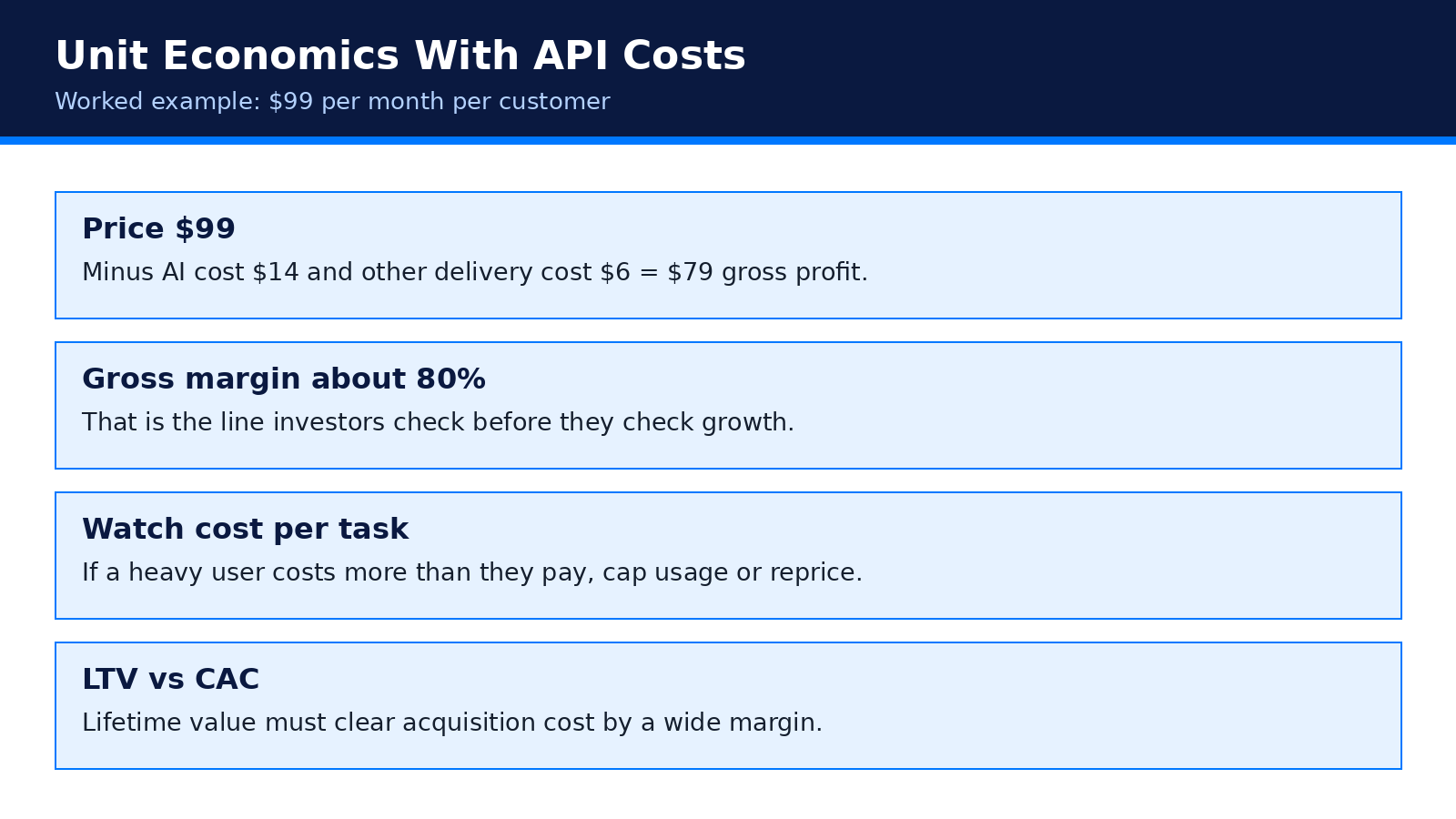
Do the arithmetic per customer, per month, in plain numbers. Take the worked example from the slides: a customer pays $99 a month. AI costs average $14 a month for their usage. Other delivery costs — hosting, support, tooling — add $6. That’s $20 of cost against $99 of revenue, leaving $79 of gross profit, or about 80% gross margin. That’s a healthy starting point. But notice what the math forces you to ask next: what does a heavy user cost? If your top 10% of users each burn $60 of API cost a month, your average hides a real problem. Cap usage, tier pricing by volume, or route simple tasks to cheaper models. Don’t just hope heavy users stay rare.
One source worth internalising here: seed investors in 2026 are explicitly looking for gross margins of 60% or more for AI SaaS, an LTV-to-CAC ratio of at least 3 to 1, and a burn multiple below 2, according to BoilerplateHub’s seed funding guide. Those aren’t magic numbers that guarantee a round. They’re the rough bars your page should clear — or explain, honestly, why it doesn’t yet and what changes that.
Our deeper walkthrough of unit economics for AI startups shows the same math with more scenarios, including what happens when token costs spike or a customer suddenly triples usage. Read it before you lock your pricing box, because pricing is the one box founders change last and regret most.
Three cost lines belong on every AI one-pager, even if two of them are estimates for now. First, variable AI cost per task or per customer, measured from real usage, not a vendor’s marketing page. Second, the fixed costs that don’t move with usage: salaries, rent, compliance, the boring stuff. Third, the cost of getting and keeping a customer — acquisition and support — because a product with great margins and terrible acquisition costs is still a bad business. Put all three on the page. Investors respect a founder who shows the ugly line items voluntarily.
AI Moat and Data Advantage: Answer the Kill Question
Every serious AI investor in 2026 asks some version of the same question: if a frontier lab ships your feature next quarter, do you die? Waveup calls this the OpenAI Kill Test, and their 2026 fundraising playbook is blunt about it — if your honest answer is yes, rethink what you’re building before you take another meeting.
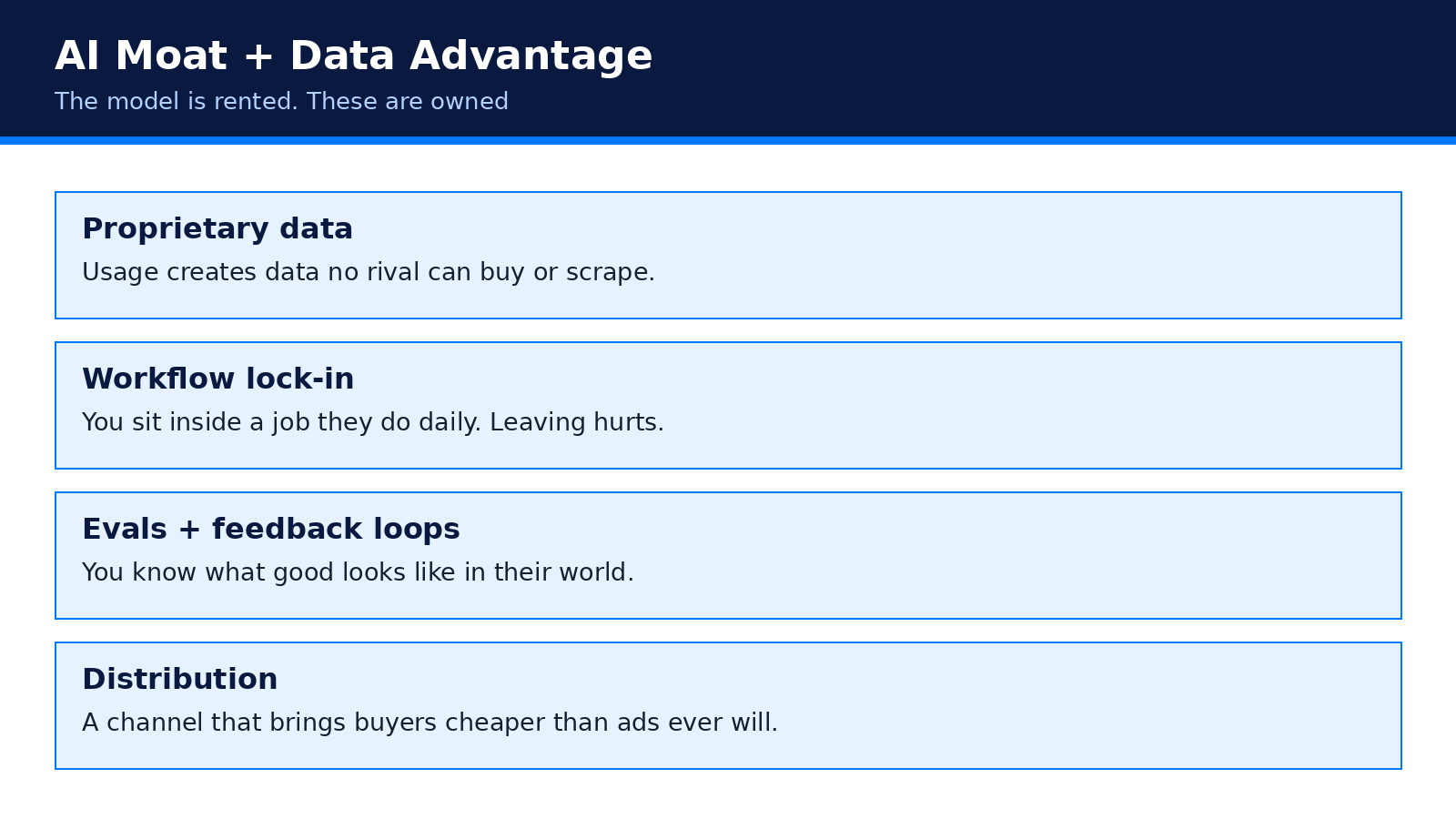
So what actually counts as a moat? Not the model. Everyone can rent the same models, and the best one changes every few months. What counts is everything around the model that takes time, trust, or access to build. Waveup lists five moats investors fund in 2026: deep workflow embeddedness, proprietary data, evals and hard-won customer logic, context and memory layers, and cornered resources like exclusive partnerships or data access. You don’t need all five on day one. You need a credible path to at least one, ideally two stacked together.
Data advantage deserves its own careful thought, because founders overclaim it constantly. A dataset you bought once is not a moat — a rival can buy it too. A dataset that grows and improves every time a customer uses your product, in ways a rival can’t reproduce without your customers, is much closer to one. Seedscope’s defensibility guide makes the same distinction sharply: interrogate whether data is static or compounding, and stack at least two moats together, because a single moat on its own is fragile. Ask yourself three questions, and write the honest answers in the moat box: does usage make the product better for the next user? How long would it take a well-funded rival to reproduce this data? And what part of it is exclusive to us — legally, contractually, or practically?
Workflow lock-in is the quieter moat, and often the stronger one for early startups. If your tool sits inside the daily job — the document system, the support queue, the scheduling flow — ripping it out breaks a process people rely on. That’s painful in a way a nicer interface never is. A standalone tool a user can cancel and forget in a month is not lock-in, no matter how much they liked the demo.
Evals are the moat nobody puts on a slide, but investors who’ve done real diligence ask about them fast. Do you know, measurably, when your product gets an answer right, when it gets it wrong, and how often a human has to step in? If you can show that loop — real customer cases, graded outcomes, fixes shipped — you’ve got something a rival can’t copy by reading your homepage. Sequoia’s 2026 thinking, summarised in InnMind’s AI Ascent 2026 breakdown, pushes the same point from the other side: pitch owned workflows, measurable outcomes, and reliability, not model novelty.
And here’s a related trap: defensibility isn’t a paragraph you write once. It’s a direction you build toward. If your moat box is blank today, leave it blank — or write “not yet, here’s the path.” Maurya’s own advice is to leave the unfair advantage box empty rather than fake it. Investors have seen a thousand fake moats. An honest blank box with a plan earns more trust than a confident lie.
Go-to-Market and Metrics: Proof, Not Promises
Go-to-market is where one-pagers usually turn into wish lists. “We’ll go viral” is not a channel. “We’ll partner with big companies” is not a channel either, not until someone at a big company has said yes. Write the channel you can start this month, with the first ten customers in mind, not the thousandth.
Metrics work the same way. Pick three numbers that tell you whether the business is working, and ignore the rest for now. For most early AI startups, a solid trio looks like this: activation (do new users complete the core task?), retention (do they come back next week or next month?), and unit margin (does each customer make you money after AI costs?). Revenue matters, obviously, but revenue without retention is just a launch spike wearing a costume.
Vanity metrics are the enemy here — total signups, total outputs generated, website visits. They go up when you shout louder, and they tell you nothing about whether anyone would miss the product if it vanished tomorrow. If a metric wouldn’t change a decision you make this month, cut it from the page. You can always add it back later, when it actually means something.
One more practical note on channels: the channel and the customer segment have to match. If your buyers are lawyers, a TikTok strategy is probably not your first move. If your buyers are Shopify store owners, a bar association event isn’t either. This sounds obvious when you read it. It’s shockingly easy to forget when you’re excited about a channel that worked for someone else’s completely different business.
The Funding Ask: A Number Tied to a Milestone
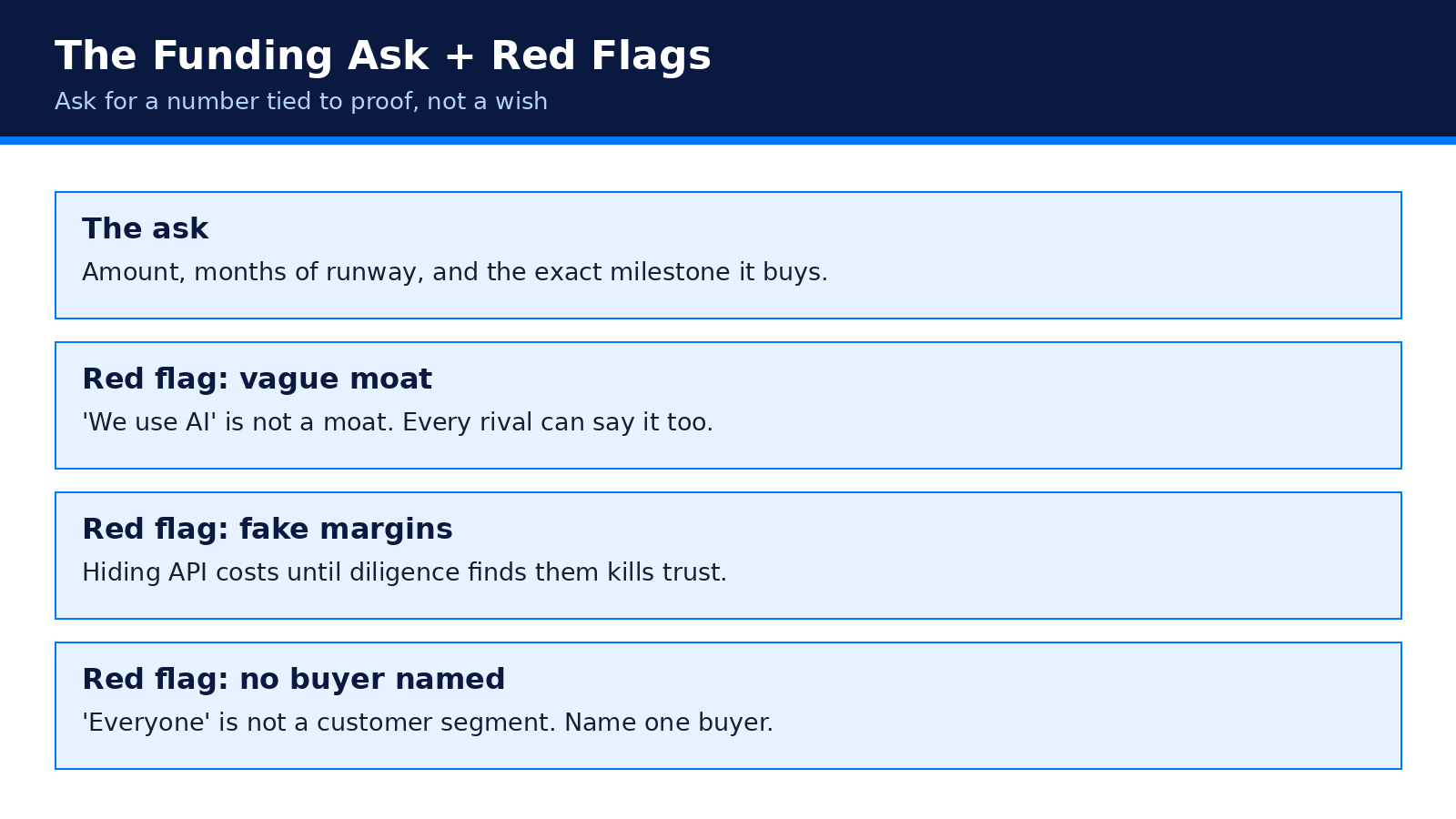
Most one-pagers end without ever saying what the founder actually wants. Don’t do that. The funding ask belongs on the page — or at least in the conversation the page starts — as a specific number, a runway length, and a milestone that money buys.
Here’s the formula: “We’re raising $X to reach Y in Z months.” X is the amount. Y is a proof point — 100 paying firms, $50,000 in monthly recurring revenue, a retention number, a signed distribution deal. Z is the runway that amount buys, usually 18 to 24 months at seed stage if you want investors to take the plan seriously. Anything vaguer than that — “we’re raising a seed round to grow” — tells an investor you haven’t done the math yet.
Context helps here, but treat benchmarks as ranges, not promises. Waveup’s 2026 data puts typical seed rounds at $3 million to $4 million, while BoilerplateHub’s guide puts the median AI seed raise in 2025 at $4.6 million with a median pre-money valuation around $17.9 million. Those numbers describe a market, not your company. Your ask should come from your costs and your milestone, not from copying someone else’s round size. If you need $1.2 million to prove the next thing, ask for $1.2 million and explain why. A right-sized ask beats a fashionable one.
Also be ready for the question behind the ask: what happens if you don’t raise? The best answer isn’t panic. It’s a smaller, slower path that still works — fewer hires, a narrower segment, a longer runway on revenue. Investors fund founders who have a plan B, not founders who treat a round as oxygen.
For the full fundraising picture — what questions come after the one-pager, and how to prepare for them — our guide on raising money for an AI startup covers the investor questions founders actually get asked in 2026, and the answers that hold up under pressure.
What Investors Red-Flag on a One-Pager
It helps to read your page the way a sceptical investor would, because that’s exactly who will read it. Here are the flags that come up again and again, in plain language.
- A moat that is just the model. “We use the latest AI” is a feature list, not a defence. If a rival can copy it by changing an API key, it’s not a moat.
- Margins that hide AI costs. Leaving token and compute costs out of the cost box, or burying them in “miscellaneous,” is the fastest way to lose trust in diligence.
- A customer segment called “everyone.” No segment means no channel, no message, and no early adopters. Name one buyer or start over.
- Revenue with no payer. “Users love it” is not revenue. Who pays, how much, and how often — if those three aren’t on the page, the business isn’t either.
- A solution in search of a problem. When the solution box is the longest, most detailed box on the page, and the problem box is one vague sentence, the founder built first and asked questions later.
- Metrics that flatter instead of inform. Signups without retention, outputs without outcomes, growth without margin. Investors have seen all of them, and they discount accordingly.
None of these flags means your idea is dead. They mean your page is telling the wrong story, or telling it too early. Fix the page, fix the underlying gap if it’s real, and go again. That’s the whole loop.
“Most startups fail, not because they fail to build what they set out to build, but because they waste time, money, and effort building the wrong product.” — Ash Maurya, on why the problem box comes first
That quote is worth taping above your desk while you draft. It’s harsh, but it’s kind, in its own way. It tells you the failure it describes is avoidable — if you do the unglamorous work of checking the problem before you fall in love with the solution.
How to Draft Yours in About Twenty Minutes
Okay, practical part. Set a timer for twenty minutes. That’s the first-pass budget Maurya recommends, and it’s generous if you stay disciplined. Grab a blank page — paper is better than a doc for the first pass, because you can’t hide behind formatting.
Minutes one to five: problem and customers. Write the three pains and the one segment. If you stall here, stop. You don’t have a plan problem, you have a research problem, and no amount of writing will fix it. Go talk to people, then come back.
Minutes five to ten: value proposition and solution. One sentence, then three features. Cross out anything that doesn’t directly serve the pains you just wrote. This part hurts, and that’s how you know it’s working.
Minutes ten to fifteen: channels, revenue, and costs. Actual numbers, even if they’re estimates. Write “estimate” next to them if that helps you be honest. Investors prefer a labelled estimate to a fake precision any day.
Minutes fifteen to twenty: metrics and AI moat. Three numbers, one moat path. If the moat box stays blank, write the path instead: “Path: firm-specific clause data from first 50 firms, plus workflow integration.” That’s honest, specific, and testable.
Then — and this is the step most founders skip — show it to someone who will be blunt with you. A founder friend, a potential customer, a mentor who doesn’t owe you kindness. Ask them one question: “What part of this would you not believe?” Their answer is your next week of work.
After that first pass, revisit the page weekly while you’re early. Not monthly. Weekly. Your assumptions are changing that fast, whether you write them down or not. The page is just where the changes become visible, so you can act on them instead of drifting.
If you want a broader starting point for the whole journey, our guide on how to start an AI startup covers the steps around the plan — idea, validation, first build, and first customers — in the order most founders actually live them.
Frequently Asked Questions
Can a one-page plan really replace a full business plan for fundraising?
For early-stage fundraising, yes, in practice. Investors at pre-seed and seed stage decide on the strength of the problem, the team, early traction, and the economics — all of which fit on one page if you’re disciplined. A full plan still has its place later, for detailed financial modelling and operational planning, but it rarely wins the first meeting. The one-pager does.
What if I don’t have an AI moat yet?
Then say so, and say what you’re building toward. A blank moat box with a credible path — proprietary data from your first customers, workflow integration, a distribution channel — earns more trust than a fake moat. Most real moats are earned over time, not declared on day one. Investors know that. What they won’t forgive is pretending otherwise.
How detailed should the unit economics be on one page?
Detailed enough to argue with, short enough to read. Price per customer, AI cost per customer, other delivery costs, and the resulting gross margin — that’s the core. Add acquisition cost and lifetime value if you have real numbers for them. If you only have estimates, label them as estimates. Precision you can’t defend is worse than a range you can.
Should I include a funding ask on the one-pager itself?
Include it if the page is going to investors, and keep it specific: amount, runway, and the milestone it buys. If the page is only for your own planning, the ask can live in your notes instead. Either way, do the math before the meeting. An investor will ask, and “we haven’t decided yet” reads as “we haven’t done the work yet.”
How often should I update my one-page plan?
Weekly while you’re pre-product-market fit, and after every meaningful customer conversation that changes an assumption. A one-pager that never changes is either perfect — unlikely — or ignored. Treat it as a living snapshot of what you believe today, not a monument to what you believed when you wrote it.
The Bottom Line
Look, nobody ever funded a startup because its business plan was long. They funded it because the founder could explain, clearly and honestly, what problem mattered, who would pay to solve it, what it cost to deliver, and why the business would still be standing when the next model release landed.
That’s what your one page has to do. Not impress. Not cover every possibility. Just tell the truth, tightly, in nine boxes. Write it in twenty minutes, show it to someone blunt, fix the part they don’t believe, and repeat. Do that for a few weeks and you’ll notice something: the page gets sharper, but so does your thinking. That’s not a coincidence. The page is just where the thinking becomes visible.
So grab a blank sheet, start with the problem, and don’t touch the solution box until the problem box is honest. Your future investor — and your future self, six months from now, grateful you didn’t build the wrong thing — will thank you for it.