

Here’s a story I hear a lot. A founder builds a clever resume screener, lands three paying customers, and then one of those customers gets a letter from their lawyer. Turns out the tool was quietly filtering out older applicants, or women returning from career breaks, or anyone whose resume didn’t match a pattern the model learned from past hires. The product worked. The company still had to kill it.
That’s the real risk in AI recruiting. It’s not that the tech is hard. It’s that hiring is one of the most regulated things a company does, and a tool that makes decisions about people inherits every rule that applies to those decisions. The good news? There’s a huge, profitable space for founders who build on the right side of that line. Honestly, the law is your moat here — most competitors won’t bother reading it.
Quick honesty note before we start: I’m a founder writing about startups, not your lawyer. Nothing here is legal advice. Treat this as a map of where the mines are, then get an employment lawyer to walk your actual product through it before you sell to anyone. That one call is the cheapest insurance you’ll ever buy.
So what makes an AI recruiting idea safe? One question does most of the work: does a human still make the call? If your tool gathers evidence, organizes it, and hands a person a clear recommendation they can accept or overrule, you’re on solid ground. If it rejects people on its own, scores faces, or reads traits off a video, you’re building on a fault line. Every idea below passes that test.
The law in plain English (the short version)
You don’t need a law degree. You need five facts, and you need to stop believing the myth that “the AI did it” is a defense. It isn’t. Under US federal law, the employer is responsible for the outcomes of its hiring process even when a vendor built the tool. That single point shapes every idea in this article.
1. Title VII and disparate impact. The Civil Rights Act’s Title VII bans hiring practices that disproportionately screen out people based on race, color, religion, sex, or national origin — even when nobody intended to discriminate. The EEOC’s May 2023 technical guidance on AI selection tools spelled this out for software: if a tool’s selection rate for a protected group falls below 80% of the highest group’s rate (the old “four-fifths rule”), that’s a red flag, and the employer has to show the tool is job-related and consistent with business necessity. That guidance was later withdrawn, but Title VII itself didn’t go anywhere, and the four-fifths rule is still how practitioners measure this stuff. The EEOC’s AI hiring guidance is the best plain-English starting point.
2. New York City Local Law 144. Since enforcement began on July 5, 2023, employers using an “automated employment decision tool” for NYC jobs must get an independent bias audit within a year of use, post a summary of the results publicly, and give candidates notice at least 10 business days ahead, including the right to request an alternative process. The definition turns on whether the tool “substantially assists or replaces” human judgment — which is exactly why human-in-the-loop design matters so much. NYC’s own AEDT page lays out the three duties.
3. Illinois: two laws, not one. The Artificial Intelligence Video Interview Act, in effect since January 1, 2020, says an employer using AI to analyze video interviews must tell the applicant first, explain how the AI works and what it assesses, and get consent before the interview — no consent, no AI evaluation. Then, from January 1, 2026, an amendment to the Illinois Human Rights Act bans using AI that has a discriminatory effect in hiring, and bans using zip codes as a proxy for protected traits. SHRM’s rundown of the video interview law is still the clearest summary of the original act.
4. The EU AI Act treats hiring as high-risk. AI systems used for recruitment or selection — placing targeted job ads, filtering applications, evaluating candidates — sit in Annex III of the EU AI Act, which means risk management, data governance, documentation, record-keeping, transparency, and human oversight duties. The high-risk obligations were originally due August 2, 2026, but the EU’s Digital Omnibus pushed them to December 2, 2027. That delay is a gift for founders: build the controls now, while competitors are still waiting. This EU AI Act hiring breakdown explains the timeline well.
5. Colorado rewrote its law before it ever started. The original Colorado AI Act (SB 24-205) would have imposed impact assessments and a duty of reasonable care on high-risk AI, including hiring tools. It never took effect. It was replaced by SB 26-189, signed in May 2026, which takes effect January 1, 2027 and narrows the regime to transparency: pre-use notice, a plain-language explanation after an adverse decision, correction rights, and human review. Classet’s Colorado update tracks the change cleanly.
One more thing I want to be straight about: I could not verify a California bill numbered AB 730 as an enacted AI hiring law, so I’m not citing it here. California’s real, verifiable action is the Civil Rights Council’s automated-decision regulations, effective October 1, 2025, which say automated decisions that harm people on protected characteristics can violate state anti-discrimination law, with records kept for four years. When a “new California law” claim doesn’t check out, drop it. Your readers’ lawyers will check.
The compliance filter: run every idea through this first
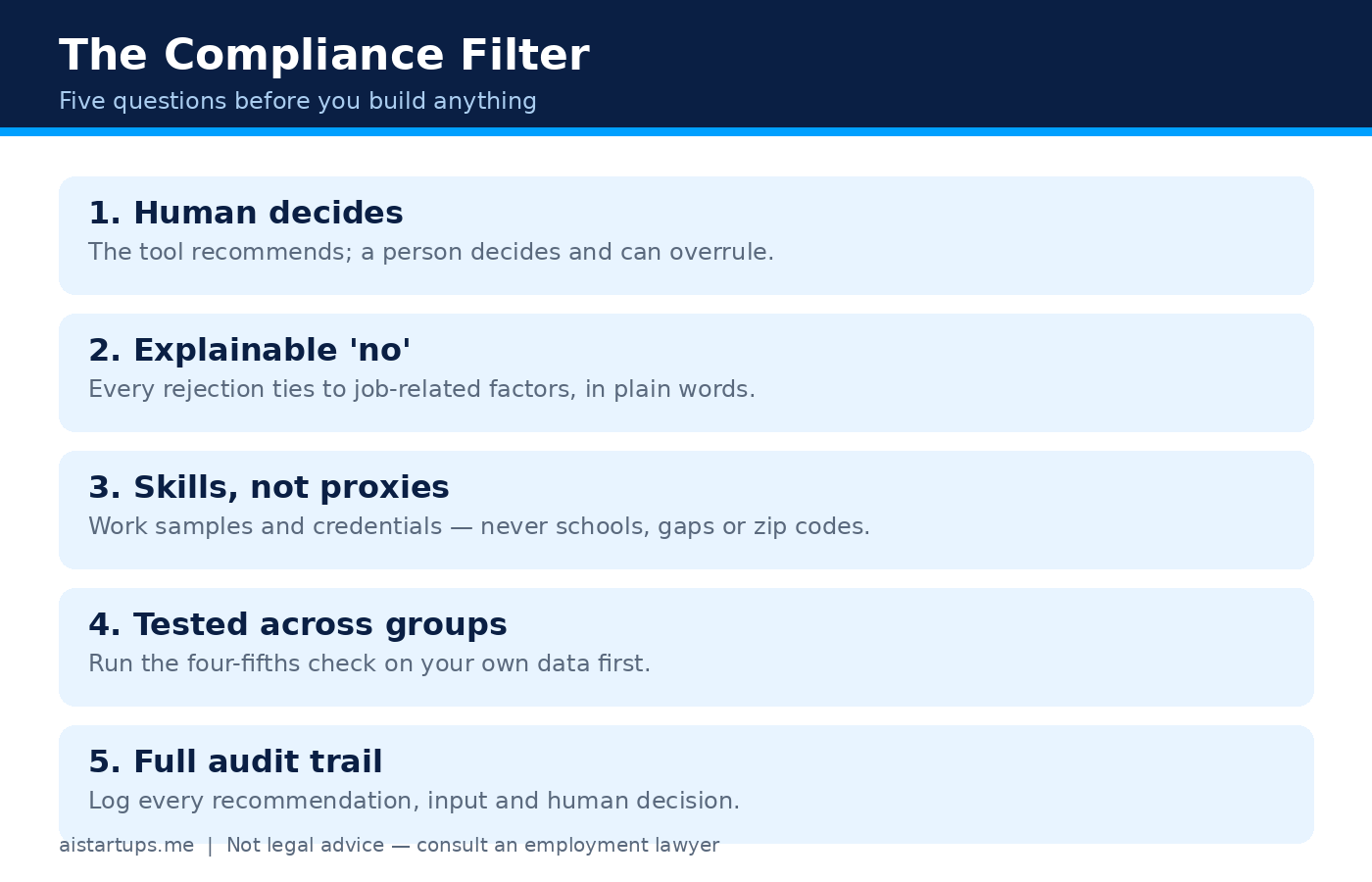
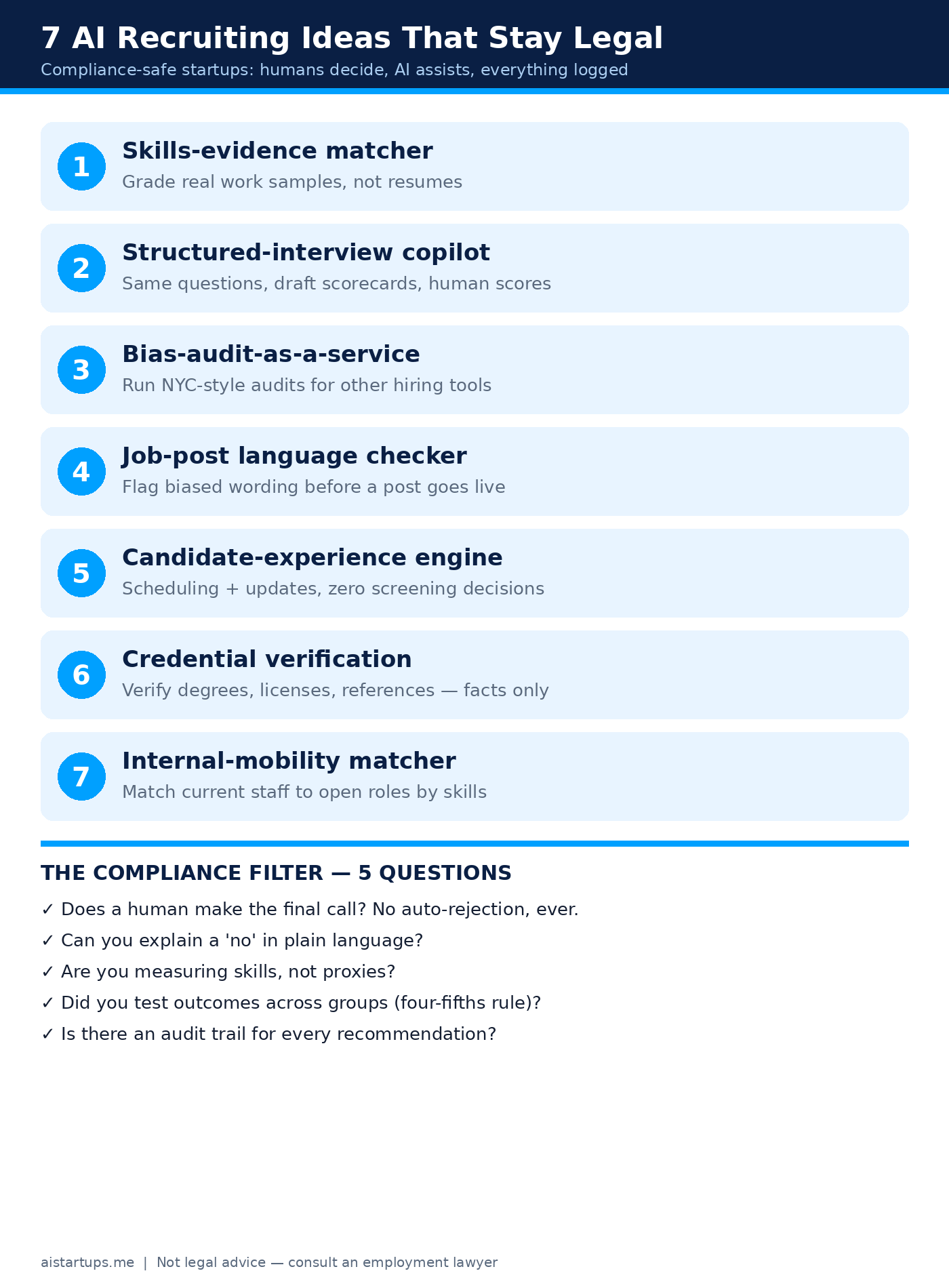
Before you fall in love with an idea, ask these five questions. If any answer is no, redesign the product, not the pitch deck.
- Does a human make the final call? The tool recommends; a person decides, and can overrule without penalty. No auto-rejection, ever.
- Could you explain a “no” in plain language? If you can’t tell a rejected candidate which job-related factors mattered, you can’t defend the decision either.
- Are you measuring skills, not proxies? Work samples, verified credentials, and structured answers are evidence. School prestige, gaps, zip codes, and voice tone are proxies — and proxies are where discrimination hides.
- Did you test outcomes across groups? Run the four-fifths check on your own data before a customer has to. If you find a gap, fix the criteria, not the math.
- Is there an audit trail? Every recommendation, the data behind it, and the human decision should be logged. That log is what turns a lawsuit into a shrug.
Notice what this filter kills: resume auto-rejecters, facial-analysis interview scorers, voice-tone judges, and anything that scrapes social media for “culture fit.” Good. Those are the products that make headlines for the wrong reasons. The seven ideas below all pass.
1. The skills-evidence matcher
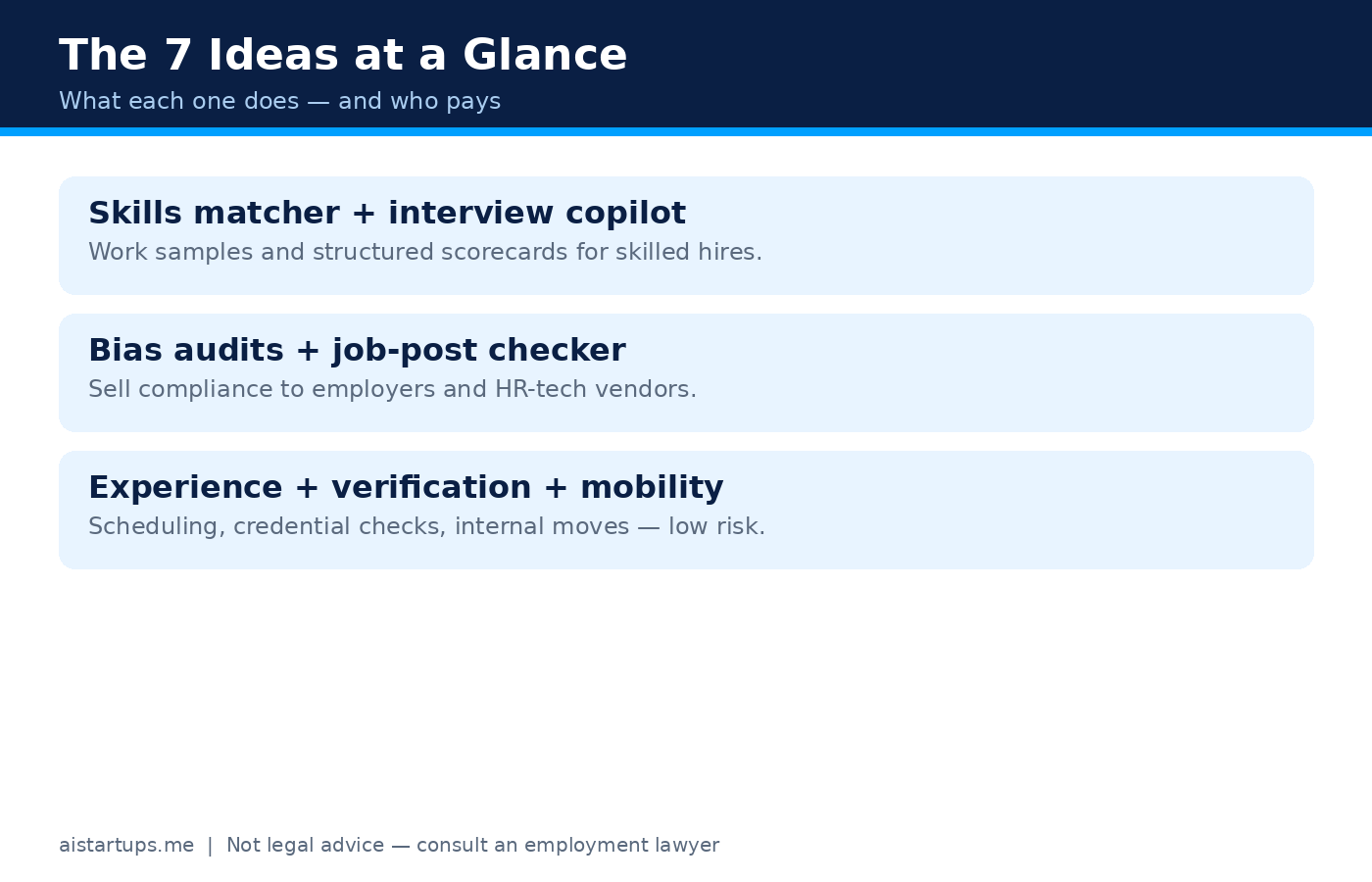
What it is: Instead of ranking resumes by keywords, candidates complete short, job-specific work samples — a support ticket reply, a spreadsheet fix, a code review, a design critique — and the AI grades the work against a rubric the hiring manager wrote. The output is evidence: “this person solved the actual problem well,” with the rubric attached.
Why it’s safe: You’re measuring the job, not the person. Work samples are the most defensible selection method in hiring science, and when the rubric is public to the hiring team, a candidate’s score is explainable in one sentence. Keep the rubric job-related, keep humans grading edge cases, and never let the tool add “bonus points” for schools or past employers.
Who pays: Mid-size companies hiring for skilled roles where resumes lie and portfolios are thin — think customer success, ops, junior engineering. Charge per seat for hiring managers plus per-assessment fees. This is also the easiest of the seven to demo: one great work sample beats a hundred slides.
2. The structured-interview copilot
What it is: A tool that sits beside the interviewer, not in front of the candidate. It generates structured questions tied to the role, transcribes answers (with consent, and never in Illinois without it), drafts a scorecard against the same rubric for every candidate, and flags when an interviewer drifts off-script or asks something off-limits.
Why it’s safe: Structured interviews are fairer than freeform chats precisely because every candidate gets the same questions. Your product makes consistency easy instead of optional. The key design choice: it never scores the candidate on its own. It drafts; the interviewer scores. And it never touches video analysis, face reading, or tone judging — transcription and question discipline only.
Who pays: Companies doing 20+ hires a year that know their interviews are inconsistent but can’t afford an industrial-psychology consultant. If you’ve ever wondered what to look for when hiring your first AI engineer, you’ve felt this pain — structured scorecards are how small teams hire like big ones.
3. Bias-audit-as-a-service for hiring tools
What it is: The picks-and-shovels play. NYC requires independent bias audits for covered tools, the EU will require documented risk management, and every mid-size employer using a screening tool now needs someone to run the numbers. You build the audit: ingest a tool’s selection data, compute selection rates and impact ratios by group, and produce the public summary plus the remediation report.
Why it’s safe: You’re the compliance layer, not the decision-maker. Your product makes other companies’ tools defensible, which means your customers are lawyers and HR leaders, not just recruiters. Independence matters here — don’t audit your own screening tool and call it independent. Sell the audit, stay out of the decision business.
Who pays: Employers with NYC hiring, enterprise HR teams, and HR-tech vendors who need audit-ready reporting to close deals. Annual contracts, audit-season spikes, and a beautiful wedge: once you audit a company’s stack, you see every tool they use. This is the closest cousin to the trust-selling playbook in AI compliance and audit tools, and it works for the same reason — fear of regulators is a better sales motivator than love of features.
4. The job-post language checker
What it is: A writing assistant that scans job posts before they go live and flags language that discourages qualified applicants or invites a discrimination claim — gendered wording (“rockstar,” “ninja,” “dominant”), unnecessary degree requirements, age-coded phrases (“digital native,” “high energy”), and proxy requirements that don’t match the actual job.
Why it’s safe: It touches no candidate data at all. It edits a document before publication. There is no selection decision, no protected-class data, and no adverse action — just better writing with a paper trail showing the company tried. That’s about as low-risk as HR tech gets, and it still saves real money: every qualified person who doesn’t apply because of a badly written post is a hire you never made.
Who pays: Recruiting teams, staffing agencies, and job boards as a white-label add-on. Price it low, sell it wide, and bundle it with idea 1 or 2 later. Solo founders love this one because it can ship in weeks.
5. The candidate-experience engine (no screening at all)
What it is: Scheduling, status updates, interview prep, feedback collection, and respectful rejection messages — the entire candidate journey except the decision. Candidates always know where they stand, nobody gets ghosted, and every touchpoint is logged.
Why it’s safe: Here’s the thing most founders miss: the safest AI recruiting product is one that never evaluates anyone. Ghosting and black-hole applications are the top complaint candidates have, and fixing them needs zero screening. You also dodge nearly every regulation in this article, because none of them govern sending a calendar invite nicely.
Who pays: High-volume employers — retail, logistics, healthcare support roles — where candidate drop-off costs real money. Charge per hire or per active requisition. It’s unglamorous, and that’s the point: unglamorous problems have budgets.
“The most defensible AI hiring product is often the one that never makes a hiring decision. Help humans decide better, faster, and with a paper trail — and let the auto-rejecters fight the regulators.”
6. Credential and reference verification, automated
What it is: AI that chases down the boring facts: degrees, licenses, certifications, employment dates, and references — then presents a verified dossier to the hiring manager. It checks facts; it doesn’t judge people.
Why it’s safe: Verification is factual, consented, and appealable — a candidate can correct a wrong record, which is exactly the kind of safeguard regulators want to see. Just stay inside the lines that already exist: get consent, use lawful sources, and never mix in social-media scraping or “reputation scores.” A clean dossier product is boring in the best way.
Who pays: Regulated industries — healthcare, finance, education — where a bad credential check is a liability event, plus staffing firms verifying at volume. Per-check pricing scales beautifully here.
7. The internal-mobility matcher
What it is: A tool that matches existing employees to open roles, projects, and promotions based on their verified skills, completed training, and stated interests — so companies promote from within instead of always hiring outside.
Why it’s safe: Internal candidates already work there, which removes most of the adverse-impact surface of external screening, and the criteria (skills, training, performance records) are documented by the employer itself. The trap to avoid: don’t let past promotion patterns train the model, or you’ll automate yesterday’s bias. Use stated skills and completed qualifications, not “people like our current managers.”
Who pays: Companies over 200 people with retention problems. Internal mobility is a retention product wearing a recruiting costume, and retention budgets are bigger than recruiting budgets. Sell it to the head of people, not the recruiter.
What NOT to build (the graveyard)
Real talk: some ideas sound brilliant in a pitch and die on contact with a lawyer. Skip these, no matter how good the demo looks.
- Auto-reject resume screeners. The moment your tool says no without a human, you’ve built the exact thing NYC audits and Title VII scrutinizes. Human review isn’t a feature you add later; it’s the product.
- Video and voice analysis. Illinois requires consent and explanation, and several states restrict biometric data. Facial expression and vocal tone are also terrible predictors of job performance. Why fight that battle?
- Social-media “culture fit” scoring. Scraping personal data, inferring protected traits, and scoring personality from posts — this is three lawsuits in a trench coat.
- Tools that learn from past hires. “Hire people like our best employees” sounds smart until you realize your best employees were hired through a biased process. Past-hire data is a bias photocopier.
How these ideas make money
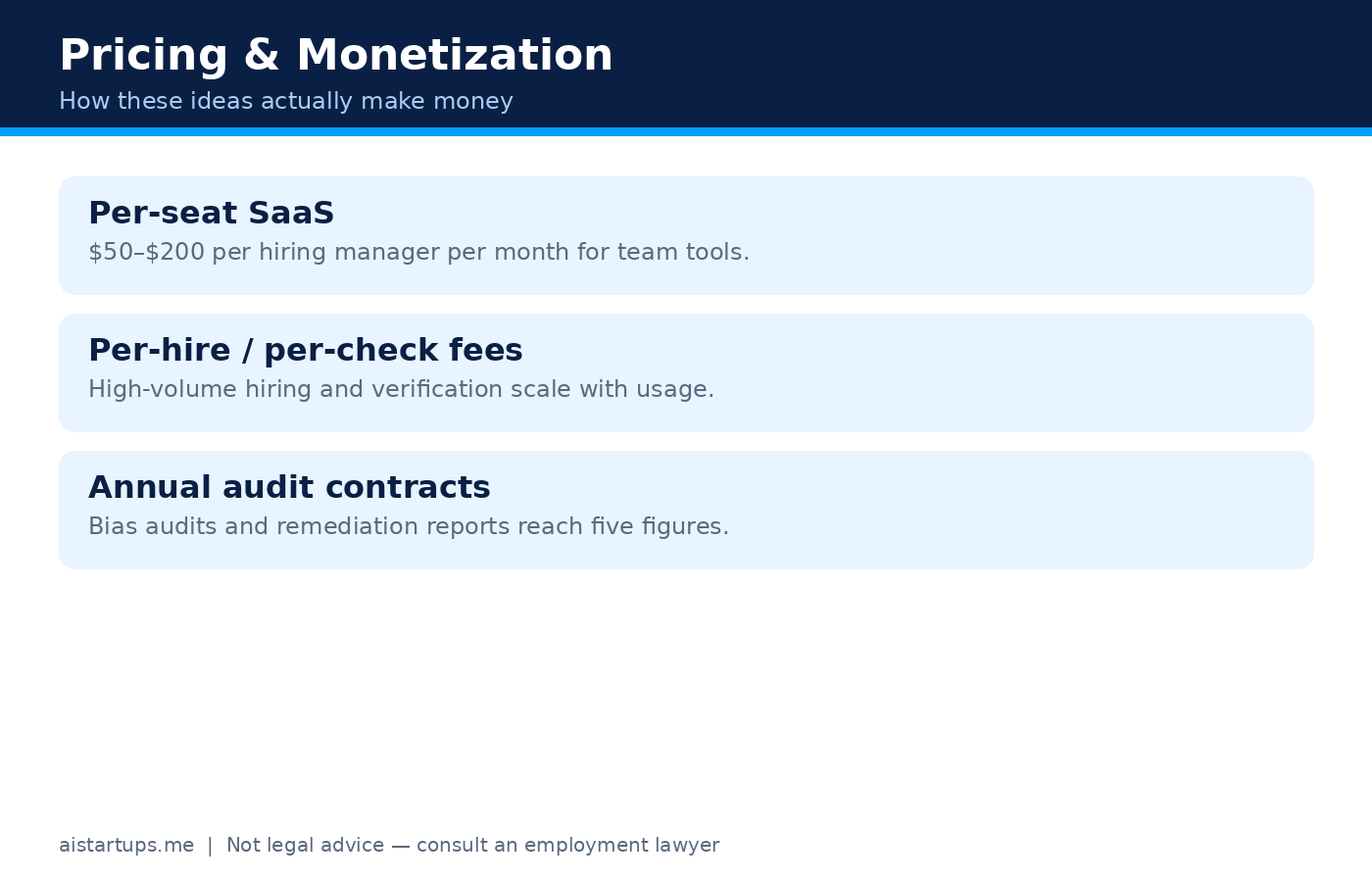
Compliance-safe doesn’t mean charity. The pricing patterns that work here are refreshingly normal. Per-seat SaaS for hiring teams ($50–$200 per hiring manager per month at the low end), per-hire or per-assessment fees for high-volume use, and annual audit contracts for idea 3, which is the only one with true enterprise price tags — audits and remediation reports regularly run into five figures per engagement.
One pattern I keep seeing: the wedge matters more than the vision. Start with one painful, narrow job — say, structured interview scorecards for startups hiring engineers — and earn the right to expand. A founder who tries to sell a “full hiring platform” on day one competes with everyone. A founder who owns interview consistency for one niche can charge, retain, and expand from a position of strength.
And if the product side isn’t your strength but the business is? This is where outside help pays for itself. If you need a website, a working prototype, or AI features wired into a real product, a team like AISquadX can build it while you focus on customers and compliance. Don’t burn six months learning to code what someone else ships in six weeks.
Your first 90 days
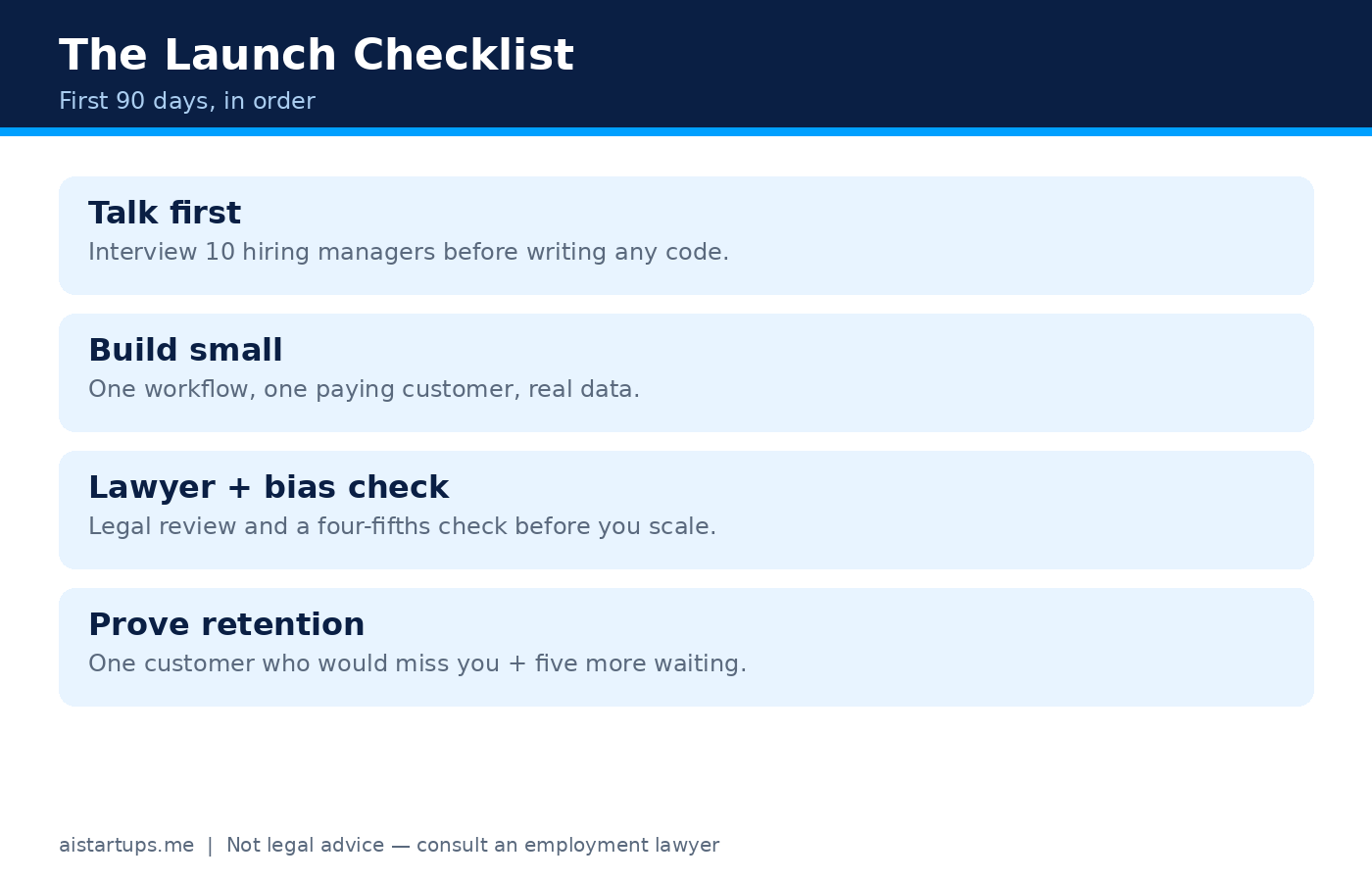
Week one is not for building. It’s for talking. Interview ten hiring managers and ask one question: “Tell me about the last hire you regretted, and the last great one you almost missed.” You’ll hear about inconsistent interviews, resume lies, and legal fear — and you’ll know which of the seven ideas matches the pain you keep hearing.
Then build the smallest honest version: one workflow, one customer, real data. Write the compliance filter into the product spec on day one, not as a retrofit. Get that employment-lawyer review before your first paying customer, not after your tenth. And keep the audit trail from the first demo — logs are easy to add early and painful to reconstruct later.
By day 90 you want three things: one paying customer who would be sad if you disappeared, one documented bias check on your own product (even a simple four-fifths calculation on pilot data), and a waitlist of five more teams with the same pain. That’s a real company. Everything else is a slide deck.
If you’re building an agency or services business around this space instead, the playbook for getting those first clients is the same one in starting an AI agency in 2026 — services first, product second, and let client work fund the build.
FAQ
Can a startup sell an AI recruiting tool that auto-rejects candidates?
Technically you can build it, but you’d be selling your customers a liability. Auto-rejection is the trigger for NYC’s bias-audit and notice duties, and it’s the hardest design to defend under Title VII’s disparate-impact rules. Build human review into the core loop and you sidestep the worst of it.
Does using a vendor’s AI tool protect my company if the tool discriminates?
No. Under Title VII, the employer remains responsible for its selection procedures even when a third-party vendor designed or runs the tool. That’s why smart buyers now demand audit reports and adverse-impact data before signing — and why idea 3, bias auditing, has such a strong market.
Is video-interview AI illegal?
Not everywhere, but it’s the highest-friction category. Illinois requires advance notice, an explanation of what the AI assesses, and consent before the interview, and you can’t evaluate anyone who doesn’t consent. Several other states restrict biometric data from interviews. Most founders should skip video analysis entirely and use structured interviews instead.
When do the EU AI Act’s hiring rules actually bite?
Recruitment and selection AI is classified as high-risk under Annex III of the EU AI Act, with obligations around risk management, documentation, transparency, and human oversight. Those high-risk duties were deferred by the Digital Omnibus to December 2, 2027 — so if you serve EU employers, you have a runway, not a reprieve. Build the controls now.
Do these laws apply to small startups or only big companies?
They apply based on what you do and who you hire, not how big you are. NYC’s law covers employers using covered tools for NYC roles, Illinois’ laws cover employers hiring in Illinois, and Title VII covers employers with 15 or more employees. A five-person startup hiring in NYC or Illinois is in scope. Size changes your enforcement risk, not your obligations.
The Bottom Line
AI recruiting isn’t a dead end — it’s a field where the founders who read the rules win. The market is enormous, employers are desperate, and the tools that survive will be the ones that help humans decide instead of deciding for them. Pick one of these seven ideas, run it through the five-question filter, talk to ten hiring managers before you build, and get a lawyer’s eyes on it before you sell.
The founders who get rich in this space won’t be the ones with the cleverest model. They’ll be the ones whose customers never get that lawyer’s letter. Build the product a general counsel would approve, and the sales calls get a lot shorter. Now go talk to a hiring manager — that’s your real first step, and it starts today.