


On October 19, 2026, one of the strangest stories in AI got its punchline. For ten straight days, an anonymous model called “Space Bunny” sat at number one on OpenRouter’s volume charts, processing 56.7 trillion tokens — more than any stealth model OpenRouter has ever run. Nobody knew whose model it was. People were benchmarking it, arguing about it, building theories about it. Then MiniMax stepped forward and said: yeah, that was us. Space Bunny was an early version of M3.1 Flash, our new model. Surprise.
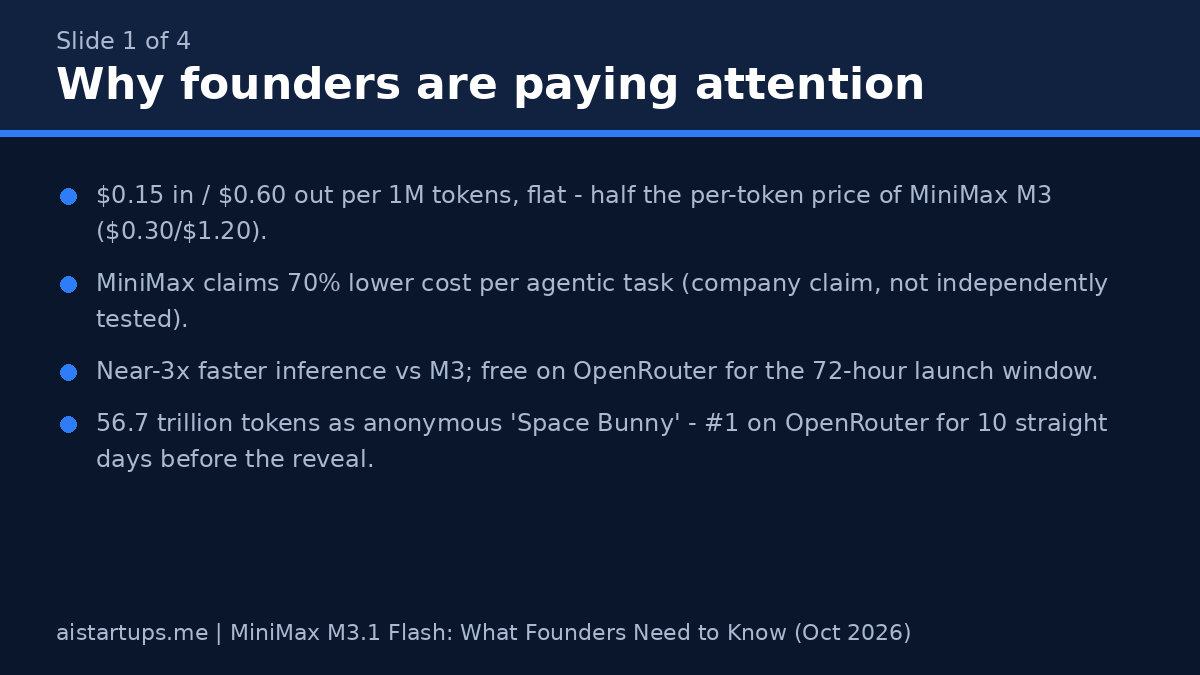
Look, I love a good mystery as much as anyone, but the reason this one matters to founders has nothing to do with the name. MiniMax is claiming M3.1 Flash delivers frontier-level intelligence for agentic tasks at roughly a third of the cost and three times the speed of its predecessor. The headline price: $0.15 per million input tokens, $0.60 per million output tokens — flat, no tiers. If those numbers hold up on real workloads, this is the kind of release that quietly reshuffles what it costs to run an AI startup.
So I did what I always do with a launch like this: I read the announcement, I read the independent coverage, I compared the company-reported benchmarks against third-party measurements, and I looked for the catches. Here’s the honest version.
What actually happened on October 19
MiniMax officially rolled out M3.1 Flash as a next-generation Flash model, describing it as a “generational leap” in agentic tasks, coding, computer use, and cybersecurity. It’s the GA version of the M3.1-Flash-Preview that had been testing since late September. The model is available through the MiniMax API, the M Plan subscription, and MiniMax Code for desktop.
The Space Bunny part is worth understanding, because it tells you something about how this model was built. According to OpenRouter’s reveal post, Space Bunny left their platform on October 5 and returned on October 19 as M3.1 Flash — and MiniMax credits the stealth period with real improvements: time to first token improved 38% (from 1.95 seconds down to 1.22), throughput rose 45% (from 70 to 100 tokens per second), and the error rate fell from 1.4% to 0.7%. That’s not marketing fluff; that’s ten days of production traffic from curious users stress-testing the thing. Shipping a model that’s already survived that kind of trial by fire is genuinely different from a lab demo.
Two more dates for your calendar: MiniMax says the model weights will be released on October 23, and a “Pro” model — which they describe as pushing the boundaries of intelligence — arrives later. So Flash is the efficiency play; the bigger sibling is still coming.
The price — and what “70% cheaper” really means
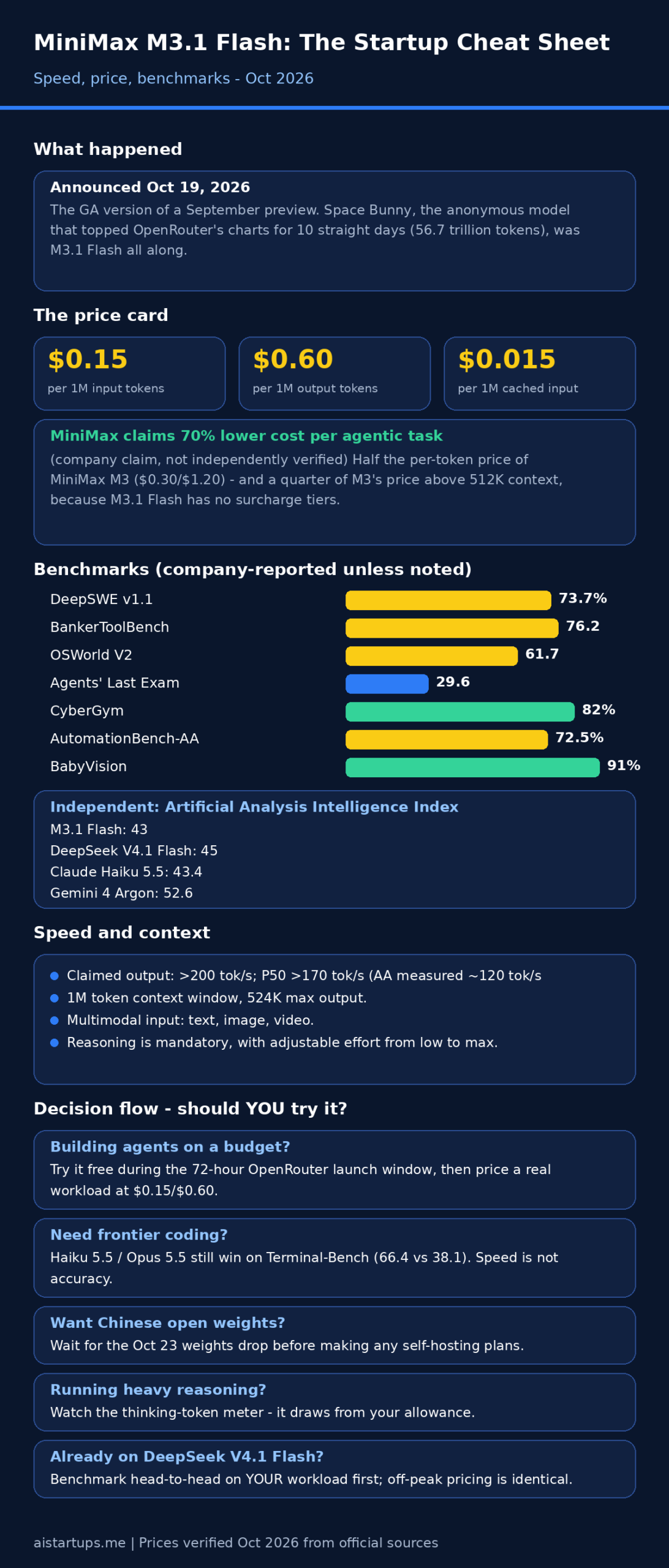
Let’s start with the number that will decide whether most founders care: $0.15 per million input tokens, $0.60 per million output tokens, and $0.015 per million cached input tokens. Flat rate. No context-length tiers, which is a real departure — the old M3 charged $0.30/$1.20 up to 512K input tokens and doubled above that threshold. So token-for-token, M3.1 Flash costs half of M3 below 512K and a quarter above it. AppStack Insider’s breakdown of the pricing is worth a read if you want the full comparison.
Now, about that “70% lower cost per agentic task” claim. Real talk: the rate card is not the bill. Artificial Analysis measured the average Intelligence Index task at $0.22 for M3.1 Flash versus $0.51 for M3 — that’s a 57% reduction, not 70%. Still excellent! But it’s below MiniMax’s headline number, and The New Stack noted that MiniMax hasn’t said how it measured the 70% figure. Also worth knowing: a study cited in the same coverage found that repeated runs of the same agentic coding task can use up to 30 times as many tokens. Your agent’s token appetite matters more than any rate card. I’ve written a whole guide on cutting your AI API bill if you want the full playbook — the short version is that caching, right-sizing models per task, and killing runaway agent loops move the needle more than switching vendors.
“MiniMax M3.1 Flash: Space Performance + Bunny Speed. Yes, Space Bunny, which has topped global leaderboards with 200T+ tokens, was an earlier version of M3.1 Flash.” — MiniMax’s official launch post, October 19, 2026
A quick money example so this feels concrete. Say your support agent reads 1M tokens and writes 100K tokens per day, 30 days a month. On M3.1 Flash that’s roughly $4.50 in input plus $1.80 in output — about $6.30 a month. The same workload on a frontier-priced model would run you many multiples of that. That’s the whole pitch: frontier-adjacent capability at a price where you stop thinking about the meter.
The catch hiding in the fine print
There is one, and it’s the kind of thing that only shows up after launch. The Inference’s launch-day report found that on M3.1 Flash, reasoning can’t be switched off — a disabled flag returns an HTTP 400 error, an unset effort field defaults to maximum, and thinking tokens draw from the same allowance. Request ceilings also dropped from 500 to 200 per minute. Translation for founders: that cheap $0.15 input price applies to a model that thinks a lot, and you pay for the thinking. If your workload doesn’t need deep reasoning, you can’t turn it down to low-effort savings the way you can with some competitors. Price your actual workload, not the rate card. (This is exactly the kind of gotcha my API cost guide warns about — always test with your real traffic patterns.)
The benchmarks — company numbers vs. independent ones
Here’s where I put on my skeptical hat, because this is where every model launch lives or dies. MiniMax’s own reported numbers:
- DeepSWE v1.1 (complex software tasks): 73.7%
- BankerToolBench (multi-step financial workflows): 76.2
- OSWorld V2 (computer use, cross-app tasks): 61.7 — first among Chinese models, per MiniMax
- Agents’ Last Exam (real professional work): 29.6
- CyberGym (vulnerability discovery): 82%
- AutomationBench-AA: 72.5%
- BabyVision (visual reasoning): 91%
MiniMax also says its own evaluations show M3.1 Flash edging DeepSeek V4.1 Flash — which I covered in our hands-on guide to DeepSeek V4.1 Flash — on the Automation-Bench and HLE benchmarks. If you’re already running on DeepSeek, that’s the head-to-head to watch.
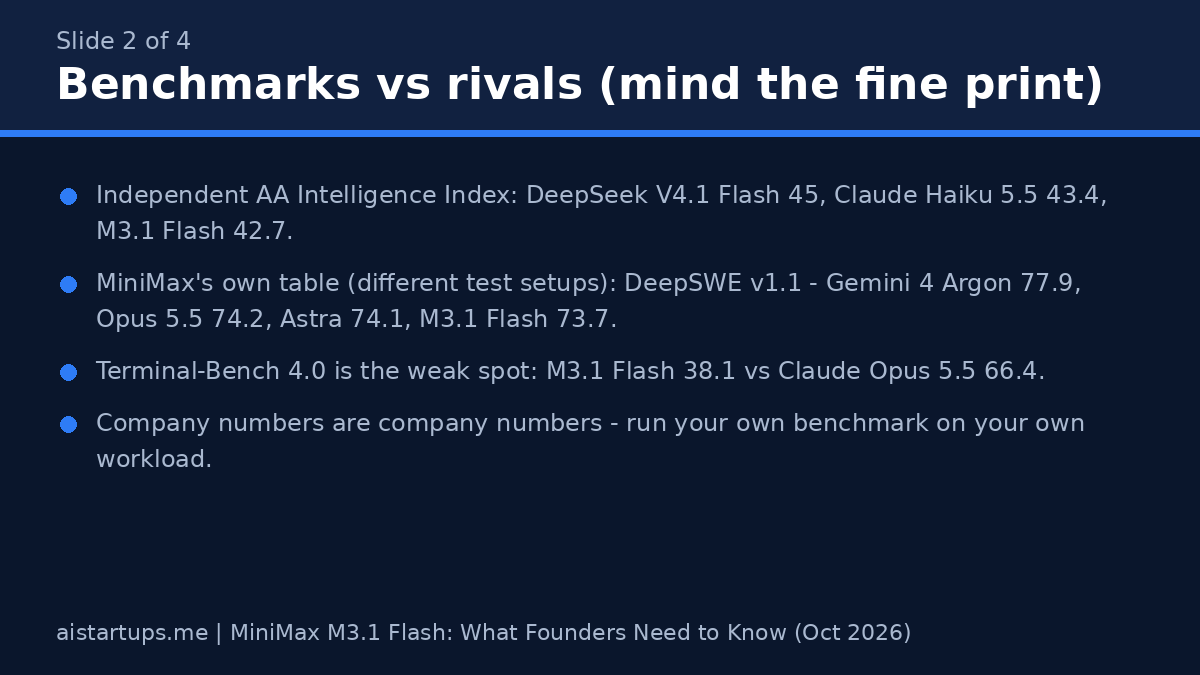
Now the independent side. Artificial Analysis scored M3.1 Flash at 42.7–43 on its Intelligence Index, which puts it behind DeepSeek V4.1 Flash (45), Claude Haiku 5.5 (43.4), and Gemini 4 Argon (52.6) — and behind Xiaomi’s MiMo-V2.6-Pro (46) among open-weight models. On DeepSWE v1.1, an independent comparison has Argon at 77.9, Claude Opus 5.5 at 74.2, GPT-6 Astra at 74.1, and M3.1 Flash at 73.7 — genuinely close to the frontier on coding, which is impressive at this price. But Terminal-Bench 4.0 is the weak spot: M3.1 Flash at 38.1 versus Opus 5.5 at 66.4. And on Agents’ Last Exam, the 29.6 trails Argon’s 39.5 — real professional work is where the gap shows.
One more honesty note: an independent analysis pointed out that MiniMax’s own comparison table benchmarks against last-generation models (Opus 5, GPT-5.6 Sol) rather than the current flagships. That’s standard industry practice and it’s also why you should never take a launch table at face value. The fair summary: M3.1 Flash looks like a very strong mid-tier model — near-frontier on coding, weaker on long-horizon real-world tasks — at a price that undercuts almost everything near it. This independent leaderboard-vs-test-results analysis walks through the gap between the company’s claims and third-party measurements in detail.
Speed — the part that might actually change your product
Here’s the thing that interests me more than any benchmark: speed. MiniMax claims output speeds exceeding 200 tokens per second in everyday use, with median speeds consistently above 170. Artificial Analysis independently measured around 120 tokens per second with 1.08 seconds to first token — lower than the claim, but still fast, and the methodological differences make a direct comparison tricky.
Why does this matter more than a benchmark point or two? Because of what I call the dead-air tax. Last month I watched a demo of an AI sales agent make 30 browser clicks to fill out a quote form. It worked — and it took almost two minutes, with the cursor spinning the whole time. The founder in the room leaned over and said, “Yeah, it works. It just feels dead while you wait.” That feeling is the hidden tax on nearly every agentic product shipping right now. A model that returns 100+ tokens per second with a ~1.2-second first token doesn’t just save money; it makes agents feel alive. For customer-facing products — support agents, sales copilots, anything interactive — that’s a product-quality difference, not just a cost difference.
The specs backing it up: 1M context window, up to 524K max output, multimodal input (text, image, and video), tool calling and structured output, and adjustable reasoning effort from low to max. That’s a genuinely complete agent-workhorse package at this price point.
Where it fits in your stack
Not every startup should switch models every time a new one drops — that’s a recipe for permanent migration hell. Here’s how I’d think about it:
- Try it if: you’re running agents where cost-per-task is the binding constraint (support, research, data processing). The free OpenRouter window makes the experiment nearly free, and the speed is real.
- Try it if: you’re on DeepSeek V4.1 Flash and curious — same $0.15/$0.60 price off-peak, so this is a pure quality/speed comparison on your workload. Run both for a week and keep the winner.
- Skip it (for now) if: you need top-tier long-horizon reasoning or terminal-style coding — Opus 5.5 and Argon still lead there, and the independent scores confirm the gap.
- Skip it if: your workload is reasoning-light — the mandatory reasoning with no off-switch means you’re paying for thinking you didn’t ask for.
- Watch it if: you’re planning self-hosting — weights drop October 23, and the license terms are still undisclosed. Don’t architect around it until you’ve seen the license.
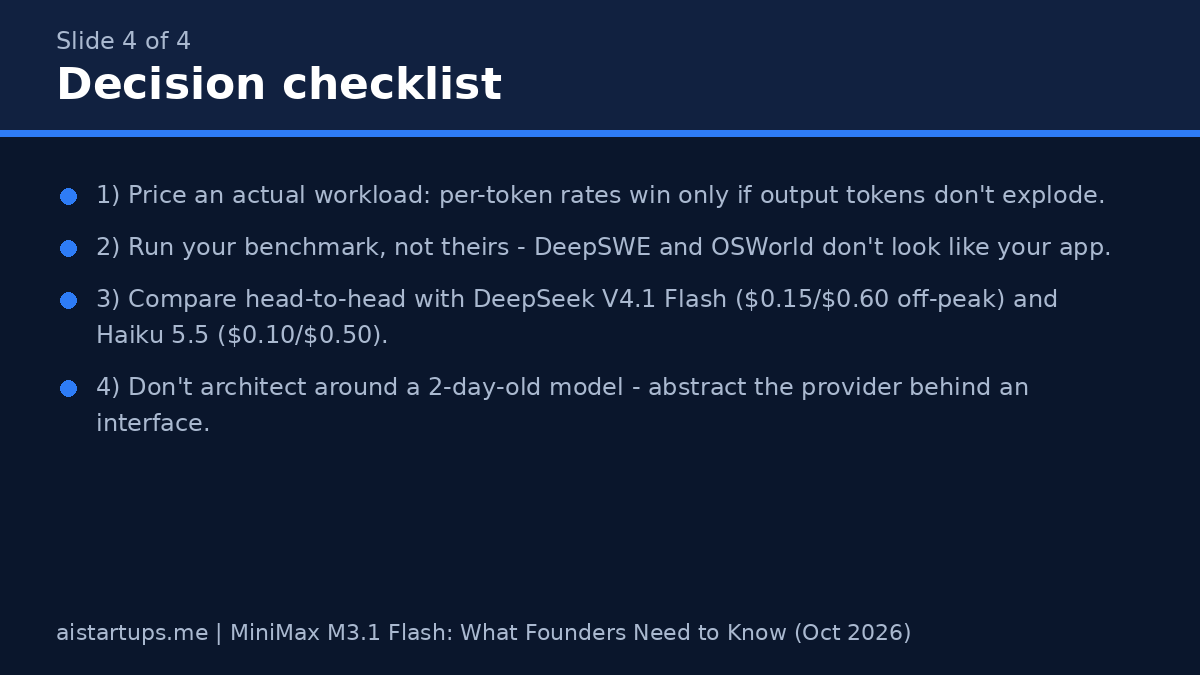
If you’re weighing this against the other budget frontier options, the field right now is: M3.1 Flash at $0.15/$0.60, DeepSeek V4.1 Flash at the same rates off-peak (doubling at peak hours), and Claude Haiku 5.5 at $0.10/$0.50 for requests under 100K tokens. Haiku is still the cheapest per token and scores slightly higher on the independent index; M3.1 Flash counters with speed and the agentic benchmark story. Honestly? Run your own benchmark on your own tasks. It takes an afternoon and it’s the only number that matters.
And a word on architecture: don’t build your company around a model that launched two days ago. Abstract the provider behind an interface — OpenAI-compatible endpoints make this nearly free — so you can swap M3.1 Flash in for a month, measure, and swap it out if something better appears. If you’re turning all of this into a real product and don’t have an in-house ML team, this is exactly the kind of integration work an AI integration studio like AISquadX handles — model selection, cost tuning, and the plumbing in between.
How to try it free this week
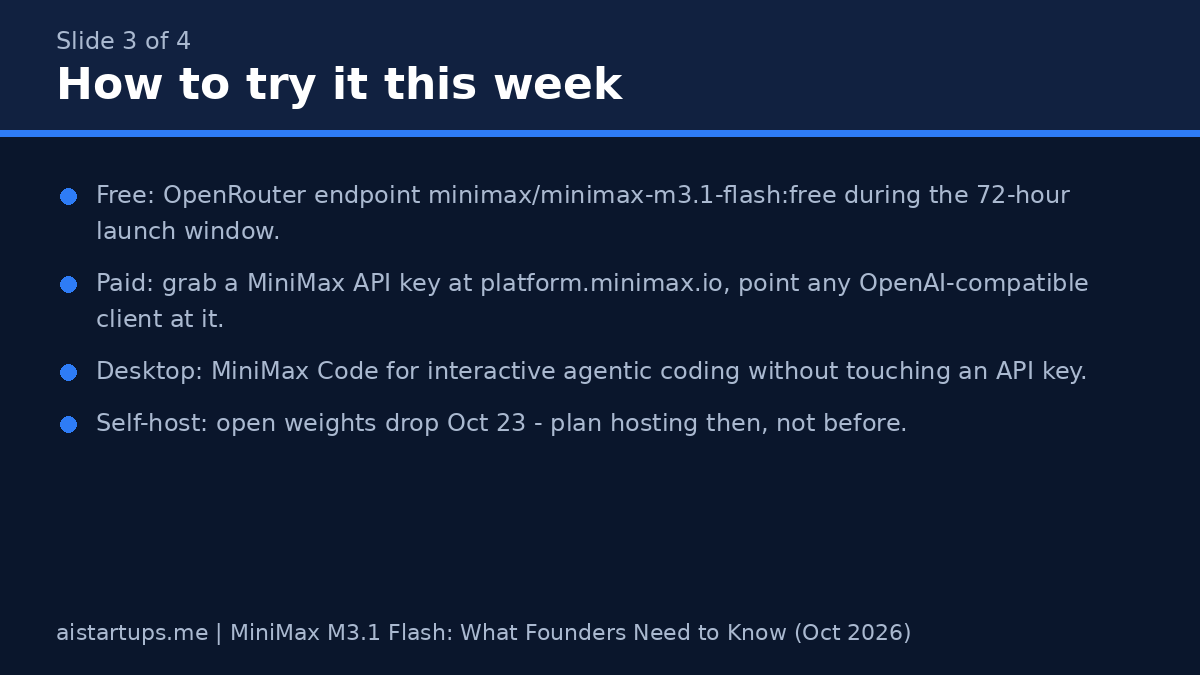
The cheapest experiment in AI right now: OpenRouter is offering M3.1 Flash free for 72 hours from launch (model id minimax/minimax-m3.1-flash:free), with 1M context and up to 524K max output. This rundown has the endpoint details. Two caveats from OpenRouter’s own docs: the free endpoints are rate-limited, and errors and empty responses still count against your limits. Fine for evaluation, not for production.
After the free window, the paid endpoint lists at the same $0.15/$0.60 flat rate. Getting set up is the usual drill: grab an API key, point your OpenAI-compatible client at the endpoint, and set the model string. If you prefer a subscription, there’s the M Plan; if you want it on your desktop, there’s MiniMax Code. And if you’re the self-hosting type, mark October 23 on your calendar for the weights release — just wait for the license terms before you plan anything around them.
For context on how fast this corner of the market is moving: Meta’s Muse Wonder launched the same week, and Grok 4.7’s pricing story is worth a look if raw price-per-token is your whole strategy. October 2026 is a genuinely crowded month for model launches — which is exactly why you want the abstraction layer I mentioned above.
FAQ
Is MiniMax M3.1 Flash really free?
For 72 hours from the October 19 launch, yes — OpenRouter offered it at $0 per token on the minimax/minimax-m3.1-flash:free endpoint. After the window closes, the paid endpoint applies at $0.15 per million input tokens and $0.60 per million output tokens, with cached input at $0.015 per million. The free tier is rate-limited, so treat it as an evaluation sandbox, not infrastructure.
How does M3.1 Flash compare to DeepSeek V4.1 Flash?
They’re priced identically off-peak ($0.15/$0.60), which makes this a clean shootout. Independent Artificial Analysis scoring gives DeepSeek V4.1 Flash a 45 on the Intelligence Index versus 43 for M3.1 Flash — but MiniMax’s own evaluations claim M3.1 Flash edges DeepSeek on Automation-Bench and HLE. If you’re on DeepSeek, the honest move is to run both on your actual workload for a week and keep the winner.
Can I run M3.1 Flash locally?
Not yet. MiniMax says the model weights will be released on October 23, 2026, but the license terms are still undisclosed — which matters enormously for commercial use. Don’t plan a self-hosting architecture around it until you’ve read the license. A “Pro” variant is also coming later for those who want more capability.
What’s the catch with the reasoning tokens?
Reasoning can’t be disabled on M3.1 Flash — a disabled flag returns an error, and an unset effort field defaults to maximum. Thinking tokens come out of your token allowance, so the headline $0.15 input price applies to a model that thinks heavily by default. You can lower the effort setting, but you can’t turn reasoning off. Request ceilings also dropped to 200 per minute from 500.
Should my startup switch to M3.1 Flash right now?
Only after you test it. The price and speed are genuinely compelling for agentic workloads, and the Space Bunny stealth run suggests it’s battle-tested. But the model is days old, the independent benchmarks show real gaps on long-horizon tasks, and the license for the weights isn’t public yet. Abstract your provider, run a head-to-head against whatever you’re using today, and let your own numbers decide.
The Bottom Line
M3.1 Flash is the most interesting efficiency release of the month, and the Space Bunny reveal is more than a cute story — ten days at the top of OpenRouter’s charts means this model shipped with production mileage most launches can only dream of. The $0.15/$0.60 flat pricing, the 1M context window, and genuinely fast inference make it a serious option for any founder running agents at scale.
But keep both eyes open: the “70% cheaper” claim is company math that independent measurement puts closer to 57%, the reasoning can’t be switched off (and you pay for the thinking), and the independent benchmarks show it’s a strong mid-tier model rather than a frontier-beater. That’s not a criticism — at this price, strong mid-tier with 200-tokens-a-second speed is exactly what most startups actually need.
My take: try it free this week, benchmark it against your current model on your real workload, and don’t marry any model that launched two days ago. The founders who win this cycle won’t be the ones who pick the perfect model — they’ll be the ones who built the stack that lets them switch in an afternoon.