


Here’s a confession: I used to think legal tech was a terrible solo-founder bet. Lawyers are risk-averse, sales cycles are brutal, and one regulatory misstep can end you. Then I looked at the numbers.
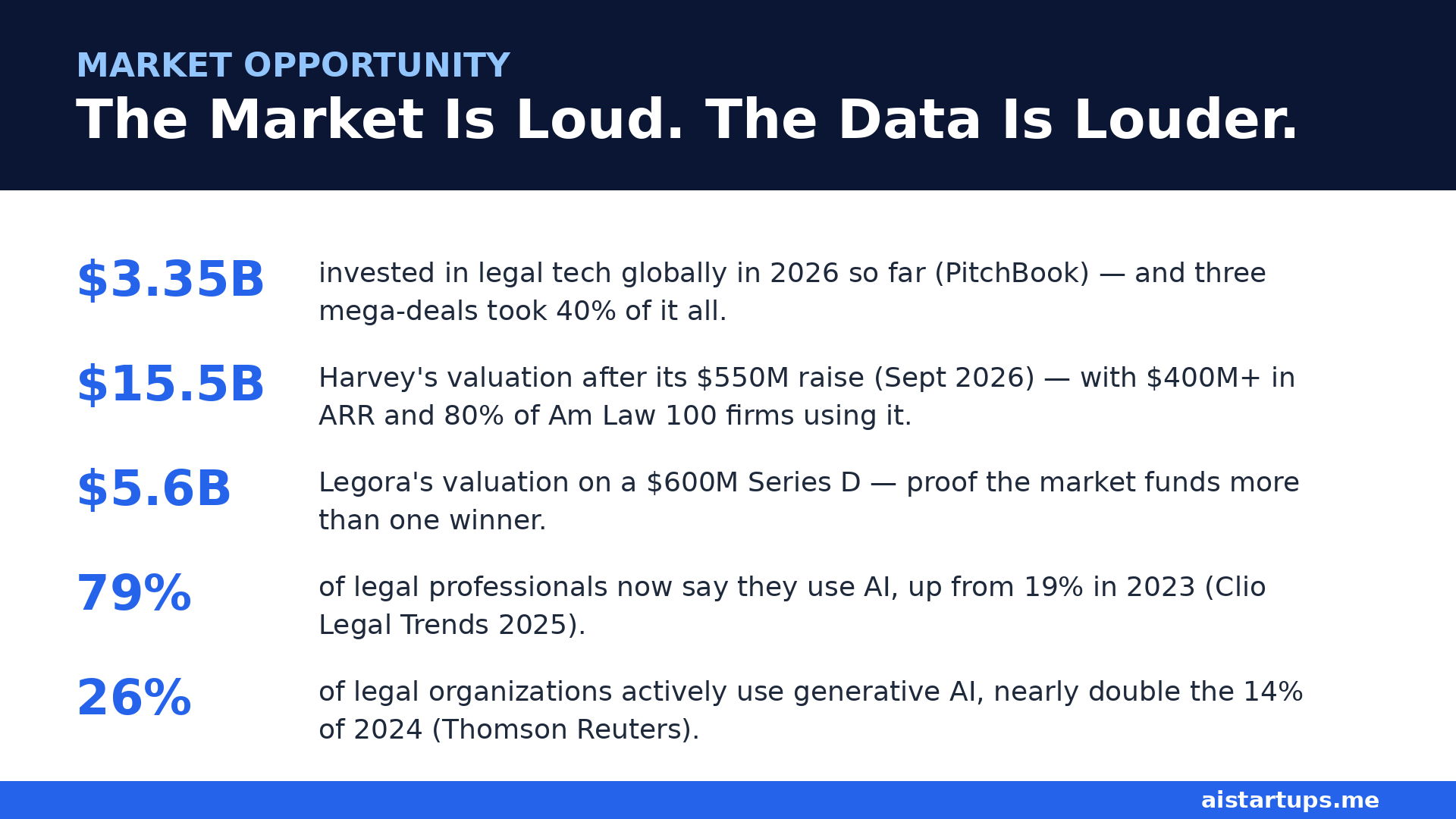
Harvey raised $550 million at a $15.5 billion valuation in September 2026. Legora pulled in a $600 million Series D at $5.6 billion. PitchBook’s data shows $3.35 billion flowed into legal tech in 2026 — and three mega-deals grabbed 40% of it. Clio’s Legal Trends Report found 79% of legal professionals now say they use AI, up from 19% in 2023. And Thomson Reuters found the share of legal organizations actively using generative AI nearly doubled in a single year, from 14% to 26%.
That last number is the one that matters for you. Roughly three-quarters of legal organizations still haven’t deployed generative AI in any serious way. The demand is proven, the budgets exist, and the market is still wide open below the enterprise tier. Big firms get Harvey. Who builds for the other 99% of firms? Honestly — that could be you.
But there’s a catch, and I won’t bury it: you can’t build “AI that replaces lawyers.” Unauthorized practice of law (UPL) is real, and bar regulators are paying attention. The smart move — the one every idea below follows — is building tools for lawyers: drafting assistants, workflow automation, and compliance monitoring that a licensed attorney reviews and signs off on. The ABA’s Formal Opinion 512 (July 2024) laid out the ethical framework: lawyers can absolutely use generative AI, as long as they meet duties of competence, confidentiality, verification, and supervision. Your product’s job is to make that compliance easy, not to dodge it.
Quick note: this article isn’t legal advice — talk to a real attorney before you build anything that touches legal work.
Why Legal Tech Works for Solo Founders Right Now
Three things line up beautifully for a one-person company in this space.
First, lawyers have money and hate drudgery. Document review, legal research, and summarization are the top three AI use cases lawyers already report (77%, 74%, 74% in the Thomson Reuters data). That’s not speculative demand — it’s revealed preference. They’ll pay real money for tools that hand back hours.
Second, the tech is finally good enough. Long-context models and solid retrieval pipelines mean a solo dev can now build a contract-review tool that genuinely works, without training a model from scratch. The hard part was never the AI — it’s the workflow, the integrations, and the trust. Those are founder problems, not lab problems.
Third, distribution favors the narrow. Harvey chases Am Law 100 firms. That leaves solo practitioners, 5-person firms, and boutique practices — tens of thousands of them — underserved and willing to try a focused tool that lives inside Word. You don’t need 3,000 customers. Thirty firms at $500/month is a real business for one person.
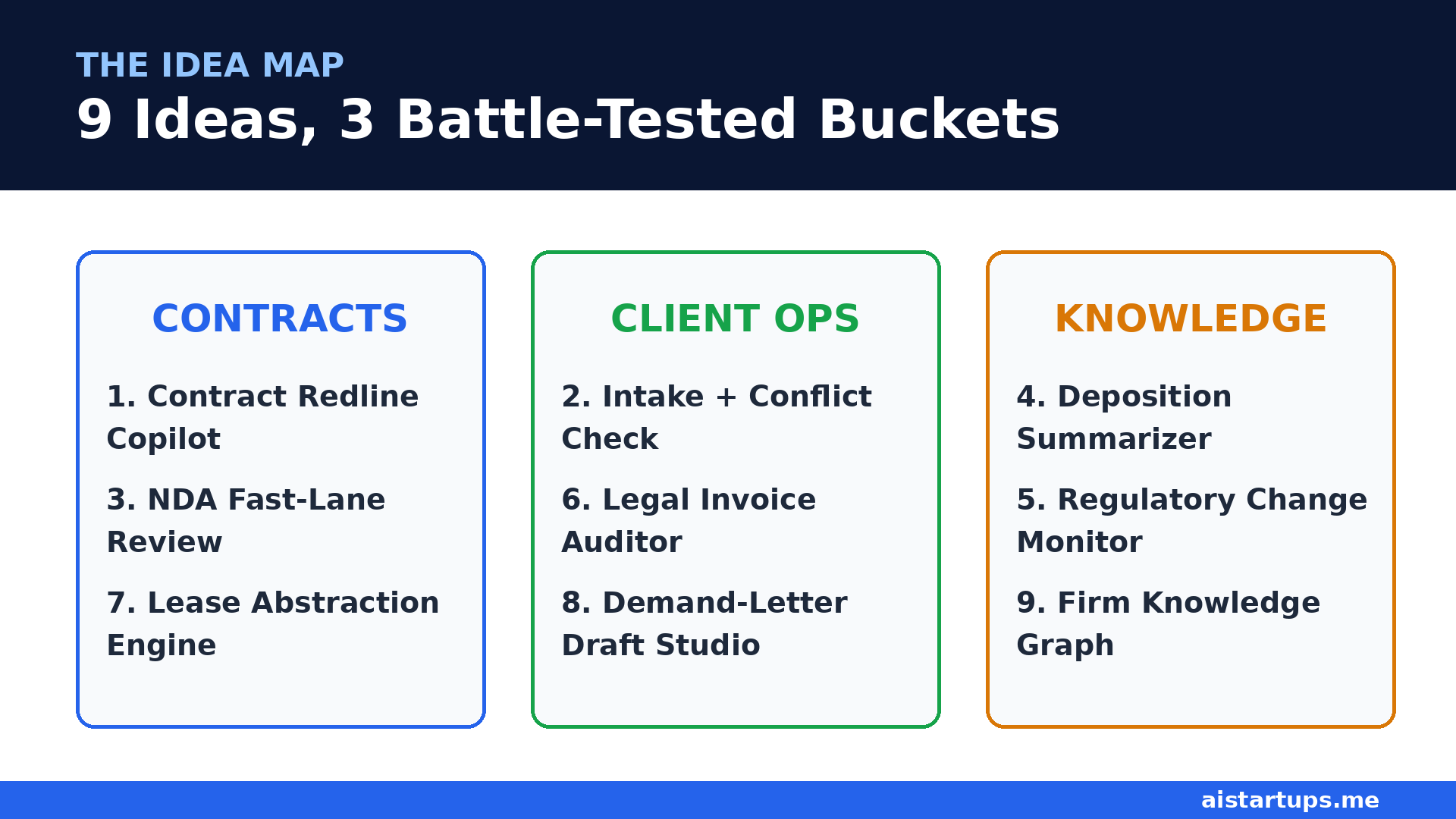
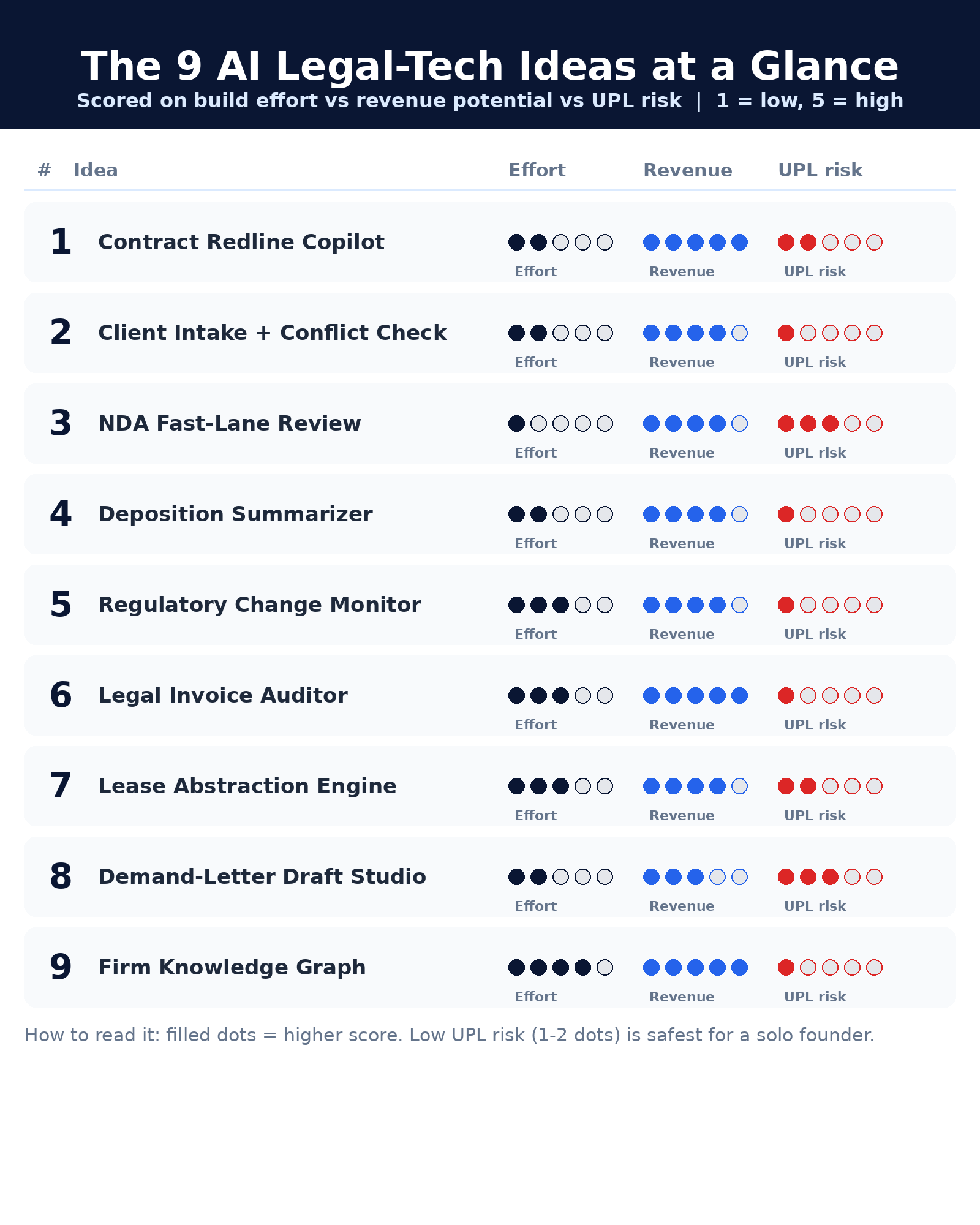
With that framing, here are the nine ideas, each scored on effort, revenue potential, and UPL risk in the infographic below.
Idea 1: Contract Redline Copilot
What it does
A Microsoft Word add-in that sits beside an associate while they review a vendor contract, MSA, or services agreement. It flags risky clauses, suggests fallback language drawn from the firm’s own precedents, and explains each suggestion in plain English. The lawyer accepts or rejects every change — your product never sends anything to anyone.
Why a solo founder can build this
This is the most proven shape in legal AI — Harvey built a $15.5 billion company on the broader version — but the narrow version (one contract type, one niche of firms) is absolutely buildable by one person. Office.js gives you the Word integration, a vector store holds the firm’s clause library, and the model does the analysis. Spellbook, which raised a $50 million Series B at a $350 million valuation and serves nearly 4,000 firms, proved that living inside Word is the winning distribution strategy. If building a Word add-in sounds intimidating, this is exactly the kind of product work an AI integration studio like AISquadX ships regularly.
Pricing angle
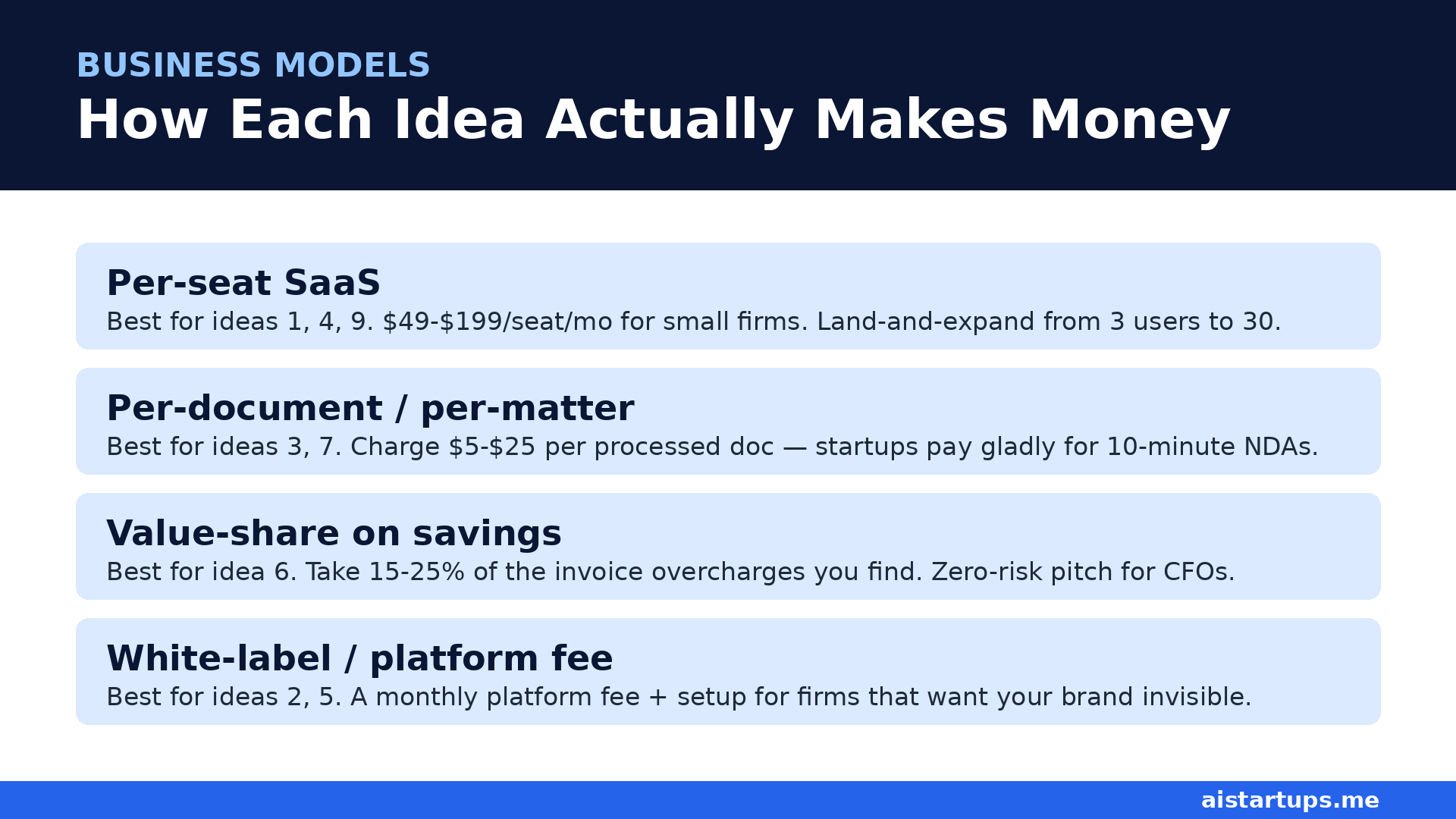
Per-seat SaaS: $99–$199 per lawyer per month. Five users in a firm = ~$750 MRR. Close ten firms and you’re at $90K ARR with a support load one person can handle.
Idea 2: Client Intake + Conflict-Check Automation
What it does
Small firms still do intake on paper forms, email threads, and gut feel. Your tool gives prospects a smart intake questionnaire, automatically runs a conflict check against the firm’s client and matter database, and routes clean prospects to a booking calendar. Flagged conflicts get queued for a partner’s review instead of slipping through.
Why a solo founder can build this
Near-zero UPL risk — you’re automating admin, not legal judgment. The technical core is a fuzzy-matching engine over the firm’s existing client list plus a workflow builder. It sells itself: firms are terrified of conflict-check malpractice exposure, so this is a compliance story as much as a convenience story. Integrations with practice-management tools (Clio, MyCase) make it sticky.
Pricing angle
Platform fee: $249–$499/month per firm. Every firm needs it, it renews forever, and churn is near zero because the workflow becomes load-bearing within weeks.
Idea 3: NDA Fast-Lane Review
What it does
Startups get buried in NDAs. Your product takes a counterparty’s NDA, compares it against the startup’s playbook in minutes, and returns a marked-up version with plain-English explanations. It’s positioned for the startup’s counsel (in-house or fractional) to approve with one click — or the tool exports a clean summary so the founder knows what to push back on before the lawyer even looks.
Why a solo founder can build this
NDAs are the perfect narrow scope: limited clause universe, high volume, and every founder has felt the pain. Build effort is genuinely low — it’s document comparison plus a rules engine, and you can launch with a solid template library. Spellbook’s CEO has said publicly that consolidation is coming to legal AI because “it’s become increasingly difficult for new entrants to gain a foothold” — but narrow, founder-loved tools are exactly how entrants still slip in.
Pricing angle
Per-document pricing: $9–$25 per NDA reviewed, or unlimited monthly tiers for accelerators and startup legal clinics. Bundle it into a “startup legal stack” alongside incorporation tools.
Idea 4: Deposition Summarizer
What it does
Litigators spend hours — sometimes days — reading deposition transcripts. Your tool ingests the transcript (or the video), produces a page-line-cited summary, extracts every admission and inconsistency, and generates a witness-prep brief. Everything links back to the source text, because litigators trust nothing they can’t verify in two clicks.
Why a solo founder can build this
Transcription is a solved problem (Whisper-class APIs), long-context models handle 300-page transcripts natively now, and the “page:line citation” feature is the killer trust-builder that a solo founder can implement well. Litigation boutiques bill thousands of hours on this work — a tool that turns a day of reading into an hour of review is an easy sell.
Pricing angle
Per-matter or per-deposition: $150–$400 per transcript, or $399/seat/month for litigation-heavy firms. One PI firm running ten depositions a month is $3,000+ in revenue from a single account.
Idea 5: Regulatory Change Monitor
What it does
Compliance teams drown in regulatory updates — new rules, amended guidance, enforcement actions. Your product watches the sources that matter for a specific niche (say, state privacy laws or fintech licensing), summarizes what changed and why it matters, and maps each change to the client’s existing policies. The output is a briefing memo a compliance officer can actually act on, not a 200-page PDF.
Why a solo founder can build this
The magic is in the curation, not the model. RSS and government APIs give you the raw feed; your value is the niche-specific filtering, the summarization, and the policy-mapping. Pick one jurisdiction and one regulation family — the narrower the better — and become the indispensable daily read for that corner of the market. Compliance officers have budgets and anxiety in equal measure, which is a lovely combination for a vendor.
Pricing angle
Subscription per company: $499–$1,500/month depending on jurisdiction coverage. Compliance is a cost center that desperately wants to look proactive — price like insurance, not software.
Idea 6: Legal Invoice Auditor
What it does
In-house legal teams get invoices from outside counsel that nobody fully checks. Block billing, vague time entries, rate creep, duplicate charges — it all slides through. Your tool ingests every invoice, checks it against the firm’s billing guidelines and historical rates, and flags violations with suggested adjustments. The GC’s office reviews and approves; the tool never pays or withholds anything on its own.
Why a solo founder can build this
This is a math problem wrapped in document parsing — arguably the lowest AI-risk build on this list. There’s no legal judgment involved, so UPL concerns basically evaporate. And the ROI story is brutally simple: if you find 8% in overcharges on a $2 million legal spend, the tool paid for itself a hundred times over. CFOs and GCs both love you.
Pricing angle
Value-share: take 15–25% of the overcharges you identify. The pitch is literally “we cost you nothing unless we save you money.” Once the fee stream proves out, convert your best accounts to flat annual contracts.
Idea 7: Lease Abstraction Engine
What it does
Real estate teams — law firms serving landlords, property managers, corporate tenants — need lease abstracts: key dates, rent escalations, renewal options, termination clauses, pulled into a clean table. Your tool processes a lease PDF and returns a structured abstract with every field linked to its source page. Bulk-upload a whole portfolio and get a spreadsheet.
Why a solo founder can build this
Leases are gloriously repetitive documents, which makes extraction accuracy high and the build tractable. The niche is big enough to be lucrative but boring enough that the giants mostly ignore it. Real estate is also a relationship business — one happy brokerage or REIT can refer you into an entire market.
Pricing angle
Per-document: $15–$40 per lease, with portfolio plans ($999/month for up to 200 leases) for the heavy users. Annual “portfolio refresh” contracts create beautiful recurring revenue.
Idea 8: Demand-Letter Draft Studio
What it does
Consumer and small-business attorneys write demand letters constantly — unpaid invoices, warranty disputes, landlord issues. Your tool takes the facts from a short interview, pulls in the relevant demand-letter templates and jurisdictional requirements, and produces a polished first draft with a demand summary, deadline, and consequence language. The attorney reviews, edits, and sends under their own letterhead.
Why a solo founder can build this
Higher UPL risk than the others — which is exactly why you sell only to licensed attorneys and hard-require their review before anything goes out. The product itself is a guided interview plus templated drafting, well within a solo build. Small-firm lawyers doing volume consumer work are price-sensitive but drowning in exactly this kind of repetitive drafting.
Pricing angle
Per-seat at the low end: $49–$99/month. These firms won’t pay Harvey prices, but there are thousands of them, and the product practically demos itself.
Idea 9: Firm Knowledge Graph
What it does
Every firm has a goldmine it can’t search: years of memos, briefs, deal docs, and research buried in a document management system. Your product indexes all of it, then answers questions like “how did we handle change-of-control clauses in last year’s SaaS deals?” with answers grounded in the firm’s own work product — every claim cited to the source document. It’s institutional memory, searchable.
Why a solo founder can build this
Highest effort on this list (RAG over messy legacy documents is genuinely hard), but also the deepest moat: once a firm’s knowledge is indexed in your system, they aren’t leaving. The ABA’s Formal Opinion 512 puts real weight on confidentiality duties when lawyers use AI — so your pitch leads with tenant isolation, no-training-on-client-data guarantees, and audit logs. Firms will pay a premium for a vendor that takes their ethics obligations seriously. Start with one document type (say, research memos) before you try to index everything.
Pricing angle
Per-seat plus platform fee: $199/seat/month plus a $500/month platform fee. This is the enterprise-adjacent play on the list — fewer customers, bigger checks, and land-and-expand that actually works.
The UPL Line: Don’t Get Cute Here
Let me be direct, because this is the part most “AI startup ideas” articles skip. Unauthorized practice of law is not a theoretical risk — it’s the fastest way to kill your company and get a regulator’s attention. The rules vary by state, but the principle is consistent: only licensed attorneys can give legal advice, represent clients, or exercise legal judgment on someone’s behalf.
Here’s the practical framework I use for every idea above:
- Sell to lawyers, not around them. If your customer is a licensed attorney who reviews and signs off on everything, you’re building a tool. If your customer is the public and there’s no lawyer in the loop, you’re building a liability.
- Automate preparation, not judgment. Drafting, summarizing, organizing, flagging — all fine. Deciding what a client should do — not fine, and not yours to automate.
- Label everything. “Draft for attorney review” should be stamped all over your UI, your outputs, and your marketing. It’s a legal position and a trust signal.
- Get the boring stuff right early. Terms of service, privacy policy, data processing agreements, and a real understanding of where client data flows. Run through a legal checklist for AI founders before you launch — it’s cheaper than fixing it after a customer asks.
Your competitive advantage in legal tech isn’t a better model — it’s being the vendor lawyers trust with their most sensitive data. Trust is the product; the AI is just the delivery mechanism.
How to Pick Your Idea (and Not the Other Eight)
Real talk: the wrong choice here isn’t picking a “bad” idea — it’s picking three ideas at once. Every one of these can work, but none of them works if you’re spread thin. Use the infographic’s scoring and ask yourself three questions:
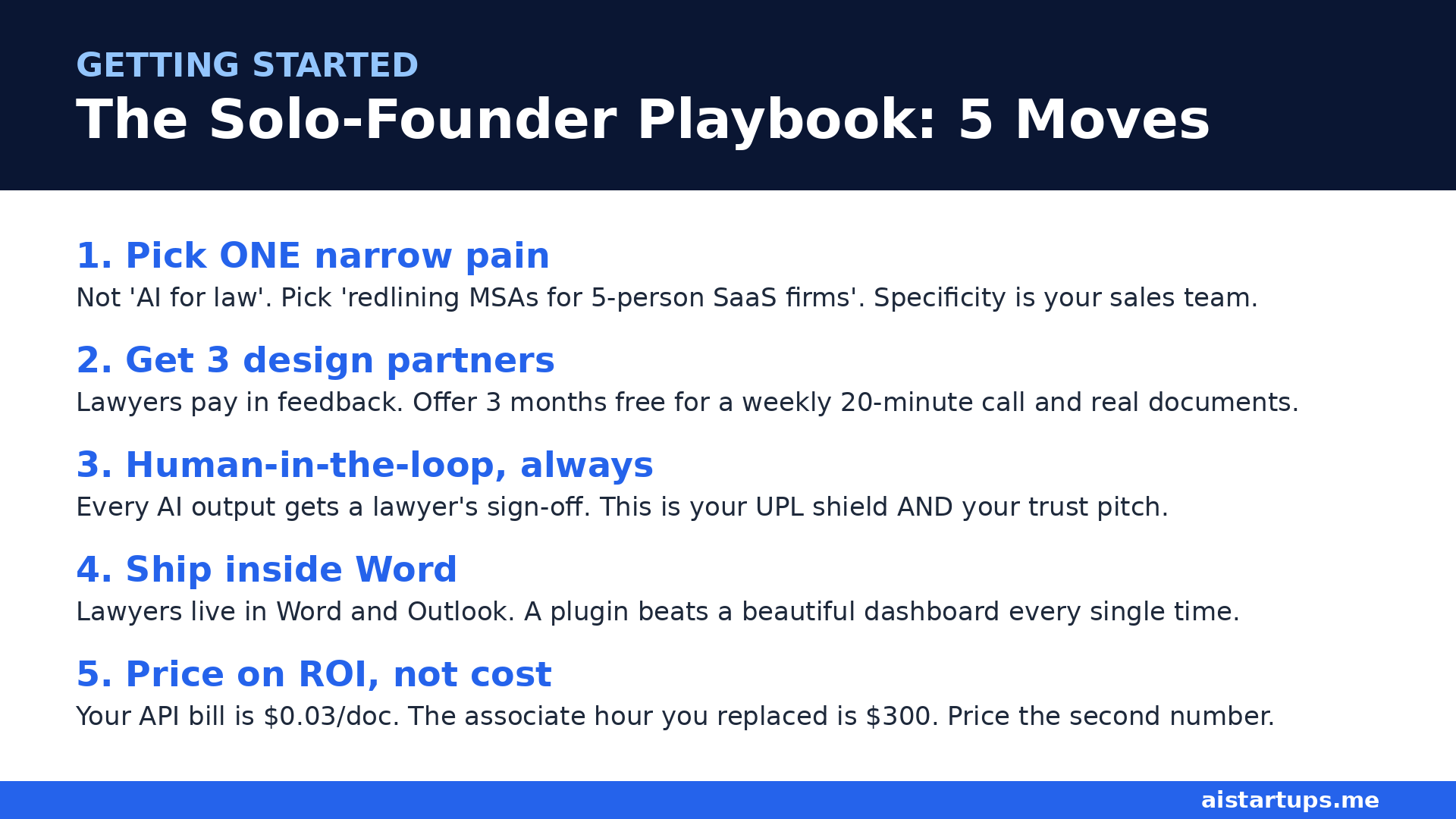
- Can I get three design partners in 30 days? If you don’t know a single lawyer in the niche, that’s your first problem, not your product. Warm intros beat cold outreach every time.
- Can I demo value in one 20-minute call? The ideas with the fastest “wow” (intake automation, NDA review, invoice auditing) close faster. Favor the demo that sells itself.
- Can I build the MVP in 6 weeks? Ideas 2, 3, and 8 are the fastest builds. Idea 9 is the slowest but the stickiest. Match the build to your runway — and validate the idea before you build a single screen.
Then price on the value you create, not the cost you incur. Your API bill might be three cents per document; the associate hour you just replaced bills at $300. That gap is your business. If pricing feels like guesswork, work through a pricing guide for AI SaaS before you set your first number — most solo founders underprice by 3x.
The Bottom Line
Legal tech had its biggest year ever in 2026, and the adoption data says the market is still early — most firms haven’t deployed generative AI in any serious way yet. The giants are fighting over the Am Law 100. Everyone else — the solo practitioners, the 5-person firms, the boutique practices doing real work on thin margins — is still waiting for tools built for them.
You don’t need a $550 million raise to serve them. You need one narrow pain, three design partners, a Word plugin that actually works, and the discipline to keep a lawyer in the loop. Pick your idea, ship the ugly MVP, and let the invoices do the talking.
Frequently Asked Questions
Is legal tech too crowded for a solo founder in 2026?
No — it’s crowded at the top, not the bottom. Harvey ($15.5B) and Legora ($5.6B) chase enterprise firms. Tens of thousands of small firms and solo practitioners remain underserved, and they buy focused tools that live inside Word. A narrow product with 30 paying firms is a great solo business.
How do I avoid unauthorized practice of law (UPL) with an AI legal product?
Sell to licensed attorneys, require their review of every output, automate preparation (drafting, summarizing, flagging) rather than legal judgment, and label everything “for attorney review.” The ABA’s Formal Opinion 512 confirms lawyers may use generative AI as long as they meet duties of competence, confidentiality, verification, and supervision — build your product to make that compliance easy.
What’s the cheapest legal-tech idea to build as a solo founder?
The NDA fast-lane review (idea 3) and client intake automation (idea 2). Both have a limited scope, use document comparison and workflow logic rather than deep AI research, and can reach a working MVP in weeks. The invoice auditor (idea 6) is also cheap technically — it’s mostly parsing and math.
How much can a solo-founder legal-tech product charge?
Small-firm tools typically run $49–$199 per seat per month; platform fees run $249–$1,500 per firm per month depending on the niche. Per-document pricing ($5–$40) works for high-volume workflows like NDAs and lease abstracts. Price on the ROI — the billable hour you replace — not on your API costs.
Do lawyers actually buy AI tools from solo founders?
Yes, when the tool solves one painful problem and lives where they work. Spellbook grew to nearly 4,000 firms largely by meeting lawyers inside Word instead of asking them to learn a new platform. Three design partners giving you real documents and weekly feedback matter more than any credential — trust and specificity close deals in this market.