


A friend of mine shipped a genuinely good AI product last spring. Smart founder, real users, solid retention on the free plan. Then the first full month of scale hit his OpenAI bill, and he called me at midnight sounding like someone reading a ransom note.
His costs had arrived before his revenue did. Not metaphorically — literally. Every user query burned tokens on his credit card weeks before any of those users converted to paid plans. He was growing, and growing was bankrupting him.
Here’s the thing: this isn’t a bug in his business. It’s the defining economic fact of building AI products in 2026. You pay for intelligence in tokens — raw, metered, unavoidable — and your customers pay you in subscriptions, seats, and vibes. The gap between those two things is where AI startups live or die, and the founders who survive it aren’t the ones with the best models. They’re the ones who understand the psychology of how AI products get priced.
This is a guide to that psychology. The token problem, the way tiers shape decisions, how trials actually convert, and the three answers to the only question that matters: who owns the token bill?

The Token Problem: Your Costs Arrive Before Your Customers Pay
Traditional SaaS pricing is simple. You build software once, sell it a thousand times, and the marginal cost of one more user is basically zero. Pricing is pure psychology — pick a number that feels fair and watch the margin.
AI products don’t work that way. Every generation, every classification, every chat turn costs you real money in tokens, charged by the million, before you’ve seen a cent of revenue. You’re not selling software anymore; you’re reselling intelligence at a markup. That’s a commodities business wearing a SaaS costume, and it changes every pricing decision you’ll make.
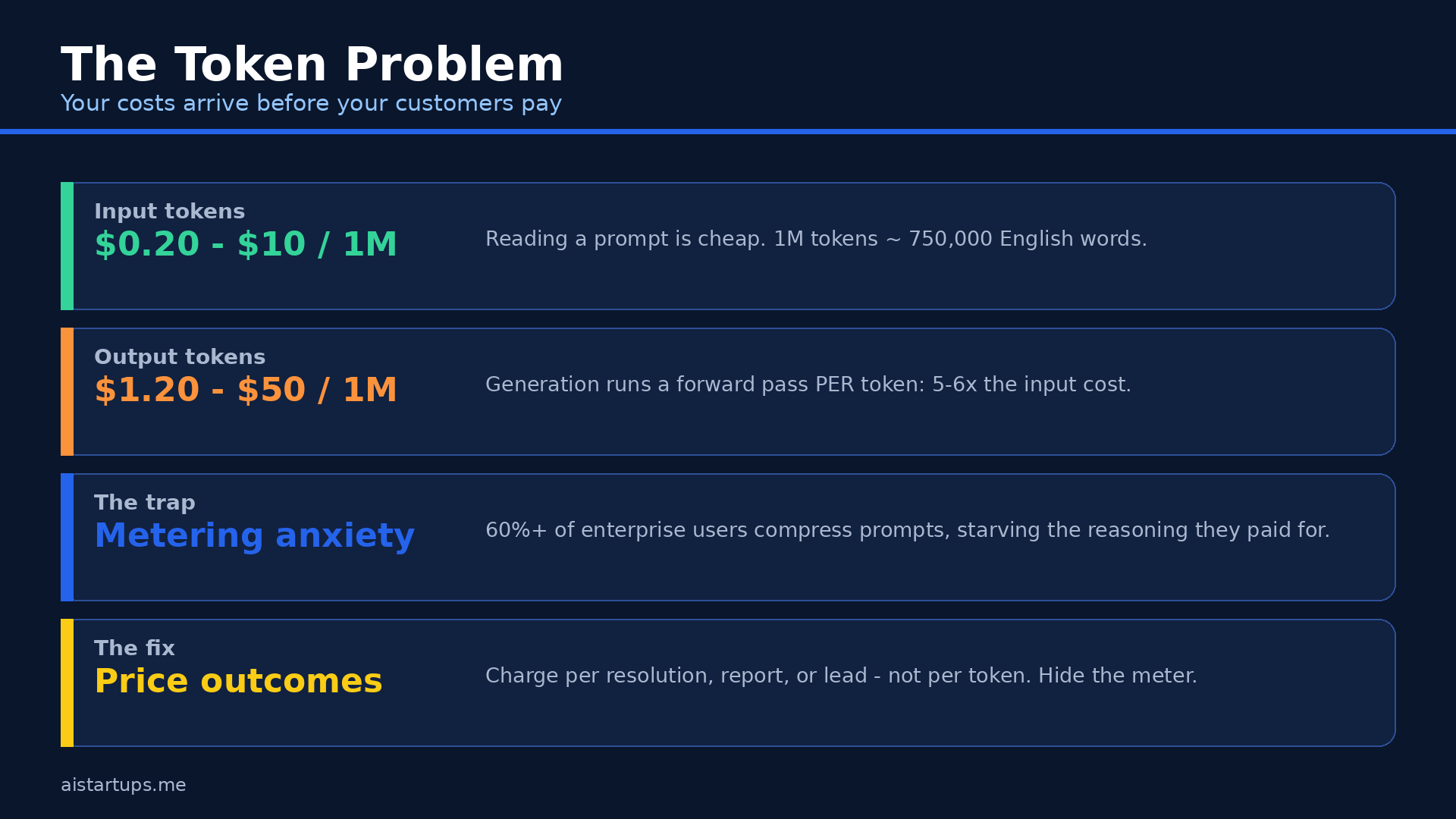
Real talk: the numbers are wider than most founders expect. As of late 2026, input tokens run anywhere from $0.20 to $10 per million, and output tokens run $1.20 to $50 per million, according to CloudZero’s breakdown of token-based pricing. One million tokens is roughly 750,000 English words — so a single power user can burn through thousands of tokens a day without breaking a sweat.
And here’s the asymmetry that quietly kills margins: output tokens cost 5 to 6 times what input tokens cost. Why? Because generation runs a forward pass of the model for every single token it produces. Reading your prompt is cheap. Writing the answer is expensive. If your product is generative — long reports, drafted emails, written content — you’re selling the expensive side of the equation.
This is exactly why model choice is a pricing decision, not just an engineering one. Take Claude Haiku 5.5, which landed in early October 2026 at $0.10 per million input tokens and $0.50 per million output tokens under 100K context. SaasCity’s analysis showed that routing classification and extraction work to cheap small models like that can move an AI SaaS product’s margins from around 20% to over 70%. That’s not an optimization, that’s a different business. (We dug deeper into cheap small models like Claude Haiku 5.5 and what they mean for founders — worth a read before you lock in your stack.)
But there’s a second, sneakier cost problem, and it’s psychological. Researchers have started documenting “metering anxiety”: when users can see the meter running, more than 60% of enterprise users deliberately compress their prompts and shorten their sessions — sacrificing the long-range reasoning the tool is actually best at, per recent reporting on AI billing behavior. Think about that. Your pricing display is actively making your product worse, because customers use a worse version of it to save money. You’re paying for the good model and they’re only letting themselves use the cheap one.
So the token problem is really two problems. One, the economics: you pay before you earn, and the spread between your cost and your price is your entire company. Two, the psychology: however you surface that cost changes how people use the product. Get either one wrong and the other doesn’t matter.
Tier Psychology: Three Choices Beat Ten
Okay, so you’ve accepted the token reality. Now you need a pricing page. And the first rule of pricing pages hasn’t changed in a century of selling things: don’t make people think too hard.
The research is blunt on this. Most startups should offer 2-3 tiers; more options create decision paralysis and lower conversion. Shopify runs five tiers from $5 to $2,300 a month, but Shopify has the product breadth to justify it — you probably don’t. Three tiers is the classic good-better-best layout for a reason: the top tier sets the anchor, the bottom tier catches the cautious, and the middle tier — which you design to be the obvious pick — is where most of your revenue lands. If you’re still sketching your tiers, our founder’s guide to AI SaaS pricing walks through the full math.
Now here’s where it gets AI-specific. The $20-a-month consumer tier isn’t a number anyone derived from costs — OpenAI set it, competitors followed, and it calcified into the anchor that every consumer now measures AI value against. Startup pricing data notes this $20 anchor as the gravitational center of consumer AI pricing. That means your $29/mo plan doesn’t get compared to your costs. It gets compared to twenty bucks. You didn’t choose that comparison; the market chose it for you. Price with that awareness or get surprised by it.
The seat model, meanwhile, is quietly eroding underneath all of this. Per-seat pricing dropped from 64% to 57% of SaaS companies in just twelve months, while 65% of vendors now layer AI metrics like tokens or credits alongside seats. Makes sense when you think about it: AI agents multiply “seats” in weird ways. Is the agent a seat? Are the ten drafts it generated seats? The unit stopped making sense, so companies are bolting usage metrics onto it. And the companies going further — 61% of SaaS companies now use hybrid pricing, which shows the highest median growth rate at 21% — are basically admitting the answer is “both.” The mid-2026 SaaS pricing data paints the same picture: AI is being monetized three ways — bundled into higher tiers, metered through credits or usage units, or some hybrid of the two.
One more number that should focus the mind: a 1% improvement in pricing delivers an 11.1% lift in operating profit, per McKinsey’s classic analysis. Pricing isn’t a page you design once. It’s the highest-leverage experiment in your company. Which, awkwardly, almost nobody runs — fewer than 30% of SaaS companies do regular pricing experiments. Being in the experimenting minority is free money on the table.
Trial Psychology: How You Ask for the Card Decides the Outcome
Trials are where pricing psychology gets personal, because you’re not selling a plan — you’re asking a stranger to hand you their credit card for something they haven’t decided they want yet. And the data says the single biggest lever is exactly how you ask.
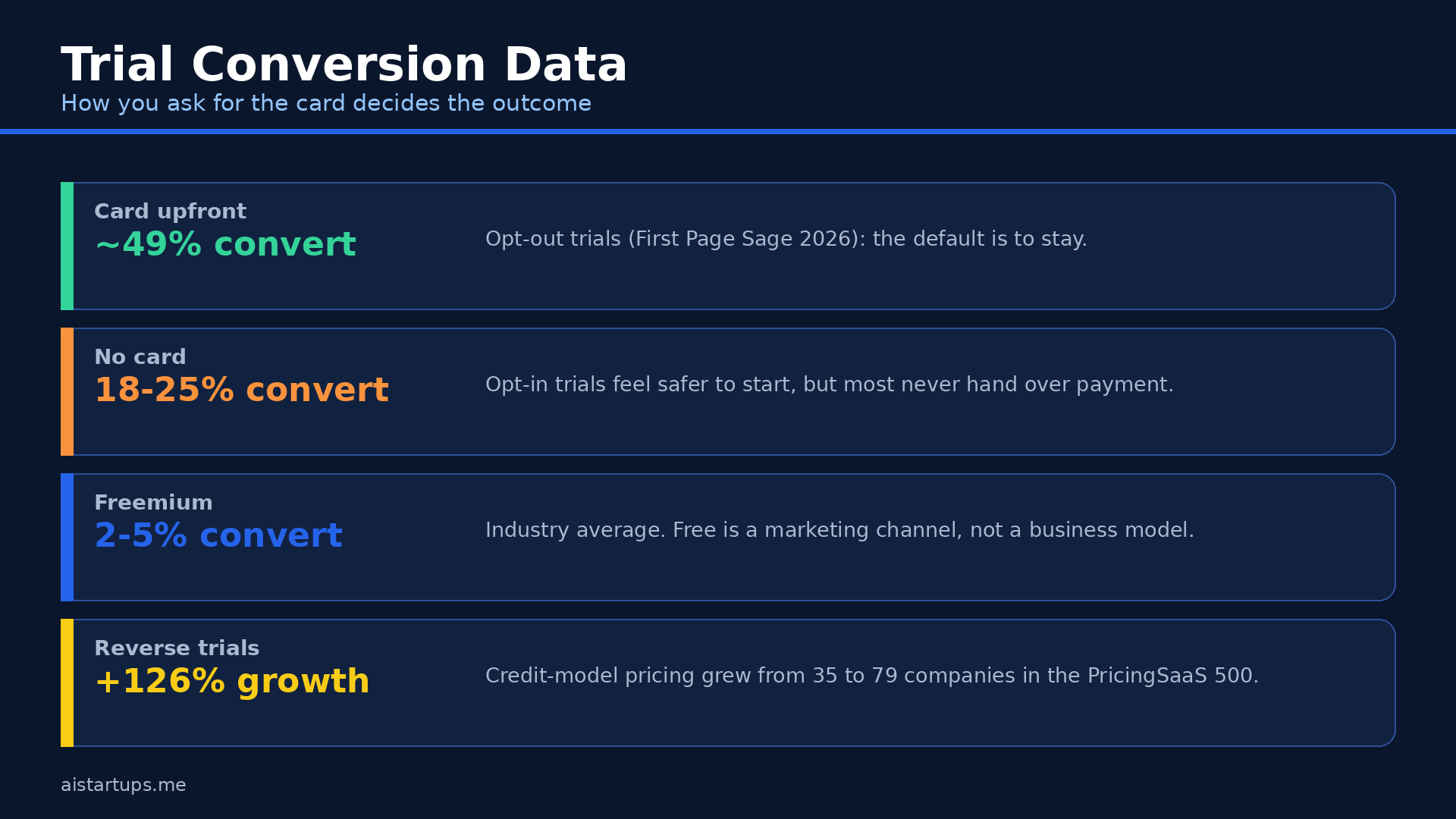
Opt-out trials — card required upfront, charged automatically unless they cancel — convert at roughly 49%. Opt-in trials — no card, sign up free, add payment later — convert at 18-25%. That’s not a small gap. That’s more than double. And freemium, the model everyone loves to default to, converts 2-5% on average. Free is a marketing channel, not a business model. (All of these benchmarks come from the 2026 pricing data compiled at startupa.ge — bookmark that page.)
Why does the card question matter so much? Two forces. First, friction: asking for the card later means asking a second time, and every ask loses people. Second, the endowment effect — once someone is inside the product with their card on file, the default is staying, and humans are deeply, reliably lazy about changing defaults. Opt-out wins because inertia is the strongest sales rep you’ll ever hire.
Honestly? The founders I see struggling with trials are usually struggling with the trial itself, not the card policy. A 14-day trial of a product that takes 10 days to set up converts nobody. The trial has to deliver a genuine win inside the trial window — one real outcome, one “oh, this actually works” moment. The card policy multiplies whatever the trial experience produces. Zero times two is still zero.
There’s also a newer pattern worth watching: the reverse trial. Start everyone on the paid plan’s features for a limited window, then drop them to free when the trial ends. Credit-model pricing — the mechanism behind reverse trials — grew 126% year-over-year, from 35 to 79 companies in the PricingSaaS 500. It’s the best of both worlds psychologically: the user experiences the full product (endowment effect, again), and the downgrade feels like losing something rather than the upgrade feeling like spending something. Loss aversion does your selling for you.
Pass-Through vs Bundled vs Hybrid: Who Owns the Token Bill?
Alright. This is the strategic core of the whole article. There are exactly three answers to “who pays for the tokens,” and each one is a different company.
1. Bundled: you own the risk
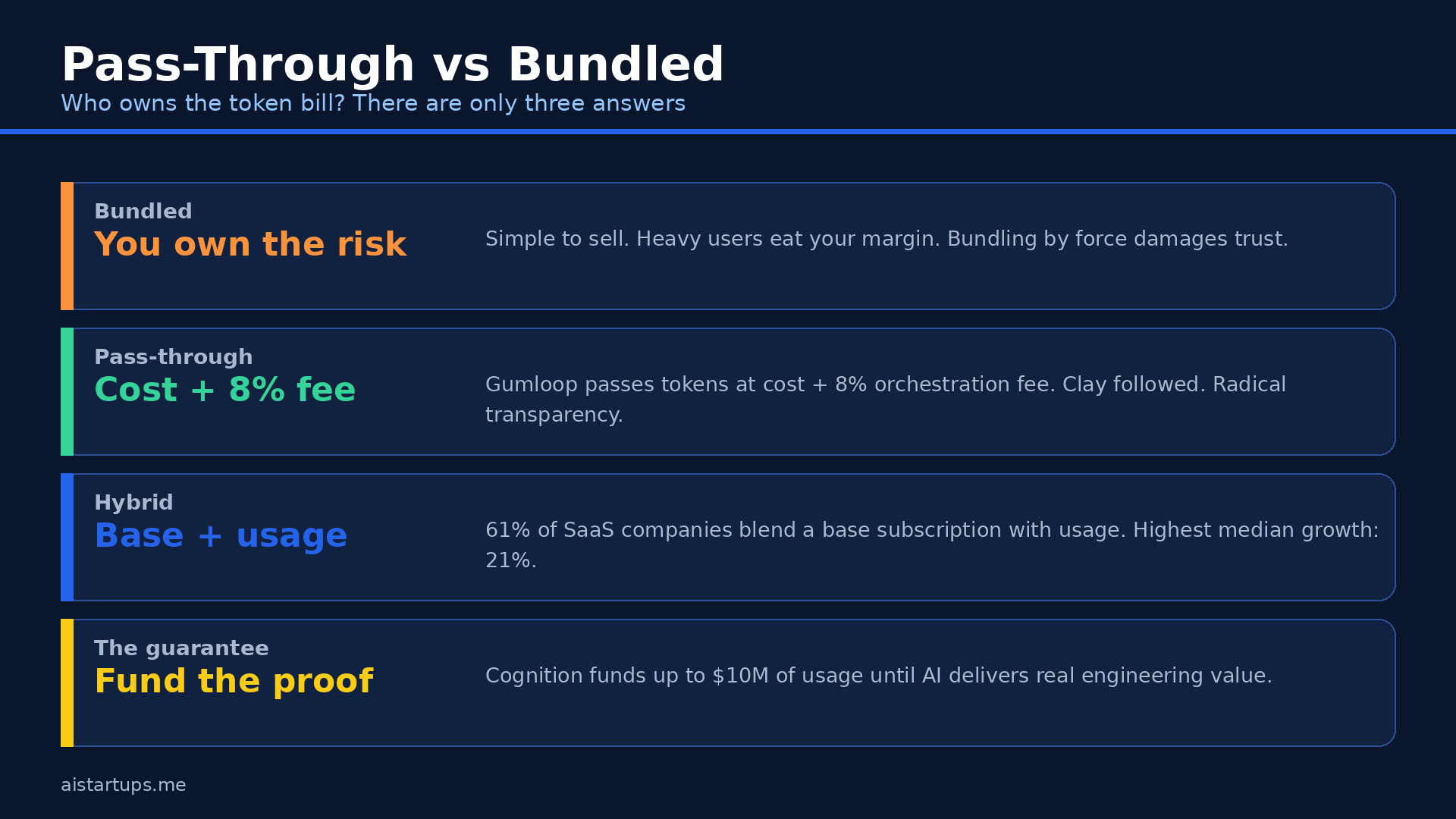
Fold the AI into your tiers at a fixed price. The customer gets predictability; you absorb the variance. This is the simplest thing to sell and the most dangerous thing to run, because your heaviest users — the ones who love you most — are the ones who sink your margin. Bundling works when your usage distribution is tight and predictable. It fails spectacularly when one enterprise customer discovers they can run their entire workflow through your “unlimited” plan.
And one warning: mandatory bundling — folding AI into the plan by default while the old cheaper option quietly disappears — damages trust. Buyers don’t object to paying for AI. They object to feeling trapped. The 2026 pricing data is clear that forced bundling reads as a price hike wearing a costume, and customers punish it.
2. Metered and pass-through: the customer owns the risk (and sees the meter)
Pass the tokens through at cost plus your fee. Gumloop made this move explicit in 2026: tokens and compute passed through at cost, plus an 8% orchestration fee. Clay followed in a similar direction that March. The pitch is radical transparency — you’re not marking up the intelligence, you’re charging for the orchestration around it.
It’s honest, and customers respect it. But remember metering anxiety from earlier: when the meter runs in the customer’s face, usage drops, and usage is where your retention lives. Pass-through pricing protects your margin and can quietly strangle your engagement. HubSpot’s answer to this tension is interesting — a universal credit mechanism across its AI capabilities, abstracting the raw tokens into HubSpot’s own unit. Credits are tokens with better PR.
The extreme version of owning the value story: outcome-based pricing. Intercom’s Fin AI agent charges $0.99 per resolved conversation. Not per token, not per seat — per resolution. The customer buys outcomes, and Intercom eats the token variance because it knows its cost per resolution better than anyone. That’s the dream, if your unit economics are tight enough to survive it.
3. Hybrid: the three-part tariff
A base subscription plus a usage layer on top. This is where the market is actually going: 76% of AI-native companies already run variable or hybrid pricing, versus 49% of SaaS companies overall, per Kyle Poyar’s 2026 State of Monetization research. Investors have noticed — only 15% prefer flat-fee or seat-based pricing now, against 24% for usage-based, 26% for outcome-based, and 35% for hybrid.
Usage-based companies grow 29.9% faster with 120% net revenue retention versus 110% for traditional models, and 64% of Forbes’ Next Billion-Dollar Startups combine usage with base subscriptions. The hybrid model wins because it splits the psychology cleanly: the base fee buys commitment and predictability (for both sides), and the usage layer keeps heavy users profitable instead of dangerous. For the full financial picture behind this, our breakdown of AI startup unit economics shows exactly how investors read these numbers — and what it actually costs to start an AI business in 2026 will sober up your spreadsheet before you commit.
“An anxiety-filled architecture right now of different pricing structures and contract frameworks.” — Salesforce’s deputy CFO, describing the state of AI pricing experimentation in 2026
That quote is worth sitting with. Even Salesforce — with all its pricing analysts and enterprise machinery — is openly anxious about this. And then there’s Cognition, the AI engineering startup valued at $48 billion, which introduced an AI productivity guarantee: funding customer usage up to $10 million until the AI delivers real engineering value. Read that again. They’re so confident in the value story that they’ll pay for the tokens themselves until the customer believes it. That’s outcome pricing taken to its logical extreme — and it’s a flex only a company with Cognition’s balance sheet can make. For the rest of us, the lesson is smaller: de-risk the value question however you can afford to, because HubSpot’s CEO Yamini Rangan nailed the buyer psychology on the Q2 2026 earnings call — customers adopting AI want proof of value before they commit, and predictability in what it costs.
The Practical Playbook
Enough theory. If you’re pricing an AI product this quarter, here’s what I’d actually do:
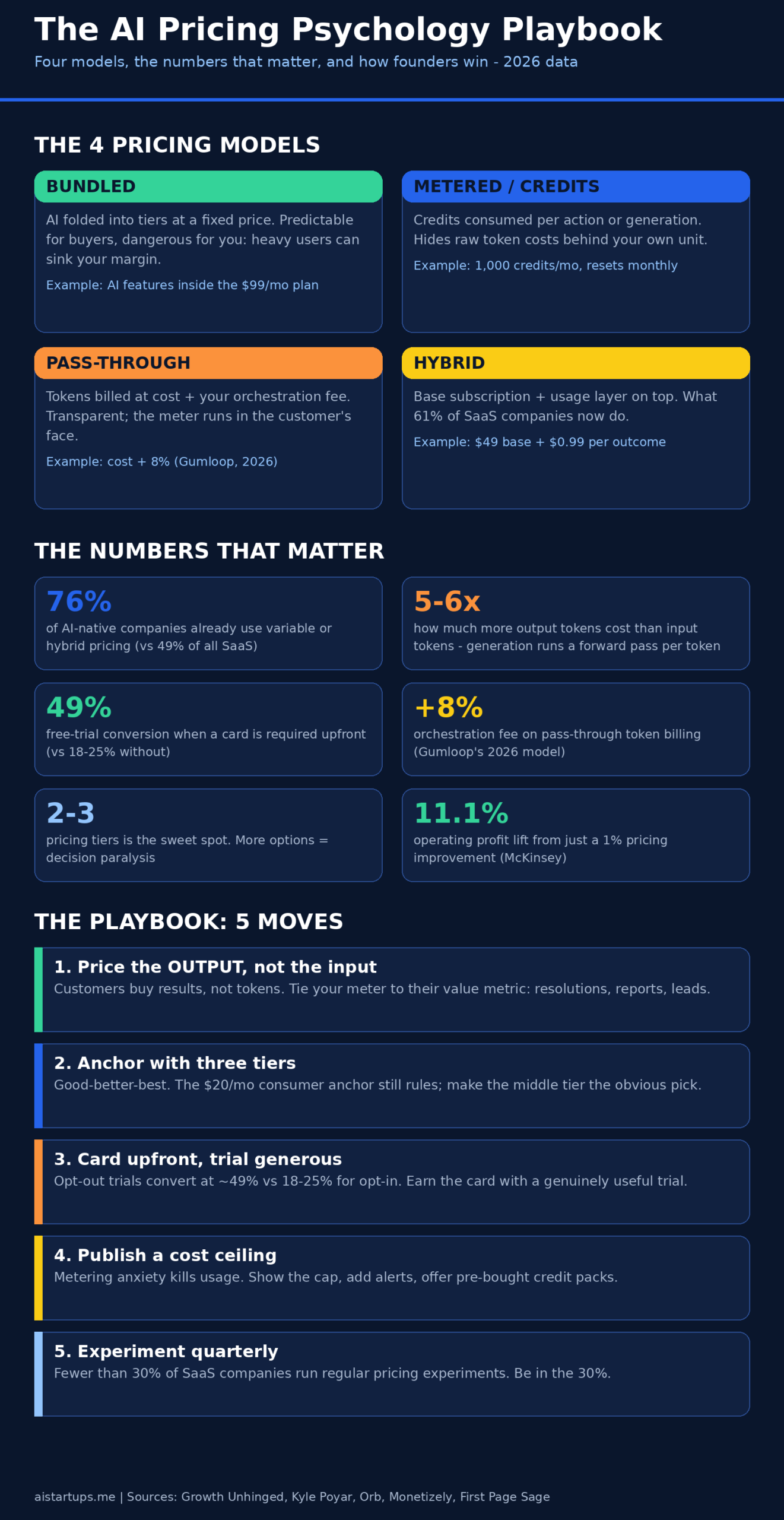
- Price the output, not the input. Customers buy results, not tokens. Tie your meter to their value metric — resolutions, reports, enriched leads, drafted documents. Intercom’s $0.99 per resolution is the template. Your token cost becomes an internal optimization problem instead of a customer-facing anxiety trigger.
- Run three tiers with a real anchor. Good-better-best. Put your aspirational tier at the top to make the middle look reasonable, keep the bottom tier genuinely useful, and design the middle tier as the default choice for your ideal customer. Respect the $20 consumer anchor — don’t pretend it doesn’t exist.
- Card upfront, trial generous. Opt-out trials convert near 49% versus 18-25% for opt-in. But earn the card: the trial must produce one real outcome inside the trial window, or you’re just collecting cancellations faster. Consider a reverse trial if your product has a strong “aha” moment.
- Publish a cost ceiling. Metering anxiety is real and measurable. Show the maximum, add usage alerts, offer pre-bought credit packs. A customer who knows their worst case spends more freely than one doing mental math on every prompt.
- Route work to the cheapest model that does the job. Your pricing assumes a cost structure — protect it. Classification and extraction don’t need your flagship model. The Haiku 5.5 margin story (20% to 70%+) is the difference between a pricing page that works and one that slowly bleeds you.
- Experiment quarterly, minimum. Fewer than 30% of SaaS companies run regular pricing experiments, which means the bar is embarrassingly low. Test one variable per quarter — the anchor price, the trial length, the middle tier’s limits. A 1% pricing improvement is worth 11.1% in operating profit. Act like it.
And one thing founders forget: your pricing page is a conversion asset, not a settings screen. The psychology above only works if the page communicates it — clear tiers, honest limits, no asterisks doing heavy lifting. If your pricing page needs a redesign to carry all of this properly, a solid web development studio like AISquadX can build one that actually converts instead of just informing.
Mistakes Founders Keep Making
Charging for tokens directly
The moment your customer is doing token arithmetic, you’ve lost. They’ll compress prompts, shorten sessions, and use a worse version of your product — the metering anxiety problem. Abstract the cost into credits, outcomes, or tiers. Let the tokens be your problem, solved with model routing and caching, not theirs.
One flat price for wildly different usage
Flat pricing with variable costs is a bet that your users are average. They’re not. The power-law user who costs you 40x the median will find your flat plan within a week of launch. If you must go flat, cap the expensive dimensions hard — generations per month, seats, projects — and make the caps visible.
Copying a competitor’s tiers without their cost structure
Their $49 plan works because their cost per customer is $8 and yours is $22. You don’t know their model routing, their caching, or their negotiated rates. Price from your own unit economics outward, not from their landing page inward.
Never raising prices
SaaS prices inflate around 11.4% a year. If you haven’t touched your pricing in two years, you’re giving yourself a pay cut in real terms while your token costs do whatever the model labs decide. Grandfather generously, raise confidently.
Frequently Asked Questions
Should I charge per token or per seat for my AI product?
Neither, if you can avoid it. Per-token pricing triggers metering anxiety — users compress prompts and get worse results. Per-seat pricing is fading (down from 64% to 57% of SaaS companies) because AI agents make “seats” ambiguous. The winning pattern is hybrid: a base subscription for predictability plus a usage layer tied to a value metric your customer understands, like resolutions, reports, or credits.
How many pricing tiers should an AI startup have?
Two to three. More options create decision paralysis and lower conversion. The classic good-better-best layout works because the top tier anchors value, the bottom tier catches cautious buyers, and the middle tier — designed as the obvious choice — captures most revenue. Only add more tiers when your product breadth genuinely demands it.
Do free trials or freemium work better for AI products?
Trials beat freemium on conversion by an order of magnitude. Card-upfront (opt-out) trials convert around 49%, no-card (opt-in) trials convert 18-25%, and freemium converts 2-5%. The catch: the trial must deliver a real outcome inside the trial window. A great card policy on a confusing trial just produces faster cancellations. Reverse trials — full features now, downgrade later — are the fastest-growing pattern.
What is pass-through pricing, and should I use it?
Pass-through means billing customers for tokens at your cost plus a fixed orchestration fee — Gumloop’s 2026 model is cost plus 8%. It’s radically transparent and protects your margin perfectly, but it puts the meter in the customer’s face, which can suppress usage through metering anxiety. It fits best for developer tools and technical buyers who already think in tokens. For everyone else, abstract into credits or outcomes.
How do I keep AI margins healthy as usage grows?
Three levers: route work to the cheapest model that handles each task (cheap small models can take margins from ~20% to 70%+), tie pricing to value metrics rather than raw costs so efficiency gains accrue to you, and use hybrid pricing so heavy users stay profitable instead of dangerous. Then re-verify quarterly — model prices move fast, and your pricing should move with them.
The Bottom Line
Pricing an AI product is really two jobs. The first is economic: know your cost per outcome, route work to cheap models where you can, and pick a structure — bundled, metered, or hybrid — where your heaviest user is still profitable. The second is psychological: anchors, three tiers, the card question, and keeping the meter from making your product worse.
Most founders only do the first job and wonder why the numbers don’t move. The data says the psychology is where the leverage is — a 1% pricing improvement worth 11.1% in operating profit, trial conversions that double on a single policy choice, buyers who’ll pay happily once they see proof of value and a predictable bill. Your tokens are a cost problem. Your pricing is a persuasion problem. Solve them in that order, and the midnight invoice calls stop.