


Here’s a stat that stopped me cold this week: in a 2025 survey of startup founders, 54% said they’d burned out in the past year. Not “felt tired.” Burned out. And 83% said they’d been under high stress, while two-thirds had seriously thought about walking away from their companies.
Real talk: if you’re building an AI startup right now, you’re probably not surprised. The pressure is different than it used to be. Teams are leaner, the pace is faster (thanks, AI hype cycle), and there’s always someone on Twitter announcing they shipped a feature in a weekend that took you three months. So you work longer. You skip the gym. You tell yourself you’ll rest after the launch — then the launch becomes the next launch.
I don’t think the answer is “try harder at self-care” while changing nothing about how you work. Bubble baths don’t fix a broken operating system. What works — honestly — is treating your energy the same way you treat your runway: as a finite resource you manage with systems, not vibes.
That’s what this guide is. A practical operating system for not burning out. Let’s get into it.

The numbers are brutal (and they’re not getting better)
Before the systems, let me show you the scoreboard — because most founders think they’re uniquely bad at handling pressure. You’re not. This is just what the job does to people right now.
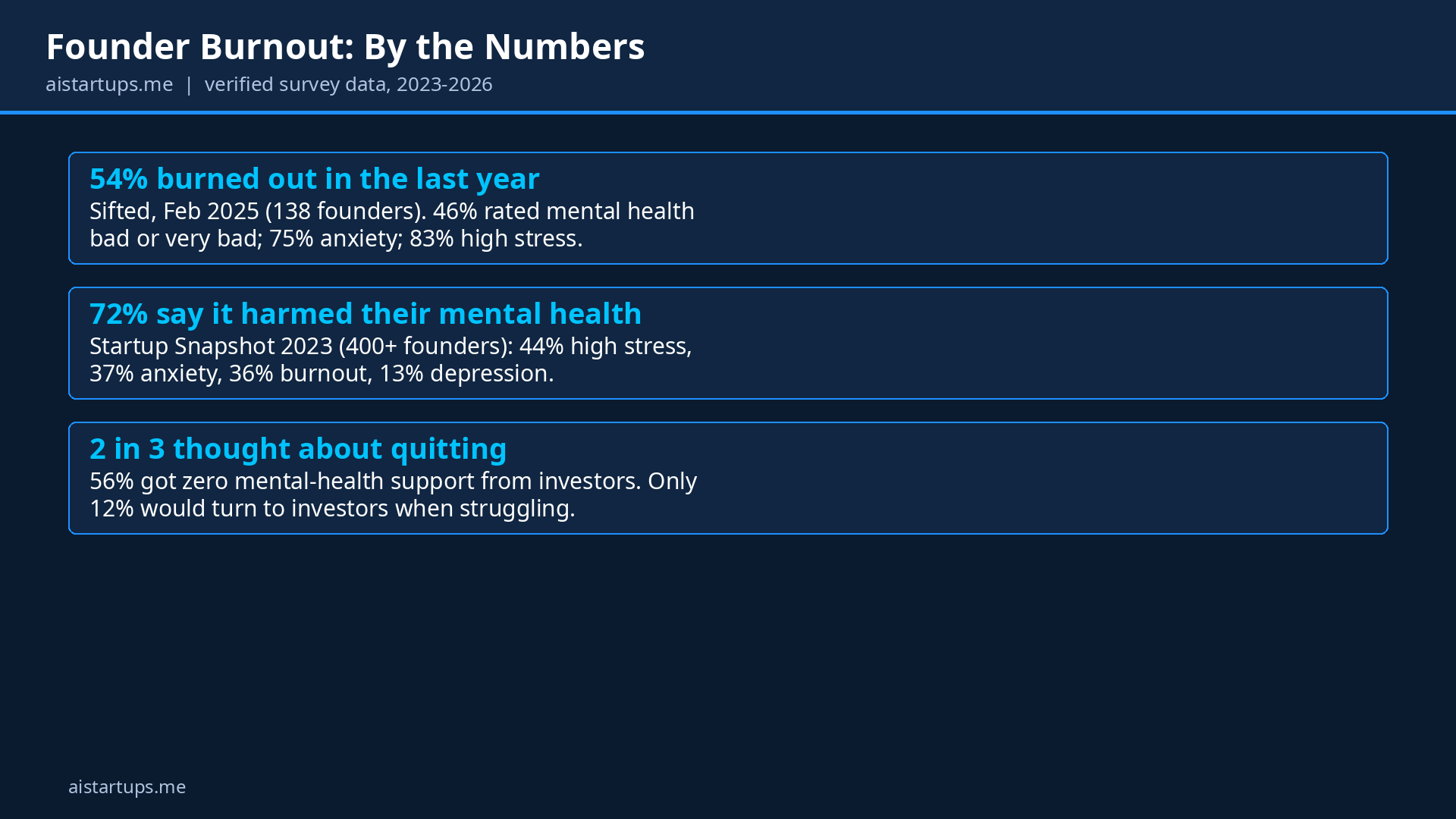
The Sifted founder mental health survey (February 2025, 138 founders, mostly early-stage) found: 54% had experienced burnout in the previous twelve months. 46% rated their mental health as “bad” or “very bad.” 75% had dealt with anxiety. Only 6% reported no mental health issues at all. Two-thirds had considered leaving their startup, and 39% said they’d think about it in the coming year. Oh, and 56% said they’d received zero mental health support from their investors.
Go back a couple of years and the picture was already grim. Startup Snapshot’s 2023 report “The Untold Toll” — the largest founder-specific dataset of its kind, 400+ founders surveyed with Intel Ignite — found 72% said entrepreneurship had impacted their mental health: 44% high stress, 37% anxiety, 36% burnout, 13% depression, 10% panic attacks. More than half said they were very stressed about the future of their startup.
And it’s not new. Way back in 2015, psychiatrist Michael Freeman’s UC Berkeley/UCSF research found 49% of surveyed entrepreneurs had experienced at least one mental health condition in their lifetime — roughly double the general population’s rate for depression.
A fresh October 2026 survey reported by TechFinancials puts the current figure at 87.7% of entrepreneurs experiencing at least one mental health challenge in daily life: anxiety 50.2%, high stress 45.8%, financial worries 39.2%, burnout 34.4%, impostor syndrome 31.7%. Only 12.3% reported none. And here’s the kicker — just 18.5% were even aware of mental health resources aimed specifically at business owners, while 56.4% said they weren’t.
So no, it’s not just you. It’s the job. Which means the fix isn’t “be tougher” — it’s redesigning how you do the job.
Why founders burn out differently
Employee burnout and founder burnout look similar on the surface (exhaustion, cynicism, can’t sleep) but the mechanics are different. Understanding the mechanics matters, because it tells you where the leverage is.
First, identity fusion. When you’re an employee, you can hate your job and still be a whole person outside it. When you’re the founder, the company IS you — your reputation, your savings, your idea. A bad quarter doesn’t feel like a bad quarter; it feels like a verdict on you. That fusion means you never really clock out, because there’s no “out” to clock.
Second, the decision burden has no floor. Gugu Mjadu of Business Partners Limited put it well in that October piece: founders lie awake over payroll and put personal savings on the line, and “a company that depends entirely on one exhausted person is fragile.” Every cash-flow call, every hire, every “do we pivot” lands on one desk. There’s no manager to escalate to. You are the escalation.
Third, rest feels like guilt. This is the sneaky one. Plenty of founders believe — quietly, without saying it — that stopping means the whole thing collapses. So they don’t stop. They “rest” by doomscrolling competitor launches at midnight, which is just working with worse lighting.
Fourth, the AI era raised the speed limit. Leaner teams, constant online availability, and the expectation that AI should make everything 10x faster have made founder pressure easier to hide and harder to escape. You’re expected to ship like a team of twenty while being a team of three. Nobody says this out loud, but the math doesn’t work — and the gap gets paid in sleep.
Here’s the thing, though. None of these are fixed by willpower. They’re fixed by structure. Which brings us to the system.
The Founder Energy System: 6 systems that prevent burnout
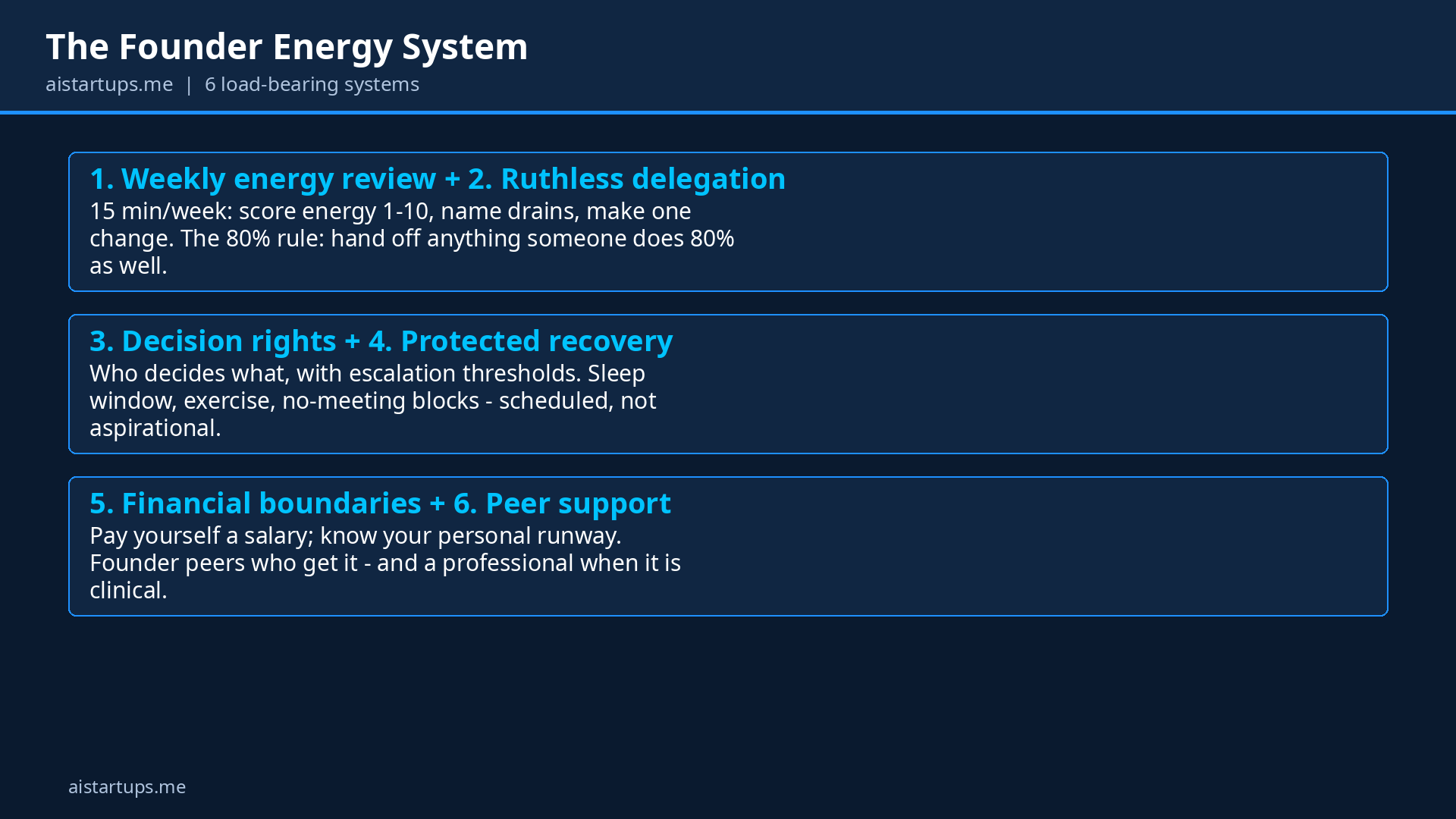
Look, there’s no shortage of burnout advice. Most of it is “take vacations” and “practice mindfulness,” which is fine if you have a chief of staff and a Series B. For the rest of us, the advice has to survive contact with a 4-month runway. So here’s a system built for actual founders — six pieces, each one load-bearing.

1. The weekly energy review (15 minutes, non-negotiable)
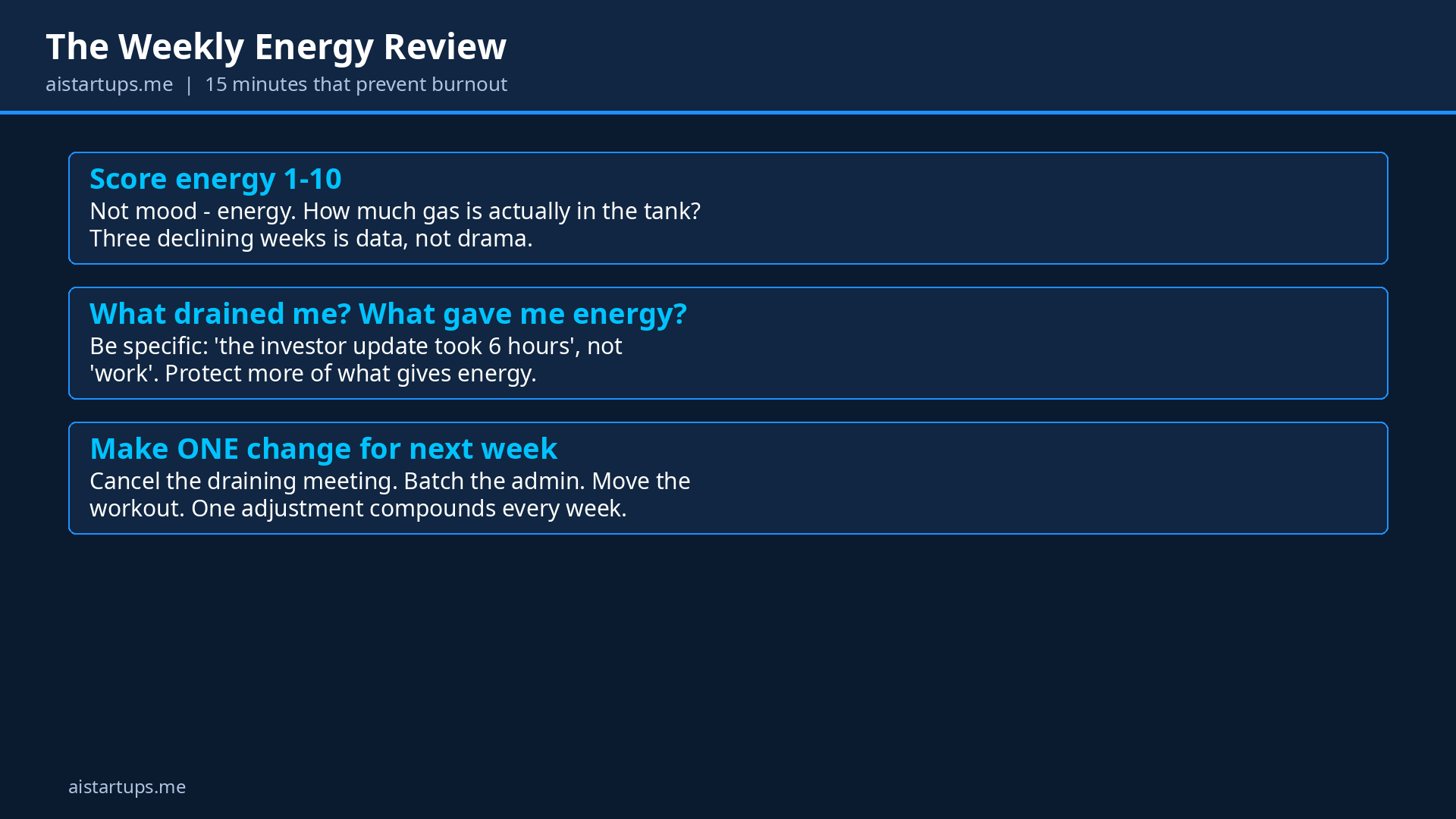
This is the keystone habit. Once a week — Friday afternoon works, Sunday evening works — you sit down for fifteen minutes and score three things:
- Energy level, 1–10. Not mood. Energy. How much gas is actually in the tank.
- What drained me this week? Be specific: “the investor update took 6 hours,” not “work.”
- What gave me energy? The customer call? The deep coding block? Protect more of that.
Then you make ONE change for next week based on what you found. One. Not a life overhaul — a single adjustment. Cancel the meeting that drains you. Batch the admin. Move the workout.
Why does this work when journaling and good intentions don’t? Because it makes burnout measurable instead of subjective. You stop arguing with yourself about whether you’re “really” tired and start seeing the trend line. Three weeks of declining scores is data, not drama — and data is something founders know how to act on.
2. Ruthless delegation (the 80% rule)
Time management coach Elizabeth Grace Saunders gives her founder clients a rule I love: if someone can do a task 80% as well as you, hand it off. That last 20% of quality is almost never worth your founder-hours. As Inc. reports, founders who resist this usually do it from fear — the belief that changing how they work will jeopardize their success. Saunders calls that a fallacy: “if you don’t change, you’re more likely to screw things up.”
Practically, this means your first real “growth hire” often isn’t an engineer — it’s leverage. A strong executive assistant or VA handling inbox triage, calendar, scheduling, and research can hand you back 10–15 hours a week. That’s not admin fluff; that’s your strategic thinking time, your sleep, your margin.
And here’s where it connects to the bigger picture: delegation isn’t just about tasks, it’s about whole functions. If building the product itself is the bottleneck eating your life — you’re a great domain expert but the dev work never ends — that’s a sign to get outside help rather than grind through it. An AI integration studio like AISquadX can take the website, the AI features, or the whole build off your plate so you’re running the business instead of drowning in the build.
If you’re at the stage of making your first technical hire instead, read our guide on hiring your first AI engineer — getting that decision right the first time saves you the most expensive kind of rework.
3. Decision rights (stop being the default)
Burnout gets dramatically worse when you remain the default owner of every issue. The fix isn’t “trust your team more” in the abstract — it’s writing down who decides what, so things stop escalating to you by default.
For every recurring decision in your company, assign it a home: hiring pipeline, finance and reporting, support escalations, calendar and meeting prep. Then set escalation thresholds — you only get involved when a number is crossed (a refund over $X, a hire at senior level, a deadline slip over a week). Everything below the threshold is someone else’s call, and you genuinely don’t hear about it.
This feels terrifying the first month. Then you realize the company didn’t collapse, and you just bought back the scarcest resource you have: unbroken attention. A founder who approves every operational detail hasn’t delegated — they’ve just redistributed their stress into smaller pieces.
4. Protected recovery (scheduled, not aspirational)
Recovery that lives on your someday-list isn’t recovery. The founders who last schedule it like revenue work:
- A sleep window. Non-negotiable hours. The Sifted survey found over half of burned-out founders also suffered insomnia — and you can’t out-hustle a sleep deficit. Protect the window first; everything else is downstream of it.
- Exercise blocks. 47% of founders in the Sifted survey said their exercise routines had slipped. Put the workouts on the calendar with the same seriousness as investor calls. Future you — the one making the big decisions — needs present you to do this.
- No-meeting time. As Entrepreneur notes, high-performing founders deliberately leave slack in the schedule: plan only about 80% of your week, audit for false urgency, and keep a weekly no-meeting block for deep work and thinking. A calendar at 100% utilization breaks at the first surprise — and startups are nothing but surprises.
- One real day off. Start small if a full day feels impossible: half a day with no phone, no “quick check” of the metrics. Saunders suggests exactly this kind of gradual weaning — you may literally feel anxious the first few times, and that’s normal. It passes.
The reframe that finally made this click for me: recovery isn’t the reward for finishing the work. The work is never finished. Recovery is the maintenance that keeps the machine running.
5. Financial boundaries (pay yourself, separate everything)
Money stress is a top-three burnout driver, and founders make it worse by fusing personal and business finances into one anxious blob. Two moves fix most of it:
Pay yourself a real salary. Even a modest one. Founders who take nothing “until we’re profitable” create a weird psychological trap where every business expense feels like it’s coming out of their kitchen budget — because it is. A fixed salary, however small, draws a line: the business has its money, you have yours. Mjadu’s advice from the October survey coverage is blunt and correct: separating personal and business finances creates clarity between the needs of the business and the needs of the human behind it.
Know your personal runway, not just the company’s. You track the company’s months of cash obsessively — do the same for yourself. When you know exactly how many months YOU can last, the vague background dread turns into a specific number you can plan around. Specific numbers are manageable. Vague dread is not.
This also reframes fundraising pressure. Raising money is consistently founders’ #1 stressor (it topped the Sifted survey again), but it’s less corrosive when your personal survival isn’t riding on every single pitch.
6. Peer support (never carry it alone)
The data on this one is almost funny in how stark it is: 56% of founders got no mental health help from investors, and only 12% said they’d turn to their investors when struggling. Meanwhile, a quarter of entrepreneurs said they had no support system that let them talk openly about mental health at all.
So build one deliberately. A founder peer group — even three or four people at a similar stage, meeting monthly — does something no therapist, investor, or spouse can fully do: they know exactly what “the churn number moved the wrong way” feels like in your body. As Mjadu puts it, peer networks make a real difference because other business owners understand the pressures in a way friends and family often can’t.
And if things are genuinely bad — persistent hopelessness, panic attacks, can’t function — talk to a professional, not just peers. There’s no prize for white-knuckling through a clinical problem with productivity hacks. The 18.5% awareness figure for founder-specific resources tells you the help exists; most founders just never look.
The warning signs you’re already in it
Burnout rarely announces itself with a dramatic collapse. It creeps. Watch for these — if three or more sound familiar, don’t file this article under “later”:
- You wake up at 3–4am thinking about the business and can’t get back to sleep.
- Work you used to enjoy now feels like wading through mud.
- You’re cynical about customers, your team, or the mission — and that cynicism is new.
- Sunday evenings fill you with dread instead of (mild) anticipation.
- Small setbacks trigger disproportionate frustration or despair.
- You’ve stopped exercising, eating properly, or seeing friends — “temporarily.”
- You fantasize about quitting, then feel guilty for fantasizing.
- You’re making worse decisions: slower, more reactive, more avoidant.
One founder in the Sifted survey described the 4am wake-ups perfectly:
“You wake up at 4am when your dream suddenly becomes about fundraising and your parasympathetic response goes into overdrive and you can’t sleep anymore.”
If that sentence felt a little too relatable — that’s the point of this whole guide. The system above isn’t for some hypothetical future version of you. It’s for this week.
What to do this week (the starter version)
Six systems can feel like a lot when you’re already running on fumes. So here’s the minimum viable version — seven moves, one week:
- Do one energy review. Friday, 15 minutes, three questions. Write the answers down.
- Cancel or shorten one recurring meeting. If it doesn’t drive a decision, it doesn’t deserve a slot.
- Hand off one task using the 80% rule. Pick the one you keep “just doing yourself” because explaining it feels slower. Explain it once, in a Loom, and never do it again.
- Block two exercise sessions on next week’s calendar. Treat them like investor meetings.
- Set a sleep window and a phone curfew. Phone charges outside the bedroom. Yes, really.
- Write down your personal runway number. Months of cash for YOU. Tape it somewhere private.
- Text one founder friend. “Coffee next week?” That’s the whole move. Peer support starts embarrassingly small.
None of these will 10x your revenue. That’s not the point. The point is that a founder operating at 70% capacity for three years beats a founder operating at 110% for nine months and then flaming out. This is a compounding game, and burnout is the thing that stops the compounding.
If the pace itself is the problem — if you’re sprinting so hard there’s no room for any of this — it might be worth re-examining the plan, not just your habits. Our 30-day startup sprint plan is built around intense-but-bounded effort: sprints have ends, and ends are what make intensity survivable. And if growth pressure is what’s eating you, the lean marketing playbook shows how to get to your first 1,000 users without setting yourself on fire.
FAQ: founder burnout, answered straight
Is burnout just part of being a founder?
No — it’s a common part, not a required part. The stats are ugly (54% in a year per Sifted), but they describe what happens under current working norms, not some law of nature. Founders with systems — delegation, decision rights, protected recovery — build for years without breaking. Treating burnout as inevitable is how you guarantee it.
How am I supposed to rest when the runway is four months?
Honestly? You rest strategically, not luxuriously. Nobody’s telling you to take a sabbatical with four months of cash. But sleep, a weekly half-day off, and one canceled meeting cost you almost nothing in output and buy you enormous decision quality. The math that matters: a burned-out founder with four months of runway makes worse decisions than a rested one with three. Protect the asset — the asset is you.
Should I tell my investors I’m struggling?
Carefully, and selectively. Only 12% of founders turn to investors for support, and 56% report getting no help from them — so go in with clear eyes. What works: framing it operationally (“I’m restructuring my week to protect decision quality”) rather than confessing fragility. What doesn’t: trauma-dumping on a board call. Your peer group and (if needed) a professional are the right venues for the raw version.
Does hiring actually help, or does managing people just add more stress?
Both — in sequence. The first 2–4 weeks of any hire are net-negative: recruiting, onboarding, explaining. Then leverage kicks in and you get hours back every week forever. The mistake is hiring for prestige (a fancy title) instead of leverage (taking whole categories of work off your plate). Hire to remove decisions from your desk, not to add headcount to your slide deck.
What if I’m already burned out — push through or take a break?
Don’t push through; that’s how months of burnout become a year of it. But don’t “take a break” and return to identical conditions either — that’s the classic relapse loop. Do both halves: step back enough to recover (even a long weekend fully unplugged moves the needle), AND change the structure before you return — fewer meetings, real delegation, decision thresholds. Recovery without structural change is just a pause button on the same movie.
The Bottom Line
Here’s what I want you to take from this: burnout isn’t a character flaw, and it isn’t the price of ambition. It’s what happens when a high-load system runs without maintenance — and you, founder, are the highest-load system in your company.
The founders who make it aren’t the ones who never get tired. They’re the ones who built the machine to handle being tired: a weekly review that catches the slide early, delegation that removes work instead of moving it around, decision rights that keep the small stuff off their desk, recovery that’s scheduled like revenue, finances with clear boundaries, and peers who get it.
Start with the 15-minute review this Friday. Everything else compounds from there.
Your startup needs you functional more than it needs you heroic. Build accordingly.