


Here’s the thing about AI startup ideas: the flashier they are, the more crowded they get. The week a “revolutionary” AI anything launches, 400 people build a clone of it. I’ve watched it happen with AI headshot apps, AI therapist bots, AI song generators. Everyone sprints toward the same spotlight.
Meanwhile — and I say this with genuine affection — the money is in the stuff nobody wants to talk about at dinner parties. Invoice processing. Appointment reminders. Compliance checklists. Nobody’s pitching these on a stage. Nobody’s going viral with an invoice-processing demo. But the founders building them? They’re cashing checks every single month while the flashy startups are still “raising a pre-seed.”
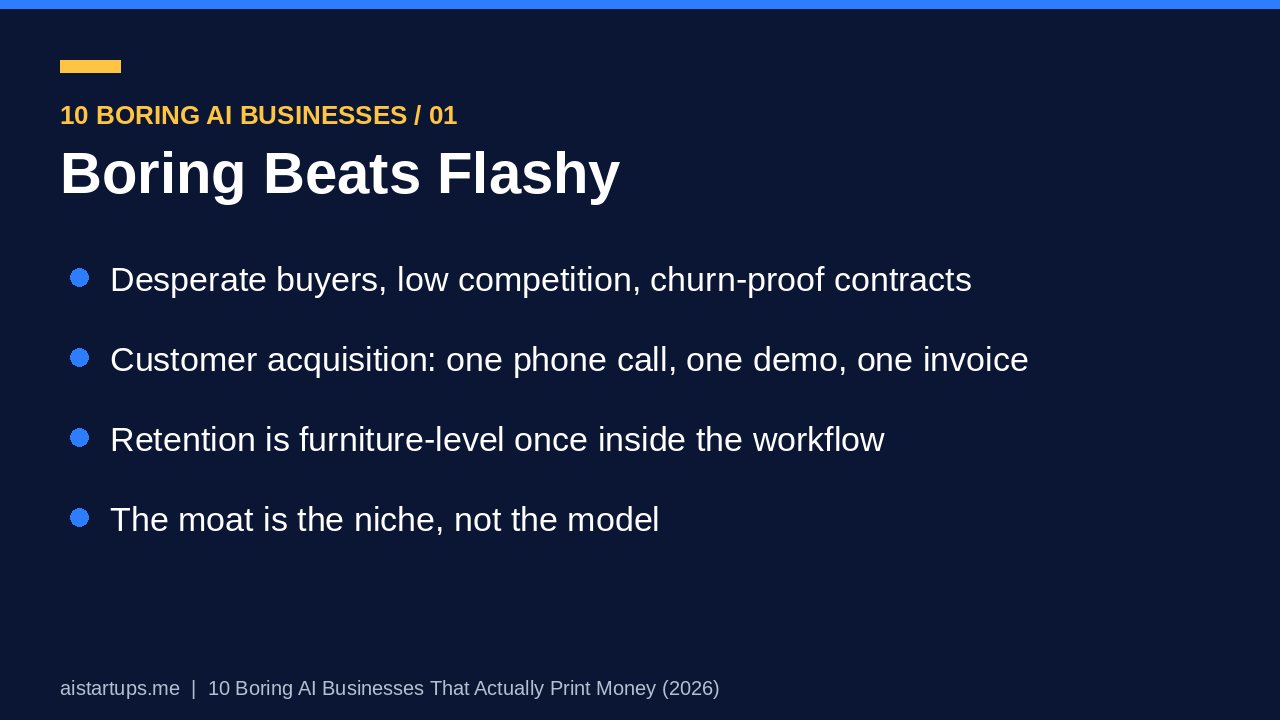
Look, there’s a reason for this. Boring businesses have three superpowers: desperate buyers, low competition, and churn-proof contracts. A roofing company owner doesn’t care that your tech uses a transformer model. He cares that his missed calls now get answered by text at 9 PM and turn into Monday-morning jobs. That’s a $300-a-month check he’ll write forever.
Real talk: boring AI businesses are the closest thing to printing money that exists in startups right now. Not because the tech is magic — it’s not — but because the economics are absurdly good. Let’s walk through ten of them, with real market numbers and the actual playbook for each.
Why “Boring” Wins (The Economics)
Before we get into the list, you need to understand why these work. It’s not vibes — it’s arithmetic.
First, customer acquisition is cheap. When you sell to plumbers instead of “the AI community,” you’re not competing with 10,000 identical landing pages. Your pitch is a phone call away from a demo on their actual invoices. That’s a completely different game from bidding on Google Ads against venture-backed giants.
Second, retention is ridiculous. The boring stuff is infrastructure. Nobody switches their invoice pipeline every quarter the way people switch chatbots. Once your system is inside a business’s daily workflow, it becomes furniture. I’ve seen churn numbers on workflow-embedded tools that would make a consumer app founder cry with joy.
Third, the tech is a solved problem. You’re not doing frontier research. You’re gluing together mature tools — document extraction, scheduling APIs, CRM webhooks — into something a specific industry would happily pay for. Honestly, that’s the whole secret. The moat isn’t the model. It’s knowing that dentists lose 12% of revenue to no-shows and having the fix ready on a Tuesday.
“The strongest AI businesses aren’t completely automated. They are AI-assisted services with a human being responsible for the final result. The person who succeeds usually understands a customer’s business, asks the right questions, and removes a small but persistent source of stress.” — AI Side Hustle Labs, on the boring advantage
Okay. With that out of the way, here are the ten. I’ll give you the business, the market behind it, and how a solo founder would actually start it this month.
1. AI Invoice & Receipt Processing for Trades and Small Shops
A plumber gets 40 invoices a month from suppliers. His office manager — usually his wife — spends a full day retyping them into QuickBooks. That’s the entire business model. Done.
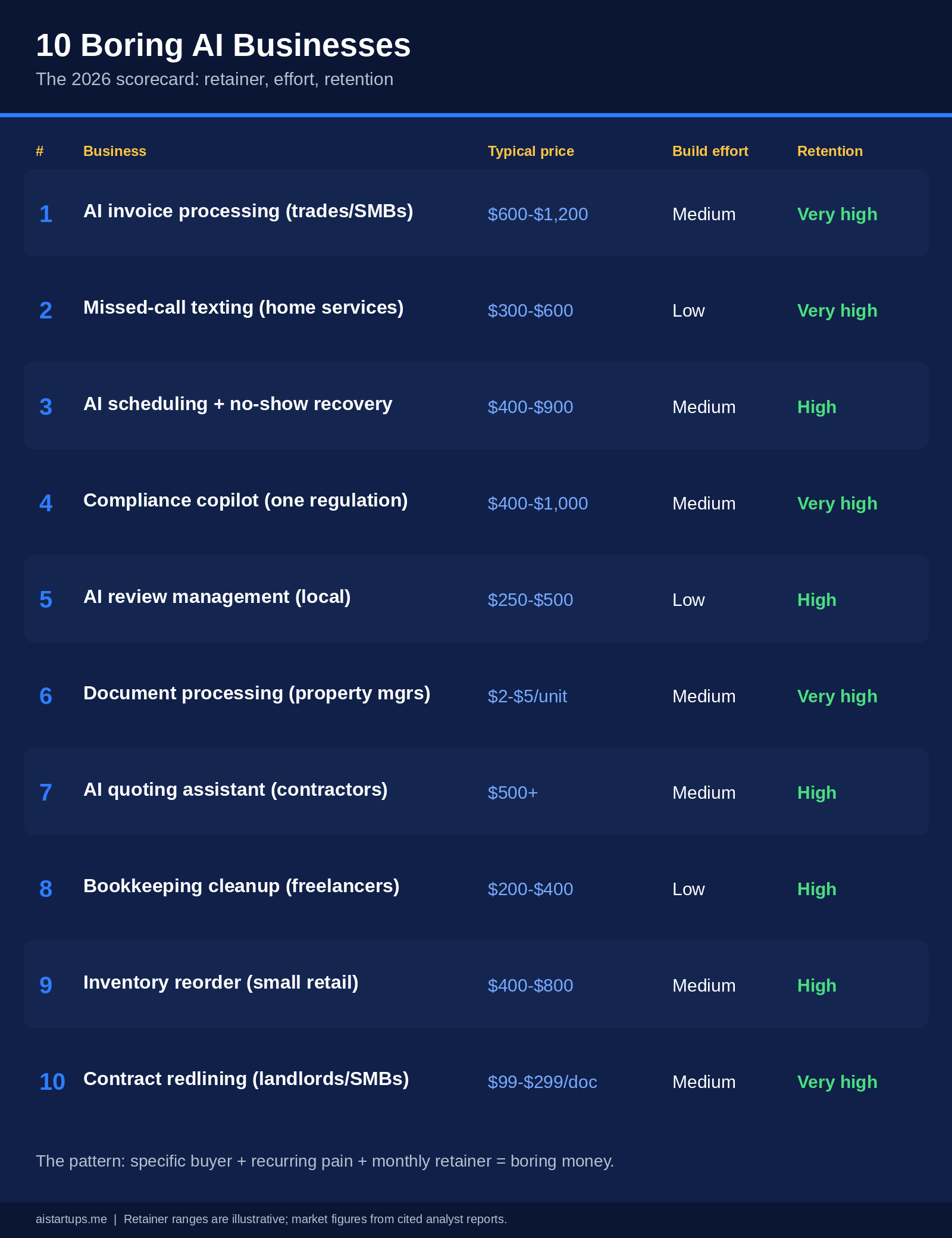
You sell a service: invoices land in a dedicated email inbox or get photographed, your pipeline extracts the data, validates it, and pushes it into their accounting software. Human review on the exceptions. Charge $600–$1,200 a month per client. The invoice processing automation market alone is projected at $3.97 billion in 2026, growing 14.25% a year, and the SMB end of it is still dramatically underserved — the enterprise tools cost too much and assume an IT department.
How to start: pick ONE trade (HVAC, electrical, auto repair). Offer a free 2-week pilot on their real invoices. They see the hours disappear, they sign. The best part? Trades talk to each other. One happy shop owner is worth five ads. If you’re already selling AI services to local businesses, this slots right in as the flagship offer.
2. Missed-Call Texting for Home Services
This one’s almost unfair. A homeowner’s AC dies at 8 PM. She calls three HVAC companies. Two go to voicemail. The third — your client’s — auto-replies with a text in 30 seconds: “Sorry we missed you! Is this an emergency? We can have someone out tomorrow morning.” Guess who gets the job.
Missed calls are money on fire for every home-services business on earth. Your product is dead simple: every missed call triggers an AI text conversation that books the job, asks for the address, and syncs it into their calendar or CRM. Setup fee of $500–$1,500, then $300–$600 a month per client.
The tech here is genuinely easy — voice-to-text APIs, a chatbot flow, a calendar integration. What you’re selling is the one thing the owner can’t do: be available 24/7. And here’s the beautiful part: the ROI is visible within days. When a client books two extra jobs in week one, they don’t need a renewal pitch. They need a bigger plan.
3. AI Scheduling + No-Show Recovery for Clinics and Salons
No-shows are a silent tax on appointment businesses. A dental practice with three hygienists loses serious money every time a chair sits empty — and it happens constantly. The fix is a scheduling assistant that confirms appointments, fills cancellations from a waitlist, and follows up on patients who ghost.
The numbers behind this niche are healthy: standalone AI scheduling software is headed for roughly $950 million in 2026, growing about 19% a year, and that doesn’t even count the bundled calendar features inside Microsoft and Google’s ecosystems — analysts put the real market north of $3 billion by 2028. Medical scheduling specifically is one of the fastest-growing segments.
Here’s how I’d start: offer a no-show recovery service on a performance basis. “I fill your empty slots. You pay me per filled appointment.” Nobody says no to that pitch, because there’s literally no downside. Once you’re in the door with results, upsell the full scheduling stack. Performance-based entry is the cheat code for boring businesses — it deletes the objection before it forms.
4. Compliance Copilot for One Specific Regulation
Compliance is the most boring word in the English language, and it’s attached to some of the biggest money in AI. Here’s why: regulations keep multiplying, fines keep rising, and every business in a regulated industry is terrified of missing something. The AI regulatory technology market is expected to hit $16.79 billion in 2026, up 38% from the year before. That’s not a niche. That’s a gold rush wearing a gray suit.
But here’s the mistake everyone makes: they try to build “compliance for everyone.” Don’t. Pick ONE regulation in ONE industry — food-safety checklists for restaurant chains, OSHA log automation for construction firms, license-renewal tracking for home-care agencies — and build the best possible version of just that.
The pitch writes itself: “You need this by law. We do it for $400 a month. Your alternative is a full-time hire.” Retainers in compliance are famously sticky because dropping the service means going back to manual tracking, and nobody volunteers for that. Also — and this matters — compliance buyers don’t haggle the way tech startups do. If it keeps them legal, they pay.
5. AI Review Management for Local Businesses
Every restaurant, salon, and dental office knows they’re supposed to respond to Google reviews. Almost none of them do it consistently. Owners are busy, responses feel awkward, and negative reviews sit there for months like a bad smell.
Your service: monitor every review across Google, Yelp, and Facebook, draft on-brand responses, and flag the ones that need a human touch. Send the owner a weekly digest of what customers are saying and what it means. Charge $250–$500 a month. It takes your system maybe 20 minutes a week per client once it’s set up.
Why this prints money: reviews directly drive foot traffic, so the value is obvious, and it’s a service every single local business needs but no one enjoys doing. It’s the definition of a persistent annoyance — which is exactly what makes for a great subscription business. Pair it with your other local-service offerings and you’ve got a bundle that’s very hard to cancel.
6. Document Processing for Property Managers
Property managers drown in paper. Lease applications, maintenance requests, inspection reports, invoices from contractors — all of it lands in an inbox or a filing cabinet, and someone’s paying rent to have a human retype it.
Intelligent document processing — extracting and structuring data from messy documents — is a $3.7 billion market in 2026, and property management is one of its hungriest verticals. Your angle: maintenance-request triage (read the tenant’s message, categorize it, route it to the right contractor, track it to completion), lease-application screening, and move-in/move-out inspection summaries.
Start with mid-size managers — 50 to 500 units — who are big enough to feel the pain and small enough that the owner can say yes on one call. Price per unit ($2–$5 a month) so the contract grows as they do. And honestly? Property managers are some of the best referral sources in local business. They know every contractor, landlord, and HOA board in town.
7. AI Quoting Assistant for Contractors
Getting a quote from a contractor is a miserable experience for customers — and quoting is a miserable experience for contractors. They drive out, measure, go home, build the estimate in a spreadsheet, and send it three days late. By then the customer has hired someone faster.
An AI quoting assistant flips this: the customer sends photos and a description, your system estimates materials and labor from the images, and the contractor gets a draft quote to approve and send in minutes instead of days. Speed wins jobs in contracting. Period.
This is a productized service with a clean story: “Cut your quote turnaround from 3 days to 30 minutes.” Charge a setup fee plus a monthly retainer, or even per-quote pricing. If you’re also thinking about the agency route — custom tools like this are exactly the kind of build a web development studio ships as client work — the playbook is the same: pick a trade, build for it specifically, sell the speed.
8. Bookkeeping Cleanup for Freelancers and Creators
Freelancers are spectacularly bad at bookkeeping. They have income from five platforms, expenses in three currencies, and a shoebox (digital or otherwise) of receipts. Come tax season, it’s a disaster — which means it’s an opportunity.
Your service: monthly AI-assisted bookkeeping. Auto-categorize every expense, reconcile accounts, chase overdue invoices with polite AI-written reminders, and hand them a clean monthly report. Charge $200–$400 a month. The tech is mature — this is pattern-matching and categorization, not rocket science — and the market is enormous: there are tens of millions of freelancers globally, and they all share the same pain.
The honest pitch: “You hate this. I love this. Pay me $300 a month and never think about it again.” Freelancers pay happily because bookkeeping is the work they procrastinate on hardest. And recurring monthly billing on autopilot work? That’s the kind of revenue that lets you sleep well.
9. Inventory Reorder Intelligence for Small Retailers
Small retailers lose money two ways: stockouts (the customer walks out) and overstock (cash rotting on a shelf). Big chains have entire teams solving this. Your local hardware store has a gut feeling and a spreadsheet.
An AI that watches their sales data and tells them what to order, when, and how much is genuinely transformative at that scale. It doesn’t need to be fancy — even simple demand prediction beats a gut feeling by a mile. Sell it as a monthly service at $400–$800, or as a setup-plus-retainer deal.
The entry move: run a free analysis on three months of their sales data and show them what they would have caught. “You ran out of your best-selling SKU for 11 days in March. That cost you roughly $X.” Numbers sell boring software better than demos do. Once they’ve seen their own data telling the story, the sale is basically done.
10. Contract Redlining for Landlords and Small Businesses
Landlords sign leases. Small businesses sign vendor contracts, NDAs, and partnership agreements. Almost none of them have a lawyer on retainer, and even fewer have one reading every document carefully. The result: they sign things they shouldn’t, or they pay $400 an hour for a lawyer to read a two-page agreement.
An AI contract-review service fixes this: upload the document, get back a plain-English summary, the risky clauses flagged, and suggested fixes. Not legal advice — a review and flagging service with lawyer referral on anything hairy. Charge per-document ($99–$299) or a monthly plan for businesses that sign contracts constantly.
Why this works: contracts are high-stakes and anxiety-inducing, which means people will pay to feel safe. It’s also one of those businesses where trust compounds — once a landlord uses you for one lease, you’re in their pocket for every future one. Start in one vertical (residential leases are the obvious beachhead), expand from there.
How to Pick One (The 5-Minute Filter)
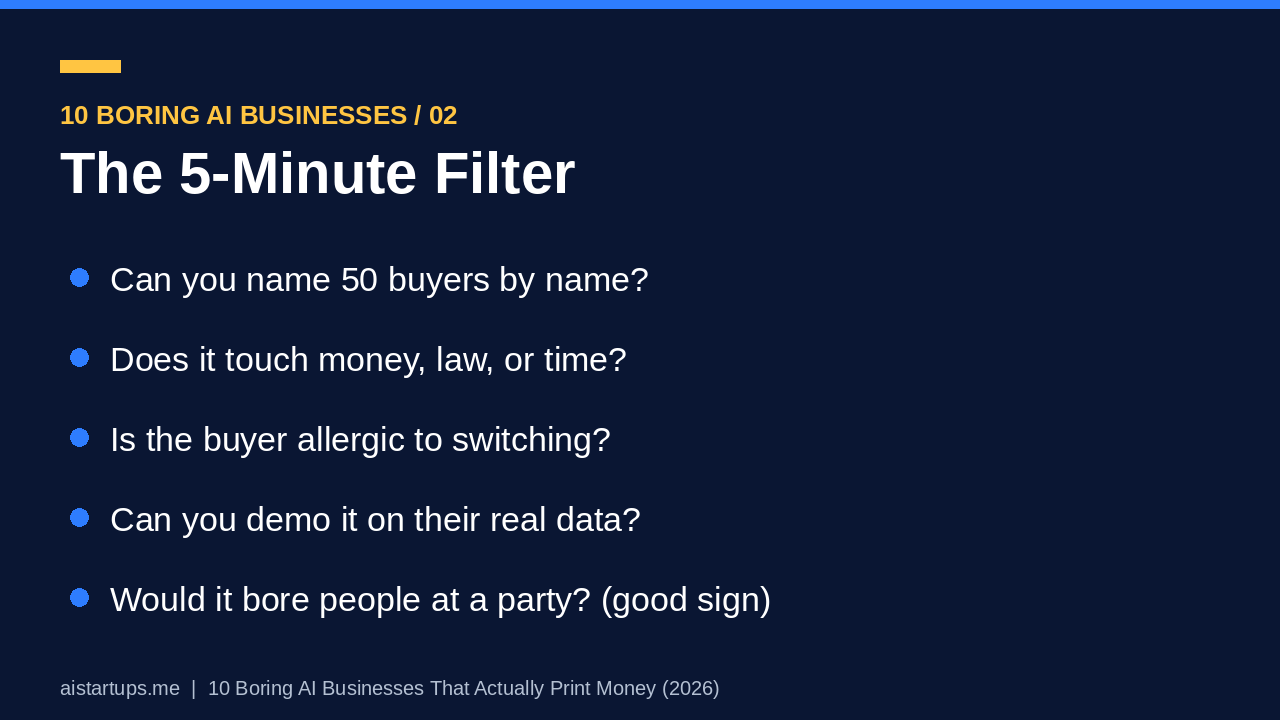
Okay, ten ideas is nine too many if you can’t choose. Here’s the filter I use — five questions, answerable in five minutes:
- Can you name 50 potential buyers by name? If yes, acquisition is cheap. If you’d have to “go viral,” skip it.
- Does it touch money, law, or time? Those are the three things people pay to fix. Everything else is a nice-to-have.
- Is the buyer allergic to switching? Workflow-embedded tools keep customers for years. Nice-to-have tools churn in months.
- Can you demo it on their actual data? “Send me last month’s invoices and I’ll show you” beats any slide deck ever made.
- Would you be bored explaining it at a party? (laughs) Honestly — if yes, you’re probably onto something. The best boring businesses are the ones that make your eyes glaze over and your bank account grow.
The pattern across all ten: find a specific person with a specific recurring pain, remove that pain with mostly-off-the-shelf AI, and charge a monthly retainer for it. That’s the entire playbook. No venture capital required — though if you want to think bigger, my guide to AI agent businesses for solo founders covers how these service businesses evolve into real products.
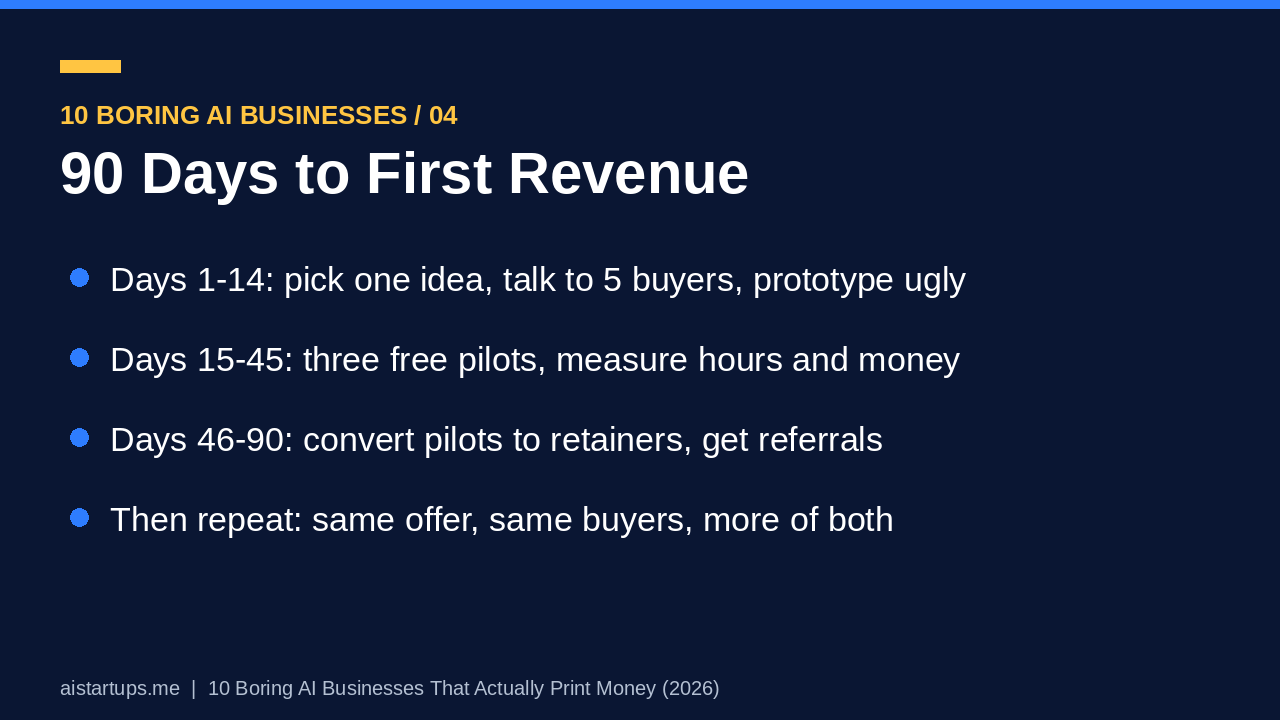
The Launch Playbook: 90 Days to First Revenue
Ideas are cheap. Here’s the part that matters — how you actually get from here to paying customers in three months.
Days 1–14: Pick and prototype. Choose one idea. Talk to five potential buyers — actual owners, not “people in the industry.” Ask about their most painful recurring task. Build the ugliest version that works, using the no-code AI stack I recommend. No logo. No landing page. Just something that processes their real data.
Days 15–45: Pilot free, on purpose. Run three free pilots with real businesses. Measure everything — hours saved, money recovered, jobs booked. Your pricing will come from these numbers. When you can say “this saved you $1,800 last month,” charging $500 is easy.
Days 46–90: Convert and compound. Turn two of three pilots into paid retainers (the third usually converts a month later). Now you have proof, testimonials, and before/after numbers. Get two more clients from referrals. You’re at $1,500–$3,000 monthly recurring with four clients and maybe 10 hours a week of work. That’s the seed of everything.
From there it’s just repetition — more of the same offer to more of the same buyers. If you want the math on how these service businesses become AI side hustles that actually pay, I’ve covered that too.
Frequently Asked Questions
Aren’t these ideas too simple? Won’t big companies just do them?
That’s the beautiful part — big companies CAN’T be bothered. The enterprise tools are expensive, require IT departments, and treat every customer like a Fortune 500 company. Your edge is being small, specific, and fast. A $600-a-month service for HVAC companies is a rounding error to the giants and a fortune to you.
How much technical skill do I actually need?
Less than you think. Every one of these ten can be built with no-code automation tools plus AI APIs — no machine learning expertise required. What you need is the ability to understand a business owner’s workflow and wire together tools that fit it. Domain empathy beats engineering credentials here, honestly.
What should I charge?
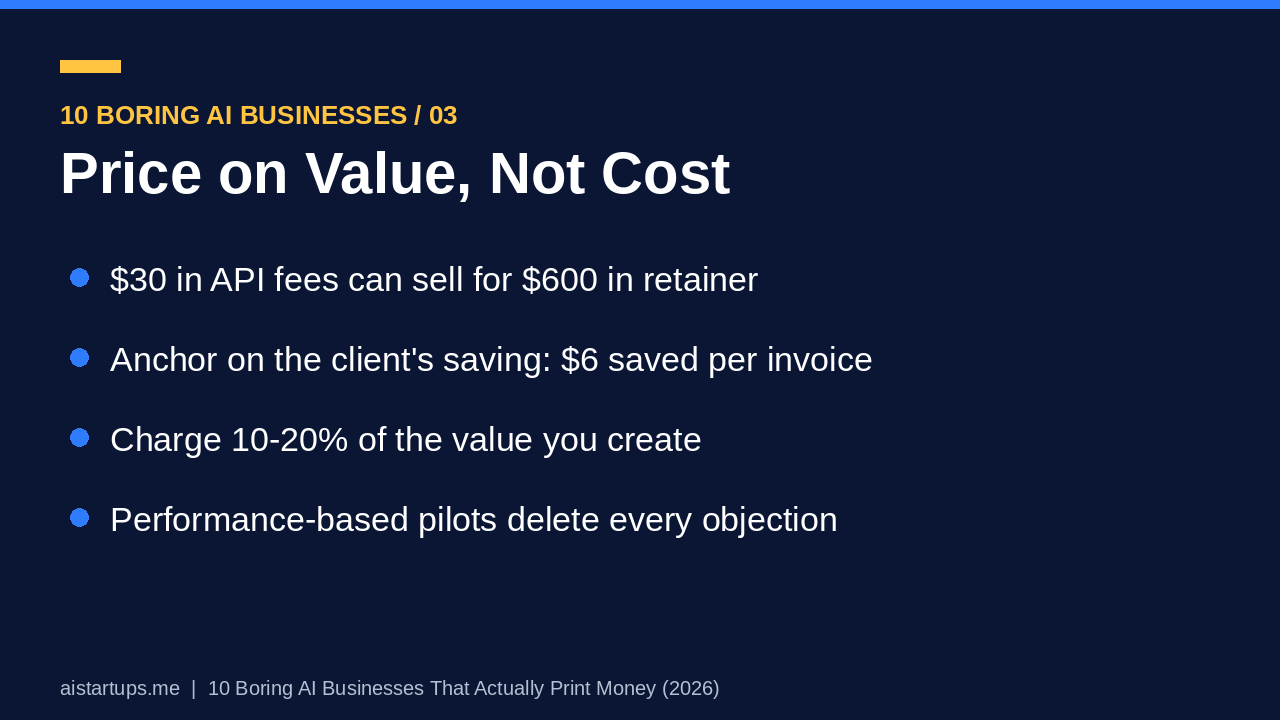
Price on value, not cost. Your system might cost you $30 a month in API fees per client — that’s irrelevant. What matters is what the client saves or earns. The $6-per-invoice saving that automated AP delivers (per Aberdeen Group’s research) is your anchor. Charge 10–20% of the value you create, and nobody will haggle.
How do I get my first client without an audience?
Phone calls and walk-ins. Seriously. Local businesses are not found on Twitter — they’re found on Main Street. Call 20 businesses, offer a free pilot on their real data, and one will say yes. Boring businesses have boring marketing, and it works: direct outreach converts because your offer is concrete and specific.
When do I scale from service to product?
When three clients need the exact same thing and you can’t keep doing it manually. That’s the signal. Turn your repeated manual steps into self-serve features, keep the service tier for custom setups, and you have a hybrid business with service revenue funding product development. That’s how most of these get built in the real world.
The Bottom Line
Every month you spend building the flashy AI idea, ten other founders are building it too. Meanwhile, there’s a plumbing company in your city losing three jobs a week to missed calls, a clinic hemorrhaging money to no-shows, and a property manager drowning in maintenance emails. They don’t want innovation. They want the boring problem gone.
Be the person who makes the boring problem disappear — on a monthly retainer — and you’ll have something most AI startups never get: revenue that shows up whether or not anyone’s tweeting about you. Ten ideas, one filter, 90 days. Pick one and start.