


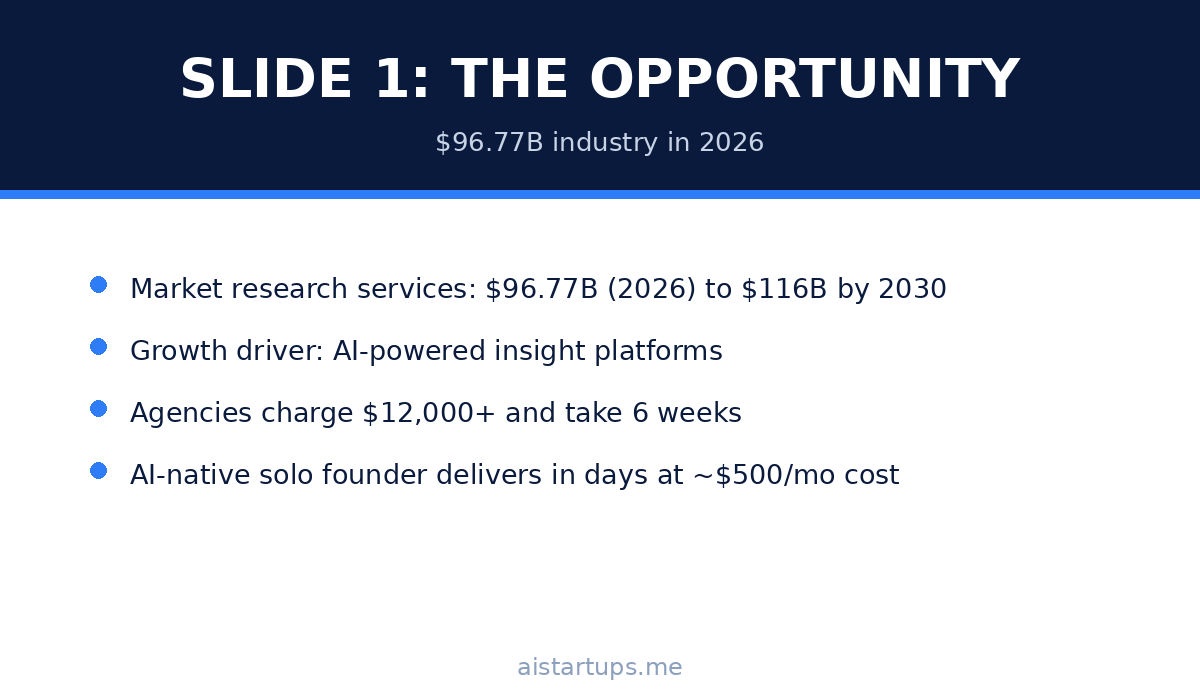
Here’s a thing that happened to me last month. A friend of mine — runs a small SaaS company, smart guy — told me he’d paid $12,000 for a market research report. Twelve grand. The agency took six weeks to deliver it, and half of it was padded with filler like “the global software market is growing” (no kidding).
Honestly? That invoice made my blood boil a little. Because sitting on my laptop, I had tools that could have produced 80% of that report’s real substance in about two days. Not for $12,000. For maybe $60 in tool subscriptions.
That’s when it clicked. This is a business — not a tool, not a side hustle idea, an actual business. Market research agencies are charging five figures for work that AI has made dramatically cheaper and faster to produce. The gap between what agencies charge and what it now costs to deliver is exactly where a lean AI-powered research service fits.
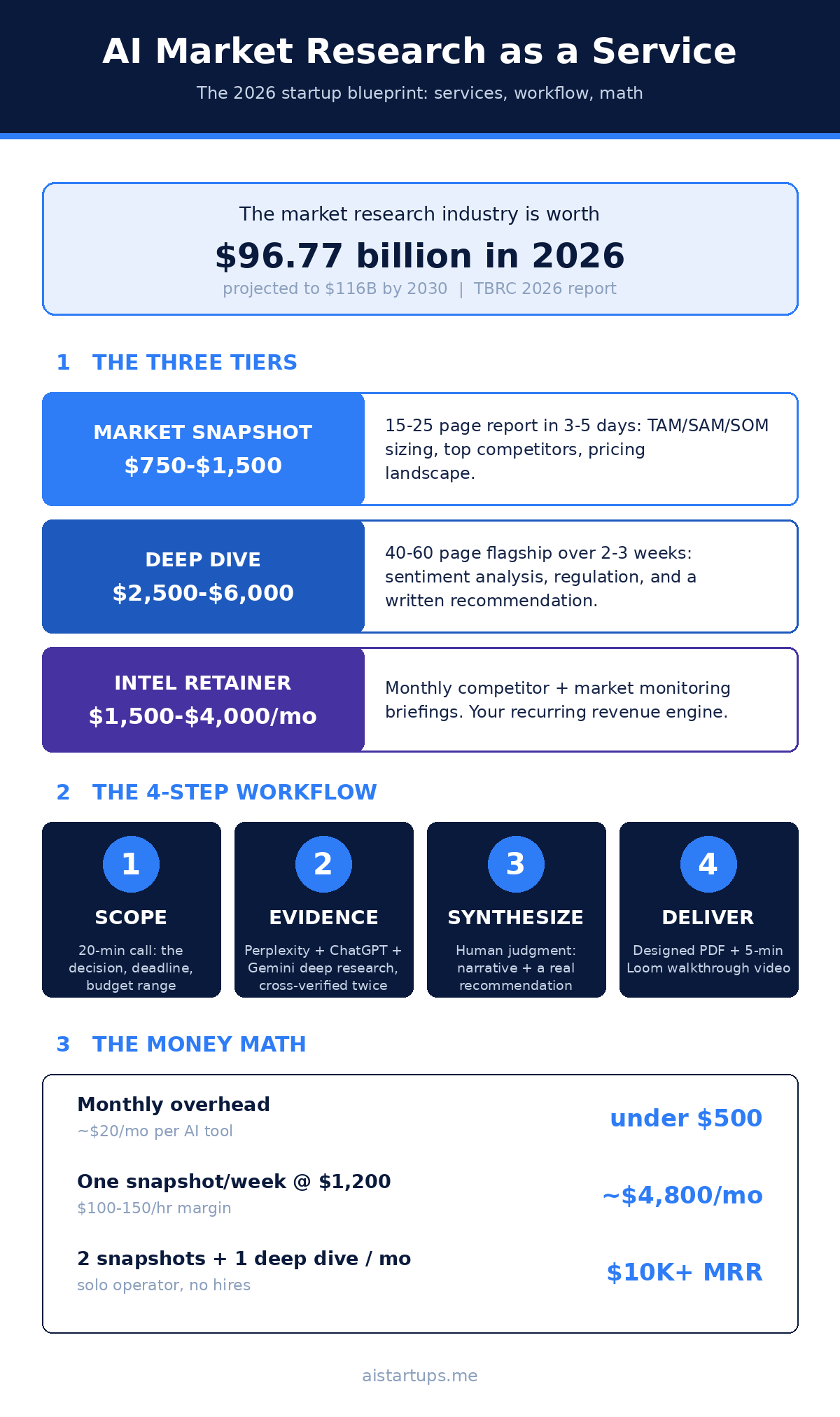
And the timing is kind of perfect. The market research services industry is worth roughly $96.77 billion in 2026, projected to hit $116 billion by 2030, according to The Business Research Company’s 2026 global market report — and the report’s own list of growth drivers includes “AI-powered consumer insights platforms” and “wider adoption of automation in research processes.” The industry itself is telling you where it’s going.
So let’s talk about what this business actually looks like. The deliverables, the pricing, the tools, the outreach playbook, the uncomfortable parts nobody mentions. Consider this the blueprint I’d hand to someone serious about launching one.
What an AI-Powered Research Service Actually Sells
First, kill the idea that you’re selling “AI reports.” Nobody buys that. Clients buy answers to expensive questions: Should we enter this market? Why are we losing deals to this competitor? What will our customers pay?
You’re selling clarity on high-stakes decisions. The AI is just how you produce it faster and cheaper than the traditional agencies. Your job is packaging judgment, structure, and source-backed evidence into something a busy founder or exec can act on in twenty minutes.
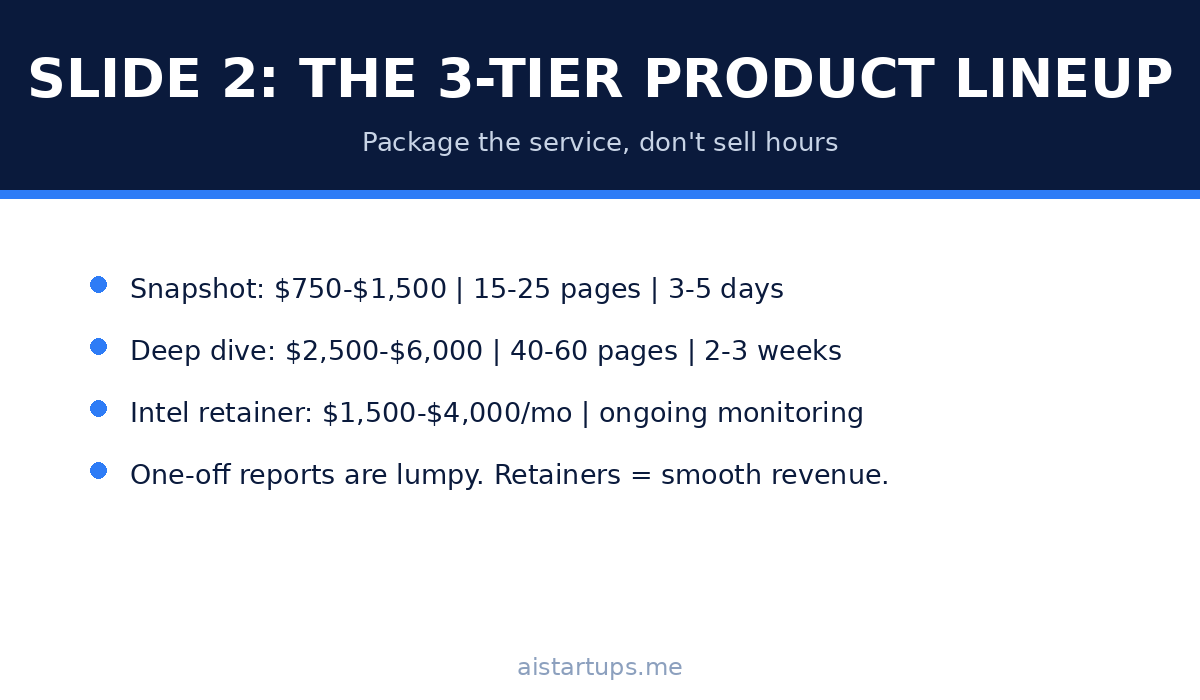
Here’s what a real productized service looks like — three tiers that map to how clients actually buy:
Tier 1: The Market Snapshot ($750–$1,500)
A 15–25 page report delivered in 3–5 business days. Market size (TAM/SAM/SOM), top competitors with positioning maps, pricing breakdown, and a “who to watch” watchlist. This is your volume product — the thing agencies of a decade ago would’ve charged $5,000+ for, and that freelancers on Fiverr sell as generic templates for a fraction of that.
The snapshot is your wedge. It’s cheap enough that a founder doesn’t need approval to buy it, and fast enough that they order it when they’re already making a decision — which means it’s inherently valuable. It also converts beautifully into bigger engagements.
Tier 2: The Deep Dive ($2,500–$6,000)
A 40–60 page flagship report over 2–3 weeks. Everything in the snapshot plus customer sentiment analysis (mining reviews, Reddit, forums), regulatory picture, go-to-market channel breakdown, and a written recommendation section where you take an actual position. Yes — a position. “Enter this market through X channel, here’s the data behind it, here are the risks.”
This is the tier where you start doing primary research: short AI-moderated customer interviews, targeted surveys, or structured outreach to industry folks. For context on traditional pricing, freelance market research consulting typically runs $40–$300 per hour according to Fiverr’s marketplace data, with interviews and focus groups averaging around $352 as fixed-price packages — while full agency projects run from a few thousand into the tens of thousands, and retainers from $1,000 to over $10,000 per month.
Tier 3: Ongoing Intelligence ($1,500–$4,000/month retainer)
A monthly competitor-and-market monitoring service. New competitor launches, pricing changes, sentiment shifts, emerging keywords — delivered as a monthly briefing with an alert when something matters. This is where the recurring revenue lives, and it’s where AI gives you the biggest edge: you can run monitoring continuously at near-zero marginal cost once your workflows are built.
Look — the honest version is this: AI doesn’t do market research. It does market research faster. The judgment — what matters, what’s noise, what’s a credible source versus a marketing blog regurgitating someone else’s blog — that’s still you. That’s what clients pay for. Never let a report go out that you wouldn’t defend in a call.
The Numbers: Why This Business Model Works
Let’s do the math, because the math is genuinely the best part.
A traditional boutique research firm costs roughly $77,000 to launch with a breakeven timeline of around 22 months, according to FinancialModelLab’s startup cost analysis. That model assumes office space, a focus group room, payroll, data acquisition budgets — the whole legacy apparatus.
Now imagine the AI-native version. Your costs:
- Research tools: ~$100–$250/month. Perplexity Pro ($20), ChatGPT Plus ($20), Google AI Pro ($19.99), plus a specialist tool like Elicit ($49/user) for academic or evidence-heavy work. October 2026 pricing across these tiers is remarkably stable — around $20/month per major tool, with a wider market-research tooling set ranging from free tiers to $169/month for trend-tracking suites like Trendos. Add the latter when you have revenue.
- Surveys/panels (as needed): pay-per-project, $99/month for a tool like Standard Insights, or outsource per-survey.
- Delivery stack: a website, a PDF templating workflow, maybe a Notion portal. Under $50/month.
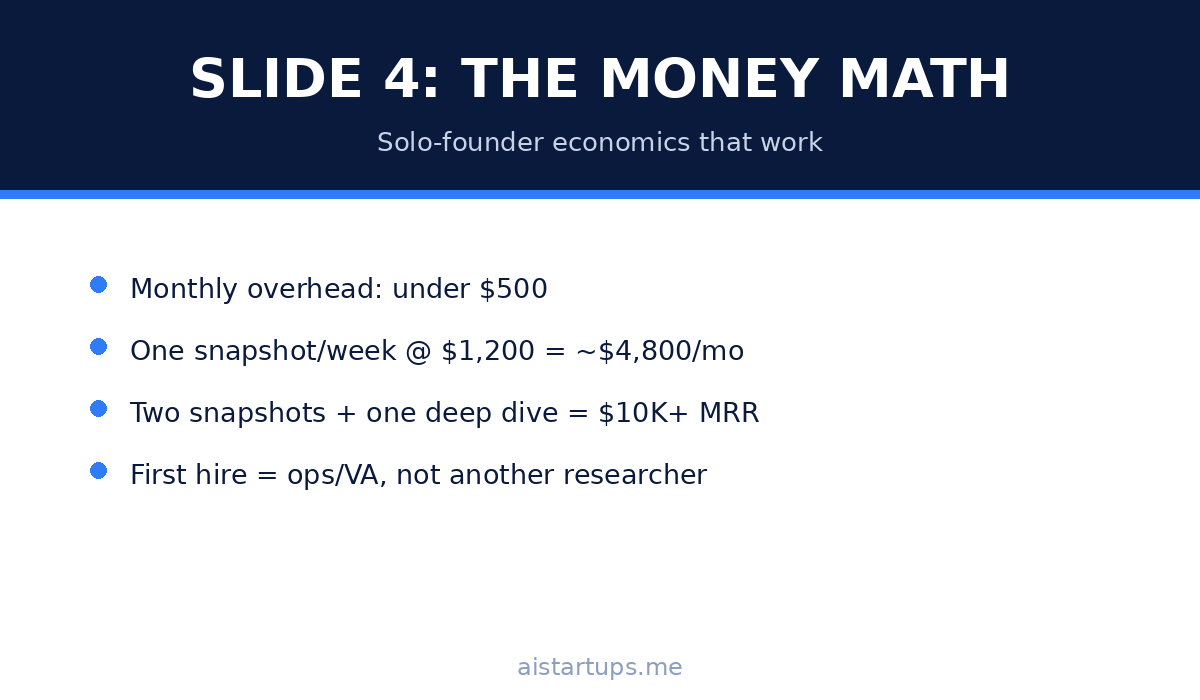
Total monthly overhead for a solo founder: honestly, under $500. Now compare that to charging $1,500 for a snapshot that takes you 10–15 hours. That’s $100–$150 an hour of margin — with a cost structure your legacy competitors can only dream about.
One snapshot per week at $1,200 = ~$4,800/month in revenue on ~$500 in costs. Two snapshots plus one deep dive per month gets you comfortably past $10K MRR as a solo operator. The business scales by raising prices and adding retainers, not by hiring analysts. Well — mostly. We’ll get to the hiring part later.
The Actual Workflow: From Client Question to Delivered Report
This is the section I wish someone had written for me. Here’s the pipeline that separates a real research service from “I asked ChatGPT to write a report” — because clients can feel the difference, trust me.
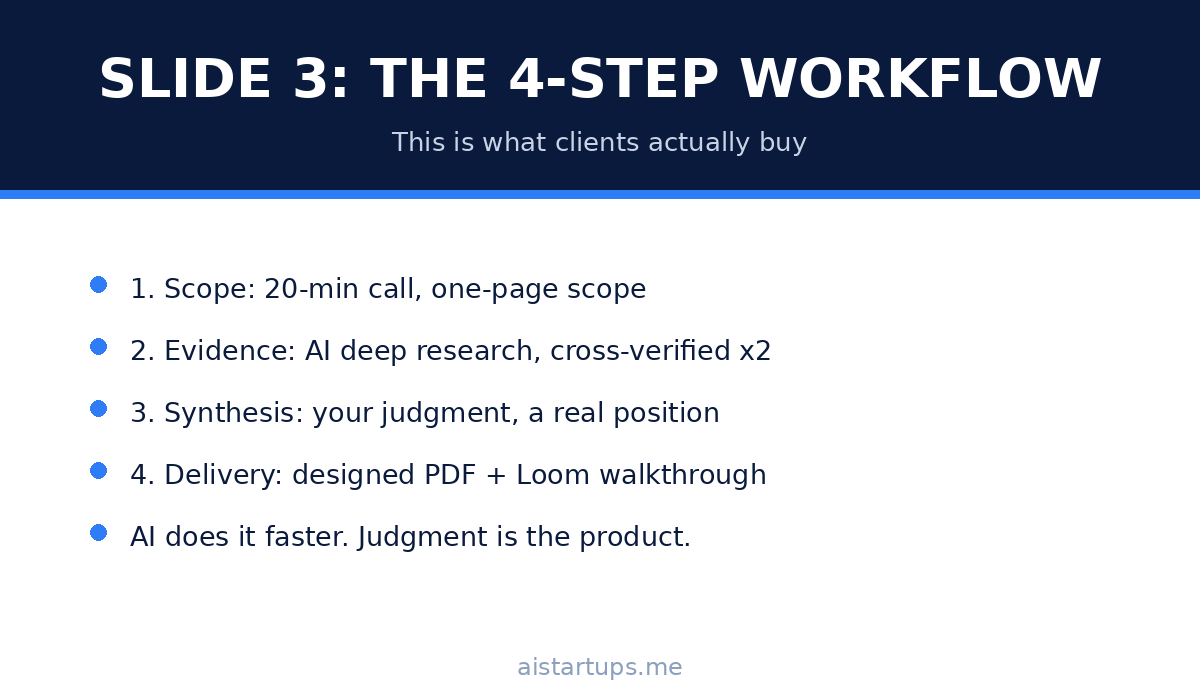
Step 1: The scoping call (non-negotiable)
Never quote from an email. Get on a 20-minute call and extract: the decision they’re making, the deadline, what they’d do with a “bad” answer (this tells you what they actually fear), and their budget range. Then write a one-page scope: question, deliverables, timeline, price. This one-page scope is worth more than any AI tool — it’s what keeps projects from ballooning. And note: this scoping discipline is the same skill behind validating an AI startup idea before writing a single line of code — you’re just running the validation playbook on someone else’s behalf.
Step 2: Build the evidence pack with AI
This is where the AI stack earns its keep. A practical combination:
- Perplexity Deep Research ($20/mo) for cited desk research — competitor teardowns, market sizing, pricing grids. Low hallucination rate, fast turnaround, every claim traceable to a source. This is your workhorse.
- ChatGPT Deep Research ($20/mo) for the long, deeply-cited reports — policy analysis, regulatory deep-dives, anything where you need consultant-grade structure. Slower, but the reports are genuinely impressive.
- Gemini Deep Research (free tier available, AI Pro $19.99 for more runs) for anything in the Google ecosystem, with its verify mode as a cross-check.
- Consensus ($20/mo) or Elicit ($49/user/mo) when a client needs academic-grade backing — healthcare, education, anything regulated.
- Social listening: tools like Brandwatch for sentiment tracking, or manual-but-systematic Reddit/Trustpilot/review mining. This is where you find the stuff competitors’ marketing never mentions.
Cross-verify everything across at least two tools. If Perplexity and ChatGPT disagree on a market size number, that disagreement goes in the report as a caveat with both numbers cited — that’s what real analysts do, and it’s a big part of why clients trust you over a $99 template.
Step 3: The human synthesis (this is the product)
Raw research output goes in; a narrative comes out. Organize around the client’s question, not around your research process. Nobody cares that you ran fourteen searches. They care about: here’s the market, here’s who wins and why, here’s what it means for you, here’s what I’d do.
The recommendation section is where you earn your fee. Take a position. Use conditional language when the data is thin (“the evidence suggests…”), but never hide behind waffle. Clients remember analysts who were right, not analysts who were safe.
Step 4: Delivery that looks expensive
Reports live or die by presentation. A well-designed PDF with clean data visuals, an executive summary that fits on one page, and a Loom walkthrough video (five minutes, you talking through the findings) makes a $1,500 report feel like a $10,000 one. Real talk: half of perceived quality is presentation. This is true for agencies too, they just won’t admit it.
Pricing Strategy: How to Price When AI Cuts Your Costs
Tempting as it is to race to the bottom on price, don’t. Your competitive advantage isn’t being cheap — it’s being fast, focused, and affordable relative to agencies. There’s a massive difference between “$1,500 instead of $12,000” and “$299 because AI is cheap.”
A few pricing principles that work:
Price on value, cost your margins on AI. The client pays for the decision you’re de-risking. A founder about to spend $200K entering a market will happily pay $3,000 for a deep dive. Your AI-driven costs are irrelevant to them — and they should stay irrelevant. (If pricing psychology is new to you, my guide to pricing an AI product breaks down the value-based frameworks that apply here just as well.)
Productize tiers, customize scoping. The three tiers above are your menu. But every engagement starts with a scoped proposal, and scoping lets you add 20–40% for complexity (regulated industries, multiple geographies, primary interviews) without apology.
Raise prices every 5 clients. Seriously. Start at the low end of each tier, collect testimonials, then raise. Most solo founders underprice by 30–50% for their first year. Your first five clients are portfolio-building; after that, charge what the market bears.
Use retainers to smooth revenue. One-off reports are lumpy. A retainer client at $2,000/month is worth more to your sanity than four one-off snapshots. Offer a retainer discount (10–15%) to any snapshot or deep-dive client within two weeks of delivery — that’s when the value is freshest in their mind.
And here’s the part about pricing infrastructure nobody talks about: you need a clean client portal — proposals, invoicing, report delivery, an archive clients can log into. A janky Google-Drive-folder setup screams “freelancer” and quietly caps what you can charge. If you don’t build websites yourself, getting a proper one made is one of the highest-ROI early investments — studios like AISquadX build these kinds of client portals and web platforms for small businesses, and the difference in perceived professionalism pays for itself fast.
Getting Clients: The Outreach Playbook
Here’s the thing about selling research: your ideal clients are already about to make an expensive decision. Your job is to be visible at that exact moment. Broad “hire me for research” marketing doesn’t work. Timely, specific outreach does.
Channel 1: Founders asking research-shaped questions in public
Monitor founder communities, startup subreddits, Indie Hackers, Twitter/X — anywhere founders post things like “thinking of entering the X market, anyone have data?” or “how big is the market for Y?” Respond with genuinely useful partial answers (not a pitch), then mention you do this as a service. I’ve seen this convert at absurdly high rates because the timing is perfect — they have the question right now.
Channel 2: Warm introductions from startup-adjacent professionals
VCs, accelerators, fractional CFOs, startup lawyers — these people get asked “do you know someone who can research this market?” regularly, and they almost never have a good answer. Partner with them. Offer a referral fee or a revenue share. One good fractional CFO relationship can feed you a client a quarter for years.
Channel 3: Content that demonstrates the craft
Publish one genuinely useful market breakdown per month — pick an interesting niche, do the work, publish a condensed public version. This is your portfolio and your SEO engine in one. Agencies gate everything behind contact forms; you publish. Over a year, this compounds into inbound. (It also forces you to keep your methods sharp — writing in public keeps you honest.)
Channel 4: The “snapshot” lead magnet
Offer a free 3-page mini-snapshot to qualified prospects — not to everyone, to people who are clearly about to make a decision. It takes you two hours with AI, and it converts like crazy because it demonstrates your exact deliverable. This is the highest-leverage sales activity in the business. Two hours of work, $1,500–$6,000 of potential revenue.
The Uncomfortable Parts (Read This Before You Start)
Every business has the parts nobody puts on the landing page. Here are this one’s:
Liability is real. If your report says a market is growing and the client invests $200K and loses it, some percentage of them will blame you. Your contracts need limitation-of-liability clauses, clear statements that research informs but doesn’t guarantee outcomes, and ideally an LLC between you and the work. Get a lawyer for the contract template. It’s a few hundred dollars and it’s not optional.
AI hallucinations are your biggest operational risk. Every number in every report must trace to a source you’ve actually opened. The Cybernews roundup of AI research tools specifically flags citation quality as the make-or-break feature for a reason. Build a verification step into your workflow and never skip it, even when you’re busy. One fabricated statistic in a client report can end the business.
You’ll be tempted to over-automate. The moment you start shipping reports that are 95% AI-generated without your synthesis, quality drops and clients notice. The irony of this business: AI is the engine, but your judgment is the product. The minute you forget that, you’re selling a commodity.
Demand is lumpy at first. Research is bought around decisions, and decisions cluster. You’ll have dead months. Retainers fix this over time, but budget for it — keep 3 months of personal expenses saved before you go full-time.
Scaling Beyond Solo
The natural evolution: solo → solo with contractors → boutique agency. Here’s how that typically plays out:
At $10–15K/month as a solo operator, you’re the bottleneck. The first hire isn’t another researcher — it’s an operations person or a VA to handle outreach, scheduling, formatting, and invoicing. Your hours should go to scoping, synthesis, and client relationships. Those are the parts clients pay for.
At $25K+/month, add a junior researcher who runs the evidence-gathering pipeline while you do quality control and synthesis. Train them on your workflow, not on “research” in general — your process is the asset. It’s the same lesson as starting an AI agency: services, pricing, and getting clients are the job; the AI is just the leverage.
And here’s the counterintuitive bit: don’t scale by doing more one-off reports. Scale by productizing further — industry-specific subscription products (a monthly “state of AI coding tools” intelligence brief for VCs, say), standardized vertical reports sold to multiple buyers, and higher-touch retainers. The agencies you’re disrupting charge for labor hours; you should be building products. This is exactly the territory of boring AI businesses that print money — unsexy, repeatable, and brutally profitable.
FAQ
How much does it cost to start an AI-powered market research service?
Under $1,000 for a lean solo launch: roughly $200–$500/month in AI tool subscriptions (Perplexity Pro, ChatGPT Plus, Google AI Pro at ~$20/month each, plus a specialist tool like Elicit at $49/user), a website, and a report template. Compare that to the roughly $77,000 startup cost modeled for a traditional research firm — the AI-native version skips the office, the focus group room, and most of the payroll.
What should I charge for market research reports?
Productize three tiers: a $750–$1,500 market snapshot (3–5 day delivery), a $2,500–$6,000 deep dive (2–3 weeks), and $1,500–$4,000/month retainers for ongoing intelligence. Traditional agencies charge five figures for comparable work, and freelance consultants bill $40–$300/hour — so you’re positioned as the fast, affordable-but-serious alternative, not the cheapest option.
Which AI tools are best for market research?
Perplexity Deep Research ($20/month) is the workhorse for cited desk research with a low hallucination rate. ChatGPT Deep Research ($20/month) produces the deepest long-form reports. Gemini Deep Research has a capable free tier with AI Pro at $19.99 for more runs. For academic-grade evidence, add Consensus ($20/month) or Elicit ($49/user/month). Always cross-verify key claims across at least two tools.
Do clients trust AI-generated research?
They trust verified research — and most clients can’t tell (or don’t care) whether AI did the gathering, as long as every claim traces to a real source and the synthesis reflects genuine judgment. The winning pitch is transparency: “AI-accelerated, human-verified, source-cited.” The businesses that fail are the ones shipping unchecked AI output and hoping nobody notices.
How do I get my first market research clients?
Start where founders are already asking research-shaped questions — founder communities, startup forums, social media. Offer a free 3-page mini-snapshot to qualified prospects making real decisions; it takes two hours and converts extremely well. Build referral relationships with VCs, accelerators, and fractional CFOs. And publish one genuinely useful public market breakdown per month as your portfolio.
The Bottom Line
Traditional market research is a $96-billion industry running on a cost structure from the 1990s — and AI just rewrote the economics of producing it. A solo founder with $500 a month in tools can now deliver, in days, the substance that agencies charge five figures and six weeks for.
But the opportunity isn’t “AI does research now.” It’s that judgment, scoping, and synthesis — the parts AI can’t do — have become more valuable, not less. Clients are drowning in AI-generated everything. A crisp, source-backed, position-taking report from a human who did the verification work stands out more than ever.
The gap between what agencies charge and what it costs to deliver is the widest it’s ever been. Gaps like that don’t stay open forever. Somebody’s going to build the lean research services of this decade — might as well be you.