

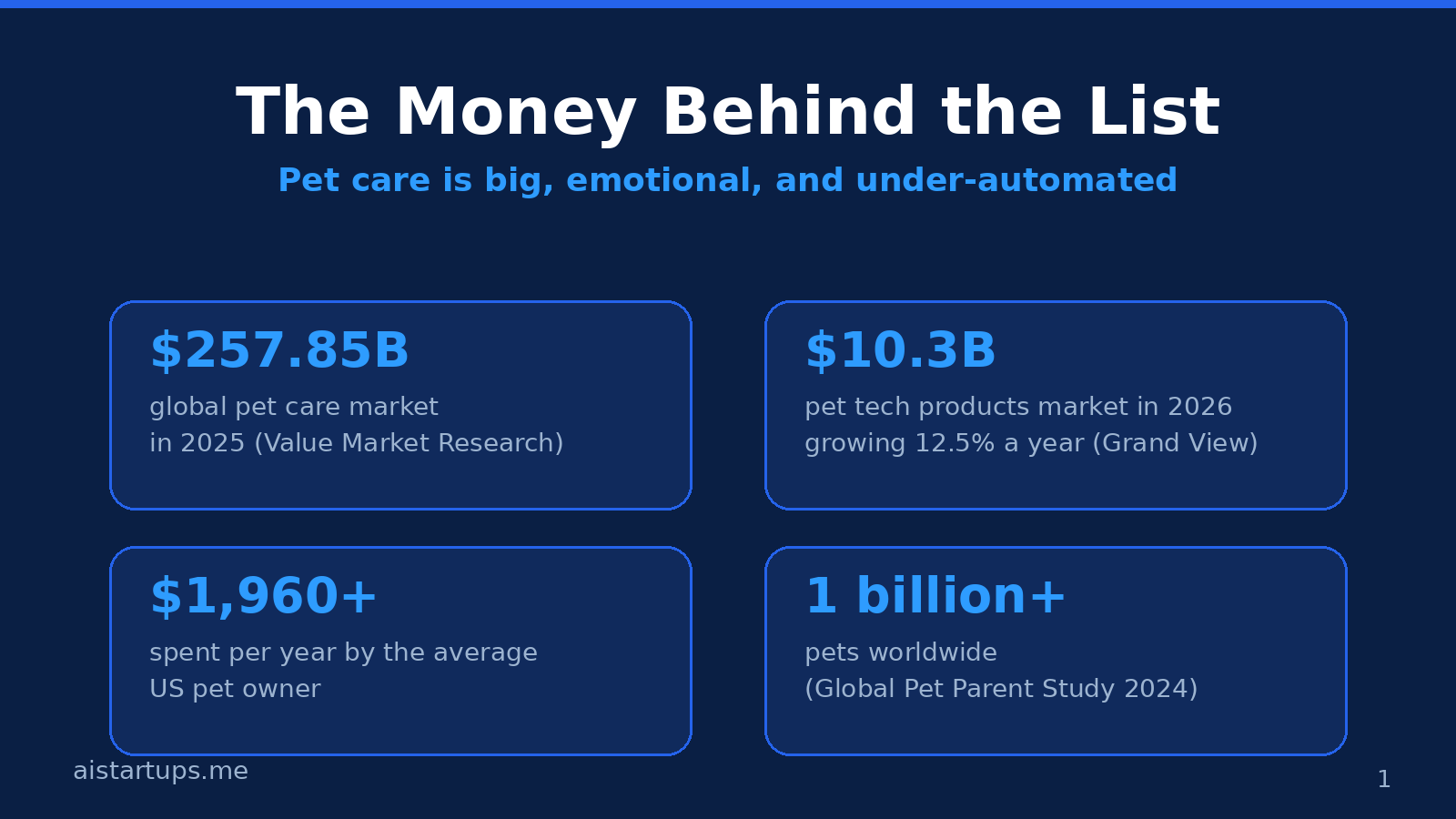
Here’s a number that should make any founder sit up straight: the average American pet owner now spends over $1,960 a year on their pets. Not on a car. Not on a holiday. On the dog. On the cat. On food, vet visits, grooming, toys, and the endless parade of things a creature who can’t hold a job somehow needs.
And the market behind that spending is enormous. The global pet care market is valued at $257.85 billion in 2025, projected at $275.67 billion in 2026, and heading for $470.47 billion by 2034 at a 6.91% annual growth rate. That’s the whole pet economy — food, vet care, grooming, boarding, all of it. The tech slice inside it is growing even faster: the pet tech products market is $9.2 billion in 2025 and $10.3 billion in 2026, on its way to $23.5 billion by 2033. And if you use the broader definition of pet tech — the one that folds in healthcare platforms and services — Global Market Insights puts it at $19.1 billion in 2026, growing to $52.9 billion by 2035. (The estimates disagree because they count different things. The direction doesn’t change: up, fast, and driven by people who treat pets like family.)
Here’s the thing, though. Pet care is still, in most places, a pen-and-paper industry wearing a smartphone costume. The vet clinic that does brilliant medicine still books appointments by phone. The groomer with a three-week waitlist still manages it in a notebook. The boarding kennel still loses money on empty runs it could have filled. And the pet owner — the person spending that $1,960 a year — still Googles “is my dog’s limp serious” at 11 PM and gets ten contradictory answers from a forum.
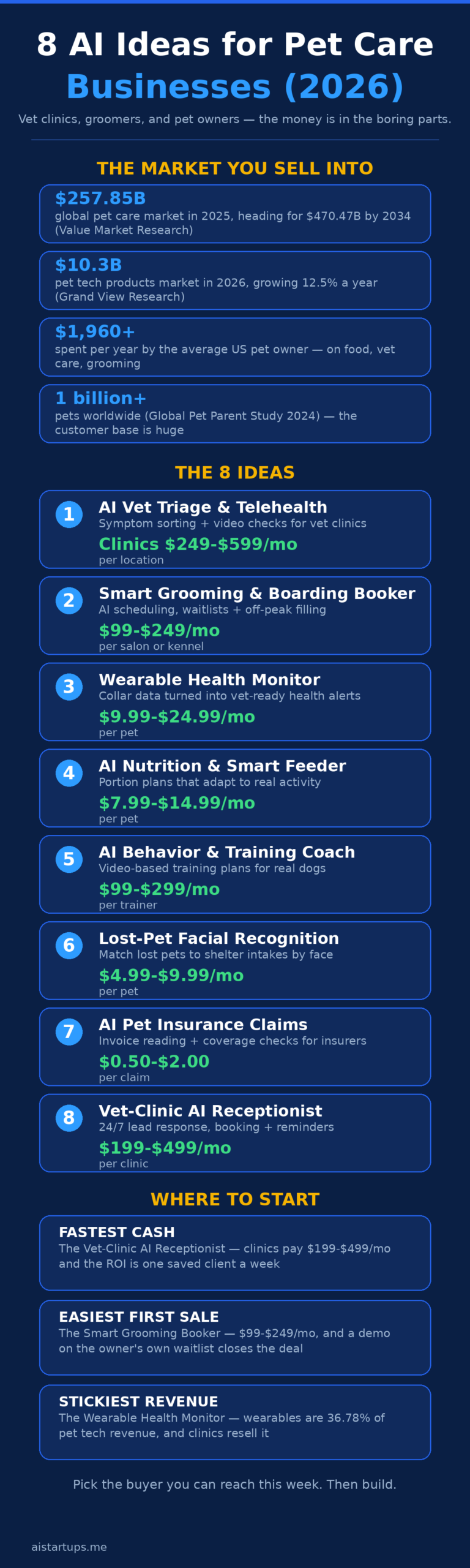
That’s the opening. This list is 8 AI product and service ideas for pet care that a solo founder or tiny team could realistically build and sell. Each one gets the same treatment — the pain, the product, who pays, and rough pricing. No venture funding required. And one ground rule runs through all of them: AI flags and triages, vets diagnose. The moment your product starts claiming to replace a veterinarian, you’re in regulated territory and you’ve lost the trust of the exact people you need to sell to. Let’s go.
How I scored these ideas
Before the list, a quick note on how I’m judging. Every idea gets two rough scores: startup cost (how much time and money to build a working version) and revenue potential (how big the check is and how often it repeats). Cheap-to-build plus big-money is the sweet spot. But there’s a third factor I care about more in pet care than in most industries: who the buyer is. A product sold to a vet clinic with a budget is a completely different business from an app sold to a pet owner who cancels after the free trial. The B2B ideas on this list will look boring next to the consumer apps. Boring is good. Boring pays rent.
One more thing before we start: every price in this article is a rough estimate, not a quote. Treat them as starting points for your own research, not gospel. The market numbers, though, are real — every stat is linked to its source, and where the sources disagree (those pet tech market sizes, for example), I’ve said so instead of picking the biggest number and pretending the others don’t exist.
Idea 1: The AI Vet Triage & Telehealth Front Door
Picture this. It’s 11:40 PM. A dog owner notices her beagle is vomiting for the third time. She Googles the symptoms, gets ten answers ranging from “he ate something weird, he’ll be fine” to “go to the emergency vet NOW,” and panics in the wrong direction — either rushing to the ER for an upset stomach or waiting too long on something serious. Meanwhile the local vet clinic’s phone rings 40 times a day with exactly these questions, and the front desk — one person, on a good day — spends half its shift playing telephone triage.
The product: an AI triage front door for vet clinics. The owner describes the symptoms in plain language (text, voice, or a photo of the wound, the stool, the weird rash), and the AI sorts the case into three buckets: routine (book a normal appointment), soon (book within 24–48 hours), or urgent (call now / go to emergency). It asks the right follow-up questions — how long, how often, eating and drinking normally, any blood — and hands the vet a structured summary before the visit even starts. Paired with a telehealth layer, the vet can do a quick video check on the “soon” cases without burning a full exam slot.
Why does this sell? Because it attacks the two most expensive things in a vet clinic: phone time and missed cases. Every triage call the AI handles is ten minutes the front desk gets back. Every routine case it books online is a slot filled without a human touching it. And every urgent case it catches early is a pet that gets seen in time — which is the kind of story a clinic tells its clients for years. The telehealth angle matters too: clinics that ran video consults during the pandemic know the demand never went away. Owners love a 15-minute video check for a post-op wound or a medication question. Vets love it when it doesn’t eat their exam-room schedule.
The non-negotiable: this product never diagnoses. It flags, it sorts, it summarizes, and it routes — and the moment anything is ambiguous, it escalates to a human vet. That framing isn’t just honest, it’s the sales pitch. Vets are (rightly) allergic to anything that smells like a robot playing doctor. “Your team reviews every case, the AI just does the paperwork and the sorting” is a sentence a practice owner can say yes to. And the demand signal is real: Bond Vet raised $245 million to expand its network of modern vet clinics, which tells you investors believe the vet front door is worth rebuilding.
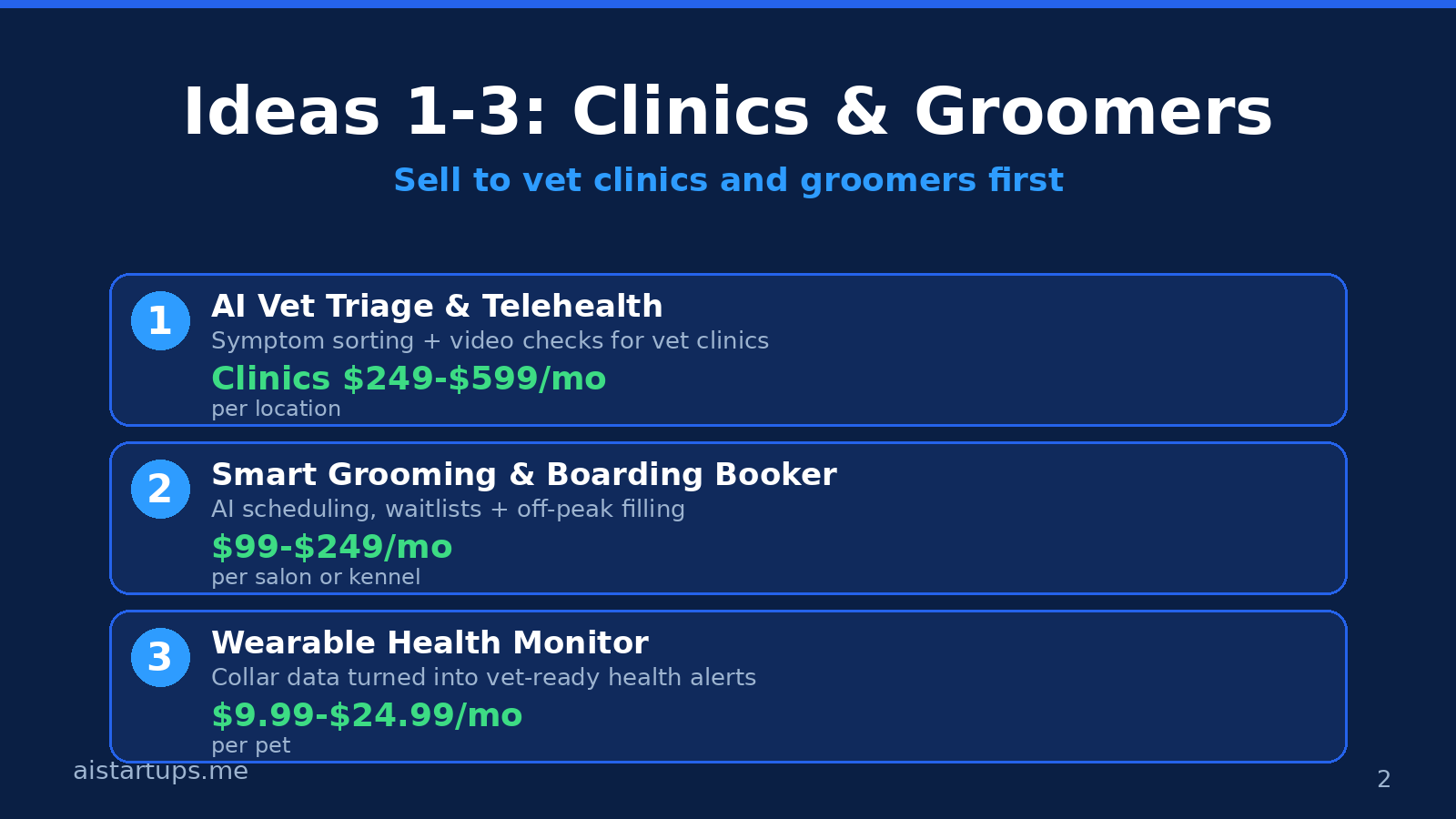
Who pays: vet clinics, $249–$599/mo per location, priced by call and chat volume. Or pet owners directly, $9.99–$19.99/mo for a triage subscription tied to their clinic. I’d start B2B — one clinic sale is worth 30 consumer subscriptions, and clinics churn far less than worried pet owners. If you want a sense of how the same admin-automation play works in human healthcare, AI healthcare admin startup ideas covers the same pattern on the other side of the waiting room.
Idea 2: The Smart Grooming & Boarding Booking Engine
Every groomer I know has the same two problems at once: a three-week waitlist for Saturday appointments, and empty Tuesday slots nobody wants. The schedule was set months ago by a human guessing at demand, the pricing is flat — $60 whether it’s prime Saturday or dead Tuesday — and the booking itself still happens by phone, which means the groomer is either cutting hair or answering the phone, never both.
The product: an AI booking engine built specifically for groomers, boarders, and daycare centers. It does three things the generic booking tools don’t. First, it manages the waitlist properly: auto-book the next person when a slot opens, text them, release the spot if they don’t confirm in 15 minutes. Second, it handles the messy reality of pet bookings — breed, coat condition, matting, temperament, “this dog bites strangers” — and prices and schedules accordingly, so a matted doodle doesn’t get a 45-minute slot that actually takes two hours. Third, it fills the dead slots: nudges and small discounts for off-peak times, rebooking reminders (“Biscuit is due for a groom in 3 weeks — want the usual Saturday?”), and no-show reduction with auto-confirmations and a late-cancel policy enforced by the system, not by a tired receptionist.
Why this is a great first business: the customer is obvious, the pain is daily, and the sale is easy to make in one conversation. A grooming salon with 20 appointments a week and a 15% no-show rate is losing three full appointments of revenue every week. Auto-confirmations and waitlist backfill recover most of that. That’s found money, and found money is the easiest thing in the world to sell. The boarding angle makes it even stickier — kennels have seasonal peaks (holidays, summer) where every empty run is money gone forever, and an engine that fills gaps from the waitlist pays for itself in a single Thanksgiving week.
Start narrow: one city, one niche. Dog grooming salons are perfect — small businesses, owner on site, decisions made in a single visit, and they talk to other groomers constantly. The same booking playbook works in other local verticals too — AI services local businesses actually buy covers the same pattern — but pet grooming has a built-in advantage most local niches don’t: the customer comes back every 4–6 weeks forever, so the salon’s lifetime value math makes your monthly fee look tiny.
Who pays: groomers, boarding kennels, and daycare centers, $99–$249/mo per location. The booking engine is the cheapest idea on this list to build and one of the fastest to sell — a demo on the owner’s own waitlist closes the deal.
Idea 3: The Wearable Health-Monitoring Subscription
Here’s the thing about pet wearables: the hardware already works, and the data it produces mostly goes to waste. A smart collar can track activity, sleep, scratching, licking, and even hydration — Mordor Intelligence notes the Fi Series 3+ collar detects scratching, licking, and hydration, and wearables are the biggest slice of the pet tech market at 36.78% of revenue in 2025. But what does the average owner do with that data? Glance at a step count, feel vaguely reassured, and move on. The collar knows the dog started scratching twice as much this week. Nobody acts on it.
The product: a health-monitoring subscription that turns collar data into decisions. Not “your dog walked 8,432 steps” — but “scratching is up 40% this week, and that pattern usually means allergies or a skin issue. Here’s what to watch for, and here’s a vet appointment slot on Thursday if it doesn’t settle.” The AI learns each pet’s baseline over weeks, so it flags changes from normal rather than generic thresholds. A senior dog slowing down 15% over a month gets a different alert than a puppy having a lazy Tuesday. And when something does look off, the summary goes straight to the owner’s vet — a one-page report the vet can actually use, instead of the owner trying to remember when the scratching started.
The market math is the strongest argument here. Wearables and trackers are the largest pet tech segment at 25.5% share according to Grand View Research, and North America alone is 42.2% of the market — so the customers are concentrated, reachable, and already buying collars. The hardware companies built the sensors. The intelligence layer on top — the part that tells an owner what the data means and when to act — is still wide open for a small player, especially one that isn’t tied to a single collar brand. Be the software that works with Fi, Whistle, Tractive, and whatever comes next, and you own the relationship.
One number worth treating with care: a peer-reviewed study cited in the Mordor report found 87.5% concordance between AI predictions and vet assessments. That’s genuinely encouraging — and it’s one study, not a guarantee. Your product should quote it as what it is (a promising study) and build its own track record with real vets, one clinic at a time. Trust compounds slowly in pet health, and it evaporates instantly if you overclaim.
Who pays: pet owners, $9.99–$24.99/mo per pet; or vet clinics, $5–$12 per enrolled pet per month for a white-labeled version they offer their clients. The clinic route is the better business — a vet who recommends your monitor to every new puppy owner is a distribution channel you could never buy. Fifty clinics at $300/mo is $15,000 MRR from a single metro area.
Idea 4: AI Nutrition & Smart-Feeder Personalization
Ask any vet what they see too much of and they’ll tell you: overweight pets. Vets raise weight at the annual checkup and the owner almost never believes it. “He’s just big-boned.” Meanwhile the feeding routine is a scoop of kibble eyeballed into a bowl twice a day, treats handed out by three different family members, and a smart feeder — if there is one — dispensing the same amount on the same schedule regardless of whether the dog had a 10-mile hike or a rainy day on the couch.
The product: a nutrition engine that connects the feeder, the activity tracker, and the vet’s guidance into one loop. The owner sets the target (maintain weight, lose 2 kg, support a senior dog’s joints), the AI adjusts portions daily based on actual activity, flags treat creep (“someone in the house is giving Biscuit a lot of extra calories — here’s the math”), and re-plans when life happens: boarding next week, a new food brand, a vet-prescribed diet change. The feeder dispenses the right amount automatically. The app shows the trend, not the guilt trip.
Why this works as a startup and not just a feature: nutrition is the half of pet care that nobody sells well. The vet mentions weight at the annual checkup; the pet food company sells the bag; nobody owns the daily feeding decision. And the hardware is already in people’s homes — smart feeders and smart litter boxes are a real category now. Petlibro expanded its AI-powered Luma Smart Litter Box into nearly 400 PetSmart stores in March 2026, which tells you the big retailers believe pet owners will buy connected hardware. Your product is the brain that makes that hardware smart — and it’s a subscription, not a one-time gadget sale, which is the whole point.
The buyer is obvious: the owner of an overweight pet who has already tried and failed with “just feed less.” That’s a purchase made with guilt and a credit card, and it’s a subscription that sticks because the results are visible on the scale. The B2B lane is the vet clinic again — vets prescribe weight-loss plans constantly and have no tool to track whether the owner follows them. Give the clinic a dashboard (“Biscuit is down 0.4 kg, on plan”) and you’ve just productized the most common advice a vet gives.
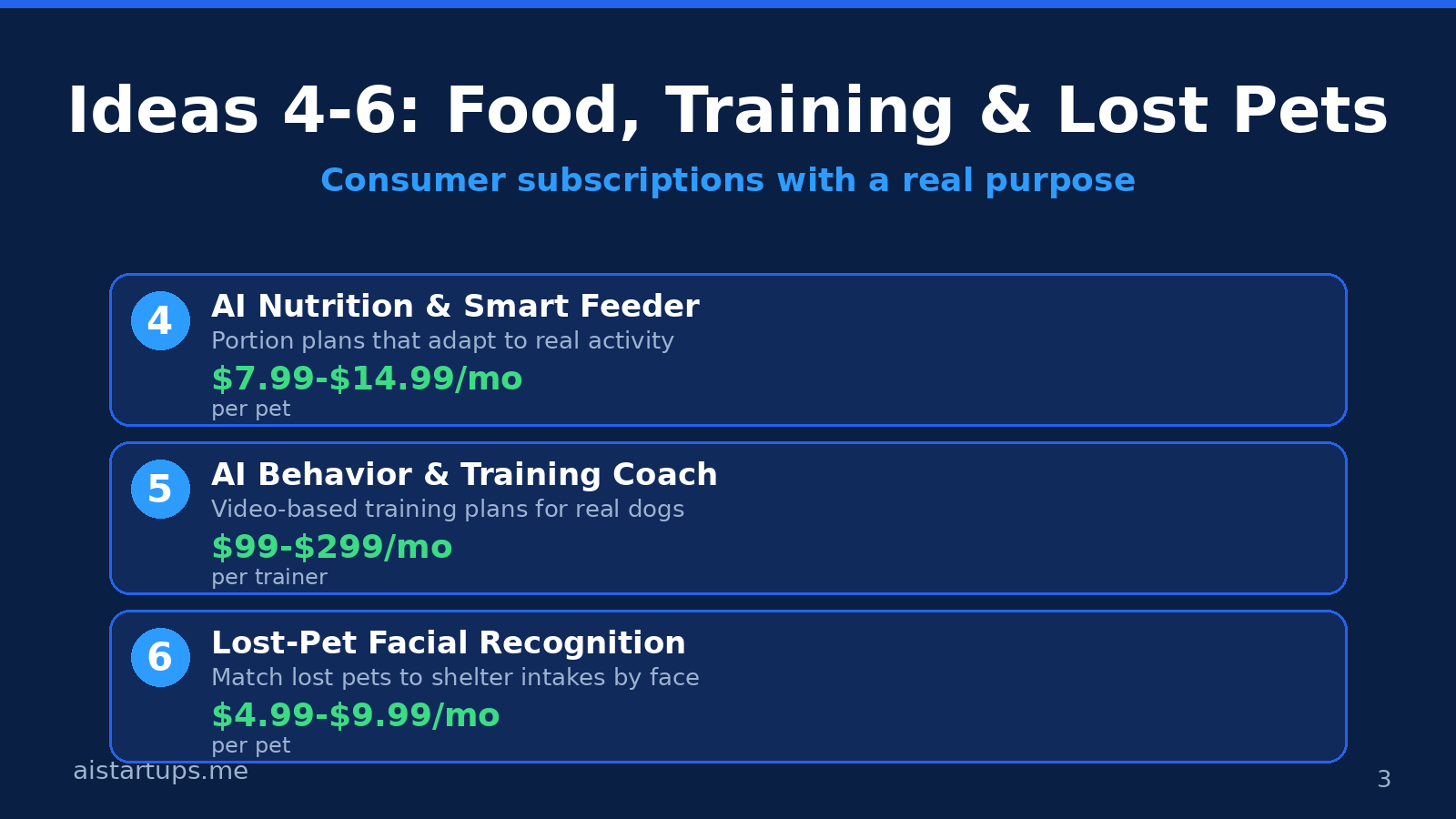
Who pays: pet owners, $7.99–$14.99/mo; or vet clinics, $149–$299/mo for the clinic dashboard with patient management. Honestly, start with the owners — they’ll tell you exactly what’s missing in week one, and they’ll pay you while they do it.
Idea 5: The AI Behavior & Training Coach
Every dog trainer has had this conversation. Owner: “My dog barks at everything and pulls on the lead.” Trainer: “How much exercise does he get?” Owner: “Uh… normal amounts.” Nobody tracks it accurately, and the advice that exists is a YouTube rabbit hole of contradictory methods — one video says use a prong collar, the next says that’s cruel, the third is a guy yelling at a husky. The owner tries three methods in a week, the dog gets confused, and the trainer gets a call six months later when the problem is worse.
The product: a behavior coach that turns the owner’s phone into a training assistant. The owner films a 30-second clip of the problem behavior — barking at the door, pulling on walks, separation anxiety when they leave — and the AI analyzes the body language and context, then gives a specific, step-by-step plan for that dog, not a generic breed guide. It tracks progress week by week (“barking episodes down from 9 a day to 4”), adjusts the plan when something stalls, and knows when to say the magic words: “this one needs a human trainer — here’s one in your area.”
Here’s why the timing is good: the global pet population exceeds one billion animals, according to the Global Pet Parent Study 2024 cited by Global Market Insights. That’s a billion pets, and a meaningful share of them have a behavior problem their owner would pay to fix — because behavior problems are the number one reason dogs get surrendered to shelters. This isn’t a nice-to-have app. For a family deciding whether they can keep their dog, it’s the product that decides the outcome. That’s a purchase with real emotional weight behind it, and it’s a market where the existing tools are either a $200-an-hour trainer or a free video that contradicts the last one.
The wedge is trainers, not consumers. Sell it to the trainer as a between-sessions tool: “your clients get coached every day, and you can take on 30% more clients because the app handles the homework.” Trainers are wonderful customers — they buy with business money, they talk to other trainers constantly, and a tool that makes their clients’ dogs behave better spreads by word of mouth. The consumer version works too, but honestly, the trainer’s endorsement is what makes a worried owner trust an app with their dog’s behavior.
Who pays: dog trainers and behaviorists, $99–$299/mo for a branded version their clients use; or consumers directly, $9.99–$19.99/mo. I’d start B2B — one trainer with 30 clients is 30 users you never had to acquire, and the trainer will tell you in week one whether your plans actually work on real dogs.
Idea 6: The Lost-Pet Facial Recognition Network
Losing a pet is one of the worst days of an owner’s life, and the system for finding them is still basically a paper poster and a prayer. Someone posts in a neighborhood Facebook group, someone else shares it, a shelter 20 miles away takes in a scared dog and has no idea who it belongs to. The microchip only helps if someone scans it. The collar tag only helps if it’s still on. And the first 24 hours — the window when most lost pets are found — are spent on hope and luck.
The product: a lost-pet network built on facial recognition for animals. Owners register their pet with a few photos (the app guides them: front, both sides, distinctive markings). When a pet goes missing, the owner files a report in one tap, and the network goes to work: it scans new intakes at partner shelters and rescues, watches posts in local lost-pet groups, and alerts nearby users (“a dog matching Biscuit was spotted two blocks from you”). The recognition model matches on facial structure and coat patterns, not just breed and color, so it can tell two similar golden retrievers apart.
Why this one is different from the rest of the list: it’s a network-effects business, which means it’s slow to start and very hard to displace once it works. The first city is the hardest — you need shelters, rescues, and enough owners registered before the matching is useful. But once a shelter in your city is scanning every intake against your database and reuniting pets in hours instead of weeks, every other shelter in the region wants in, and every owner who hears the story registers their pet the same day. The pitch to shelters is free or nearly free — they’re nonprofits doing heroic work on nothing — and the revenue comes from the owner side: a $4.99/mo “protected pet” subscription, or a one-time $49 registration with lifetime alerts.
One caution, and it’s a big one: this product lives or dies on accuracy and honesty about its limits. A false match that sends a grieving owner to the wrong shelter is worse than no match at all. Ship with confidence scores, show the owner the comparison photos, and let a human confirm every match before anyone gets their hopes up. And be upfront that this is a complement to microchips, not a replacement — the chip is still the gold standard when a vet or shelter scans a found animal. Your network is the layer that finds the pet before anyone gets that far.
Who pays: pet owners, $4.99–$9.99/mo per pet or $49 one-time registration; shelters and rescues get free access, and municipalities pay $500–$2,000/mo for a city-wide deployment. The municipal lane is the sleeper — a city that can show it reunites more pets and euthanizes fewer will fund this from the animal-services budget without blinking.
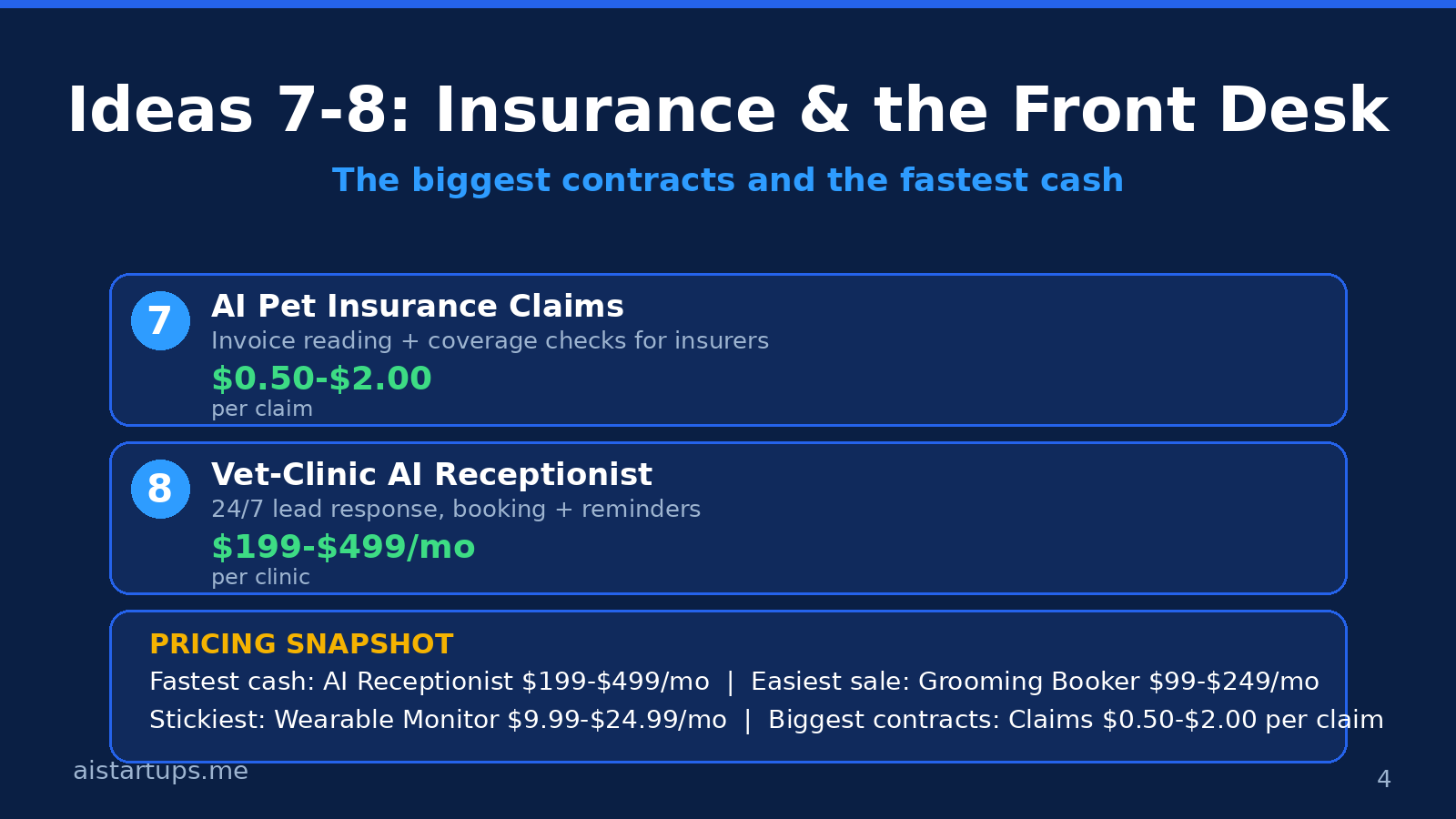
Idea 7: AI Pet Insurance Claims Automation
Pet insurance is booming — and the claims process is where it goes to die. An owner pays a $400 vet bill, photographs the invoice, uploads it to an app, waits a week, gets asked for “additional documentation,” uploads the same invoice again, and eventually gets a partial reimbursement with a line item they don’t understand. The insurer’s side isn’t better: adjusters drown in handwritten invoices, inconsistent procedure codes, and photos of receipts taken at a bad angle. Everybody hates the process, and everybody blames the other side.
The product: a claims-automation layer for pet insurers (and for the vet clinics that feed them). The AI reads the invoice — any format, any handwriting, any bad photo — extracts the procedures, matches them against the policy’s coverage, flags anything that needs a human look, and drafts the decision with the reasoning attached. A claim that used to take a week takes a day. A claim that used to need three rounds of “please provide more information” needs one. And on the clinic side, the same tool pre-checks coverage before the owner is even asked to pay: “this procedure is covered at 80%, your out-of-pocket is $84.”
Why insurers buy this: claims processing is their biggest operational cost after the payouts themselves, and speed is the thing their customers actually judge them on. An insurer that reimburses in 24 hours gets five-star reviews; an insurer that takes two weeks gets a cancellation and a viral complaint. The ROI pitch is trivially easy to make — “we cut your cost per claim in half and your processing time by 80%” — and it’s a B2B sale to a buyer with a real budget and a real pain. The market tailwind helps too: with owners spending $1,960+ a year and vet costs climbing, insurance adoption keeps rising, which means claim volume keeps rising, which means the automation problem gets worse every year you wait.
The hard part is trust and compliance. Insurers are regulated, cautious, and allergic to black-box decisions — so your product must show its work on every claim: what it read, what it matched, why it decided, and a clean handoff to a human adjuster for anything ambiguous. Start with one mid-size insurer as a pilot, on one claim type (routine wellness visits are the simplest), and expand from there. And keep the framing tight: this automates paperwork, not judgment. The adjuster still decides the hard cases — they just stop spending their day retyping invoices.
Who pays: pet insurers, $0.50–$2.00 per claim processed, or $2,000–$10,000/mo per insurer for a platform license. The per-claim model is the easier first sale — the insurer pays only when the tool does work — and the platform license is the upsell once they trust it. This is the biggest-contract idea on the list, and also the slowest to close — budget for a 60–90 day sales cycle and a pilot before the company-wide rollout. If you want the broader playbook for selling AI services to businesses with real budgets, 12 AI micro-SaaS products you can launch solo covers the same pricing logic in other niches.
Idea 8: The Vet-Clinic AI Receptionist
This is the fastest-cash idea on the list, and it’s not close. Here’s a scene that plays out every day in every vet clinic: someone Googles “vet near me,” finds the website, fills in the contact form at 9 PM asking about prices and availability — and hears nothing until the front desk opens at 8 AM, by which time they’ve already booked the competitor that answered instantly. Vet clinics sell a service people buy on impulse and anxiety, and they staff their front desk like it’s 1998.
The product: an AI receptionist for vet clinics. It answers every inquiry 24/7 — website chat, Instagram DMs, SMS, missed-call text-back — answers the common questions (pricing, hours, vaccine schedules, “do you see rabbits?”), triages the urgent ones to the on-call vet, books the appointment, sends the reminders, and follows up automatically until the owner shows up or opts out. When the conversation gets complicated, it hands off to a human with a full transcript. It also handles the unglamorous stuff that eats a clinic’s day: prescription refill requests, vaccine reminders, post-op check-in messages, and the “your lab results are in” call that nobody has time to make.
The ROI pitch writes itself, and that’s the whole point. A clinic that converts even two extra new-client bookings a week has paid for the tool ten times over. “We pay for ourselves if we save you one lost client a week” is a sentence a practice owner understands instantly, because they can feel the calls slipping away every night. And the retention angle is just as strong: a clinic that texts a vaccine reminder at the right moment keeps a client for years; a clinic that forgets loses them to the practice down the road.
The tech here is the most accessible on this list. You don’t need to train a model — you need a good voice and text agent wired into the clinic’s booking system and a solid handoff flow. The moat isn’t the AI, it’s the integrations and the playbooks: the exact follow-up sequence that gets a new client to actually show up, the exact answers to the 40 questions every owner asks, the exact moment to offer the new-client exam rate. Build those from your first five clinics and you’ve got something a generic chatbot company can’t copy. This is the same playbook that works for AI ideas for fitness and wellness — except vet clinics have recurring revenue and a visible leak, so the sale is easier than in most local verticals.
Who pays: vet clinics, $199–$499/mo per location. Start with independent clinics in one city; the owner is usually on site and can say yes the same day you demo it. This pairs naturally with Idea 1 — the receptionist answers, the triage engine sorts — and selling both to the same clinic is a $500+/mo account from a single relationship.
The fastest way to actually start
Okay, eight ideas. Now the part most lists skip: how do you pick one and ship it? Here’s my honest take, and it’s the same advice I’d give a friend.
- Don’t build first. Pick the idea whose customers you can reach this week. The Grooming Booker sells to groomers — are there 20 grooming salons in your city you could walk into today? The Receptionist sells to vet clinics — do you know anyone who works at one? Distribution beats product every single time, and in a relationship-driven industry like pet care, warm intros are the whole game. This is the same reason AI side hustles that actually make money tend to be boring service businesses with a clear customer, not clever tech.
- Sell the service before the software. For almost every idea on this list, you can run the first 5–10 customers manually with AI tools behind the scenes. Answer a vet clinic’s messages by hand with an AI-drafted script before you build the Receptionist. Run a grooming waitlist audit for three salons in a spreadsheet before you build the Booker. You’ll learn what customers actually want (it’s never what you think), get paid while you learn, and only automate what’s proven. The software comes later, once the playbook is obvious.
- Price on the customer’s math, not yours. A vet clinic doesn’t care that your AI costs you $0.40 per conversation. It cares that one new client is worth far more over the pet’s lifetime than a month of your fee. Price at a fraction of the value you create — two saved clients a week against a $299/mo fee is a rounding error, which is exactly why they’ll say yes.
Before you commit to an idea, run this five-minute gut check:
- Can you name 10 specific people who feel this pain right now?
- Would at least one of them pay you $100+ this month for a manual version?
- Does the buyer control a budget (not “ask my boss”)?
- Is there a natural repeat — another month, another season, another location?
If you get four yeses, build it. Three yeses, talk to five buyers first. Fewer than that — pick a different idea off the list.
And if the idea of building the whole thing yourself makes you want to lie down — fair. This is also a legitimate path: partner with a web development studio to build the MVP while you focus on customers. AISquadX is the kind of AI integration studio that can take a validated idea from this list to a working product in weeks, which is the right division of labor when your superpower is selling, not shipping code.
Pet owners spend over $1,960 a year on their animals, and the global pet care market is heading for $470 billion. Every idea on this list is just a different way to answer the phone faster, book the slot that’s sitting empty, or catch the health problem a week earlier — and in pet care, a week earlier is everything.
FAQ
Do I need pet industry experience to build one of these?
No — and honestly, outsiders often see the gaps more clearly. What you need is access: five conversations with vet clinic owners, groomers, or trainers will teach you more than a year of reading. Ask about their worst week, not their dream software. Build for the pain, not the fantasy. The one exception is the triage and wearable ideas, where you really do need a vet as a co-designer from day one — and where the AI must flag and route, never diagnose.
How much does it cost to build an AI pet care tool?
Less than you’d think. The cheapest ideas here (the AI Receptionist, the Grooming Booker as a manual service) can start as a service run with AI tools behind the scenes — a few hundred dollars in tooling. A real SaaS MVP with booking integrations and a proper front end runs $3k–$15k depending on complexity. The expensive part was never the code; it’s the months of selling to get your first 20 customers. The wearable and facial-recognition ideas cost more — hardware partnerships and model training aren’t free — so start those as a service or a pilot with one clinic or shelter before you commit real money.
Isn’t pet tech already crowded with big players?
The hardware is crowded. The software layer that serves small businesses mostly isn’t. Fi, Whistle, and Tractive own collars; the big practice-management systems own the vet clinic’s back office. But the gaps between them — the front door, the waitlist, the between-visit coaching, the claims paperwork — are still served by phone calls, notebooks, and gut feel. That’s where a solo founder wins: not by out-building the giants, but by owning one painful workflow for one kind of customer in one city, then expanding from there.
Can these ideas work outside the US?
Yes, with localization. The pet care market is global — North America is 42.2% of the pet tech products market, which means nearly 60% of it is everywhere else, and the fastest growth in pet tech is coming from Asia Pacific. The Grooming Booker and the Receptionist translate almost directly anywhere vets and groomers exist. The insurance idea needs local insurance structures. The lost-pet network needs local shelter partnerships. Honestly, less-saturated markets are often the better opportunity — the US has the most pet tech competition on earth, and a good booking engine in a city with none is a much easier sale.
Which idea makes money the fastest?
The service-first ones: the Vet-Clinic AI Receptionist and the Smart Grooming Booker. You can sell both this week — answer a clinic’s messages for them, manage a groomer’s waitlist by hand — and convert to software later. The slowest is the Lost-Pet Facial Recognition network: it needs shelters, registrations, and a critical mass of users before the matching is useful at all. Fast money: sell the painkiller. Big money: build the network.
The Bottom Line
Pet care is a $257.85 billion industry heading for $470 billion, built on owners who spend over $1,960 a year and would spend more if someone made their life easier — and it still runs large parts of its operation on phone calls, notebooks, and gut feel. That’s not a criticism. It’s the opening. You don’t need a breakthrough model. You need to pick one painful, specific problem, sell the fix to people who feel it weekly, and charge a fraction of the value you create.
My shortlist, if I were starting tomorrow: the Vet-Clinic AI Receptionist for fast cash, the Wearable Health Monitor for sticky subscription revenue, and the Grooming Booker for the easiest first sale. But the best idea is the one whose customers you can reach this week. Pick your lane from the chart, talk to five potential buyers, and start selling the service before you build the software. The pets are already in the waiting room — and somebody’s going to build the tools that look after them. Might as well be you.