

Here’s a number that should change how you think about your first enterprise customer: the median B2B SaaS sales cycle is 84 days, and for deals in the $50k–$100k range it stretches to roughly 120 days. Selling into a company with 10,000+ employees? That averages 185 days. And those are the medians — the deals that actually close.
Now here’s the thing nobody tells first-time AI founders: your first enterprise deal won’t look like a sale at all. It’ll look like a partnership. A messy, slow, gloriously unglamorous partnership where one brave team inside a big company agrees to build something with you before your product is really finished. That’s a design partner. And if you land the right one, it changes everything — your roadmap, your pricing, your credibility, and your odds of ever getting a second enterprise customer.
I’ve spent a lot of time studying how early AI startups actually pull this off, and the pattern is surprisingly consistent. The founders who win enterprise design partners aren’t the ones with the slickest decks or the biggest models. They’re the ones who treat the whole thing as a co-building exercise, price it like a real business, and survive the unsexy parts — security reviews, procurement, legal — without losing their minds.
Real talk: this is the hardest way to get your first customer. It’s also the best one. A design partner who converts to paid is worth more than a hundred free signups, because they prove a stranger with a budget will pay for what you built. So let’s walk through the whole playbook — finding the partner, structuring the deal, running the pilot, and turning it into a contract.
What an Enterprise Design Partner Actually Is
A design partner isn’t a beta tester. Beta testers poke at a finished product and file bugs. A design partner helps you decide what to build in the first place — in exchange for early access, influence over the roadmap, and usually a discount at launch.
The distinction matters because it changes the whole relationship. A beta user owes you nothing. A design partner commits time: regular calls, real workflows, real data, honest feedback when something doesn’t work. In return, you commit to actually listening — and to building what they need, not just what you planned.
Bessemer Venture Partners puts it well: design partners are a small, deliberately selected group of target customers who shape the product from the very beginning. Done right, the program validates your product, tells you what to build first, confirms what customers will pay, and can become your first batch of paying advocates — before you’ve ever run a formal sales motion.
And the numbers behind that claim are striking. Strella, an AI-powered customer research platform, recruited 12 design partners entirely through cold LinkedIn outreach — no warm intros, no favors. All 12 converted to paid customers. The company hit $1.6 million in ARR in its first year of monetization, with 150% net dollar retention on that first cohort. That’s not a feel-good story. That’s product-market fit, measured in revenue.
Ada took a different route to the same idea. Before writing a single line of code, co-founders Mike Murchison and David Hariri worked as customer service agents at seven different companies. Those seven companies became Ada’s original design partners — and the partnership taught them something no spreadsheet could: enterprise buyers didn’t want outcome-based pricing tied to resolved tickets. They wanted predictable annual commitments they could budget around. That one insight shaped Ada’s entire pricing model.
Why Enterprises Say Yes (and Why Most Say No)
Let’s be honest about the other side of the table. A big company doesn’t need you. It has vendors, budgets, procurement processes, and a security team whose entire job is saying no to small companies with unproven software. So why would anyone inside a 5,000-person enterprise take a chance on your three-person startup?
Because of pain. Specific, expensive, someone’s-bonus-depends-on-it pain.
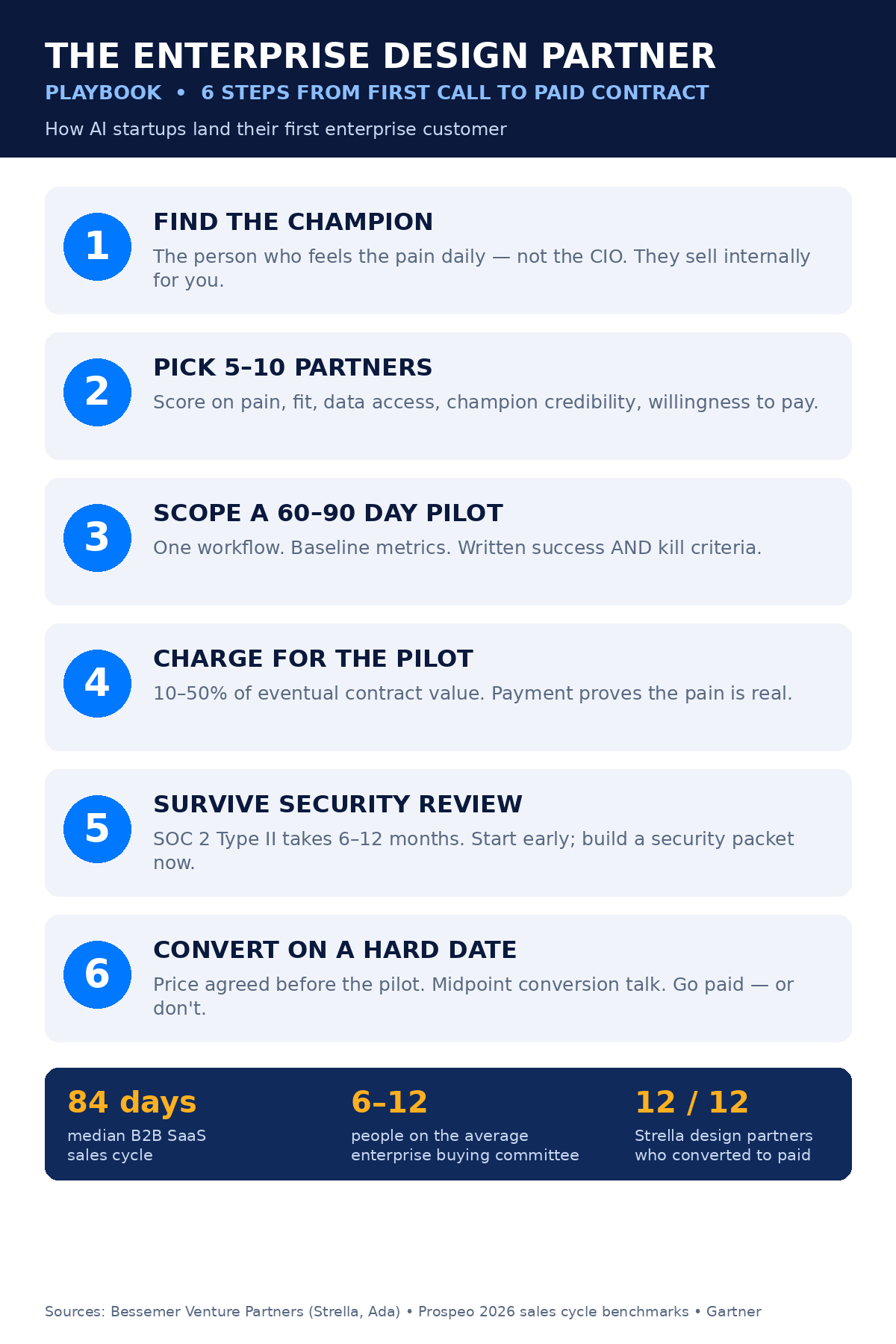
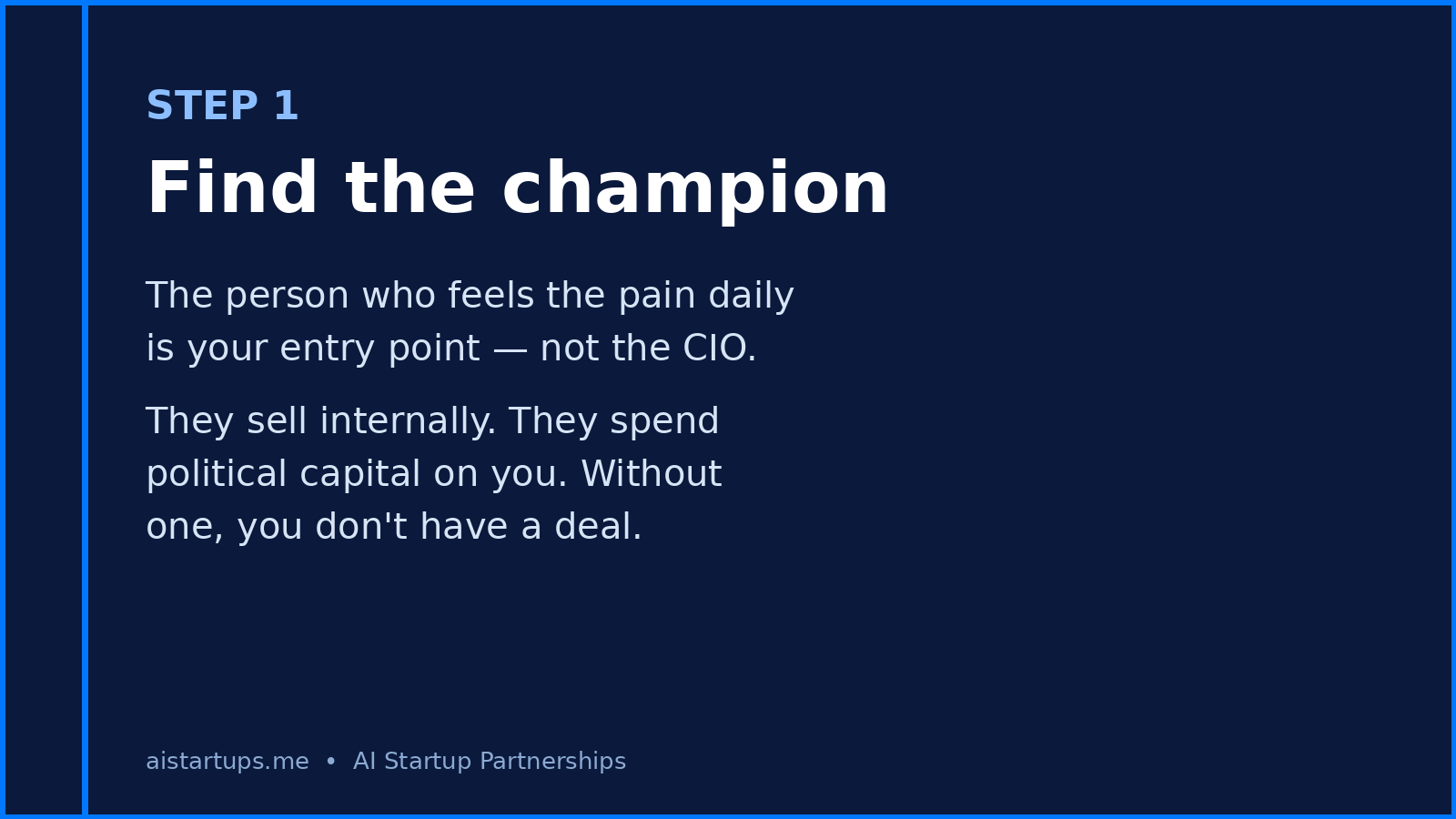
The champion — that one person inside the company who feels the problem daily — is your entire entry point. They don’t care about your model architecture. They care that their team spends 20 hours a week on work your product could do in two. They care that their boss keeps asking why a process takes six weeks. Your job isn’t to impress the enterprise. It’s to find that one person, prove you understand their pain better than they do, and give them something they can sell internally.
Here’s what usually kills the deal before it starts:
- You pitch the product, not the problem. Enterprise buyers have seen a thousand AI demos. They’ve never seen someone describe their exact workflow pain back to them, accurately, in their own language.
- You target the wrong person. The CIO doesn’t feel the pain. The head of the team doing the work does. Start there.
- You look like a science project. If your demo needs a PhD to run and your security posture is “we’ll figure it out,” the champion can’t defend you in the room where decisions happen.
- You ask for too much, too soon. A company-wide rollout on the first call is a fantasy. A 30-day test with one team is a conversation.
The founders who land design partners understand a simple truth: you’re not selling software. You’re selling a small, safe experiment that makes one person inside a big company look good.
How Many Partners — and How to Pick Them
Don’t try to recruit twenty design partners. You’ll drown. Most practitioners recommend somewhere between five and twelve. Bessemer’s guide lands on the same range: enough to spot patterns across your ideal customer profile, few enough that the feedback stays manageable and the program keeps its high-touch character. The a16z framework often cited in this space suggests five to ten, and warns against going above twenty.
The number matters less than who you pick. The a16z framework often cited in this space boils selection down to a few tests — and the practical advice is consistent everywhere: score every candidate on five things:
- Acute pain. Do they feel this problem badly enough to spend their own political capital on it? If the answer is “sort of,” move on.
- Fit with your ideal customer. Your first partner should look like your tenth customer. A logo that doesn’t match your target market teaches you the wrong lessons.
- Access to real users and real data. A partner who can’t get you in front of the actual team doing the work is a dead end. You need the workflow, not a slide about the workflow.
- A named champion with internal credibility. Not “someone in ops.” A person, with a title, who can get a meeting with procurement and legal when the time comes.
- Willingness to pay — eventually. This is the filter most founders skip, and it’s the one that matters most. A partner who will never pay is an advisor, not a customer.
One more thing about picking: cold outreach is a feature, not a fallback. Strella deliberately recruited strangers through cold LinkedIn messages because they wanted an honest signal. As co-founder Lydia Hylton put it, “It’s much harder to convince a stranger on the internet than someone doing you a favor. If you can get a stranger to become a design partner, you likely have something.” A friend who says yes out of kindness tells you nothing. A stranger who says yes tells you everything.
That said, be realistic about the volume. Playbooks from founders who’ve done this suggest planning for 150 to 200 conversations to land a handful of partners. That’s not a bug. It’s the funnel. Treat it like one.
If you haven’t nailed down exactly who your ideal customer is yet, stop here and do that first. Our customer discovery guide walks through 25 questions that will sharpen your target before you spend a single outreach email on the wrong company.
Free vs. Paid: The Pricing Decision That Defines Everything
This is where most founders get it wrong, and I mean badly wrong.
The instinct is to give the product away for free. “They’re doing us a favor by testing it.” “We’ll charge later.” “Free gets us in the door.” I get it — I really do. But free partnerships are easy to sign and easy to ignore. When a partner pays nothing, they commit nothing. Your calls get rescheduled. Feedback gets vague. The pilot drifts for six months and dies quietly because nobody on their side had any skin in the game.
Payment — even a small amount — proves the pain is real and keeps the partner engaged. It also gives you the only signal that matters: willingness to pay. Enthusiasm is noise. Conversion is clarity.
So what should you charge? There’s no single right answer, but here are the models that actually work in practice:
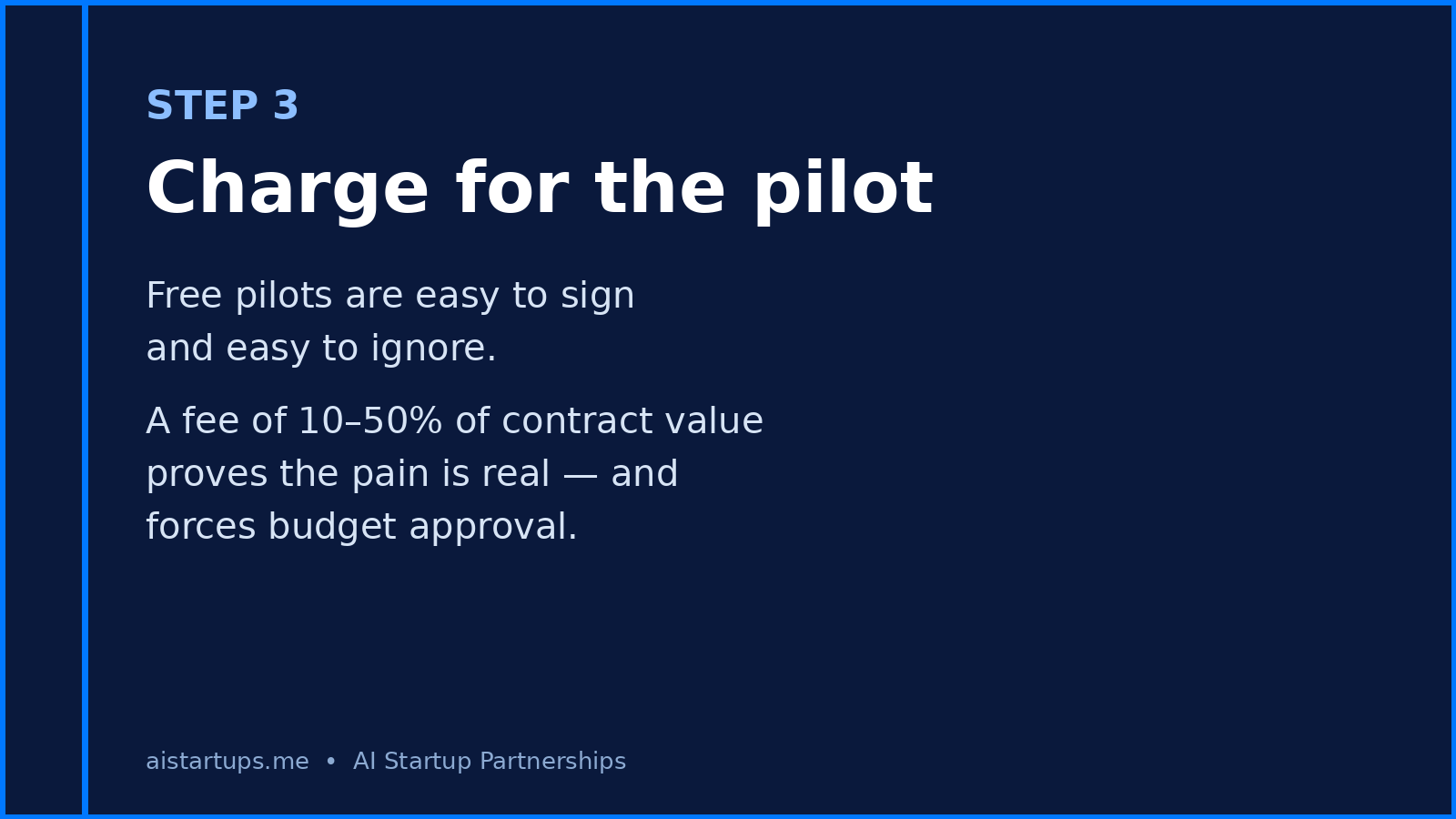
- A small paid pilot fee. Commonly 10% to 50% of the eventual annual contract value, paid upfront for a 60- to 90-day pilot. The fee covers your support costs and — more importantly — forces the partner to get budget approval, which means someone with authority has already said yes.
- Free pilot, priced conversion in writing. The pilot itself costs nothing, but the agreement states the price and the date the partner becomes a paying customer if the success criteria are met. No ambiguity, no renegotiation, no “let’s see how it goes.”
- A refundable deposit. Less common, but useful when the partner’s procurement process can’t handle a small fee quickly. The money sits in escrow; if the pilot hits its targets, it converts to the first payment.
Whatever you choose, get it in writing before the pilot starts — the fee (or the future price), the pilot length, the success criteria, and what happens on day 91. A design partner program should end with a hard deadline and a binary ask: go paid, or don’t. That’s exactly how Strella ran it, and all 12 of their partners converted.
And here’s a pricing lesson from the Ada story that’s worth sitting with: your design partners will teach you how your market actually buys. Ada learned enterprise buyers wanted predictability over outcome-based billing. Strella learned per-project pricing created friction, so they moved to a seat-based model. Your pricing shouldn’t come from a spreadsheet. It should come from watching real buyers navigate their own procurement process.
If the money conversation feels uncomfortable, it helps to know your numbers cold before you negotiate — your unit economics decide how much discount you can actually afford to give a design partner without sinking the business.
The Champion vs. the Economic Buyer (Know the Difference)
Your champion is the person who feels the pain. The economic buyer is the person who controls the budget. Sometimes they’re the same person. In an enterprise, they almost never are.
This is the single most common reason first enterprise deals stall. A founder spends three months building a great relationship with a champion, the pilot goes well, everyone’s excited — and then the deal dies in a budget meeting the founder never knew existed, killed by someone whose name they never learned.
Map the buying committee before you scope anything. At minimum, you need four roles named, with real people attached:
- The champion. Feels the pain, sells internally, spends political capital on you. Your lifeline.
- The economic buyer. Owns the budget. Can say yes — and, more importantly, can say no. If you haven’t met them by week three, you’re not in a real deal.
- The technical evaluator. Usually someone in IT or engineering. They care about security, integrations, and whether your product will break something. Win them early or they’ll veto you late.
- The blocker. Legal, procurement, infosec, or a competing internal team. Every enterprise has one. Your champion should be able to tell you who it is — if they can’t, they don’t have as much internal pull as you thought.
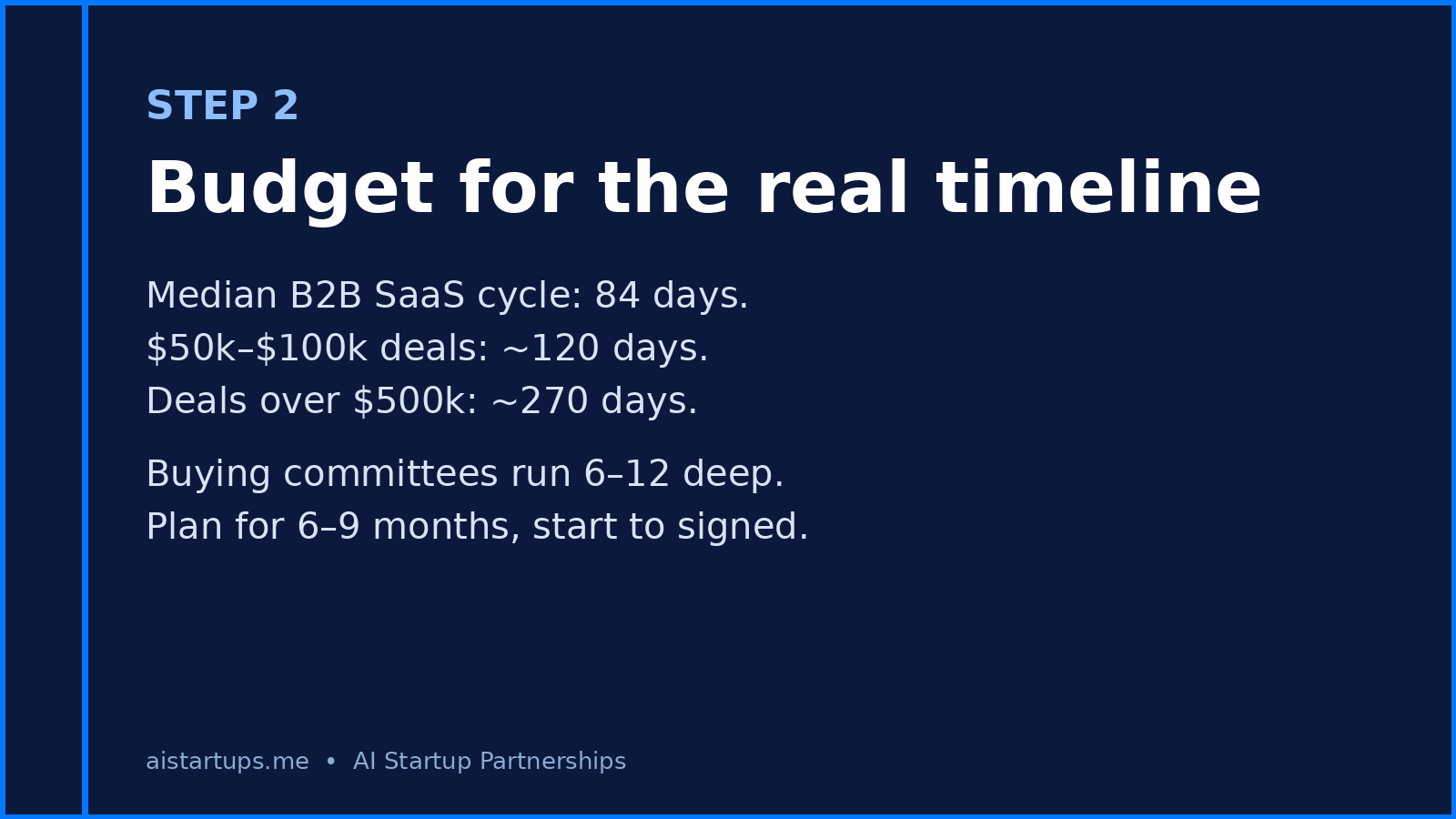
Benchmark data from Prospeo’s 2026 sales cycle guide puts the scale of this in perspective: buying committees have expanded from 3–5 stakeholders to 8–12, and the median B2B SaaS sales cycle is 84 days — but that jumps to about 120 days for $50k–$100k deals and roughly 270 days for deals over $500k. Gartner’s research puts the average buying committee at around 6.8 stakeholders. Every extra person is another calendar to coordinate, another objection to surface, and another reason a deal can stall. (These are vendor-published benchmarks, so treat them as directional rather than gospel — but the direction is consistent across every source I checked.)
The practical move: ask your champion, directly, “Who else needs to say yes before this becomes a contract — and can you introduce me to them now, while the pilot is still being scoped?” Founders who ask this in week two close deals. Founders who ask it in month four write post-mortems.
Scoping the Pilot: Small, Measurable, Time-Boxed
A pilot is a test with a verdict at the end — not an open-ended science project. The scope is where pilots quietly become death marches, so get this part right.
A good pilot has five ingredients:
- One workflow, not five. Pick the narrowest slice of the problem that still proves value. One team, one process, one measurable outcome. If your pilot tries to fix everything, it proves nothing.
- Baseline metrics, agreed before you start. How long does the process take today? What’s the error rate? What does it cost? If you don’t measure the “before,” you can’t prove the “after.” One startup selling AI to a major retailer learned this firsthand — they launched in co-pilot mode first, with every AI response approved by a human, so they could show a clean before-and-after on accuracy and speed.
- Written success criteria. Not “the team likes it.” Numbers. “Reduce review time by 40%.” “Cut error rate below 2%.” “Process 500 cases in 30 days.” Both sides sign off on the numbers before day one.
- Kill criteria. Yes, kill criteria. Agree in advance on what failure looks like — and that if the pilot misses its targets, both sides walk away cleanly. This sounds scary. It’s actually the thing that makes the partner trust you, because it proves you’re not going to cling to a failing deal for a year.
- A hard end date. 60 to 90 days is the standard window. Long enough to show real results, short enough that nobody forgets why the pilot exists. Put the conversion decision date in the agreement.
Before the pilot starts, there’s one more thing to lock down: the right to tell the story. Secure permission to publish a case study before you sign the contract, not after the pilot succeeds — because after the pilot succeeds, the partner’s legal team has every incentive to say no. A reference customer is the most valuable asset a design partner program produces. Don’t leave it to chance. If you want a fuller phase-by-phase walkthrough of everything in this section, the ISU Pilot Playbook lays out the same three phases — set up the approach, run the landing, harvest the next runway — with a checklist for each.
Surviving Security Review (the Part Nobody Warns You About)
Here’s the moment that kills more first enterprise deals than any other: the security questionnaire arrives. It’s 200 questions long. It asks about your encryption standards, your incident response plan, your data retention policy, your subprocessors, your penetration testing history. And somewhere in there, it asks for your SOC 2 report.
Let’s talk about SOC 2 honestly, because the numbers are bigger than most founders expect. A SOC 2 Type II report — the one enterprise buyers actually want — typically takes 6 to 12 months from a standing start, including a 3- to 12-month observation window during which your controls have to actually operate. Costs vary widely: vendor-published guides put the first-year all-in figure anywhere from $30,000 to $150,000 depending on company size and scope, with auditor fees alone running $10,000 to $50,000. A faster Type I report (a point-in-time assessment, no observation window) can be done in 2 to 4 months, but most security-focused enterprise buyers won’t accept it as a substitute for Type II. Treat these as vendor ranges, not quotes — but budget for the high end, not the low one.
Flux Law’s SOC 2 guide for startups puts the timeline bluntly: if an enterprise deal closes today and they need your Type II report, you’re 12 to 18 months away if you’re starting from scratch. Type I buys you time. It doesn’t close security-focused buyers.
So what do you do when you’re six months from a report and the deal is on the table now? A few things that actually work:
- Start the process before you need it. If enterprise is your market, start SOC 2 prep the moment you have your first serious conversation — not the moment someone asks for the report. The observation window can’t be rushed.
- Build a security packet early. A one-page security overview, your data processing agreement (DPA), a list of subprocessors, your encryption and retention policies. Having these ready signals competence, even without the report.
- Offer deployment options. Some enterprises will accept a pilot that runs on anonymized or synthetic data, or inside their own cloud environment, while the full review runs in parallel. Ask what’s possible — the answer is often more flexible than the questionnaire suggests.
- Be honest about where you are. “We’re in our observation window, report expected in Q3, here’s our Type I and our pen test” is a credible answer. “We’re totally secure, trust us” is not.
Also worth knowing: the questionnaire is rarely the real gate. The real gate is the security team’s judgment call about whether you’re a risk worth managing. A founder who shows up prepared, answers promptly, and has a DPA ready looks like a vendor. A founder who takes three weeks to answer looks like a liability.
Procurement, Legal, and the Long Middle
Once the pilot succeeds, you enter the part of the enterprise sale that has nothing to do with your product: procurement and legal. This is where the timeline goes sideways. Enterprise sellers routinely describe advertised timelines of 3 to 6 months ballooning to 9 to 12 months once procurement, legal, and IT security get involved — and negotiation-to-close alone eats 35% to 40% of total cycle time on enterprise deals.
A few things that help:
- Start the paperwork during the pilot, not after it. Ask for the vendor onboarding forms, the MSA template, and the DPA in week two of the pilot. Legal reviews take weeks. Running them in parallel with the pilot is free time.
- Negotiate IP ownership explicitly. The default you want: you own the product and the underlying IP; the partner owns their data and any of their confidential information used in the pilot. Custom features built for the partner are yours to keep in the product unless the agreement says otherwise. Get a lawyer for this one — it’s the clause that causes the most founder regret later.
- Expect the MSA to come from their side. Their paper, their terms, their redlines. Budget for a lawyer to review it. Yes, it costs money. A bad indemnity clause costs more.
- Keep your champion warm through the whole process. Procurement has no emotional investment in your deal. Your champion does. Weekly check-ins, short updates, a shared doc tracking where things stand — keep them in the loop so they can push from the inside when things stall.
One thing that catches founders off guard: enterprise procurement often requires you to be a registered vendor with insurance, tax forms, and a bank account that can receive wire transfers. None of this is hard. All of it takes longer than you think. Start it early.
Running the Pilot Without Losing the Plot
The pilot is running. The product is in their hands. Now what?
Weekly cadence. Non-negotiable. A 30-minute call, same time every week, with a standing agenda: what shipped, what broke, what the data says, what’s next. Send a short written update after every call. This is how you stay in control of the narrative — and how you catch problems while they’re still small.
Measure everything against the baseline you agreed on. If the success metric was “cut review time by 40%,” you should be able to show the number moving by week three. If it’s not moving, say so — and say what you’re changing. Silence is what kills pilots. Bad news delivered early is manageable. Bad news discovered at the final review is fatal.
And keep building the relationship wider than your champion. Meet the end users. Learn their names. Sit in on a workflow session. The users are the people who’ll actually live with your product, and their feedback is worth more than any executive’s opinion. They’re also your future internal advocates — the people who’ll say “we need this” when the budget conversation happens.
A note on something founders often overlook in the middle of a pilot: your demo and your website are still doing quiet work. Every new stakeholder your champion brings in will Google you before the meeting. If your site looks unfinished or your demo environment is broken, that person walks in skeptical. When we were getting our own demo environment ready, we worked with AISquadX — a web development studio that handles the design and build side — because the first impression a new stakeholder gets shouldn’t be a broken page. It’s a small thing. Small things compound.
Converting the Pilot Into a Contract
Week eight of a 90-day pilot. The numbers look good. Now comes the moment the whole program was built for: the conversion conversation.
Don’t wait until day 90 to have it. Start the conversation at the midpoint review. “Here’s where the numbers stand against the success criteria we agreed on. Here’s what a year-one contract looks like. Here’s the price we agreed on. What do you need from us to get this approved?”
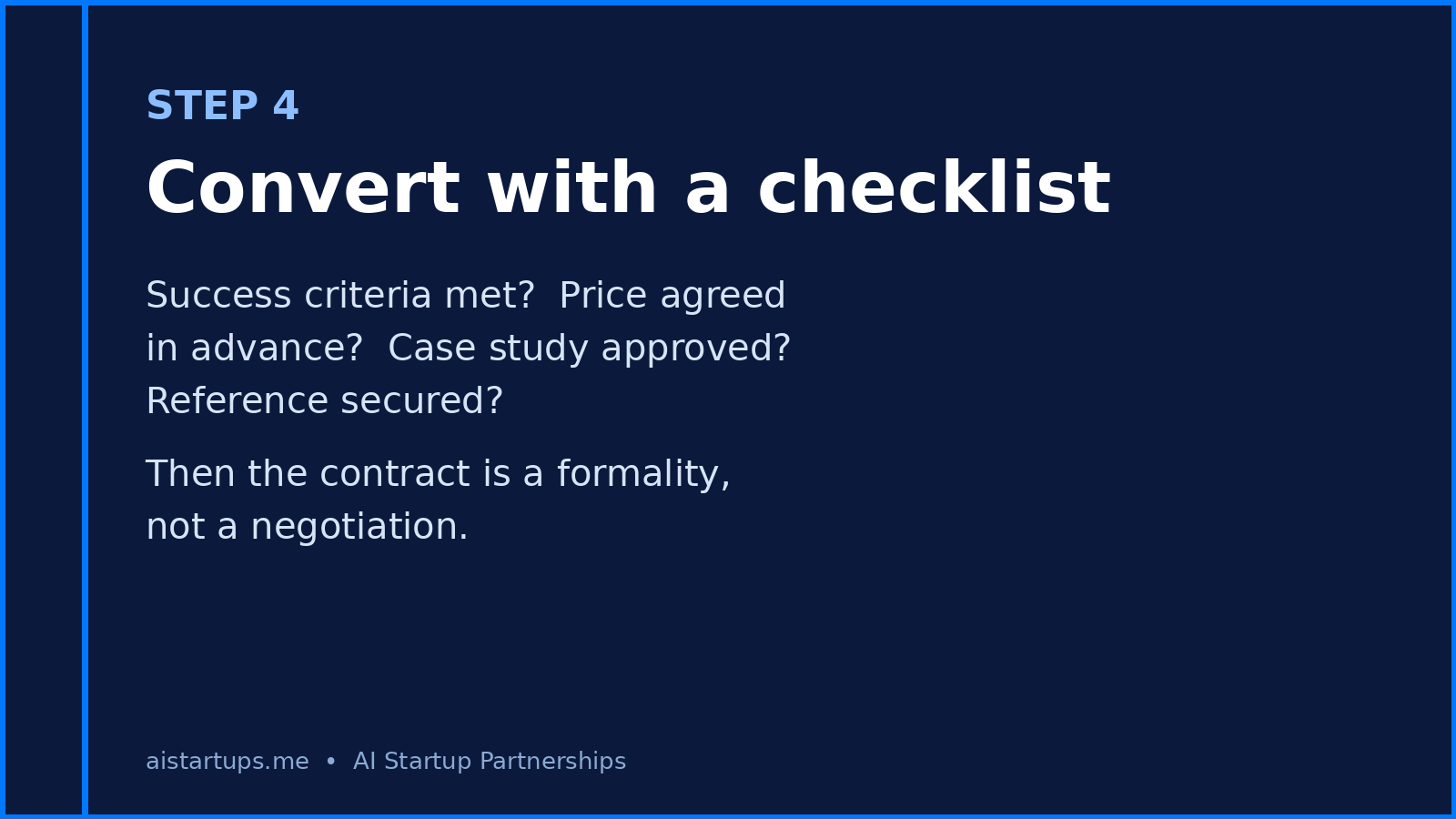
The conversion meeting should feel like a formality, not a negotiation. That’s the whole point of agreeing on success criteria and price before the pilot started. If you did that work, the meeting is just: did we hit the numbers? Yes. Then here’s the contract.
A few things that smooth the path:
- Bring the case study draft. Show them the story you’ll tell together — with their approval, of course. It reminds everyone in the room that this partnership has value beyond the contract.
- Offer a clean year-one structure. Annual contract, clear scope, defined support. Enterprise buyers want predictability — Ada learned that from its own design partners.
- Ask for the reference explicitly. “Can we list you as a customer? Can we do a joint case study? Can you introduce us to one peer at another company?” One reference customer is the beginning of your second enterprise deal.
And if the pilot misses its targets? Be honest about it. Walk through the numbers together, figure out whether the gap is fixable in 30 days or fundamental. If it’s fundamental, end the pilot cleanly, thank them, and keep the relationship. A clean ending with a champion who respects you is worth more than a desperate renewal. That person moves companies. They remember who was straight with them.
The Mistakes That Kill First Enterprise Deals
I’ve covered a lot of what to do. Here’s the short list of what not to do — the mistakes I see again and again:
Taking on too many partners at once. Five partners who each get your full attention beat twelve who each get a monthly email. Over-recruiting is how you end up building ten bespoke consulting projects instead of one product.
Building whatever the loudest partner asks for. Design partners shape the roadmap — they don’t own it. If a request only serves one company and contradicts your ideal customer profile, say no. Politely, clearly, and early.
Skipping the written agreement. A handshake deal with a champion is not a pilot agreement. Without written success criteria, a timeline, and a conversion price, you have a friendly conversation that will drift until it dies.
Treating security as an afterthought. If you wait until the questionnaire arrives to think about SOC 2, you’re a year behind. Start early, even if it’s just the basics.
Going single-threaded. One relationship inside a 5,000-person company is not a deal. It’s a hope. Multi-thread from week two.
Confusing enthusiasm for validation. “This is amazing!” on a demo call is not product-market fit. A signed pilot agreement with a fee is. A renewal is. Everything else is encouragement — nice to hear, dangerous to plan around.
“The goal of a design partner program isn’t to elicit enthusiastic responses on a call; it’s to measure prospective customers’ willingness to pay. Structure your program with a hard deadline and a clear conversion ask. When Strella’s 12 cold-outreach partners all converted, that was evidence of product-market fit. Positive sentiment is encouraging, but not a sign of monetization.” — Bessemer Venture Partners, on the design partner playbook
A Realistic Timeline, Start to Finish
So how long does all of this actually take? Here’s a rough map, based on the benchmarks and stories above. Your mileage will vary — but if someone promises you a 30-day enterprise deal, they’re selling you something.
- Weeks 1–4: Outreach and qualification. 150 to 200 conversations to find a handful of real candidates. Pick 5 to 10, score them, choose one or two to start with.
- Weeks 3–6: Scoping and agreement. Map the buying committee, agree on the workflow, baseline metrics, success criteria, and price. Get the pilot agreement signed.
- Weeks 6–18: The pilot. 60 to 90 days of weekly cadence, measured results, and relationship building. Start procurement paperwork in parallel.
- Weeks 14–24: Conversion and contracting. Midpoint conversion conversation, final review, MSA and DPA negotiation, vendor onboarding. This is where the timeline stretches — budget for it.
- Month 6–9: First paid contract live. Reference customer, case study, and your first real enterprise logo.
Six to nine months from first outreach to signed contract. That’s the honest answer. It’s also why starting early matters so much — and why the founders who treat this as a side project while chasing other channels usually end up with nothing. Enterprise partnerships are a strategy, not a tactic.
For context on how this fits into your broader early-stage plan, our 2026 AI agency playbook covers the service-led route to first revenue — and if you’re raising alongside this, know the investor questions you’ll face before you walk into the room. And before you sign anything with a partner, make sure your own house is in order: settle the co-founder agreement first, because a design partner deal signed by a company with unresolved founder equity is a mess waiting to happen.
FAQ
How many enterprise design partners should an AI startup recruit first?
Five to ten is the range most practitioners recommend — enough to spot patterns across your ideal customer profile, few enough to keep the program high-touch. Strella ran 12, Ada ran 7. The number matters less than the quality: each partner should feel acute pain, match your target market, and be willing to pay eventually.
Should design partners pay, or should the pilot be free?
Charge something. A small paid pilot — often 10% to 50% of the eventual annual contract value — proves the pain is real, forces budget approval, and keeps the partner engaged. If the pilot itself is free, the price and conversion date must still be agreed in writing before it starts. Free with no written conversion terms is an advisory relationship, not validation.
How long does a typical enterprise pilot last?
60 to 90 days is the standard window: long enough to show measurable results against agreed baseline metrics, short enough to keep urgency. The full journey — outreach to signed contract — usually runs six to nine months once procurement, legal, and security review are factored in.
Do I need SOC 2 before I can land an enterprise design partner?
Not always before the pilot, but you need a plan. Many enterprises will run a pilot on anonymized or limited data while your compliance work proceeds in parallel. A SOC 2 Type II report takes 6 to 12 months and costs tens of thousands of dollars in the first year, so start the process as soon as enterprise becomes your target market — waiting until a buyer asks for the report puts you a year behind the deal.
What should a design partner agreement include?
At minimum: the pilot scope (one workflow), the timeline (60–90 days), written success and kill criteria, the pilot fee or the agreed future price, IP ownership terms (you keep the product IP; the partner keeps their data), a data processing agreement, and the right to publish a case study. Have a lawyer review it — especially the IP and indemnity clauses.
The Bottom Line
Your first enterprise design partner is the hardest customer you’ll ever win. It takes months, not weeks. It involves security questionnaires, procurement forms, legal redlines, and a buying committee of six to twelve people who all need a reason to say yes. And honestly? Most founders who try it will tell you it’s the least fun part of building a startup.
But here’s what you get in return: a product shaped by real buyers instead of guesses. Pricing that reflects how enterprises actually buy. A reference customer who opens the next ten doors. And the one piece of evidence no investor, no hire, and no future customer can argue with — a stranger with a budget paid you, and then paid you again.
So pick one company. Find the person who feels the pain. Offer them a small, measurable experiment with a clear end date and a price attached. Then do the unglamorous work — weekly calls, security forms, legal reviews — until the pilot becomes a contract.
That’s the whole playbook. It’s slow, it’s manual, and it works.