


Here’s a market almost nobody in the AI-services world is talking about — and it’s sitting on roughly $158 billion in the US alone.
Accounting firms. Boring? Sure. But boring pays. And right now, firms are in a bind they can’t hire their way out of.
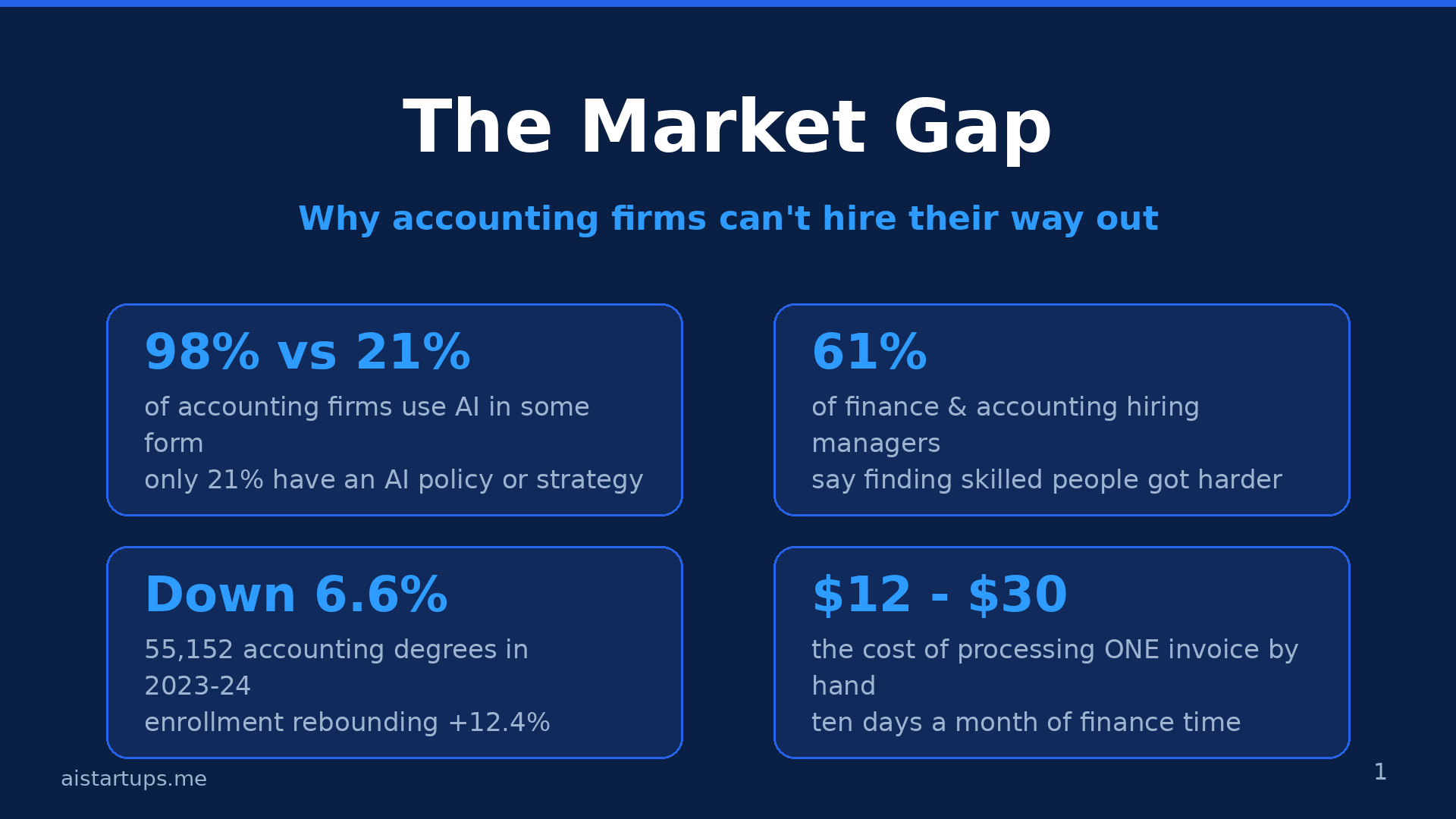
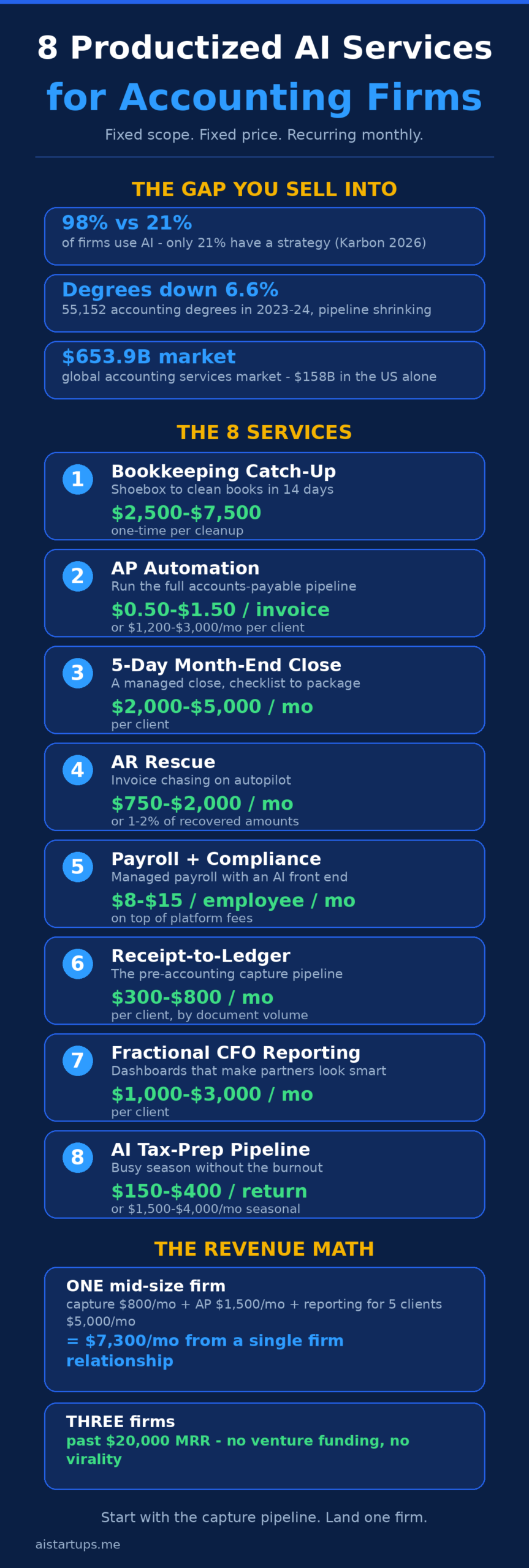
Look at the numbers: the US awarded 55,152 accounting degrees in 2023–24, down 6.6% from the year before. About 61% of finance and accounting hiring managers say finding skilled professionals is harder than it was a year ago. And while firms scrambled, AI walked right through the front door — 98% of accounting firms use AI in some form now, according to Karbon’s 2026 survey.
But here’s the part that should make your ears perk up: only 21% of them have an AI policy or strategy. Nearly every firm uses AI. Barely one in five has any plan for it.
That gap — between “we have the tools” and “we know what we’re doing” — is a business opportunity with your name on it. Not as a consultant with an hourly rate and a slide deck. As someone selling productized AI services: fixed scope, fixed price, recurring monthly. The firm doesn’t buy your time. It buys an outcome.
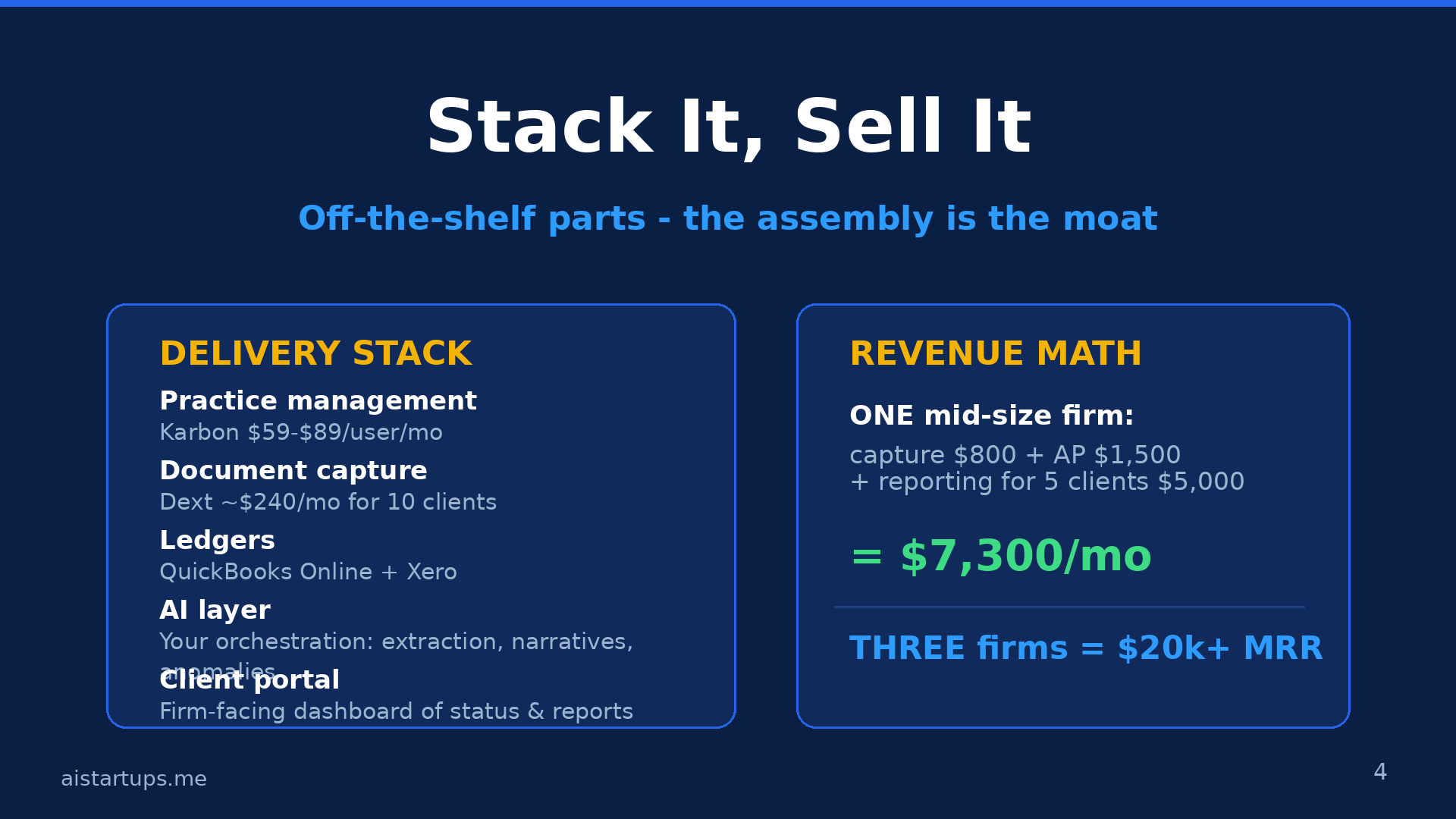
Real talk: firms are already spending the money. Practice management software runs $59–$89 per user per month for platforms like Karbon. Document capture runs ~$240/month for a 10-client practice on Dext. The budget exists — the discipline to use it well mostly doesn’t. That’s the arbitrage.
I’ve watched founders build real revenue selling into this market without being accountants themselves. Here’s how you’d do it: eight services, each one scoped tight enough to sell, priced honestly, and deliverable with today’s AI tooling.
Why Accounting Firms Are the Perfect AI Services Market
Before the list, let’s get the pitch straight — because if you ever talk to a partner at one of these firms, this is the two-minute version you’ll use.
The demand is structural. Thomson Reuters found that enterprise generative AI adoption at tax firms nearly tripled in a single year — from 8% in 2024 to 21% in 2025. That’s the fastest move in all of professional services. And it still leaves roughly four firms in five without any enterprise-grade deployment. The industry is mid-transformation and most firms are doing it by hand.
The pain is acute. When 61% of hiring managers can’t find skilled people and the degree pipeline shrank 6.6% in a single year, the work doesn’t disappear — it lands on senior partners at midnight during tax season. Anything that gives a firm capacity without a full-time hire has a buyer.
The buying motion is simple. Firms buy subscriptions. They already pay per-user, per-client, per-month for everything. A productized service at $1,500–$5,000/month isn’t a weird ask — it looks like the invoices they already pay, with a clearer outcome attached.
And here’s the quiet part: most “AI agencies” chase dentists, realtors, and coaches. Almost nobody builds specifically for accounting firms. The lane is open. (If you like the “boring business that prints money” thesis, my piece on boring AI businesses makes the general case — this article is the accounting-firm edition.)
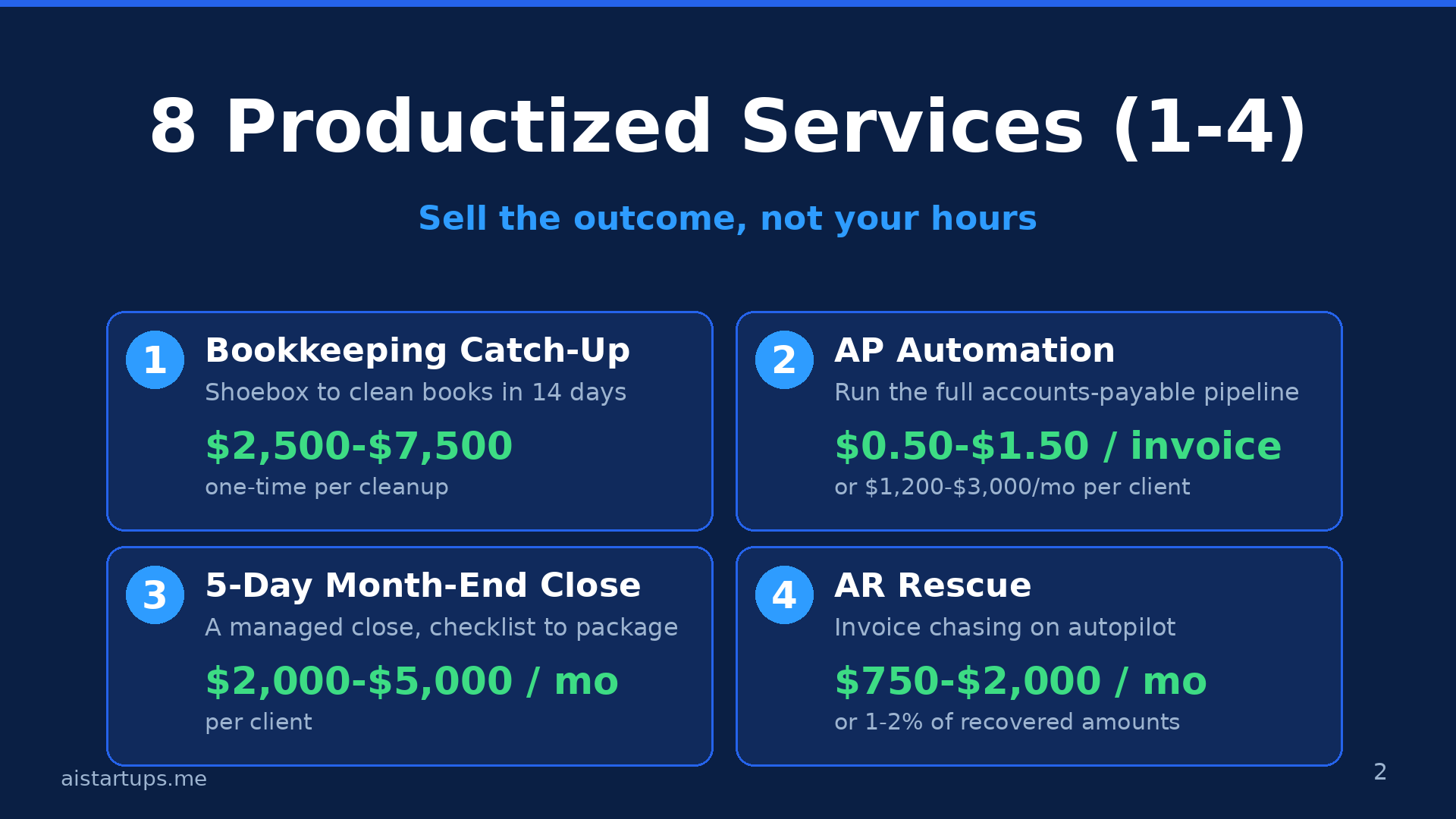
Service 1: The Bookkeeping Catch-Up — From Shoebox to Clean Books in 14 Days
Every firm has a drawer (okay, a portal folder) full of clients whose books are six months behind. Catch-up work is the worst kind of work: tedious, low-margin, and impossible to staff during busy season.
The service: a fixed-scope, fixed-price cleanup. The client uploads their mess — bank statements, receipts, invoices, a QuickBooks file that hasn’t been touched since March. Your AI pipeline extracts, categorizes, and reconciles everything. A human (you, at first; a contracted bookkeeper later) reviews by exception instead of line-by-line.
What AI does: document capture and OCR (Dext-style extraction claims 99.9% accuracy on structured fields), bank-feed matching, anomaly flagging for duplicate or missing transactions, and first-pass categorization against the client’s chart of accounts.
Price it: $2,500–$7,500 one-time per cleanup depending on months behind and transaction volume, then roll the client into a monthly maintenance plan ($500–$1,500/month). The one-time cleanup is the wedge; the recurring plan is the business.
The honest caveat: you need a real review step. AI categorizes at scale, but a firm is staking its reputation on the output. Review-by-exception — where the human only touches flagged items — keeps your margins intact without gambling on quality.
Service 2: AP Automation-as-a-Service — Kill the $12–$30 Invoice
Processing a single invoice by hand costs somewhere between $12 and $30 and eats roughly ten days a month of finance-team time for a mid-size business. Those numbers come from the AP automation world, and they hold up: the cost isn’t the paper, it’s the chase — approvals, coding, matching to purchase orders, chasing the manager who “will get to it Friday.”
Your service: run the entire accounts-payable pipeline for the firm’s clients. Invoices come in by email, get extracted with line items, coded to the right GL accounts, routed for approval automatically, and pushed into the client’s QuickBooks or Xero. The firm sells it to their clients as a modern AP service; you run the engine.
What AI does: multi-line-item extraction, supplier learning (the system remembers how Vendor X’s invoices look), approval workflow routing, duplicate detection, and three-way matching against POs and receipts.
Price it: $0.50–$1.50 per invoice processed, or $1,200–$3,000/month per client for high-volume shops. Enterprise-grade AP tools like Vic.ai run on custom contracts that price most small firms out entirely — your productized version brings that capability downmarket, which is exactly the point.
This one’s a volume game. One firm with twenty clients each pushing 200 invoices a month is 4,000 invoices. At a dollar an invoice, you see the math. The setup per client is the real work — week one is mapping their approval chain; after that it’s mostly monitoring.
Service 3: The 5-Day Month-End Close
Ask a controller how long month-end takes and watch their face. Two weeks is normal. Three isn’t unusual. The close is a coordination problem dressed up as an accounting problem: who has the prepaids, who’s waiting on the bank rec, which accruals are still “in progress.”
Your service: a managed close. You own the checklist, the follow-ups, and the first draft of every reconciliation. The firm’s staff does the judgment calls — you’re the machine that makes the machine run.
What AI does: automated reconciliations with match rates that improve over time, flux analysis that drafts the variance explanations (“payroll up 12% — three new hires in cost center 412”), close-checklist orchestration with automatic nudges, and a draft close package assembled before the controller’s first coffee.
Price it: $2,000–$5,000/month per client. This is the highest-trust service on this list, so don’t sell it to strangers — sell it to firms where you’ve already delivered a cleanup or a capture pipeline and proven you’re careful.
Well — mostly careful. The close touches everything, so your error budget is basically zero for the first three months. Build the checklist in something the firm can see (Karbon and its peers all have workflow tooling), and make every automated step auditable. Transparency is the product as much as the speed is.
Service 4: AR Rescue — Invoice Chasing on Autopilot
Small businesses are terrible at collecting their own money. The average small business has tens of thousands in overdue invoices at any given time, and the follow-up emails are the first thing that gets skipped when everyone’s busy. Firms know this. Their clients’ cash flow is the firm’s problem too — unpaid invoices become bad debt, bad debt becomes write-offs, write-offs become awkward conversations.
Your service: an automated collections pipeline, white-labeled for the firm. Polite, escalating, relentless. Day 7: friendly reminder. Day 14: firmer note with the invoice attached. Day 30: “should we call?” — routed to a human. Everything logged, everything the firm can show the client.
What AI does: tone-calibrated email sequences (friendly, not robotic — this is someone’s customer relationship), payment-link generation, promise-to-pay tracking, and escalation summaries so the firm only touches the accounts that actually need a human voice.
Price it: $750–$2,000/month per client, or 1–2% of recovered amounts. The ROI story writes itself: if the pipeline recovers $30k a quarter that would have been written off, nobody argues about the fee.
One warning, and it’s a real one: you are touching the firm’s client relationships. Get the tone wrong once and you’re done. Start every engagement with the firm approving the exact email templates. Boring, safe, effective — in that order.
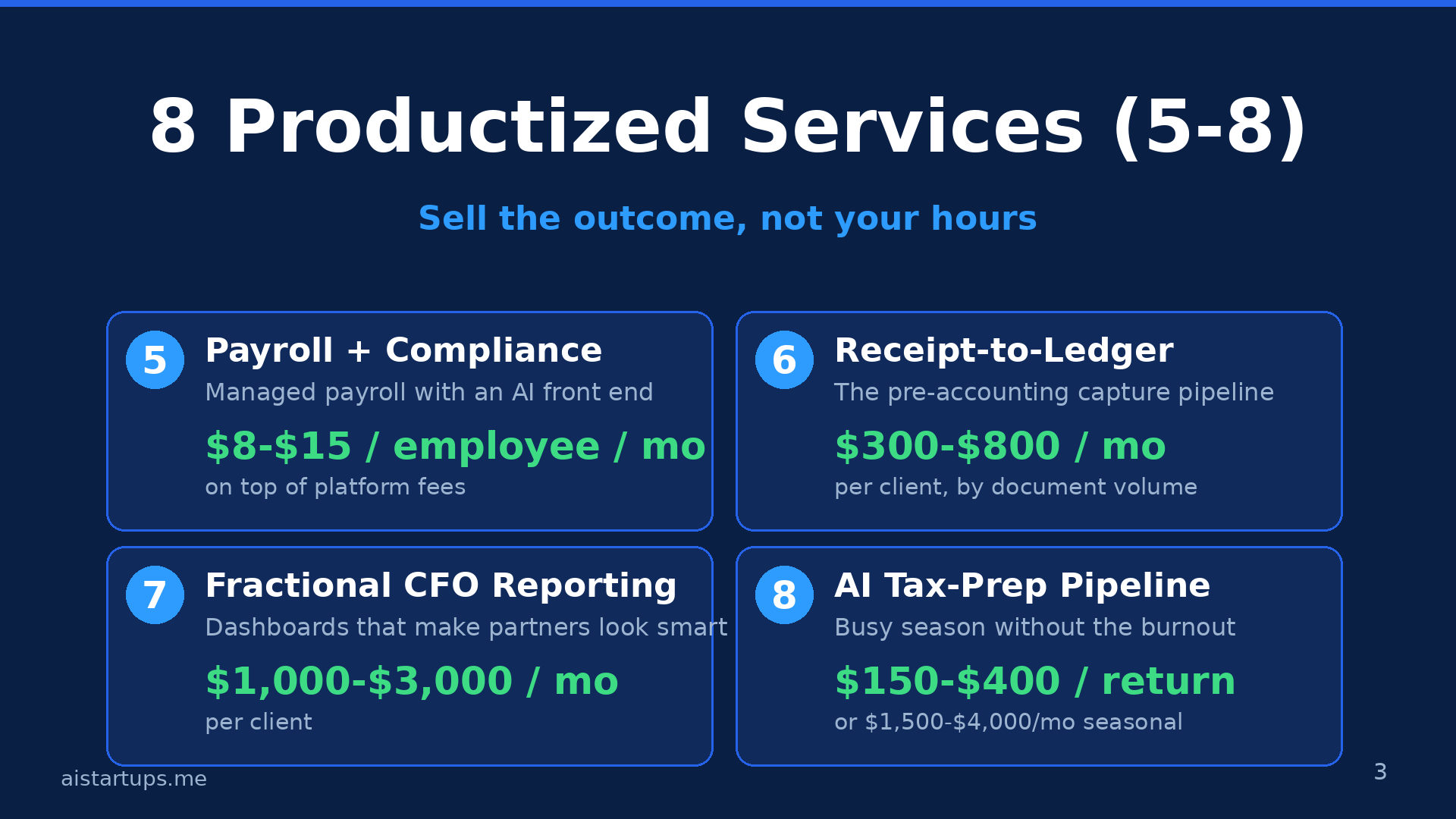
Service 5: Payroll + Compliance Without the Paper Cuts
Payroll is the service firms love to hate. It’s recurring, it’s deadline-driven, and one missed filing turns into penalties and a furious client. Most small firms either do it manually (expensive) or refer it out (margin left on the table).
Your service: managed payroll processing with an AI front end. Timesheets get parsed and validated automatically, filings get prepared and queued, and the firm gets a dashboard showing every client’s payroll status at a glance — who’s processed, who’s pending, what’s filed.
What AI does: timesheet anomaly detection (the 47-hour week that was really a typo), jurisdiction-aware filing calendars, document assembly for new-hire packets, and plain-English summaries of “what changed this pay run” for the firm’s review.
Price it: $8–$15 per employee per month on top of the payroll platform’s own fees. A 40-person client is $320–$600/month of nearly pure margin once the pipeline is built. Multiply by the firm’s client roster.
The compliance angle is the selling point: missed deadlines are the #1 payroll complaint, and an automated filing calendar with escalation is the cure. Firms will pay for sleep.
Service 6: Receipt-to-Ledger Capture — The Pre-Accounting Pipeline
This is the least glamorous service on the list and possibly the easiest to sell. Every firm has clients who dump receipts into an email thread or — god help us — a physical envelope. Someone has to turn that pile into ledger entries. That someone is currently a junior accountant who hates it.
Your service: a capture pipeline the firm hands to every new client at onboarding. Snap a photo, forward an email, drag a PDF into the portal — everything flows into structured, categorized, tax-coded entries in the firm’s ledger of choice. The firm gets clean data; the client gets a modern experience; you get paid per client per month.
What AI does: mobile capture with automatic edge detection and glare correction, line-item extraction, tax-code assignment, supplier auto-matching, and duplicate suppression across channels (the receipt photographed AND emailed doesn’t post twice).
Price it: $300–$800/month per client depending on document volume. Dext’s own practice plans run roughly $240/month for a 10-client practice as the underlying tool cost — your margin is the setup, the training, and the ongoing exception handling that turns a tool into a service.
Honestly? This is the service I’d start with. It’s simple to demo, the before/after is visceral (envelope of receipts → clean ledger), and it creates the relationship that lets you sell services 1–5 later.
Service 7: Fractional CFO Reporting — Dashboards That Make Partners Look Smart
Here’s the thing about small-business clients: they don’t read financial statements. They read whatever their accountant tells them. And most firms don’t have the capacity to produce genuinely useful monthly reporting — so clients get a P&L PDF and a prayer.
Your service: a monthly reporting pack, produced for the firm to deliver under its own brand. KPI dashboard, cash-flow forecast, variance commentary in plain English, and a one-page “what to watch” brief. The partner walks into the client meeting looking like a genius. You’re the genius behind the curtain.
What AI does: automated KPI calculation and benchmarking, natural-language variance narratives, 13-week cash-flow forecasting, and anomaly surfacing (“your gross margin dropped 4 points — here’s the three line items that explain it”).
Price it: $1,000–$3,000/month per client. This is advisory-margin work priced like a product — and it’s the service that turns a bookkeeping relationship into a strategic one. Firms that offer real reporting retain clients dramatically better than firms that just file things.
The catch: the numbers have to be right, and the narratives have to be useful, not just grammatically correct. Every pack gets a human review for the first six months. After that, review by exception — but never ship a forecast you wouldn’t defend in front of the client yourself.
Service 8: The AI Tax-Prep Pipeline — Busy Season Without the Burnout
Tax season is where accounting firms go to suffer. The bottleneck isn’t the tax law — it’s the document chase. Clients send half their documents in February, the other half in April, and the firm spends March playing detective. Meanwhile the degree pipeline keeps shrinking: those 55,152 degrees in 2023–24 were down 6.6%, and while enrollment is rebounding (up 12.4% in spring 2025), new graduates don’t process 1040s on day one.
Your service: a tax-prep assembly line. Automated document collection with reminders that actually work, AI-extracted source documents pre-mapped to the return, missing-item tracking the client can see, and a first-draft return package for the preparer to review. The firm does the tax judgment; you remove everything else.
What AI does: intake checklists that adapt per client, W-2/1099/brokerage-statement extraction and reconciliation, missing-document escalation, e-signature orchestration, and a review-ready workpaper package.
Price it: $150–$400 per return for individual prep support, $1,500–$4,000 per month per firm during season for the full pipeline. Seasonal pricing is fine — firms think in seasons anyway.
Start selling this one in October. By January every firm has already decided how they’ll survive busy season. The firms that buy early are the ones with their act together — which are exactly the clients you want.
Your Delivery Stack: What to Actually Build On
None of this requires you to train a model. The stack is off-the-shelf, and the moat is in the workflows and the relationships, not the tech. Here’s a realistic build:
- Practice management: Karbon ($59/user/mo Team, $89 Business on annual billing) is the category leader — but that’s a per-firm decision. You just need to integrate with whatever the firm runs.
- Document capture: Dext or equivalent for the receipt-to-ledger pipeline. Budget the practice plan (~$240/mo for 10 clients) into your pricing.
- AP automation: Vic.ai-class extraction is available through several vendors; enterprise contracts price small firms out, which is your opening.
- Ledgers: QuickBooks Online and Xero cover 90%+ of small-business clients. Don’t get cute — meet the firm where it is.
- AI layer: your own orchestration for extraction review, narrative generation, anomaly detection, and the client-facing summaries. This is where API costs live — and where keeping your AI API bill under control becomes a margin discipline, not a hobby.
- Client portal: the firm-facing dashboard where they see status, exceptions, and reports. If the website and portal part intimidates you, a web development studio like AISquadX builds exactly this kind of thing for AI service businesses — the client experience is half the product here.
Notice what’s missing: no custom ML, no PhD required. The last decade of accounting software already digitized the data; the last two years of AI made the processing cheap. You’re selling the assembly, not the parts.
How to Land Your First Three Firms
Accounting is a relationship business, which cuts both ways: hard to break into, sticky once you’re in. Here’s the playbook I’d run:
- Sell the capture pipeline first. It’s the cheapest to demo, the easiest to understand, and it puts you inside the firm’s workflow. Offer a 30-day pilot on three of their messiest clients. If the books aren’t cleaner, you don’t get paid. (You’ll get paid.)
- Price the pilot like a product, not a project. “We process your 200 monthly invoices for $1,200/month, first month free if we miss our accuracy target.” Firms have been burned by consultants; they haven’t been burned by vendors with SLAs.
- Ask for the introduction, not the testimonial. Partners know other partners. One happy firm in a metro area is worth more than any ad spend — the accounting world is small, and “who does your AP?” is a real conversation at every industry dinner.
And don’t pitch “AI.” Pitch the outcome: “your close takes five days,” “no more shoebox clients,” “busy season without the all-nighters.” The partners who sign checks care about capacity and retention. The AI is your problem, not theirs. (The broader playbook for selling AI services to local businesses covers the same ground — my guide to AI services you can sell this month is the general-purpose version of this strategy.)
The firms winning right now aren’t the ones with the best AI. They’re the ones that stopped treating capacity as a hiring problem and started treating it as a systems problem. The 98% already bought the tools. The 21% with a strategy are hiring people like you to be the strategy.
What Could Go Wrong (Read This Before You Start)
Three honest risks, because I’d rather you hear them from me:
Data security is non-negotiable. You’re handling client financials. SOC 2 vendors, encrypted storage, a written data policy before you touch a single document — and know whether your AI vendors train on your inputs. Firms will ask. Have the answer.
You’re liable for the output. A miscategorized expense is a rounding error; a missed filing is a penalty letter with your fingerprints on it. Carry errors-and-omissions insurance from day one, and build human review into anything that touches compliance.
Seasonality will test you. Tax season is feast, summer is famine. The productized monthly services (capture, AP, reporting) are what smooth the revenue — don’t build a business that’s 80% March and April.
If you want the agency-building side of this — packaging, pricing psychology, getting those first clients — the AI agency playbook walks through the whole motion step by step.
Frequently Asked Questions
Do I need to be an accountant to sell AI services to accounting firms?
No — and honestly, not being one can help. Firms don’t need another accountant; they need capacity, systems, and someone who’ll own the pipeline. What you do need is a contracted bookkeeper or CPA who reviews the work, especially anything touching tax or compliance. Your job is the system; their job is the judgment.
How much does it cost to start?
Less than you’d think. The tooling — capture software, practice-management integrations, AI APIs — runs a few hundred dollars a month to start. The real investment is the first two or three pilot engagements, where you’re building the workflows while delivering them. Most founders in this space get to revenue within 60–90 days because the pilots convert.
Will AI replace the firms I’m selling to?
No. AI is taking over data entry, reconciliation, and first drafts — the signing off, the judgment calls, and the client advice stay firmly human. Firms using AI report handling more clients, not employing fewer staff. You’re selling them leverage, not a replacement. That’s an easy pitch because it’s true.
What’s the realistic revenue for a solo founder?
Do the math on one mid-size firm: capture pipeline ($800/mo) + AP automation ($1,500/mo) + reporting packs for five clients ($5,000/mo) ≈ $7,300/month from a single firm relationship. Three firms gets you past $20k MRR. That’s the boring, achievable version — no venture funding, no virality required.
How do I handle client data security?
Start with the non-negotiables: vendors with SOC 2 certification, encryption in transit and at rest, and a written policy on whether AI tools train on your inputs (anonymize client identifiers where possible). Put the policy in writing before you onboard your first client, and be ready to show it — firms ask about this in the first meeting, and “we’ll figure it out” kills deals.
The Bottom Line
Accounting firms have the demand (a shrinking talent pipeline and $158 billion in US market size), the budget (they already pay per-seat SaaS prices without flinching), and the gap (98% use AI, 21% have a strategy). What they don’t have is someone to own the outcome.
That’s the whole business. Not “AI consulting.” Eight productized services, fixed scope, fixed price, recurring revenue — sold to an industry that’s too busy to build them itself and too proud to admit it.
Start with the capture pipeline. Land one firm. Let the partners introduce you to the next three. Boring? Absolutely. Profitable? That’s the idea.