
Real talk: I almost skipped this one. Another AI video model launched this week, and my notes app is already a graveyard of models that were going to “change everything” and then quietly died in a pricing page.
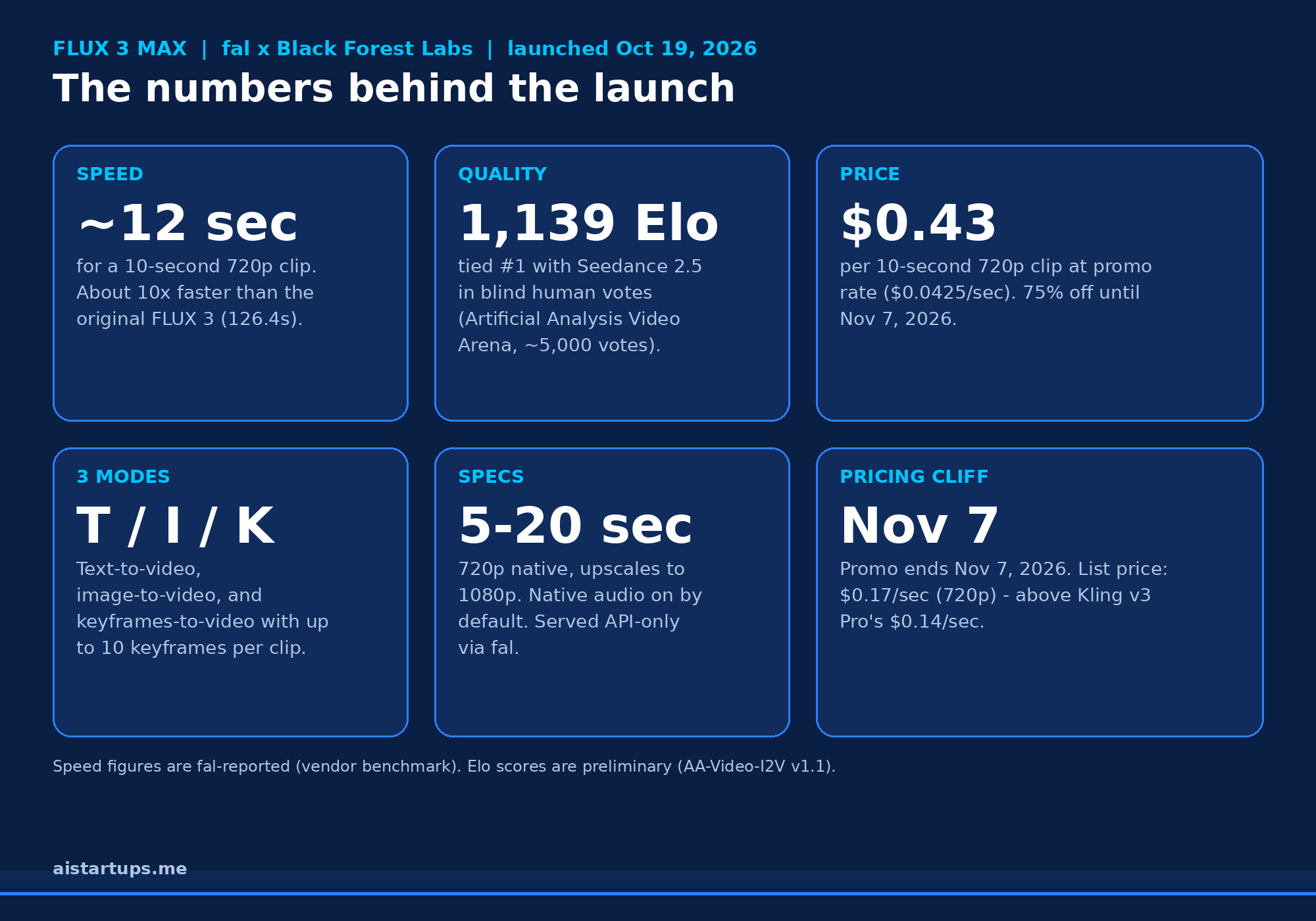
But FLUX 3 Max made me put my coffee down. Here’s the short version: a 10-second, 720p video clip — with native audio — generated in about 12 seconds. For roughly $0.43. And in blind human preference tests, it’s tied for first place with Seedance 2.5.
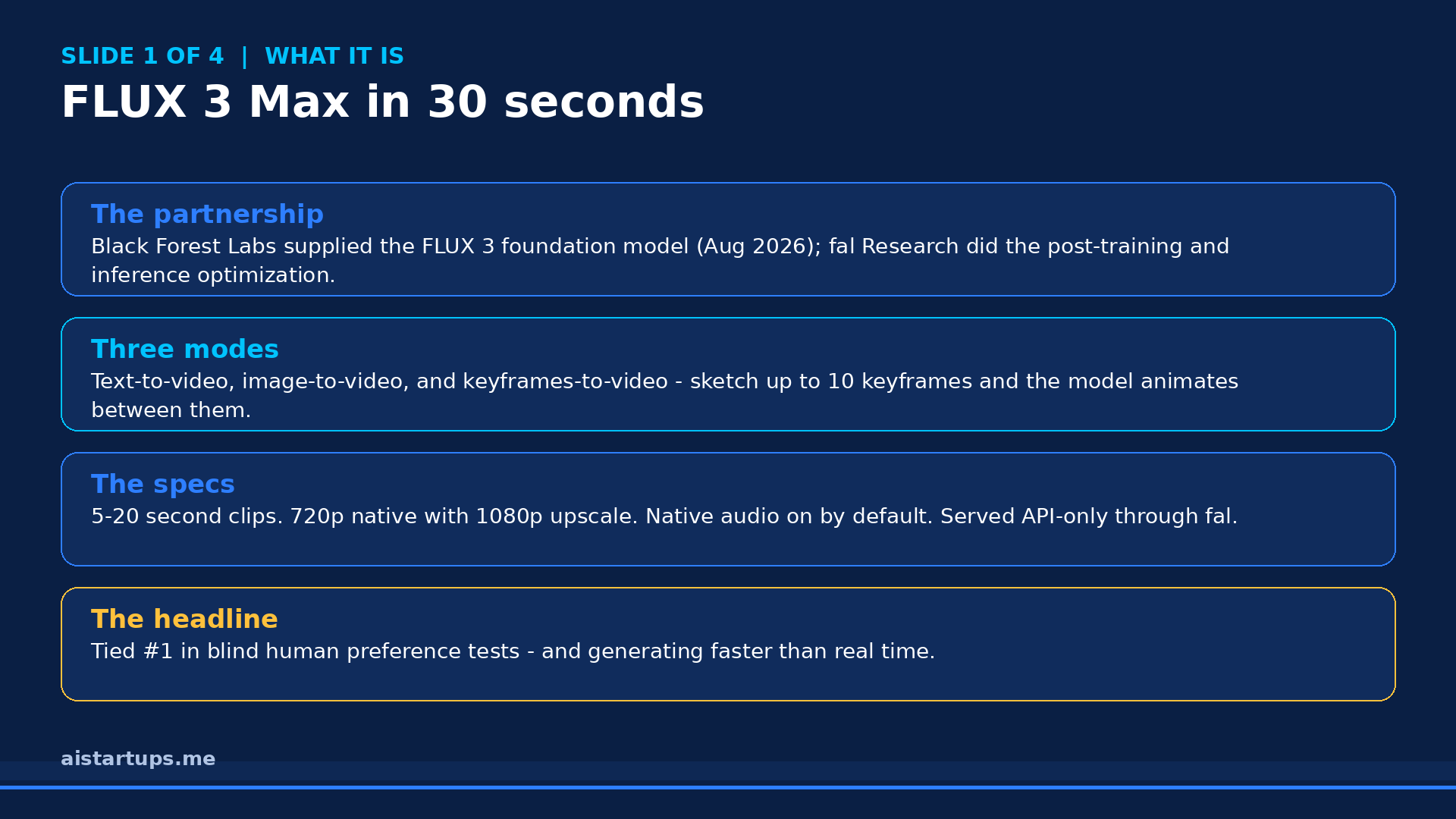
Launched October 19, 2026, FLUX 3 Max is the result of an unusual partnership: Black Forest Labs supplied the FLUX 3 foundation model (released August 2026), and fal’s research team handled the post-training, inference optimization, and systems engineering. It’s served only through fal’s API. No consumer app, no waitlist theater — just an endpoint.
This guide is written for founders, not researchers. What it costs, how fast it really is, how you’d actually use it in a startup, and the math that decides whether it’s worth your money. Let’s go.
What FLUX 3 Max actually is
Strip away the launch-day adjectives and FLUX 3 Max is a text-and-image-to-video model with three generation modes:
- Text-to-video: describe the shot, get a 5–20 second clip back.
- Image-to-video: feed it a still — your product screenshot, a brand photo, a storyboard frame — and it animates it.
- Keyframes-to-video: supply up to 10 keyframes marking scenes at specific moments, and the model fills in the motion between them. This is the sleeper feature. Most models give you one scene per clip; this one lets you sketch a mini-narrative.
Clips run 5 to 20 seconds. Native resolution is 720p with upscaling to 1080p, and audio is on by default — the model generates sound natively rather than bolting on a soundtrack afterwards. That’s inherited DNA: the original FLUX 3 shipped with native audio and lip-synced dialogue in 14+ languages, according to the companies’ own reporting. I haven’t independently tested the lip-sync myself, so file that under “promising, verify before you build a talking-head ad on it.”
One thing to be clear about: this is an API-only product. There’s no friendly web app with a big “Generate” button. You (or your developer) hit fal’s API, and video comes back. For technical founders that’s a non-issue. For non-technical founders, it means you’ll want either a wrapper tool built on top or someone technical on speed dial. More on the practical workflow below.
The launch was covered across the AI press — Unite.AI has the full breakdown of the fal–Black Forest Labs partnership, and The Inference digs into the business model behind the 75%-off launch pricing. Both worth a read if you want the industry context.
The three numbers that matter: speed, quality, price
Most model launches give you one impressive number. This one gives you three, and they multiply each other. That’s what got my attention.
Speed: ~12 seconds for a 10-second clip
fal reports that a 10-second 720p clip generates in roughly 10.95 to 12.45 seconds. The original FLUX 3 needed 126.44 seconds for the same job — so the post-training made it about 10x faster. fal also claims roughly 22x faster than Seedance 2.5 (277.8 seconds) at equal reported quality, based on their internal benchmark.
Honest caveat: those are vendor-reported numbers from fal’s own testing. Take the exact decimals with a grain of salt. But even if the real-world number is 20 seconds instead of 12, the practical point stands — this thing generates faster than real time, which changes how you work with it. You stop treating each generation like a precious, expensive event and start iterating like you would with copy: generate four variants, pick the best, move on. That behavioral shift is the real story.
Quality: tied #1 in blind human votes
Speed means nothing if the output looks like melted plastic. On Artificial Analysis’s Video Arena — blind human preference votes, not a vendor benchmark — FLUX 3 Max scored 1,138 to 1,139 Elo across roughly 4,868 to 5,054 votes, tied for first place with Seedance 2.5. The original FLUX 3 sat at 1,086 to 1,089, so post-training delivered about a +50 Elo lift. These are preliminary scores on the AA-Video-I2V v1.1 setup, but blind human preference is the closest thing this industry has to an honest test, and tied-for-first is tied-for-first. AlexTech’s launch coverage and Bottle Rocket’s breakdown both walk through the benchmark details.
Price: 75% off until November 7
Here’s where it gets interesting for a startup budget. Launch pricing is 75% off the list price, valid until November 7, 2026:
- 720p: $0.0425/second promo ($0.17 list) — a 10-second clip costs about $0.43
- 1080p: $0.0725/second promo ($0.29 list)
- Billed per second, no minimums, no subscription, and commercial use is allowed under fal’s terms.
So right now, generating video with a top-tier model costs less than a gumball per clip. That promo window is doing exactly what it’s designed to do — get you hooked before November 7, when the list price kicks in.
Founder cost math: what video actually costs you
Let’s translate per-second pricing into numbers a founder can plan around. All promo math uses the 720p tier at $0.0425/second, since that’s where the value is.
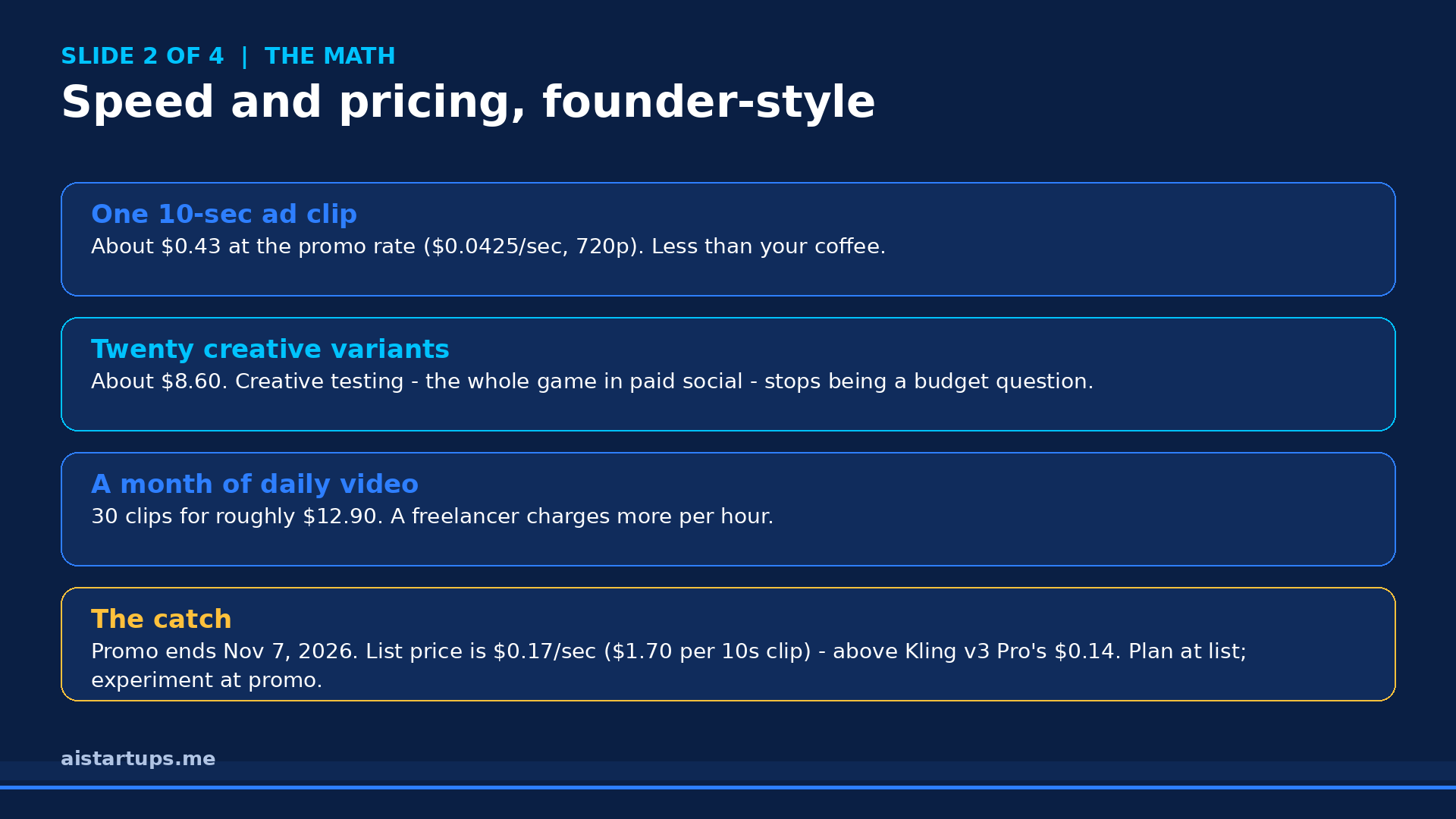
One 10-second ad clip: $0.43. You will spend more on the coffee you drink while waiting for it.
Twenty creative variants of one ad: $8.60. This is the number that should make performance marketers sit up. Creative testing is the whole game in paid social — the ad account that tests 20 hooks beats the one testing 3. At $8.60 per batch of 20, the cost of creative volume basically disappears as a constraint. Your constraint becomes idea quality, which is a much better problem to have.
A month of daily social video (30 clips): about $12.90. A single freelancer charges more than that per hour.
A landing-page hero video (one polished 15-second clip, upscaled to 1080p): roughly $1.09. One dollar and nine cents for the centerpiece of your homepage.
Now the comparison that matters. FourWeekMBA’s analysis puts the promo price at roughly 79% below Google’s Veo 3.1 video pricing — that’s the headline the launch is riding on. But read the fine print with me: the promo ends November 7. At list price ($0.17/second for 720p), a 10-second clip costs $1.70 — which is actually more than Kling Video v3 Pro at $0.14/second on fal. So the current pricing is a genuine steal and the list pricing is merely competitive. Plan your unit economics at list price and treat the promo period as free experimentation budget. That’s the disciplined way to think about it: burn through hundreds of test clips before November 7, find your winners, then pay list price only for the formats that convert.
If you’re weighing it against other models in general, our comparison of the best AI video generators for startups covers the broader field — and if Kling specifically is on your shortlist, our Kling 4.0 founder’s guide walks through that option in the same practical style.
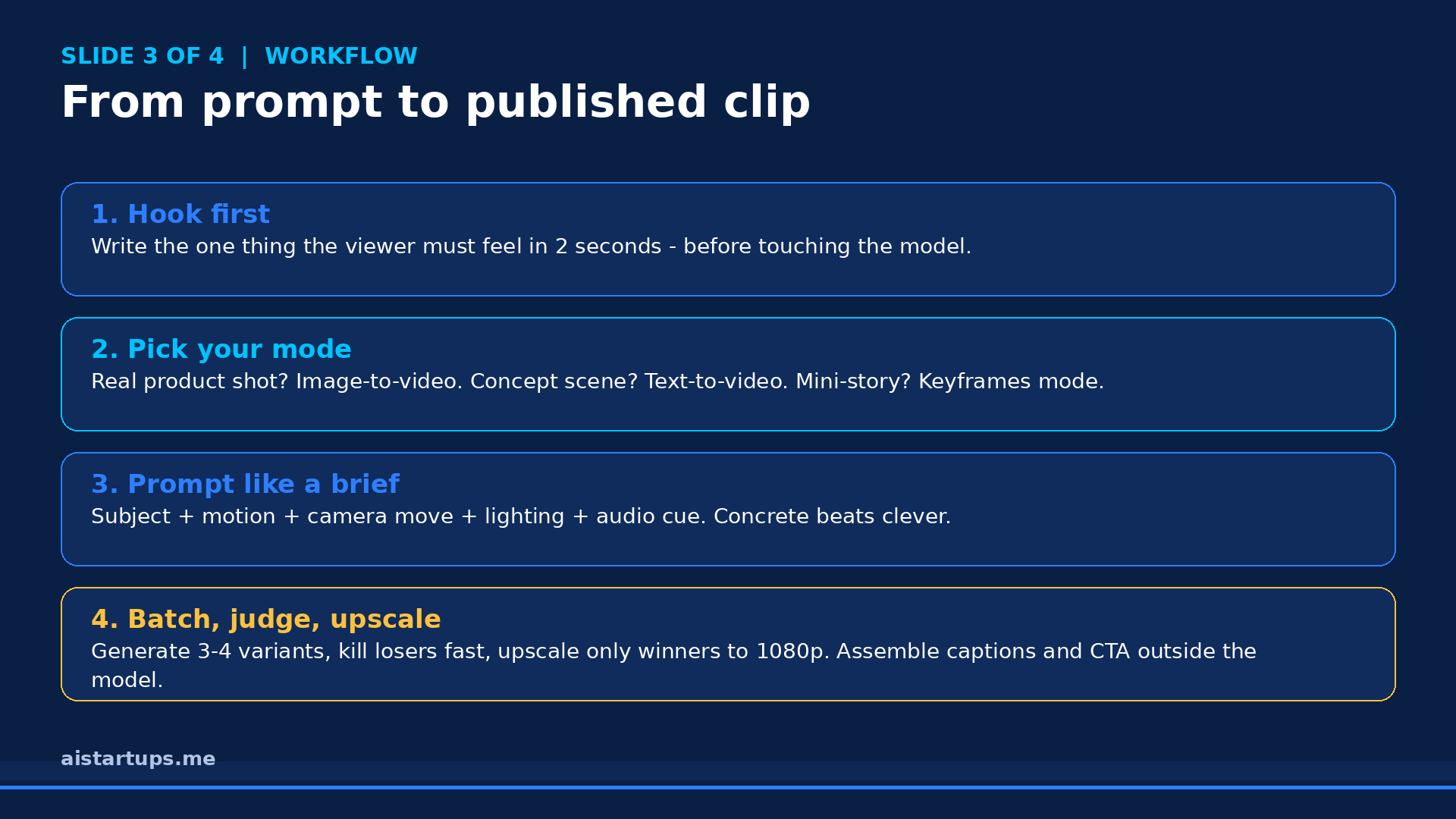
The founder workflow: from prompt to published clip
Theory is nice. Here’s the actual workflow I’d run if I were launching a product next month and wanted video everywhere without hiring a video team.
Step 1: Write the hook first, not the prompt
Bad prompts come from unclear thinking. Before you touch the model, write one sentence: the single thing this clip must make the viewer feel or believe in the first two seconds. “Our app saves you 5 hours a week” is a hook. “A video about productivity software” is a wish. The model can’t fix a vague idea — well, it can generate a beautiful vague video, which is worse, because now you’ve wasted 12 seconds feeling productive.
Step 2: Pick your mode
Product shot or screenshot? Use image-to-video and start from the real thing — authenticity converts better than a fully imagined scene, and it keeps your brand visuals consistent. Pure concept or lifestyle scene? Text-to-video. Multi-beat mini-story (problem → product → result)? Keyframes mode: sketch three keyframes, one per beat, and let the model handle the transitions. That three-beat structure is basically a 15-second ad in one generation.
Quick aside: if you need the starting still image and don’t have one, the image side of this same model family is worth knowing — our FLUX 3 Image Klein guide covers generating the input frames cheaply before you animate them here.
Step 3: Write prompts like ad briefs
A good video prompt has four parts: subject, motion, camera, and light. Then an audio cue, since the model generates native audio. Example structure: “[Subject] doing [motion], [camera move], [lighting/mood]. Audio: [ambient sound or voice line].” Keep it concrete. “Slow push-in on a founder’s hands typing on a laptop at a sunlit desk, shallow depth of field. Audio: soft keyboard clicks and quiet room tone.” That’s a prompt. “Make it look premium” is not a prompt — that’s a hope with extra steps.
Step 4: Generate in batches, judge fast
This is where the 12-second generation time pays off. Generate 3–4 variants of every concept in one sitting — vary the camera move, the lighting, the opening frame. Watch them at 1x speed (they’re 10 seconds long; this takes a minute), kill the losers immediately, and keep one or two. Don’t fall in love with your first generation. The model is fast enough that your taste becomes the bottleneck, which is exactly how it should be.
Step 5: Upscale only the winners
Generate at 720p for speed and cost, then upscale to 1080p only the clips that survive your review. No point paying the 1080p rate ($0.0725/second promo) for a clip you’re going to delete. This two-stage habit — cheap drafts, premium finals — is how you keep a $13/month video habit from becoming a $130 one.
Step 6: Assemble outside the model
FLUX 3 Max gives you clips, not finished ads. The last mile — captions, your logo sting, the call-to-action card, trimming to platform specs — happens in your editor of choice. CapCut, Premiere, even a simple web tool. Budget 15 minutes of assembly per finished ad. The model did the expensive part (the footage); you’re doing the cheap part (the packaging).
Step 7: Publish and measure like everything else
A video ad is just an ad. Track cost per click, watch-through rate, and conversion like you would any creative. The advantage here isn’t that AI video is magic — it’s that you can now afford the volume of testing that used to require a production budget. Run the numbers weekly. Kill what doesn’t convert. Double down on what does.
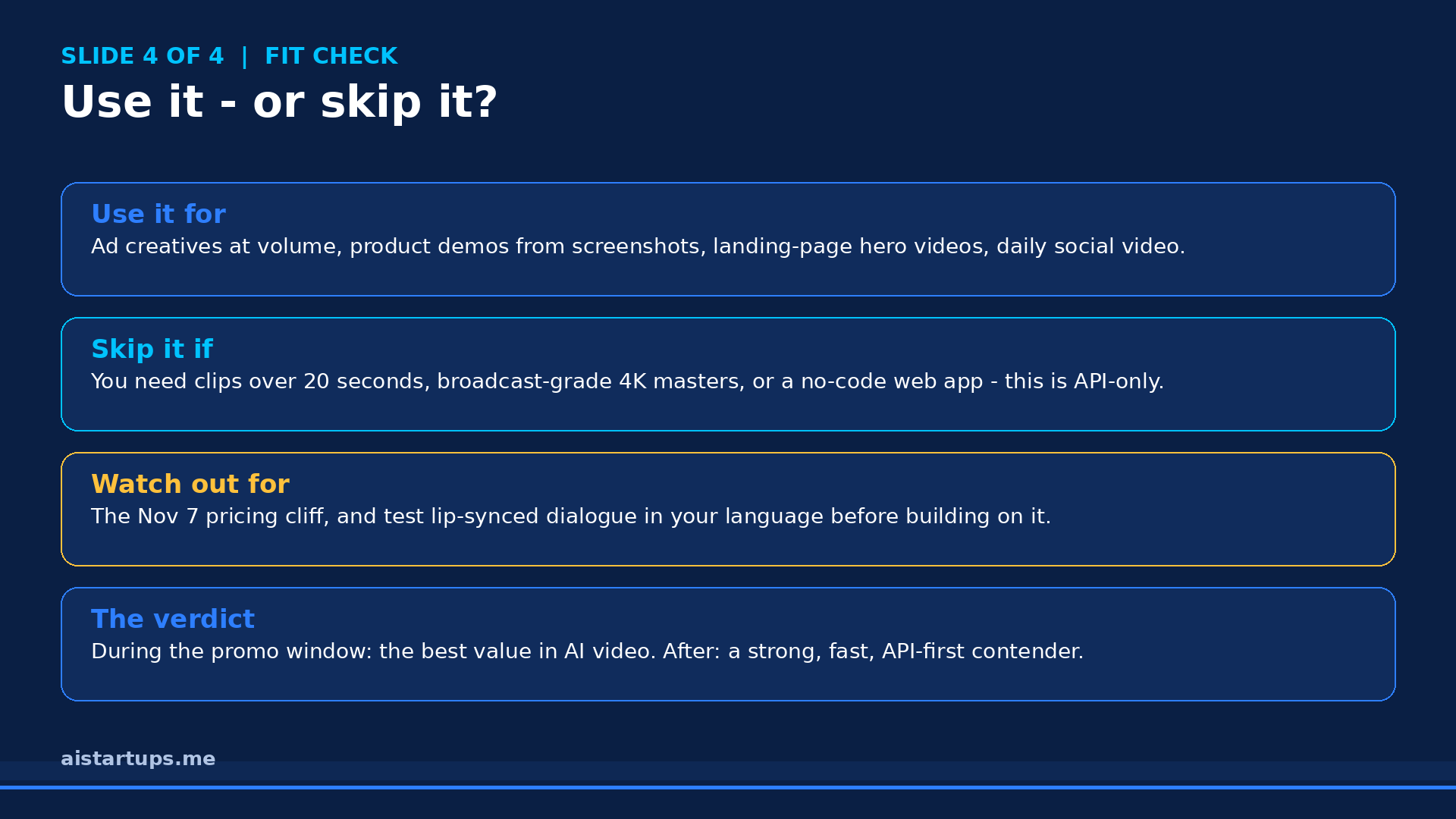
What founders would actually use it for
Enough theory. Four concrete use cases where this model earns its keep in a real startup:
Ad creatives at volume. The killer app, full stop. Paid social lives and dies on creative testing, and most early startups test too few variants because each one used to cost real money or real designer hours. Twenty variants for $8.60 during the promo window removes the excuse. Test hooks, test openings, test CTAs. Let the data pick winners.
Product demos from screenshots. Image-to-video is quietly the most founder-friendly mode here. Take your actual product UI, animate a cursor flowing through the key workflow, add a voiceover line in the prompt’s audio cue. You’ve got a demo video without screen-recording software, without a narrator, without editing. For dev tools and SaaS, this is genuinely useful — prospects see the real product moving, not a mockup.
Landing-page hero videos. A moving hero section converts better than a static one — that’s been true since forever; the blocker was always production cost. A 15-second brand clip behind your headline now costs about a dollar. If the landing page around that video needs building or wiring into your existing stack, that’s the kind of dev work an AI integration studio like AISquadX handles while you focus on the creative. One polished clip, one strong headline, one CTA. Ship it.
Social video at startup scale. Thirty clips a month for ~$13 in generation costs. Founder-led content, product teasers, behind-the-scenes motion graphics, trend-jacking clips made the same afternoon the trend appears. Speed matters here more than anywhere — a trend has a half-life of days, and a 12-second generation loop means you can ride it same-day instead of watching it pass.
Where it loses: who should skip it (for now)
I’m enthusiastic about this model, but enthusiasm without the caveats is just marketing. Here’s the honest list.
Clips are 5–20 seconds. That’s it. No long-form, no 60-second explainers in one shot. You can chain clips, but each generation is a short burst. If your content strategy needs two-minute videos, this is a clip supplier, not a solution.
720p native. The 1080p upscale exists and it’s fine for social and web, but if you’re projecting at a conference or need broadcast-grade masters, temper expectations. For a phone screen — where your customers actually are — 720p is plenty. Just know the ceiling.
API-only means friction. No web app, no mobile app, no “type and get video” for your non-technical cofounder. Somebody has to wire up the API or build a thin internal tool on top of it. For a technical team this is an afternoon. For a non-technical solo founder, it’s a real hurdle — budget for it or pick a model with a consumer interface.
The price goes up November 7. I’ve said it three times because it matters three times. At list price this is a competitive tool, not a miraculous one. Everything I’ve described as “absurdly cheap” has an expiry date. Use the promo window aggressively, and make your go/no-go decision on the list price.
Dialogue and lip-sync need your own testing. The FLUX 3 lineage includes native audio and lip-synced dialogue in 14+ languages per the companies’ reporting, and FLUX 3 Max inherits native audio generation. But “the model family supports it” and “it works reliably for my talking-head ad in Urdu” are different claims. Test with your actual use case before committing.
At $0.43 a clip, the bottleneck stops being your budget and starts being your idea pipeline. That’s the whole story of FLUX 3 Max — it doesn’t make video cheaper, it makes hesitation expensive.
Frequently asked questions
What is FLUX 3 Max?
FLUX 3 Max is an AI video generation model launched October 19, 2026, by fal in partnership with Black Forest Labs. BFL supplied the FLUX 3 foundation model; fal’s research team did the post-training and inference optimization. It generates 5–20 second clips in three modes — text-to-video, image-to-video, and keyframes-to-video — with native audio, and it’s served exclusively through fal’s API.
How much does FLUX 3 Max cost?
Until November 7, 2026, launch pricing is 75% off: $0.0425/second for 720p ($0.17 list) and $0.0725/second for 1080p ($0.29 list). A 10-second 720p clip costs about $0.43 during the promo. Billing is per second with no minimums and no subscription, and commercial use is allowed. After November 7, the list price applies — $1.70 for that same 10-second clip.
How fast is FLUX 3 Max?
fal reports a 10-second 720p clip generates in roughly 10.95 to 12.45 seconds — about 10x faster than the original FLUX 3 and, per fal’s internal benchmark, around 22x faster than Seedance 2.5 at equal reported quality. Those are vendor-reported figures, so treat the decimals loosely, but faster-than-real-time generation is the practical takeaway: you can iterate on creative in minutes, not hours.
Can I use FLUX 3 Max videos commercially?
Yes. fal’s terms allow commercial use, and billing is per-second with no subscription required. That makes it usable for paid ads, landing pages, and client work. As with any AI model, keep an eye on the terms of service for changes, and don’t generate anything featuring real people’s likenesses or trademarked characters for commercial use — that’s a legal headache no per-second price makes worthwhile.
How does FLUX 3 Max compare to Kling 4.0 and Veo 3.1?
On blind human preference (Artificial Analysis Video Arena), FLUX 3 Max is tied #1 with Seedance 2.5 at ~1,139 Elo — ahead of where the original FLUX 3 scored. On price, the promo rate ($0.0425/sec) sits roughly 79% below Veo 3.1’s pricing per FourWeekMBA’s analysis, but at list price ($0.17/sec) it’s actually pricier per second than Kling Video v3 Pro ($0.14/sec on fal). The honest answer: during the promo window it’s the best value in its class; after November 7, compare on your actual use case — Kling and Veo both have consumer-friendly apps, while FLUX 3 Max is API-only.
The Bottom Line
FLUX 3 Max is the rare launch where the headline numbers all point the same direction: tied for best quality in blind tests, generating faster than real time, and — until November 7 — priced like a rounding error. The API-only setup and 5–20 second clip limit keep it honest: this is a professional tool for people who make video part of their growth engine, not a toy.
My advice to founders is simple. If video is anywhere in your marketing plan — ads, landing pages, social, demos — spend the next two weeks generating aggressively at promo prices. Build your creative library, find your winning formats, learn the prompting patterns that work for your brand. Then, when list pricing arrives, you’ll be paying for a proven workflow instead of experimenting at full price.
The models will keep getting faster and cheaper. That’s the trend, and it’s not reversing. The founders who win are the ones who build the muscle memory now — the prompting taste, the testing discipline, the pipeline from idea to published clip — while the tools are practically free. FLUX 3 Max just happens to be the best-priced gym membership in town this month. Use it.