

Real talk: most founders pick the wrong option first.
They read one blog post that says “fine-tuning is dead, RAG is everything” — then spend three weeks building a vector database when a better system prompt would have solved it by Friday. Or they go the other way: pay for a full fine-tuning run because someone on Twitter said “real companies fine-tune,” when their actual problem is that the model doesn’t know their product docs. Which it can’t, because those docs were written last Tuesday.
I’ve watched this play out across enough AI startups to see the pattern. The question isn’t which technique is “better.” It’s which one matches your problem. And here’s the thing nobody tells you upfront: two of the three options solve completely different problems. Mixing them up is like buying a boat when you needed a truck.
So let’s settle it. What fine-tuning actually does, what RAG actually does, what “just prompt better” can really handle, what each one costs in 2026, and the decision order that keeps you from wasting money. No hype, no abstractions. Just the framework I’d hand a founder friend over coffee.


What each option actually does (no, really)
Before we talk money, we need to clear up what these techniques are for. Because about half the “fine-tune vs RAG” debates online are people arguing about which hammer is better when one of them is a screwdriver.
Option 1: Just prompt better
This is the boring one. System prompts. A handful of examples showing the model what good output looks like. Your best documentation pasted into the context window. Cached prefixes so you aren’t paying full price for that system prompt on every call. It’s free to try, takes an afternoon, and — honestly — solves an embarrassing percentage of real problems.
Modern context windows are enormous now. GPT-6 Sol ships with a 1,050,000-token context window; Claude’s Opus and Sonnet 5.5 both run a 1M context. You can stuff an entire product manual into a prompt and still have room. And with cached input running as low as $0.01 per million tokens on GPT-6 Luna, the “long prompt” strategy that used to terrify CFOs now costs pocket change.
Prompting is for behavior in the moment: tone, format, instructions, a few examples. Its weakness is exactly what you’d expect — it’s stateless. The model forgets everything between sessions, and every new fact costs you context on every single call.
Option 2: RAG (retrieval-augmented generation)
RAG is a librarian for your model. You take your documents — product docs, help-center articles, your database of past support tickets — chop them into chunks, convert them into embeddings (numerical fingerprints of meaning), and store them in a vector database. When a user asks a question, you look up the most relevant chunks and paste them into the prompt before the model answers.
The model still generates the answer. But now it has your facts in front of it, including the ones written yesterday.
That’s RAG’s superpower: fresh knowledge without retraining. Update the docs, re-embed the changed chunks, done. No training job, no new model, no waiting. The model can also cite what it retrieved, which matters a lot when customers are making decisions off your answers.
Option 3: Fine-tuning
Fine-tuning rewires the model itself. You train it on hundreds or thousands of your own examples — support conversations in your brand voice, classification decisions your team makes daily, structured outputs in your exact schema. After training, the model behaves the way you want by default, without you having to explain the rules in every prompt.
Here’s the sentence that saves founders the most money in this whole article: fine-tuning teaches behavior, not knowledge. A fine-tuned model is better at sounding like you and formatting things your way. It does not reliably learn new facts from fine-tuning — if your docs change next week, the weights still say whatever they said at training time. That’s why the folks who fine-tune on their help center and then wonder why it invents prices are fighting physics, not their vendor.
The decision framework: which one is yours?
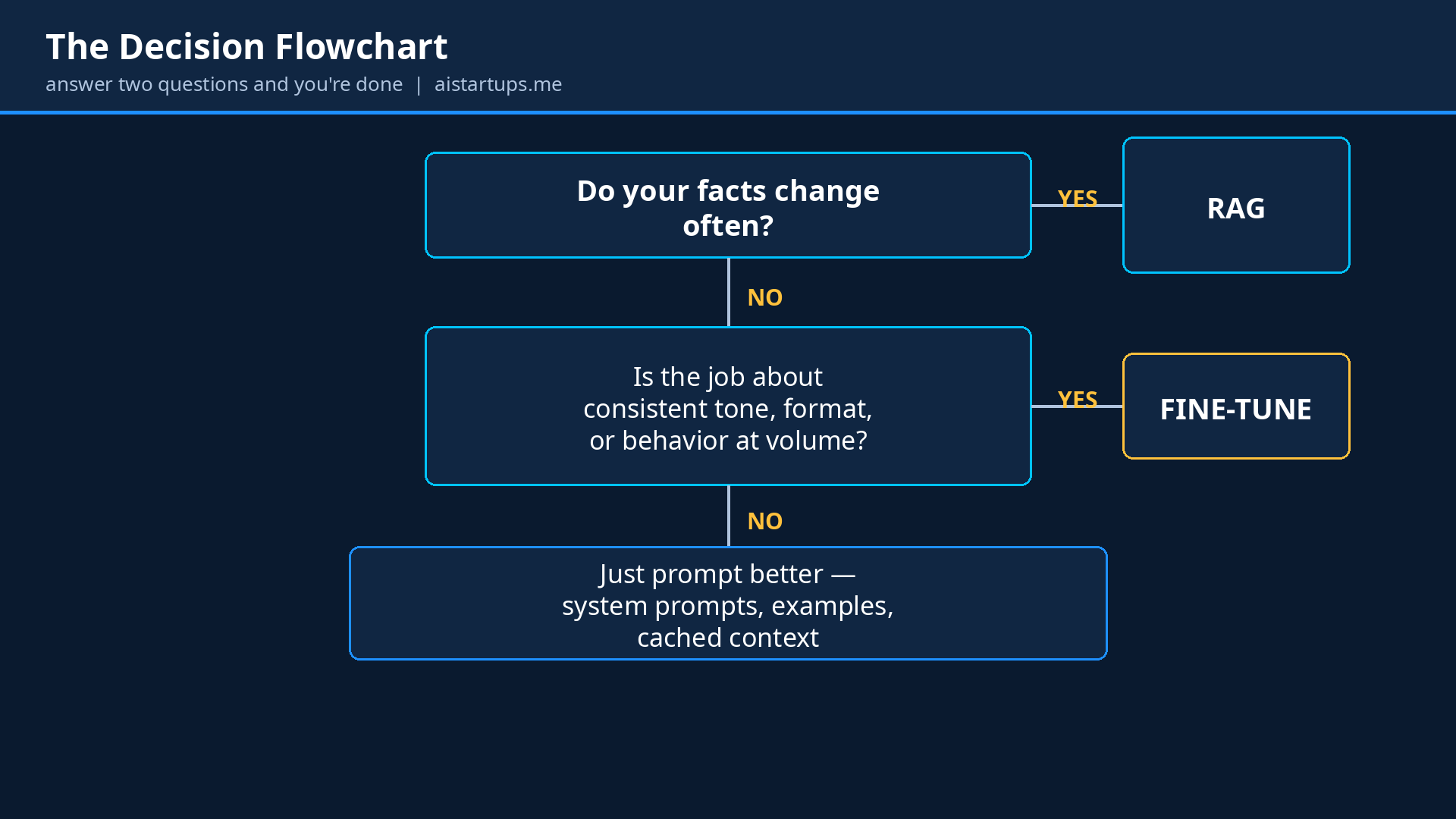
Start here. Three questions, in order:
1. Does your knowledge change often?
If the facts the model needs change weekly, daily, or (heaven help you) hourly — prices, inventory, policies, docs, who’s-who at the company — that’s RAG. Full stop. A fine-tuned model frozen at training time will confidently recite last month’s pricing while your RAG pipeline quietly pulled this morning’s numbers. I’ve seen this mistake cost a startup real support tickets before they figured out the model wasn’t “hallucinating,” it was just out of date.
2. Is the job about consistent behavior at volume?
Same output format thousands of times a day. Same brand voice across every ticket. A classifier that has to make the same judgment call your best employee makes, at 3 AM, at scale. Fine-tuning shines when the shape of the work is stable even if the inputs vary — and especially when it lets you replace a big expensive model with a smaller fine-tuned one. (A fine-tuned mini-class model that matches a flagship on your narrow task is one of the oldest cost wins in this industry.)
3. Everything else? Prompt better first.
Seriously. Before you build infrastructure or pay for training runs, spend a day with the system prompt. Add five great examples. Cache the static prefix. Half the “we need to fine-tune” stories I hear are really “our system prompt is two sentences and we never iterated on it.” Don’t pay $25 per million training tokens to fix a prompt you wrote in ten minutes.
Quick gut-check you can run today: if a smart human intern with perfect access to your docs could do the job, RAG plus prompting is probably enough. If the job needs the intern to become your company — its voice, its judgment, its habits — that’s when fine-tuning earns its keep.
What it actually costs in 2026
Okay, the numbers. Everything below is from current public pricing pages and recent verified breakdowns — not vibes. (Prices move fast in this industry; the price war between the labs has been cutting rates every quarter, which we’ve been tracking here. Treat these as the 2026 baseline and re-check before you budget.)
Fine-tuning: the real math
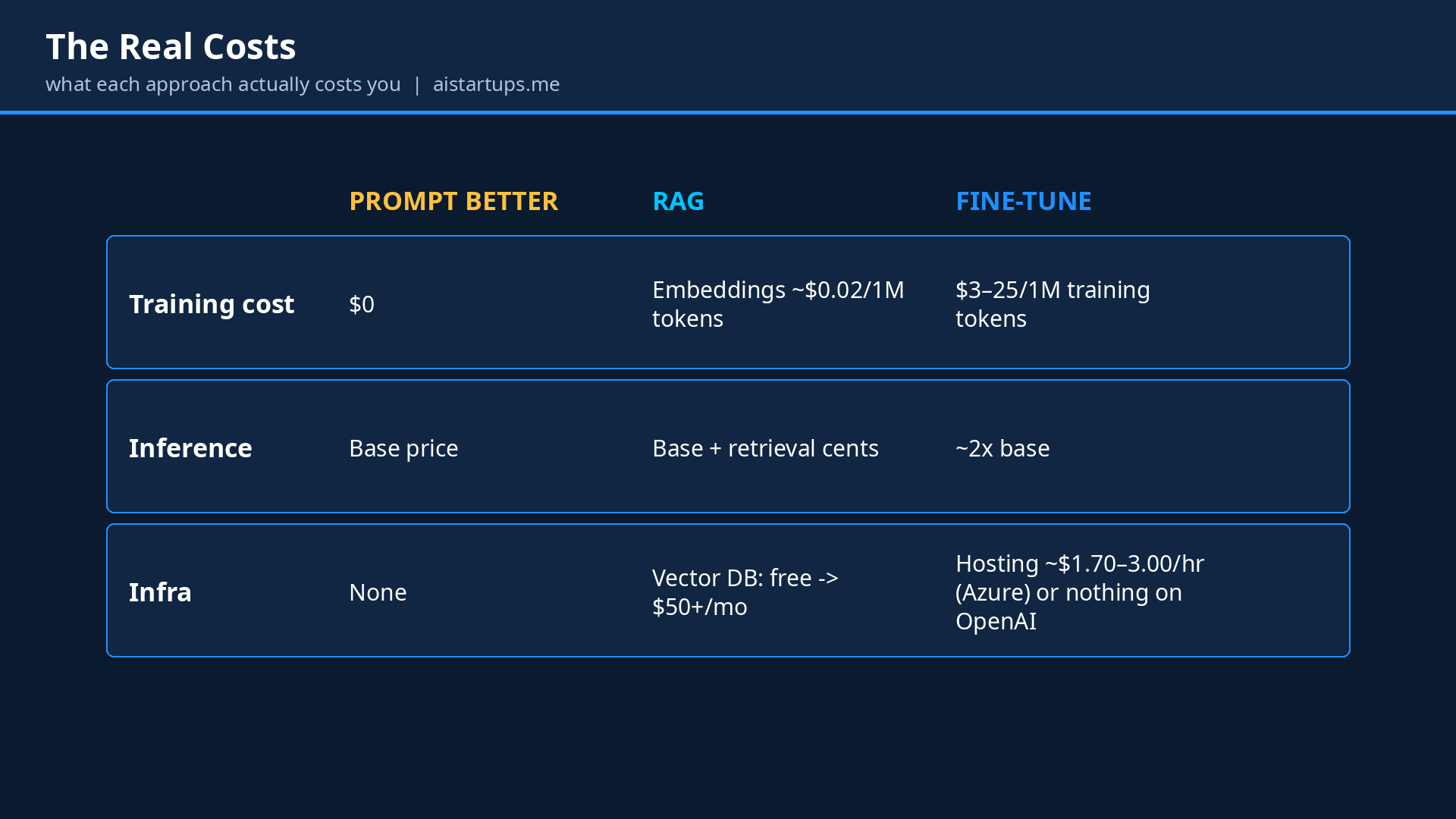
OpenAI’s fine-tuning runs on a simple formula: training tokens × epochs × price per token. For GPT-4o-mini, training costs $3.00 per million tokens; for GPT-4o it’s $25.00 per million. The newer GPT-4.1 family lands around $0.80–$3.00 per million depending on variant. So a 50,000-example dataset at ~512 tokens per example, trained for 3 epochs, runs about $23 on GPT-4o-mini. That’s the part people fixate on, and honestly? It’s the cheap part.
The expensive part is the inference premium. A fine-tuned model typically costs more per token than the base model, forever. Fine-tuned GPT-4o-mini inference runs $0.30 input / $1.20 output per million tokens — double the base model’s rate. On Azure, you also pay hosting: roughly $1.70–$3.00 per hour to keep your fine-tuned model deployed, which is about $1,224 a month at the low end before a single token flows. (OpenAI’s direct API doesn’t charge a separate hosting fee, which is one reason teams pick it.)
So the honest budget for a production fine-tune is: training (one-time, usually tens of dollars) + inference premium (ongoing, scales with volume) + retraining (every time your data drifts — and it will). Retrain quarterly on a 5M-token dataset at GPT-4o-mini rates and you’re looking at roughly $60 a year in training — trivial. But the inference premium at 10,000 queries a day adds up to about $1,500 a year. Still reasonable! One independent analysis I found modeled exactly this scenario — 5M-token dataset, 10k queries/day, quarterly retraining — and landed at ~$1,538/year total for the fine-tuned setup, which came out roughly 41x cheaper than running the same workload on a much bigger base model through RAG.
That last comparison is the key insight: fine-tuning’s real payoff is when it lets you downshift to a smaller, cheaper model. If you’re fine-tuning a flagship to do what the flagship already does, you’re paying extra for nothing.
One more thing worth knowing: Anthropic doesn’t offer fine-tuning on its native API at all (Claude fine-tuning is only available through partners like Amazon Bedrock). If your stack is all-Claude, your customization path is prompting, RAG, and long context — which, given 1M-token contexts, is a more comfortable constraint than it used to be. Google’s path runs through Vertex AI, where tuning bills per training token plus hosting costs, and their docs walk through supervised fine-tuning followed by preference tuning as the recommended sequence.
RAG: the real math
RAG has three cost lines, and all of them are small:
- Embeddings. Converting your documents into vectors costs almost nothing. OpenAI’s text-embedding-3-small runs $0.02 per million tokens; the large version is $0.13 per million. A million tokens is roughly 750,000 words — an entire documentation site. Google’s Gemini Embedding 2 sits around $0.20 per million. And if you want to self-host, Google’s EmbeddingGemma 2 is open-weight under Apache 2.0 — a 740M-parameter model covering text, code, images, and audio that runs in under 600MB of RAM. Embedding your whole corpus once typically costs cents.
- The vector database. This is the one real bill. Pinecone’s Starter tier is free (2GB storage, 2M write units, 1M read units a month) — enough for serious prototyping. Builder is a flat $20/month. Standard starts at a $50/month minimum and bills storage at $0.33/GB plus $4–$4.50 per million write units and $16–$18 per million read units. Or skip managed entirely: pgvector is free and handles up to 10–50M vectors on a single node, which is more than most startups will ever have.
- Retrieval inference. Each query embeds the question (pennies per million queries) and adds a few hundred retrieved tokens to your prompt. On GPT-6 Luna at $0.10 input per million tokens, that’s functionally free.
A typical early-stage RAG setup — embeddings of a few thousand documents, Pinecone’s free or $20 tier, a small model answering — often runs under $50 a month total. The catch is operational: RAG is a pipeline, not a checkbox. Chunking strategy, embedding quality, retrieval tuning, keeping the corpus fresh — that’s real engineering time. If you don’t have that time in-house, this is exactly the kind of thing a good dev team wires up for you. Teams like AISquadX, an AI integration studio, build production RAG pipelines for startups that would rather ship than become vector-database experts.
Better prompting: the real math
Near zero. Your system prompt tokens cost whatever your model charges — GPT-6 Luna is $0.10 per million input tokens, Claude Haiku 5.5 matches that under 100K tokens, and cached input is 90%+ cheaper on most providers. Prompt iteration costs you afternoons, not dollars. This is why it’s always step one.
The golden order (and when to break it)
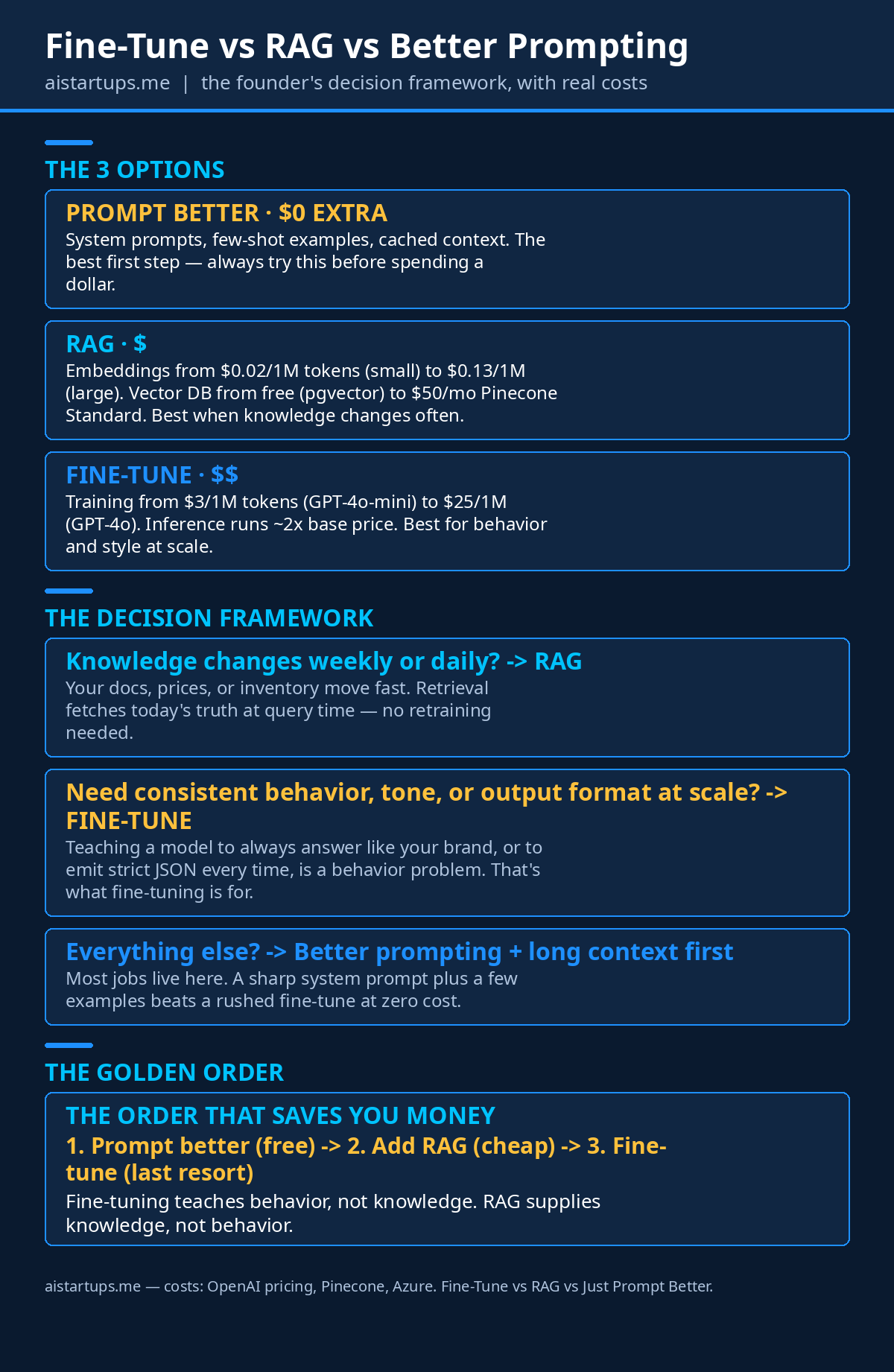
If you take one thing from this article, take this sequence:
- Prompt better first. System prompt, examples, cached prefix. A day or two. Free.
- Add RAG when knowledge is the problem. Facts change, customers ask about your stuff, answers need citations. Weeks of work, tens of dollars a month.
- Fine-tune when behavior is the problem at scale. Consistent format, voice, judgment — thousands of times a day — and it lets you swap a big model for a small one. Real money, real commitment.
Now, the exceptions — because real life has them:
- Break the order if latency is your product. Fine-tuning bakes behavior into the model, so you can drop the giant few-shot prompt entirely. Shorter prompts, faster responses, lower per-call cost. For real-time products (voice, trading, gaming), that can matter more than anything else.
- Break the order if your task is adversarial. Classification, moderation, fraud-adjacent decisions — cases where prompt injection or edge-case inputs are the norm. A fine-tuned classifier is harder to talk out of its job than a prompted one.
- Break the order if you need the model to not know things. Weird but real: fine-tuning can suppress behaviors and shape refusals more reliably than prompts, which users can sometimes talk around.
- Combine them freely. The best production systems I’ve seen use all three: a fine-tuned small model for consistent behavior, RAG for fresh facts, and careful prompting to glue it together. These aren’t religions; they’re tools in one toolbox.
The mistakes that cost real money
Let me save you the tuition I watched other founders pay:
Mistake 1: Fine-tuning for knowledge. The model memorizes your Q3 prices, then Q4 arrives and it confidently lies. Knowledge goes in the retrieval layer. Always. Fine-tuning is for how it talks, not what it knows.
Mistake 2: Building RAG before trying a long prompt. Your docs are 40 pages? That’s ~30K tokens. It fits in the context window of every serious model in 2026, and cached input makes it cheap. I’ve seen teams build a six-week vector pipeline to solve a problem a system prompt solved in testing.
Mistake 3: Ignoring the inference premium. That $23 training run feels great until you realize you’re paying 2x per token for the next two years. Always model the annual cost, including retraining, before you commit — this is unit economics for your AI layer, and investors will ask about it.
Mistake 4: No eval set. However you customize, build a set of 50–100 real examples with correct answers before you start, and measure every change against it. The number of teams running on vibes — “it feels better now” — is honestly frightening. This one habit separates the startups that ship from the ones that tinker.
Mistake 5: Treating it as one-and-done. Models get updated, your data drifts, retrieval quality decays. Budget a quarterly tune-up: re-run your evals, refresh the corpus, check whether the new base model made your fine-tune redundant. (It happens more often than you’d think — base models keep getting better at things people used to fine-tune for.)
“Fine-tuning teaches behavior, not knowledge. RAG supplies knowledge, not behavior. And better prompting is free — so it always goes first. The founders who waste money are the ones who reach for the most expensive tool before trying the cheapest one.”
What I’d actually do: three founder scenarios
Scenario A: You’re building a support bot for your SaaS. Docs change with every release. Answers need to quote the right help article. That’s RAG + a sharp system prompt + a small cheap model like GPT-6 Luna or Claude Haiku 5.5. Total monthly cost: likely under $100. Don’t fine-tune — your docs will change and the weights won’t.
Scenario B: You’re building an AI writing tool with a signature voice. Every output needs the same tone, structure, and formatting, thousands of times a day, and long example prompts are eating your margins. Fine-tune a small model on a few thousand of your best examples. Shorter prompts, faster outputs, ~2x the small model’s base rate — which is still a fraction of the flagship you were using. This is the textbook fine-tuning win.
Scenario C: You’re pre-launch and just trying to make the demo work. Prompt better. That’s it. No vector DB, no training runs. Ship the demo, get users, learn what’s actually hard — then come back to this framework with real data. Premature infrastructure is the root of all startup evil, and AI infra is no exception. (Our broader guide to cutting your AI API bill covers the margin side of this once you’re live.)
FAQ
Is fine-tuning dead now that context windows are so big?
No — but its territory shrank. Long context and RAG killed the “I need the model to know my stuff” use case for fine-tuning. What’s left, and still very alive, is behavior: consistent format, voice, and judgment at scale, especially when it lets you replace an expensive flagship with a cheap fine-tuned small model. If someone tells you fine-tuning is dead, ask what their eval set says.
Can I use RAG and fine-tuning together?
Absolutely, and the best production systems often do. A common pattern: fine-tune a small model for consistent behavior and output format, then feed it retrieved context via RAG for fresh facts. The fine-tuned model is better at using the retrieved chunks correctly, and RAG keeps the knowledge current. They’re complementary, not rivals.
How much data do I need to fine-tune?
Less than you’d think for behavior, more than you’d hope for knowledge. Teams regularly see results with a few hundred to a few thousand high-quality examples for style and format tasks. OpenAI’s own guidance has long said you can get strong results with as little as a few dozen examples for simple adaptations. The quality of your examples matters far more than the count — 200 perfect examples beat 20,000 sloppy ones.
What’s the cheapest way to run RAG in production?
Embeddings are nearly free ($0.02 per million tokens on OpenAI’s small model, or $0 with a self-hosted open model like EmbeddingGemma 2). For the vector database, start with pgvector if you’re already on Postgres — it’s free. When you outgrow it, Pinecone’s Starter tier is free and Builder is a flat $20/month. Most early-stage RAG setups run under $50/month all-in. The real cost is engineering time to get chunking and retrieval quality right.
Should I fine-tune an open-weight model instead of using a closed API?
It depends on your scale and team. Open-weight models (Llama, Qwen, Mistral) let you fine-tune locally or on cheap GPU hosts, own the weights, and avoid inference premiums — training a 70B-class model can run ~$4.50 per million tokens on hosted services, with inference around $0.71 per million. But you take on hosting, ops, and eval burden. For most early startups, the managed APIs win on speed; self-hosting wins when volume makes per-token premiums painful. Run the math at your actual query volume before deciding.
The Bottom Line
Stop asking “fine-tune or RAG?” as if it’s a personality test. Ask what your problem is. Knowledge that changes? RAG. Behavior at scale? Fine-tune. Everything else? Write a better prompt and ship it today.
The golden order exists because money flows downhill: prompting is free, RAG is cheap, fine-tuning is a commitment. Follow it, and you’ll spend your AI budget on the thing that actually moves your product — not on a training run that taught your model last quarter’s pricing.
And build that eval set. Fifty examples, correct answers, run it before and after every change. It’s the single highest-ROI habit in this whole game, and it costs you an afternoon.
Now go ship something.