


Yesterday, a two-year-old startup from Brooklyn dropped a 501-billion-parameter AI model and the whole open-source AI world snapped to attention. Not OpenAI. Not Google. Reflection AI — a company most founders had never heard of until about 48 hours ago.
Here’s why I’m writing about it less than a day after launch: Beam isn’t just another model release. It’s the first serious American answer to the Chinese open-weight models (DeepSeek, Qwen, GLM) that have been eating everyone’s lunch on price-performance. And for startup founders, the interesting part isn’t the benchmark scores. It’s what a frontier-class open-weight model does to your cost structure, your data control, and your negotiating leverage with the big API providers.
So let’s break it down properly — the specs in plain English, what the numbers actually say (and what they don’t), how to get your hands on it, and what I’d do with it this month if I were building right now.
So what is Beam, exactly?
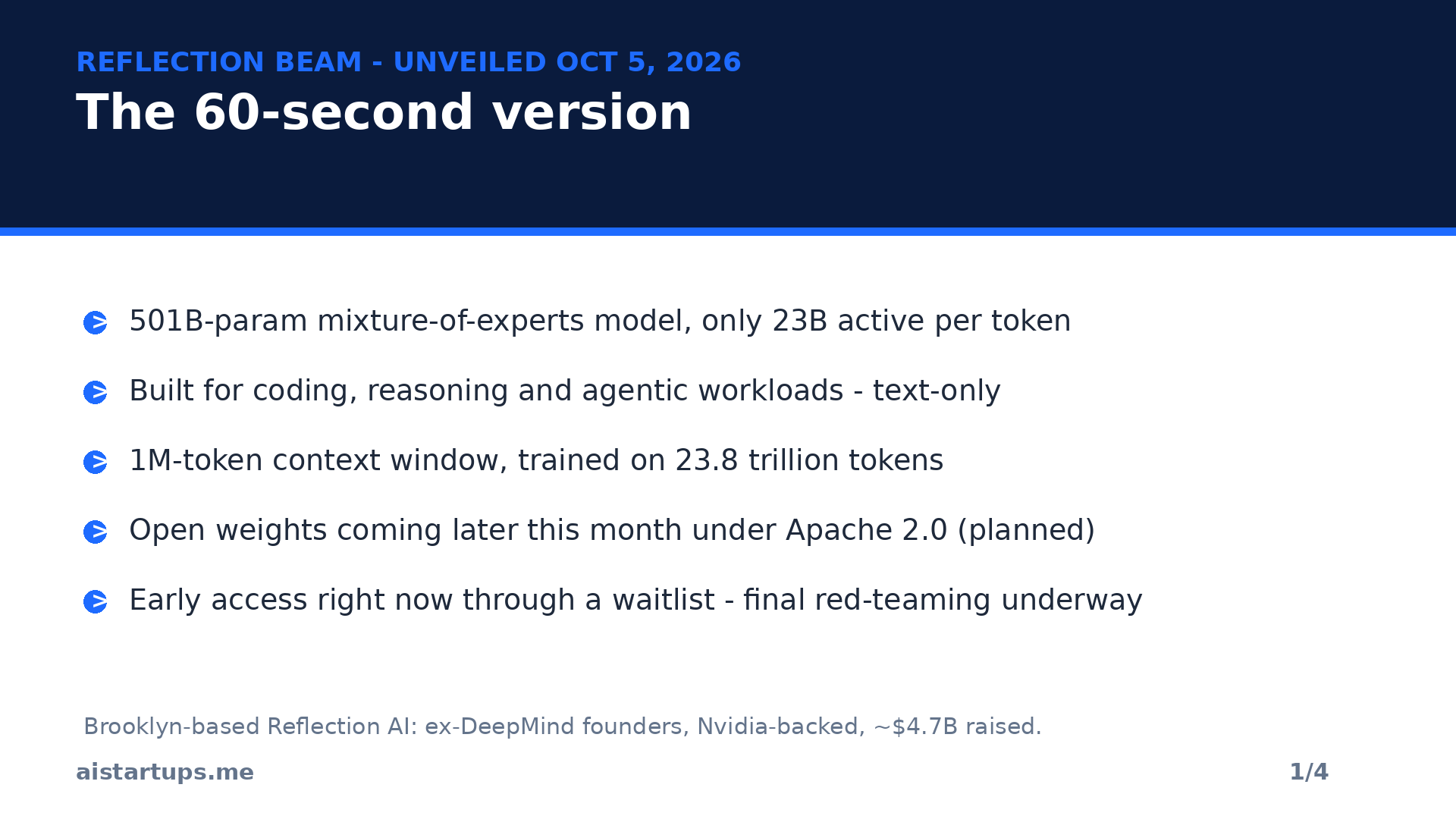
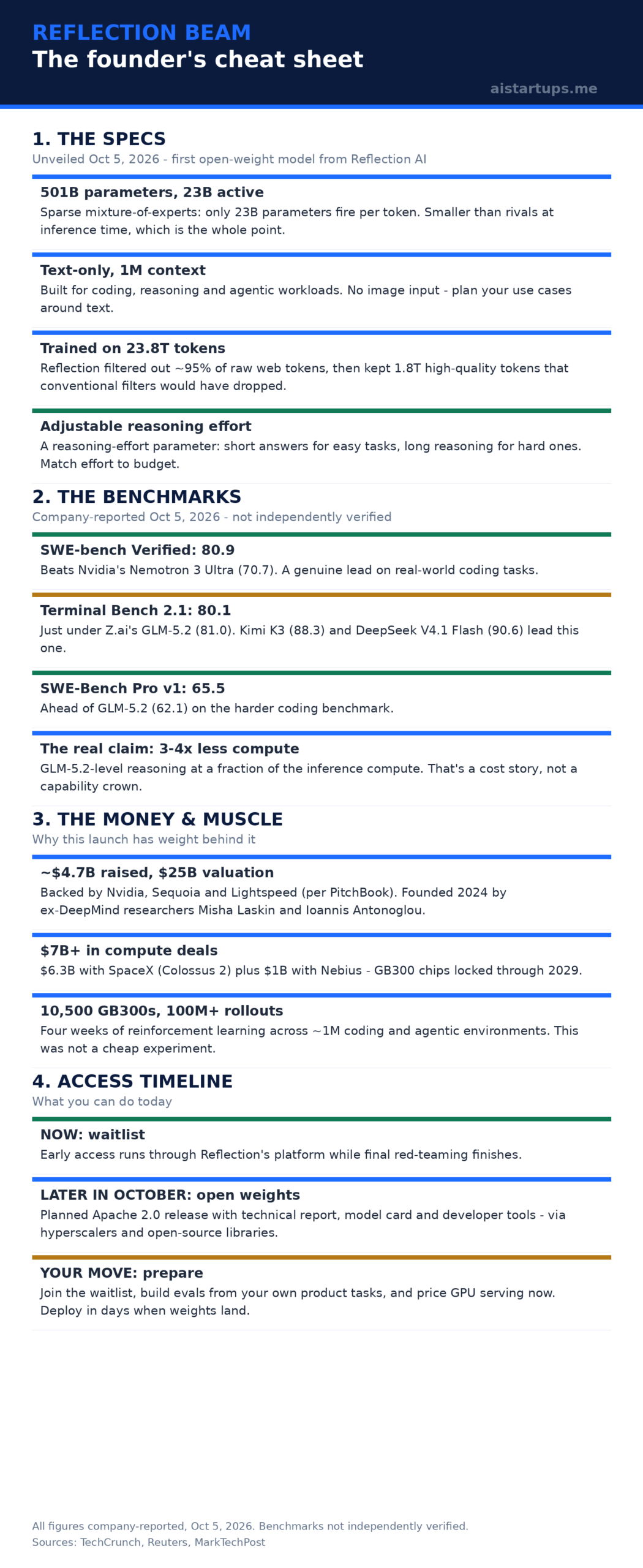
Beam is Reflection AI’s first frontier model, unveiled October 5, 2026. It’s a sparse mixture-of-experts (MoE) model with 501 billion total parameters — but here’s the part that matters: only 23 billion of those parameters actually fire for any given token.
Think of it like a hospital. A hospital might employ 500 specialists, but your checkup only involves two or three of them. The rest stay in their offices, costing you nothing. That’s the MoE trick: enormous total knowledge, but you only pay inference compute for the experts your task actually needs. Compare that to Z.ai’s GLM-5.2, which carries roughly 744 billion total parameters with about 40 billion active — Beam is doing comparable work while waking up barely half the experts.
The rest of the spec sheet, in plain terms: it’s text-only — no image input, so if your product needs vision, this isn’t your model, at least not yet. It carries a 1 million token context window — roughly 750,000 words, your entire codebase or a year of support tickets in a single prompt. It was trained on 23.8 trillion tokens, with Reflection throwing away about 95% of raw web data during curation, then rescuing 1.8 trillion high-quality tokens that conventional filters would have dropped — data quality over data quantity, the current religion of model training. And there’s an adjustable reasoning-effort parameter: dial it down for quick answers, crank it up for hard problems. In founder terms, you get to match the compute spend to the difficulty of the task instead of paying flagship prices for everything.
It’s built specifically for coding, reasoning, and agentic workloads. Not a chatbot model. Not a general assistant. A workhorse for developers and the agents they build — which, honestly, is exactly where startup value is being created right now.
The money and muscle behind it
Reflection AI was founded in 2024 by two former Google DeepMind researchers, Misha Laskin (CEO) and Ioannis Antonoglou. Per PitchBook, via TechCrunch, the company has raised roughly $4.7 billion from backers including Nvidia, Sequoia Capital, and Lightspeed Venture Partners, at a $25 billion pre-money valuation.
Then there’s the compute. This summer Reflection signed a $6.3 billion deal with SpaceX for access to Nvidia GB300 chips at the Colossus 2 data center, plus another $1 billion through cloud provider Nebius — locking in supply through 2029. The training run itself used 10,500 GB300 GPUs for four weeks of reinforcement learning, generating over 100 million rollouts across nearly a million coding and agentic environments. Pretraining finished in under four weeks on 6,144 GB300s.
Why should you care about someone else’s GPU bill? Because it tells you this isn’t a research demo or a marketing stunt. Nobody spends that kind of money to ship a press release. Reflection is explicitly pitching “AI factories” — letting enterprises and even sovereign nations build customized local AI systems on their own proprietary data. They’ve already started testing the concept with Shinsegae Group in South Korea, and signed a partnership to supply models to the U.S. Department of Energy and Department of War back in May. Axios reported that hedge funds and trading firms are lining up too.
Real talk: the enterprise-sovereign angle isn’t your world as an early-stage founder. But the fact that serious money is betting on open weights being the future? That very much is.
The benchmarks — read them honestly
Okay. Numbers. Reflection published its own scorecard, and I want to be straight with you about what it shows and what it doesn’t.
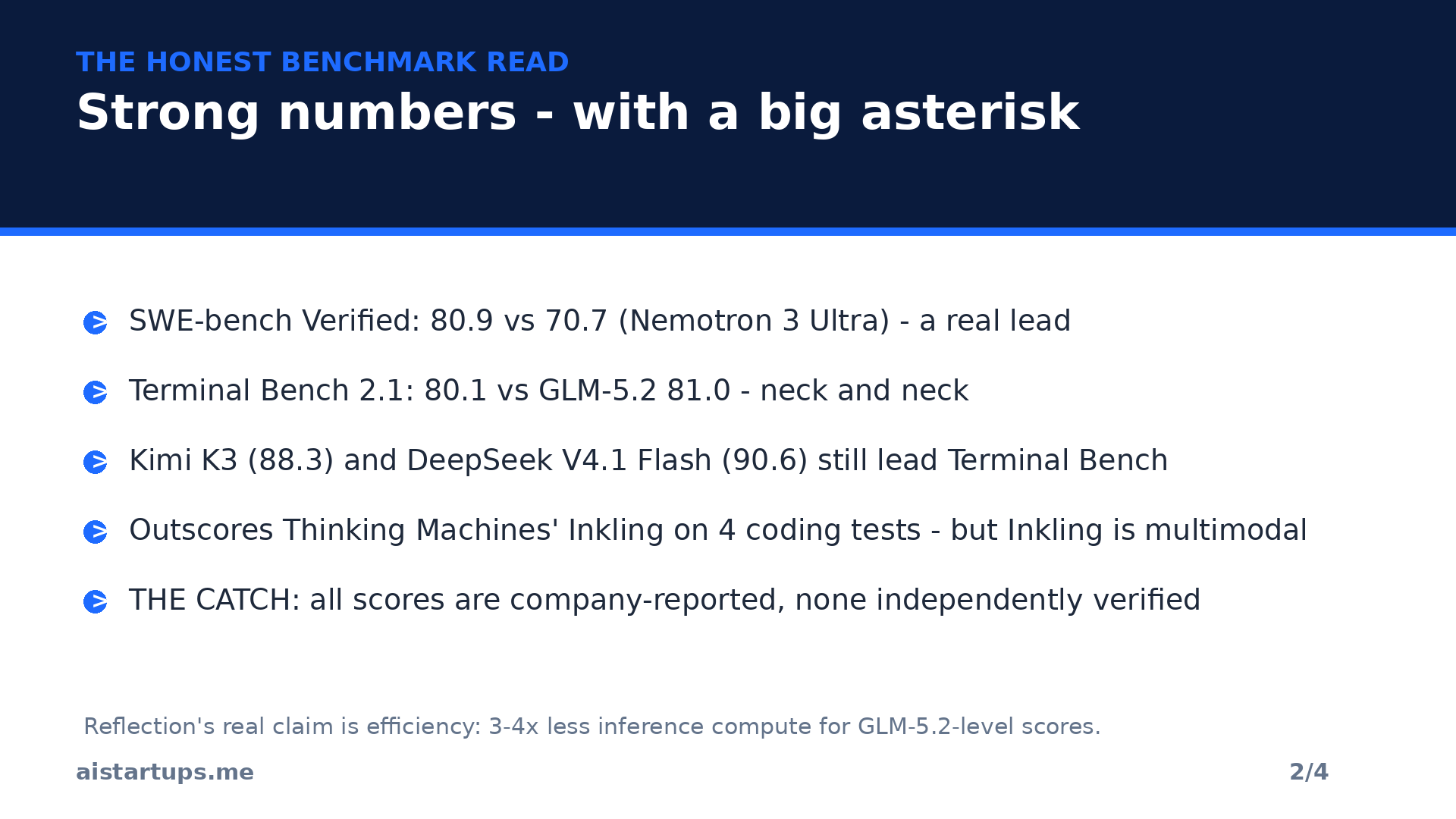
| Benchmark | Beam | Closest rival |
|---|---|---|
| SWE-bench Verified | 80.9 | 70.7 (Nemotron 3 Ultra) |
| SWE-Bench Pro v1 | 65.5 | 62.1 (GLM-5.2) |
| Terminal Bench 2.1 | 80.1 | 81.0 (GLM-5.2) |
| GPQA Diamond | 90.5 | 91.2 (GLM-5.2) |
| Humanity’s Last Exam (no tools) | 36.2 | 40.5 (GLM-5.2) |
The honest read: Beam genuinely leads on SWE-bench Verified — that’s real-world coding tasks, and beating Nvidia’s Nemotron 3 Ultra by ten points is not nothing. It’s roughly tied with GLM-5.2 on agentic terminal tasks. And it trails on the rest: Kimi K3 (88.3) and DeepSeek’s V4.1 Flash (90.6) are still clearly ahead on Terminal Bench.
Now the asterisk, and it’s a big one: every one of these numbers is company-reported and none has been independently verified. TechCrunch flagged this explicitly. Reflection even published the comparisons where rivals beat it, which is admirably candid — but “trust us, we’re losing gracefully on some tests” is still “trust us.”
Here’s the thing, though. Reflection’s actual claim isn’t “we’re the smartest model.” It’s “we’re GLM-5.2-class at 3 to 4 times less inference compute.” That’s a cost claim, not a capability crown — and cost claims are exactly what founders should be listening for. One caveat inside the caveat: that efficiency figure is a model-compute comparison based on benchmark data, not a measured estimate of what you’ll actually pay to run it once serving overhead, prefill, and long contexts enter the picture. Directionally exciting. Don’t put it in your unit economics spreadsheet yet.
Why this actually matters for your startup
Let me connect the dots to your P&L, because that’s the part nobody in the launch coverage bothered to do.
Right now, most AI startups rent intelligence. You call someone’s API, you pay per token, your margins are hostage to their pricing page, and your customers’ data flows through their servers. It works — until it doesn’t. Until the price changes, or the model gets deprecated, or an enterprise prospect asks “where exactly does our data go?” and your answer is embarrassing.
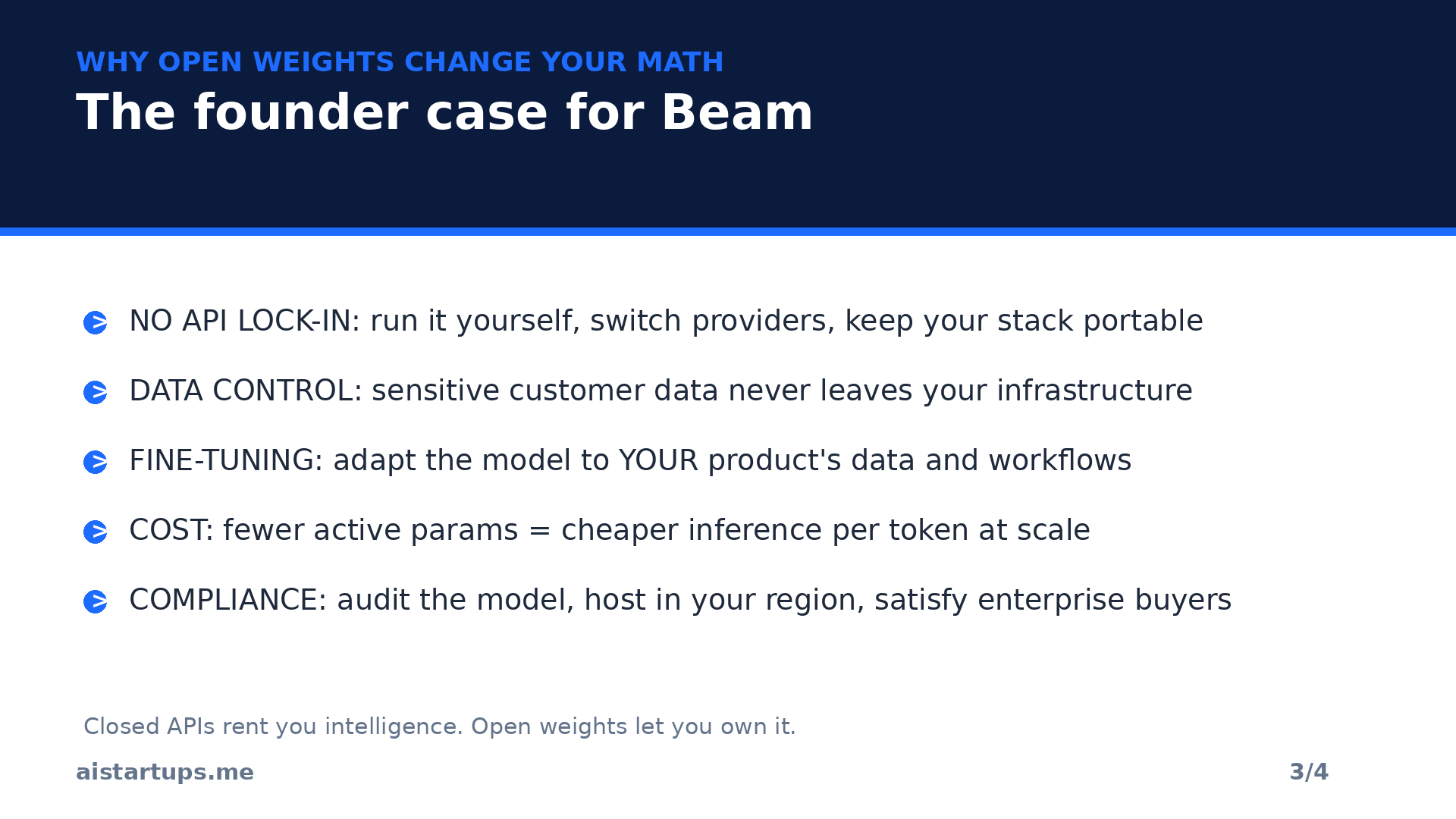
Open weights flip that relationship. Here’s what changes when a model like Beam lands under Apache 2.0:
1. Your API bill stops being a variable you can’t control
We’ve been tracking the AI price war that’s already slashing model costs — every major lab is now competing on price, not just benchmarks. Open weights accelerate that. When you can self-host a 23B-active model instead of paying flagship API rates, your cost per task becomes an engineering decision, not a vendor’s pricing decision. If you’re serious about cutting your AI API bill, the open-weight route is increasingly the biggest lever you have.
2. Data stays yours
Self-hosted means customer data never leaves your infrastructure. For anyone selling into healthcare, finance, legal, or government-adjacent markets, that’s not a nice-to-have — it’s the difference between “we’ll evaluate you” and “our compliance team said no.” Full stop.
3. Fine-tuning becomes a moat
You can’t fine-tune someone else’s API model on your proprietary data — well, mostly. With open weights, you can adapt Beam to your specific workflows, your customers’ jargon, your edge cases. That’s how a small startup beats a generic model: not with a better base model, but with a better adapted model.
4. No deprecation rug-pulls
API providers sunset models. It happened to plenty of teams this year. Weights on your own servers don’t get deprecated — you upgrade when you’re ready, on your schedule.
The catch? You need the infrastructure and the know-how to serve a 501B-parameter MoE, which is not a weekend project. Be honest with yourself about whether that’s you right now. There’s no shame in renting intelligence while you’re finding product-market fit — but you should know the ownership path exists, and it’s getting cheaper every quarter.
Beam vs everything else
So where does Beam sit in the actual decision you’d make this month? Quick framing:
- vs. Chinese open models (GLM-5.2, Kimi K3, DeepSeek V4.1, Qwen): Beam’s pitch is Western provenance plus efficiency. Raw scores still favor Kimi K3 and DeepSeek on several benchmarks. If your only metric is benchmark-per-dollar and you don’t care about jurisdiction, the Chinese models still lead. If data sovereignty, supply-chain politics, or enterprise procurement rules matter to your buyers, Beam just became very interesting.
- vs. closed APIs (Claude, GPT, Gemini): different game entirely. Closed models still lead on raw capability and they’re zero-infrastructure — you call an API and you’re done. Stack Beam against closed options like Claude Sonnet 5.5 when your volumes are high enough that per-token API costs hurt, or when data control is non-negotiable.
- vs. other Western open models (Mistral, Meta, Cohere, Inkling): Beam outscores Thinking Machines Lab’s Inkling on four coding tests where both report results — though Inkling is multimodal and Beam is text-only, so it’s not apples to apples. This is now the most serious Western open-weight coding model on the board.
My rule of thumb: prototype on closed APIs (speed matters more than cost at zero users), and plan your migration to open weights for the moment your monthly API bill starts making you wince. Beam just moved that migration option up the capability ladder.
How to get your hands on it
Let’s be concrete, because “exciting launch” means nothing without an action plan:
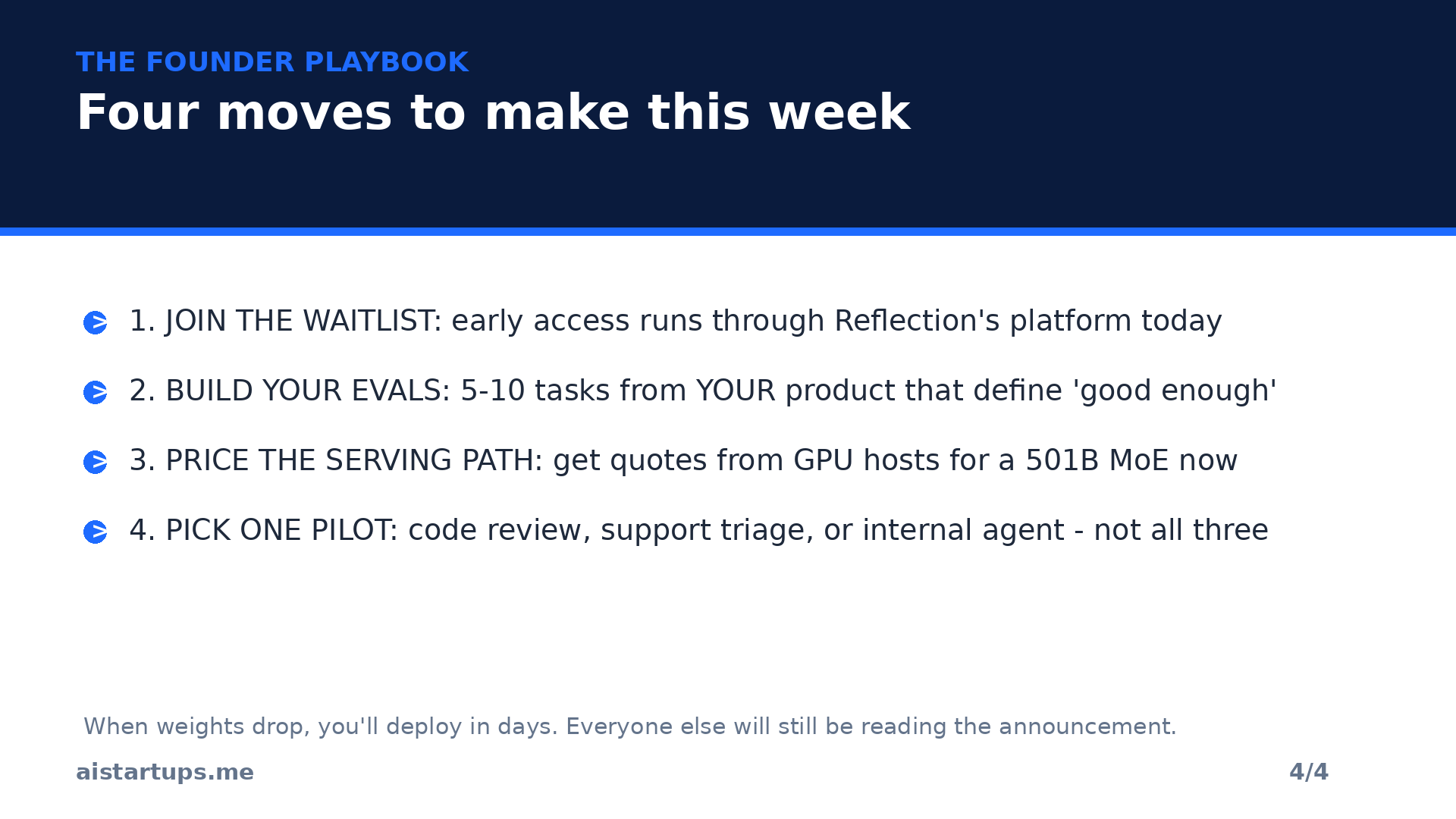
- Join the waitlist now. Beam is in final red-teaming, and early access runs through Reflection’s platform via sign-up. Get in the queue today — waitlists are free and early access slots tend to favor the early.
- Build your evals this week. Pick 5–10 tasks from your actual product — real support tickets, real code review diffs, real agent workflows — and define what “good enough” looks like. When weights drop, you’ll know in an afternoon whether Beam beats your current stack. Everyone else will still be arguing about benchmarks on social media.
- Price the serving path now. A 501B MoE needs serious GPU memory even with only 23B active. Get quotes from GPU cloud providers for your expected volume before you need them. If the numbers don’t work at your scale, that’s useful information — stick with APIs and revisit in six months.
- Pick ONE pilot workload. Code review, support triage, an internal agent — not all three. Open-weight migrations fail when teams try to boil the ocean. One workload, measured properly, then expand.
Later this month — Reflection’s words, so treat the date as aspirational — the full weights land under the Apache 2.0 license (planned), along with a technical report, a model card, and developer tools, distributed through hyperscalers and neoclouds with open-source library integrations at launch. That’s when the real experimentation starts.
Reflection calls Beam a “workhorse model” for enterprises, the public sector, and developers — and honestly, that framing is refreshing. Not “superintelligence.” Not “the smartest model ever.” A workhorse. The pitch is reliability-per-dollar, not magic.
What I’d actually do with it this month
If I were running an AI startup today, here’s my honest playbook — not hype, just sequencing:
Week 1: waitlist signup, eval suite built, serving quotes requested. Keep shipping on your current API stack. Do not pause your roadmap for a model you can’t download yet — that’s how launches kill momentum.
When weights drop: run your evals against Beam and your current model on the same tasks. If Beam matches quality on your pilot workload at meaningfully lower cost, migrate that one workload. Measure for two weeks. Then decide about workload two.
The fine-tuning question: this is where Beam gets genuinely exciting for startups with proprietary data. A base model fine-tuned on your customers’ actual workflows will beat a generic flagship on your specific tasks more often than people expect. If your team doesn’t include ML engineers, this is exactly the kind of deployment and fine-tuning work an AI integration studio like AISquadX handles every day — worth a conversation before you try to hire your way through it.
And the thing I’d not do: rebuild my architecture around Beam today. It’s one day old. The weights aren’t out, the evals aren’t independent, and dates slip. Position yourself to move fast; don’t move yet.
The risks and open questions
Because someone should say the quiet parts out loud. First, red-teaming isn’t finished — the model is still going through final safety evaluations, so the weights release could slip and the safety profile could change; don’t build compliance-sensitive features on a model whose final safety report you haven’t read. Second, the benchmarks are unverified — said it before, saying it again: company-reported numbers, and independent evals will only arrive with the weights. Third, text-only is a real limitation — if your product touches documents with images, screenshots, or diagrams, Beam can’t see them, so your pipeline needs to handle that gap or you need a multimodal companion model. Fourth, the “Western open” framing is political — positioning against Chinese models is partly a procurement strategy, since governments buy American; that’s fine, but evaluate the model on its merits, not its passport. And fifth, licensing details matter — “Apache 2.0 (planned)” means planned, not shipped, so read the actual license when the weights drop, especially the fine print on commercial use and redistribution, and run through the legal checklist for AI startups before you sign anything or ship anything customer-facing on top of it.
Frequently asked questions
Is Reflection Beam available right now?
Not for download — not yet. As of the October 5 unveiling, Beam is in final red-teaming, with early access available through a waitlist on Reflection’s platform. The open weights are planned for release later in October 2026 under the Apache 2.0 license, together with a technical report, model card, and developer tools.
How much will Beam cost to use?
There’s no API pricing because there’s no public API yet — it’s an open-weight release, not a hosted service. Your cost will be whatever it takes to serve it: GPU compute from a cloud provider, either self-managed or through a hosted inference platform once integrations land. Reflection claims 3–4x less inference compute than rivals at similar capability, but that’s a model-compute estimate, not a price quote. Get real serving quotes for your volume before budgeting.
Is Beam better than GPT or Claude?
On the benchmarks Reflection published, Beam is competitive with open models like GLM-5.2 on coding and agentic tasks — and it beats some, trails others. Against closed flagships from OpenAI and Anthropic, Reflection itself positions Beam as a “workhorse,” not the capability leader. The honest answer: it’s not trying to be smarter, it’s trying to be cheaper to run and yours to control. Different job.
What does the Apache 2.0 license mean for my startup?
Apache 2.0 is one of the most permissive open-source licenses: you can use, modify, and distribute the model commercially, including in proprietary products, with minimal obligations (keep the license notice, note your changes). That’s why the license matters as much as the model — it’s what makes self-hosting and fine-tuning legally clean for a startup. Final confirmation comes when the actual weights and license text ship.
Should my startup switch to Beam?
Not today — you can’t, the weights aren’t out. The smart move is preparation: join the waitlist, build evals from your real product tasks, and price out serving. When the weights land, you’ll have data instead of opinions. If you’re pre-product-market fit, keep building on closed APIs for speed and revisit open weights when your API bill or your enterprise buyers force the conversation.
The Bottom Line
Reflection Beam is the most significant open-weight launch of the year for one reason: it proves the Western open ecosystem can still compete on efficiency, not just vibes. A 501B model that only wakes 23B parameters per token, matching GLM-5.2-class performance at a fraction of the inference compute, with Apache 2.0 weights landing this month — that’s a real option appearing on every founder’s infrastructure menu.
But keep your head. The benchmarks are company-reported, the weights aren’t out, and the efficiency claim is an estimate. What you can do today is free: join the waitlist, build your evals, price your serving. The founders who do that homework this week will deploy in days when the weights drop. Everyone else will still be reading launch coverage.
And zoom out for a second: between the price war at the closed labs and serious open weights getting cheaper to run, the cost of intelligence is collapsing from both ends. That’s the actual story. Beam is just this week’s chapter — but it’s a good one.