

A friend of mine runs a roofing company. Fifteen employees, decent revenue, the kind of business that keeps a town running. Last month he showed me his desk setup and I counted: ChatGPT open in one tab, a Copilot sidebar, some scheduling app with an “AI” badge, and a CRM he’d bought because a webinar promised it would “10x his pipeline.”
He’d spent maybe $400 a month on AI tools. And you know what they were actually doing for him? Writing emails slightly faster. That was it. His estimators still retyped every quote by hand. His office manager still chased invoices like it was 2014. He had every tool and none of the transformation.
“I keep buying the hammers,” he told me, “but nobody’s building the house.”
That’s the whole AI agency business in one sentence. And right now, in late 2026, it’s the simplest AI business a solo founder can start — because the gap between “bought AI” and “uses AI properly” has never been wider, and the cost of closing that gap has never been lower.
Real talk: I don’t think agencies are glamorous. There’s no venture-scale exit here, no TechCrunch headline. But I’ve watched people go from zero to $10K–$20K monthly recurring revenue in under a year selling something most businesses desperately need and almost nobody can build for themselves. The economics are honestly a little absurd. Let me show you.
Why 2026 is the agency window
Every few years there’s a moment when demand shows up before supply does. This is one of those moments, and the numbers are unusually clear.
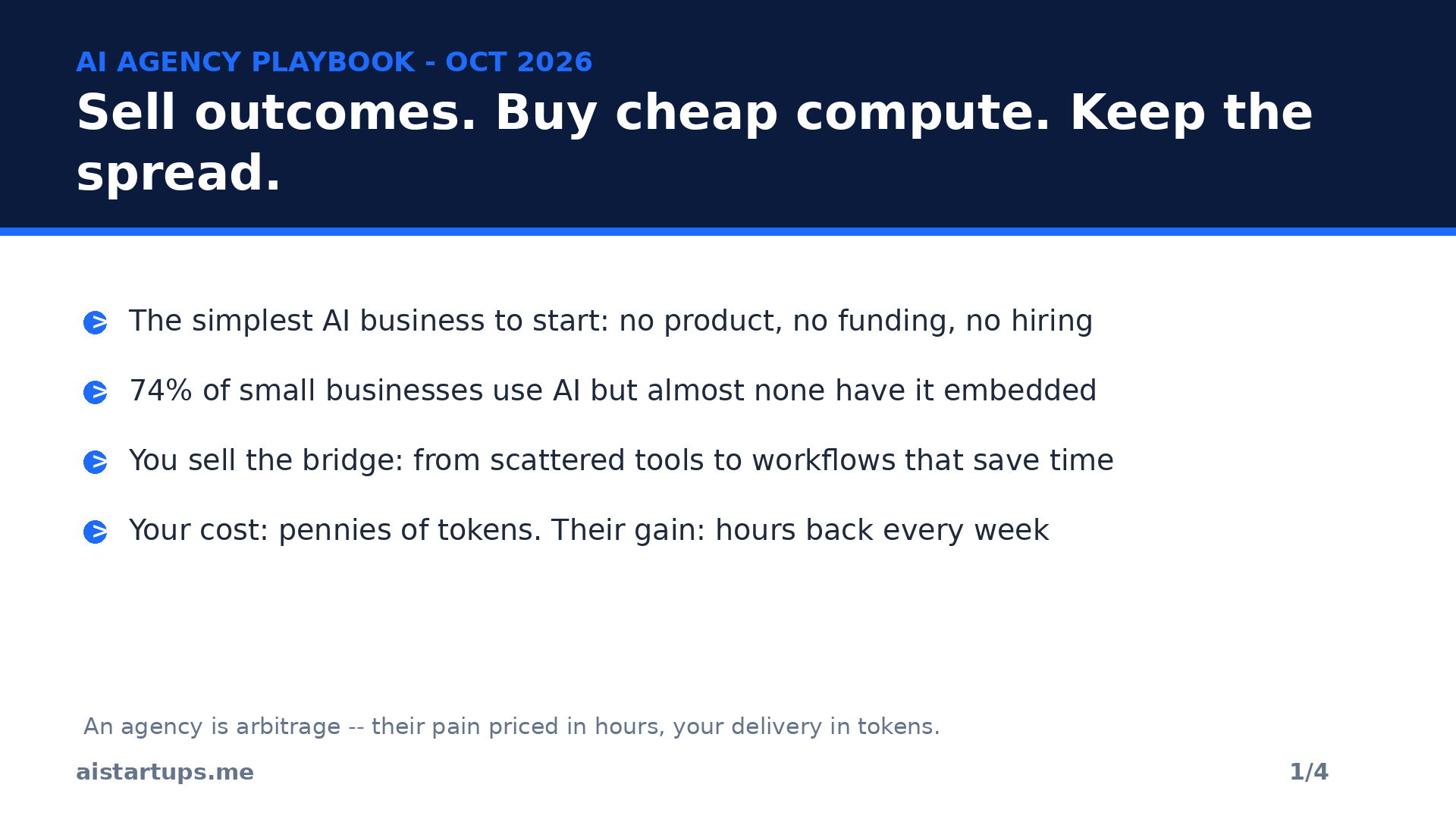
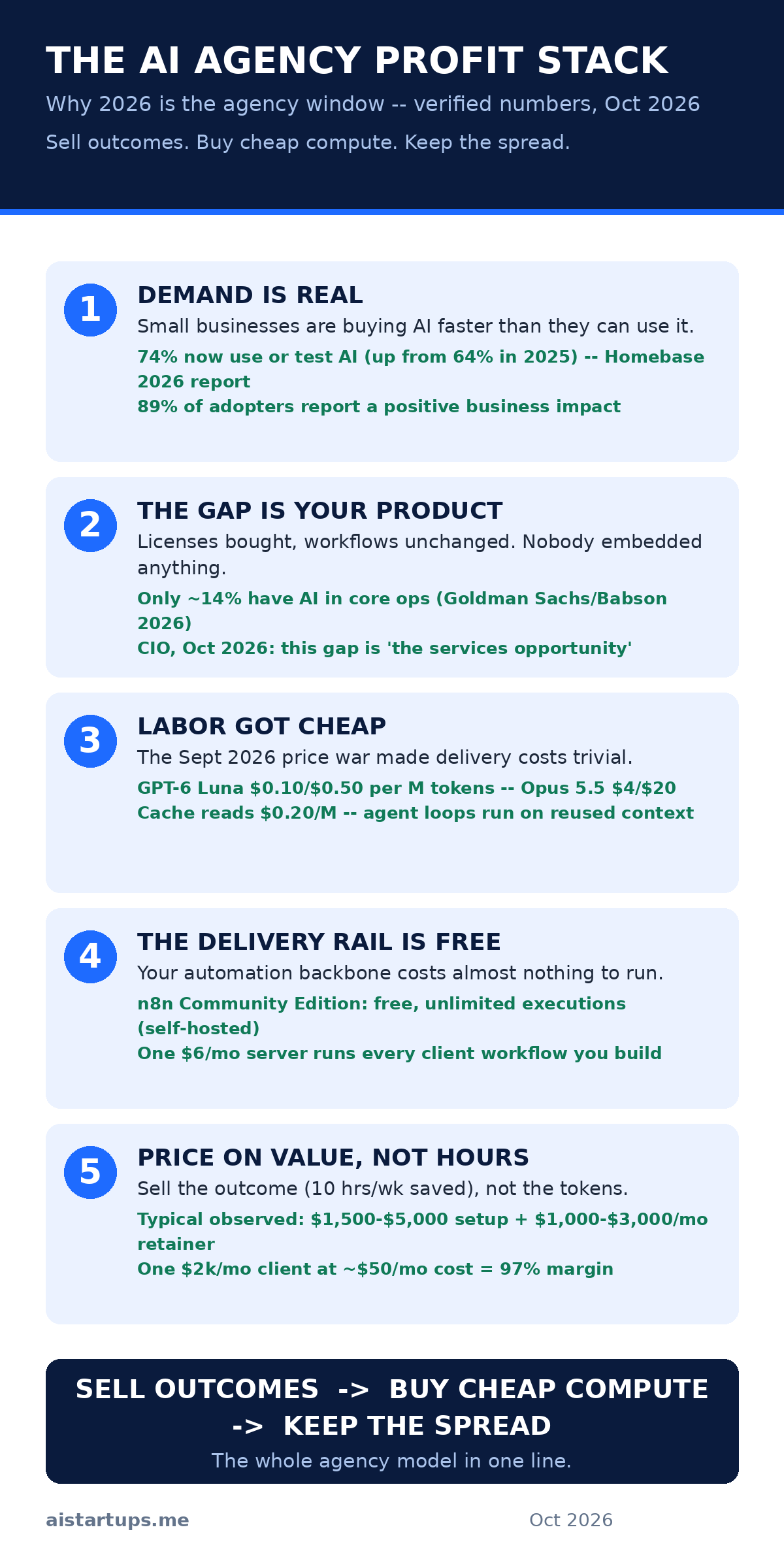
Homebase’s 2026 Main Street AI Gap Report surveyed 750 small business owners and found 74% are now using or actively testing AI — up from 64% just a year earlier. And 89% of those adopters say it’s having a positive impact on their business. The ones using AI for scheduling and payroll together save an average of 7.7 hours and $343 a month — over $4,100 a year. (FinancialContent’s writeup has the full breakdown.)
So demand is not the problem. Everybody’s buying. Here’s the catch — and this is the entire business opportunity: buying isn’t using. A Goldman Sachs/Babson survey of small businesses found that while 76% use AI, only about 14% have it actually embedded in their core operations. Everyone else is my roofer friend: paying for hammers, no house being built.
A CIO piece this month put a name on it: the services gap. A license can be purchased in minutes, but moving a team from scattered experimentation to workflows that actually save time requires discovery, setup, training, and follow-through — capabilities small businesses almost never have in-house. The article’s verdict, from a 30-year managed-services veteran: “the gap between how quickly small businesses want to move and how safely they are prepared to move is the real opportunity.”
That opportunity is you. An AI agency doesn’t sell software. It sells the bridge between the software they already bought and the results they were promised. And here’s the thing nobody quite believes until they run the numbers: the bridge costs you almost nothing to build.
The only five services worth selling
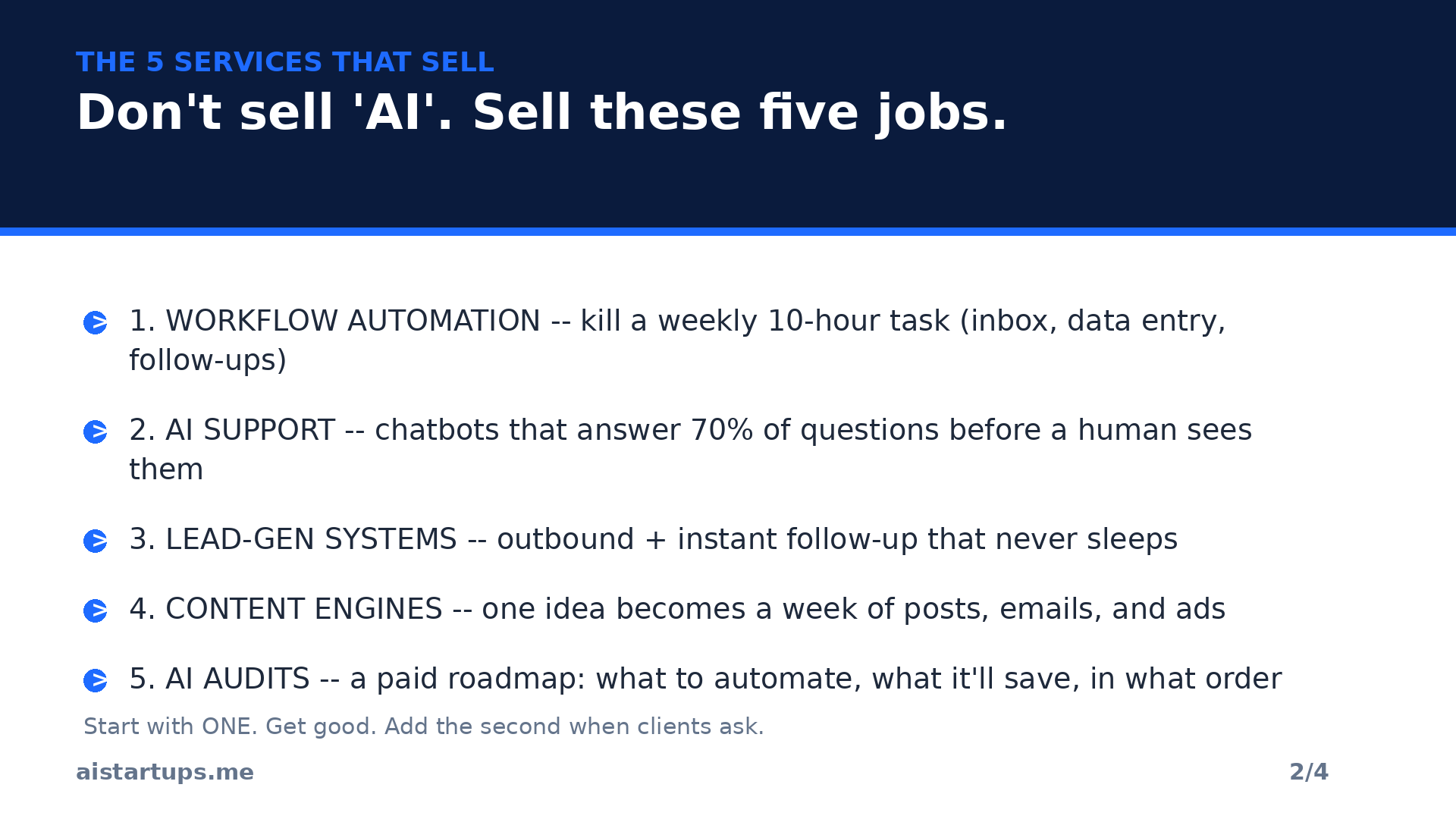
The classic beginner mistake is selling “AI” as a concept. Clients don’t buy concepts; they buy specific pains disappearing. After watching what actually closes, here are the five services that sell — pick one to start, seriously, one:
1. Workflow automation
Find one task a business does every single week that eats hours: triaging the shared inbox, copying data between systems, chasing late payers, scheduling follow-ups. Then automate it. This is the bread and butter — it’s concrete, it’s easy to demo, and the ROI math is trivially easy to explain. If you want more ideas in this lane, I’ve covered 11 AI services you can sell to local businesses that pair naturally with an agency offer.
2. AI customer support
A chatbot trained on the business’s own FAQs, policies, and docs, sitting on their website and answering the repetitive 70% before a human ever gets involved. Dentists, HVAC companies, e-commerce stores — they all answer the same twenty questions all day. Set a good one up once and it runs for years.
3. Lead-generation and follow-up systems
Small businesses are terrible at speed-to-lead. A prospect fills out a form at 11pm and hears back Tuesday. An AI system that responds in seconds, qualifies, books the appointment, and nudges no-shows is worth its weight in gold to a contractor or a clinic. This one sells itself in the demo — which matters, because you’ll be demoing a lot.
4. Content engines
One idea in, a week of output: social posts, email newsletters, ad variations, blog drafts — all in the client’s voice, all reviewed by a human before publishing. Agencies and local businesses alike pay for this because content is the chore everyone postpones. Warning: this space is crowded, so niche it down (e.g., “content engines for real estate agents”) or skip it as your first offer.
5. AI audits and roadmaps
This one’s underrated. A paid engagement — typically a few hundred to a couple thousand dollars — where you spend a week mapping what a business should automate, in what order, and what each automation would save. It positions you as the expert, it filters for serious buyers, and roughly half of audits convert into implementation work. Honestly? Sell the audit first. It’s the easiest yes you’ll ever get.
Notice what’s not on the list: custom model training, “AI strategy consulting” in the abstract, building someone’s chatbot app from scratch. You want boring, repeatable, demoable work. The fancier the deliverable sounds, the harder it sells and the longer it takes to build. Boring prints money. (If you haven’t read my roundup of boring AI businesses that print money, the philosophy is the same.)
What to actually charge (pricing that works)
Okay, the part everyone overthinks. Here’s the pricing structure that works for solo AI agencies in 2026, based on what I keep seeing actually close:
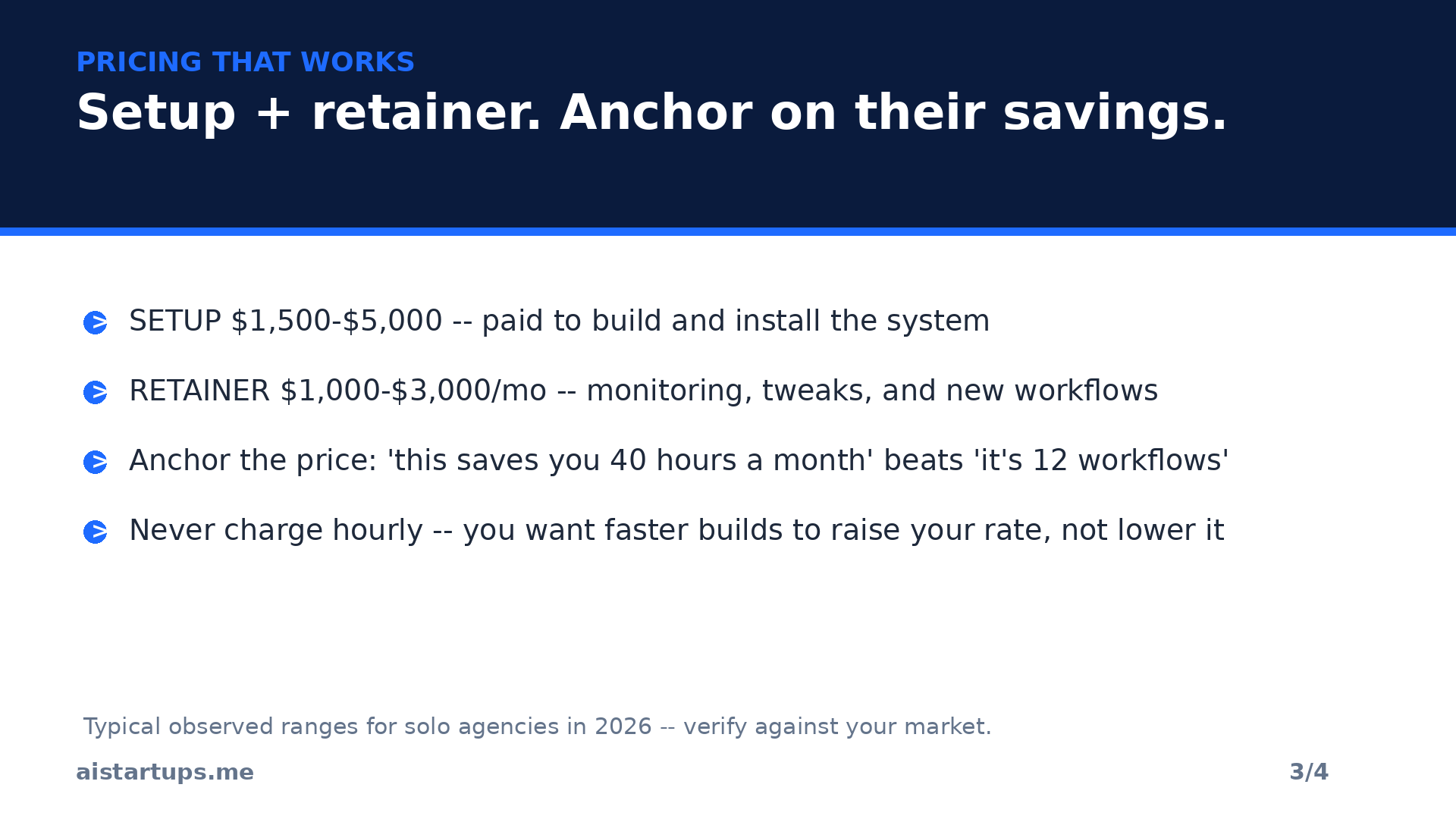
- Setup fee: $1,500–$5,000. Paid once, for building and installing the system. Charge this even for your first clients — “free pilot” should mean discounted, never free. Free clients don’t implement, don’t give feedback, and don’t convert.
- Monthly retainer: $1,000–$3,000. For monitoring, tweaking, adding workflows, and being the person they call when something breaks. This is where the business actually lives. One-time projects are jobs; retainers are a business.
- Anchor on their savings, not your costs. “This system saves your office manager 40 hours a month” justifies $2,000/month. “It uses 12 n8n workflows and a vector database” justifies nothing. Never, ever itemize your costs on an invoice.
- Never charge by the hour. Hourly billing punishes you for getting faster. If you can build in a day what used to take a week, your effective rate should go up, not down. Fixed scope, fixed price, always.
Three rough tiers to start: a $997 “AI audit” (foot in the door), a $2,500–$5,000 “single system install” (the core offer), and a $1,500–$3,000/month “managed AI operations” retainer (the goal). As you collect case studies, the numbers go up — agencies with proof charge double these ranges without blinking.
If pricing psychology is new to you, my guide on how to price an AI product covers the anchoring and packaging mechanics in more depth — most of it applies to services too.
The profit math nobody talks about
This is the part that made me sit up the first time I ran it. Your two costs are compute and infrastructure, and both fell off a cliff in September 2026.
OpenAI and Anthropic launched new models within an hour of each other on September 22nd and immediately started undercutting each other — what developer Simon Willison called a genuine price war. The resulting price menu, per the DEV writeup: GPT-6 Luna at $0.10/$0.50 per million input/output tokens, GPT-6 Sol at $2/$10, and Claude Opus 5.5 at $4/$20 — with cache reads down to $0.20 per million. For the high-volume, repetitive work agencies do (classify this, draft that, route this), Luna-class models at ten cents a million input tokens are almost comically cheap.
Then there’s the delivery rail. n8n’s Community Edition is free and self-hosted with unlimited executions — you pay only for the server, roughly $4–$7 a month on a managed host, and one box can run every client workflow you build. Your “factory” costs less than a Netflix subscription.
So run the actual unit economics on a typical client: $2,000/month retainer. Your cost to serve — API calls plus your share of the server — lands somewhere around $30–$80 a month. That’s a 96–98% gross margin, and the main input is your time. No inventory, no shipping, no staff. I’ve seen SaaS founders weep over 80% margins. Agencies are playing a different sport.
Well — mostly. The margin is real, but your time is the constraint, which is exactly why the retainer model matters: it pays you for the system running, not for hours worked. Ten retainer clients at $2,000 is $20K/month of near-passive revenue against maybe $500 in costs. That’s the whole model. It’s not complicated, which is why it works.
“A license can be purchased in minutes. Moving a 30-person team from scattered experimentation to safe, repeatable workflows requires discovery, data-access decisions, training, governance and follow-through. Most small businesses do not have those capabilities in-house.” — CIO, on the small-business AI services gap, October 2026
Landing clients one to three (the unglamorous way)
Here’s where most agency advice goes wrong: it tells you to build a brand, run ads, post content for six months. Forget all of that. Your first three clients come from direct outreach, full stop. Everything else is procrastination dressed up as strategy.
The playbook that works:
- Pick ONE niche. Not “small businesses.” Dental clinics. Or HVAC contractors. Or boutique law firms. One niche means one demo, one pitch, one set of objections — and every client makes the next sale easier because you speak their language. Generalists starve; specialists get referrals.
- Build the demo before you have the client. Pick your niche’s most obvious pain — missed calls for clinics, slow quote follow-up for contractors — and build the working system once, for a fictional or friendly business. Record a 3–5 minute screen recording walking through it. This video is now your entire sales deck.
- Message 50 businesses. Email, Instagram DMs, walk-ins — whatever fits the niche. The message is simple: “I built an AI system specifically for [niche] that [does the thing]. Here’s a 3-minute demo. Worth a 15-minute call?” Expect a 5–10% reply rate and a 1–3% close rate. That’s not failure, that’s the math: 50 conversations, 1–2 clients.
- Close a discounted pilot, then over-deliver. First client gets 30–40% off in exchange for fast feedback and a testimonial. Deliver like your life depends on it, because your second and third clients basically come from this one’s story.
For the broader mechanics of turning strangers into customers without a budget, my lean marketing playbook for getting your first 1,000 users maps well onto agency outreach — same scrappy channels, same emphasis on doing things that don’t scale until they do.
One more thing on delivery: you’ll hit projects that are bigger than a solo operator should build alone — a proper client website, a customer portal, deeper systems integration. Don’t turn that work down and don’t hack it together at 2am. Partner with specialists or an AI integration studio like AISquadX for the build-heavy pieces while you own the client relationship and the AI workflows. White-label the delivery, keep the margin, protect your time. That’s how a one-person agency punches like a ten-person one.
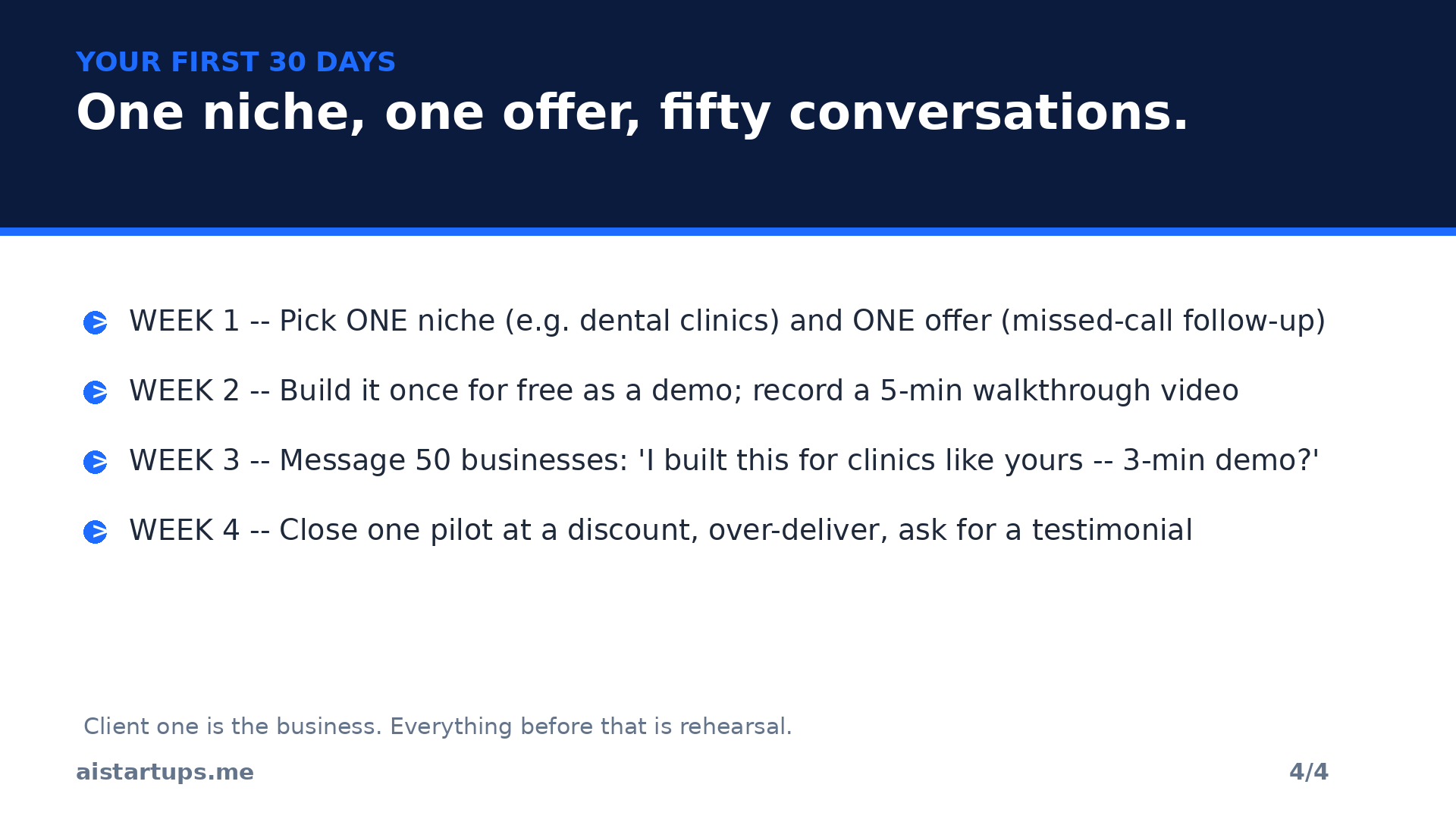
Your first 30 days
If I were starting from zero tomorrow, here’s the actual calendar:
Week 1 — Pick the lane. Choose your niche and your one offer. Not two offers, not “we’ll see what the market wants.” One niche, one painful problem, one system. Spend the week learning that niche’s language: what software they use, what a busy Tuesday looks like for them, what keeps the owner up at night.
Week 2 — Build the demo. Build the system end to end for a hypothetical client. Make it genuinely work — real integrations, real data flow, not a mockup. Record the walkthrough video. Write the one-page offer sheet: the problem, the system, the price, the guarantee. (A 30-day “if it doesn’t save you X hours, you don’t pay the retainer” guarantee closes an absurd number of deals.)
Week 3 — Start conversations. Fifty outreach messages. Track everything in a spreadsheet: who, when, what they said. Follow up once after 4–5 days — half your replies will come from the follow-up, not the first message. Book every call you can get, even the tire-kickers; you’re practicing.
Week 4 — Close and deliver. Get one pilot signed. Then go quiet, build it properly, and launch it. Document everything — screenshots, before/after metrics, a quote from the owner. That documentation is worth more than the pilot revenue, because it’s what sells clients two through ten.
FAQ
Do I need to know how to code to start an AI agency?
No — and this surprises people. Modern no-code tools (n8n for workflows, various chatbot builders, Zapier/Make for glue) cover 90% of what small-business clients need. What you actually need is the ability to map a business process, connect tools together, and write good prompts. That said, a little JavaScript helps when you hit edge cases, and it’s worth learning as you go. Clients pay for outcomes, not for your stack.
How much money do I need to start?
Almost nothing. A domain, basic tooling, and a small server run you well under $100/month. Your real investment is 4–6 weeks of time building the demo and doing outreach. Compare that to any product business — no inventory, no ad spend required, no team. It’s the cheapest real business I know of to start in 2026.
Isn’t the AI agency space already saturated?
The “AI agency” label is crowded on Twitter and YouTube. The actual market — the 33 million small businesses in the US alone, most of whom have never heard of an AI agency — is barely touched. Remember the stat: 74% use AI, ~14% have it embedded. The saturation is in people talking about agencies, not in agencies serving roofers, dentists, and logistics companies. Niches are still wide open.
Should I charge per project or monthly retainer?
Both, in sequence: a setup fee for the build, then a monthly retainer for keeping it running and improving it. The setup fee covers your build time; the retainer is the business. Push every client toward a retainer from day one — frame it as “managed AI operations,” not “support.” Businesses understand paying monthly for things that keep working.
What happens when AI gets so easy that clients do it themselves?
Fair question, and here’s my honest answer: the tools getting easier is what creates your market, not what kills it. CRMs got easy; agencies selling CRM implementations are doing fine. Websites got easy; web agencies still exist. The pattern is consistent — easier tools mean more buyers, and buyers still pay someone to do it right. Your moat was never the tech. It’s the niche expertise, the implementations, and the trust.
The Bottom Line
An AI agency in 2026 is about as close to a cheat code as legitimate businesses get: verified demand (three-quarters of small businesses are already buying), a wide-open services gap (almost none have it working), delivery costs near zero (ten-cent models and free automation rails), and pricing anchored to hours saved rather than costs incurred.
It’s not passive income — anyone selling you that is lying. It’s a real services business with real clients and real work. But it’s a services business where one person with a laptop can clear $15K–$20K a month within a year, with margins that would make a SaaS founder jealous.
Pick the niche. Build the demo. Message fifty businesses. The window is open now, and windows like this don’t stay open forever.