


Here’s a question I keep getting from founders: “We’re paying for ChatGPT across the team. Should we switch to Claude?”
And honestly? My answer has changed three times this year. Not because the products changed that much — but because the pricing keeps moving underneath everyone.
Look, six months ago this comparison was easy. ChatGPT Business was the safe default and Claude was the writer’s darling with a confusing team plan. Then OpenAI cut Business seat prices in April. Then both companies launched matching $125 “premium” seat tiers in August like they were reading each other’s roadmaps. Then September’s AI price war collapsed model prices on the API side too.
So here’s where we actually are in late 2026: ChatGPT Business and Claude Team now cost essentially the same money. Standard seats are $25 a month on both. Premium seats are $125 a month on both. Both have a two-seat minimum. Both promise not to train on your workspace data.
Which means the old way of deciding — “which one’s cheaper?” — is dead. The real question is which one fits how your team actually works. And that’s a much more interesting question, because the two products have quietly grown into very different tools.
I’ve spent the last few weeks digging through both vendors’ current pricing pages, the announcement coverage, and a genuinely useful pricing breakdown of the Claude side — so you don’t have to. Let’s do this properly.
The pricing surprise: there’s almost nothing between them
Let’s get the numbers out of the way first, because they’re the least interesting part of this decision now — and that’s the point.
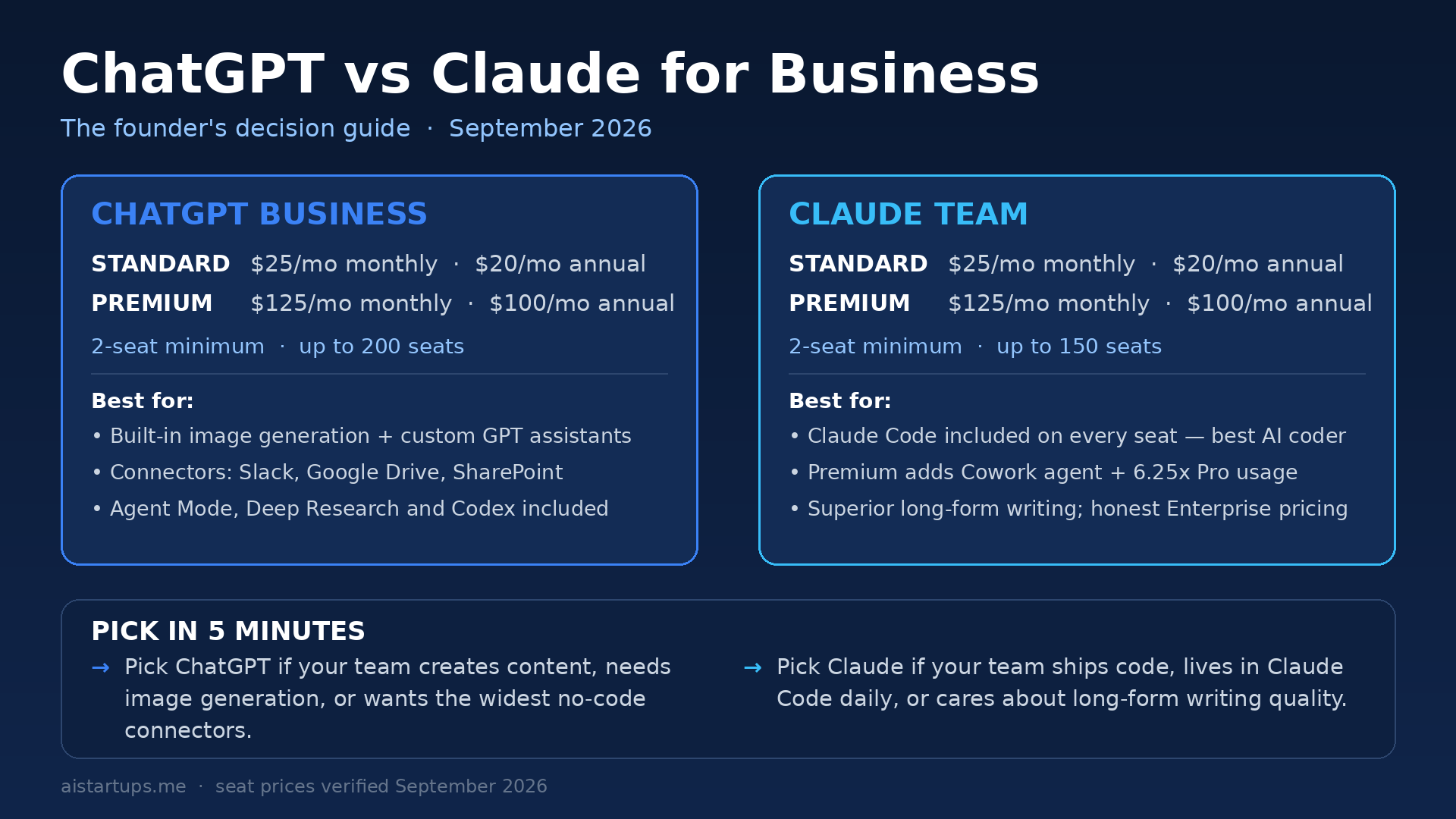
ChatGPT Business runs two seat types inside one workspace. Standard seats cost $25 per user per month on monthly billing, or $20 per user per month billed annually, with a two-seat minimum. That annual rate is down from $30/$25 after OpenAI’s April 2026 price cut — a 20-person team on annual billing now runs $4,800 a year instead of $6,000.
Then in August 2026, OpenAI added Premium seats at $125 per user per month ($100 annual). Premium gets you roughly five times the usage capacity of a Standard seat and removes the five-hour rolling usage cap entirely, with weekly usage resets. The clever bit: you can mix Standard and Premium seats in the same workspace (up to 200 seats total), so you upgrade the three people who live inside the tool and leave everyone else on Standard. One analysis I read put it well — if your team has never hit the five-hour limit, $100 extra per seat buys headroom you’ll probably never touch.
Claude Team is, frankly, a mirror image. Standard seats: $25 monthly, $20 annual, two-seat minimum, up to 150 seats. Premium seats: $125 monthly, $100 annual. A detailed Claude pricing breakdown verified in September 2026 puts Team Standard at 1.25x Pro usage per session and Team Premium at 6.25x — and notes that both tiers include Claude Code.
Above both sits Enterprise. ChatGPT Enterprise is custom-quoted (the classic “contact sales, bring a big number” deal). Claude Enterprise has an unusually transparent structure for this market: $20 per seat per month plus all usage billed at standard API rates, annual only.
So yes — OpenAI and Anthropic have converged on nearly identical seat pricing. Real talk: this is the price war working exactly as intended. You’re the beneficiary. Stop comparing the price tags and start comparing the products.
What ChatGPT Business actually gives your team
ChatGPT Business is the broader, more “everything app” of the two. Here’s what a Standard seat gets you in late 2026:
A shared workspace with centralised billing and an admin console. SSO. Your workspace data excluded from model training by default (this matters more than people think — more on that later). GPTs — custom assistants you can build for specific workflows and share with the team. Projects for organising long-running work. Connectors that pull in Slack, Google Drive, and SharePoint so the model can actually see your company’s documents. Agent Mode for multi-step tasks, Deep Research for the big “go read the internet and come back with a report” jobs, and Codex for coding.
Plus the thing Claude still can’t touch: built-in image generation. If your marketing person needs a hero image, a social graphic, or a quick mockup at 11pm, they don’t leave the chat window. For content-heavy startups, that single feature quietly justifies the seat on its own.
The honest weakness? Usage caps. Standard seats still have that five-hour rolling limit, and heavy users will feel it — which is exactly why the Premium tier exists. As one report put it, agentic AI burns through far more tokens than old-school chatting did, and the pricing is finally catching up to that reality.
What Claude Team actually gives your team
Claude Team is the narrower, deeper tool — and its superpower is obvious the moment your engineers touch it.
Every Team seat includes Claude Code, Anthropic’s agentic coding tool, which is widely considered the best AI coding assistant on the market right now. Team Premium goes further with 6.25x Pro-level usage per session plus Claude Cowork, Anthropic’s newer agent for general knowledge work. For a dev-heavy startup, this alone can end the debate: your engineers will simply get more done on Claude.
Beyond coding, Claude’s long-standing strengths carry over to the business plan: genuinely excellent long-form writing (blog posts, docs, investor updates that don’t sound like a robot wrote them — well, mostly), Projects for shared team workspaces, centralised billing with admin controls, usage limits you can set per user, and the same no-training-on-your-data default.
The honest weaknesses? The ecosystem is thinner. No native image generation — your designer is going elsewhere for visuals. Fewer first-party connectors than ChatGPT’s Slack/Drive/SharePoint lineup, though Claude’s MCP (Model Context Protocol) integrations are closing that gap for technical teams. And the seat cap tops out at 150 versus ChatGPT Business’s 200, which only matters if you’re scaling past that — at which point you’re probably negotiating Enterprise anyway.
Head to head: the five things that actually matter
1. Price and seat maths
It’s a draw. I keep saying it because founders keep not believing me. A 10-person team on Standard seats, annual billing: $2,400/year on either platform. Three power users on Premium plus seven on Standard: $4,680/year on either platform. The maths is identical down to the dollar.
Where they differ is at the edges. ChatGPT’s workspace caps at 200 mixed seats; Claude’s at 150. Claude’s Enterprise has published usage-based pricing ($20/seat + API rates), which is refreshingly honest if your usage is spiky. ChatGPT’s Enterprise is a black box until you talk to sales.
And don’t forget the individual plans sitting underneath all of this. Claude Pro is $20/month ($17 annual) and ChatGPT Plus is $20/month — if you’ve got two founders and no employees yet, you don’t need a Business plan at all. Plenty of startups I know run on individual plans until they hit five or six people, then consolidate for the admin controls. There’s no prize for buying enterprise features early; knowing what it really costs to start an AI business means not overspending on tooling in month one.
2. Coding and engineering
Claude wins this, and it’s not close. Claude Code on a Team seat is the single best reason to pick Anthropic — agentic coding that handles real multi-file tasks, with usage allowances that make sense for working developers. ChatGPT’s Codex is competent and improving, but every engineering-led team I know that tried both landed on Claude for code.
If your startup’s core output is software — and in 2026, whose isn’t — this section might be the whole decision. A Team Premium seat at $125/month sounds steep until you compare it to one engineering hour. It isn’t steep. It’s the cheapest productivity gain you’ll buy all year.
3. Writing, marketing, and content
This one’s closer, and it splits by type of content. For long-form writing — blog posts, thought leadership, documentation, investor memos — Claude’s prose is still the best in the business. It has a feel for rhythm and structure that ChatGPT’s output often lacks.
But for marketing operations — the daily grind of social posts, ad variants, email sequences, and the images to go with them — ChatGPT Business pulls ahead. Native image generation, GPTs you can configure as brand-voice assistants, Deep Research for competitive analysis, and connectors that let it read your actual content calendar. A marketing team of three will feel more at home in ChatGPT.
My honest take: content teams that write pick Claude; content teams that ship pick ChatGPT.
4. Admin, security, and compliance
Both check the boxes a startup actually needs: SSO, centralised billing, admin consoles, per-user usage controls, and workspace data excluded from training by default. Neither will embarrass you in a vendor security review at seed stage.
The differences show up as you scale. ChatGPT Enterprise brings data residency options, SCIM provisioning, and the compliance API that regulated industries ask about. Claude Enterprise counters with custom data retention policies and that transparent usage-based pricing. If you’re selling into healthcare or finance, get both vendors’ security docs and let your actual requirements decide — don’t pick based on a blog post. (Ask me how I know.)
5. Ecosystem and connectors
ChatGPT wins on breadth: first-party connectors for Slack, Google Drive, and SharePoint, a mature GPTs marketplace, and Agent Mode that can chain tools together. It meets a non-technical team where they already work.
Claude wins on depth for technical teams: MCP is genuinely the more powerful integration story if you have engineers to wire it up, and Cowork is Anthropic’s bet that agents — not connectors — are the future of knowledge work. But “have your engineers wire it up” is doing a lot of heavy lifting in that sentence for a five-person startup with no spare engineering cycles.
The decision framework: pick in five minutes
Enough analysis. Here’s the framework I’d hand a founder friend:
- Pick ChatGPT Business if: your team is marketing/content-heavy; you need image generation inside the same tool; you want the widest set of no-code connectors (Slack, Drive, SharePoint); your team is mostly non-technical and needs the gentlest learning curve.
- Pick Claude Team if: your team is engineering-heavy; Claude Code would be your developers’ daily driver; long-form writing quality matters to your brand; you want the most transparent Enterprise pricing as you scale.
- Pick Premium seats (either platform) if: specific individuals are hitting usage caps weekly — upgrade the person, not the whole team. Both platforms let you mix seat types, so a 3-premium/7-standard split is the smart default for a 10-person team.
- Pick neither yet if: you’re pre-team. Two founders on Plus/Pro individual plans ($20/month each) is $40/month well spent. Buy the Business plan when you need centralised billing and admin controls — usually around hire five or six.
- Consider both if: you’re genuinely split — engineers on Claude Team, everyone else on ChatGPT Business. It’s more admin overhead, but I’ve seen funded startups do exactly this and it’s perfectly rational. The tools are different enough that “one for builders, one for everyone else” is a defensible strategy.
The traps nobody warns you about
A few ways founders waste money here, from cheapest mistake to most expensive:
Trap 1: Buying seats when the API is cheaper. If one developer is burning through Claude Code all day, a $100/month Max subscription or metered API usage can beat a $125 Premium seat. Good pricing guides all make the same point: match the buying model to the usage pattern, not the job title.
Trap 2: Premium seats for everyone. The vendors would love this. Your finance person would not. Audit actual usage after 30 days — most teams find two or three people need Premium and everyone else is fine on Standard. That’s a $3,000/year decision hiding inside a settings page.
Trap 3: Ignoring the data controls. Both platforms exclude business workspace data from training by default — but verify this in your admin console on day one, especially if you’re in a regulated space or handling client data. “Default” and “configured” are different words.
Trap 4: Forgetting the rollout. The tool choice matters less than adoption. The startups that get value nominate one person to build the first three GPTs or Claude Projects, run a 30-minute team session, and wire the tool into one real workflow (standup notes, support triage, content drafts). The ones that don’t get value buy 20 seats and wonder why usage is flat. And if you want these tools properly embedded — custom integrations in your product, AI wired into your website or support flow — that’s the kind of project an AI integration studio like AISquadX handles, rather than something to duct-tape on a Friday afternoon.
The price war ended the pricing debate. ChatGPT and Claude now cost the same per seat — so buy the one your team will actually open every morning. The most expensive AI tool is the one nobody uses.
Frequently asked questions
Is ChatGPT Business or Claude Team cheaper in 2026?
Neither — they’re effectively identical. Standard seats are $25/user/month (monthly) or $20 (annual) on both platforms; Premium seats are $125/$100 on both. Both require a two-seat minimum. Decide on features and fit, not price.
Which is better for a startup’s engineering team?
Claude Team, because every seat includes Claude Code — widely regarded as the best agentic coding assistant available — and Team Premium adds Cowork plus 6.25x Pro-level usage. If your engineers live in the tool all day, Claude is the clear pick.
Can I mix Standard and Premium seats?
Yes, on both platforms. ChatGPT Business workspaces support up to 200 mixed seats; Claude Team supports up to 150. The smart default is Standard for most of the team and Premium only for the two or three heaviest users.
Do ChatGPT Business and Claude Team train on my company’s data?
No — both exclude business workspace data from model training by default. Still, verify the setting in your admin console when you set up the workspace, particularly if you handle client or regulated data.
Should a two-person startup buy a Business/Team plan?
Probably not yet. Two individual plans (ChatGPT Plus or Claude Pro at $20/month each) give you full flagship access for $40/month. Upgrade to a Business or Team plan when you need centralised billing, SSO, and admin controls — typically around five to six people.
The Bottom Line
A year ago, this article would have been about price. Today it can’t be — OpenAI and Anthropic have spent 2026 matching each other seat for seat, dollar for dollar, until the price tags are interchangeable.
So here’s the honest, short version. Engineering-heavy team? Buy Claude Team — Claude Code alone justifies it. Marketing, content, or generalist team? Buy ChatGPT Business — the connectors, GPTs, and built-in image generation make it the better daily driver. Split down the middle? Put engineers on Claude and everyone else on ChatGPT; it’s more admin, but it’s rational.
And whatever you pick, start on Standard seats, audit usage after a month, and upgrade individuals to Premium only where the caps actually bite. The vendors built the mixing for exactly this — use it.
Pair whichever you choose with the wider stack of AI tools founders actually use, and you’ve got a serious operating advantage for about the cost of one team lunch per seat per month. Not bad for the most contested $25 in software right now.