


Here’s a confession: I spent an embarrassing amount of time planning my last trip. Not the fun part — the flights, the hotel, the “is this neighborhood safe at 11pm” part. I had twelve tabs open, three spreadsheets’ worth of notes in my head, and a group chat where four friends were arguing about dates. And I kept thinking: this is 2026. Why does booking a holiday still feel like project management?
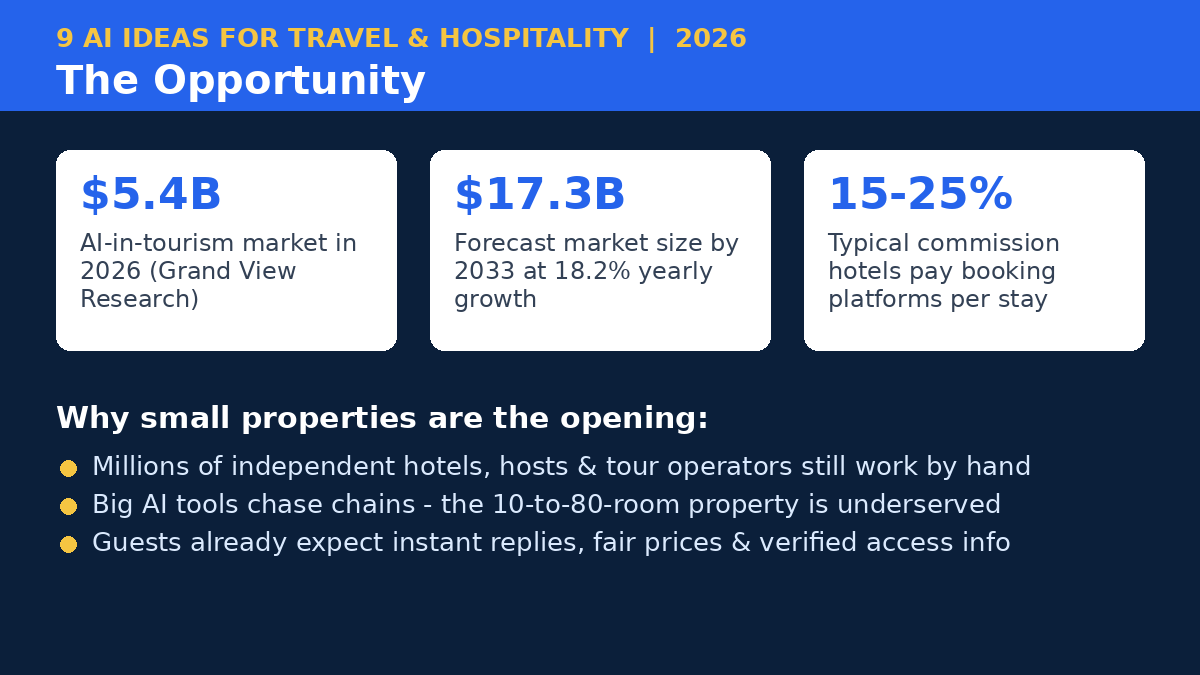
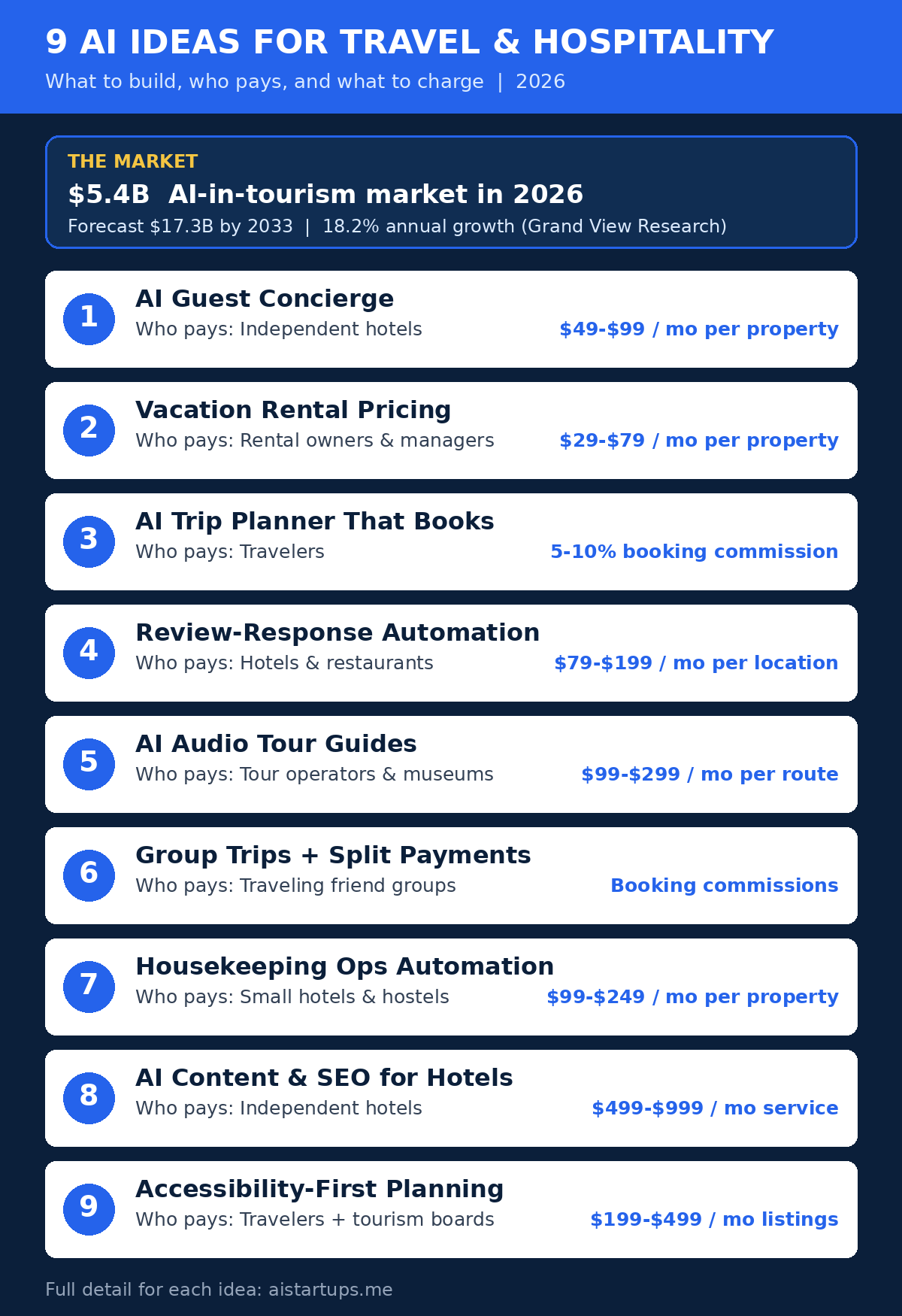
Turns out I’m not the only one who noticed. The AI-in-tourism market was worth $4.3 billion in 2025 and is projected to hit $5.4 billion in 2026, on its way to a forecast $17.3 billion by 2033 at an 18.2% annual growth rate, according to Grand View Research figures compiled by Gitnux. A second estimate tells the same story: The Business Research Company puts AI in travel at $4.37 billion in 2025, growing to $5.37 billion in 2026 and $12.11 billion by 2030. Two different firms, same direction. Money is pouring in.
And here’s the thing most founders miss: the big money isn’t only going to the giants. Yes, the Hoppers and the Expedias of the world are building AI features. But travel and hospitality is an industry of millions of small businesses — independent hotels, vacation rental owners, tour guides, restaurants, boutique hostels — and most of them are still doing things by hand. They answer the same guest questions a hundred times a week. They price rooms by gut feel. They beg for reviews and never reply to the ones they get. Every one of those manual chores is a product waiting to happen.
That’s what this list is. Nine AI startup ideas for travel and hospitality that a solo founder or a tiny team could realistically build and sell in 2026. Each one gets the same treatment: what it is, who pays, how it makes money, why now, and what you’d actually build it with. No venture funding required. Let’s get into it.
How I’m judging these ideas
Quick note on the scoring before we start, because it shapes the whole list. Every idea gets judged on three things: how painful the problem is (does the buyer feel it every single day?), how easy it is to reach the buyer (can you email them, or do you need a sales team and a trade show booth?), and how fast you can get to a first paying customer. Cheap-to-build plus easy-to-reach wins. The flashiest idea on this list is not the best business on this list. The boring one that a hotel manager will buy in a 20-minute demo? That’s the one that pays rent.
One more thing: every price in this article is a rough estimate, not a quote. Treat the numbers as starting points for your own research. The market stats are real and linked to their sources; the pricing is my best guess at what the market will bear. And before you build any of these, do the unglamorous work first — validate the idea with real hotel owners and hosts. Five honest conversations will save you five months of building the wrong thing.
The 9 ideas
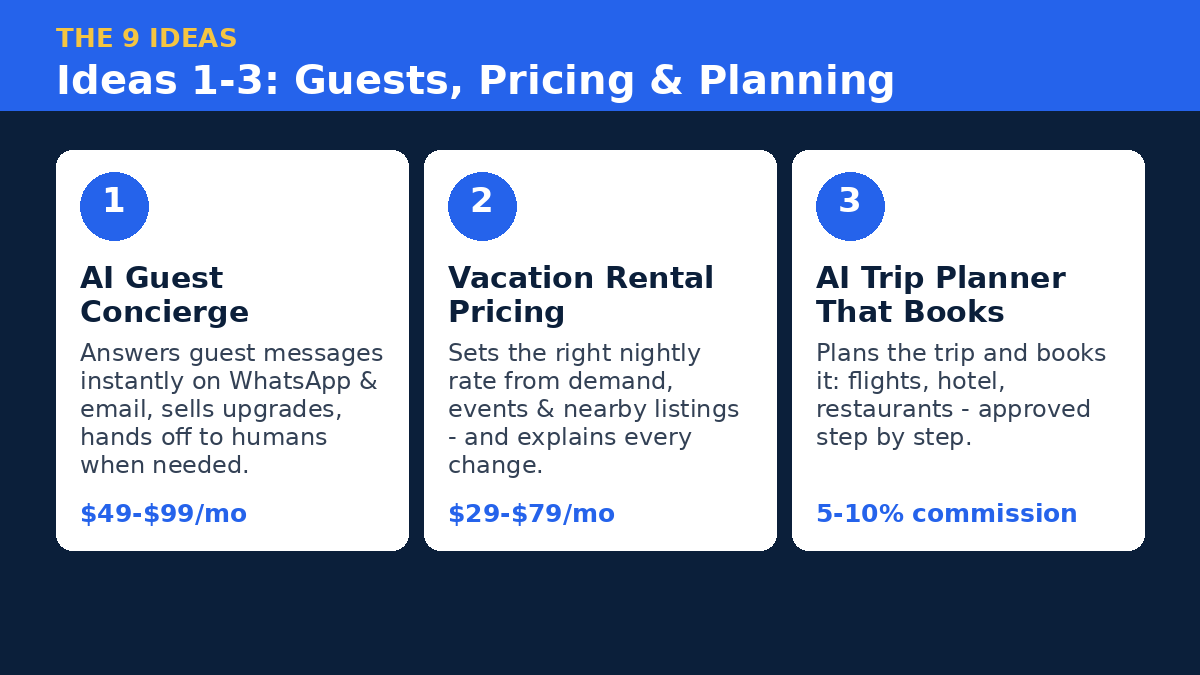
1. The AI guest-messaging concierge for independent hotels
Picture a 40-room boutique hotel. The front desk gets the same messages all day, every day: “What time is check-in?” “Do you have parking?” “Can I get a late checkout?” “Is breakfast included?” “Where’s the nearest pharmacy?” The staff answer them on WhatsApp, on email, on Booking.com messages, and at the desk — and half the time the answer comes hours late, after the guest has already booked somewhere else.
The product: one AI concierge that sits across all of those channels and answers instantly, in the guest’s language, with the hotel’s actual policies. Not a dumb FAQ bot — it knows the room types, the rates, the local recommendations, and it can take real actions: send the door code, book the airport shuttle, sell a room upgrade, take a restaurant reservation. When it doesn’t know something, it hands off to a human with the full conversation attached. The guest never feels the seam.
This space already has real players, which is good news — it proves hotels will pay. Canary Technologies sells AI Guest Messaging and an AI Voice product to hotels. HiJiffy runs a hotel chatbot that it reports resolves up to 93% of guest inquiries through automation. Duve sells a guest app with messaging and upsells. Those companies mostly chase chains and larger properties, and their pricing shows it: HiJiffy Basic starts from $109/month and Duve from $120/month, according to vendor pricing pages compiled by Guideflow and Dextr. That leaves a wide-open gap underneath them: the tens of thousands of independent hotels, guesthouses, and B&Bs with 10 to 80 rooms that can’t justify a hundred-plus dollars a month per property — or that were never approached at all.
Who pays: independent hotels, guesthouses, and small hostels. How it makes money: $49–$99/month per property for messaging plus a cut of upsells (late checkout, breakfast, room upgrades). Duve claims an average of roughly $180 in upsell revenue per room per month for its customers — that’s a vendor claim, not an independent fact, but even a tenth of that makes the pitch easy: “the tool pays for itself if it sells two late checkouts a month.” Why now: guests already expect instant replies because they get them everywhere else, and WhatsApp is now the front desk for most of the world. Starter stack: a GPT-class model with a knowledge base per property, WhatsApp Business API plus email and a web widget, a simple dashboard for the owner to edit policies, and a human handoff queue. You could get a working version in front of a real hotel in a month.
2. Dynamic pricing for vacation rentals
Here’s a number that still shocks me. A huge share of vacation rental owners set their nightly rate once — usually when they list the property — and then barely touch it. Meanwhile, the hotel next door changes its prices three times a day. The result is predictable: the rental sits empty on a weekend it could have sold for double, and it’s booked solid at a bargain rate during the one festival weekend of the year. The owner loses money both ways and never knows it.
The product: a pricing engine built specifically for small vacation rental owners and managers — the people with 1 to 20 properties who can’t afford (or can’t operate) enterprise revenue management. It pulls the property’s calendar and booking history, watches local demand signals (events, seasonality, competitor rates, flight search trends), and suggests — or automatically applies — the right nightly rate, minimum stay, and last-minute discount. The owner sees a plain-English explanation for every change: “Raised Friday to $189 because the food festival sold out and your three nearest comparable listings are at $210.”
The big names here — Lighthouse and FLYR Labs — mostly serve hotels and airlines, and their products are priced and built for professionals. That’s your opening. The vacation rental market is millions of individual owners, and most of them manage pricing in a spreadsheet (or their head). A tool that plugs into Airbnb and Vrbo, takes ten minutes to set up, and shows its work in plain language would feel like magic to them.
Who pays: vacation rental owners and small property managers with 1–20 listings. How it makes money: $29–$79/month per property, or a small percentage of the extra revenue (1–2% is an easy sell when you can show the uplift). Why now: short-term rental supply has exploded, which means more competition and thinner margins — owners who used to fill up by accident now need to actually compete on price. Starter stack: Airbnb/Vrbo calendar sync, a scraper or API feed for comparable listings, a demand-signal feed (local events calendars, seasonality data), and a simple rules engine on top of a forecasting model. Start with one city, nail it, then expand — pricing models that work in Lisbon don’t automatically work in Denver.
3. The AI trip planner that actually books
Every AI trip planner I’ve tried has the same flaw: it writes a beautiful itinerary and then leaves you to do all the work. Here’s your perfect three days in Lisbon — now go book six different things on six different websites, good luck. The planning part was never the hard part. The booking part is.
So build the one that books. The user describes the trip in plain language — “four days in Rome with my parents, my dad can’t walk much, budget around $150 a night, we love food” — and the AI plans it, checks real availability, and books the flights, the hotel, and the restaurant, with the user approving each step. The itinerary isn’t a document. It’s a receipt.
Why hasn’t anyone nailed this? Because it’s genuinely hard — you need live inventory, payment handling, cancellation logic, and a trust layer for when things go wrong. That’s exactly why it’s worth building. Hopper has shown that consumers will let an app make booking decisions for them (its price-prediction and fintech-style add-ons are a big part of its business). The gap is the full trip: flights plus stay plus activities, planned around real constraints like mobility, dietary needs, and who’s actually traveling together.
Who pays: travelers directly (a planning fee or a markup baked into bookings), plus affiliate commissions from booking partners. How it makes money: 5–10% commission on booked travel, plus an optional $9–$19/month premium tier for frequent travelers who want saved preferences and price alerts. Why now: travelers are already asking chatbots to plan trips — the behavior exists, the booking layer is what’s missing. Starter stack: flight and hotel booking APIs (Duffel, Amadeus, or similar), a planning agent with strong tool use, a payment flow with clear approval steps, and a human support fallback for the inevitable “my flight got cancelled” moment. Start narrow — one trip type, like weekend city breaks for couples — and get the booking loop perfect before you widen it.
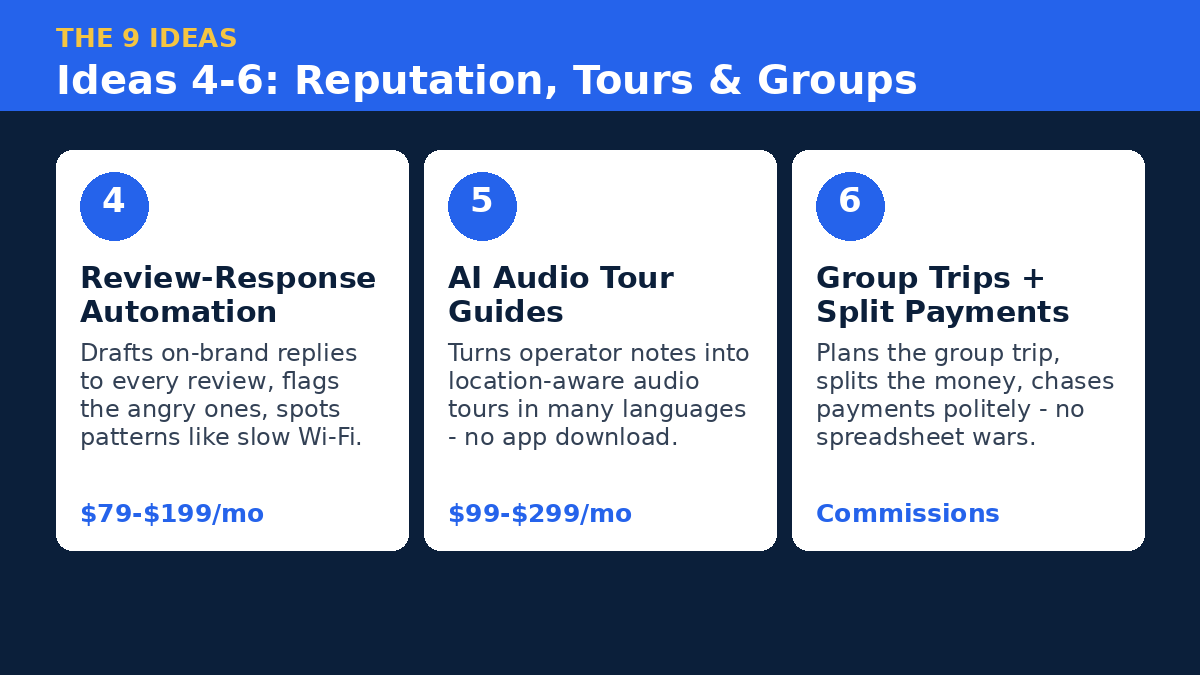
4. Review-response automation for hotels and restaurants
Let me ask you something. When was the last time you booked a hotel that hadn’t replied to a single review? For me, it shows. A property with 400 reviews and zero responses feels abandoned, even if the rooms are lovely. Guests notice. And Google notices too — responding to reviews is one of the simplest things a business can do for its local search ranking.
And yet most small hotels and restaurants never reply. Not because they don’t care, but because it takes time they don’t have, and because writing 30 polite, distinct, on-brand replies a week is genuinely miserable work. So the reviews pile up, the rating drifts down a tenth of a point at a time, and the owner doesn’t connect the dots until bookings dip.
The product: an AI review responder that drafts a reply to every review — good, bad, and the dreaded three-star “it was fine” — in the business’s voice, referencing the specific things the guest mentioned. The owner approves (or auto-approves) in one tap. It also flags the reviews that need a human: the furious ones, the ones mentioning safety or refunds, the ones that look fake. And it turns the review stream into a weekly report: “guests keep mentioning the slow Wi-Fi on the third floor — here’s the pattern across 14 reviews.”
Who pays: independent hotels, restaurants, tour operators, and small chains — basically any hospitality business with more than 50 reviews a month. How it makes money: $79–$199/month per location, with multi-location discounts for small groups. Why now: review volume keeps growing, AI-written replies are finally good enough to not sound robotic (with a human approval step), and local search keeps rewarding businesses that engage. Starter stack: Google Business Profile and TripAdvisor API connections, a fine-tuned tone profile per business (built from their existing replies), a one-tap approval queue, and a simple sentiment-trend dashboard. This is one of the fastest ideas on the list to get to revenue — a working demo takes a weekend, and the pitch writes itself.
5. AI audio tour guides
I once paid $25 for an audio guide at a historic site and got a device that felt like it was designed in 2004, with a voice that could put a caffeinated squirrel to sleep. Meanwhile my phone — the thing in my pocket that knows where I am, what language I speak, and that I’m traveling with a seven-year-old — sat there doing nothing. That gap is the business.
The product: AI audio tours that generate themselves. A tour operator, a museum, a walking-tour company, or a city tourism board drops in their raw material — a few pages of notes, a Wikipedia link, an old guidebook script — and the tool turns it into a location-aware audio tour in multiple languages, with different versions for adults, kids, and history buffs. The visitor opens a web link (no app download, please), the tour plays as they walk, and it adapts: “You’re standing in front of the old customs house — look up at the blue tiles, those are originals from 1892.”
The economics work because the old way is brutal. Hiring voice actors and recording a tour in one language costs thousands; doing it in six languages costs a fortune, so most attractions offer one or two and call it done. AI narration and translation have gotten good enough that the quality bar is now “better than the 2004 device,” which is not a high bar. The real product isn’t the audio — it’s the platform that lets a small tour operator create and update tours in an afternoon instead of a quarter.
Who pays: tour operators, museums, historic sites, city tourism boards, and walking-tour companies. How it makes money: $99–$299/month per attraction or tour route, plus a per-listener fee ($0.50–$1) for high-volume sites. Why now: voice quality crossed the “good enough” line, travelers expect their own language as standard, and attractions are desperate for anything that works without an app download. Starter stack: a good text-to-speech engine with natural voices, a mapping/geofencing layer, a simple content editor for operators, and a web-based player with offline caching. Start with one city and a handful of walking tours, and let the operators’ own content do the selling.
6. Group-trip planning with split payments
Group trips are where friendships go to be tested. Not by the trip — by the money. Someone books the Airbnb, someone else pays for the rental car, a third person covers dinner, and then there’s a spreadsheet, a group chat argument about who owes what, and one person quietly eating $400 because they didn’t want to make it weird. We’ve all been that person. (Or the person who caused it. No judgment.)
The product: a group-trip planner that handles the money as well as the plan. The group picks dates, votes on destinations, and the AI builds a shared itinerary and a shared budget. When someone books something, it lands in the trip pot automatically. Payments split themselves, reminders go out politely (the AI is the bad guy, not your friend), and everyone can see the running balance at any time. The trip ends and the money is settled — no spreadsheet, no awkward conversation, no $400 martyrs.
What makes this a real business and not just a nice app: the booking commissions. Group trips are big-ticket — a week in a villa for eight people is thousands of dollars — and the person organizing it is doing real work. The tool earns its keep by making that work painless, then takes a cut of the bookings it facilitates. The social layer is the moat: once a friend group plans one trip in your app, the next trip starts there too.
Who pays: travelers (free for planning, commission on bookings) plus an optional premium tier. How it makes money: booking commissions on stays and activities, plus $4.99–$9.99/month premium for larger groups and advanced features. Why now: group travel is booming (bachelor parties, family reunions, friends’ trips), and nobody has cracked the money part — the existing tools plan the trip or split the bill, but not both in one place. Starter stack: a shared-trip data model, booking APIs for stays and activities, a payments layer with split logic, and a voting/polling interface. The hard part isn’t the tech, it’s the trust — start with a clean, transparent ledger that everyone in the group can see.
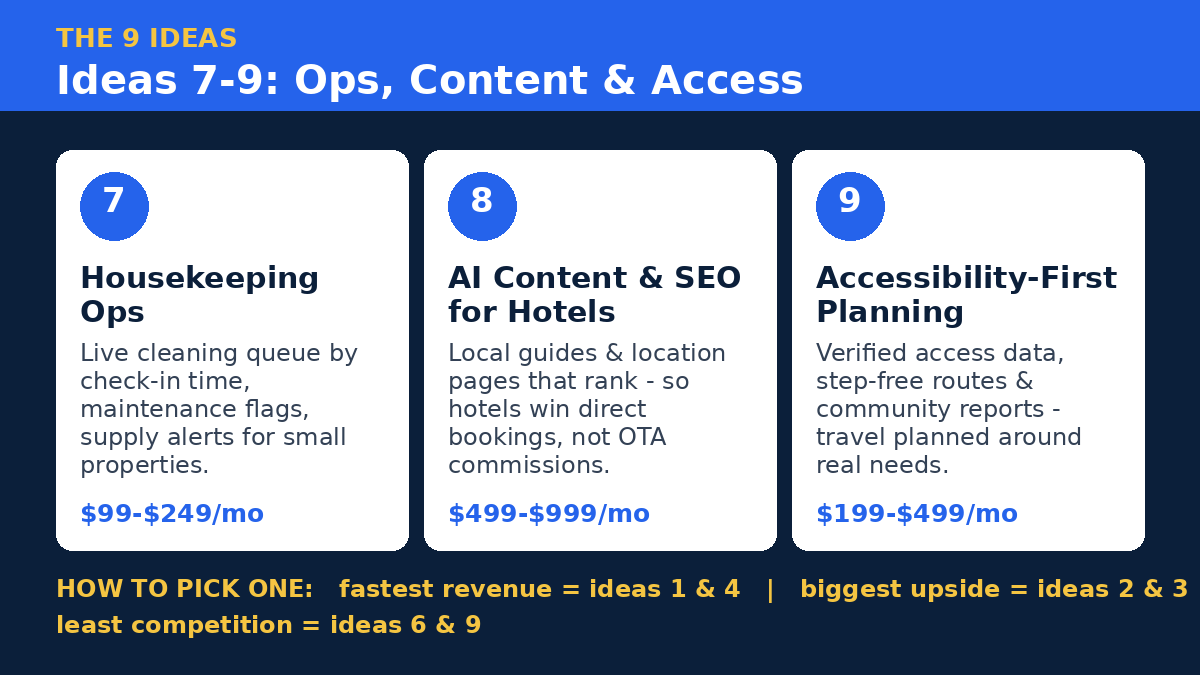
7. Housekeeping and ops automation for small properties
Here’s the unglamorous truth about running a small hotel: the guest experience is decided by housekeeping, and housekeeping is decided by a whiteboard. Or a group chat. Or — I wish I were joking — a printed spreadsheet pinned to a wall. Room 12 is dirty, room 14 needs fresh towels, the guest in 9 asked for an extra pillow, maintenance needs to look at the shower in 7, and the front desk is trying to coordinate all of it while checking someone in.
The product: an ops copilot for small properties that turns the chaos into a live task board. Housekeeping staff get a simple phone view: which rooms to clean, in what order, with the priority set by check-in times. The front desk sees live room status without calling anyone. The AI layer does the smart bits: it predicts which rooms will need a deep clean based on stay length and guest count, reorders the cleaning queue when a flight is delayed, flags maintenance issues from guest messages before they become complaints, and auto-orders supplies when stock runs low. Big property management systems like Mews and Cloudbeds do pieces of this, but they’re built for bigger operations with bigger budgets and dedicated staff to run them. A 25-room guesthouse needs the same coordination with a tenth of the complexity.
Who pays: small hotels, guesthouses, hostels, and serviced apartments (roughly 10–80 rooms). How it makes money: $99–$249/month per property, priced by room count. Why now: hospitality staffing is still tight, which means the same team has to do more with fewer people — and the properties that survive are the ones that stop losing hours to coordination. Starter stack: a mobile-first task board, integration with the property’s booking system for check-in/check-out times, a messaging layer for staff, and a lightweight prediction model for cleaning time and supply usage. The demo that sells this is a before-and-after of a Saturday changeover: same staff, same rooms, half the chaos.
8. An AI content and SEO service for hotels
Quick experiment. Search for a small hotel in a town you’ve never heard of, and look at its website. I’ll wait. Chances are the site is five years old, the “things to do” page is empty, the blog hasn’t been updated since 2021, and the hotel is paying a 15–25% commission to online travel agencies on every booking — that’s the typical OTA cut, per industry guides — partly because its own website can’t be found on Google.
That gap is a service business, not just a software product, and honestly that’s why I like it. The offer: an AI-powered content engine for independent hotels. The tool researches the area (attractions, events, seasonal demand), generates location pages, guides, and blog posts in the hotel’s voice, publishes them on a schedule, and tracks which pages actually bring direct bookings. The hotel gets a website that ranks for “boutique hotel near [place]” instead of paying commission on every single guest forever. The human in the loop edits, fact-checks, and adds the local knowledge no AI can know — like which beach bar is actually worth it in October.
The math is the pitch. If a 30-room hotel moves even 10% of its bookings from OTAs to direct, that’s thousands of dollars a month saved in commission — and your $499–$999/month service looks cheap by comparison. The AI does the heavy lifting on research and drafting, so one person can run content for 10–15 hotels instead of one. If you’re the kind of founder who’d rather build the website and booking flow than the content engine, that’s a valid version of this too — a web development studio like AISquadX can handle the build while you focus on the content system itself. Either way, the customer is the same: the independent hotel owner who is tired of paying rent to the booking platforms.
Who pays: independent hotels, guesthouses, and small hotel groups. How it makes money: $499–$999/month per property as a done-for-you service, or $199–$399/month for the software alone. Why now: OTA commissions keep squeezing margins, AI content tooling is finally good enough to produce genuinely useful local guides at scale, and direct bookings are the one lever a small hotel controls. Starter stack: a content pipeline (local research, drafting, human editing queue), a simple CMS integration, rank tracking, and a monthly report that ties pages to bookings. Start with three hotels in one destination, prove the direct-booking lift, and let the results sell the next ten.
9. Accessibility-first travel planning
This is the idea I feel most strongly about, and it’s the one most founders walk straight past. Roughly one in six people on earth lives with a significant disability. And for them, travel planning isn’t a fun puzzle — it’s a research project full of dead ends. Is the hotel room actually wheelchair accessible, or does “accessible” just mean there’s a ramp at the front door and a shower you can’t get into? Can a blind traveler navigate the airport alone? Is there a quiet room at the venue for someone with sensory needs? The information exists, but it’s scattered across a hundred sites, half of it wrong, and almost none of it verified.
The product: a travel planner built for accessibility first, not as an afterthought filter. Travelers set their access profile once — mobility, vision, hearing, sensory, dietary, medical equipment — and every recommendation respects it by default. Hotels are scored on verified accessibility data, not marketing claims. Routes account for step-free stations and accessible transfers. The AI layer reads reviews and photos to verify claims (“guests in wheelchairs mention the bathroom door is too narrow — flag it”), and the community layer lets travelers share first-hand reports that keep the data honest.
Why is this a good business and not just a good cause? Because this audience is loyal, underserved, and spends real money — and because the data you build becomes a moat nobody else has. The big booking platforms treat accessibility as a checkbox. A dedicated product with verified data and a community that trusts it becomes the default starting point for millions of travelers. And the B2B side is real too: hotels and tourism boards will pay to be listed accurately and to fix the gaps your data finds.
Who pays: travelers (free or low-cost planning) plus hotels, tourism boards, and travel brands paying for verified listings and accessibility audits. How it makes money: $199–$499/month for business listings and audits, plus booking commissions. Why now: accessibility regulations are tightening in the US and EU, travelers are more vocal about access failures than ever, and AI can now extract and verify accessibility details from reviews and photos at a scale humans never could. Starter stack: a structured accessibility data model, review/photo analysis for verification, booking APIs filtered by access criteria, and a community reporting feature. Start with one city and one access need — wheelchair-friendly stays, for example — and earn trust before you widen the scope.
“The best travel startup ideas don’t start with the technology. They start with a person standing at a hotel front desk, or staring at twelve open tabs, thinking: why is this still so hard? Build for that person, and the technology will follow.”
How to pick your one
Nine ideas is eight too many to build at once. Here’s how I’d narrow it down, honestly:
- If you want revenue fastest: review-response automation (idea 4) or the guest-messaging concierge (idea 1). Both have buyers you can email today, demos you can build in weeks, and a pitch that fits in one sentence.
- If you want the biggest upside: the AI trip planner that books (idea 3) or dynamic pricing for rentals (idea 2). Harder to build, bigger prize — but go in knowing the first version will be rough.
- If you want the least competition: accessibility-first planning (idea 9) or group-trip planning with split payments (idea 6). Fewer rivals, more patience required, and a community that will champion you if you get it right.
- If you want a service business, not a software company: the AI content and SEO service for hotels (idea 8). You can start with three clients and a laptop, and the AI does the scaling for you.
And whatever you pick, the first step is the same — talk to the buyers before you build. If you’re still early in the journey, read how to start an AI startup the right way, and if you want a wider view of what’s working right now, the profitable AI startup ideas for 2026 list is a good companion read. The best idea on this page is the one you’ll actually talk to customers about this week. For solo founders specifically, the AI agent business ideas for solo founders roundup pairs well with the agent-heavy ideas above.
Frequently asked questions
Do I need travel industry experience to start one of these?
It helps, but it’s not a requirement. What you need is access to the buyers — hotel owners, rental hosts, tour operators — and the patience to listen to them before you build. Most of these ideas fail because the founder built for a hotel they imagined, not one they talked to. Five real conversations beat five years of industry experience you don’t have yet.
How much does it cost to build an AI travel startup in 2026?
Less than you think. A working version of most ideas on this list can be built by one person in 4–8 weeks using off-the-shelf models, booking APIs, and a simple web app. The expensive part isn’t the build — it’s distribution. Budget more time and money for getting in front of hotel owners than for the code itself.
Are hotels actually willing to pay for AI tools?
Yes — the existing players prove it. Canary Technologies, HiJiffy, Duve, and the property management platforms like Mews and Cloudbeds all sell to hotels at real prices, from around $109/month for a basic chatbot to much larger contracts for chains. The trick is selling to the properties they don’t reach: the independent hotels and small guesthouses that still do everything by hand.
What’s the biggest risk with these ideas?
Distribution, honestly. Hotels are famously hard to reach — owners are busy, they don’t read cold emails, and they buy from people they trust. The founders who win in this space usually get their first ten customers through warm introductions, local tourism associations, or by literally walking into hotels. If you hate sales, pick an idea with a consumer audience instead.
Can a solo founder really compete with companies like Hopper or Canary?
You’re not competing with them — you’re serving the customers they ignore. Hopper chases mass-market consumers; Canary chases chains and larger hotels. A solo founder wins by going narrow: one city, one property type, one painful problem, solved properly. That’s a business the giants can’t be bothered to build, and it’s a great place to start.
The Bottom Line
Travel and hospitality is one of those industries that looks modern from the outside and runs on manual work underneath. The guest messages get answered by hand. The prices get set by gut feel. The reviews go unanswered. The trips get planned across twelve tabs. Every one of those chores is a product, and the market behind them is growing fast — from about $5.4 billion in 2026 toward a forecast $17.3 billion by 2033.
So pick one idea from this list. Not the flashiest one — the one whose buyer you can reach this week. Talk to five hotel owners, or five rental hosts, or five tour operators. Ask them what eats their time. Then build the smallest version that fixes it, charge for it, and let the customers tell you what to build next. That’s how these businesses actually start. Not with a pitch deck — with a conversation.