

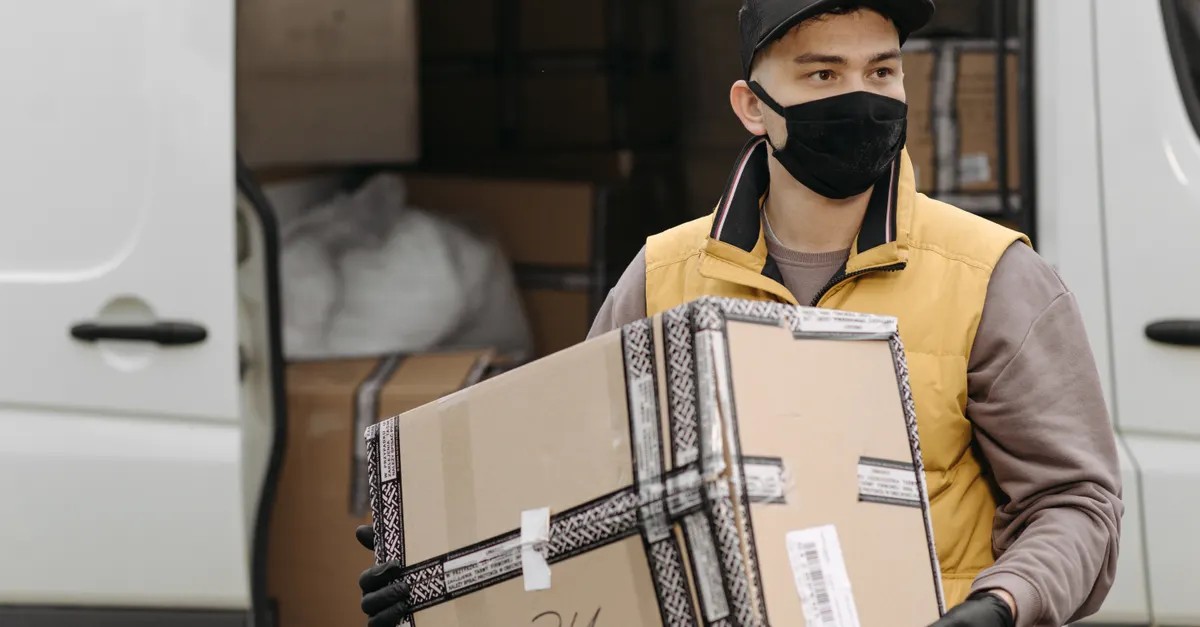
Here’s the number that got me into this topic: the last mile — that final trip from a warehouse or shop to someone’s front door — eats 53% of the total cost of shipping a package. More than half. Up from 41% in 2018. The truck, the plane, the warehouse, the sorting center — all of that together costs less than the last few miles.
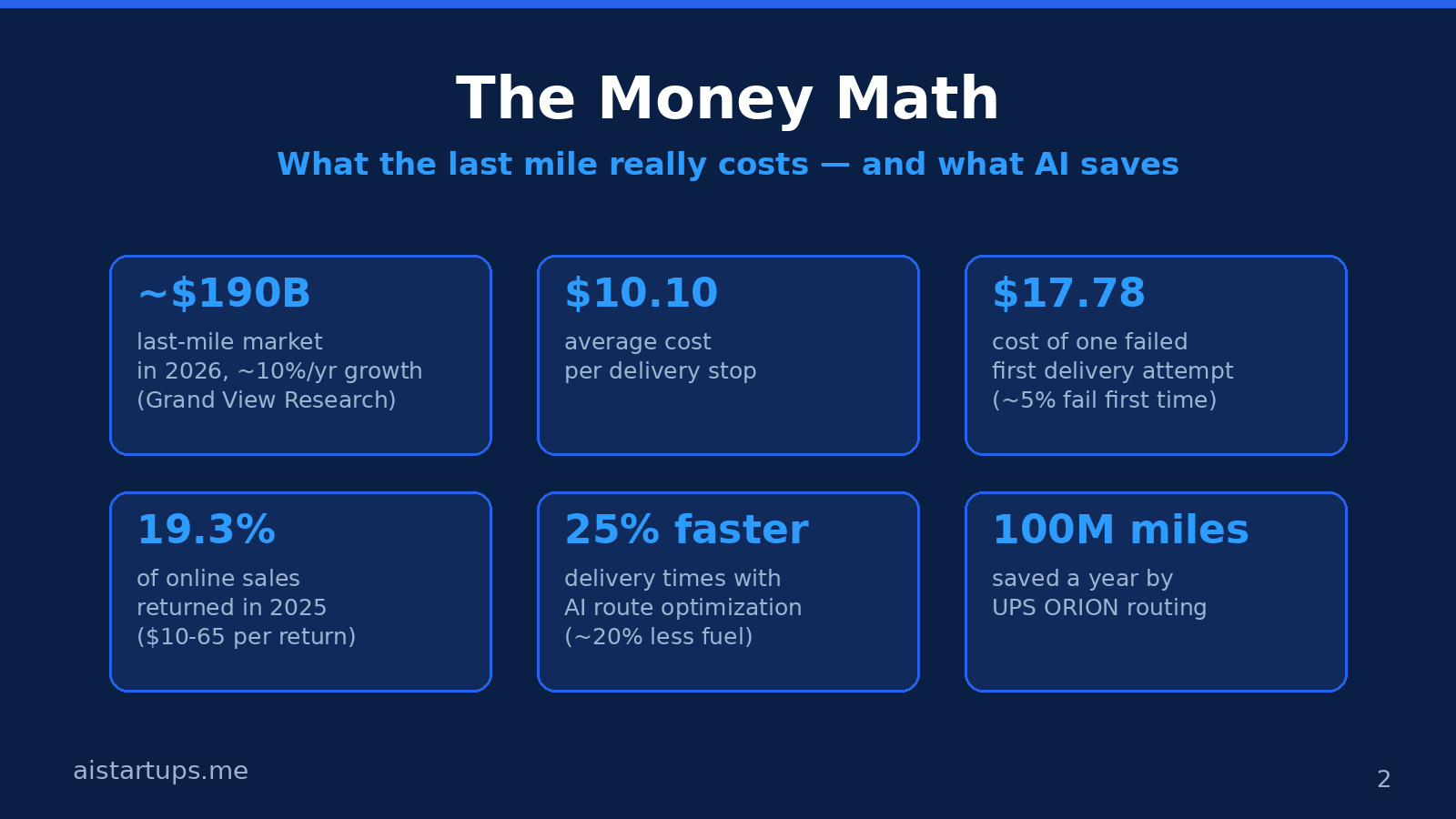
And the people doing the actual delivering are mostly small businesses: a courier with six vans, a local shop doing its own drop-offs, a pharmacy that still plans routes on a whiteboard. They don’t have a logistics department. They have a dispatcher with a phone and a headache. That’s the opportunity. Grand View Research puts the last-mile delivery market at roughly $181.6 billion in 2026, growing about 10% a year toward $348.8 billion by 2033. Straits Research lands in the same place: $194.35 billion in 2026, heading for $410.58 billion by 2034. Call it roughly $180-195 billion in 2026, growing about 10% a year.
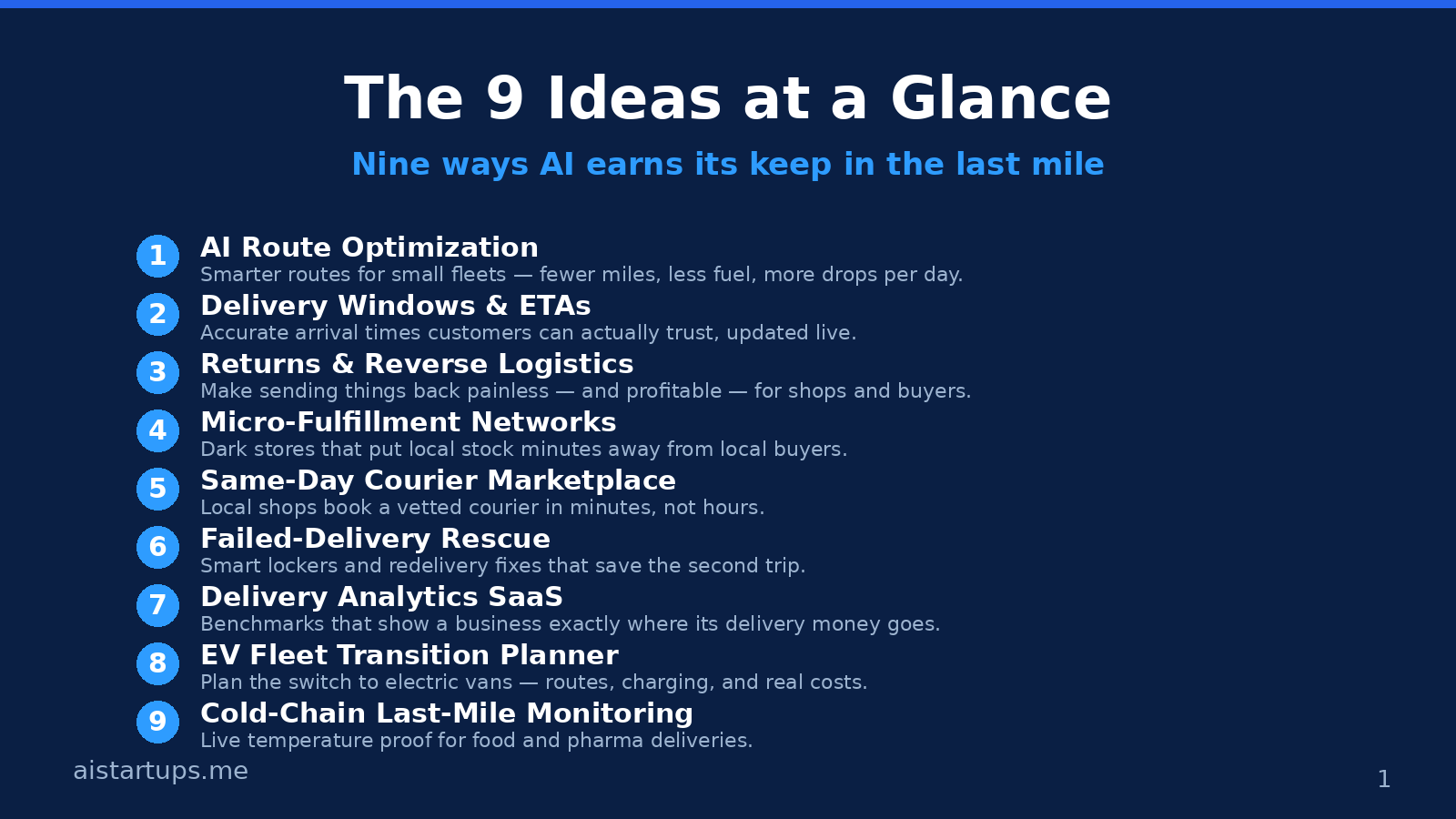
I spent the last few days digging into what delivery actually costs, where it breaks, and what AI can realistically fix right now. Not the sci-fi stuff — no drone fleets. The boring, money-saving stuff: better routes, honest arrival times, returns that don’t bleed a shop dry, lockers that stop the second trip. Below are nine ideas, each with the problem, the product, who pays, a pricing sketch, why now, and the first steps. Pick one. That’s the whole game.
First, Why Logistics? Why Now?
Real talk: most AI startup advice points you at the same crowded rooms — chatbots, AI writing tools, another dashboard for SaaS companies. Logistics is the opposite. It’s a massive market full of small businesses that make money every single day and have almost no in-house tech skills. Your customer already has revenue. They already spend on fuel, drivers, and software. And they will happily pay someone who makes their vans do more drops per day.
There’s a second reason, and honestly it’s the bigger one. The pain is measurable in a way most startup ideas aren’t. A delivery boss knows exactly what a failed delivery costs (about $17.78 a pop, and roughly 5% of first attempts fail). So when your tool saves 25% of delivery time and about 20% of fuel — which is what AI route optimization typically delivers — you don’t have to sell them a vision. You show them last week’s fuel bill and this week’s. And the timing is right: 66% of shoppers now expect same-day delivery, only about half of online retailers offer it, and 91% of consumers actively track their packages. The delivery experience is now part of the product.
One more thing before we get into the ideas: every number in this article comes from a real, checkable source — market research firms, industry reports, the companies’ own published results. If a number matters to your business plan, click through and confirm it yourself.
1. AI Route Optimization for Small Fleets
The problem
Picture a courier company with eight vans. Every morning, the dispatcher looks at 120 stops and draws up routes the way they’ve always done it — a mix of habit, gut feel, and whatever the drivers suggest. Some vans come back half empty. Some drivers cross the same street three times. Fuel gets burned, hours get wasted, and nobody can prove a better route exists because nobody ever tested one. The big players solved this years ago — UPS’s ORION system saves about 100 million miles a year, DHL’s Greenplan cut delivery costs by roughly 20%, and Tesco’s AI routing saved 11.2 million miles — but the eight-van courier down the road is still planning routes in their head.
The product
You sell a route optimization tool built for fleets of 5 to 50 vehicles. A dispatcher uploads the day’s stops, and the tool returns the best routes: which van takes which stops, in what order, accounting for traffic, delivery windows, vehicle size, and driver hours. It re-plans live when a customer cancels or a road closes. You don’t build the routing engine from scratch — mapping APIs exist, and the AI layer that learns a fleet’s patterns and balances loads across drivers is where your value lives.
Who pays
The fleet owner or the operations manager, out of money they’re already losing. A courier doing 200 stops a day at about $10.10 per stop spends roughly $2,000 a day on delivery. Cut that by 15-30% — the typical range for AI routing — and you’re saving them $300-600 a day. Your monthly fee looks tiny next to that.
Pricing sketch
Charge $30-60 per van, per month, with a setup fee of $500-1,500 to configure the system, import stop data, and train the dispatcher. Ten vans at $50 a month is $500 a month in recurring revenue from one customer, and five customers gets you to $2,500 a month.
Why now
Fuel isn’t getting cheaper, driver wages aren’t going down, and UPS and FedEx just raised base rates an average of 5.9% for 2026 — which pushes more volume toward smaller regional couriers who need to compete on efficiency. If you need the customer-facing booking site and the routing dashboard built properly for a client, a web development studio like AISquadX can put the whole thing together — but the core of this business is the routing, not the website.
First steps
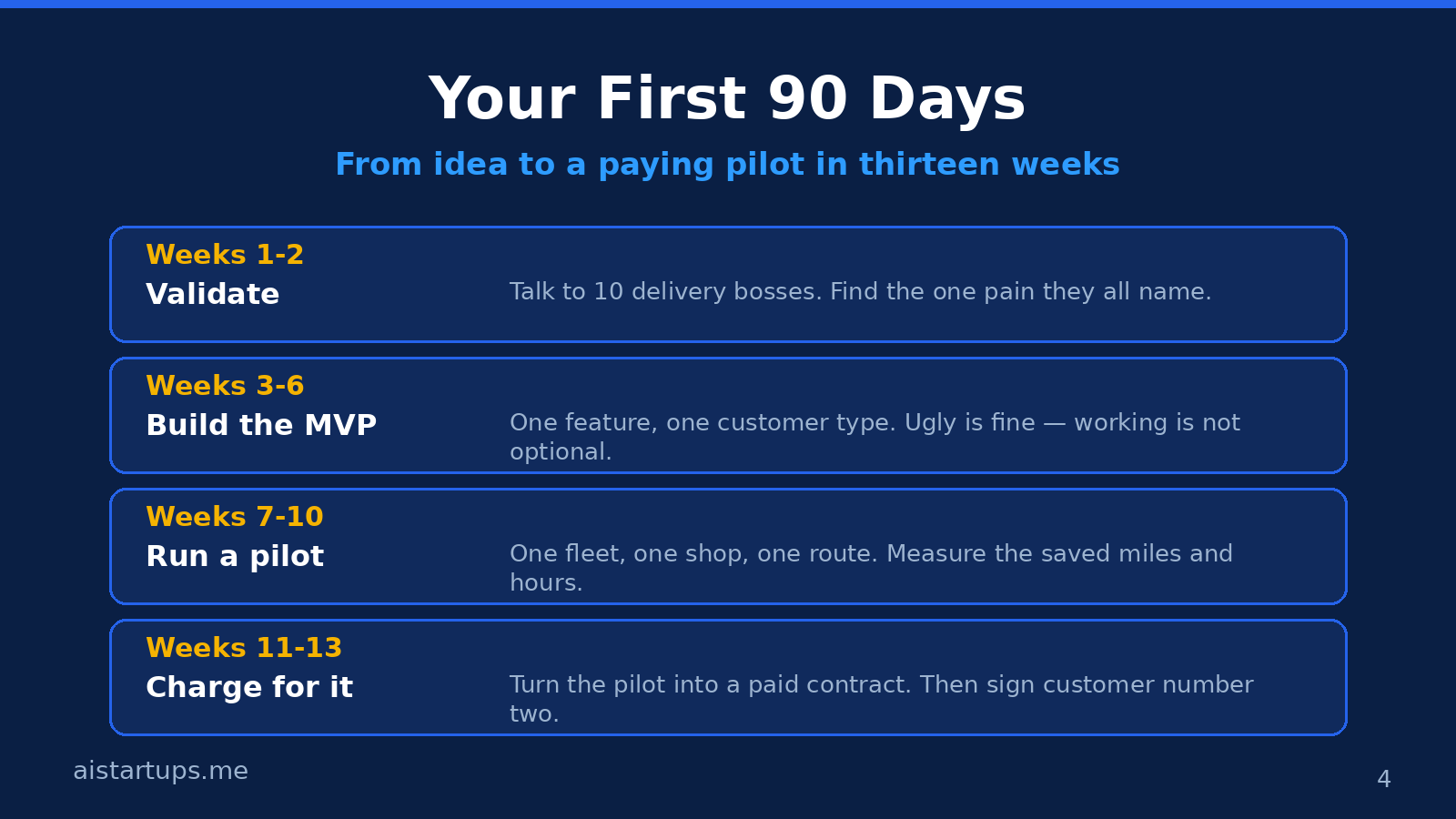
Find one courier with 5-15 vans and offer a two-week paid pilot: you plan their routes for two weeks, they compare fuel and drops-per-day against the previous two weeks. If the numbers move, you have a customer and a case study. Don’t build the full product first — prove the saving, then productize what you did.
2. Dynamic Delivery Windows & Accurate ETAs
The problem
“Your order will arrive between 9am and 5pm.” That’s not a delivery window, that’s a hostage situation. The customer stays home all day, the driver shows up at 4:45, and everyone is annoyed. Meanwhile 91% of consumers actively track their packages, which means they’re staring at a tracking page that says almost nothing useful. And about 5% of last-mile deliveries fail on the first attempt, at roughly $17.78 each — the second trip, the redelivery, the customer service time.
The product
You build the ETA engine that sits between a delivery business and its customers. It takes the live route, live traffic, the driver’s actual progress, and the order of remaining stops, and gives each customer a real arrival window — two hours, then one hour, then “your driver is 20 minutes away.” It texts the customer when the driver is close, and lets them reschedule or redirect to a locker in one tap if they’re not going to be home. The trick is honesty: a narrow window that’s wrong is worse than a wide window that’s right.
Who pays
Online retailers, grocery delivery services, furniture and appliance shops — anyone whose customers wait at home for a delivery. They pay because failed deliveries and support calls cost them directly, and because a good delivery experience is now a reason customers come back.
Pricing sketch
Charge $0.10-0.25 per tracked delivery, or a flat $200-600 a month for a retailer doing a few thousand deliveries a month, plus a $300-800 setup fee. The per-delivery model is the easiest sell because it scales with their volume — quiet month, small bill — and it makes your value obvious: every failed delivery you prevent saves them $17.78, and your fee is pennies per order.
Why now
Customers already expect live tracking — 91% of them check it — but most small retailers still send a “your order is on its way” email and nothing else. Same-day delivery is now expected by 66% of shoppers, which means the delivery window is getting shorter and the tolerance for sloppy ETAs is getting smaller. The shops that fix this first win the repeat orders.
First steps
Pick one local retailer that delivers — furniture, appliances, groceries — and offer to run their delivery notifications for a month. Use their existing driver routes and just add the ETA texts and the live tracking page. Measure two things: failed deliveries before and after, and support calls about “where’s my order?” If both drop, you’ve got your pitch for the next ten shops.
3. Returns & Reverse-Logistics Platform
The problem
Returns are the part of e-commerce nobody likes talking about. In 2025, 19.3% of online sales were returned, according to NRF and Happy Returns — that’s $849.9 billion of US retail returns in a single year. And processing one return costs $10-65. For a small online shop, returns aren’t a cost of doing business. They’re a slow bleed. Here’s how it plays out: a customer emails the shop, the shop emails back a label, the customer prints it (if they have a printer — who has a printer anymore?), drops the parcel at a post office, and waits. The shop gets the jacket back a week later, refunds the customer, and tries to resell it. Every step is manual and slow.
The product
You build a returns platform for small and mid-size online shops: a branded returns portal where customers start a return in 60 seconds, pick a drop-off point or book a courier pickup, and get instant refund or exchange options. On the back end, your system routes the return to the right place — back to stock, to a refurbisher, to a reseller — based on the item’s condition and value. AI reads the return reason, flags patterns (is everyone returning this shoe because the sizing is off?), and tells the shop owner what to fix.
Who pays
The online shop, on a monthly subscription plus a per-return fee. They already pay $10-65 to process each return, so if your platform cuts that cost and keeps more customers exchanging instead of refunding, the fee pays for itself. Your best customers are fashion, footwear, and home goods shops — the categories with the highest return rates.
Pricing sketch
Charge $99-299 a month for the platform plus $1-3 per return processed. A shop doing 500 returns a month at $2 a return plus a $199 subscription is about $1,200 a month to you, and they’re still saving money against their old per-return cost. The per-return fee is the engine: it grows with your customer’s volume, which is exactly the kind of revenue you want.
Why now
Return rates keep climbing as more shopping moves online — US e-commerce was 17.1% of total retail sales in Q2 2026, according to the US Census Bureau, and every point of that growth adds returns. At the same time, big retailers are tightening return policies and charging for returns, which pushes customers toward shops that handle returns well. If you want a sense of how the same service-first thinking plays in other local businesses, my piece on AI ideas for pet care businesses follows the same pattern — find the expensive, boring problem and fix it first.
First steps
Talk to five online shop owners and ask them one question: what does a return actually cost you, start to finish? Most of them won’t know, because they’ve never added it up. Do the math with them — $10-65 per return, times their monthly volume — and then show them a one-page mockup of a returns portal with their branding on it. The shop that winces at the number is your first customer.
4. Micro-Fulfillment / Dark-Store Network for Local Retailers
The problem
Same-day delivery is expected by 66% of shoppers, but only 51% of online retailers offer it. Why? Because same-day delivery from a warehouse 40 miles away is a fantasy — by the time the order is picked, packed, and driven across town, the day is over. So local retailers lose the sale, and the order goes to Amazon, which delivered more than 13 billion items same-day or next-day in 2025. The local shop has the stock, sometimes sitting on a shelf ten minutes from the customer. It just has no way to get it there fast.
The product
You build the micro-fulfillment network: small, AI-managed dark stores — compact storage spaces with no shopfront — placed inside a city so most customers are within a 15-30 minute drive. Your system decides what stock goes in each dark store based on local demand, routes orders to the nearest one, and dispatches couriers for the final leg. Local retailers put their stock in your network and suddenly they can offer same-day delivery without building a warehouse. Well — mostly. You don’t start with a network. You start with one dark store, one neighborhood, and five retailers.
Who pays
The retailers, on a per-order fulfillment fee plus a small monthly fee for the storage space. They pay because same-day delivery wins orders they’d otherwise lose to Amazon, and because your fee per order is a fraction of the sale they keep.
Pricing sketch
Charge retailers $2-5 per fulfilled order plus $100-300 a month per storage bay, depending on the city. A dark store handling 100 orders a day at $3 an order is $300 a day, or about $9,000 a month in fulfillment fees — before the storage fees. The costs are real, though: rent, staff to pick and pack, and the AI that keeps the shelves stocked with the right things. This is the most capital-heavy idea on the list, so don’t start here unless you have a partner with space or a retailer willing to co-fund the first location.
Why now
The same-day delivery market was worth $9.9 billion in 2024 and is heading for $29.82 billion by 2030 — a 20.6% annual growth rate. On the supply side, empty retail space in cities is cheaper than it was five years ago, and the tools to run a small fulfillment operation — inventory prediction, order routing, courier dispatch — are all available off the shelf now. The pieces exist. Someone just has to put them together in one city and prove it works.
First steps
Don’t lease anything yet. Pick one neighborhood, talk to ten local retailers, and ask what they’d pay for same-day delivery in their area. Then rent a small storage unit for a month, stock it with the five fastest-moving products from three of those retailers, and run same-day deliveries with a local courier for two weeks. If the orders come in and the unit economics work on paper, you have a real business.
5. Same-Day Courier Marketplace for Local Shops
The problem
A florist gets an order at 11am for a bouquet that needs to be across town by 2pm. A pharmacy needs a prescription delivered to an elderly customer this afternoon. What do they do? They call around. They beg a staff member to drive it. They lose the order, or they lose an afternoon. There are couriers out there — independent drivers, bike couriers, small courier firms — but there’s no easy way for a small shop to find one, right now, at a fair price. The big courier platforms are built for volume shippers with accounts and contracts. The florist with one urgent delivery is nobody’s priority.
The product
You build the marketplace that connects local shops with vetted local couriers, on demand. The shop posts a delivery — pickup, drop-off, size, urgency — and couriers nearby bid or accept at a set price. The shop sees the courier’s rating, the price, and the live tracking. Your AI handles the matching: which courier is closest, who’s reliable on this kind of delivery, what the fair price is right now given demand. Trust is everything here — one smashed wedding cake and the florist never uses you again — so vetting isn’t optional: ID checks, insurance, a trial period with low-value deliveries, and a rating system that actually removes bad couriers.
Who pays
Both sides, but mostly the shop. Take a 15-25% commission on each delivery, or charge the shop a small monthly fee plus a lower commission. The courier pays nothing to join — you need them more than they need you, especially at the start. A pharmacy delivering medicine the same day is not haggling over a dollar. They’re paying for certainty.
Pricing sketch
Commission of 20% on a $12 average delivery is $2.40 per delivery to you. That sounds small until you do the volume: 200 deliveries a day across a city is $480 a day, or about $14,000 a month. Add a $49-a-month shop subscription for priority dispatch and monthly reporting, and the numbers get serious. The catch is the cold start — you need couriers before shops will join, and shops before couriers will bother. Solve it by signing up 20 couriers first, then going to the shops with a real network to show them.
Why now
Same-day expectations are the tailwind: 66% of shoppers expect it, and the same-day market is growing at over 20% a year. But the real reason now is the supply side — there are more independent couriers than ever, and they need work between the big platform jobs. The shops are ready, the couriers are ready, and the only thing missing is the matchmaker.
First steps
Start with one neighborhood and one category — florists, or pharmacies, or bakeries. Sign up 20 couriers, then walk into ten shops in that category and offer them a month of deliveries at cost. Run everything through a simple group chat and a spreadsheet for the first two weeks. Yes, really. If the shops keep calling you after the free month ends, build the platform.
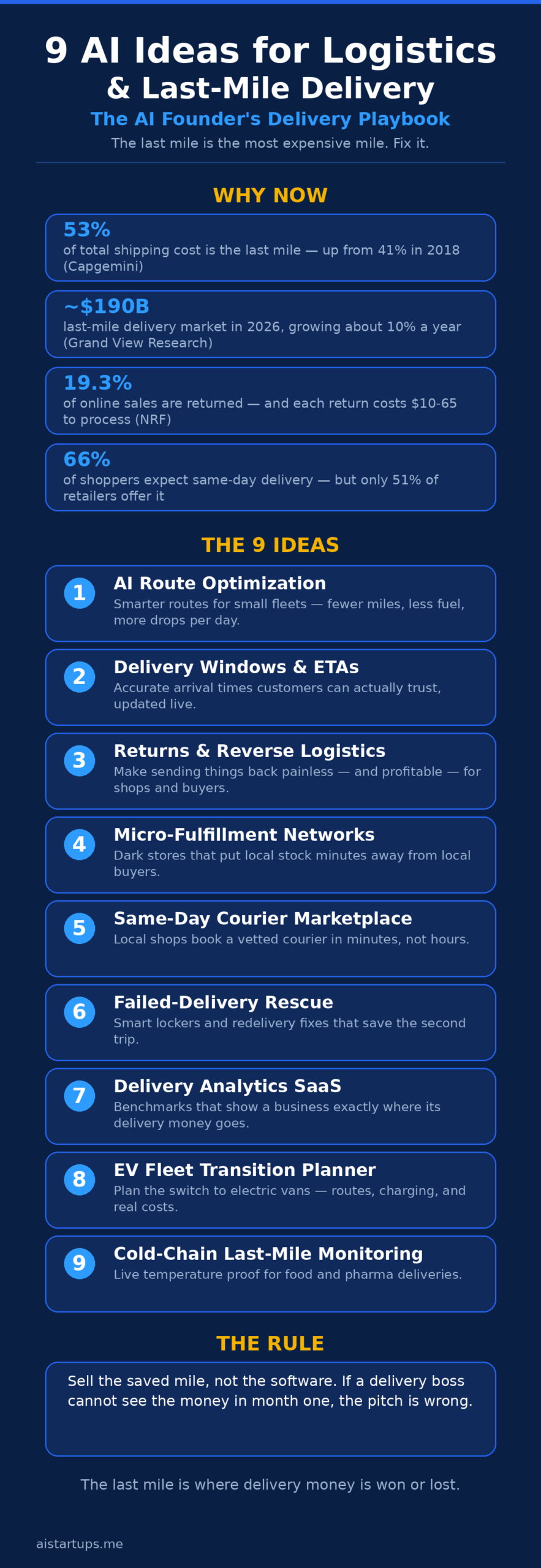
6. Failed-Delivery Rescue & Smart Parcel Lockers
The problem
About 5% of last-mile deliveries fail on the first attempt. Someone’s at work, the gate is locked, the driver can’t find the flat. Each failure costs roughly $17.78 — the second trip, the depot storage, the customer service call, the refund when the customer gives up. For a courier doing 1,000 deliveries a day, that’s 50 failed deliveries and nearly $900 a day evaporating. Every day. The current fix is the redelivery attempt — same driver, same problem, tomorrow. Or the customer treks to a depot on the edge of town. Neither is good.
The product
You build the rescue layer: a network of smart parcel lockers in places people actually go — supermarkets, train stations, apartment lobbies, petrol stations — plus the software that reroutes a failed delivery to the nearest locker automatically. The customer gets a text: “We missed you — your parcel is in locker 12 at the supermarket on High Street, code 4821, pick it up anytime in the next 3 days.” No second trip. No depot trek.
Who pays
The couriers and the retailers, per successful locker delivery — $0.50-1.50 per parcel is a fair range. They pay because it’s cheaper than a second delivery attempt at $17.78, and because it turns a failed delivery into a completed one. The locker host — the supermarket, the station — gets a small fee or free rent in exchange for the foot traffic the lockers bring.
Pricing sketch
Charge couriers $1 per locker delivery. A locker bank handling 100 parcels a day is $100 a day, or $3,000 a month per location — and the hardware pays for itself in months, not years, at that rate. The real money is the network: 20 locker locations in a city at 100 parcels a day each is $60,000 a month. But lockers cost real money up front — $5,000-15,000 per bank, plus installation and maintenance — so start with rented space in one supermarket and prove the volume before you buy ten banks.
Why now
Failed deliveries are a growing problem because more people order online and fewer people are home during the day. At the same time, locker networks are proven — they work in Europe, they work in Asia, and customers actually like them once they try one. The gap is that most cities outside the big metros have no locker network at all, and the couriers serving those cities are eating the $17.78 per failure with no alternative. You’re not inventing the locker. You’re bringing it to the places that don’t have it yet.
First steps
Talk to one courier company and one supermarket. Ask the courier how many failed deliveries they have per week in that supermarket’s area, and ask the supermarket if they’d host a locker bank for a share of the fee. Rent a single locker bank, place it, and measure the pickup rate for a month. If 80%+ of parcels get collected within 48 hours, expand.
7. Delivery Analytics & Cost-Benchmarking SaaS
The problem
Here’s a question most delivery businesses can’t answer: what does each delivery actually cost you? Not the average. Each one. By route, by driver, by customer, by time of day. Most of them know their total fuel bill and their total driver hours, and that’s about it. They can’t tell you which customers are profitable and which ones lose money on every order. A retailer offering free delivery on a $15 order to a customer 30 miles away might be losing $5 on every order — and doing it a hundred times a week. Nobody sees it, because nobody’s looking at the numbers properly.
The product
You build the analytics dashboard that plugs into a delivery business’s existing systems — their order data, their driver app, their fuel cards — and shows them the truth. Cost per delivery, by route, driver, customer, and time of day. Benchmarks against similar businesses: is your $10.10 per stop good or bad for a fleet your size? Alerts when a route’s cost spikes or a customer’s deliveries are consistently unprofitable. And a monthly report the owner can actually read — one page, plain language, three numbers that matter.
Who pays
Small and mid-size delivery businesses, courier companies, and retailers with their own delivery operations — on a monthly subscription. They pay because the tool finds money they’re already losing. Your best customers are the ones doing 500+ deliveries a week, because that’s where the per-delivery savings add up fastest.
Pricing sketch
Charge $149-499 a month depending on fleet size and delivery volume, with a $500-1,000 setup fee to connect their data sources and clean up their historical data. (And their data will be messy. Budget real time for the cleanup — it’s half the job.) A hundred customers at $299 a month is about $30,000 a month in recurring revenue, and the marginal cost of adding one more customer is low once the integrations exist. This is the most scalable idea on the list, and the one with the highest ceiling.
Why now
Two forces are pushing the same way. First, delivery costs are rising — carrier rates up 5.9% for 2026, fuel and wages climbing — so owners are finally asking the cost questions they used to ignore. Second, the data already exists: order systems, driver apps, fuel cards, GPS trackers. Five years ago, pulling it together was a custom project. Now the tools to connect it are standard. You’re not asking the customer to install anything new. You’re asking them to let you read what they already have.
First steps
Find one courier willing to share three months of delivery data — orders, driver logs, fuel receipts — and build them a one-off report. Cost per stop, by driver, by route, by customer. If the report shows them something they didn’t know (it will), you have a customer and a template. Build the product around the second and third customers, not the first. If you’re still deciding how to price a tool like this, my guide on how to price an AI SaaS product walks through the same per-seat vs. per-usage trade-offs.
8. EV Fleet Transition & Charging Logistics Planner
The problem
Every delivery fleet owner is getting the same pressure from every direction: fuel costs, emissions rules in city centers, customers asking about green delivery. But switching a fleet to electric is not a simple purchase. It’s a planning problem. Which routes can an electric van actually do on one charge? Where do the vans charge, and when? What does the switch really cost — not the sticker price, the total cost over five years, including charging, maintenance, and the routes that still need diesel? Most fleet owners can’t answer those questions, so they do nothing. And while they wait, they keep paying diesel prices and watching competitors who switched earlier win the city-center contracts that now require low-emission vehicles.
The product
You build the transition planner: software that takes a fleet’s real route data — every stop, every mile, every day, for months — and models the switch to electric. Which vans can go electric first, and which routes should they take? Where should chargers go — at the depot, at the drivers’ homes, at public fast chargers on the route? The AI simulates thousands of combinations and gives the owner a plan: “Switch these 12 vans first, put two chargers here, keep diesel on these three long routes for now.”
Who pays
Fleet owners with 10+ vehicles, and — this is the interesting part — the leasing companies, charging providers, and local governments that want fleets to switch. A leasing company will pay for your analysis because it helps them sell electric vans. A city council will pay because it helps them hit emissions targets. And the fleet owner pays for the plan itself, because a wrong switch costs far more than your fee.
Pricing sketch
Charge $2,000-5,000 for a full transition plan for a fleet of 10-50 vehicles, plus $200-500 a month for ongoing monitoring — are the vans performing as modeled, are the chargers in the right places, which van should switch next? The project fee is the main revenue at first, and the monitoring retainer is what keeps the relationship alive. Be upfront about any referral fees from charging providers and leasing companies — a fleet owner who discovers them later will stop trusting your plan.
Why now
City-center emissions rules are tightening every year, and the fleets that can’t enter a low-emission zone are losing work. At the same time, electric vans are finally good enough for real delivery routes — the range, the payload, and the charging speed all work for the short, stop-start routes that make up most last-mile delivery. The fleets know they have to switch. They just don’t know how. That’s the job.
First steps
Find one fleet owner who’s already thinking about electric — they’ve asked a dealer for a quote, or they’ve lost a contract over emissions — and offer to model their fleet for free in exchange for using the results as a case study. Use their route data, build the plan, and show them the numbers. If the plan is good, they’ll pay for the full version, and you’ll have the case study that opens the next five doors.
9. Cold-Chain Last-Mile Monitoring for Food & Pharma
The problem
Some deliveries can’t just be late. They have to be cold. A meal kit, a box of vaccines, a bag of insulin — if the temperature rises above the safe range for too long, the product is ruined, and in the case of medicine, someone’s health is at risk. But the last mile is the weakest link in the cold chain: a van with a broken fridge, a driver who leaves the door open, a parcel sitting on a sunny doorstep for two hours. And here’s the scary part: most of the time, nobody knows it happened. The food arrives, it looks fine, the customer eats it. The temperature breach is invisible — until someone gets sick, or a pharmacy gets audited.
The product
You build the monitoring layer: cheap temperature sensors in the delivery bag or box, paired with a phone app that logs the temperature every minute and uploads it live. The customer gets a temperature report with their delivery — “your order stayed between 2-4°C the whole way.” The pharmacy gets a compliance log it can show an auditor. And your AI watches the live data and warns the driver before a breach happens.
Who pays
Pharmacies, meal-kit companies, grocery delivery services, and food brands — anyone whose product spoils. They pay because the alternative is a ruined batch, a failed audit, or a customer who got sick. For pharma, compliance alone justifies the fee: a delivery service that can prove its cold chain wins contracts from pharmacies that can’t afford to guess.
Pricing sketch
Charge $99-299 a month per delivery business for the platform, plus $1-3 per sensor per delivery (or a sensor rental model — $5 a month per sensor, replaced when it dies). A pharmacy doing 200 cold deliveries a month at $2 a sensor plus a $199 subscription is about $600 a month to you. The sensor cost is real, so negotiate bulk pricing early, and design the system so sensors get returned and reused — a deposit system works, or a mail-back envelope in the delivery bag.
Why now
Online pharmacy and meal-kit delivery are growing fast, and regulators are paying more attention to the last mile than they used to. At the same time, the sensors got cheap enough that monitoring every delivery is affordable, not just the high-value ones. The combination — more cold deliveries, more scrutiny, cheaper sensors — is the opening. And the trust angle is only getting stronger: customers who order medicine or fresh food online are exactly the customers who want proof it was handled properly.
First steps
Talk to three independent pharmacies that deliver, and ask how they prove the cold chain today. The answer will be “we don’t” or “we trust the driver.” That’s your opening. Buy ten sensors, run them on one pharmacy’s deliveries for two weeks, and show the owner the temperature logs — including any breaches you find. If you find a breach, that’s not bad news. That’s the sale.
“The last mile isn’t a logistics problem. It’s a trust problem. The customer trusts you with their dinner, their medicine, their Saturday. Get the last mile right and you don’t just save money — you earn the next order.”
Which Idea Should You Pick?
If you’ve read this far, you’re probably wondering which of the nine to actually start with. Honest answer: it depends on what you’re good at and who you already know. If you’re technical and you like products, start with idea 1 (route optimization) or idea 7 (delivery analytics) — they’re the most scalable, and route optimization is the fastest to prove: two weeks, one fleet, one fuel bill comparison. If you’re a people person who likes being out in the field, start with idea 5 (same-day courier marketplace) or idea 9 (cold-chain monitoring) — they’re relationship businesses, and cold-chain is the one I’d pick if I had pharmacy contacts, because the compliance angle makes the sale almost automatic. If you want the biggest contract per customer, start with idea 4 (micro-fulfillment) or idea 8 (EV fleet transition) — but don’t start there unless you have a partner or a customer willing to co-fund the first version.
And if you’re not sure? Start with idea 2 (delivery windows and ETAs) or idea 6 (failed-delivery rescue). They produce the clearest before-and-after number — failed deliveries before, failed deliveries after.
A quick checklist before you pick:
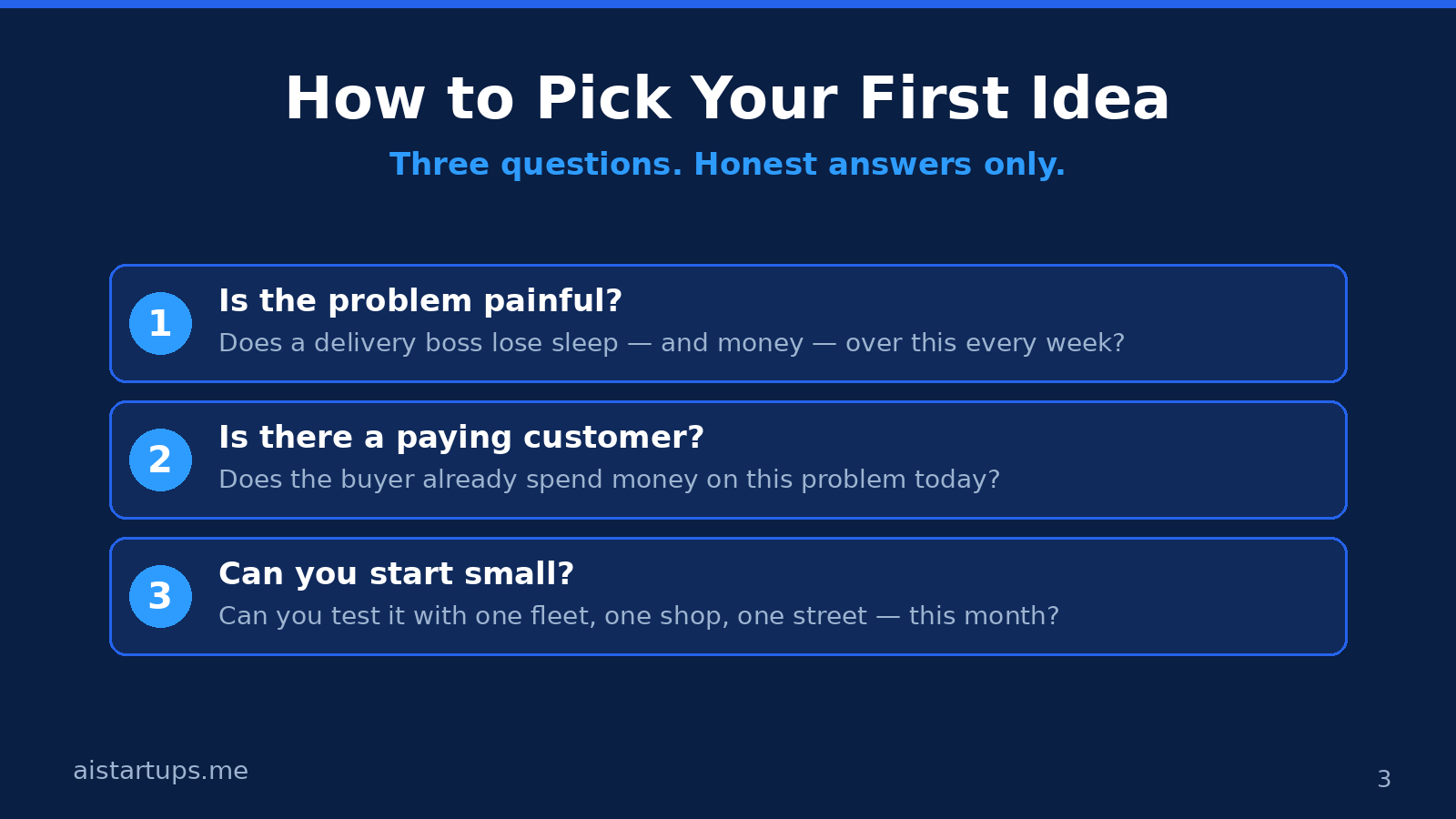
- Do you already know a delivery boss who would take your call? Start with the idea that solves their problem, not the one that sounds coolest.
- Can you show a result in 30 days? If not, the idea is too big for a first version. Shrink it.
- Does the buyer already spend money on this problem? Fuel, failed deliveries, and returns all have existing budgets. That’s where you want to be.
- Can you charge monthly? One-time projects pay the rent once. Retainers pay it every month.
For a broader sense of how these service-based AI ideas play out across other local businesses, two more pieces in this series are worth your time: 7 AI ideas for the beauty salon industry follows the same pattern — software the owner already pays for, plus AI on top — and AI services local businesses can sell this month is a practical starting point if you want to sell AI services to local businesses of any kind, not just delivery.
Frequently Asked Questions
Do I need logistics experience to start one of these businesses?
No — and honestly, most delivery bosses would rather you didn’t pretend to. Your job is the technology, the setup, and the numbers. Their job is the delivery. What you do need is respect for how a depot actually runs: the pace of a Monday morning, the cost of a failed delivery, the fact that a dispatcher’s phone never stops ringing. Spend a day riding along with a driver or sitting in a dispatch office before you pitch anything.
How much money do I need to start?
For the software ideas — route optimization, ETAs, analytics — you can start with under $1,000, mostly tool subscriptions and your time, because you’re configuring existing mapping and routing tools rather than building them. The marketplace and returns ideas need a bit more, around $1,000-3,000 for the first pilot. The hardware ideas — lockers and cold-chain sensors — cost the most: budget $5,000-15,000 for a first locker bank. In every case, your first sale should be a paid pilot, not a free trial.
Which idea makes money fastest?
Route optimization, usually. The saving is visible in the first fuel bill, the customer already spends the money you’re saving, and the pilot takes two weeks. ETAs and failed-delivery rescue are close behind — both show results in the first month. The slowest to pay back are micro-fulfillment and EV transition planning, because they need real capital or long sales cycles. Fast money isn’t everything, though: the analytics SaaS is slower to start and worth more in the long run, because it’s the most scalable idea on the list.
Is the last-mile delivery market really that big?
Yes. Grand View Research puts it at $181.6 billion in 2026, growing about 10% a year toward $348.8 billion by 2033. Straits Research lands in the same range: $194.35 billion in 2026, heading for $410.58 billion by 2034. And more than 165 billion parcels were shipped globally in 2024. The market is big, it’s growing, and the last mile is the most expensive part of it — 53% of total shipping cost.
Can one person really run an AI business for delivery companies?
Yes, and that’s the whole point. You’re not building routing engines from scratch — you’re configuring tools that already exist, setting them up for businesses that can’t do it themselves, and charging a monthly fee to keep them running. Five fleets at $500 a month is $2,500 a month in recurring revenue for work that fits around a day job. The constraint isn’t the technology, it’s the selling. If you can get in front of delivery bosses and show them one clear result — fewer miles, fewer failed deliveries, lower cost per stop — the rest of the business follows.
The Bottom Line
The last mile is the most expensive mile in delivery — 53% of the total shipping cost — and it’s run, in most cities, by small businesses planning routes on gut feel and losing money on failed deliveries, returns, and empty vans. The market is roughly $180-195 billion in 2026 and growing about 10% a year. The customers already have budgets. The tools already exist. All that’s missing is someone who connects the two — and that someone could be you.
Don’t try to build all nine ideas. Pick one. Talk to three delivery bosses this week. Ask them what a failed delivery costs them, and what they’d pay to stop losing it. Then run one live test, measure the result, and charge for it. That’s the whole business, and it’s a good one.
Sources: Grand View Research — Last Mile Delivery Market Report; Straits Research — Last Mile Delivery Market; GoBolt — Last Mile Delivery Cost; ClickPost — Same-Day Delivery Statistics; 3PL Insider — Average Ecommerce Return Rate; FleetRabbit — Last-Mile Delivery Trends 2026.