

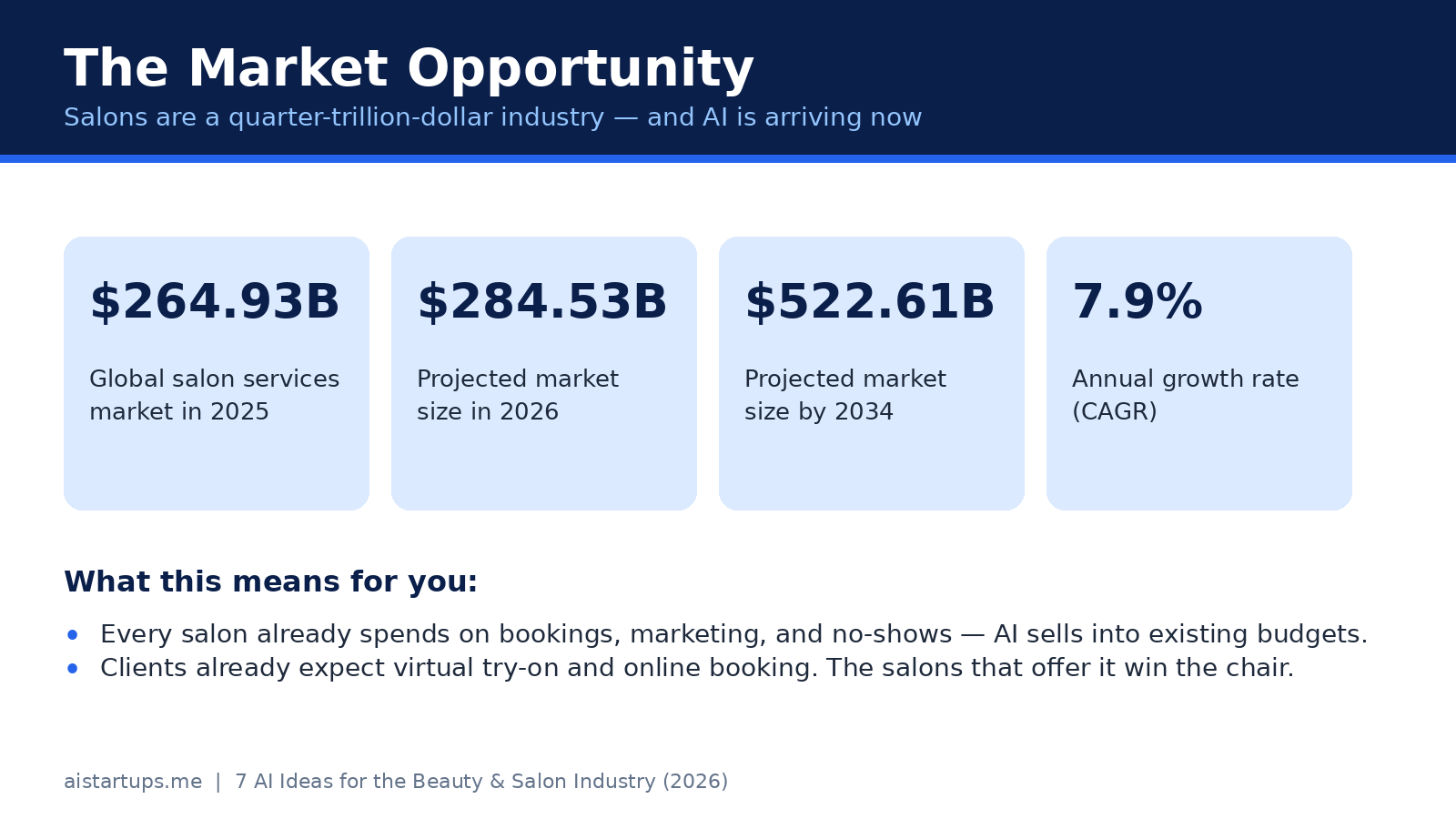
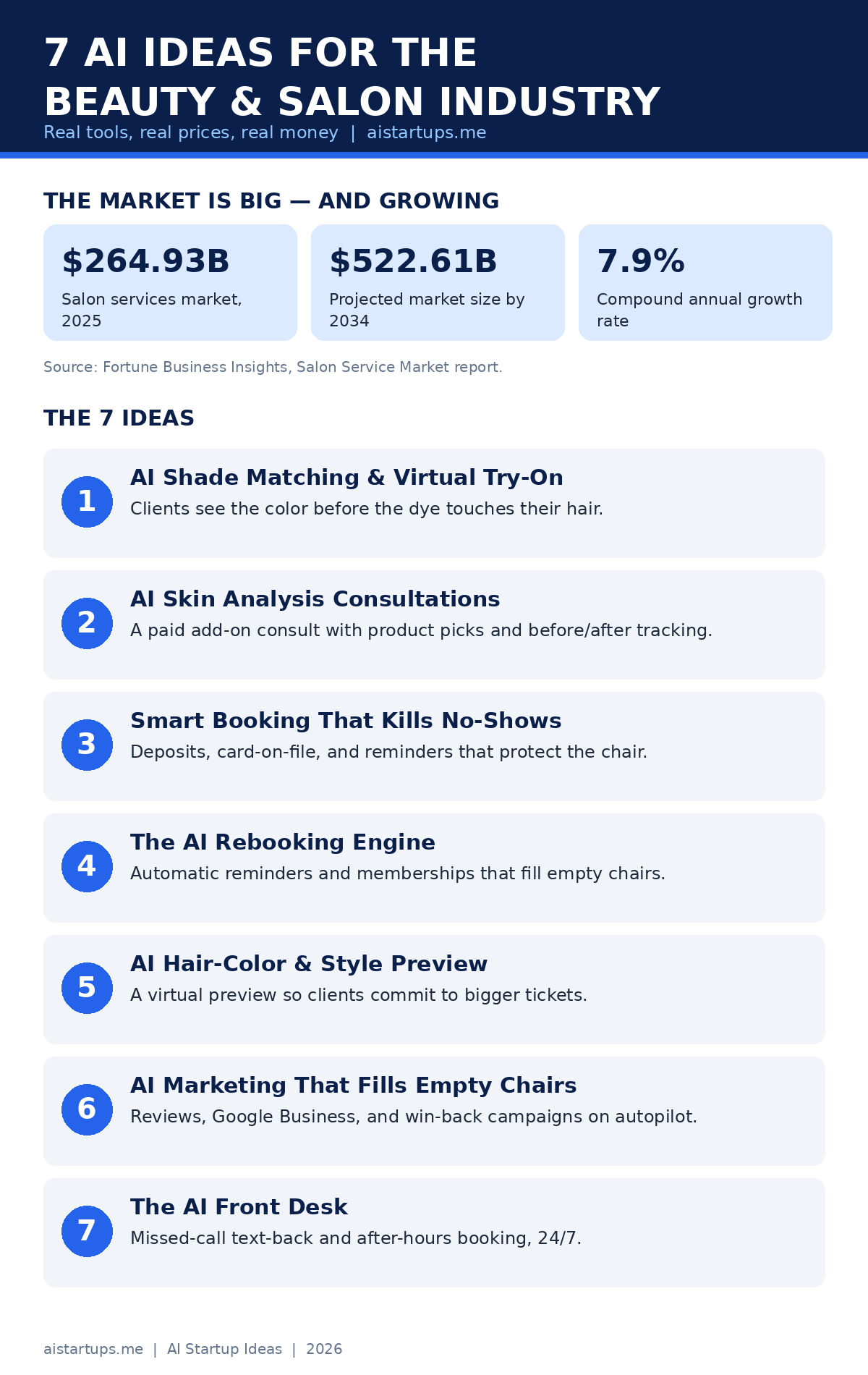
Here’s a number that stopped me mid-scroll: the global salon services market was worth $264.93 billion in 2025, and it’s projected to hit $522.61 billion by 2034. That’s a 7.9% annual growth rate, year after year, in an industry most tech founders completely ignore.
Think about it. Every town has salons. Every salon has the same headaches: no-shows, empty chairs on Tuesday afternoons, clients who can’t decide on a hair color, and a front desk phone that rings while the stylist’s hands are full of dye. These aren’t exotic problems. They’re everyday, expensive problems — and they’re exactly the kind of problems AI is actually good at solving right now.
I spent the last few days digging into the tools salons are already using, the prices they actually pay, and the AI features clients are already expecting. What I found surprised me. This isn’t a “someday” market. Virtual try-on is already live at Estée Lauder and MAC. AI skin analysis is already scoring ten different skin concerns in a single selfie. And salon booking software with AI built in starts at around $20 a month.
So if you’re looking for an AI business idea that doesn’t need a PhD, a venture round, or a prayer — this is a good place to look. Below are seven ideas, each with a realistic business angle: what it costs to start, who pays, and how the money actually works.
First, Why Salons? Why Now?
Real talk: most AI startup advice points you at the same crowded rooms — chatbots for SaaS companies, AI writing tools, another dashboard. Salons are the opposite. They’re a massive, fragmented market full of small businesses that make money every single day and have almost no in-house tech skills.
That combination is gold for a founder. Your customer already has revenue. They already spend on software, marketing, and staff. And they will happily pay someone who makes their chairs fuller and their no-shows rarer. You don’t have to convince them AI matters — their clients are already asking for virtual try-on and online booking.
There’s another angle, too. Beauty is a visual industry, and AI got good at visual stuff first. Shade matching, skin analysis, hair previews — these aren’t research projects anymore. They’re shipping products with real brand names attached. The window is open, but it won’t stay wide open forever. The founders who move now get to sell into a market that’s still learning what’s possible.
One more thing before we get into the ideas. Every price and stat in this article comes from a real, checkable source — the companies’ own pricing pages and published market research. If a number matters to your business plan, click through and confirm it yourself. Prices change, and your pitch should be built on numbers you trust.
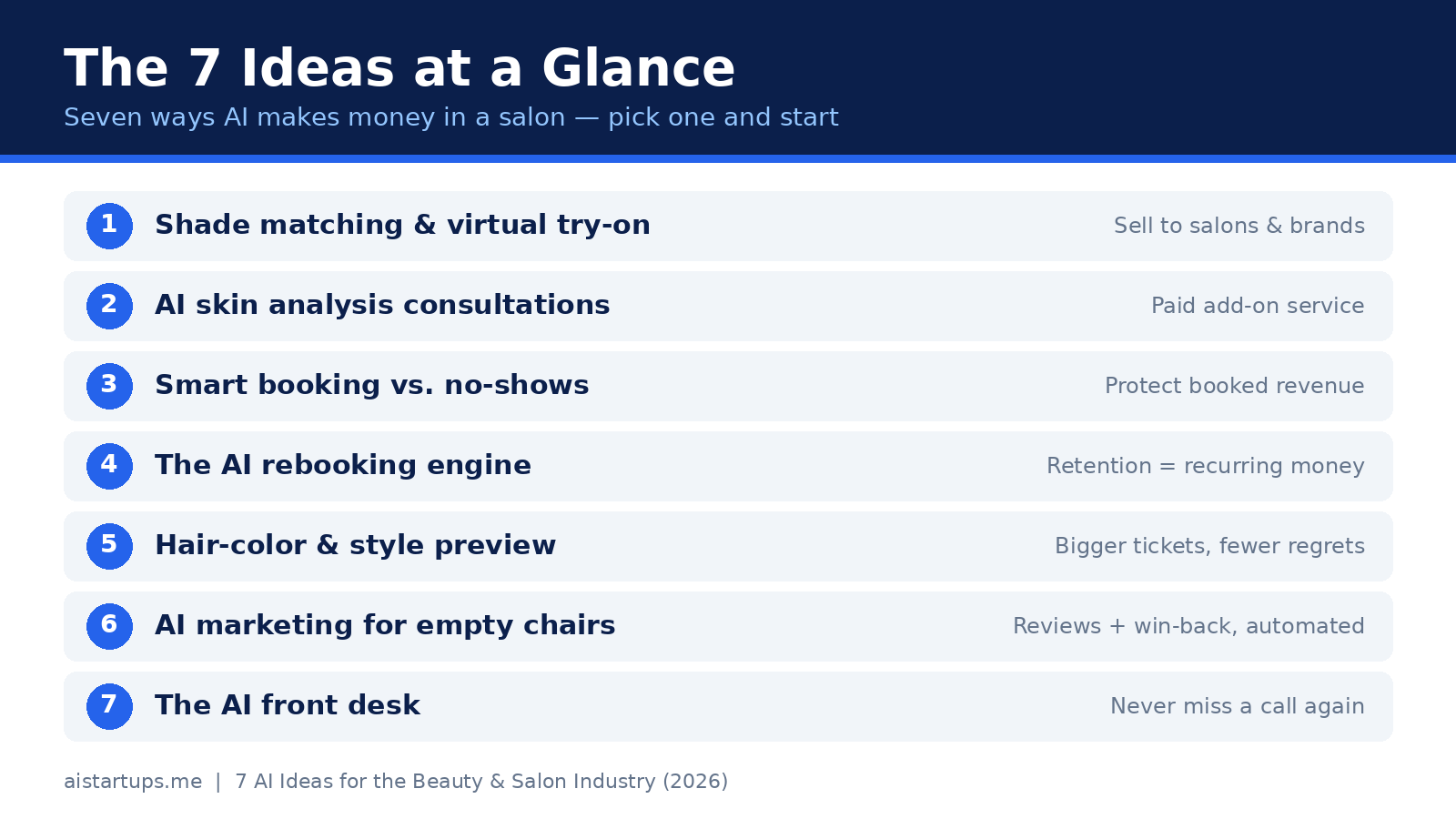
1. AI Shade Matching & Virtual Try-On as a Service
The idea in one sentence
Let clients see exactly how a lipstick shade, foundation, or hair color will look on their own face — before they buy it or sit in the chair.
This is the flagship AI idea in beauty, and it’s already proven. Perfect Corp’s AI shade finder and AR virtual try-on are used by Estée Lauder, e.l.f. Beauty, Clinique, MAC, and Tarte. L’Oréal’s ModiFace — which L’Oréal acquired back in 2018 — powers virtual try-on for Maybelline, Lancôme, and NYX. These aren’t pilot projects. They’re the standard way big beauty brands sell online now.
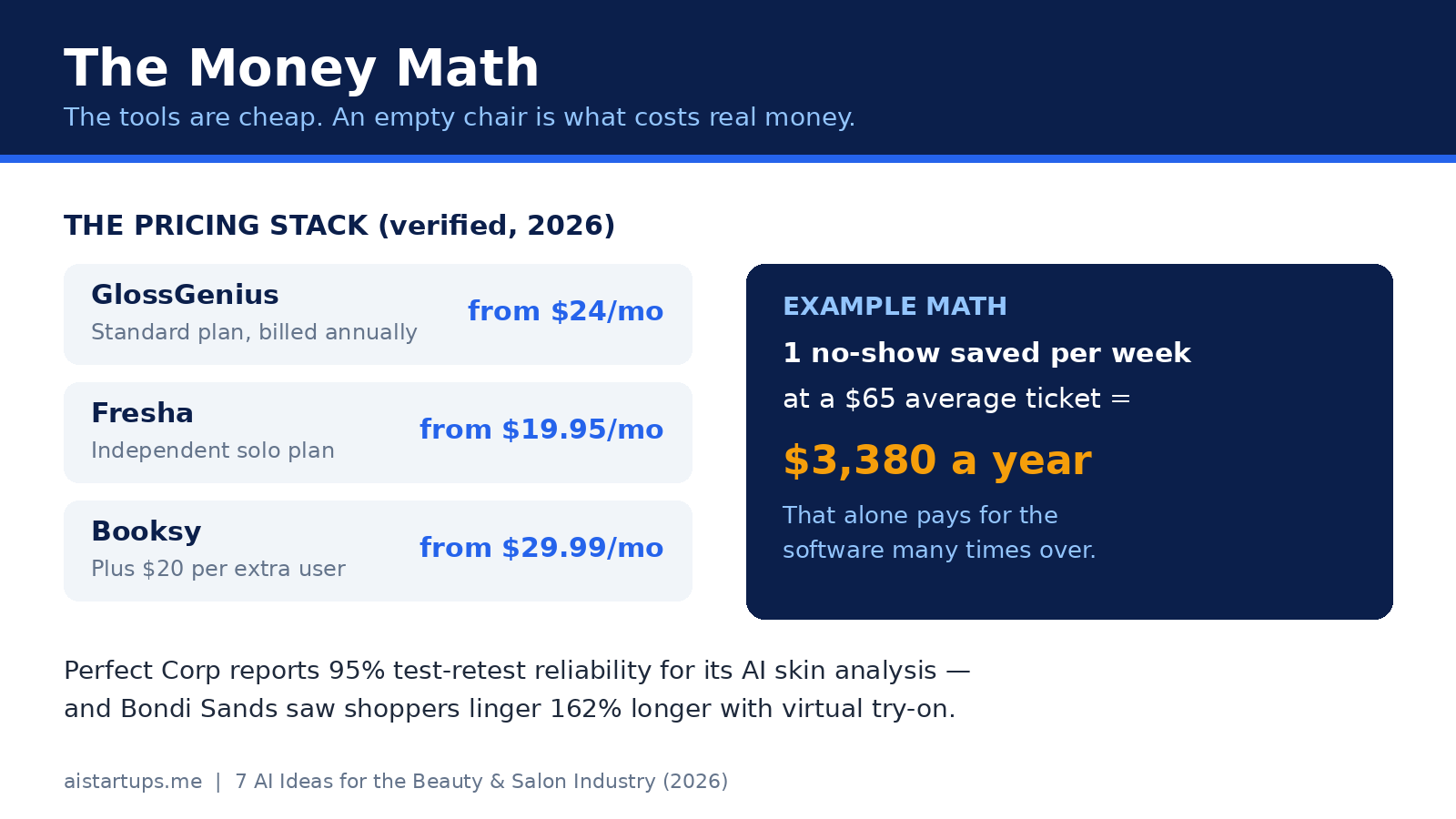
And here’s the number that makes salon owners sit up: after Bondi Sands launched AI virtual try-on, shoppers lingered 162% longer. Longer browsing means more products in the basket and fewer returns. That’s the pitch, right there, in one sentence.
How you make money
You’ve got two ways to play this. The first is B2B: sell virtual try-on as a service to independent salons, beauty retailers, and smaller cosmetics brands that can’t build it themselves. You set up the tool, load their product catalog, and charge a setup fee plus a monthly subscription — think $200–$500 a month per salon, depending on what’s included.
The second way is to run it yourself as a retail upsell tool. Partner with a salon, put a try-on station (really just a tablet with a good camera) at the front of the shop, and take a cut of the extra product sales it drives. Clients who can see the shade on their own face buy more confidently — and they buy the product the same day instead of “thinking about it.”
Startup cost and who pays
Startup costs are lower than most people expect. You don’t need to build the AI yourself — Perfect Corp and similar providers offer the technology, and your job is the setup, the catalog work, and the salon relationship. A realistic starting budget is a few hundred dollars for a good tablet and a trial account, plus your time. The salon pays the monthly fee, or the brand pays for the try-on experience on their site. Either way, the buyer is a business with a marketing budget, not a consumer you’re hoping will subscribe.
The honest challenge? Big brands already have this handled. Your market is the long tail: the independent salon with six chairs, the local cosmetics brand, the regional retailer. That’s thousands of businesses, and most of them have never been offered this at a price they can afford. If you need the booking site and the AI integration built properly for a client, a web development studio like AISquadX can put the whole thing together — but the core of this business is sales and setup, not code.
2. AI Skin Analysis Consultations
The idea in one sentence
Turn a 60-second selfie scan into a paid skincare consultation with product recommendations and before-and-after tracking.
Perfect Corp’s AI Skin Analysis scores ten skin concerns from a single photo: moisture, oiliness, pores, acne, texture, redness, radiance, firmness, wrinkles, and dark circles. The company reports 95% test-retest reliability, which is the kind of number that makes a consultation feel like a real service instead of a gimmick. Clients get a report that looks scientific, the salon gets a reason to recommend specific products, and the whole thing takes about a minute.
How you make money
The simplest model is a paid add-on. A salon already charges for a facial or a cut — you add a $15–$35 AI skin consultation on top. The client gets a printed or emailed skin report, a product list matched to their results, and a follow-up scan in six weeks to show progress. That follow-up scan is the clever part: it gives the client a reason to come back, and it gives the salon proof the products are working.
You can also sell the service itself. Set up the analysis station in a salon, train the staff to run it, and take a monthly fee or a per-consultation split. Or package it as a standalone pop-up service for spas, dermatology clinics, and beauty events. The before-and-after tracking is what makes this sticky — once a client has two scans on file, they’re not going to a competitor that starts from zero.
Startup cost and who pays
A tablet, a ring light, and a subscription to a skin analysis provider are the main costs. You’re looking at a few hundred dollars to get the first station running. The client pays for the consultation as an add-on, and the salon pays you for the setup and the monthly service. The risk here is modest, and the upside is a recurring service that slots into appointments the salon is already selling.
One warning, though — and I mean this seriously. This is skincare, not a party trick. Don’t make medical claims, don’t diagnose anything, and make sure whatever tool you use is clear that it’s a cosmetic analysis. The honest positioning (“here’s what the scan sees, here’s what our products target”) sells just fine without crossing any lines.
3. Smart Booking That Kills No-Shows
The idea in one sentence
Replace the paper diary and the “just call us” booking with software that takes deposits, keeps a card on file, and reminds clients automatically — so an empty chair stops being a normal Tuesday.
Ask any salon owner what their most expensive problem is and most of them won’t say rent or products. They’ll say the client who books a two-hour color appointment and never shows up. That chair can’t be resold at the last minute. The stylist still gets paid. The products were already mixed. It’s pure loss, and it happens every week in salons everywhere.
The fix is not complicated, and that’s the point. The booking tools salons already use have the features built in — deposits, card-on-file, automated SMS and email reminders, waitlists. The business opportunity is that a huge number of salons still aren’t using any of it. They’re on a paper book, or a basic calendar, or (I have genuinely seen this) a WhatsApp group chat. Your job is to set up the system, move their clients onto it, and make sure it actually gets used.
The tools and what they cost
Here are the real prices, from the companies’ own pages:
- GlossGenius — Standard is $24 a month billed annually ($28 month-to-month). Gold is $48 a month annually for up to 9 staff, and Platinum is $148 a month annually. Card processing runs 2.4% plus $0.15 for in-person payments.
- Fresha — the Independent solo plan is $19.95 a month, and the Team plan is $14.95 per team member. Fresha takes a 20% one-time commission (minimum $6) on brand-new clients who find the salon through its marketplace. There’s a 7-day trial.
- Booksy — $29.99 a month plus $20 per extra user. Its optional Boost feature takes 30% of a new client’s first visit, up to $100, in exchange for promoting the salon. There’s a 14-day trial.
Those numbers matter because they set your pricing. If the software costs a salon $25–$50 a month and it saves even one appointment a week, the math is obvious to the owner. A single saved no-show at a $65 average ticket is $65 back. Save one a week and that’s $3,380 a year — the software pays for itself many times over, and that’s before you count the hours the front desk stops spending on reminder calls.
How you make money
Charge a setup fee ($300–$800 is reasonable for a small salon) to configure the software, import the client list, set up deposit rules and reminder sequences, and train the staff. Then charge a monthly retainer of $100–$300 to manage it: keep the calendar clean, handle the waitlist, tweak the reminders, and send the owner a simple monthly report showing how many no-shows were prevented.
The retainer is where the real business lives. Setup is a one-time payment; the retainer is the part that compounds. Five salons at $200 a month is $1,000 a month in recurring revenue, and you’re doing maybe an hour of work per salon per week once the system is running. That’s the kind of boring, reliable income that actually builds a business.
Who pays? The salon owner, out of money the system is visibly saving them. That’s the easiest sale in this whole list, because you can show the result in the first month: fewer empty chairs, more deposits collected, and a front desk that isn’t chained to the phone. If you want a comparison for how this plays in other local businesses, the same playbook works in fitness — I wrote about AI ideas for the fitness and wellness industry and the booking-and-retention ideas there rhyme with these almost exactly.
4. The AI Rebooking Engine
The idea in one sentence
Most salons lose money not because they can’t find new clients, but because they forget to bring the old ones back — an automated rebooking system fixes that on autopilot.
Here’s the thing about salon economics that most outsiders miss. Getting a new client is expensive and slow: ads, discounts, word of mouth, a first visit that barely breaks even. Keeping a client is cheap. A regular who comes every five weeks for a cut and color is worth thousands a year, and the salon already has their name, their number, and their hair history. The problem is that nobody follows up. The client means to rebook, life gets in the way, six weeks becomes ten, and then they’re trying a new place because it was easier.
An AI rebooking engine closes that gap. It watches the booking calendar, knows that a color client is due back in five weeks and a cut client in four, and sends the reminder at the right moment — by text, not email, because texts actually get read. If the client doesn’t respond, it follows up once more with a couple of open slots. If a slot opens up because of a cancellation, it offers it to the waitlist first. Nobody on staff has to remember any of this. The system just does it, every day, for every client.
How you make money
This is a retention product, so sell it on retention math. Take a salon with 400 active clients. If your system brings back even 5% of the ones who would have drifted away, that’s 20 clients. At a $65 average ticket every five weeks, that’s roughly $13,000 a year in recovered revenue. You charge a fraction of that as a monthly fee — $200–$400 a month is a fair range — and the owner still comes out far ahead.
Memberships are the second revenue layer, and honestly, they’re the more interesting one. Help a salon package its regulars into a membership: a monthly blowout club, a color membership, a “never pay full price for a root touch-up again” plan. The AI handles the billing reminders, the booking, and the “your membership visit is due” nudge. The salon gets predictable monthly income instead of feast-and-famine weeks. You get a setup fee plus a cut or a flat monthly rate for running it.
Startup cost and who pays
The tools here overlap with idea 3 — GlossGenius, Fresha, and Booksy all have rebooking reminders and membership features built in, so in practice this idea often starts as an add-on to the smart booking setup. Your startup cost is mostly your time: learning the tools properly, building the reminder templates, and setting up the reporting so the owner can see the recovered bookings. The salon pays, monthly, for a service that shows up directly in their revenue.
Well — mostly. One honest caveat: automation only works if the salon’s client data is clean. If their booking history is a mess of duplicate names and wrong phone numbers, the reminders go nowhere. Budget time for a data cleanup in your setup fee, and be upfront about it. A week of cleanup now saves months of “why isn’t this working” later.
5. AI Hair-Color & Style Preview Before the Chair
The idea in one sentence
Let clients try on a new hair color or cut on their own photo before they commit — so they book the bigger service with confidence instead of chickening out at the consultation.
Every stylist knows this client. She books a full balayage, sits in the chair, and then — right at the moment of truth — asks for “just a trim and a gloss instead.” She’s not being difficult. She’s scared. A color change is a commitment, and she can’t picture the result. So the salon loses a $150 service and gains a $45 one.
A virtual hair preview removes that fear. The client uploads a selfie, tries on the copper, the caramel balayage, the blunt bob, and walks into the appointment already sure about what she wants. The consultation becomes a confirmation instead of a negotiation. The stylist spends less time talking a nervous client down from the ledge and more time doing the actual work.
How you make money
There are two buyers here. The first is the salon itself: sell the preview tool as a booking add-on. Clients get a link with their confirmation text — “try your new look before you arrive” — and the salon pays you a monthly fee for the tool and the setup. The second buyer is the bigger prize: regional salon chains and beauty brands that want the preview on their own website to drive bookings and product sales. That’s a larger contract, a larger setup fee, and a longer relationship.
You can also charge per result. Some salons will happily pay $5–$10 per preview session if it converts into a booked color service, because the alternative — a consultation that ends in a trim — costs them far more. The key metric to track and show the owner is conversion: what percentage of preview users book the full service versus those who don’t. If the number is good, your fee sells itself.
Startup cost and who pays
This one costs a little more to start than the booking ideas, because the preview technology is more specialized — you’re either licensing a virtual try-on tool or building on top of one. Budget for a provider subscription and a proper setup, and price your first few salons as pilots so you can learn what actually converts. The salon pays, and the client pays indirectly by booking bigger services. And remember, L’Oréal’s ModiFace already proved the concept at the biggest possible scale — you’re bringing a proven idea down to the salons that can’t get L’Oréal on the phone.
Look, I’ll be honest: this idea has a real “wow” factor, and that’s both the strength and the trap. The demo impresses everyone. But a demo isn’t a business. Make sure the first salon you sign is one you’ll measure properly — preview users, bookings, average ticket — because the numbers are what turn a fun demo into a product other salons will pay for.
6. AI Marketing That Fills Empty Chairs
The idea in one sentence
Run a salon’s reviews, Google Business profile, social content, and win-back campaigns with AI doing the heavy lifting — so the chairs fill themselves while the owner does hair.
Salon owners are not marketers. They became stylists because they love the work, not because they love writing Instagram captions at 11pm. And yet their business depends on exactly that: being visible on Google, having fresh reviews, posting before-and-after photos, and chasing up the clients who haven’t been in for three months. Most of it doesn’t happen. The Google Business profile has photos from 2022. The last review is from March. The Instagram account posts when someone remembers.
This is the easiest idea on the list to explain to a salon owner, because the pain is visible to them every day. Your service takes over the whole marketing loop: AI drafts the social posts from the salon’s own before-and-after photos, the review request goes out automatically after every appointment, the Google Business profile gets updated weekly, and the win-back campaign texts the clients who’ve gone quiet with a genuine reason to return — an open slot, a seasonal offer, a new service they might like.
How you make money
This is a classic agency retainer, and it’s priced like one: $300–$800 a month per salon depending on how much you take on. Start with the pieces that are easiest to automate and easiest to measure — review generation and Google Business updates — then add social content and win-back campaigns once the owner trusts you.
The win-back campaign deserves a special mention because it’s the highest-return piece and the one salons never do. A salon with a thousand past clients has hundreds who haven’t visited in 90+ days. A simple, well-timed text — “We miss you, here’s an open chair on Thursday” — brings a meaningful percentage of them back. That’s found revenue, and it’s the kind of result that keeps a client paying your retainer for years. The same retention-first thinking shows up in other local businesses too: if you want a second example, my piece on AI ideas for restaurants and cafes covers the same win-back logic for a different kind of regular.
Startup cost and who pays
Startup costs are close to zero — your time, a scheduling tool, and whatever AI writing tools you already use. The salon pays the monthly retainer, and the smart move is to start with one salon, document the results (reviews gained, profile views, returning clients), and use that case study to sign the next three. One documented win beats ten cold pitches.
A word of caution: don’t let the AI write fake reviews or fake testimonials. Ever. That’s not a gray area, it’s a fast way to get a salon penalized on Google and to lose every client you have. AI drafts the request, the client writes the review. That’s the line, and it’s not a hard one to hold.
7. The AI Front Desk
The idea in one sentence
A salon’s phone rings most when nobody can answer it — after hours, during a busy color service, at lunch. An AI front desk answers every call, books the appointment, and texts back the ones it misses.
Picture the scene. It’s Saturday morning, the salon is full, every stylist has color processing on someone’s head, and the phone is ringing. Nobody picks up. That caller is a new client with a credit card and a Saturday afternoon free. They call one more salon. If that salon answers, your salon just lost a client it never knew existed.
The AI front desk fixes the leak. A voice receptionist answers the call, checks real availability, books the appointment, and takes the deposit. A missed-call text-back catches the ones who hang up: “Sorry we missed you — want to book? Here are today’s open slots.” After hours, it keeps booking while the salon is dark. On Monday morning, the owner opens a calendar that’s already fuller than it would have been.
How you make money
This is the highest-priced idea on the list, and it should be, because it replaces the most expensive thing in a small business: a full-time receptionist. A salon that pays a receptionist $2,500 a month will happily pay $400–$800 a month for a system that never calls in sick, never takes a lunch break, and answers at 9pm on a Sunday. Charge a setup fee to configure the voice system, connect it to the booking software, and write the scripts in the salon’s own voice — friendly, not robotic.
The upsell is the analytics. Once you’re the front desk, you can show the owner the numbers they never had: how many calls came in, how many became bookings, what times people call, and which services they ask about. That report is worth money on its own, and it’s the reason owners renew. You’re not selling a phone system. You’re selling the answer to “how many clients did we almost lose this month?”
Startup cost and who pays
The voice AI tools behind this are available off the shelf now — you’re configuring and integrating, not building a voice model from scratch. Budget a few hundred dollars for tool subscriptions and testing, plus serious time getting the scripts right. The scripts are everything: a voice agent that sounds stiff or misunderstands “balayage” will lose bookings instead of winning them. Test it on your own phone a hundred times before a real client hears it.
The salon pays the monthly fee, and this is the idea where a pilot matters most. Offer the first month as a paid pilot with a clear success metric — booked appointments from calls that would otherwise have been missed — and let the numbers do the selling. Zenoti, the enterprise salon platform, unveiled its own AI Workforce for salons and spas on September 30, 2025, which tells you the big players think this is the direction. Your advantage is that you can bring the same idea to the independent salon down the street at a price it can actually pay.
“The salon doesn’t need more clients. It needs to stop losing the ones who already tried to reach it. Answer the phone — or let something answer it for you — and the rest of the business gets easier.”
Which Idea Should You Pick?
If you’ve read this far, you’re probably wondering which of the seven to actually start with. Honest answer: it depends on what you’re good at and who you already know. But here’s how I’d think about it.
If you’re a people person who likes being in salons, start with idea 3 (smart booking) or idea 6 (AI marketing). They’re the cheapest to start, the easiest to explain, and the fastest to show results. A salon owner can see the no-shows drop in the first month. That’s a sale you can close in one conversation.
If you’re more technical and you like products, start with idea 1 (virtual try-on) or idea 5 (hair preview). They’re harder to set up and the sales cycle is longer, but the contracts are bigger and the work is more defensible. Nobody else in your town is pitching shade matching to the salon on Main Street.
If you want the biggest monthly fee per client, start with idea 7 (the AI front desk). It’s the most complex to get right, so don’t start here unless you’re willing to spend real time on the setup and testing. But it’s also the one that replaces a salary, which means the owner can justify the largest budget.
And if you’re not sure? Start with idea 4 (the rebooking engine). It sits in the middle of everything else: it uses the booking tools, it feeds the marketing, and it produces the clearest before-and-after number — clients who came back. It’s the idea I’d pick if I had to choose one tomorrow morning with no existing salon relationships and a small budget.
A quick checklist before you pick:
- Do you already know a salon owner who would take your call? Start with the idea that solves their problem, not the one that sounds coolest.
- Can you show a result in 30 days? If not, the idea is too big for a first version. Shrink it.
- Does the buyer already spend money on this problem? Booking, marketing, and no-shows all have existing budgets. That’s where you want to be.
- Can you charge monthly? One-time projects pay the rent once. Retainers pay it every month.
For a broader sense of how these service-based AI ideas play out across other local businesses, two more pieces in this series are worth your time: 8 AI ideas for pet care businesses follows the same pattern — software the owner already pays for, plus AI on top — and AI services local businesses can sell this month is a practical starting point if you want to sell AI services to local businesses of any kind, not just salons.
Frequently Asked Questions
Do I need to know anything about hair or beauty to start one of these businesses?
No — and honestly, most salon owners would rather you didn’t pretend to. Your job is the technology, the setup, and the numbers. Their job is the hair. What you do need is respect for how a salon actually runs: the pace of a Saturday, the cost of a no-show, the fact that a stylist’s hands are busy when the phone rings. Spend a day in a salon before you pitch anything. You’ll learn more in six hours on the floor than in six weeks of research.
How much money do I need to start?
For the booking, rebooking, and marketing ideas, you can start with under $500 — mostly tool subscriptions and your time. The virtual try-on and hair preview ideas cost more because you’re licensing specialized technology, so budget $1,000–$3,000 for your first pilot. The AI front desk sits in the middle: a few hundred dollars in tool subscriptions, but a lot of hours getting the voice scripts right. In every case, your first sale should be a paid pilot, not a free trial — if a salon won’t pay something, they don’t value it enough to use it.
Which salon software should I learn first?
Learn one deeply instead of three shallowly. GlossGenius starts at $24 a month billed annually and is popular with independent stylists and small salons. Fresha starts at $19.95 a month for solo operators and brings a client marketplace with it. Booksy starts at $29.99 a month plus $20 per extra user and is strong on the client-facing booking experience. Pick the one that’s most common in your area, learn it inside out, and build your pitch around it. You can always add the other two later.
Is AI virtual try-on actually accurate enough for clients to trust?
For shade matching and makeup, yes — that’s why brands like Estée Lauder, MAC, and Clinique use it at scale, and why Bondi Sands saw shoppers linger 162% longer after launching it. For skin analysis, Perfect Corp reports 95% test-retest reliability across its ten measured skin concerns. For hair color, the preview is a strong guide, not a guarantee — lighting, hair history, and the stylist’s skill all matter. The honest way to sell it is as a decision tool, not a promise. Clients love seeing the direction before they commit, even if the final result depends on the stylist’s hands.
Can one person really run an AI business for salons?
Yes, and that’s the whole point. You’re not building software from scratch — you’re configuring tools that already exist, setting them up for businesses that can’t do it themselves, and charging a monthly fee to keep them running. Five salons at $200–$400 a month is $1,000–$2,000 a month in recurring revenue for work that fits around a day job. The constraint isn’t the technology, it’s the selling. If you can get in front of salon owners and show them one clear result, the rest of the business follows.
The Bottom Line
Salons are a $264.93 billion industry growing at 7.9% a year, and almost nobody in tech is paying attention to them. The clients already expect virtual try-on, online booking, and instant answers. The owners already pay for software and already lose money to no-shows and empty chairs. All that’s missing is someone who connects the two — and that someone could be you.
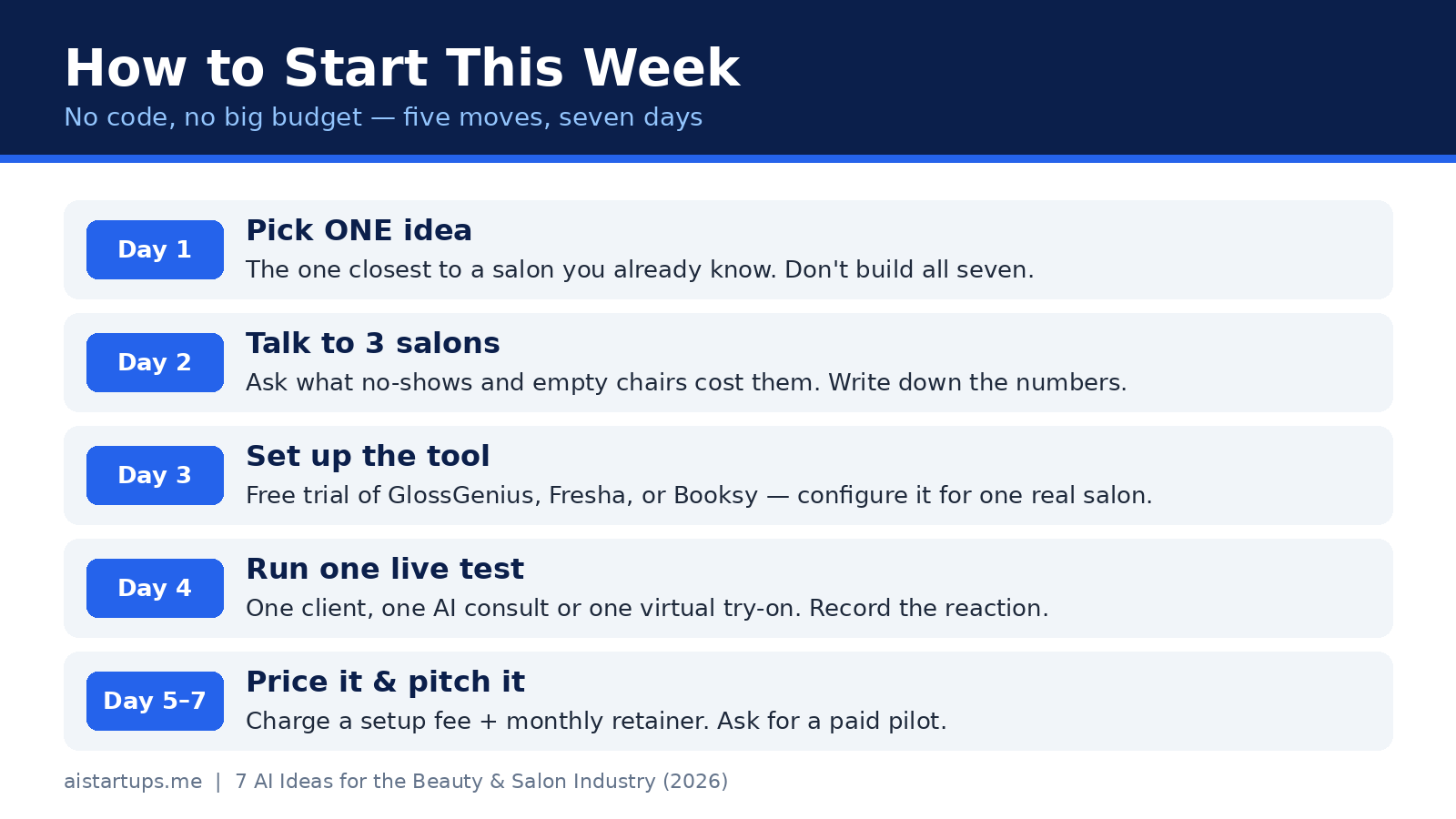
Don’t try to build all seven ideas. Pick one. Talk to three salon owners this week. Ask them what an empty chair costs them on a Tuesday, and what they’d pay to stop losing it. Then set up the tool, run one live test, and charge for the result. That’s the whole business, and it’s a good one.
Sources: Fortune Business Insights — Salon Service Market; GlossGenius Pricing; Fresha vs. Booksy pricing comparison; Perfect Corp — AI Beauty Technology; BeautyMatter — AI Foundation Wars.